

FII FPI & DII Trading Activity on 6 April 2026 : Key Insights from April 6, 2026


%20(3).webp)

 Add Swastika as preferred source
Understanding FII vs DII trading activity today is essential for anyone tracking the Indian stock market. On 06 April 2026, the divergence between Foreign Institutional Investors (FIIs) and Domestic Institutional Investors (DIIs) once again highlighted how global and local sentiments shape market direction.
FIIs were strong sellers, while DIIs stepped in aggressively to support the market. Let’s break down what this means and how investors should interpret these signals.
Key Highlights at a Glance
- FIIs remained net sellers, indicating cautious global sentiment
- DIIs continued strong buying, supporting market stability
- Domestic liquidity is currently cushioning foreign outflows
- Market direction may remain range-bound in the short term
FII vs DII Activity Today: Data Breakdown
On 06 April 2026, in the capital market segment:
- FIIs sold equities worth ₹7,839 crore (NSE) and ₹8,167 crore (combined exchanges)
- DIIs bought equities worth ₹7,950 crore (NSE) and ₹8,088 crore (combined exchanges)**
This clearly shows a tug-of-war between foreign selling and domestic buying.
Why Are FIIs Selling?
Foreign Institutional Investors often react to global macroeconomic factors. Key reasons behind the current selling trend include:
1. Global Uncertainty
Rising interest rates in developed economies and geopolitical tensions can trigger capital outflows from emerging markets like India.
2. Dollar Strength
A stronger US dollar reduces the attractiveness of Indian equities for FIIs.
3. Profit Booking
After recent rallies, FIIs may be locking in profits, especially in large-cap stocks.
Why Are DIIs Buying Aggressively?
Domestic Institutional Investors, including mutual funds and insurance companies, are playing a stabilizing role.
1. Strong Retail Inflows
Consistent SIP inflows into mutual funds are giving DIIs steady liquidity.
2. Long-Term Outlook
DIIs focus more on India’s long-term growth story rather than short-term volatility.
3. Market Correction Opportunities
DII buying often increases when markets dip, helping maintain balance.
Impact on Indian Stock Market
The contrasting behavior of FIIs and DIIs creates a balanced market environment.
Short-Term Impact
- Markets may remain volatile
- Sector rotation is likely
- Midcaps and smallcaps could see selective action
Long-Term Impact
- Domestic liquidity is becoming a key pillar
- Reduced dependence on foreign capital
- Stronger resilience during global shocks
Regulatory bodies like the Securities and Exchange Board of India and Reserve Bank of India continue to ensure market stability and transparency, which further strengthens investor confidence.
What Should Investors Do?
Understanding FII vs DII trends can help you make smarter investment decisions:
- Avoid panic selling during FII outflows
- Focus on fundamentally strong companies
- Use market dips as buying opportunities
- Track sector-wise FII and DII movement
Role of Swastika Investmart
In such dynamic market conditions, having the right platform and research support matters. Swastika Investmart stands out as a SEBI-registered broker offering:
- Advanced research and advisory tools
- Reliable and responsive customer support
- A tech-driven platform for seamless trading
- Strong focus on investor education
These features help investors navigate volatile markets with confidence.
Frequently Asked Questions
What is FII vs DII activity?
FII vs DII activity refers to the buying and selling of stocks by foreign and domestic institutional investors in the market.
Why do FIIs impact the market more?
FIIs bring large volumes of capital, so their buying or selling can significantly influence market trends.
Is DII buying a positive sign?
Yes, strong DII buying indicates confidence in the domestic economy and can stabilize markets during FII selling.
How can I track FII and DII data daily?
You can track it through stock exchange websites like NSE and BSE or brokerage platforms offering market insights.
Final Thoughts
The ongoing trend in FII vs DII trading activity today shows that while global investors remain cautious, domestic institutions are strongly backing the Indian market. This balance is crucial for maintaining stability.
For investors, the key is to stay informed, avoid emotional decisions, and focus on long-term growth opportunities.
If you want to make smarter investment decisions backed by research and technology, explore Swastika Investmart here:
Big Budget









.webp)
.webp)
.webp)
.webp)
.webp)
















.webp)
.webp)
.webp)
.webp)
Latest Articles
Stock Market Midday Live Updates 27 March 2026: Sensex Falls 2.25%, Nifty Slides Amid Global News


The Indian stock market witnessed a sharp sell-off today as benchmark indices Sensex and Nifty 50 dropped over 2% amid rising global uncertainties. The stock market highlights for 27 March 2026 reflect investor nervousness driven by geopolitical tensions, rising crude oil prices, and continued foreign fund outflows.
After a brief two-day rally, markets reversed sharply, reminding investors how quickly sentiment can shift in volatile conditions.
Key Takeaways
- Sensex dropped 1,690 points to close at 73,583
- Nifty 50 fell 486 points, ending at 22,819
- Rising crude oil prices and global tensions weighed heavily on markets
- Rupee hit a record low of 94.82 against the US dollar
- Heavy selling seen in banking, finance, and aviation stocks
Why Did the Market Fall Today?
Global Geopolitical Tensions
The ongoing US-Iran conflict remains a major concern for global markets. Investors fear prolonged instability, which could disrupt oil supply chains and global economic growth. Such uncertainty often leads to risk-off sentiment, prompting investors to pull out from equities.
Surge in Crude Oil Prices
Brent crude surged above $109 per barrel, significantly impacting oil-importing countries like India. Higher crude prices increase inflationary pressure and widen the current account deficit, which negatively affects market sentiment.
Weak Rupee Adds Pressure
The Indian rupee depreciated sharply to an all-time low of 94.82 against the US dollar. A falling rupee increases import costs and can hurt corporate earnings, especially for companies dependent on foreign inputs.
Continuous FII Selling
Foreign Institutional Investors have been consistently selling Indian equities. This sustained outflow adds downward pressure on the markets, especially during global uncertainty.
Sector-Wise Impact
Banking and Financials Under Pressure
Stocks like Bajaj Finance, HDFC Bank, and State Bank of India saw significant declines. Banking stocks are often sensitive to macroeconomic uncertainty and interest rate expectations.
Aviation and Oil-Sensitive Stocks Hit
InterGlobe Aviation declined sharply due to rising fuel costs. Aviation companies are directly impacted by higher crude prices, which increase operational expenses.
IT and Defensive Stocks Show Resilience
On the positive side, IT majors like Tata Consultancy Services and telecom players like Bharti Airtel managed to close in the green. These sectors are generally considered defensive during volatile phases.
What This Means for Investors
Short-Term Volatility Likely
Given the current global backdrop, markets may remain volatile in the near term. Traders should be cautious and avoid aggressive positions.
Long-Term Investors Should Stay Calm
For long-term investors, such corrections can present buying opportunities in fundamentally strong stocks. Historically, markets have recovered from geopolitical shocks over time.
Importance of Diversification
This market correction highlights the importance of having a diversified portfolio across sectors and asset classes to reduce risk.
Regulatory Perspective
Indian markets operate under strict oversight from SEBI, ensuring transparency and investor protection. Additionally, RBI closely monitors currency movements and inflation trends, which play a crucial role in shaping market direction.
Investors should keep an eye on any policy interventions by RBI, especially in response to currency depreciation and inflation risks.
Smart Investing in Volatile Markets
Periods like these test investor discipline. Instead of reacting emotionally, it is important to:
- Stick to your investment strategy
- Avoid panic selling
- Focus on quality stocks with strong fundamentals
- Use corrections to accumulate gradually
Platforms like Swastika Investmart can be valuable during such times. As a SEBI-registered broker, it offers reliable research insights, advanced tools, and strong customer support to help investors navigate market volatility. Their focus on investor education also empowers users to make informed decisions.
Frequently Asked Questions
Why did Sensex fall today?
Sensex fell due to global geopolitical tensions, rising crude oil prices, a weak rupee, and continuous foreign investor selling.
How did Nifty perform on 27 March 2026?
Nifty 50 declined by 486 points or 2.09%, closing at 22,819.
Which sectors were most affected?
Banking, financials, and aviation stocks were the worst hit, while IT and telecom showed some resilience.
Is this a good time to invest?
For long-term investors, market corrections can offer good entry points in quality stocks, provided investments are made strategically.
How does crude oil impact the Indian stock market?
Higher crude oil prices increase inflation and import costs, which negatively impact corporate earnings and overall market sentiment.
Conclusion
The sharp fall in Sensex and Nifty highlights how global factors can quickly influence Indian markets. While the current environment remains uncertain, disciplined investing and a long-term perspective are key to navigating such volatility.
If you are looking to make informed investment decisions backed by strong research and technology, consider exploring opportunities with Swastika Investmart.
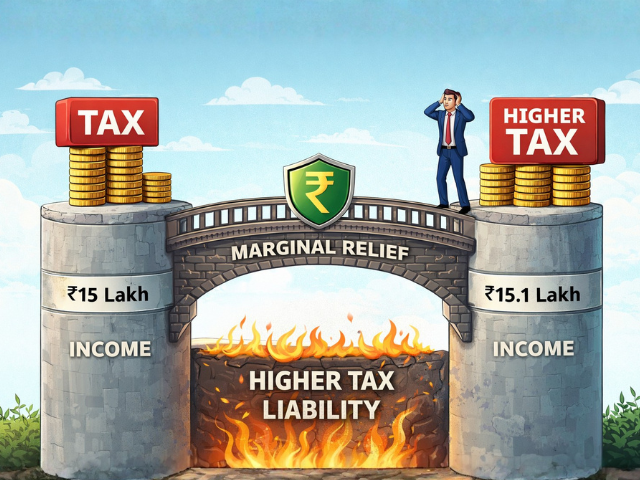
Understanding Marginal Relief: Preventing higher taxes on slightly higher income
Key Takeaways
- Marginal relief prevents unfair tax jumps when income crosses a threshold
- It ensures extra tax does not exceed the extra income earned
- Applies mainly to surcharge on high income
- Helps high income taxpayers manage tax liability efficiently
- Important for tax planning and investment decisions
What Is Marginal Relief?
Marginal relief is a simple but important concept in income tax. It ensures that if your income increases slightly above a certain limit, your tax does not increase disproportionately.
In India, when income crosses specific thresholds, a surcharge is applied. This can suddenly increase your tax liability. Marginal relief acts as a safeguard so that the additional tax you pay is never more than the additional income you earned.
In short, it protects taxpayers from paying “extra tax” just because they crossed a limit by a small margin.
Why Is Marginal Relief Needed?
India follows a progressive tax system where higher income attracts higher tax rates. On top of that, surcharge is added once income crosses certain limits like 50 lakh, 1 crore, and above.
The problem arises when:
- Your income crosses a threshold by a small amount
- But your tax increases sharply due to surcharge
This creates an unfair situation. That is where marginal relief comes in.
How Marginal Relief Works
The idea is very simple:
Extra tax payable should not exceed the extra income earned beyond the threshold.
Basic Formula
Marginal Relief = Increase in Tax Liability minus Increase in Income
If the extra tax is higher than the extra income, relief is given to reduce the tax burden.
Example to Understand Marginal Relief
Let’s take a practical example.
Scenario 1: Income Below Threshold
Income: ₹50 lakh
Tax: Normal tax without surcharge
Scenario 2: Income Slightly Above Threshold
Income: ₹51 lakh
Now surcharge applies, increasing total tax significantly
Without marginal relief, you might end up paying more than ₹1 lakh extra tax for just ₹1 lakh extra income.
With Marginal Relief
The tax increase is capped so that it does not exceed the additional ₹1 lakh income.
This ensures fairness in taxation.
Where Does Marginal Relief Apply?
Marginal relief is mainly applicable in cases of surcharge for:
- Individuals earning above ₹50 lakh
- Income above ₹1 crore
- Higher income slabs where surcharge rates increase
It is applicable under both old and new tax regimes wherever surcharge is levied.
Impact on Tax Planning
Marginal relief plays a crucial role in financial planning, especially for:
High Income Individuals
Business owners, professionals, and senior executives often fall near surcharge thresholds. Proper planning can help them:
- Avoid unnecessary tax burden
- Optimize income structure
- Use deductions and exemptions wisely
Investors and Traders
Capital gains from equity, mutual funds, or derivatives can push total income above thresholds.
For example:
- A large profit booking in stocks
- Bonus income or ESOPs
- Sale of property or assets
In such cases, marginal relief ensures that the tax impact remains reasonable.
Real World Context
Imagine a trader who earns ₹49.5 lakh during the year. Near year end, they book profits of ₹2 lakh from the stock market, taking total income to ₹51.5 lakh.
Without marginal relief, the surcharge would increase tax sharply. But thanks to marginal relief, the tax increase is controlled.
This is why many investors track their taxable income carefully toward the end of the financial year.
Key Points to Remember
- Marginal relief applies only when surcharge is triggered
- It is automatically calculated while filing income tax returns
- It does not eliminate tax, it only reduces the excess burden
- It ensures fairness in the tax system
Common Misconceptions
“Marginal relief reduces total tax significantly”
Not exactly. It only reduces the excess tax caused by crossing the threshold.
“It applies to all taxpayers”
No, it mainly applies to those whose income crosses surcharge limits.
“You need to apply for it separately”
No, it is automatically considered in tax computation.
Relevance for Indian Markets
Marginal relief indirectly impacts market behavior, especially among high net worth investors.
When investors are aware of tax implications:
- They may time profit booking
- They may spread income across financial years
- They may prefer tax efficient instruments
This influences trading volumes and investment strategies, especially near financial year end.
FAQs
1. What is marginal relief in simple terms?
Marginal relief ensures that extra tax paid is not more than the extra income earned after crossing a tax threshold.
2. Who can claim marginal relief?
Individuals whose income crosses surcharge limits like ₹50 lakh or ₹1 crore can benefit from marginal relief.
3. Is marginal relief available in the new tax regime?
Yes, marginal relief applies wherever surcharge is applicable, including the new tax regime.
4. Do I need to apply separately for marginal relief?
No, it is automatically calculated when you compute your income tax.
5. Can marginal relief reduce my tax to zero?
No, it only reduces excess tax due to surcharge, not the entire tax liability.
Conclusion
Marginal relief is a small but powerful provision in India’s tax system. It ensures fairness by preventing a sudden spike in tax liability due to a slight increase in income.
For investors, traders, and high income professionals, understanding this concept can make a real difference in tax planning and decision making.
At Swastika Investmart, we believe that smart investing is not just about returns but also about efficient tax planning. With our SEBI registered platform, advanced research tools, and dedicated support, you can make informed financial decisions with confidence.

Range Rover Production Halt: Will Tata Motors Stock Face More Pressure?
Key Takeaways
- JLR has paused production at its Solihull plant for about two weeks
- Supply chain issues are the main reason behind the halt
- Tata Motors stock reacted negatively due to uncertainty
- JLR remains a key profit driver for Tata Motors
- Short term volatility likely, long term outlook depends on recovery
What Happened at the JLR Plant?
Jaguar Land Rover, the luxury vehicle arm of Tata Motors, has temporarily halted production at its Solihull plant in the UK. This facility manufactures high end models like Range Rover and Range Rover Sport.
The shutdown is reportedly due to a parts supply issue involving a key supplier. While the pause includes a planned holiday shutdown, the disruption has raised concerns in the market.
For investors, this is important because JLR contributes a significant portion of Tata Motors’ revenue and profitability.
Why Is the Range Rover Production Halt Important?
JLR Is the Profit Engine
Tata Motors’ domestic business has improved in recent years, but JLR still plays a critical role in overall performance. Premium models like Range Rover carry higher margins compared to mass market vehicles.
A disruption in production directly affects:
- Wholesale volumes
- Revenue growth
- Profit margins
Even a short term halt can impact quarterly numbers.
Market Reaction to the News
Tata Motors shares declined after reports of the production halt surfaced. This reaction reflects market concerns about:
- Supply chain stability
- Earnings visibility
- Repeated disruptions
This is not the first time JLR has faced challenges. Earlier, a cyber incident had already disrupted production and impacted financial performance.
Investors tend to react quickly to such developments, especially when they involve key revenue drivers.
Understanding the Supply Chain Risk
Why Do Such Disruptions Happen?
Modern automobile manufacturing depends on a complex global supply chain. Even a small issue with a critical component can halt entire production lines.
In this case, a supplier related issue has forced JLR to pause operations.
Real World Example
During the semiconductor shortage, many global automakers had to cut production despite strong demand. This shows how dependent the industry is on smooth supply chain functioning.
The current situation at JLR highlights similar vulnerabilities.
Financial Impact on Tata Motors
Short Term Impact
- Lower production volumes
- Possible decline in revenue for the quarter
- Temporary pressure on margins
Long Term Impact
If the issue is resolved quickly, the impact may remain limited. However, repeated disruptions can affect investor confidence.
It is also important to note that JLR had already faced challenges in the recent past, including a cyberattack that impacted production and revenues.
How Should Investors View This?
Avoid Panic Selling
A two week production halt does not necessarily change the long term fundamentals of the company.
Focus on Key Indicators
Investors should track:
- JLR production recovery timeline
- Order backlog and demand trends
- Margin performance
- Management commentary
Compare with Industry Trends
Supply chain issues are not unique to Tata Motors. Many global automakers face similar challenges. This puts the current situation in perspective.
Impact on Indian Markets
Tata Motors is a heavyweight stock in the auto sector and part of major indices. Any sharp movement in the stock can influence broader market sentiment.
However, the impact on the overall market is usually limited unless the issue escalates significantly.
Key Risks Going Forward
- Prolonged supply chain disruptions
- Weak demand in global luxury car markets
- Currency fluctuations impacting JLR earnings
- Rising input costs
These factors can influence the stock’s performance in the coming months.
Opportunity or Caution?
For long term investors, such corrections can sometimes offer buying opportunities, provided the underlying business remains strong.
However, short term traders should be cautious as volatility may continue until there is clarity on production resumption.
FAQs
1. Why did Tata Motors stock fall recently?
The stock fell due to the temporary halt in production at JLR’s Solihull plant caused by supply chain issues.
2. How important is JLR for Tata Motors?
JLR is a key contributor to Tata Motors’ revenue and profitability, especially through premium vehicles like Range Rover.
3. Is the production halt a long term concern?
Currently, it appears to be a short term issue. Long term impact depends on how quickly operations resume.
4. Should investors sell Tata Motors stock now?
Investors should avoid knee jerk reactions and focus on long term fundamentals and recovery trends.
5. What should investors track next?
Watch for updates on production restart, quarterly earnings, and management guidance.
Conclusion
The Range Rover production halt has created short term uncertainty for Tata Motors, leading to a negative reaction in the stock price. While the issue highlights ongoing supply chain risks, it does not necessarily change the company’s long term growth story.
For investors, the key lies in separating short term noise from long term fundamentals. Keeping an eye on global auto trends and JLR’s recovery will be crucial.
In such dynamic market conditions, having access to reliable research and expert insights can make a significant difference. With its SEBI registered platform, advanced tools, and investor focused approach, Swastika Investmart helps you make informed decisions with confidence.

Global LNG Supply Shock: How Cyclone Narelle and Qatar Crisis Are Driving Prices Higher
Key Takeaways
- Global LNG supply is under pressure due to multiple disruptions
- Cyclone Narelle has impacted major Australian LNG export facilities
- Qatar supply disruption has worsened the global shortage
- Asian LNG prices have surged sharply due to supply-demand imbalance
- Indian energy companies and inflation may feel the ripple effects
What Is Causing the Global LNG Supply Shock?
The global LNG market is currently facing a rare combination of supply disruptions. On one side, geopolitical tensions in the Middle East have affected supplies from Qatar, one of the world’s largest LNG exporters. On the other, extreme weather in Australia has forced shutdowns at key production facilities.
Cyclone Narelle, a severe tropical storm, has disrupted operations at major LNG plants in Western Australia. These facilities contribute a significant share to global LNG exports. When such a large supply base is affected, the impact is felt across international markets.
At the same time, supply concerns from Qatar have added to the uncertainty. With both these major suppliers facing disruptions, global LNG availability has tightened sharply.
Why LNG Prices Are Rising So Fast
Supply Constraints
Australia accounts for a substantial portion of global LNG exports. When facilities like Gorgon, Wheatstone, and North West Shelf face shutdowns, a large chunk of supply disappears temporarily.
At the same time, reduced output from Qatar has created a double shock in the market.
Strong Demand from Asia
Asian countries, including Japan, South Korea, China, and India, rely heavily on LNG imports for energy needs. These buyers are now competing for limited supply, pushing prices higher.
Geopolitical Tensions
The Middle East crisis has disrupted key shipping routes and created uncertainty around future supplies. This has further increased the risk premium in LNG prices.
As a result, LNG prices in Asia have surged significantly in a short period.
Real World Example of the Impact
Imagine a situation where two of the biggest suppliers of a product suddenly stop or reduce production. At the same time, demand remains strong or even increases. This naturally leads to higher prices.
That is exactly what is happening in the LNG market today. Buyers are scrambling to secure cargoes, and suppliers who can deliver are commanding higher prices.
Impact on Indian Economy
Higher Energy Costs
India imports a significant portion of its LNG requirements. Rising global prices directly increase the cost of energy for industries such as power, fertilizers, and city gas distribution.
Inflationary Pressure
Higher gas prices can lead to increased production costs for industries. This eventually gets passed on to consumers in the form of higher prices, contributing to inflation.
Pressure on Current Account
Higher import bills for LNG can widen India’s current account deficit. This can also impact the rupee if the trend continues for a longer period.
Impact on Indian Stock Market
City Gas Distribution Companies
Companies like Gujarat Gas and Indraprastha Gas may face pressure if they are unable to pass on higher costs to customers.
Fertilizer and Power Companies
These sectors rely heavily on natural gas. Rising input costs can affect their margins and profitability.
Energy Stocks
Some upstream or diversified energy companies may benefit from higher prices, but downstream players may struggle.
Overall, the impact is mixed and depends on the business model of each company.
What Should Investors Watch?
Global Supply Developments
Keep an eye on how quickly Australian LNG facilities resume operations and whether Qatar restores full supply.
Crude and Gas Price Trends
Energy markets are interconnected. Movements in crude oil often influence natural gas prices as well.
Government Policies
The Indian government may step in with policy measures to control inflation or support key industries if prices remain high.
Long Term Perspective on LNG Markets
While short term disruptions can create volatility, the long term outlook for LNG remains strong. As countries move towards cleaner energy sources, LNG is seen as a transition fuel.
However, events like Cyclone Narelle highlight the vulnerability of global supply chains. Weather events and geopolitical tensions can quickly disrupt markets.
FAQs
1. Why are LNG prices rising globally?
LNG prices are rising due to supply disruptions in Australia and Qatar combined with strong demand from Asian countries.
2. How does this impact India?
India faces higher import costs, which can increase inflation and affect industries dependent on natural gas.
3. Which sectors are most affected in India?
City gas distribution, fertilizers, and power sectors are the most impacted due to their reliance on natural gas.
4. Is this a temporary issue or long term trend?
It is primarily a short term supply shock, but geopolitical risks can keep markets volatile.
5. Should investors worry about energy stocks?
Investors should stay cautious and track global developments, as different energy companies are affected differently.
Conclusion
The current global LNG supply shock is a clear example of how interconnected and fragile energy markets can be. A cyclone in Australia and geopolitical tensions in the Middle East have together created a significant supply crunch, driving prices higher.
For India, the impact is visible in rising energy costs and potential inflationary pressure. For investors, this situation highlights the importance of tracking global macro trends while making decisions.
Navigating such complex market scenarios requires reliable insights and strong research support. With its SEBI-registered platform, advanced tools, and investor-focused approach, Swastika Investmart helps you stay ahead in changing market conditions.

Petrol & Diesel Excise Duty Cut: What It Means for Indian Economy, Markets & OMC Stocks (HPCL, BPCL, IOC Analysis
Quick Summary
- Government reduced excise duty sharply on petrol and diesel
- Oil marketing companies may see margin relief but crude prices remain a risk
- Consumers may not see immediate price cuts at petrol pumps
- Government faces a significant revenue hit, impacting fiscal balance
- OMC stocks may remain volatile in the short term
What Has Changed in the Latest Excise Duty Cut?
The government recently announced a significant reduction in excise duty on fuel. Petrol duty was reduced from ₹13 per litre to ₹3, while diesel duty was cut from ₹10 to zero.
At first glance, this looks like a big relief measure. But the real impact is slightly more complex. This move comes at a time when crude oil prices are elevated due to geopolitical tensions, especially in the Middle East.
In simple terms, the government has reduced its tax share to support oil marketing companies and stabilize the broader economy.
Why Did the Government Cut Excise Duty?
There are three key reasons behind this move:
1. Rising Crude Oil Prices
Global crude oil prices have surged close to $120 per barrel. This has increased the cost of raw material for oil companies.
2. Losses for Oil Marketing Companies
Companies like HPCL, BPCL, and IOC were selling fuel at lower prices than their cost, leading to under-recoveries. Reports suggest losses of ₹24 per litre on petrol and ₹30 per litre on diesel.
3. Inflation Control
High fuel prices increase transportation costs, which in turn raises prices of goods and services. By cutting excise duty, the government is trying to control inflation.
Impact on Oil Marketing Companies
Short-Term Relief in Margins
Lower excise duty reduces the burden on oil marketing companies. If pump prices remain unchanged, companies can retain the benefit, improving their marketing margins.
Cash Flow Improvement
Better margins mean improved cash flows, which can strengthen balance sheets. This is especially important when crude prices are high.
But Risks Still Exist
Despite the relief, high crude prices continue to be a major concern. If crude remains elevated, OMCs may still face pressure on profitability.
This explains why stocks initially rose but later turned volatile.
Why Did HPCL, BPCL, and IOC Stocks Fall After Rising?
Markets are forward-looking. While the duty cut is positive, investors are factoring in several concerns:
- High crude oil prices are still hurting margins
- No immediate reduction in fuel prices means demand boost is limited
- Future policy actions remain uncertain
This led to profit booking after the initial rally in OMC stocks.
Impact on the Indian Economy
Positive: Inflation Control
Lower fuel costs can reduce transportation expenses. Over time, this helps control inflation and supports consumption.
Negative: Fiscal Pressure
The government will face a revenue loss of around ₹1.55 lakh crore annually due to this cut. This could increase fiscal deficit concerns.
Balanced Approach
The move reflects a trade-off. The government is sacrificing revenue to protect the economy from inflation shocks.
Who Benefits the Most?
Oil Marketing Companies
They get partial relief from losses due to lower tax burden.
Consumers
While prices at the pump may not fall immediately, inflation control benefits consumers indirectly.
Government
Although it loses revenue, it gains in terms of economic stability and inflation management.
Real Market Perspective
Let’s take a practical scenario. If crude prices remain above $100 per barrel and pump prices are not increased, OMCs continue to face pressure.
However, if crude stabilizes and excise duty remains low, companies can significantly improve profitability.
This makes OMC stocks highly sensitive to global crude trends rather than just domestic policy changes.
Key Things Investors Should Track
- Crude oil price movement
- Government pricing policies
- OMC marketing margins
- Demand trends for fuel
These factors will decide the future direction of stocks like HPCL, BPCL, and IOC.
FAQs
1. Will petrol and diesel prices decrease after the excise duty cut?
Not necessarily. The government may use the cut to offset OMC losses instead of reducing pump prices immediately.
2. Why are OMC stocks volatile despite positive news?
Because high crude prices and uncertainty in future policies still create risk for profitability.
3. Is this a good time to invest in oil marketing companies?
It depends on crude price trends. Investors should be cautious and track global developments.
4. How does excise duty impact inflation?
Higher fuel taxes increase transportation costs, leading to higher prices of goods. Lower taxes help control inflation.
Conclusion
The excise duty cut on petrol and diesel is a significant step aimed at balancing inflation and supporting oil marketing companies. While it provides short-term relief, the bigger picture still depends on global crude oil prices and geopolitical developments.
For investors, this is a classic case of policy support versus global risk. OMC stocks may remain volatile, but they also offer opportunities for those who understand the macro environment.
If you are looking to navigate such market-moving developments with expert insights, Swastika Investmart offers strong research tools, SEBI-registered credibility, and a tech-enabled platform to help you make informed decisions.
.webp)
Stocks in News Today 27 March 2026: Aurobindo, Azad Engineering, Brigade, and Bharat Dynamics Key Market Movers
Staying updated with stocks in news today is essential for traders and investors looking to capture short-term opportunities and understand broader market sentiment. On 27 March 2026, several Indian companies made headlines with significant developments ranging from global partnerships to defense milestones. Let’s break down what these updates mean for the market and your portfolio.
Quick Takeaways
- Aurobindo Pharma strengthens global footprint with a European biosimilar deal
- Azad Engineering secures a long-term contract with a global industrial giant
- Brigade Enterprises expands real estate pipeline in Bengaluru
- Bharat Dynamics advances India’s defense capabilities with a key milestone
Aurobindo Pharma Expands European Reach
Aurobindo Pharma’s arm, CuraTeQ Biologics, has signed a distribution agreement with STADA Arzneimittel AG. This deal focuses on marketing two biosimilars across select European markets.
Why It Matters
This move signals Aurobindo’s growing ambition in the high-margin biologics segment. Biosimilars are gaining traction globally due to their cost efficiency compared to original biologic drugs. Expanding into Europe also diversifies revenue streams, reducing reliance on the US generics market.
Investor Insight
Pharma stocks often react positively to global expansion news, especially when it involves regulated markets like Europe. However, investors should also track regulatory approvals and execution timelines.
Azad Engineering Secures Long-Term Global Contract
Azad Engineering has signed an eight-year agreement with Mitsubishi Heavy Industries, Japan. Under this deal, the company will act as a single-source supplier for gas turbine components.
Why It Matters
Long-term contracts with global industrial leaders provide revenue visibility and stability. It also reflects Azad Engineering’s manufacturing capabilities and quality standards.
Investor Insight
Such deals often improve investor confidence, especially in capital goods and engineering stocks. Keep an eye on order book growth and margin expansion in upcoming quarters.
Brigade Enterprises Launches New Bengaluru Project
Brigade Enterprises has announced a new residential project in Bengaluru with an estimated revenue potential of Rs. 700 crore.
Why It Matters
The Indian real estate sector, particularly in cities like Bengaluru, is witnessing steady demand driven by IT sector growth and urban migration. New project launches indicate developer confidence and healthy demand outlook.
Investor Insight
Real estate stocks are cyclical and closely tied to interest rates and economic conditions. With the Reserve Bank of India maintaining a balanced stance on inflation and rates, the sector remains stable for now.
Bharat Dynamics Achieves Defense Milestone
Bharat Dynamics has completed the first off-production model of the Advanced Akash Weapon System.
Why It Matters
India’s push for defense indigenization continues to gain momentum. Achievements like this align with government initiatives such as Make in India and Atmanirbhar Bharat.
Investor Insight
Defense stocks have been in focus due to strong government support and increasing budget allocations. Companies like Bharat Dynamics benefit from long-term contracts and policy tailwinds.
Broader Market Context
Tracking stocks in news today is not just about individual companies. It also reflects broader economic and policy trends.
- SEBI regulations ensure transparency in disclosures, making such announcements reliable for investors
- RBI’s monetary policy impacts sectors like real estate and capital goods
- Global partnerships highlight India’s growing role in international supply chains
For retail investors, combining news-based insights with fundamental analysis is key to making informed decisions.
How Swastika Investmart Adds Value
In a fast-moving market, having the right research and tools can make a significant difference. Swastika Investmart, a SEBI-registered broker, offers:
- In-depth research reports and actionable insights
- A tech-enabled platform for seamless trading
- Reliable customer support for investors at every stage
- Strong focus on investor education to help you make smarter decisions
Whether you are tracking daily market movers or building a long-term portfolio, having access to credible analysis can improve outcomes.
FAQs
1. Why should I track stocks in news daily?
Tracking daily stock news helps identify short-term trading opportunities and understand market sentiment shifts.
2. Do all news events impact stock prices immediately?
Not always. Some developments are already priced in, while others may take time to reflect in stock prices.
3. Are defense stocks a good long-term investment?
Defense stocks benefit from government support and long-term contracts, but valuations and execution risks should be considered.
4. How do global deals affect Indian companies?
Global partnerships enhance credibility, diversify revenue, and often lead to long-term growth opportunities.
5. Is it safe to invest based only on news?
No. News should be combined with fundamental and technical analysis for better decision-making.
Final Thoughts
The latest stocks in news today highlight how Indian companies are expanding globally, securing long-term contracts, and contributing to national priorities like defense and infrastructure. These developments not only influence stock prices but also reflect the evolving strength of India’s economy.
If you want to stay ahead in the market with reliable insights and smart tools, you can explore Swastika Investmart’s platform here:


.webp)
.webp)

.webp)






START YOUR INVESTMENT JOURNEY
Get personalized advice from our experts
- Dedicated RM Support
- Smooth and Fast Trading App
