From Inflation to Bond Yields: Understanding Interest Rate Cycles & Market Impact.




Key Takeaways
- Inflation directly influences interest rate decisions by central banks
- Rising inflation pushes bond yields higher and impacts equity valuations
- Interest rate cycles affect different sectors in different ways
- Bond markets react faster than equities to macro changes
- Smart asset allocation helps investors navigate these cycles
Introduction
If you have ever wondered why markets suddenly turn volatile or why borrowing costs change, the answer often lies in three interconnected factors: inflation, bond yields, and interest rate cycles.
At the center of this ecosystem is the Reserve Bank of India, which adjusts policy rates to balance growth and inflation. These decisions ripple through bond markets, equity markets, and ultimately your investment portfolio.
Understanding this chain reaction is essential for investors who want to stay ahead rather than react late.
What is Inflation and Why It Matters
Inflation refers to the rise in prices of goods and services over time. While moderate inflation is a sign of healthy demand, excessive inflation can disrupt economic stability.
Real-World Example
When fuel prices increase, transportation costs go up. This affects everything from groceries to manufacturing. As a result, consumers end up paying more across categories.
👉 This is how inflation spreads across the economy
How Inflation Impacts Interest Rates
Central banks use interest rates as a tool to control inflation.
When Inflation Rises
- Central bank increases interest rates
- Borrowing becomes expensive
- Demand slows down
When Inflation Falls
- Central bank cuts interest rates
- Borrowing becomes cheaper
- Consumption and investment rise
The Policy Role
The Reserve Bank of India closely tracks inflation trends before making policy decisions. Its primary goal is to maintain price stability while supporting growth.
Understanding Interest Rate Cycles
Interest rate cycles move in phases depending on economic conditions.
📉 Easing Phase
- Rates are reduced
- Liquidity increases
- Equity markets tend to perform well
📈 Tightening Phase
- Rates are increased
- Liquidity tightens
- Market valuations may compress
⏸️ Pause Phase
- Rates remain unchanged
- Markets turn data-dependent
- Volatility can remain high
Bond Yields: The Missing Link
Bond yields are often the first indicators of changing economic conditions.
What Are Bond Yields?
Bond yield is the return an investor earns on a bond.
Relationship Between Inflation and Bond Yields
- Rising inflation leads to higher bond yields
- Falling inflation leads to lower bond yields
👉 Key Rule:
When yields rise, bond prices fall, and vice versa
Why Bond Markets React First
Bond investors closely monitor:
- Inflation data
- Interest rate expectations
- Fiscal policies
👉 This makes bond markets more sensitive and quicker to react than equity markets
Impact on Equity Markets
Equity markets respond differently depending on the stage of the cycle.
🔴 High Inflation and Rising Rates
- Valuations come under pressure
- Growth stocks may correct
- Cost-sensitive sectors struggle
🟢 Stable Inflation and Lower Rates
- Earnings visibility improves
- Liquidity supports valuations
- Market sentiment turns positive
Sector-Wise Impact in India
🚀 Beneficiaries
- Banking sector during rising rates
- Commodities and energy during inflation spikes
⚠️ Challenged Sectors
- Real estate and auto due to higher borrowing costs
- FMCG due to input cost pressures
Practical Example from Indian Markets
During periods of rising inflation in India, bond yields have historically moved higher, leading to cautious equity market behavior. Rate-sensitive sectors such as real estate and auto often underperform, while banks may benefit from improved margins.
This pattern reinforces the importance of tracking macro indicators rather than focusing only on stock-specific news.
How Investors Should Respond
Understanding macro cycles can significantly improve investment decisions.
🧠 1. Focus on Asset Allocation
Balance between equity, debt, and other assets
📊 2. Track Bond Yields
They often signal upcoming changes in interest rates
📉 3. Adjust Sector Exposure
Reduce exposure to rate-sensitive sectors during tightening phases
⏳ 4. Stay Long-Term Focused
Short-term volatility is part of market cycles
Why This Matters More Today
With global uncertainties, commodity price fluctuations, and changing inflation trends, interest rate cycles have become more dynamic.
For Indian investors, this means:
- More frequent market shifts
- Greater importance of macro awareness
- Need for disciplined investing
FAQs
1. What is the relationship between inflation and bond yields?
Rising inflation usually leads to higher bond yields, while falling inflation leads to lower yields.
2. How do interest rate cycles affect stock markets?
Rate hikes can pressure valuations, while rate cuts generally support market growth.
3. Why do bond markets react faster than equity markets?
Bond markets are more sensitive to macroeconomic changes like inflation and interest rates.
4. Which sectors perform well during rising interest rates?
Banking and financial sectors may benefit, while rate-sensitive sectors may struggle.
5. How should investors use this information?
Investors should track macro indicators, diversify their portfolios, and adjust strategies based on economic cycles.
Conclusion
From inflation to bond yields and interest rate cycles, the connection is clear. These factors shape market direction and influence investment outcomes more than short-term news flows.
For investors, the goal is not to predict every move but to understand the cycle and position accordingly.
At Swastika Investmart, we combine deep market research, advanced tools, and investor education to help you navigate complex market environments with confidence.
Big Budget











.webp)
.webp)
.webp)
.webp)
.webp)














.webp)
.webp)
.webp)
.webp)
Latest Articles
.webp)
What is a Demat Account?


A Demat or Dematerialized Account is like a digital locker for your stocks and investments. You don't need to worry about keeping track of physical certificates anymore. Instead, everything is stored electronically with a Depository Participant (DP), showing that you own those investments. This means you can trade or transfer them smoothly whenever you want, without dealing with paper documents.
A Demat Account provides strong security measures, reduces paperwork, makes transactions smoother, and improves how you keep track of your investments. But that's not all! By opening a Demat Account, you open the door to many opportunities. You can trade not just in stocks but also in other areas like derivatives, commodities, and currency. Plus, you get access to extra services like voting online for company decisions, bidding for new stocks, and enjoying perks from the companies you invest in. Overall, it makes your investment journey easier and more rewarding.
Factors to consider when opening a demat account
- Seamless Trading Experience: When your Demat and trading accounts are with the same broker, it simplifies the process of buying and selling stocks. You can easily manage your transactions without worrying about different accounts or paperwork.
- Robust Technology Platform: Look for a Demat account provider with a reliable technology platform. This ensures smooth functioning of your account, from fund transfers to tracking your investments, all in one place.
- Transparent Charges: Understand the charges related with your Demat account, including opening fees, annual maintenance charges, and transaction fees.
- Efficient Banking, Broking, and Custody: A seamless integration of banking, broking, and custody services enhances your overall experience. Ensure your broker offers hassle-free fund transfers and efficient management of your securities.
- Quality Support Services: Check out for aspects such as customer service, technical support, and problem resolution. Know whether they provide customer service representatives, offer multiple channels for support (such as phone, email, or live chat), and resolve issues in a timely manner.
Demat Account Opening Procedure- Step-by-Step Guide
Opening an online trading account is the first step towards becoming a successful investor. Before we begin, decide whether you want to open an account with Swastika through their website or with Justrade2.0 via their mobile app. Both options offer user-friendly interfaces and convenient features to make the account opening process seamless.
Via Website (Swastika):
- Visit Swastika's website & click “Open an Account”: Go to Swastika's website and find the option to open an account. It's usually a button or link that says something like "Open an Account."
- Enter mobile no. & email: Fill in your mobile number and email address. This is so they can contact you about your account.
- Enter Aadhaar no. & PAN: Enter your Aadhaar number and PAN card details.
- Fill in basic details: Provide basic information like your name, address, and date of birth. This helps Swastika create your account.
- Select segment: Choose the investment segment you're interested in, like stocks or mutual funds.
- Upload required documents: Scan or take pictures of the documents Swastika asks for, like your Signature, Income Proof, bank Proof. Upload these documents to their website.
- In Person Verification (IPV): Swastika may require In Person Verification (IPV) as part of their account opening process. This involves a physical verification of your identity and documents by a representative of Swastika. Arrange a suitable time and location for the IPV process as instructed by Swastika.
- Provide Nominee Details:Provide details about your nominee. This includes their name, relationship to you, contact information, and any other relevant details. Nominee details are important for certain financial transactions and account management purposes.
- E-sign: Use your Aadhaar number to electronically sign the documents. This is like signing your name on paper but done digitally.
- Account opened: Once you've completed all the steps and everything is verified, your account is officially opened! You'll receive confirmation and can start using your Swastika account to trade.
Via Mobile App (Justrade2.0):
- Download Justrade2.0: Find and download the Justrade2.0 app from the app store on your mobile phone.
- Enter mobile no. & email: Just like on the website, you'll need to provide your mobile number and email address.
- Enter Aadhaar no. & PIN into Digilocker to fetch PAN: Use your Aadhaar number and PIN to access your PAN card details from Digilocker.
- Fill in basic details: Enter your personal information, like your name, address, and date of birth.
- Select plan & segment: Choose the type of account and investment segment you're interested in.
- Upload required documents: Take photos of your documents using your phone's camera and upload them directly to the app.
- E-sign: Use your Aadhaar number to electronically sign the necessary documents.
- Account opened: Once everything is submitted and verified, your account is ready to use! You can start trading using the Justrade2.0 app on your phone.
That's it! Following these steps will help you open an account with Swastika via their website or with Justrade2.0 via their mobile app
Documents Required for Opening Demat and Trading Accounts
To open a demat & share trading account you need the following documents
For Indian resident individuals
- Your PAN Card
- Your valid Government approved address proof (any one of the following)-
- Aadhar Card
- Driver's Licence
- Passport
- Voter's ID
- Ration Card
- Registered lease or sale agreement of residence
- Insurance copy
- Utility bills like telephone, electricity or gas (less than 3 months old
- Your bank proof mentioning your name, account number and IFSC code clearly (any one of the following)-
- Cancelled cheque
- Bank statement/Passbook (last 6 months)
Futures and Options
For Equity and Currency Derivatives you would require an income proof along with the above-mentioned documents. Income proof can be any one of the following -
- Bank account statement/Passbook (last 6 months)
- Income tax returns (last 1 year)
- Salary slips (last 6 month)
Benefits of Demat Accounts:
- Reduced Risk: Demat accounts eliminate the risk of losing or damaging paper certificates. Electronic securities stored in these accounts cannot be lost or damaged over time, providing greater security for your investments.
- Effortless Trading: Linking your Demat account with a trading account allows for quick and convenient trading. You can buy or sell shares with just a click, without the need to visit company offices or stock exchanges personally. Look for brokers offering a 2-in-1 (Demat cum trading) account for seamless trading experience
- Easy Portfolio Tracking: Demat accounts offer portfolio tracking capabilities, providing easy access to your holdings. You can monitor your entire portfolio using various devices such as smartphones or laptops.
- IPO Investments: Demat accounts are essential for investing in Initial Public Offerings (IPOs) in India. Companies issuing IPOs require your Demat account details for share allotment. Having a Demat account also grants access to various other investment schemes and holdings, making IPO investments hassle-free.
- Diversification: Besides stocks, you can hold a variety of securities such as mutual funds, bonds, exchange-traded funds (ETFs), and government securities in your Demat account, enabling portfolio diversification.
- Participation in Corporate Actions: Demat accounts are essential for receiving dividends, bonus shares, or other corporate actions seamlessly.
- Cost-Effective: Compared to traditional paper-based transactions, Demat accounts reduce paperwork and associated costs, making investing more cost-effective in the long run.
- Loan Against Securities: Some financial institutions offer loans against securities held in Demat accounts, providing liquidity without the need to sell your investments.
Demat Account Charges Simplified:
- Maintenance Fees: These are annual charges for keeping your Demat account active, regardless of how often you trade. Look for the most cost-effective option when choosing your account.
- Account Opening Charges: Some DPs charge a fee to open a Demat account, while others don't. Choose the option that suits you best.
- Custodian Fees: These fees are monthly charges based on the number of securities you hold. If your DP has already paid one-time charges, you might not face custodian fees. Individuals usually pay these one-time charges, so brokers often don't charge custodian fees on Demat accounts.
- Transaction Fees: These fees are incurred each time you buy or sell securities through your Demat account. DPs may charge a flat fee per transaction or a percentage based on the transaction value. Be aware of these charges when making transactions.
Open Demat Account FAQs:
What is a trading account?
A trading account is a type of investment account that allows you to buy and sell financial securities, such as stocks, bonds, options, and commodities, through a brokerage firm or financial institution. It acts as a gateway to the stock market, enabling you to execute trades and participate in various investment opportunities.
When you open a trading account, you are provided with a unique account number and login credentials that grant you access to the trading platform offered by your broker. Through this platform, you can place buy and sell orders, monitor your portfolio, view market data and charts, and manage your investments.
Trading accounts come in different types, such as cash accounts and margin accounts. In a cash account, you can only trade with the funds you have deposited, while a margin account allows you to borrow money from the broker to increase your buying power, subject to certain conditions and margin requirements.
Overall, a trading account is essential for individuals looking to actively participate in the financial markets and build their investment portfolios.
Who's a Depository Participant?
A Depository Participant is like a middleman between you and the stock market. They can be a bank or a brokerage firm registered with either CDSL or NSDL. You can find a list of these participants online and pick the ones with the best services.
There are two main types of brokerage firms: discount and service. Discount brokers mainly focus on trading stocks and derivatives according to your instructions. Service brokers offer a wider range of services, like advice on investments, mutual funds, insurance, and IPOs. Before you open an online demat account, decide which type of brokerage services you need.
Can I hold different types of securities in a Demat account?
Yes, you can hold various types of securities such as equities, bonds, mutual funds, ETFs, government securities, and derivatives in a Demat account.
What is Dematerialisation and Rematerialisation Services?
Demat accounts automate the dematerialisation of securities linked to the trading account. If you have physical securities from previous trades, they can be dematerialised by paying a fee. Additionally, Demat accounts offer rematerialisation services, allowing you to convert dematerialised securities back into their physical form when needed.
Is it safe to open a Demat account online?
Opening a Demat account online can be safe if you choose a reputable brokerage firm, verify security measures, use secure devices and networks, keep login credentials secure, monitor account activity, beware of phishing attempts, and keep software updated. By following these precautions, you can securely manage your investments and enjoy the convenience of online trading without compromising your financial security.
Conclusion
A Demat account offers a secure, paperless way to manage investments like stocks, bonds, and mutual funds. It simplifies trading, reduces paperwork, and provides access to a variety of investment opportunities. By opening a Demat account with a reliable broker, you can trade efficiently and benefit from added services like online voting and bidding for new stocks. With proper security measures, online trading becomes safe and convenient, making investing more accessible and rewarding.
Stay updated with Swastika Investmart for more financial insights. JOIN NOW

10 Proven Trading Strategies to Maximize Profits and Reduce Losses
Stock trading can be very profitable, especially if you stick with it for a long time. To be successful, it's important to understand things like a company's financial health and its real value.
Trading has been around for a long time, starting with the barter system where people traded goods directly with each other. This old form of trading laid the groundwork for the modern stock market.
The stock market is a place where people buy and sell shares of companies. These shares represent part ownership in the business. The first modern stock exchange started in Amsterdam in 1602, where people traded shares of the Dutch East India Company.
Derivatives, which are contracts based on the value of an asset, were first traded in 1607 by a single company. Dividends, or profits shared with stockholders, were given out a few years later. Amsterdam was also the birthplace of futures and options trading.
Today, more and more people are getting interested in the stock market, even those who don’t have much experience. Many see trading as a good way to grow their wealth.
Staying consistently profitable in trading is the goal of every trader, but the journey isn’t always smooth. However, by following some proven strategies, you can increase your chances of staying in the green. Here are ten tried and tested trading strategies to help you stay in profit, explained in simple language.
1. Set Clear Goals and Stick to a Plan
The foundation of successful trading is having a clear goal and a solid plan. Before you even make your first trade, know what you want to achieve.
- Define your trading objectives: Are you looking for short-term gains, or is long-term growth your goal?
- Create a plan: Outline your entry and exit points, how much you’re willing to risk, and how you’ll respond to market changes.
- Stick to the plan: It’s easy to get swayed by emotions, but staying disciplined is key to long-term profitability.
2. Use Stop-Loss Orders
A stop-loss order is a tool that automatically sells your stock if it drops to a certain price, preventing further losses.
- Set your stop-loss: Determine the maximum loss you’re willing to take on a trade and set your stop-loss accordingly.
- Protect your capital: By using stop-loss orders, you can prevent a small loss from turning into a big one.
3. Diversify Your Portfolio
Diversification means spreading your investments across different assets or sectors to reduce risk.
- Avoid putting all your eggs in one basket: Invest in various sectors like technology, healthcare, and consumer goods. If one sector performs poorly, others might do well, balancing your overall returns.
- Include different asset types: Consider adding bonds, ETFs, or mutual funds to your portfolio for added stability.
4. Follow Market Trends
Trend trading is a strategy where you make decisions based on the direction of the market.
- Identify the trend: Use technical analysis tools like moving averages to determine whether the market is trending up, down, or sideways.
- Trade with the trend: If the market is going up, focus on buying (going long). If it’s going down, you might consider selling (going short).
5. Practice Risk Management
Risk management involves controlling the amount of money you expose to potential loss on any given trade.
- Use the 1% rule: Don’t risk more than 1% of your trading capital on a single trade. This way, even if a trade doesn’t go as planned, it won’t significantly impact your overall portfolio.
- Balance risk and reward: Always aim for a higher potential reward compared to the risk. For example, risking ₹10,000 to make ₹30,000 ensures that even if you lose occasionally, you’ll still come out ahead.
6. Keep Emotions in Check
Emotions like fear and greed can cloud your judgment and lead to poor trading decisions.
- Stay calm: Don’t let short-term market fluctuations affect your trading decisions. Stick to your plan and avoid making impulsive trades.
- Avoid emotional trading: If you feel overly stressed or emotional, it might be best to take a break from trading until you can approach it with a clear mind.
7. Regularly Review and Adjust Your Strategy
Markets are constantly changing, so it’s important to review your trading strategy regularly.
- Analyze past trades: Look at what worked and what didn’t. Learn from your mistakes and successes.
- Adjust your strategy: If market conditions change or you notice a pattern in your trading performance, don’t hesitate to tweak your strategy to better align with your goals.
8. Learn to Identify and Trade Support and Resistance Levels
Support and resistance levels are key concepts in technical analysis that can help you make better trading decisions.
- Support level: This is the price level where a stock tends to find support as it falls. Think of it as a floor that the price has trouble falling below.
- Resistance level: This is the price level where a stock often faces selling pressure as it rises, acting like a ceiling.
- Trade near these levels: Buy near support and sell near resistance for better profit potential.
9. Use Technical Indicators
Technical indicators like moving averages, Relative Strength Index (RSI), and MACD can provide insights into market trends and potential entry and exit points.
- Moving Averages: These smooth out price data to create a trend-following indicator.
- RSI: Helps identify whether a stock is overbought or oversold, which can indicate a potential reversal.
- MACD: Shows the relationship between two moving averages and can help signal buying or selling opportunities.
10. Stay Informed and Adapt to Market Conditions
The financial markets are influenced by various factors, including economic data, geopolitical events, and market sentiment. Staying informed helps you anticipate potential changes.
- Follow market news: Keep up with the latest financial news, earnings reports, and economic data releases.
- Be adaptable: Markets can change quickly. Be ready to adjust your strategy or portfolio if necessary to align with new market conditions.
Conclusion
Trading for profit requires discipline, knowledge, and the right strategies. By setting clear goals, managing risk, following trends, and staying updated, you can increase your chances of consistent profitability. Remember, no strategy guarantees success, but these ten tried and tested methods can significantly enhance your trading outcomes.

What are Price Patterns?
Price Patterns are shapes or formations on charts that can be categorized and used to predict future price movements.
These patterns have been seen repeatedly across different charts and times, proving their reliability.
- Duration: Price patterns can last from a few days to several months or even years. Longer patterns usually lead to more significant price moves.
- Price Targets: The targets from these patterns estimate how far the price might move, but they are approximate.
- Interpretation: Analysing patterns involves both skill and flexibility. Patterns may not match the textbook description perfectly but can still be valid.
- Considerations: Always look at the price behaviour and the time it takes for the pattern to form to get a complete picture.
Classification of Patterns
Reversal patterns are important signals in trading that suggest a current trend (whether it's going up or down) might soon change direction. They usually appear after a long period of a particular trend. These patterns help traders predict when a trend might be ending and a new one might start.
Common examples of reversal patterns include:
- Head & Shoulders
- Double Top/Double Bottom
- Triple Top/Triple Bottom
- Broadening Formations
- Rounding Bottom/Rounding Top or Cup & Handle Pattern
Continuation patterns are signals in trading that suggest a brief pause in the current trend, but the trend is likely to continue in the same direction after the pause. In other words, the trend takes a short break and then keeps going.
Common examples of continuation patterns include:
- Flags
- Pennants
- Triangles: Ascending Triangle/Descending Triangle
- Rectangles:
Both Continuous and Reversal Patterns

Rising/Falling Wedges
In this blog, we will have a brief look at how these patterns look.
Double Top : A Double Top is a bearish reversal pattern that signals a potential end to an uptrend. It forms when the price creates two high points (highs) at nearly the same level, separated by a period of time.
- Prior Trend: There must be a strong upward trend.
- First High: The price reaches a high point and then pulls back slightly.
- Second High: The price rises again to a similar level as the first high but on lower trading volume.
- Pattern Completion: The pattern is completed when the price drops below the lowest point between the two highs, confirming a trend reversal. This drop should happen with an increase in trading volume.
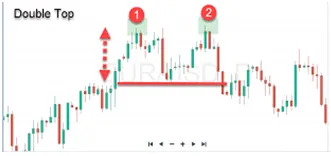
Tip: One will find double top developing often in stocks but one must look at the prior trend and volume to rely on the formation.
Double Bottom
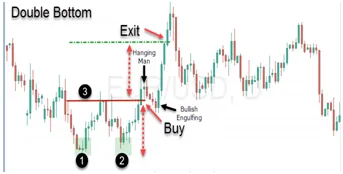
A Double Bottom pattern is a bullish reversal pattern signalling a potential end to a downtrend.
- Prior Trend: There must be a strong downward trend
- First Low: The price hits a low point (low) and then starts to rise.
- High: After the first low, the price climbs and forms a high point (high), which may look slightly rounded.
- Second Low: The price drops again, creating a second low at a similar level to the first, but with lower trading volume.
- Pattern Completion: The pattern is completed when the price rises above the highest point between the two lows, indicating a reversal of the downtrend. This breakout should occur with increased trading volume.
Triple Top
A Triple Top is a bearish reversal pattern that indicates the potential end of an uptrend. It features three distinct high points at roughly the same price level. Here’s a simplified explanation:
- Prior Trend: There must be a strong upward trend before the Triple Top forms.
- Three Highs: The price reaches three highs, each at a similar level, and these highs are well-spaced, marking turning points where the price starts to drop after each high.
- Volume: During the formation of the Triple Top, trading volume usually decreases, with the highest volume at the first high and lower volume on the following highs. However, when the price finally breaks below the support level (the lowest point between the highs), volume should increase, confirming the pattern.
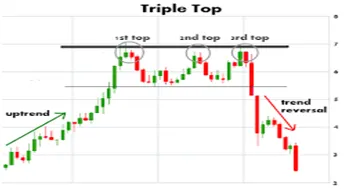
Tip: Pattern is complete when the both lows have been broken on heavier volume.
Triple Bottom
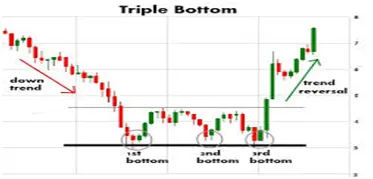
A Triple Bottom is a bullish reversal pattern that signals the potential end of a downtrend. It features three distinct low points at roughly the same price level.
- Prior Trend: There must be a strong downward trend before the Triple Bottom forms.
- Three Lows: The price hits three low points, each at a similar level, and these lows are well-spaced, marking turning points where the price starts to rise after each low.
- Volume: During the formation of the Triple Bottom, trading volume usually decreases, with the highest volume at the first low and lower volume on the following lows. However, when the price finally breaks above the resistance level (the highest point between the lows), volume should increase, confirming the pattern.
Head & Shoulders
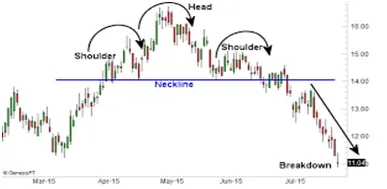
- Prior Trend: For a Head & Shoulders pattern to be a reversal signal, there must be a clear uptrend before it forms. Without this uptrend, the pattern can't signal a reversal.
- Left Shoulder: During an uptrend, the price hits a high point (left shoulder) and then drops a bit. This drop usually stays above the trend line, so the uptrend continues.
- Head: After the drop from the left shoulder, the price rises again, reaching a new high (the head). After this high, the price drops again, creating a low point that helps form the neckline.
- Right Shoulder: From the low of the head, the price rises again but doesn’t reach the height of the head. This high (right shoulder) is usually around the same level as the left shoulder. The final decline should break the neckline, completing the pattern.
Inverse Head and Shoulders
The Inverse Head and Shoulders, signals a potential change from a downtrend to an uptrend. Here’s how it forms:
- Prior Trend: There must be a clear downtrend before this pattern can signal a reversal. Without a downtrend, the pattern doesn’t work.
- Left Shoulder: During the downtrend, the price drops to a low point (left shoulder) and then starts to rise.
- Head: After the rise from the left shoulder, the price drops again to a lower point (the head), then rises again, creating a high point that helps form the neckline.
- Right Shoulder: The price drops from the high of the head to form another low (right shoulder). This low should be higher than the head and usually around the same level as the left shoulder. The final rise should break above the neckline, completing the pattern.
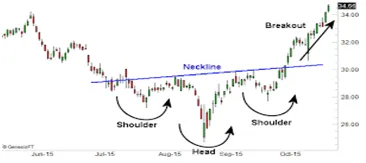
When the price breaks above the neckline, it suggests the downtrend may be ending, and the price could start rising.
Broadening Formations
Broadening Formations are patterns where the price creates an expanding triangle. Unlike regular triangles, where the trend lines come together, broadening formations have trend lines that spread out, making the shape of an expanding triangle.
In simple terms, as the price moves, the highs and lows get further apart, creating a pattern that looks like an expanding triangle.
Broadening Bottoms
A Broadening bottom looks like a megaphone and appears during a downtrend. It features:
- Higher Highs and Lower Lows: The price makes progressively higher highs and lower lows, creating a wide, expanding shape over time.
This pattern is a bullish reversal signal, meaning that after it forms, the price trend is likely to shift from down to up.
Volume: Trading volume is often uneven but tends to rise when the price goes up and fall when the price goes down.
Broadening Wedges Ascending
A Broadening Wedges Ascending is a bearish reversal pattern where:
- Trend Lines: Two trend lines slope upwards and get wider apart over time.
- Volume: Trading volume usually increases as the pattern develops.
This pattern indicates that the current uptrend might be ending and a downtrend could begin
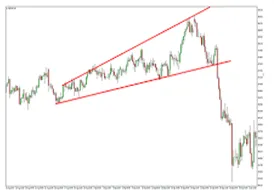
Broadening Wedges Descending
A Broadening Wedges Descending is a bullish reversal pattern where:
- Trend Lines: Two trend lines slope downwards and get wider apart over time.
- Volume: Trading volume typically increases as the pattern forms.
This pattern suggests that the downtrend might be ending and a new uptrend could start.
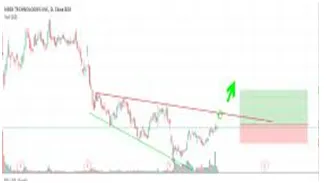
RISING WEDGE
A Rising Wedge is a bearish pattern that forms when prices start wide at the bottom and gradually narrow as they move higher. This pattern slopes upward and signals a potential drop in prices. Here's a simple breakdown:
- Bearish Bias: A rising wedge generally indicates that prices are likely to fall, even though the pattern slopes upward.
- Continuation Pattern: If the wedge forms during a downtrend, it suggests the price might continue to fall after a brief upward movement.
- Reversal Pattern: If the wedge forms during an uptrend, it signals that the upward trend may be ending, and a downward trend could begin.
Regardless of whether it's a continuation or a reversal, a rising wedge usually predicts a drop in prices.
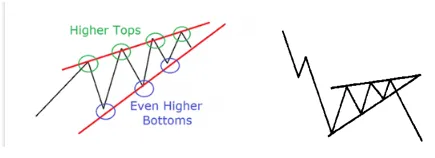
Falling Wedge Pattern
A falling wedge is a chart pattern that looks like a downward-sloping cone. It starts wide at the top and gets narrower as the price moves lower.
- Bullish Signal: It’s considered a bullish pattern, meaning it suggests the price might go up after the pattern forms.
- Continuation Pattern: If the price was going up before the falling wedge, it means the wedge is just a pause, and the uptrend is likely to continue after the pattern completes.
- Reversal Pattern: If the price was going down before the falling wedge, it indicates that the downtrend might end, and the price could start going up.
Overall, whether it’s a continuation or a reversal, a falling wedge generally suggests that prices are likely to rise after the pattern finishes.
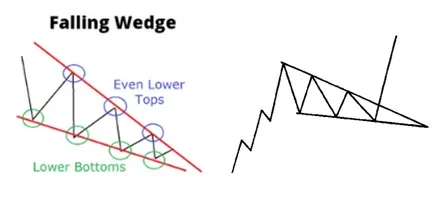
Rounding Top
- The price trend slowly curves downward over time, creating a rounded shape.
- Bullish Signal: This pattern is known as a bullish consolidation pattern, which means it suggests that after this gradual downward curve, the price is likely to start moving up
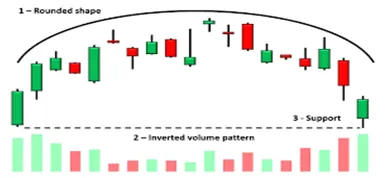
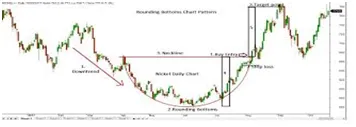
Rounding Bottom
A rounding bottom pattern is a bullish consolidation pattern where the price trend gradually curves upward over time, resembling the shape of a cup. This pattern suggests that the market is slowly gaining strength and is likely to continue rising after the consolidation period.
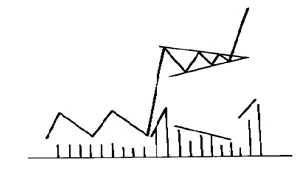
FLAGS & PENNANTS
Flags and Pennants are short-term continuation patterns that show a brief pause in a strong price move before the trend continues in the same direction. These patterns appear after a sharp rise or fall in price with high trading volume.
Flags look like small rectangles that slope against the trend. This pattern looks like a small rectangle that slopes against the main trend. Volume usually decreases during the formation, then picks up again when the price breaks out of the flag.

Pennants have a triangular shape. This pattern looks like a small triangle with converging trend lines and resembles a short symmetrical triangle. Like flags, volume typically decreases during the pattern and increases when the price breaks out.
Both patterns indicate a short break before the price resumes its previous direction, whether up or down.
Rectangle
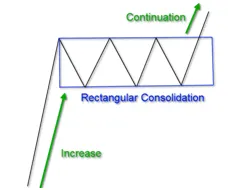
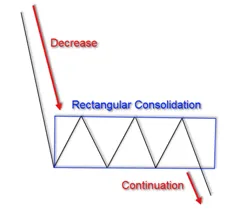
A Rectangle is a continuation pattern that forms when the price moves within a set range during a break in the trend. It looks like a rectangle because the price has two highs and two lows that create parallel lines at the top and bottom.
- Highs and Lows: The price hits similar high points and low points, creating a trading range.
- Other Names: Rectangles are also called trading ranges, consolidation zones, or congestion areas.
This pattern shows that the price is pausing and is likely to continue in the same direction once it breaks out of the range.
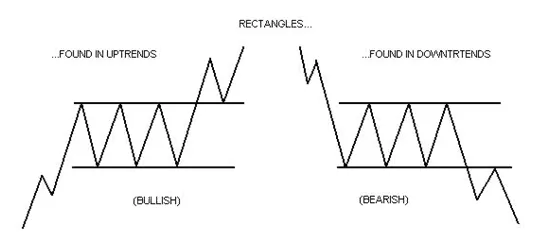
Rectangle Top
Bullish Rectangle Pattern: This is a bullish reversal pattern where the price also moves within a horizontal range, with two horizontal trend lines. When the price breaks above this range, it usually indicates an upward move.
Rectangle Bottom
Bearish Rectangle Pattern: This is a bearish reversal pattern where the price moves within a horizontal range, forming two horizontal trend lines. When the price breaks below this range, it often signals a downward move.
Symmetrical Triangle
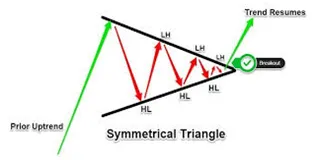
A Symmetrical Triangle pattern forms when two trend lines come together and create a triangle shape.
- Upper Trend Line: Slopes downward, connecting lower highs.
- Lower Trend Line: Slopes upward, connecting higher lows.
- Apex: The point (intersection) where the two trend lines meet.
As the triangle forms, trading volume usually decreases. The pattern indicates that the price could break out in either direction when it reaches the apex.
Ascending Triangle
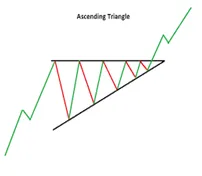
An Ascending Triangle is a bullish pattern that generally forms during an uptrend. It features:
- Horizontal Top Line: A flat line at the top, showing consistent resistance.
- Rising Bottom Line: An upward-sloping line connecting higher lows.
This pattern often signals that the price will keep rising after the triangle forms. It can also appear at the end of a downtrend as a reversal pattern, but it's usually a continuation pattern that shows the price is likely to keep going up.
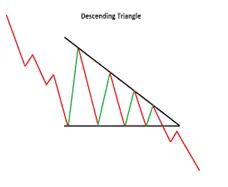
A Descending Triangle is a bearish pattern that usually forms during a downtrend. It has:
- Horizontal Bottom Line: A flat line at the bottom, showing consistent support.
- Downward-Sloping Top Line: A line sloping downwards, connecting lower highs.
This pattern often signals that the price will continue to fall after the triangle forms. It can also appear at the end of an uptrend as a reversal pattern, but it typically indicates the price is likely to keep going down.
Conclusion
Price patterns on charts, whether reversal or continuation, play a vital role in predicting future price movements in the market. Reversal patterns like Double Top, Double Bottom, and Head & Shoulders signal changes in the direction of the current trend, while continuation patterns like Flags, Pennants, and Triangles indicate a brief pause before the trend resumes. Understanding these patterns helps traders make informed decisions about when to enter or exit trades, maximizing potential profits. By analyzing the shape and volume accompanying these patterns, traders can gain insights into market sentiment and anticipate price shifts.
Stay updated with Swastika and learn more about stock market and its terminologies!

Swastika Q1 FY25: Impressive Growth Across All Metrics
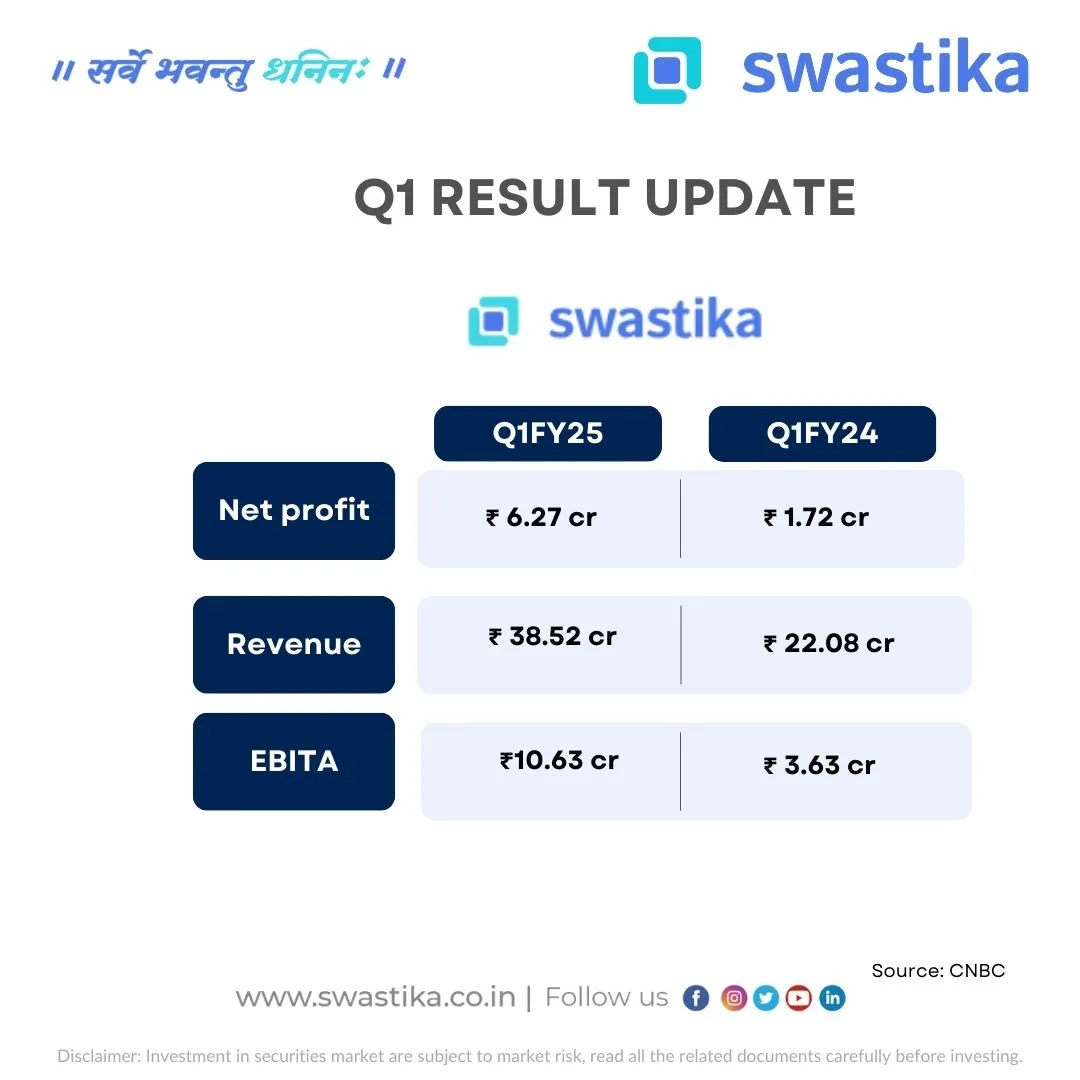
Swastika has reported stellar growth in Q1FY25, with significant improvements in all key financial metrics compared to the same period last year. Here are the highlights:
Key Highlights:
Net Profit: ₹6.27 crore, up from ₹1.72 crore in Q1FY24
Revenue: ₹38.52 crore, a strong increase from ₹22.08 crore
EBITA: ₹10.63 crore, a significant rise from ₹3.63 crore
This impressive performance underscores Swastika's strategic initiatives and strong market position. As we continue to innovate and expand, we remain committed to delivering value to our stakeholders.
Conclusion-
Swastika's Q1FY25 results reflect impressive growth, with substantial increases in net profit, revenue, and EBITA compared to Q1FY24. This performance highlights the effectiveness of the company's strategic initiatives and its strong position in the market. As Swastika continues to innovate and expand, it remains focused on delivering long-term value to its stakeholders, positioning itself for sustained success.
Disclaimer: Investment in the securities market is subject to market risks. Please read all related documents carefully before investing.
Start Trading with Swastika Now!

Indian Oil Corporation Limited Q1 FY25 Financial Performance Highlights
Key Highlights
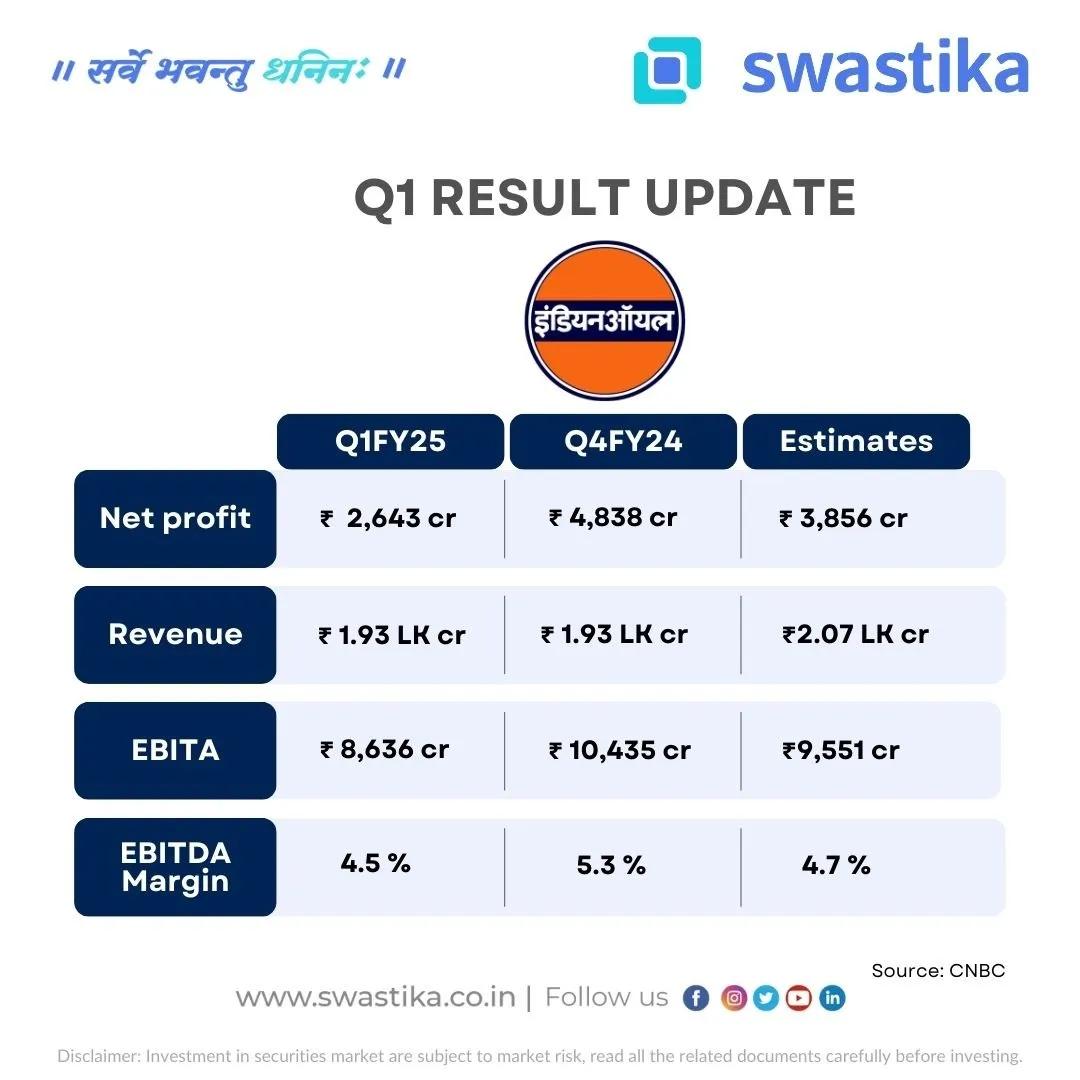
- Net Profit
- Q1 FY25: ₹2,643 crore
- Q4 FY24: ₹4,838 crore
- Estimate: ₹3,856 crore
- Note: The net profit has decreased significantly by ₹2,195 crore compared to Q4 FY24 and is below the estimated profit.
- Revenue:
- Q1 FY25: ₹1.93 lakh crore
- Q4 FY24: ₹1.93 lakh crore
- Estimate: ₹2.07 lakh crore
- Note: Revenue remains consistent with Q4 FY24 but is below the estimated revenue.
- EBITA:
- Q1 FY25: ₹8,636 crore
- Q4 FY24: ₹10,435 crore
- Estimate: ₹9,551 crore
- Note: EBITA has decreased by ₹1,799 crore compared to Q4 FY24 and is also below the estimated EBITA.
- EBITDA Margin:
- Q1 FY25: 4.5%
- Q4 FY24: 5.3%
- Estimate: 4.7%
- Note: The EBITDA margin has declined by 0.8% from Q4 FY24 and is slightly below the estimated margin
Conclusion-
The company’s Q1 FY25 results show a significant decline in net profit, EBITA, and EBITDA margin compared to Q4 FY24, with figures falling below estimates. Although revenue remained consistent with Q4 FY24, it was still lower than the expected amount. The decrease in profitability and margins suggests challenges during the quarter, indicating that the company needs to address these issues to improve its financial performance moving forward.
For more details, visit Swastika's website.
Source: CNBC

Bharat Forge Limited Q1 FY25 Financial Performance Highlights:
- Net Profit:
- Q1 FY25: ₹269.4 crore
- Q1 FY24: ₹315 crore
- Estimate: ₹392 crore
- Note: The net profit has decreased by ₹45.6 crore compared to Q1 FY24 and is below the estimated profit.
- Revenue:
- Q1 FY25: ₹2,338 crore
- Q1 FY24: ₹2,127 crore
- Estimate: ₹2,370 crore
- Note: Revenue has increased by ₹211 crore compared to Q1 FY24 but is slightly below the estimated revenue.
- EBITA:
- Q1 FY25: ₹651 crore
- Q1 FY24: ₹553 crore
- Estimate: ₹650 crore
- Note: EBITA has increased by ₹98 crore compared to Q1 FY24 and meets the estimate.
- EBITDA Margin:
- Q1 FY25: 28%
- Q1 FY24: 26%
- Estimate: 27.6%
- Note: The EBITDA margin has improved by 2% from Q1 FY24 and exceeds the estimated margin
.webp)
For more details, visit Swastika's website.Source: CNBC


.webp)
.webp)

.webp)





START YOUR INVESTMENT JOURNEY
Get personalized advice from our experts
- Dedicated RM Support
- Smooth and Fast Trading App