

The Power of Compounding – Why Starting Early Matters




Introduction
Albert Einstein reportedly called compound interest the "eighth wonder of the world." Whether or not he actually said it, the math is undeniable. Compounding is the process where your investment returns begin earning their own returns — and over time, this snowball effect becomes truly extraordinary.
The catch? Compounding needs one essential ingredient: time.
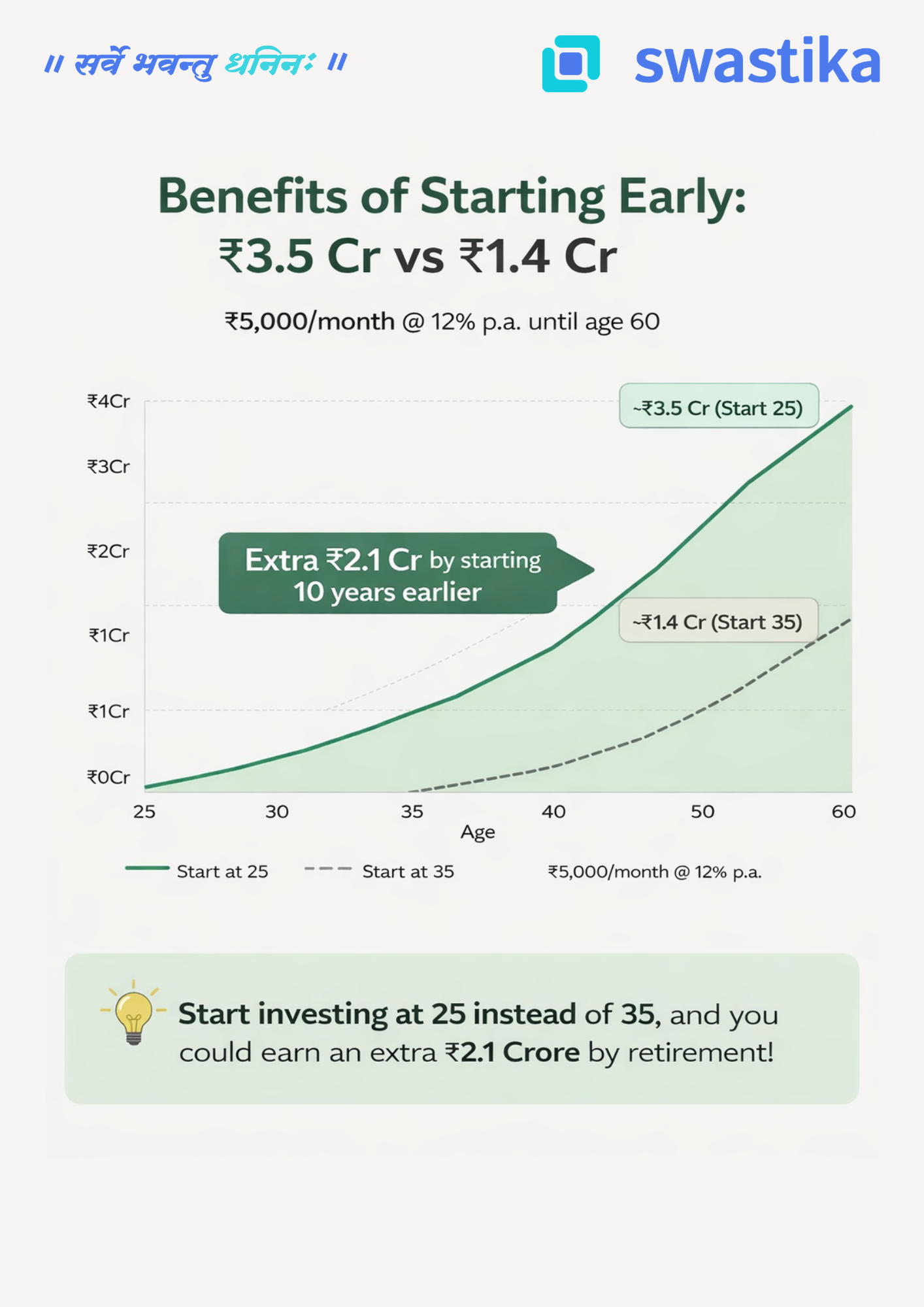
The more years you give your money to grow, the more dramatic — and life-changing — the results become. This is exactly why starting your investment journey early, even with a modest amount, can make a difference of crores by the time you retire.
A Tale of Two Investors: Arjun vs Priya
Let's bring this concept to life with a simple, real-world example.
Meet Arjun and Priya. Both are sensible, disciplined investors. Both invest ₹5,000 every month through a SIP (Systematic Investment Plan) in equity mutual funds, earning an average annual return of 12%. Both stop investing at age 60.
The only difference? Arjun starts at 25. Priya starts at 35.
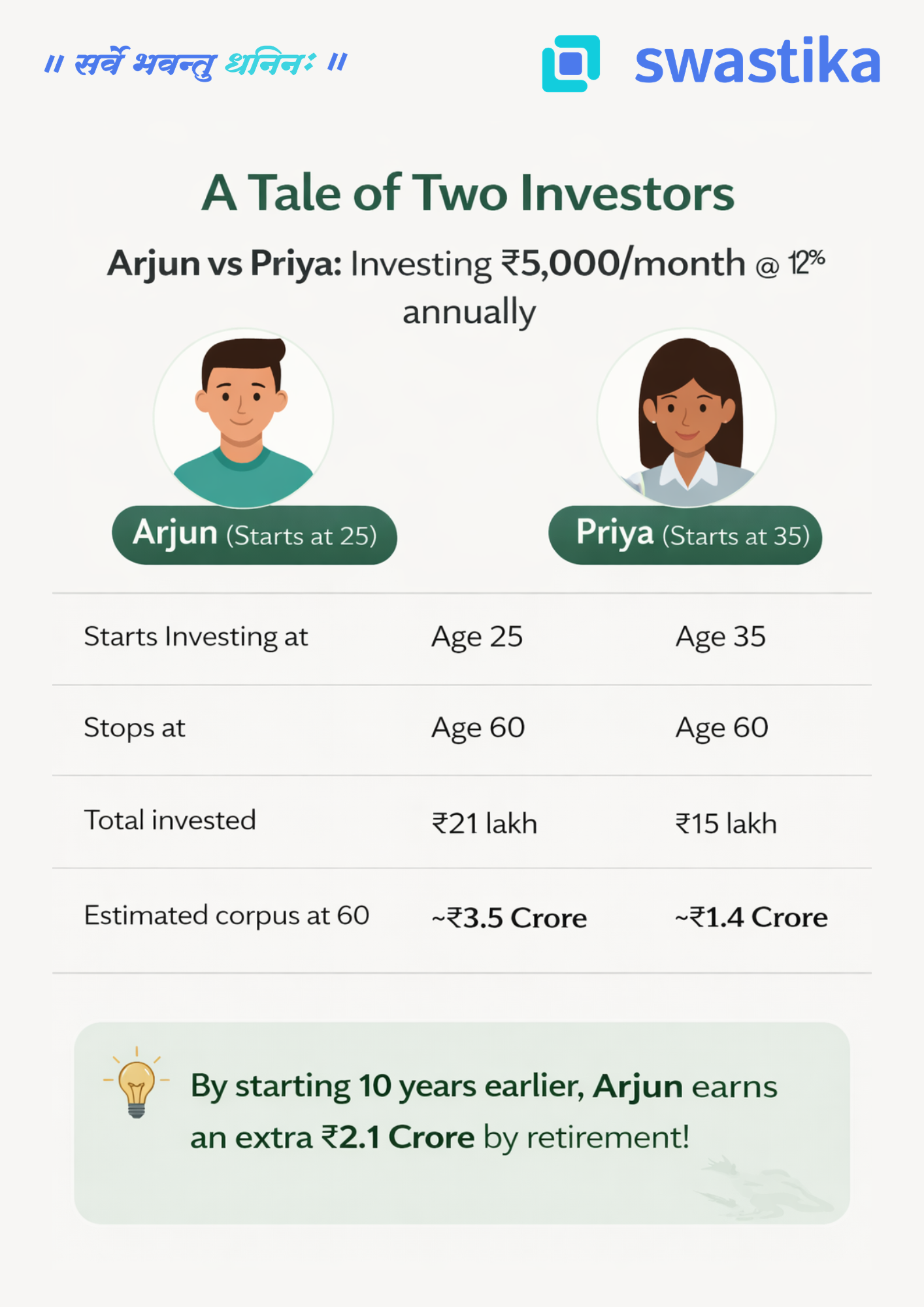
The numbers are striking. Arjun invests just ₹6 lakh more than Priya in absolute terms — yet walks away with ₹2.1 Crore more at retirement.
That extra ₹2.1 Crore didn't come from investing more aggressively or taking bigger risks. It came purely from starting 10 years earlier.
Why Does Time Make Such a Huge Difference?
This is where the magic of compounding reveals itself.
In the early years of investing, growth looks modest and almost unimpressive. But as the years pass, your corpus grows not just on your original investment, but on all the accumulated returns from previous years. The curve goes from almost flat to steeply exponential — and that steep climb happens in the later years.
When Arjun starts at 25, his money has 35 years to ride that exponential curve. Priya's money, starting at 35, only catches the last 25 years — and critically, it misses the steepest part of the climb in the final decade.
Think of it this way: the last 10 years of compounding are worth more than the first 20. That is the counterintuitive truth at the heart of long-term investing.
The Real Cost of Waiting
Many young earners tell themselves, "I'll start investing once I'm more settled — once the salary improves, once the EMI is paid off, once life is a bit easier."
But the numbers show that every year of delay is extraordinarily expensive — far more expensive than any EMI or lifestyle expense. Priya didn't invest carelessly. She invested faithfully for 25 years. Yet she ends up with less than half of what Arjun accumulated — not because she did anything wrong, but simply because she started a decade late.
The cost of waiting 10 years wasn't ₹6 lakh in additional contributions. The cost was ₹2.1 Crore in lost wealth.
Three Principles to Remember
1. Start now, not later.The best time to start investing was yesterday. The second best time is today. Even a SIP of ₹1,000–₹2,000 per month in your 20s is infinitely better than waiting for the "right time."
2. Consistency beats intensity.You don't need to invest large sums all at once. A small, steady, monthly commitment — maintained without interruption — is what unlocks the full power of compounding over decades.
3. Stay invested through market cycles.Compounding works only if you let it work. Exiting during market corrections or stopping your SIP in tough months breaks the chain. Time in the market, not timing the market, is what builds wealth.
The Bottom Line
If you are in your 20s or early 30s, you hold an asset that no amount of money can buy later: time. Use it. Start a SIP today — even a small one. Let compounding do its slow, steady, powerful work.
Because the difference between starting at 25 and starting at 35 is not just 10 years. As Arjun and Priya's story shows, that difference is ₹2.1 Crore.
Big Budget










.webp)
.webp)
.webp)
.webp)
.webp)














.webp)
.webp)
.webp)
.webp)
Latest Articles

Understanding In-The-Money (ITM) Options


In a call option, you have the right, but not the obligation, to buy a stock for a set price (strike price) by a certain date (expiry date). There are different types of call options, and today we'll focus on In-the-Money (ITM) call options. Let's break it down:
- Call Option: You're basically hoping the stock price will go up so you can buy it cheap and then sell it for a profit.
- In-the-Money (ITM): This means the stock's current price is higher than the strike price of your call option.
Example:
Let's say the current price (spot price) of a stock is ₹8,300
- You buy a call option with a strike price of ₹8,200 (your agreed upon this purchase price)
- Since the stock price (₹8,300) is higher than your strike price (₹8,200), your call option is In-the-Money (ITM).
Options can be categorized as:
- In-The-Money (ITM)
- At-The-Money (ATM)
- Out-Of-The-Money (OTM)
These terms help investors decide which options to buy or sell.
- Intrinsic Value: This is the actual value of an option if you used it today. It’s the difference between the current stock price and the strike price.
ITM Options
- Call Option: ITM if the strike price is lower than the current stock price.
Example: Current stock price is ₹1000, and the call option strike price is ₹900. This option is ITM because ₹1000 (current price) - ₹900 (strike price) = ₹100.
- Put Option: ITM if the strike price is higher than the current stock price.
Example: Current stock price is ₹1000, and the put option strike price is ₹1100. This option is ITM because ₹1100 (strike price) - ₹1000 (current price) = ₹100.
Option Premium Components
The price you pay for an option (option premium) has two parts:
- Intrinsic Value
- Time Value
Formula: Option Premium=Intrinsic Value+Time ValueOption Premium=Intrinsic Value+Time Value
Characteristics of ITM, ATM, and OTM Options
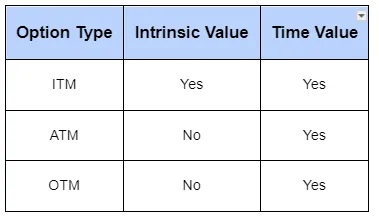
- Intrinsic Value: The real value of an ITM option. It’s the difference between the stock price and the strike price.
- Time Value: The extra amount you pay because the option might become more valuable before it expires. This value decreases as the expiration date gets closer.
Let’s take another example to understand an ITM Call Option:
An ITM call option has a strike price lower than the current stock price.
Example:
- Current Price: ₹8300
- ITM Call Option: Any strike price below ₹8300
- Example Option: NIFTY FEB 8200 CALL (Strike Price = ₹8200, Current Price = ₹8300)
Benefits of ITM Call Options
- Lower Risk: ITM options are less likely to expire worthless because the stock price is already in your favor.
- Good Balance of Leverage and Risk: You can get good returns with a smaller investment compared to buying the stock itself.
- Less Volatile: ITM options are less affected by sudden market changes compared to other options.
Things to Consider with ITM Call Options
- Higher Cost: ITM options cost more because they already have some built-in profit potential.
- Lower Leverage: Higher cost means you have less money left for other investments.
- Time Decay: As the option gets closer to its expiration date, its value decreases faster.
- Limited Profit: Your profit is capped at the strike price plus the premium you paid.
Who Should Use ITM Call Options?
- Investors who are bullish (optimistic) on a stock's price and want to profit from an increase.
- Investors seeking to hedge (protect) their existing stock holdings.
- Investors looking for a balanced approach with some level of built-in profit potential and lower risk.
Conclusion
ITM call options can be a powerful tool, but it's important to understand the costs, risks, and limitations before using them. Carefully consider your investment goals and risk tolerance before diving in.

What is a Circuit Breaker?
A circuit breaker in the stock market is a mechanism that sets a price band within which a stock can be traded on a given day. Circuit breakers operate automatically by halting trading when global exchange values reach predetermined levels. This band includes a lower limit (lower circuit) and an upper limit (upper circuit).
Why is a Circuit Breaker Needed?
Stock prices often fluctuate due to market sentiments, influenced by positive or negative news. Circuit breakers are set up to prevent extreme price movements, protecting investors from sudden, unexpected changes. They also help reduce price manipulation to some extent.
The Securities and Exchange Board of India (SEBI) has defined various circuit levels: 2%, 5%, 10%, and 20%. These levels are based on the stock's closing price from the previous day.
Example:
If XYZ stock closed at ₹100 yesterday and has a 10% circuit limit, today it can only be traded between ₹90 (lower limit) and ₹110 (upper limit). If the stock reaches either limit, trading is halted.
How Circuit Breakers Work
In the trade world, a circuit breaker serves the same purpose as it does in residential electrical circuits. It engages and cuts the circuit when it senses an overload. Circuit breakers are emergency safeguards in the trading industry put in place by stock markets to temporarily or permanently halt trading activity when market prices decline drastically.
Individual Stocks:
If the price hits the upper or lower limit, trading in that particular stock is halted.
Market Indices:
A 10%, 15%, or 20% change triggers a market-wide halt.
Upper and Lower Circuit Limits
The limits prevent excessive speculation and volatility. Depending on the stock category, a stock can shift by 5%, 10%, or a maximum of 20% during a trading day.
Example of Upper Circuit and Lower Circuit
Let's say XYZ stock closed at ₹100 yesterday. If it has a 10% circuit limit:
- Upper Circuit: The upper limit would be ₹110 (10% above ₹100). If the stock price reaches ₹110, trading is halted because it has hit the upper circuit. This indicates strong buying interest, and the price can't go higher for the rest of the day.
- Lower Circuit: The lower limit would be ₹90 (10% below ₹100). If the stock price drops to ₹90, trading is halted because it has hit the lower circuit. This indicates strong selling pressure, and the price can't go lower for the rest of the day.
Market-Wide Circuit Breakers
Time-Based Rules:
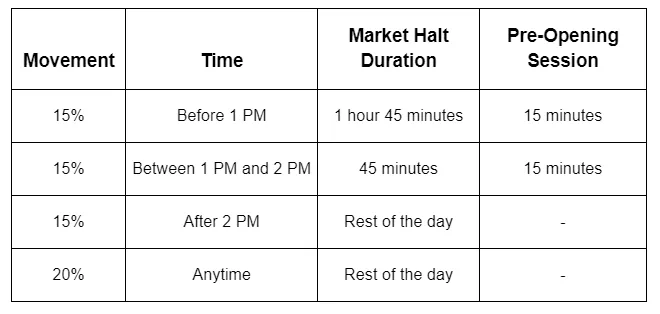
- Before 1 PM: A 15% movement halts the market for 1 hour and 45 minutes, followed by a 15-minute pre-opening session.
- Between 1 PM and 2 PM: A 15% movement halts the market for 45 minutes, followed by a 15-minute pre-opening session.
- After 2 PM: A 15% movement halts the market for the rest of the day.
- At Any Time: A 20% movement halts the market for the entire day.
Summary Table of Circuit Breaker Durations
Conclusion
Circuit breakers play a important role in stabilizing the stock market by preventing excessive volatility and protecting investors from sudden, significant price changes.

Understanding Market Capitalization: Meaning, Importance
Ever wondered how much a company is "worth"? The answer lies in a key metric: Market Capitalization. In the stock market, it shows a company's total value based on its current share price and the number of shares available for trading. Instead of looking at revenue or total asset worth, investors use this number to assess a company's size. The market capitalization of a takeover candidate aids in evaluating whether the acquirer will receive a decent deal from the deal.
Formula:
Market Cap = Current Share Price * Total Outstanding Shares
So, if Company W share price is Rs. 200 and there are 5 crore outstanding shares, its Market Cap would be Rs. 1,000 crore (200 * 5 crore).
Why does it matters?
It gives you a snapshot of where a company stands:
- Growth Potential: A smaller company might be newer and have more room to grow, making it an attractive option for growth investors.
- Stability: Larger companies are more stable and less affected by market fluctuations. They often have more financial reserves to cover losses and recover from downturns.
- Risk and Volatility: Small-cap companies can offer high growth potential but come with higher risk and volatility. Large-cap companies are generally more stable but may grow more slowly.
Using Market Capitalization to Diversify Your Portfolio
Diversification is about spreading your investments to manage risk:
- Across Asset Classes: For example, investing in both stocks and bonds.
- Within Asset Classes: Investing in a mix of small-cap, mid-cap, and large-cap stocks to balance potential risks and returns.
Types of Companies
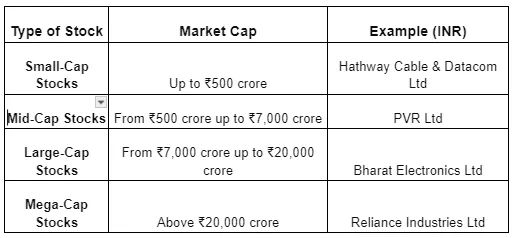
Companies are categorized into different types based on their market capitalization. This helps investors balance their portfolios to minimize risk.
Categories
Small-Cap Stocks
- Market Cap: Up to ₹500 crore.
- Growth Potential: Small-cap companies are often in their early stages and have growth potential. However, they are also more risky.
- High Risk, High Reward: These companies can offer high returns during favorable economic conditions but are more affected by market fluctuations and economic downturns.
- Examples: Hathway Cable & Datacom Ltd.
Mid-Cap Stocks
- Market Cap: From ₹500 crore up to ₹7,000 crore.
- Balanced Growth: Mid-cap companies have a balance between growth potential and stability. They are more established than small-cap companies but still have space for growth.
- Moderate Risk: These companies are less risky than small-caps but more volatile than large-caps. They can provide returns with moderate risk.
- Examples: PVR Ltd.
Large-Cap Stocks
- Market Cap: From ₹7,000 crore up to ₹20,000 crore.
- Stability: Large-cap companies are well-established and financially sound. They are market leaders with a proven track record.
- Lower Risk, Steady Returns: These companies offer more stability and are less likely to experience volatility. They are suitable for conservative investors seeking steady returns.
- Examples: Bharat Electronics Ltd.
Mega-Cap Stocks
- Market Cap: Above ₹20,000 crore.
- Market Dominance: Mega-cap companies are the largest and dominant in their industries. They are often multinational corporations with influence on the market.
- Very Low Risk: These companies provide the highest level of stability and are considered safe investments. While the growth potential might be lower, they offer reliable returns and are ideal for risk-avoid investors.
- Examples: Reliance Industries Ltd.
Conclusion
Market capitalization is an important factor in evaluating stocks and mutual funds. It helps investors take decisions based on their risk tolerance and return expectations. However, while it is a valuable indicator of a company’s financial health, investors should not rely solely on it. A thorough analysis of the company’s overall performance and market conditions is essential before making investment decisions.

How Do Election Results Impact the Indian Stock Market?
Elections are crucial events in any democracy, and India is no exception. The outcomes of elections can have significant impacts on the stock market. This blog explores how election results influence the Indian stock market and what the potential impacts of Prime Minister Narendra Modi’s third term could be.
Political Factors Affecting the Stock Market
Market Sentiment and Stability:
- Market Sentiment: Elections often bring a sense of uncertainty. Investors generally prefer stability, and election outcomes can either boost or reduce their confidence. If the results are in favor of a party or leader perceived to be business-friendly and stable, the market reacts positively.
- Policy Predictability: Stable governments are often able to implement policies more predictably. Investors like predictability as it reduces the risks associated with sudden policy changes.
Economic Policies:
- Pro-Growth Policies: If the elected government has a track record or a plan focusing on economic growth, infrastructure development, and business-friendly regulations, the stock market usually reacts positively.
- Reform Initiatives: Governments promising and delivering structural reforms (like tax reforms, deregulation, and infrastructure spending) can boost investor confidence and drive market rallies.
Fiscal Management:
- Budget and Spending: Election outcomes can impact fiscal policies. Governments that promise sensible fiscal management and reduced deficits tend to be favored by the markets.
- Spending Programs: Conversely, if a new government is expected to increase public spending significantly without a clear plan for managing the budget, it may cause concern among investors about inflation and fiscal health, potentially leading to market volatility.
Global Perception:
- Foreign Investments: Global investors closely watch Indian elections. A government perceived as stable and reform-oriented can attract more Foreign Direct Investment (FDI) and Foreign Institutional Investment (FII), positively influencing the stock market.
- Geopolitical Stability: Election results that contribute to regional stability or enhance diplomatic relations can positively impact the stock market.
Narendra Modi’s Potential Third Term and Its Impact
Prime Minister Narendra Modi, known for his strong leadership and decisive economic policies, could significantly impact the stock market if he secures a third term. Here’s how:
Continuation of Economic Reforms:
Modi’s government has been known for several landmark economic reforms such as the Goods and Services Tax (GST), Insolvency and Bankruptcy Code (IBC), and digitalization initiatives. A third term could mean the continuation and deepening of these reforms, providing a stable and predictable policy environment that is likely to be welcomed by investors.
Infrastructure and Development Projects:
Modi’s focus on infrastructure development, including projects like smart cities, improved transportation networks, and digital infrastructure, could continue. These initiatives can stimulate economic growth, create jobs, and increase demand in various sectors, positively influencing the stock market.
Foreign Investment and Economic Relations:
Under Modi’s leadership, India has improved its ease of doing business rankings and attracted significant foreign investments. A third term could further strengthen India’s global economic relations, encouraging more foreign investments and boosting market confidence.
Political Stability:
A third term for Modi could imply political stability, which is generally favorable for the stock market. Stability reduces uncertainty and helps in long-term planning for both domestic and foreign investors.
Focus on Technology and Innovation:
Modi’s government has also emphasized technology and innovation through initiatives like Digital India and Make in India. Continued focus in these areas could foster a more robust tech ecosystem, providing growth opportunities for tech stocks and start-ups.
Potential Risks:
Implementation Risks: While Modi’s policies are generally market-friendly, the actual implementation of large-scale reforms can sometimes face hurdles, leading to temporary market fluctuations.
Global Economic Conditions: The global economic environment can also impact the effectiveness of Modi’s policies. Trade wars, global slowdowns, or geopolitical tensions can affect market performance regardless of domestic policies.
Conclusion
Election results have a deep impact on the Indian stock market, primarily due to changes in market sentiment, policy direction, and fiscal management. A potential third term for Prime Minister Narendra Modi is expected to bring continued economic reforms, infrastructure development, and political stability, all of which are likely to positively influence the stock market. However, investors should remain mindful of implementation challenges and global economic conditions that can also affect market dynamics. As always, a balanced and insightful approach to investing is crucial in navigating the impacts of election results on the stock market.
Learn more about stock market with Swastika!

What is Prospectus?
A prospectus is a formal document that gives information about an investment offering to the public and is required by the Securities and Exchange Commission (SEC) to be filed. Bonds, mutual funds, and stock offers need the filing of a prospectus. Because it includes a wealth of pertinent information about the investment or security, the prospectus can assist investors in making better-informed investing decisions.
- Preliminary Prospectus
This is the initial offering document provided by the company. It contains most details about the business and the transaction. However, it doesn't include the number of shares or the price.
- Final Prospectus
This document provides all the details of the investment offering to the public. It includes background information, the number of shares or certificates to be issued, and the offering price.
Prospectus Example
In mutual funds, the prospectus covers objectives, investment strategies, risks, and performance, fees, and fund management details.
Requirements for Issuing a Prospectus
To issue a prospectus, a company must:
- File it with local regulatory bodies like SEBI and stock exchanges.
- It must be dated and signed.
- Include all necessary information outlined in the Companies Act 2013.
- Avoid providing misleading information.
Why Read a Prospectus? Here's Why It Matters:
An SEC-mandated prospectus gives investors crucial information regarding an offering of securities.
It disseminates risk information to the public and compiles important details about the investment and the business being invested in.
Investors should take into account the type and degree of risk involved, which is why those facts are usually included early in the prospectus and in more depth later on.
Investors want to know that the firm they are investing in is financially stable enough to fulfill its obligations, therefore the financial standing of the business is also crucial.
Types of Prospectuses
- Red Herring Prospectus: Filed with the registrar before offering shares. Usually lacks details like quantity or price.
- Abridged Prospectus: A brief summary with essential offer details. Must include all documents needed for purchasing the security.
- Deemed Prospectus: Considered deemed if it details the company’s investment offer to the public.
- Shelf Prospectus: Distributed by banks or financial institutions, containing details of multiple investment types.
Details Included in a Prospectus
A prospectus contains the following details:
- Company Information: Name, registered office address, objectives, and background.
- Offer Details: Number of shares or certificates to be issued, offering price, and any minimum subscription amount.
- Financial Information: Audited financial reports, including profit and loss statements, balance sheets, and cash flow statements.
- Management Details: Information about the company's directors, management team, and key personnel.
- Risk Factors: An overview of the risks associated with the investment, including market risks, regulatory risks, and operational risks.
- Legal and Regulatory Information: Details of any legal proceedings, regulatory compliance, and agreements relevant to the offering.
- Use of Proceeds: How the funds raised from the offering will be used by the company.
- Fees and Expenses: Details of any fees, expenses, or charges associated with the investment, including management fees and transaction costs.
- Offering Structure: Any special terms or conditions of the offering, such as underwriting arrangements or distribution channels.
- Other Relevant Information: Any additional information deemed relevant to investors, such as industry trends, competitive landscape, and future growth prospects.
Conclusion
By reading the prospectus carefully, you can:
- Compare different investment options.
- Spot any potential risks.
- See if the investment aligns with your goals and risk tolerance

What is a Covered Call? Overview of a Covered Call Strategy
As an investor, navigating the stock market can often involve balancing potential profits with risks. One strategy that stands out for its is the Covered Call Strategy. This approach allows you to generate income from your stock holdings Let's dive into what a covered call is and how this strategy can benefit you as an investor.
Understanding a Covered Call Strategy
Imagine you own shares of a company. You believe the stock may rise in the long run but don't expect gains in the near term. However, you still want to earn some income from these shares in the meantime. This is where a covered call strategy comes in
In a covered call strategy, an investor sells a call option on a stock they already own. This nets them a premium from the sale of the option. the call option is sold as an Out of The Money (OTM) call, meaning the option's strike price is higher than the current stock price. The call option would not get exercised unless the stock price increases above the strike price. Until then, the investor retains the premium as income, making this strategy attractive for those who are neutral to moderately bullish about their stock.
How a Covered Call Strategy Works
To use a covered call option strategy, you must first own the stock of a company. Let's assume you already hold the stock, showing a bullish movement. Over time, you become unsure about the stock's short-term upside potential and don't expect a significant price increase. Here's what you can do:
- Sell a Call Option: You sell a call option contract at a strike price higher than your stock's purchase price. The buyer of the call option pays you a premium for this contract.
- Collect the Premium: Regardless of whether the option is exercised, you keep the premium. This becomes your immediate income from the stock.
- Outcome Scenarios: After executing a covered call strategy, one of three scenarios can occur:some text
- Stock Price Remains Stable or Falls: The call option expires worthless, and you keep both the premium and your shares.
- Stock Price Rises Slightly: The stock price increases but remains below the strike price. The call option still expires worthless, allowing you to keep the premium and benefit from the stock's appreciation.
- Stock Price Rises Significantly: The stock price rises above the strike price. The call option is exercised, and you must sell your shares at the strike price. You keep the premium and receive the strike price for your shares, potentially missing out on further gains beyond the strike price.
When to Use a Covered Call
The covered call strategy works particularly well in the following situations:
Generating Income
The primary use of the covered call strategy is to generate income. If you own assets like stocks or ETFs that you're willing to sell at a certain price, selling a covered call can help generate additional income.
Neutral or Slightly Bullish Market
The covered call strategy is effective in a neutral or slightly bullish market. If you expect the price of an asset to remain relatively stable or increase slightly, selling a covered call can allow you to generate income while still owning the asset and benefiting from modest price increases.
Reducing Risk/Hedging
By selling a call option, you can theoretically limit downside risk if the price of the underlying stock falls. If the stock price drops below the strike price of the call option, the option will expire worthless, and you'll still own the underlying stock, which you can sell or hold for potential future gains.
When to Avoid a Covered Call
A covered call should be avoided in the following situations:
Expecting a Stock Price Rise
If you expect the stock to rise significantly in the near future, selling a covered call may limit your potential upside. It's better to hold onto the stock and let it appreciate.
Facing Serious Downside
If the stock looks like it's going to drop significantly, using a covered call to get extra cash might not be wise. In such cases, it’s probably best to sell the stock or consider short selling to profit from its decline.
Advantages of a Covered Call Strategy
- Generates Income: Covered calls generate income from holdings that wouldn't otherwise provide a cash flow stream.
- Adds to Returns: Investors periodically sell covered call options to enhance a position's return.
- Acts as a Hedge: A covered call offers some protection by reducing the breakeven price due to the premium.
- Low-Risk Strategy: Selling covered calls is easy and low-risk because the stock position "covers" the short call.
Conclusion
In summary, covered calls can be a strategy for investors looking for risk management and income generation. By merging stock ownership with the sale of call options, investors can increase their potential returns in a moderate appreciation of stock price. This strategy provides a balance between earning additional income and managing risks, making it a valuable tool for an investor.
Learn more about financial terminologies with Swastika!


.webp)
.webp)

.webp)






START YOUR INVESTMENT JOURNEY
Get personalized advice from our experts
- Dedicated RM Support
- Smooth and Fast Trading App
