

The Power of Compounding – Why Starting Early Matters




Introduction
Albert Einstein reportedly called compound interest the "eighth wonder of the world." Whether or not he actually said it, the math is undeniable. Compounding is the process where your investment returns begin earning their own returns — and over time, this snowball effect becomes truly extraordinary.
The catch? Compounding needs one essential ingredient: time.
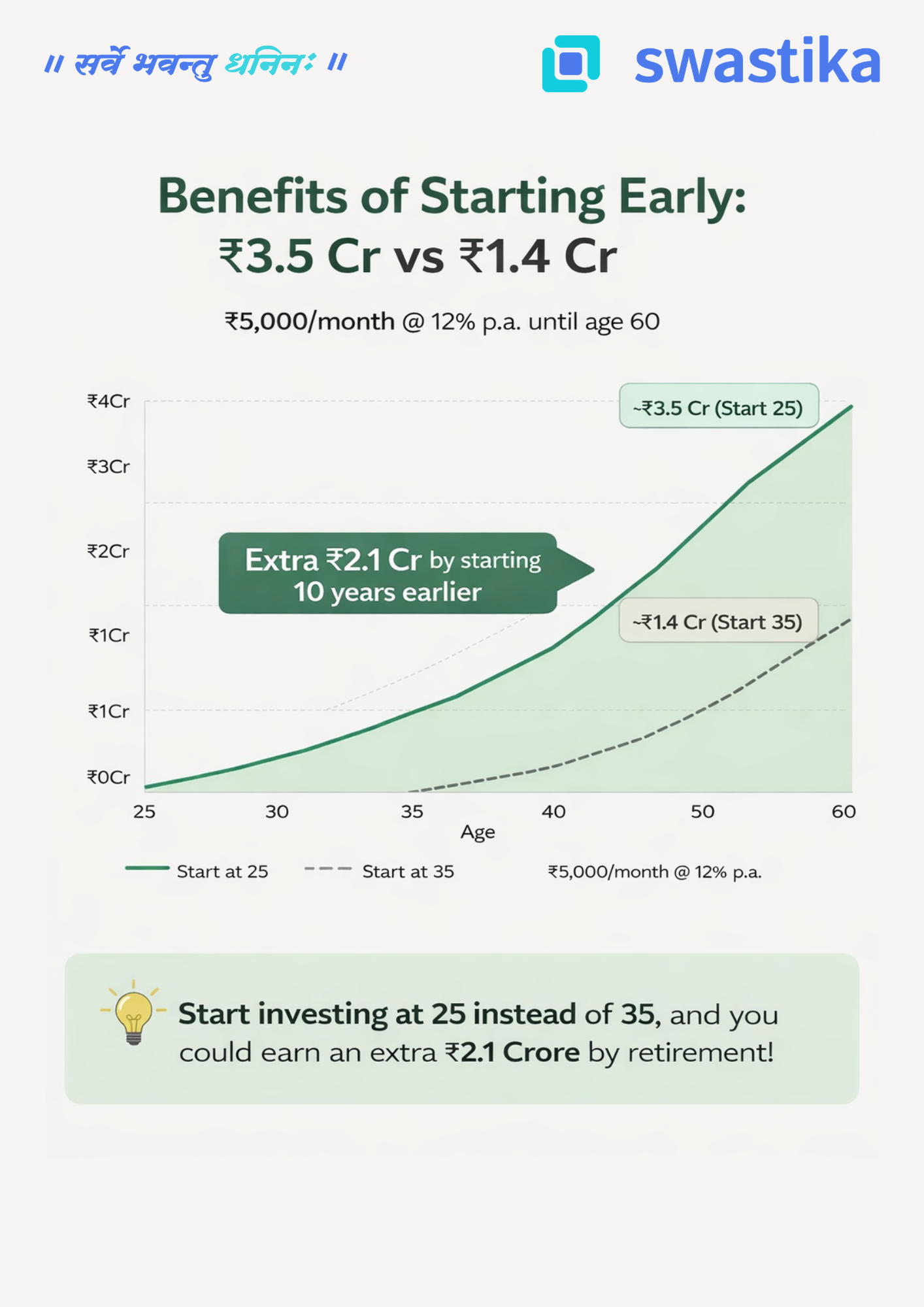
The more years you give your money to grow, the more dramatic — and life-changing — the results become. This is exactly why starting your investment journey early, even with a modest amount, can make a difference of crores by the time you retire.
A Tale of Two Investors: Arjun vs Priya
Let's bring this concept to life with a simple, real-world example.
Meet Arjun and Priya. Both are sensible, disciplined investors. Both invest ₹5,000 every month through a SIP (Systematic Investment Plan) in equity mutual funds, earning an average annual return of 12%. Both stop investing at age 60.
The only difference? Arjun starts at 25. Priya starts at 35.
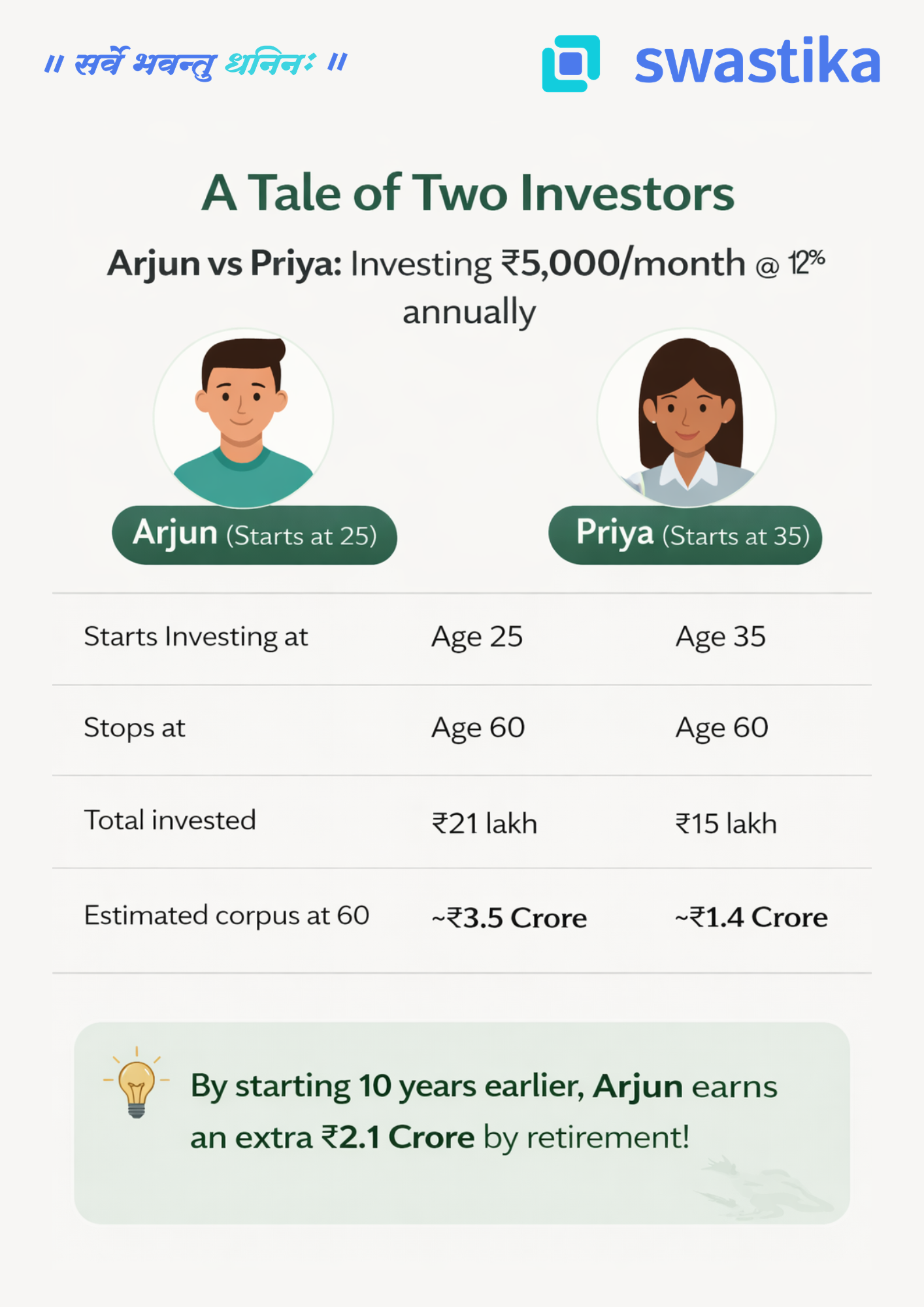
The numbers are striking. Arjun invests just ₹6 lakh more than Priya in absolute terms — yet walks away with ₹2.1 Crore more at retirement.
That extra ₹2.1 Crore didn't come from investing more aggressively or taking bigger risks. It came purely from starting 10 years earlier.
Why Does Time Make Such a Huge Difference?
This is where the magic of compounding reveals itself.
In the early years of investing, growth looks modest and almost unimpressive. But as the years pass, your corpus grows not just on your original investment, but on all the accumulated returns from previous years. The curve goes from almost flat to steeply exponential — and that steep climb happens in the later years.
When Arjun starts at 25, his money has 35 years to ride that exponential curve. Priya's money, starting at 35, only catches the last 25 years — and critically, it misses the steepest part of the climb in the final decade.
Think of it this way: the last 10 years of compounding are worth more than the first 20. That is the counterintuitive truth at the heart of long-term investing.
The Real Cost of Waiting
Many young earners tell themselves, "I'll start investing once I'm more settled — once the salary improves, once the EMI is paid off, once life is a bit easier."
But the numbers show that every year of delay is extraordinarily expensive — far more expensive than any EMI or lifestyle expense. Priya didn't invest carelessly. She invested faithfully for 25 years. Yet she ends up with less than half of what Arjun accumulated — not because she did anything wrong, but simply because she started a decade late.
The cost of waiting 10 years wasn't ₹6 lakh in additional contributions. The cost was ₹2.1 Crore in lost wealth.
Three Principles to Remember
1. Start now, not later.The best time to start investing was yesterday. The second best time is today. Even a SIP of ₹1,000–₹2,000 per month in your 20s is infinitely better than waiting for the "right time."
2. Consistency beats intensity.You don't need to invest large sums all at once. A small, steady, monthly commitment — maintained without interruption — is what unlocks the full power of compounding over decades.
3. Stay invested through market cycles.Compounding works only if you let it work. Exiting during market corrections or stopping your SIP in tough months breaks the chain. Time in the market, not timing the market, is what builds wealth.
The Bottom Line
If you are in your 20s or early 30s, you hold an asset that no amount of money can buy later: time. Use it. Start a SIP today — even a small one. Let compounding do its slow, steady, powerful work.
Because the difference between starting at 25 and starting at 35 is not just 10 years. As Arjun and Priya's story shows, that difference is ₹2.1 Crore.
Big Budget










.webp)
.webp)
.webp)
.webp)
.webp)












.webp)
.webp)
.webp)
.webp)
Latest Articles

Forex Trading Signals: How to Use Them Effectively


In the fast-paced world of forex trading, information is key. Forex trading signals are like road signs guiding you through the twists and turns of the currency markets. But how do you use them effectively to navigate this financial landscape? Let’s dive in and explore how you can harness the power of forex trading signals to enhance your trading strategy.
Understanding Forex Trading Signals
Forex trading signals are essentially indicators or alerts that suggest potential trading opportunities based on market analysis. These signals can come from various sources, including professional analysts, algo trading platforms, or even your own analysis.
Types of Forex Trading Signals
Technical Signals: These signals are generated from technical analysis of price charts, such as moving averages, MACD (Moving Average Convergence Divergence), RSI (Relative Strength Index), and chart patterns like triangles or head and shoulders.
Fundamental Signals: These signals stem from fundamental analysis of economic indicators, news events, and geopolitical developments that may impact currency prices.
Sentiment Signals: Sentiment indicators gauge market sentiment or the collective mood of traders, often through tools like the COT (Commitments of Traders) report or sentiment surveys.
Tips for Using Forex Trading Signals Effectively
Choose Reliable Sources: Ensure you subscribe to reputable signal providers or platforms known for their accuracy and transparency.
Understand the Signal: Take the time to comprehend why a particular signal is being generated. Knowing the rationale behind it can help you make more informed trading decisions.
Validate with Your Analysis: Don't blindly follow signals. Use them as a supplementary tool alongside your own analysis to confirm potential trading opportunities.
Risk Management: Set clear risk management parameters, including stop-loss and take-profit levels, based on the signal's recommendation and your risk tolerance.
Backtesting: Test the reliability of signals by reviewing historical data. This can help you gauge their effectiveness over time and in various market conditions.
Stay Disciplined: Stick to your trading plan and avoid emotional reactions to signals, especially during periods of market volatility.
Diversify Signals: Consider using a combination of different types of signals to gain a more comprehensive view of the market and reduce reliance on any single source.
Forex trading signals can be valuable tools for traders, providing insights and potential trading opportunities in the dynamic currency markets. However, it's essential to use them judiciously and in conjunction with your own analysis and risk management practices.
By understanding the different types of signals, validating their reliability, and staying disciplined in your approach, you can use forex trading signals effectively to enhance your trading strategy and strive for success in the forex market.

The Impact of Economic Factors on Mutual Fund Performance
Mutual funds are popular investment vehicles where individuals pool their money to invest in a diversified portfolio of stocks, bonds, or other securities. The performance of mutual funds can be influenced by various economic factors. Let's delve into how these factors can impact mutual fund performance and what investors should consider.
Economic Factors That Affect Mutual Fund Performance:
Interest Rates:
Interest rates set by central banks have a significant impact on mutual funds, especially bond funds. When interest rates rise, bond prices fall, leading to lower returns for bond mutual funds. Conversely, falling interest rates can boost bond prices and increase returns for bond funds.
Inflation:
Inflation erodes the purchasing power of money over time. Mutual funds need to generate returns that outpace inflation to maintain investors' real purchasing power. Funds investing in inflation-protected securities or assets like real estate investment trusts (REITs) may perform better during inflationary periods.
Economic Growth:
Economic growth affects the performance of mutual funds, especially equity funds. During periods of robust economic growth, stock prices tend to rise, benefiting equity mutual funds. Conversely, economic downturns can lead to lower corporate profits and stock market declines, impacting equity fund returns negatively.
Currency Exchange Rates:
Mutual funds investing in international markets are susceptible to currency exchange rate fluctuations. Strengthening of the domestic currency relative to foreign currencies can reduce returns from international investments, while a weakening domestic currency can enhance returns.
Market Sentiment:
Investor sentiment and market psychology play a crucial role in mutual fund performance. Positive sentiment can drive stock prices higher, benefiting equity funds, while negative sentiment can lead to market declines, affecting fund returns adversely.
Government Policies:
Government policies, including tax laws and regulatory changes, can impact mutual fund performance. Changes in tax rates on capital gains or dividends can affect after-tax returns for investors. Regulatory changes may also influence the investment strategies and operations of mutual funds.
Global Events:
Global events such as geopolitical tensions, natural disasters, or pandemics can have widespread impacts on financial markets and mutual fund performance. These events can increase market volatility and uncertainty, affecting fund returns across various asset classes.
How Investors Can Navigate Economic Factors:
Diversification:
Diversifying across asset classes, sectors, and geographic regions can help mitigate the impact of economic factors on mutual fund performance. By spreading investments, investors can reduce exposure to any single economic event or factor.
Monitoring Economic Indicators:
Keeping track of key economic indicators such as GDP growth, inflation rates, unemployment data, and central bank policies can provide insights into the prevailing economic conditions and potential impacts on mutual funds.
Asset Allocation:
Adjusting asset allocation based on economic outlook and risk tolerance can help investors position their portfolios to better withstand economic fluctuations. Allocating assets to different types of mutual funds based on their correlation with economic factors can enhance portfolio resilience.
Professional Advice:
Seeking advice from financial advisors or fund managers can provide personalized guidance on navigating economic factors and selecting suitable mutual funds. Professional expertise can help investors make informed decisions aligned with their financial goals.
Economic factors exert a significant influence on mutual fund performance, impacting returns across various asset classes. By understanding these factors and implementing prudent investment strategies, investors can navigate economic fluctuations and build resilient portfolios. Diversification, monitoring economic indicators, strategic asset allocation, and seeking professional advice are essential elements for effectively managing mutual fund investments in dynamic economic environments.
.webp)
ब्याज़ दर कटौती के संकेतो से बढ़ी सोने की चमक
सुस्त अमेरिकी आर्थिक आंकड़ों और फेडरल रिजर्व के अध्यक्ष जेरोम पॉवेल के मुद्रास्फीति कम होने सम्भावना पर आने वाले महीनों में संभावित दर में कटौती के संकेतों के कारण पिछले सप्ताह को सोने की कीमतें रिकॉर्ड ऊंचाई पर पहुंच गईं, जो कीमतों में लगातार तीन सप्ताह की बढ़ोतरी है। सोने ने अपनी रिकॉर्ड-तोड़ रैली जारी रखी हुई है, जो 2165 डॉलर प्रति औंस के सर्वकालिक उच्च स्तर पर पहुंच गई है। अमेरिकी आंकड़ों में मामूली कमजोरी ने सोने में तेजी का कारण बना दिया, फिर भी उतार-चढ़ाव का परिमाण असमान रूप से बड़ा प्रतीत हो रहा है, जो संभवतः पिछले सप्ताह से शुरू हुई बड़ी वायदा खरीदारी से प्रभावित है। सोने के कीमतों को बढ़ावा और मिला जब पॉवेल ने संकेत दिया कि आने वाले महीनों में ब्याज दरों में कटौती की संभावना है "अगर अर्थव्यवस्था उम्मीद के मुताबिक व्यापक रूप से विकसित होती है", साथ ही मुद्रास्फीति में गिरावट के और सबूत भी मिलते रहे। पॉवेल की टिप्पणी वाले दिन जारी आंकड़ों से स्पष्ट होता है की श्रम बाजार की स्थितियों में नरमी का संकेत है, जिसके परिणामस्वरूप अमेरिकी ट्रेजरी पैदावार और डॉलर में गिरावट आई, और सोने की मांग बढ़ गई। भू-राजनीतिक अनिश्चितता के कारण केंद्रीय बैंक की खरीदारी जारी रहेगी और चीन में मंदी से वैश्विक विकास नियंत्रित रहेगा। इसलिए, अनिश्चित वित्तीय माहौल में सोना केंद्रीय बैंकों के लिए सुरक्षित निवेश बना हुआ है।
तकनिकी विश्लेषण
इस सप्ताह सोने और चांदी की कीमते तेज़ रहने का अनुमान है। एमसीएक्स अप्रैल वायदा सोने में सपोर्ट 63000 रुपये पर है और रेजिस्टेंस 67000 रुपये पर है। मई वायदा चांदी में सपोर्ट 72000 रुपये पर है और रेजिस्टेंस 76000 रुपये पर है।

Backtesting Strategies: A Crucial Step in Algo Trading
In the fast-paced world of algorithmic trading, where split-second decisions can make or break a trade, the importance of backtesting strategies cannot be overstated. Backtesting is the process of evaluating a trading strategy using historical data to assess its performance and robustness before risking real capital in the market. It's not just a box-ticking exercise; it's a crucial step that separates successful algo traders from the rest. Let's delve deeper into why backtesting is essential and how you can master this process to improve your trading outcomes.
Understanding Backtesting:
Backtesting allows traders to simulate their trading strategies against historical market data to determine how they would have performed in the past. This simulation helps uncover potential flaws in the strategy, refine its parameters, and optimize performance before deploying it in live trading. By analyzing historical trades, traders can gain insights into the strategy's profitability, drawdowns, risk-adjusted returns, and other key metrics.
The Benefits of Backtesting:
Risk Management: Backtesting helps traders assess the risk associated with their strategies. By analyzing historical drawdowns and volatility, traders can adjust position sizing and risk management rules to mitigate potential losses.
Performance Evaluation
Backtesting provides a clear picture of a strategy's performance over different market conditions and time periods. Traders can identify periods of outperformance or underperformance and adjust their strategies accordingly.
Strategy Optimization
Through iterative backtesting, traders can fine-tune their strategies by tweaking parameters, adding filters, or optimizing entry and exit rules to enhance profitability and reduce risk.
Confidence Building
Backtesting instills confidence in traders by providing empirical evidence of a strategy's effectiveness. Knowing that a strategy has performed well in the past gives traders the conviction to stick with it during inevitable periods of drawdown.
Best Practices for Effective Backtesting:
Use Quality Data
Ensure that you have access to clean, accurate, and reliable historical data spanning a sufficient time period. The quality of your backtest results depends heavily on the quality of the data you use.
Define Clear Objectives
Clearly define the goals and objectives of your trading strategy before conducting the backtest. Determine key performance metrics and benchmarks to evaluate the strategy's success.
Implement Realistic Assumptions
Take into account transaction costs, slippage, and market impact when simulating trades during backtesting. Realistic assumptions help ensure that the backtest results accurately reflect real-world trading conditions.
Validate Results
Validate backtest results through out-of-sample testing and forward testing on live data. This helps verify the robustness of the strategy across different market conditions and reduces the risk of overfitting to historical data.
Continuous Improvement
Backtesting is not a one-time activity; it's an ongoing process. Continuously monitor and evaluate your trading strategy, incorporating new data and market insights to adapt and improve over time.
In algo trading, backtesting is more than just a precautionary measure; it's a fundamental aspect of strategy development and risk management. By rigorously testing trading strategies against historical data, traders can gain valuable insights, refine their approaches, and increase their chances of success in the dynamic world of financial markets. Mastering the art of backtesting is not easy, but for those willing to put in the effort, it can be a game-changer in achieving consistent and profitable trading results.

The Evolution of Stock Market Brokers: From Traditional to Online Platforms
In the ever-changing landscape of the financial world, the role of stock market brokers has undergone a remarkable evolution. Once confined to bustling trading floors and phone lines buzzing with transactions, brokers have transitioned into the digital age, leveraging online platforms to connect with investors worldwide. This shift has not only transformed the way trades are executed but has also democratized access to financial markets, empowering individuals to take control of their investments like never before.
The Traditional Brokerage Model
Not too long ago, investors relied heavily on traditional brokerage firms to facilitate their trades. These firms operated through brick-and-mortar offices staffed with brokers who acted as intermediaries between buyers and sellers. Investors would typically call their broker to place orders, relying on their expertise to execute trades at favorable prices.
The traditional brokerage model offered personalized service and expert advice, making it a popular choice for investors seeking guidance in navigating the complexities of the stock market. However, this personalized service often came at a premium, with brokers charging hefty commissions for their services. Additionally, the process of placing trades was relatively slow, as it relied on manual execution methods.
The Rise of Online Brokerage Platforms
The advent of the internet brought about a seismic shift in the brokerage industry. Online brokerage platforms emerged, offering investors a more convenient and cost-effective way to trade stocks and other securities. These platforms allowed investors to execute trades directly from their computers or mobile devices, bypassing the need for traditional brokers.
One of the key advantages of online brokerage platforms is their accessibility. Investors can now access real-time market data, research tools, and educational resources at their fingertips, enabling them to make more informed investment decisions. Furthermore, online brokers typically charge lower commissions than their traditional counterparts, making investing more affordable for the average individual.
Democratizing Access to Financial Markets
Perhaps the most significant impact of the transition to online brokerage platforms is the democratization of access to financial markets. Previously, investing in stocks was largely limited to affluent individuals or institutional investors who could afford the high fees charged by traditional brokers. With the rise of online platforms, anyone with an internet connection and a modest amount of capital can participate in the stock market.
This democratization has empowered individuals from all walks of life to take control of their financial futures. Whether they're saving for retirement, building a nest egg, or pursuing other financial goals, individuals now have the tools and resources they need to invest confidently and intelligently.
The Future of Stock Market Brokers
As technology continues to advance, the role of stock market brokers will likely continue to evolve. Artificial intelligence, machine learning, and automation are poised to revolutionize the way trades are executed and investment advice is delivered. Additionally, the rise of cryptocurrency and other alternative assets may present new opportunities and challenges for stock market brokers in the years to come.
Despite these changes, one thing remains constant: the importance of trust and transparency in the broker-client relationship. While online trading platforms offer convenience and accessibility, investors must still exercise caution and conduct thorough research before choosing a stock market broker. By staying informed and staying vigilant, investors can navigate the evolving landscape of stock market brokerage with confidence and success.

The Evolution of Online Trading Platforms: Trends and Innovations in 2024
In the ever-evolving landscape of finance and investment, online trading platforms have become indispensable tools for traders and investors worldwide. As we step into 2024, these platforms continue to undergo significant transformations, driven by technological advancements, shifting market dynamics, and changing user preferences. Let's delve into the trends and innovations shaping the online trading space this year.
Integration of Artificial Intelligence (AI) and Machine Learning (ML):
Online trading platforms are increasingly harnessing the power of AI and ML to provide more personalized and efficient services to users. AI algorithms analyze vast amounts of data, including market trends, news sentiment, and user behavior, to offer tailored investment recommendations and insights. Moreover, ML algorithms continuously learn from user interactions, refining their predictions and strategies over time. In 2024, we can expect further advancements in AI-driven trading bots, portfolio optimization tools, and risk management solutions.
Expansion of Cryptocurrency Trading:
Cryptocurrency trading has surged in popularity in recent years, and online trading platforms are catering to this growing demand. In 2024, we anticipate platforms offering an expanded range of cryptocurrencies for trading, along with enhanced security measures to safeguard digital assets. Moreover, integrated wallets and seamless fiat-to-crypto conversion features will make it easier for users to participate in the crypto market directly from their trading accounts.
Rise of Social Trading Platforms:
Social trading platforms, which allow users to follow and replicate the trades of successful investors, are gaining traction. In 2024, these platforms are expected to integrate more social features, such as live streaming of trading activities, interactive discussion forums, and leaderboards showcasing top-performing traders. Additionally, advanced analytics tools will enable users to assess the performance and risk profile of different traders more effectively, empowering them to make informed decisions.
Focus on Sustainability and ESG Investing:
Environmental, Social, and Governance (ESG) investing is becoming increasingly important for investors seeking to align their portfolios with their values. Online trading platforms are responding to this trend by offering ESG screening tools, sustainable investment options, and impact measurement metrics. In 2024, we anticipate a greater emphasis on integrating ESG considerations into the investment decision-making process, along with transparent reporting on the environmental and social impact of investment portfolios.
Enhanced User Experience with Mobile Trading:
With the proliferation of smartphones and mobile devices, online trading platforms are prioritizing mobile optimization to cater to the needs of on-the-go traders. In 2024, expect to see more intuitive mobile apps with advanced charting tools, real-time notifications, and seamless trade execution capabilities. Furthermore, integration with voice commands and augmented reality (AR) features may redefine the mobile trading experience, making it more immersive and user-friendly.
Regulatory Compliance and Security Measures:
Regulatory compliance and cybersecurity remain paramount concerns for online trading platforms. In 2024, we anticipate platforms implementing stricter KYC (Know Your Customer) and AML (Anti-Money Laundering) procedures to ensure compliance with regulatory requirements. Additionally, robust cybersecurity measures, such as two-factor authentication, biometric authentication, and encryption protocols, will be adopted to safeguard user data and assets from cyber threats.
In conclusion, the evolution of online trading platforms in 2024 is characterized by a convergence of technology, innovation, and user-centricity. From AI-driven insights to expanded cryptocurrency offerings and social trading features, these platforms are constantly adapting to meet the evolving needs of traders and investors. As the financial landscape continues to evolve, online trading platforms will remain at the forefront of democratizing access to global markets and empowering individuals to achieve their investment goals.


.webp)
.webp)

.webp)






START YOUR INVESTMENT JOURNEY
Get personalized advice from our experts
- Dedicated RM Support
- Smooth and Fast Trading App
