

The Power of Compounding – Why Starting Early Matters




Introduction
Albert Einstein reportedly called compound interest the "eighth wonder of the world." Whether or not he actually said it, the math is undeniable. Compounding is the process where your investment returns begin earning their own returns — and over time, this snowball effect becomes truly extraordinary.
The catch? Compounding needs one essential ingredient: time.
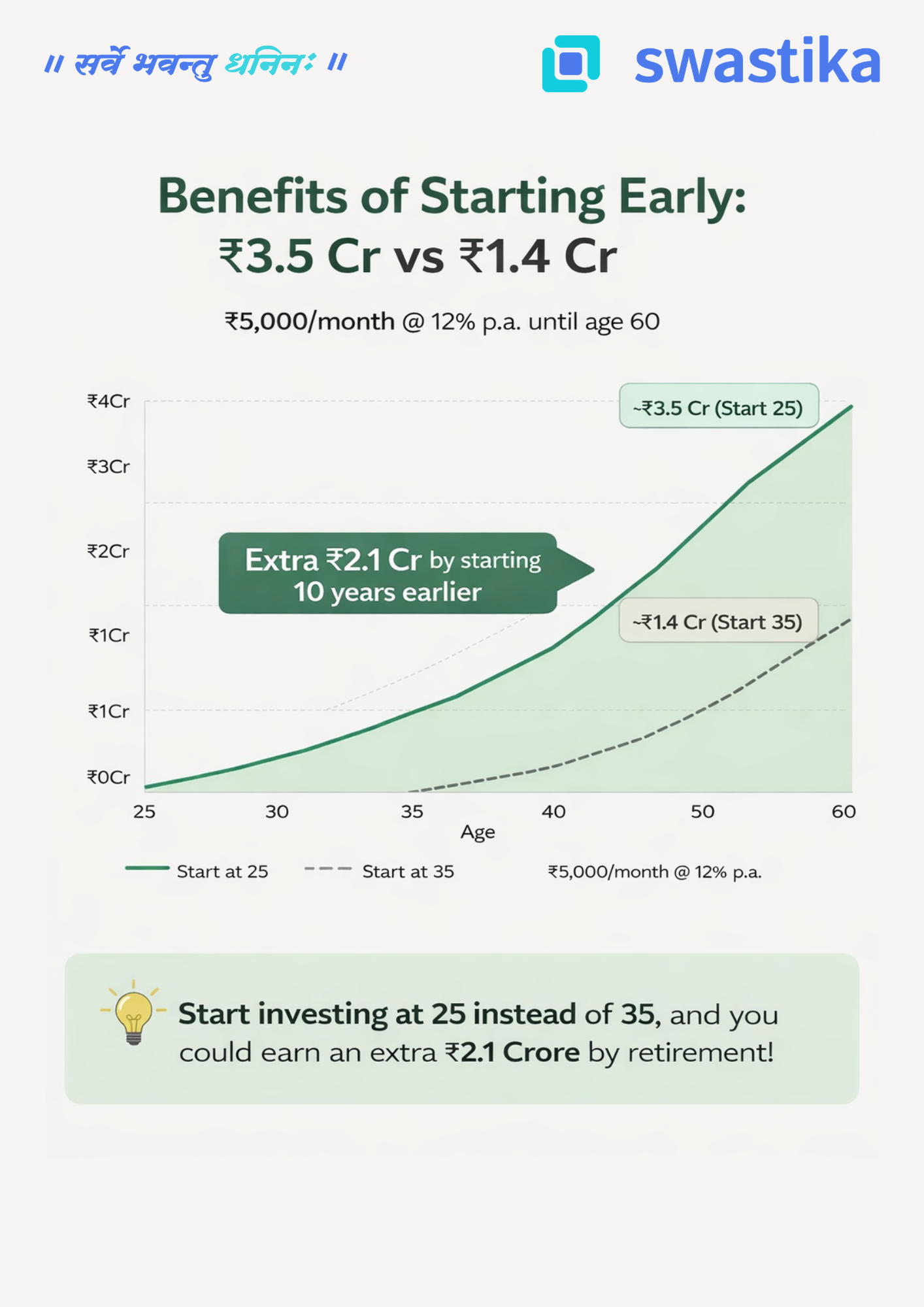
The more years you give your money to grow, the more dramatic — and life-changing — the results become. This is exactly why starting your investment journey early, even with a modest amount, can make a difference of crores by the time you retire.
A Tale of Two Investors: Arjun vs Priya
Let's bring this concept to life with a simple, real-world example.
Meet Arjun and Priya. Both are sensible, disciplined investors. Both invest ₹5,000 every month through a SIP (Systematic Investment Plan) in equity mutual funds, earning an average annual return of 12%. Both stop investing at age 60.
The only difference? Arjun starts at 25. Priya starts at 35.
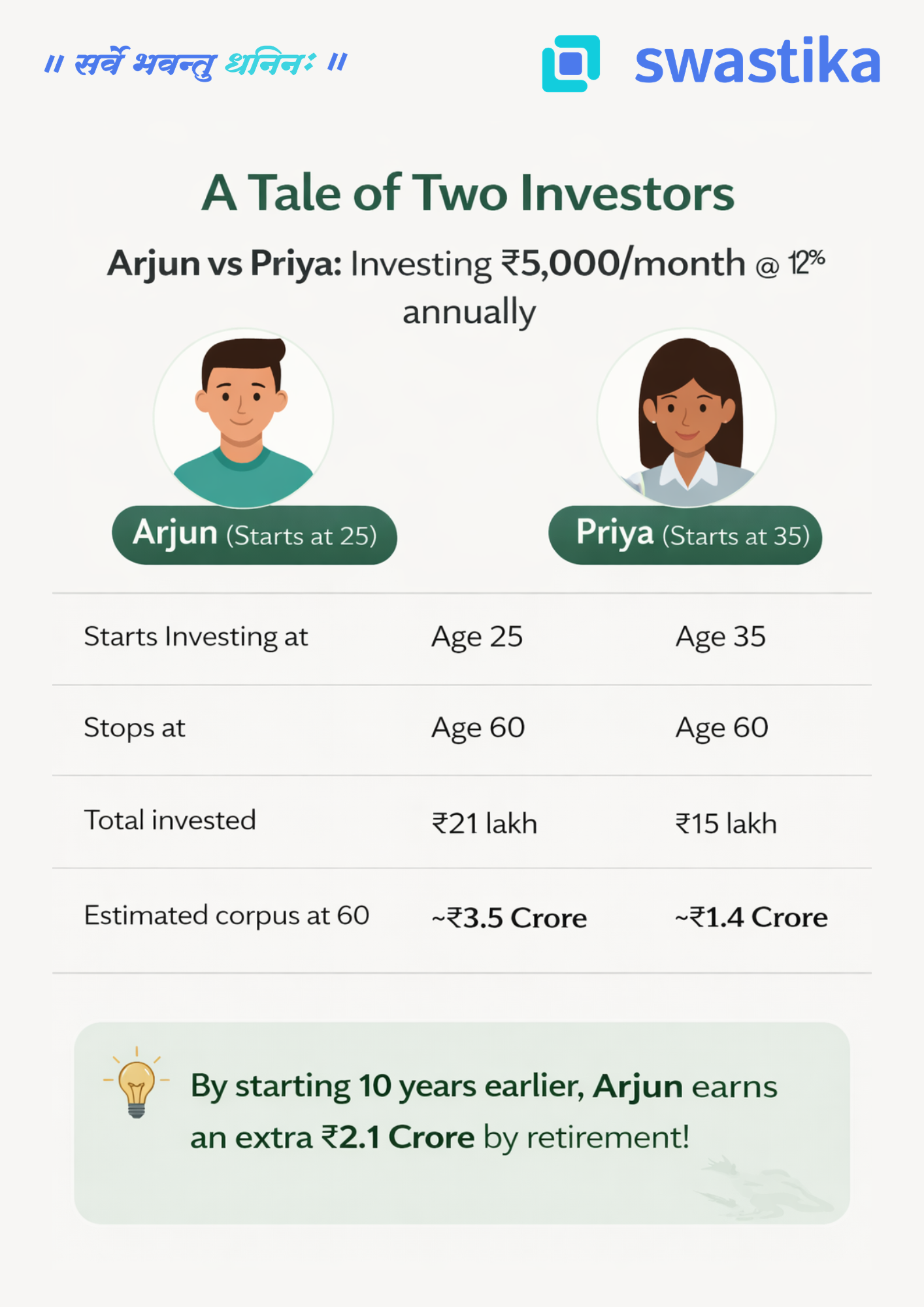
The numbers are striking. Arjun invests just ₹6 lakh more than Priya in absolute terms — yet walks away with ₹2.1 Crore more at retirement.
That extra ₹2.1 Crore didn't come from investing more aggressively or taking bigger risks. It came purely from starting 10 years earlier.
Why Does Time Make Such a Huge Difference?
This is where the magic of compounding reveals itself.
In the early years of investing, growth looks modest and almost unimpressive. But as the years pass, your corpus grows not just on your original investment, but on all the accumulated returns from previous years. The curve goes from almost flat to steeply exponential — and that steep climb happens in the later years.
When Arjun starts at 25, his money has 35 years to ride that exponential curve. Priya's money, starting at 35, only catches the last 25 years — and critically, it misses the steepest part of the climb in the final decade.
Think of it this way: the last 10 years of compounding are worth more than the first 20. That is the counterintuitive truth at the heart of long-term investing.
The Real Cost of Waiting
Many young earners tell themselves, "I'll start investing once I'm more settled — once the salary improves, once the EMI is paid off, once life is a bit easier."
But the numbers show that every year of delay is extraordinarily expensive — far more expensive than any EMI or lifestyle expense. Priya didn't invest carelessly. She invested faithfully for 25 years. Yet she ends up with less than half of what Arjun accumulated — not because she did anything wrong, but simply because she started a decade late.
The cost of waiting 10 years wasn't ₹6 lakh in additional contributions. The cost was ₹2.1 Crore in lost wealth.
Three Principles to Remember
1. Start now, not later.The best time to start investing was yesterday. The second best time is today. Even a SIP of ₹1,000–₹2,000 per month in your 20s is infinitely better than waiting for the "right time."
2. Consistency beats intensity.You don't need to invest large sums all at once. A small, steady, monthly commitment — maintained without interruption — is what unlocks the full power of compounding over decades.
3. Stay invested through market cycles.Compounding works only if you let it work. Exiting during market corrections or stopping your SIP in tough months breaks the chain. Time in the market, not timing the market, is what builds wealth.
The Bottom Line
If you are in your 20s or early 30s, you hold an asset that no amount of money can buy later: time. Use it. Start a SIP today — even a small one. Let compounding do its slow, steady, powerful work.
Because the difference between starting at 25 and starting at 35 is not just 10 years. As Arjun and Priya's story shows, that difference is ₹2.1 Crore.
Big Budget











.webp)
.webp)
.webp)
.webp)
.webp)
















.webp)
.webp)
.webp)
.webp)
Latest Articles

ग्लोबल अर्थव्यवस्था के कमजोर संकेतो से बढ़े सोना-चांदी के भाव।


पिछले सप्ताह रिज़र्व बैंक ऑफ़ इंडिया द्वारा अपनी मॉनेटरी पालिसी में ब्याज दरों में कोई बदलाव नहीं किया और इस सप्ताह जारी होने वाले मुद्रास्फीति के आकड़ो में कमी होने के अनुमान से बाजार में तरलता बनी रहने की उम्मीद है। अमेरिका, चीन और यूरो जोन से जारी होने वाले आंकड़े कमजोर दर्ज किये गए जिससे सोने और चांदी के भाव निचले स्तरों से पलट गए है और अमेरिकी डॉलर इंडेक्स में छोटी अवधि के लिए आई तेज़ी पूरी होती दिखने लगी है। अमेरिका और यूरोप की अर्थव्यवस्था में व्यवसाइक गतिविधियाँ कम होने से निवेशकों का ध्यान कीमती धातुओं की और बढ़ने लगा है। पिछले सप्ताह जारी आकड़ो से संकेत मिले है कि 2023 की पहली तिमाही और 2022 की अंतिम तिमाही की बढ़ोतरी में गिरावट के बाद यूरोज़ोन अर्थव्यवस्था इस साल की पहली तिमाही में मंदी की चपेट में आ गई है। अमेरिका में बेरोज़गारी के आंकड़े 233 हज़ार से बढ़कर 261 हज़ार पहुंच गए है। प्रमुख अर्थव्यवस्थाओ से मिल रहे कमज़ोर संकेतो के चलते सोने और चांदी की कीमतों में पिछले सप्ताह निचले स्तरों से बढ़त दर्ज की गई है। लेकिन, बैंक ऑफ़ कनाडा द्वारा पिछले सप्ताह ब्याज दरों में 0.25 प्रतिशत बढ़ोतरी की गई है और अमेरिका में रोज़गार बाज़ार में मजबूती रहने के कारण फेड हॉकिश रुख अपना सकता है, जिसके संकेत फेड सदस्य दे चुके है। अगर अर्थव्यवस्था में खपत के पैमानें पर नज़र डाली जाये तो अमेरिका में ड्राइविंग सीजन रहने के बावजूद और सऊदी अरब द्वारा पिछले सप्ताह कच्चे तेल के उत्पादन में कटौती करने के बाद भी इसकी कीमतों में दबाव, अर्थव्यवस्था में मांग कमजोर रहने के संकेत देते है। चीन के सबसे बड़े बैंकों ने अर्थव्यवस्था में विकास को बढ़ावा देने के लिए पिछले सप्ताह बचतकर्ताओं के लिए ब्याज दरों में कटौती की, जिससे खपत की धीमी रफ़्तार में सुधार हो सके। इस सप्ताह अमेरिका के सीपीआई, एफओएमसी और यूरोपियन सेंट्रल बैंक की बैठक, और चीन की मौद्रिक नीति, कीमती धातुओं के लिए महत्वपूर्ण रहेंगे।
तकनिकीविश्लेषण :
इस सप्ताह कीमती धातुओं में तेज़ी रहने की सम्भावना है। एमसीएक्स जून वायदा सोने में सपोर्ट 58300 रुपये पर है और रेजिस्टेंस 61000 रुपये पर है। जुलाई वायदा चांदी में सपोर्ट 71000 रुपये पर है और रेजिस्टेंस 76000 रुपये पर है।
The Power of Algo Trading: the Automated Trading Revolution
Introduction
In today's fast-paced world, where technology affects every aspect of our lives, it comes as no surprise that the financial markets have embraced automation. One such powerful technological advancement is algorithmic trading, popularly known as Algo trading. Algo trading has revolutionized the way financial instruments are traded, offering speed, precision, and efficiency like never before.
What is Algo Trading?
Algo trading, short for algorithmic trading, refers to the use of computer programs or algorithms to execute trades in financial markets. These algorithms are designed to analyze vast amounts of market data, identify patterns, and execute trades automatically without human intervention. Algo trading relies on complex mathematical models and statistical analysis to make data-driven decisions in real-time.
Benefits of Algo Trading
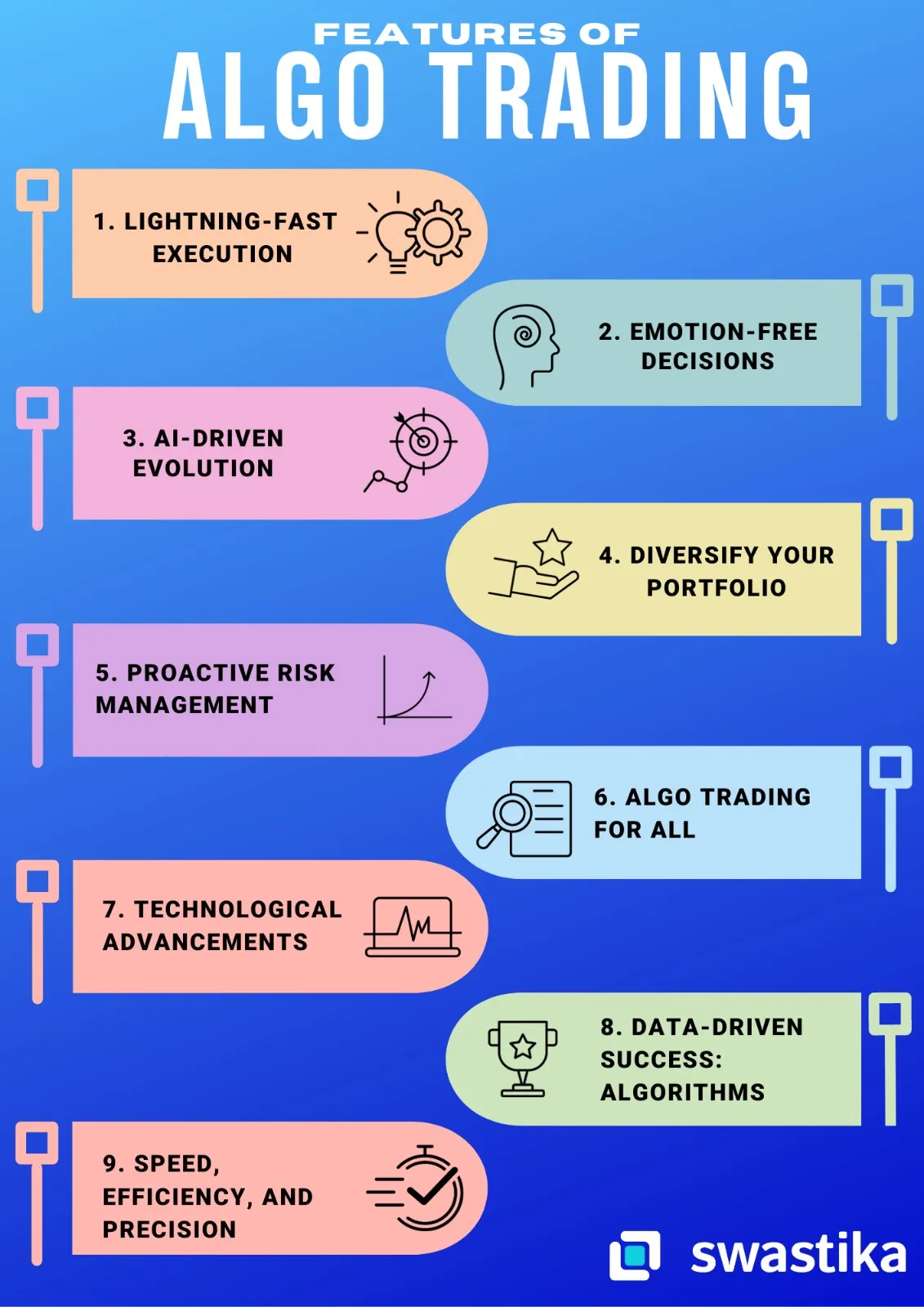
- Speed and Efficiency: Algo trading eliminates human limitations and emotions, enabling lightning-fast execution of trades. This speed is crucial in highly volatile markets, where a delay of a few seconds can make a significant difference. Algorithms can instantly analyze multiple indicators, spot trading opportunities, and execute trades in fractions of a second.
- Accuracy and Consistency: By removing human emotions from the trading process, Algo trading ensures consistency in decision-making. Algorithms follow predefined rules and execute trades based on objective criteria, reducing the chances of errors caused by human bias or irrationality.
- Increased Market Access: Algo trading provides access to a wide range of markets and instruments, including stocks, commodities, currencies, and derivatives. It enables traders to diversify their portfolios and explore opportunities across different markets, which would be challenging to achieve manually.
- Risk Management: Algo trading allows for the implementation of risk management strategies in real-time. Algorithms can automatically adjust trade sizes, set stop-loss orders, and apply other risk control measures to protect capital. This proactive approach to risk management helps traders mitigate potential losses and safeguard their investments.
- Back testing and Optimization: Algo trading systems can be back tested using historical data to evaluate their performance and optimize their parameters. Traders can fine-tune their algorithms, identify weaknesses, and refine their strategies based on past market behavior. This iterative process enables continuous improvement and adaptation to changing market conditions.
Disadvantages of Algo Trading
- Complexity- Developing a profitable Algo trading strategy requires a deep understanding of market data, technical indicators, and programming languages. This can be a daunting task for many traders, especially those who are new to the market.
- Reliance on historical data- Algo trading strategies are based on historical data, which may not always be a reliable indicator of future market trends. This can lead to losses if the market behaves differently than expected.
- Expensive-Developing an Algo trading strategy requires a significant investment in time and resources. Traders may also need to pay for access to market data and trading platforms.
Implementing Algo Trading
To engage in Algo trading, traders typically require access to a trading platform or a brokerage that supports algorithmic trading. These Algo trading platforms provide a range of tools and features to develop, test, and execute algorithms. Traders can code their algorithms using programming languages such as Python or use visual programming interfaces to create strategies without coding knowledge. While the technical aspects of Algo trading may seem daunting to beginners, many brokerage firms offer pre-built algorithms or algorithmic trading solutions that can be easily customized by individual traders. This accessibility allows traders with varying levels of technical expertise to participate in Algo trading.
Regulatory Framework and Risks
Algo trading operates within a regulatory framework set by financial authorities to ensure fair and transparent markets. Regulatory bodies establish guidelines to prevent market manipulation, maintain market integrity, and safeguard investor interests. Traders engaging in Algo trading must comply with these regulations, including obtaining necessary licenses and adhering to reporting requirements. However, like any investment strategy, Algo trading carries certain risks. Technical glitches, system failures, or connectivity issues can result in substantial financial losses. Moreover, algorithms are only as good as the underlying data and assumptions they are based on. Sudden market shifts or unforeseen events can disrupt algorithms and lead to unexpected outcomes. It is essential for traders to thoroughly understand the risks involved and implement appropriate risk management measures.
The Future of Algo Trading
Algo trading has rapidly gained popularity and is expected to continue its upward trajectory in the future. Advancements in technology, such as artificial intelligence and machine learning, are further enhancing the capabilities of Algo trading systems. These advancements enable algorithms to learn from past data, adapt to changing market conditions, and make more intelligent trading decisions. Moreover, as Algo trading becomes more accessible and user-friendly, it is attracting a broader range of market participants, including individual traders and small investors. The democratization of Algo trading has the potential to level the playing field and provide equal opportunities for all market participants.
Conclusion
Algo trading has revolutionized the financial markets, empowering traders with unprecedented speed, accuracy, and efficiency. Through the use of sophisticated algorithms, traders can leverage vast amounts of data to make informed trading decisions and execute trades in real-time. While Algo trading carries certain risks, when implemented with proper risk management measures, it can provide significant advantages and opportunities for market participants. As technology continues to advance, Algo trading is poised to evolve further, opening new avenues for innovation and profitability. Whether you are a seasoned trader or a novice investor, understanding and exploring the world of Algo trading can unlock new possibilities and help you stay ahead in today's dynamic investment landscape. So, embrace the power of Algo trading and embark on a journey of automated trading excellence.

फेड की हॉकिश टिपण्णी से सोने में गिरावट
भारत में शादियों का सीजन के दौरान सोने की कीमतों में बड़ा सुधार देखने को मिला है। पिछले सप्ताह एमसीएक्स में जून वायदा सोना 1.7 प्रतिशत टूट कर 59800 रुपये प्रति दस ग्राम के स्तरों पर पहुंच गया। लगातार दो हफ्तों से सोने की कीमतों में ऊपरी स्तरों पर दबाव बना हुआ है और यह अपने उच्चतम स्तरों से 2000 रुपये प्रति दस ग्राम घट चुका है। दरअसल, अमेरिकी डेब्ट सीलिंग पर बिडेन प्रशाशन आशावादी रहा है और उम्मीद है की इसकी लिमिट बढ़ा दी जाएगी जिससे डेब्ट सीलिंग को लेकर चल रही अनिश्चितता कम हुई है और कीमती धातुओं के भाव में दबाव बना है। पिछले सप्ताह फेड चेयर जेरोम पॉवेल के अतिरिक्त अन्य फेड मेंबर्स की स्पीच से स्पष्ट हुआ है की ज्यादातर फेड मेंमबर आगे भी ब्याज़ दरों में वृद्धि के पक्ष में बने हुए है, जिससे बेंचमार्क अमेरिकी ट्रेज़री यील्ड और डॉलर इंडेक्स में बढ़ोतरी दर्ज की गई है। कॉमेक्स वायदा बाजार में सोना 2089 डॉलर के उच्च स्तरों से टूट कर 1970 डॉलर प्रति औंस के निचे फिसल गया है। हालांकि, फेड मेंबर्स की मॉनेटरी पॉलिसी पर हॉकिश टिपण्णी के बाद, पिछले दो सप्ताह में डॉलर 1 रुपये मजबूत होकर 82.70 रुपये के स्तरों पर पहुंच गया है, जिससे घरेलु वायदा बाज़ार में सोने की गिरावट सीमित रही है। अमेरिका से जारी होने वाले रिटेल सेल्स के आकड़ो में पिछले महीने की तुलना में बढ़ोतरी दर्ज की गई है और बेरोज़गारी के दावे में कमी दर्ज की गई, जिससे संकेत मिलते है की उच्च ब्याज दरे रहने के बावजूद अर्थव्यवस्था मजबूत है इसके परिणाम स्वरुप फेड सदस्यों की टिपण्णी हॉकिश रही है। इस सप्ताह एफओएमसी मीटिंग के मिनट्स, अमेरिकी जीडीपी, बेरोज़गारी दावे और कोर पीसीई प्राइस इंडेक्स के आंकड़े महत्वपूर्ण रहेंगे।
तकनिकी विश्लेषण :
इस सप्ताह कीमती धातुओं में दबाव बने रहने की सम्भावना है। एमसीएक्स जून वायदा सोने में सपोर्ट 58000 रुपये पर है और रेजिस्टेंस 61800 रुपये पर है। जुलाई वायदा चांदी में सपोर्ट 70000 रुपये पर है और रेजिस्टेंस 74000 रुपये पर है।

What is a Stock SIP? How to Invest in Stocks Using SIPs
Introduction
A systematic Investment Plan (SIP) is a popular investment strategy that allows individuals to invest in mutual funds regularly.
But have you ever wondered if you can apply the concept of SIP to stocks?
In this blog, we will explore the concept of a Stock SIP, its benefits, and who should consider it.
Understanding Stock SIP can help investors diversify their investment portfolios and potentially benefit from long-term wealth creation.
What is a Stock SIP?
Stock SIP is a strategy where an investor systematically invests a fixed amount of money at regular intervals into selected stocks.
Similar to traditional SIPs in mutual funds, a Stock SIP allows investors to spread their investments over time and take advantage of rupee cost averaging.
Instead of investing in a single stock at a lump sum amount, investors can accumulate shares of various stocks over a period through regular investments.
How Does Stock SIP Work?
- Investors can start a Stock SIP by choosing a specific amount they want to invest regularly, such as monthly or quarterly.
- The selected amount is invested in predetermined stocks at fixed intervals.
- Investments can be made directly by the investor or through a top stock broker.
- The number of shares purchased through a Stock SIP depends on the prevailing market price of the selected stocks at the time of investment.
- Over time, the investor accumulates shares of different stocks in their portfolio, aiming for long-term capital appreciation.
Benefits of Stock SIP
- Rupee Cost Averaging: Stock SIP allows investors to buy more shares when prices are low and fewer shares when prices are high. This strategy helps average out the cost per share over time.
- Disciplined Investing: Stock SIP instills discipline in investors by encouraging regular investments, regardless of market conditions.
- Diversification: Stock SIP enables investors to diversify their portfolios by investing in different stocks across various sectors.
- Long-Term Wealth Creation: By consistently investing in quality stocks over the long term, investors have the potential to create significant wealth as they benefit from the power of compounding.
- Flexibility: Investors have the flexibility to modify or stop their Stock SIPs based on their financial goals and changing market conditions.
Who Should Consider Stock SIP?
Stock SIPs may be suitable for investors who have a long-term investment horizon and can tolerate market fluctuations.
Here are a few scenarios where investors might consider a Stock SIP:
- Goal-Oriented Investing: Investors with specific financial goals, such as retirement planning, education funds, or buying a house, can use Stock SIPs to accumulate wealth over time.
- Belief in Fundamental Analysis: Investors who believe in fundamental analysis and have confidence in their stock selection process can use Stock SIPs to build a portfolio of quality stocks.
- Diversification and Risk Mitigation: Investors looking to diversify their investment portfolios beyond mutual funds and other asset classes can consider Stock SIPs as an additional investment avenue.
- Affordable Investing: Stock SIPs allow investors to start with a relatively small amount of money, making it more accessible to individuals with limited investable funds.
Considerations Before Starting a Stock SIP
Before starting a Stock SIP, it is essential to keep the following points in mind:
- Market Volatility: Stock SIPs are subject to market risks and can experience fluctuations in share prices. Investors should be prepared for short-term market volatility and focus on the long-term horizon.
- Stock Selection: Thorough research and analysis are crucial when selecting stocks for a SIP. Investors should consider factors such as company fundamentals, industry outlook, and management quality.
- Monitoring and Review: Regular monitoring and review of the stocks in the SIP portfolio are necessary to ensure that the investments align with the investor's financial goals and market conditions.
Conclusion
While SIPs are traditionally associated with mutual funds, a Stock SIP provides an avenue for investors to accumulate shares of selected stocks in a disciplined manner.
Stock SIPs offer benefits such as rupee cost averaging, diversification, and long-term wealth creation.
However, investors should consider their risk appetite, financial goals, and ability to monitor and review their investments before starting a Stock SIP.
As with any investment strategy, it is crucial to do thorough research, seek professional advice, and stay informed about the market to make informed investment decisions.
By understanding the concept of Stock SIPs and considering the factors discussed in this blog, investors can explore new avenues for wealth creation and portfolio diversification.
**Disclaimer: The information provided in this blog is for educational purposes only and should not be considered as financial advice. Investors are advised to consult with a qualified financial advisor before making any investment decisions.

Extended Trading Hours in Indian Market and its Post-Impact
The Indian stock market has been a major contributor to the country's economic growth. With the increasing demand for trading in the stock market, the National Stock Exchange (NSE) and Bombay Stock Exchange (BSE) have proposed to extend the trading hours. After consulting with experts, the National Stock Exchange (NSE) has decided to extend the market trading hours for interest rate derivatives until 5 pm. additionally, they are considering extending the trading hours for F&O until 11:55 pm and equity trading hours in the cash segment until 5 pm.
What are the Current Trading Hours on NSE and BSE?
Currently, the trading hours on NSE and BSE are from 9:15 am to 3:30 pm, Monday to Friday. While, the pre-opening session starts at 9:00 am and ends at 9:15 am.
Benefits of Longer Trading Hours
Increased Liquidity: The extension of trading hours will increase liquidity in the market. With more traders and investors participating in the market, there will be more buying and selling activity, which will increase liquidity.
Global Exposure: The extension of trading hours will provide Indian traders and investors with an opportunity to trade in global markets during their regular trading hours. This will provide them with exposure to global markets and help them diversify their portfolio.
Comparing Indian and global market hours
Timings Duration Shanghai Composite Index 9.30 am to 11.30 am1 pm to 3 pm4 hours Tokyo Stock Exchange 9 am to 11.30 am12.30 pm to 3 pm5 hours National Stock Exchange 9:15 am to 3:30 pm6 hours 15 minutes Bombay Stock Exchange9:15 am to 3:30 pm6 hours 15 minutes New York Stock Exchange 9.30 am to 4 pm 6.5 hours London Stock Exchange 8 am to 12 pm 12.02 pm to 4.30 pm 8 hours 28 minutes Euronext Paris 9 am to 5.30 pm 8.5 hours Frankfurt Stock Exchange 8 am to 10 pm14 hours Better Price Discovery: Longer trading hours can lead to better price discovery as investors get more time to react to news and events.
Disadvantages of Longer Trading Hours
- Increased Volatility: The extension of trading hours may lead to increased volatility in the market. With more trading activity, there may be sudden price movements, which may lead to increased volatility.
- Increased Risk: The extension of trading hours may increase the risk for traders and investors. With the market remaining open for a longer period, there may be more opportunities for traders to take risky positions, which may lead to losses.
- Reduced Quality of Life: Longer trading hours can reduce the quality of life for brokers and traders, as they need to work for longer hours.
Is This a Real Need of the Hour?
The need for longer trading hours is debatable. While longer trading hours can increase liquidity and help in the integration of the Indian stock market with global markets, it can also increase the risk of volatility and reduce the quality of life for brokers and traders. Therefore, the decision to extend the trading hours should be taken after considering all the pros and cons. The extension of trading hours in the Indian market has been done for several reasons. One of the primary reasons is to align the Indian stock market with the global markets. Many global markets, including the US and Japan, have extended trading hours. This move will help Indian traders and investors to trade in global markets during their regular trading hours. This will provide them with exposure to global markets and help them diversify their portfolio. It will also help in reducing the time gap between the Indian market and the global markets, which will help in reducing the impact of global events on the Indian market. Another reason for the extension of trading hours is to increase the liquidity in the market. With the extension of trading hours, more traders and investors will be able to participate in the market, which will increase the liquidity. This will also help in reducing the bid-ask spread, which is the difference between the highest price a buyer is willing to pay for a stock and the lowest price a seller is willing to accept. Moreover, the extension of trading hours will also help in reducing the pressure on the market during the regular trading hours. With more trading hours available, traders and investors will be able to spread their trades over a longer period, which will help in reducing the pressure on the market during the regular trading hours.
Post Impact on Stock Market
The post-impact of longer trading hours on the stock market can be as follows:
Impact on Brokerages
The extension of trading hours has also had an impact on brokerages. Brokerages have had to increase their staffing levels to accommodate the extended trading hours. This will led to an increase in their operating costs, which may impact their profitability.
Impact on Investors
The extension of trading hours has also had an impact on investors. Investors now have to monitor the market for a longer period, which may lead to increased stress and fatigue. This may impact their decision-making ability and may lead to suboptimal investment decisions.
Impact on Market Participants
The extension of trading hours has also had an impact on market participants, including traders, investors, and market makers. Let's discuss the impact on each of these participants.
Traders & Investors
The extension of trading hours has provided traders with more opportunities to trade in the market. However, it has also increased the competition among traders, which has led to increased pressure to perform. Traders now have to monitor the market for a longer period, which may lead to increased stress and fatigue. This may impact their decision-making ability and may lead to suboptimal trading decisions.The extension of trading hours has also had an impact on investors. Investors now have to monitor the market for a longer period, which may lead to increased stress and fatigue. This may impact their decision-making ability and may lead to suboptimal investment decisions. Moreover, the increased volatility in the market may lead to increased risk for investors, which may impact their investment strategies.
Impact on Market Infrastructure
The extension of trading hours has also has an impact on the market infrastructure. The stock exchanges have had to upgrade their systems to accommodate the extended trading hours. This has led to an increase in their operating costs, which may impact their profitability. Moreover, the increased trading activity during the extended trading hours may lead to increased stress on the market infrastructure, which may impact the smooth functioning of the market. In conclusion, the extension of trading hours in the Indian stock market has had a significant impact on the market participants and the market infrastructure. While it has provided traders and investors with more opportunities to trade in the market, it has also increased the competition among traders and led to increased stress and fatigue. Market makers have had to increase their staffing levels, which has impacted their profitability. The stock exchanges have had to upgrade their systems to accommodate the extended trading hours, which has led to an increase in their operating costs. It is important for market participants to understand these impacts and take appropriate measures to manage their risk.

Unlocking Diversification with Equal Weight Index Funds
Understanding Equal Weight Index Funds
Equal weight index funds are a type of index fund that follow an alternative weighting methodology. Unlike traditional market capitalization-weighted index funds, where stocks are weighted based on their market value, equal weight index funds assign equal weight to each stock within the index. This means that every stock in the index has an equal impact on the fund's performance, regardless of its market capitalization.
How Equal Weight Index Funds Work
In an equal weight index fund, each stock in the index is assigned the same weight, regardless of its market capitalization. This means that the fund invests an equal amount of money in each stock. For example, if an equal weight index fund tracks an index with 50 stocks, it will allocate 2% (100% / 50) of its assets to each stock.To maintain the equal weight allocation, the fund periodically rebalances its portfolio, usually on a quarterly or semi-annual basis. During rebalancing, the fund buys or sells stocks to ensure that each stock maintains its equal weight in the portfolio.
Who Should Invest in Equal Weight Index Funds?
Equal weight index funds may be suitable for investors who:
- Seek better diversification: Investors looking for a more diversified approach to index investing may find equal weight index funds appealing.
- Want exposure to small and mid-cap stocks: Those looking to invest in small and mid-cap stocks for their growth potential may consider equal weight index funds.
- Have a long-term investment horizon: Due to their higher costs and turnover, equal weight index funds may be more suitable for investors with a long-term investment horizon.
Comparison: Equal Weight Index Funds vs. Market Capitalization-Weighted Index Funds
Aspect Equal Weight Index Funds Market Capitalization-Weighted Index Funds Weighting Methodology Equal weight allocation to all stocks Weighted based on market capitalization Diversification Higher diversification across all stocks Concentrated exposure to larger companies Performance Potential Outperformance during smaller stock rallies Reflects market movements of larger stocks Rebalancing Frequency Periodic rebalancing to maintain equal weightage Less frequent rebalancing Transaction Costs Potentially higher due to rebalancing Lower turnover, potentially lower costs Volatility Can exhibit higher volatility Generally lower volatility Market Efficiency Potentially includes less efficient companies Reflects market efficiency Transparency and Simplicity Transparent and straightforward investment strategy Straightforward investment strategy
Advantages of Equal Weight Index Funds:
- Diversification: Provides higher diversification across all stocks, reducing concentration risk.
- Potential for Outperformance: Can potentially outperform market capitalization-weighted index funds during smaller stock rallies.
- Rebalancing Benefits: Periodic rebalancing helps maintain the equal weight allocation, enabling "buy low, sell high" principles.
- Simplicity and Transparency: Follows a transparent and straightforward investment strategy, easy to understand.
Disadvantages of Equal Weight Index Funds:
- Higher Turnover and Costs: Rebalancing may result in higher turnover and transaction costs, potentially impacting expenses.
- Potential Volatility: Equal weight index funds may exhibit higher volatility due to the inclusion of smaller companies with higher weights.
- Market Efficiency: Market capitalization-weighted indexes are often considered more reflective of market efficiency, while equal weight index funds may include less efficient companies.
- Liquidity Concerns: Smaller companies in equal weight index funds may have lower liquidity compared to larger, widely traded stocks.


.webp)
.webp)

.webp)






START YOUR INVESTMENT JOURNEY
Get personalized advice from our experts
- Dedicated RM Support
- Smooth and Fast Trading App
