

The Power of Compounding – Why Starting Early Matters




Introduction
Albert Einstein reportedly called compound interest the "eighth wonder of the world." Whether or not he actually said it, the math is undeniable. Compounding is the process where your investment returns begin earning their own returns — and over time, this snowball effect becomes truly extraordinary.
The catch? Compounding needs one essential ingredient: time.
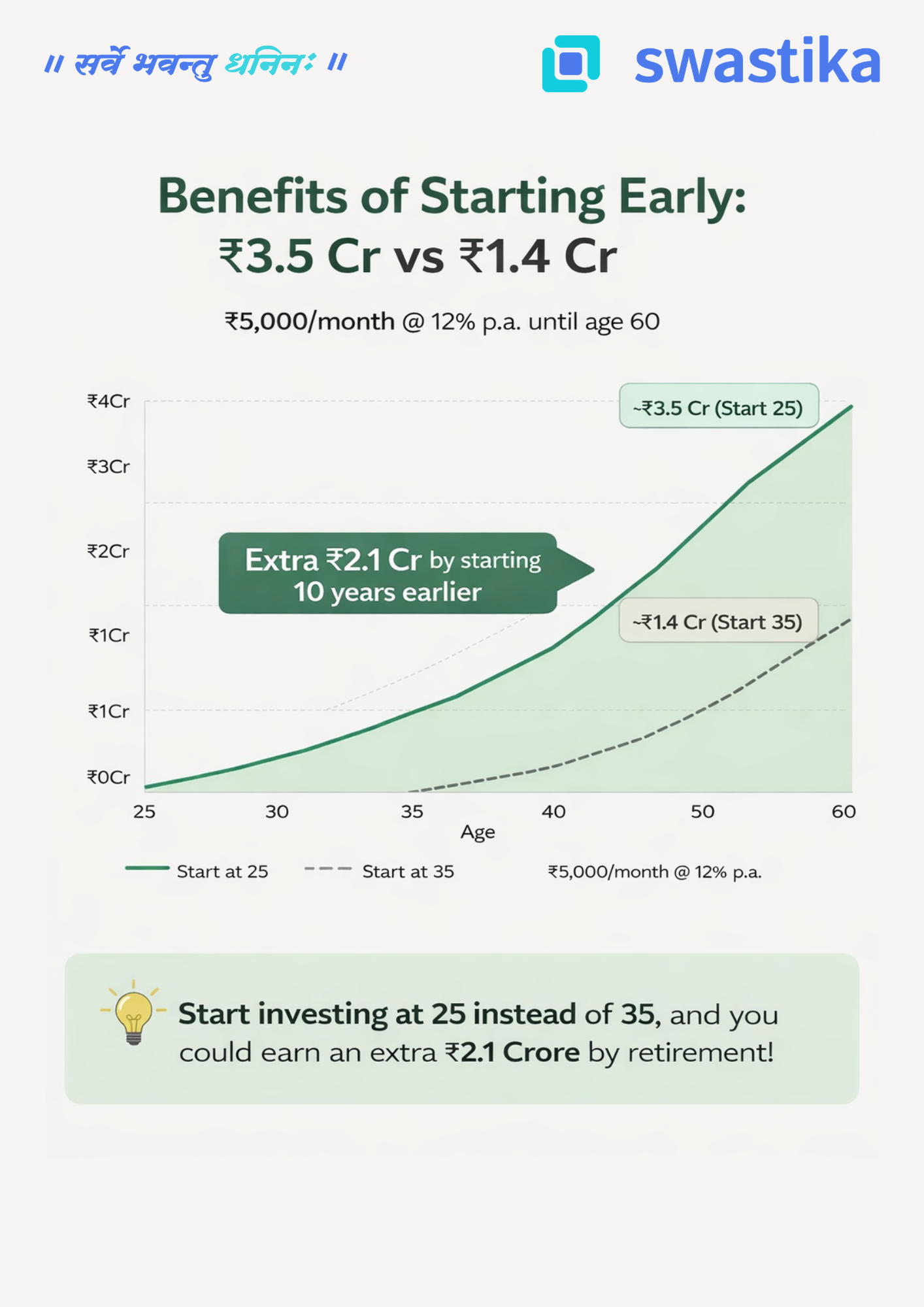
The more years you give your money to grow, the more dramatic — and life-changing — the results become. This is exactly why starting your investment journey early, even with a modest amount, can make a difference of crores by the time you retire.
A Tale of Two Investors: Arjun vs Priya
Let's bring this concept to life with a simple, real-world example.
Meet Arjun and Priya. Both are sensible, disciplined investors. Both invest ₹5,000 every month through a SIP (Systematic Investment Plan) in equity mutual funds, earning an average annual return of 12%. Both stop investing at age 60.
The only difference? Arjun starts at 25. Priya starts at 35.

The numbers are striking. Arjun invests just ₹6 lakh more than Priya in absolute terms — yet walks away with ₹2.1 Crore more at retirement.
That extra ₹2.1 Crore didn't come from investing more aggressively or taking bigger risks. It came purely from starting 10 years earlier.
Why Does Time Make Such a Huge Difference?
This is where the magic of compounding reveals itself.
In the early years of investing, growth looks modest and almost unimpressive. But as the years pass, your corpus grows not just on your original investment, but on all the accumulated returns from previous years. The curve goes from almost flat to steeply exponential — and that steep climb happens in the later years.
When Arjun starts at 25, his money has 35 years to ride that exponential curve. Priya's money, starting at 35, only catches the last 25 years — and critically, it misses the steepest part of the climb in the final decade.
Think of it this way: the last 10 years of compounding are worth more than the first 20. That is the counterintuitive truth at the heart of long-term investing.
The Real Cost of Waiting
Many young earners tell themselves, "I'll start investing once I'm more settled — once the salary improves, once the EMI is paid off, once life is a bit easier."
But the numbers show that every year of delay is extraordinarily expensive — far more expensive than any EMI or lifestyle expense. Priya didn't invest carelessly. She invested faithfully for 25 years. Yet she ends up with less than half of what Arjun accumulated — not because she did anything wrong, but simply because she started a decade late.
The cost of waiting 10 years wasn't ₹6 lakh in additional contributions. The cost was ₹2.1 Crore in lost wealth.
Three Principles to Remember
1. Start now, not later.The best time to start investing was yesterday. The second best time is today. Even a SIP of ₹1,000–₹2,000 per month in your 20s is infinitely better than waiting for the "right time."
2. Consistency beats intensity.You don't need to invest large sums all at once. A small, steady, monthly commitment — maintained without interruption — is what unlocks the full power of compounding over decades.
3. Stay invested through market cycles.Compounding works only if you let it work. Exiting during market corrections or stopping your SIP in tough months breaks the chain. Time in the market, not timing the market, is what builds wealth.
The Bottom Line
If you are in your 20s or early 30s, you hold an asset that no amount of money can buy later: time. Use it. Start a SIP today — even a small one. Let compounding do its slow, steady, powerful work.
Because the difference between starting at 25 and starting at 35 is not just 10 years. As Arjun and Priya's story shows, that difference is ₹2.1 Crore.
Big Budget












.webp)
.webp)
.webp)
.webp)
.webp)
















.webp)
.webp)
.webp)
.webp)
Latest Articles

How to Protect Your Demat Account from Fraud


Introduction:
In today's digital age, where financial transactions are conducted online, it is crucial to safeguard your demat account from potential fraud. As a stockbroker company, we understand the importance of protecting your investments and ensuring the security of your demat account. In this blog, we will provide you with valuable insights and practical tips on how to protect your demat account from fraud. Let's dive in!
Choose a Strong Password:
- Protect your demat account with a powerful password that combines uppercase and lowercase letters, numbers, and special characters.
- Avoid using common passwords or personal information that can be easily guessed.
- Change your password regularly and never share it with anyone.
Enable Two-Factor Authentication (2FA):
- Two-factor authentication adds an extra layer of security to your demat account.
- Enable 2FA to ensure that only authorized individuals can access your account.
- Use methods such as OTP (One-Time Password) or biometric verification for enhanced security.
Be Aware of Phishing Attacks:
- Phishing is a common method used by fraudsters to obtain sensitive information.
- Be cautious of emails, messages, or calls asking for your account details or passwords.
- Always verify the authenticity of the source before providing any information.
Keep Software Updated:
- Regularly update your computer's operating system, antivirus software, and web browsers.
- Software updates often include security patches that protect against the latest threats.
- Enable automatic updates to ensure you stay protected against new vulnerabilities.
Secure Internet Connection:
- Avoid using public Wi-Fi networks or unsecured internet connections for accessing your demat account.
- Use a trusted and secure network, preferably a private and password-protected connection.
- Consider using a virtual private network (VPN) for an added layer of security.
Monitor Account Activity:
- Regularly monitor your demat account for any suspicious or unauthorized transactions.
- Set up email or SMS alerts for account activity to stay informed about any changes or withdrawals.
- Immediately report any suspicious activity to your stockbroker or the respective authorities.
Keep your contact details updated
- Keep your contact details updated with your Depository Participant (DP). This includes your mobile number and email address.
- This will ensure that you receive alerts and notifications related to your Demat account. In case of any suspicious activity, you will be immediately notified, and necessary action can be taken.
Beware of Unverified Calls and Messages:
- Fraudsters may attempt to contact you through calls or messages, posing as representatives from your stockbroker.
- Be cautious and avoid sharing any sensitive information over the phone.
- Always verify the authenticity of the caller by contacting your top stock broker directly.
Review Account Statements:
- Carefully review your demat account statements and trade confirmations.
- Look for any discrepancies or unfamiliar transactions.
- Report any unauthorized trades or irregularities to your stockbroker immediately.
Educate Yourself:
- Stay informed about the latest fraud trends and scams targeting demat accounts.
- Follow reliable sources, financial news, and industry updates to enhance your knowledge.
- Regularly visit trusted websites and blogs that provide valuable insights on demat account security.
Choose a Reliable DP
- Do thorough research and choose a DP that has a good reputation and track record.
- You can also check their security measures and policies to ensure that your Demat account is safe and secure.
Choose a Reputable Stockbroker:
- Select a stock broker company with a strong reputation and robust security measures.
- Research and choose a stockbroker like Swastika Investmart that implements stringent security protocols.
- Read reviews and seek recommendations from trusted sources to ensure you are partnering with a reliable stockbroker.
Conclusion:
Protecting your demat account from fraud is essential for safeguarding your investments and financial well-being. By following these simple yet effective tips, you can significantly reduce the risk of falling victim to fraudulent activities. Stay vigilant, be proactive, and regularly update your knowledge about demat account security. Remember, your financial security is in your hands!
For more detailed information and personalized guidance, feel free to Contact Swastika Investmart. We are committed to providing a secure and reliable platform for your investments.

Stock SIP vs. Mutual Fund SIP: Which One Should You Choose?
Understanding SIP: A Brief Overview
- A systematic Investment Plan (SIP) is an investment strategy that allows investors to invest a fixed amount at regular intervals.
- SIPs help in averaging the cost of investments and benefit from the power of compounding over the long term.
- While traditional SIPs are associated with mutual funds, Stock SIP offers the option to invest in individual stocks.
Stock SIP: Direct Ownership and Potential Returns
- Stock SIP involves investing a fixed sum of money at regular intervals in selected stocks.
- Investors have the flexibility to choose stocks based on their investment objectives and risk appetite.
- Stock SIP provides direct ownership of stocks, giving investors a sense of control and engagement.
- With careful selection and research, stocks have the potential to generate higher returns compared to mutual funds.
Mutual Fund SIP: Professional Management and Diversification
- Mutual Fund SIP involves investing a fixed sum of money at regular intervals in a mutual fund scheme managed by a professional fund manager.
- Mutual funds offer diversification by investing in a portfolio of stocks across various sectors.
- Professional management helps investors save time and effort in selecting and managing individual stocks.
- Mutual funds are suitable for investors who prefer a hands-off approach and rely on the expertise of fund managers.
Considerations for Stock SIP and Mutual Fund SIP:
- Market Knowledge: Stock SIP requires investors to have a good understanding of the stock market, company analysis, and industry trends.
- Research and Analysis: Thorough research is necessary to select and monitor individual stocks in a Stock SIP.
- Volatility and Risk: Stocks are inherently volatile, and investors must be prepared for market fluctuations and potential losses.
- Monitoring and Review: Regular monitoring of the selected stocks or mutual funds is crucial to ensure they align with your investment goals.
Key Differences between Stock SIP and Mutual Fund SIP:
Parameters
Stock SIP
Mutual Fund SIP
Ownership
- Direct ownership
- Ownership through units
Flexibility
- Customized portfolio
- Professionally managed
Risk and Volatility
- Higher risk and volatility
- Lower risk and volatility
Investment Expertise
- Requires market knowledge and research
- Relies on professional fund managers
Diversification
- Depends on individual stock selection
- Provides diversification across multiple stocks
Advantages of Stock SIP
Advantages of Mutual Fund SIP
- Customized portfolio based on goals and risk appetite.
- Professional management by experienced fund managers.
- Direct ownership of underlying stocks.
- Diversification across a basket of stocks.
- Potential for higher returns with well-selected stocks.
- Lower risk through diversification and professional management.
- Additional income from dividends.
- Convenience of having the fund manager handle transactions.
Disadvantages of Stock SIP
Disadvantages of Mutual Fund SIP
- Individual stock selection requires market knowledge and research.
- Limited control over specific stock selection and portfolio changes.
- Higher risk and volatility associated with individual stocks.
- Dependency on fund manager's decisions and performance.
- Monitoring and managing individual stocks can be time-consuming.
- Potential for underperformance compared to market benchmarks.
- Lack of diversification compared to mutual funds.
- Limited ability to customize the portfolio to individual preferences.
Conclusion:
Both Stock SIP and Mutual Fund SIP offer unique advantages and considerations. Stock SIP provides customization and potential for higher returns, while Mutual Fund SIP offers professional management and diversification. Your investment decision should depend on factors such as your risk appetite, market knowledge, time availability, and investment goals. It's advisable to consult with a financial advisor or stock market broker to make an informed choice that aligns with your financial objectives. Remember, investing always carries some degree of risk, so it's essential to invest wisely and stay updated with market trends and developments.

Pre-Market Trading: How It Works, Benefits, and Risks
Introduction to Pre-Market Trading
Pre-Market trading is a session that takes place before regular market hours, allowing investors to place orders and trade stocks before the market officially opens. This session provides an opportunity for investors to react to news and events that may have occurred after the market closed the previous day. In this blog, we will discuss how Pre-Market trading works, its benefits, risks, and strategies to help you make informed decisions.
How Pre-Market Trading Works
Pre-Open Session Timings:
The pre-open session on the National Stock Exchange (NSE) and Bombay Stock Exchange (BSE) takes place from 9:00 AM to 9:15 AM, divided into three slots:
- 9:00 AM to 9:08 AM: Order Entry Period
- 9:08 AM to 9:12 AM: Order Matching and Trade Confirmation Period
- 9:12 AM to 9:15 AM: Buffer Period
Order Types:
During the pre-open session, investors can place the following types of orders:
- Limit Order: An order to buy or sell a stock at a specific price or better.
- Market Order: An order to buy or sell a stock at the best available price.
Price Determination:
The exchange uses a process called equilibrium price determination to discover the opening price for a stock. This process takes into account all the buy and sell orders placed during the pre-open session and determines a single price at which the maximum number of shares can be traded.
Benefits of Pre-Market Trading
- Early Access to Market Movements: Pre-Market trading allows investors to react to news and events that may have occurred after the market closed the previous day, providing an opportunity to take advantage of potential price movements.
- Price Discovery: The preopen session helps in price discovery, as it determines the opening price for the stock based on the buy and sell orders placed during the session.
- Reduced Volatility: By allowing investors to place orders before the market opens, pre-market trading can help reduce the volatility that may occur during regular market hours.
Risks Associated with Pre-Market Trading
- Limited Liquidity: Pre-Market trading typically has lower trading volumes compared to regular market hours, which can result in limited liquidity and wider bid ask spreads.
- Price Fluctuations: Due to limited liquidity, stock prices may fluctuate more during the Pre-Market session, making it difficult for investors to execute orders at their desired price.
- Execution Risk: Orders placed during the pre-open session may not be executed if there is not enough liquidity or if the equilibrium price is not within the specified price range.
Strategies for Pre-Market Trading
- Gap Trading Strategy: Investors can use the gap trading strategy to capitalize on price gaps that may occur between the closing price of the previous day and the opening price of the current day. This strategy involves buying or selling a stock based on the direction of the price gap.
- NewsBased Trading: Investors can use pre-market trading to react to news and events that may have occurred after the market closed the previous day. By analyzing the potential impact of the news on stock prices, investors can make informed decisions about whether to buy or sell stock during the pre-open session.
Conclusion
Pre-Market trading offers investors an opportunity to react to news and events before the market officially opens, potentially providing an advantage in terms of price movements. However, it also comes with risks, such as limited liquidity and price fluctuations. By understanding how Pre-Market trading works and employing appropriate strategies, investors can make informed decisions and potentially benefit from this unique trading session.

तीन महीनो के निचले स्तरों पर पहुंचे सोने के भाव
कीमती धातुओं में बिकवाली का दबाव पिछले सप्ताह भी जारी रहा और घरेलु वायदा बाजार एमसीएक्स में सोने की कीमते तीन महीने के निचले स्तरों पर आ गई है। अगस्त कॉन्ट्रैक्ट सोने के भाव पिछले सप्ताह 0.76 प्रतिशत टूट कर 57800 रुपये प्रति दस ग्राम पर आ गए। जबकि चांदी के भाव में मामूली साप्ताहिक गिरावट रही और इसके भाव 69000 रुपये प्रति किलो के स्तरों पर कारोबार करते दिखे। दरसल, फेड द्वारा ब्याज दर बढ़ोतरी पर अपना कठोर रुख बरक़रार रखने के कारण अमेरिकी बेंचमार्क ट्रेज़री यील्ड में बढ़ोतरी देखने को मिल रही है जिससे डॉलर इंडेक्स में भी तेज़ी बानी हुई है और कीमती धातुओं के भाव में दबाव है।
मजबूत अमेरिकी आर्थिक आंकड़ों ने जोखिम उठाने की क्षमता को बढ़ा दिया है और फेडरल रिजर्व द्वारा ब्याज दरों में और बढ़ोतरी को लेकर भी चिंता बढ़ गई। अमेरिकी सकल घरेलू उत्पाद के आंकड़े में तेजी से बढ़ोतरी और बेरोज़गारी दावों में कमी से यह स्पष्ट हुआ है कि दुनिया की सबसे बड़ी अर्थव्यवस्था उम्मीद से अधिक मजबूत है, जिससे सोने की सुरक्षित हेवन अपील कम हो गई है। यूरोप और यूनाइटेड किंगडम में मुद्रास्फीति अभी ऊचाई पर क़ायम है जिससे इन देशो की केंद्रीय बैंक भी मौद्रिक निति के प्रति कठोर है, जो सोने की कीमतों पर दबाव बना रही है। इस सप्ताह कीमती धातुओं के लिए एफओएमसी मीटिंग के मिनट्स और यूएस पैरोल के आंकड़े कीमती धातुओं के लिए महत्वपूर्ण रहेंगे।
तकनिकी विश्लेषण
इस सप्ताह कीमती धातुए सिमित दायरे में रह सकती है। एमसीएक्स अगस्त वायदा सोने में सपोर्ट 56500 रुपये पर है और रेजिस्टेंस 59000 रुपये पर है। सितम्बर वायदा चांदी में सपोर्ट 67000 रुपये पर है और रेजिस्टेंस 71000 रुपये पर है।
स्वस्तिका इंवेस्टमार्ट के साथ कमोडिटी मार्केट में निवेश करें। पुरस्कार जीतने वाले रिसर्च विशेषज्ञों से शेयर मार्केट और कमोडिटी की नवीनतम अपडेट प्राप्त करें।

Equal Weight Index Funds: A Beginner's Guide to Diversified Stock Market Investing
Investing in the stock market can seem complex, but there are simplified options available, like Equal Weight Index Funds. These funds aim to provide broad market exposure while offering a straightforward investment strategy. In this blog, we will explore the concept of Equal Weight Index Funds, their benefits, and how they can be an attractive investment option for individuals in the Indian stock market. We will also provide an example to illustrate how these funds work.
What are the Equal Weight Index Funds:
Equal Weight Index Funds is a type of index fund that follows an equal-weighted approach to constructing the portfolio. In traditional market-cap weighted index funds, larger companies dominate the fund's performance, as their higher market capitalization gives them more weight. However, Equal Weight Index Funds assign the same weight to each stock in the index, regardless of their size.
For example, let's say we have an Equal Weight Index Fund tracking the Nifty 50 Index, which represents the top 50 stocks on the National Stock Exchange (NSE) in India. In a market-cap weighted fund, a large company like Reliance Industries would have a significant influence due to its substantial market capitalization. But in an Equal Weight Index Fund, each stock would have an equal allocation, ensuring that smaller companies have an equal say in the fund's performance.
Benefits of Equal Weight Index Funds:
- Diversification: Equal Weight Index Funds provide investors with diversification across all the stocks in the index, reducing the risk associated with investing in individual stocks. This approach ensures that a single company's poor performance does not significantly impact the overall fund performance.
- Exposure to Smaller Companies: Traditional index funds tend to be biased towards larger companies. Equal Weight Index Funds, on the other hand, provide exposure to smaller and mid-sized companies. This can be advantageous as smaller companies often have higher growth potential, and their success can contribute to the fund's performance.
- Rebalancing: Equal Weight Index Funds require periodic rebalancing, which involves selling the outperforming stocks and buying the underperforming ones to maintain the equal weight allocation. This process essentially forces investors to buy low and sell high, potentially enhancing returns over time.
- Simplicity: Equal Weight Index Funds offer a straightforward investment strategy, making them accessible to both novice and experienced investors. The fund manager's role is primarily focused on maintaining the equal weight allocation and periodic rebalancing.
Disadvantages of Equal Weight Index Funds:
- Higher Turnover and Costs: Rebalancing may result in higher turnover and transaction costs, potentially impacting expenses.
- Potential Volatility: Equal weight index funds may exhibit higher volatility due to the inclusion of smaller companies with higher weights.
- Market Efficiency: Market capitalization-weighted indexes are often considered more reflective of market efficiency, while equal weight index funds may include less efficient companies.
- Liquidity Concerns: Smaller companies in equal weight index funds may have lower liquidity compared to larger, widely traded stocks.
Example of Equal Weight Index Fund in the Indian Stock Market: Suppose an investor decides to invest in an Equal Weight Index Fund tracking the Nifty Next 50 Index, which represents the next 50 companies on the NSE after the Nifty 50. The fund has a total asset value of Rs. 1 crore (10 million) and consists of 50 stocks, each with an equal allocation of Rs. 2 lakhs (200,000).
After a year, the fund's performance reveals that some stocks have outperformed while others have underperformed. As a result, the fund manager decides to rebalance the portfolio. The outperforming stocks are sold, and the proceeds are used to buy more of the underperforming stocks. This ensures that the equal weight allocation is maintained.
By rebalancing, the fund manager aims to capture the potential gains from the underperforming stocks while reducing exposure to the overperforming ones. Over time, this disciplined approach can potentially lead to improved returns.
Comparison: Equal Weight Index Funds vs. Market Capitalization-Weighted Index Funds
Conclusion:
Equal Weight Index Funds provide investors with a simple and effective way to gain exposure to a broad market index while offering diversification and exposure to smaller companies.

Unlock Early Bird Profits with Simple Pre-Market Trading Strategies
Introduction to Pre-Market Trading
Pre-Market trading is a session that takes place before regular market hours, allowing investors to place orders and trade stocks before the market officially opens. This session provides an opportunity for investors to react to news and events that may have occurred after the market closed the previous day. In this blog, we will discuss how Pre-Market trading works, its benefits, risks, and strategies to help you make informed decisions.
Understanding Pre-Market Trading
Pre-Open Session Timings:
The pre-open session on the National Stock Exchange (NSE) and Bombay Stock Exchange (BSE) takes place from 9:00 AM to 9:15 AM, divided into three slots:
- 9:00 AM to 9:08 AM: Order Entry Period
- 9:08 AM to 9:12 AM: Order Matching and Trade Confirmation Period
- 9:12 AM to 9:15 AM: Buffer Period
Order Types:
During the pre-open session, investors can place the following types of orders:
- Limit Order: An order to buy or sell a stock at a specific price or better.
- Market Order: An order to buy or sell a stock at the best available price.
Price Determination:
The exchange uses a process called equilibrium price determination to discover the opening price for a stock. This process takes into account all the buy and sell orders placed during the preopen session and determines a single price at which the maximum number of shares can be traded.
Benefits of Pre-Market Trading
- Early Access to Market Movements: Pre-Market trading allows investors to react to news and events that may have occurred after the market closed the previous day, providing an opportunity to take advantage of potential price movements.
- Price Discovery: The preopen session helps in price discovery, as it determines the opening price for a stock based on the buy and sell orders placed during the session.
- Reduced Volatility: By allowing investors to place orders before the market opens, Pre-Market trading can help reduce the volatility that may occur during the regular market hours.
Risks Associated with Pre-Market Trading
- Limited Liquidity: Pre-Market trading typically has lower trading volumes compared to regular market hours, which can result in limited liquidity and wider bidask spreads.
- Price Fluctuations: Due to limited liquidity, stock prices may fluctuate more during the Pre-Market session, making it difficult for investors to execute orders at their desired price.
- Execution Risk: Orders placed during the preopen session may not be executed if there is not enough liquidity or if the equilibrium price is not within the specified price range.
Strategies for Pre-Market Trading
- Gap Trading Strategy: Investors can use the gap trading strategy to capitalize on price gaps that may occur between the closing price of the previous day and the opening price of the current day. This strategy involves buying or selling a stock based on the direction of the price gap.
- News Based Trading: Investors can use Pre-Market trading to react to news and events that may have occurred after the market closed the previous day. By analyzing the potential impact of the news on stock prices, investors can make informed decisions about whether to buy or sell a stock during the preopen session.
Examples of Pre-Market Trading:
Let's look at a couple of simple examples to understand pre-market trading:
Example 1: Positive News
Suppose a popular Indian e-commerce company announces better-than-expected quarterly earnings after the regular market closes. This news is likely to create positive market sentiment and potentially lead to an increase in the company's stock price.
During the pre-market session, investors who hear about the positive earnings report and expect the stock price to go up may place buy orders for shares of that e-commerce company. By doing this, they can take advantage of the potential price increase and buy the stock before the regular market opens.
Example 2: Negative Global Event
Let's say there is negative news from a global event that causes a sharp decline in the stock prices of technology companies listed on international markets, including the NASDAQ. This negative sentiment may also impact Indian technology stocks when the regular market opens.
In this scenario, investors who anticipate the negative impact on Indian technology stocks can place sell orders during the pre-market session. By doing so, they can protect themselves from potential losses or take advantage of the downward price movement by selling the stocks before the regular market opens.
These simplified examples illustrate how investors can make trades during the pre-market session based on news or events that may impact stock prices. By acting early, investors have the opportunity to benefit from favorable price movements or minimize potential losses.
Conclusion
Pre-Market trading offers investors an opportunity to react to news and events before the market officially opens, potentially providing an advantage in terms of price movements. However, it also comes with risks, such as limited liquidity and price fluctuations. By understanding how Pre-Market trading works and employing appropriate strategies, investors can make informed decisions and potentially benefit from this unique trading session.


.webp)
.webp)

.webp)






START YOUR INVESTMENT JOURNEY
Get personalized advice from our experts
- Dedicated RM Support
- Smooth and Fast Trading App
