

The Power of Compounding – Why Starting Early Matters




Introduction
Albert Einstein reportedly called compound interest the "eighth wonder of the world." Whether or not he actually said it, the math is undeniable. Compounding is the process where your investment returns begin earning their own returns — and over time, this snowball effect becomes truly extraordinary.
The catch? Compounding needs one essential ingredient: time.
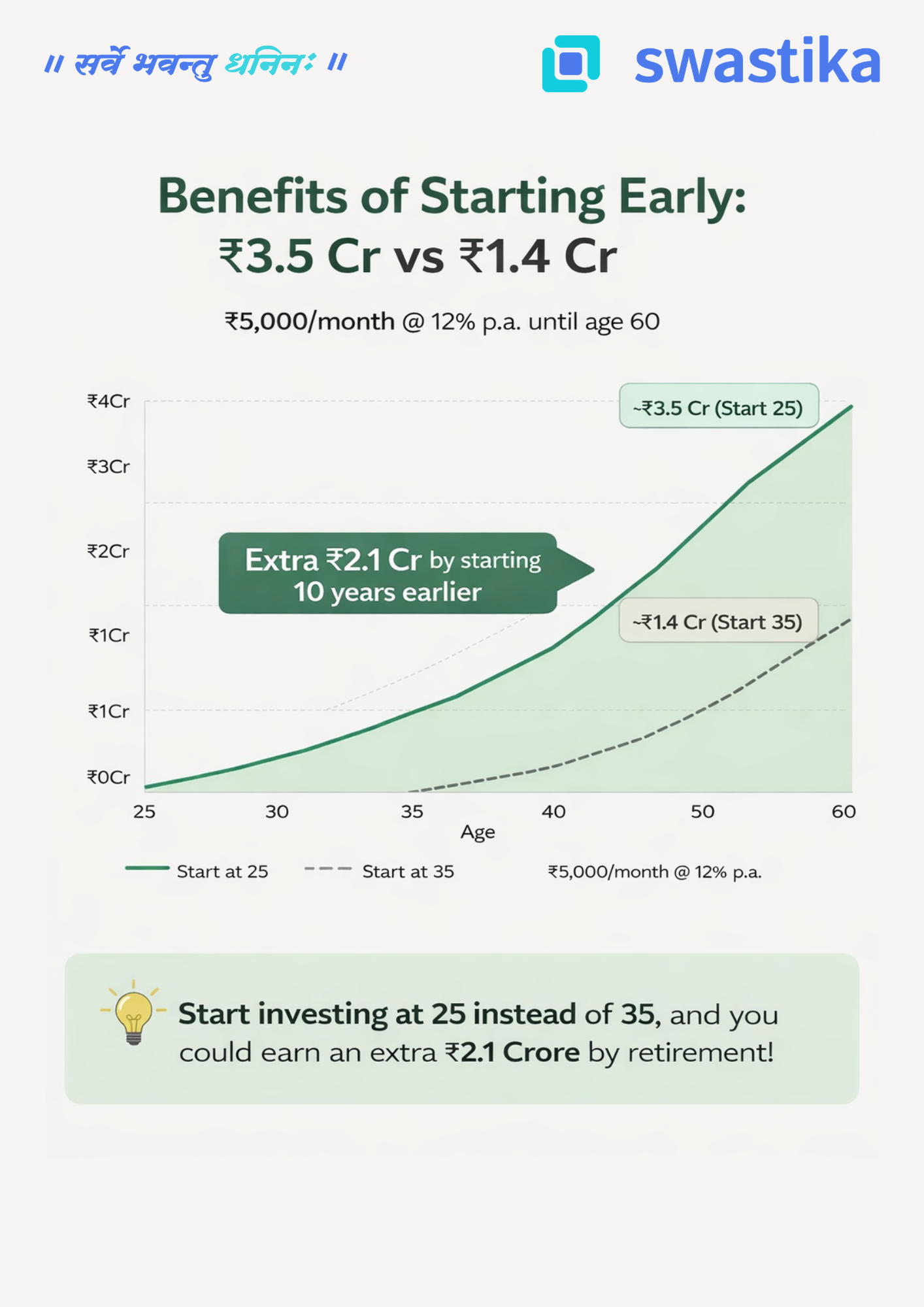
The more years you give your money to grow, the more dramatic — and life-changing — the results become. This is exactly why starting your investment journey early, even with a modest amount, can make a difference of crores by the time you retire.
A Tale of Two Investors: Arjun vs Priya
Let's bring this concept to life with a simple, real-world example.
Meet Arjun and Priya. Both are sensible, disciplined investors. Both invest ₹5,000 every month through a SIP (Systematic Investment Plan) in equity mutual funds, earning an average annual return of 12%. Both stop investing at age 60.
The only difference? Arjun starts at 25. Priya starts at 35.
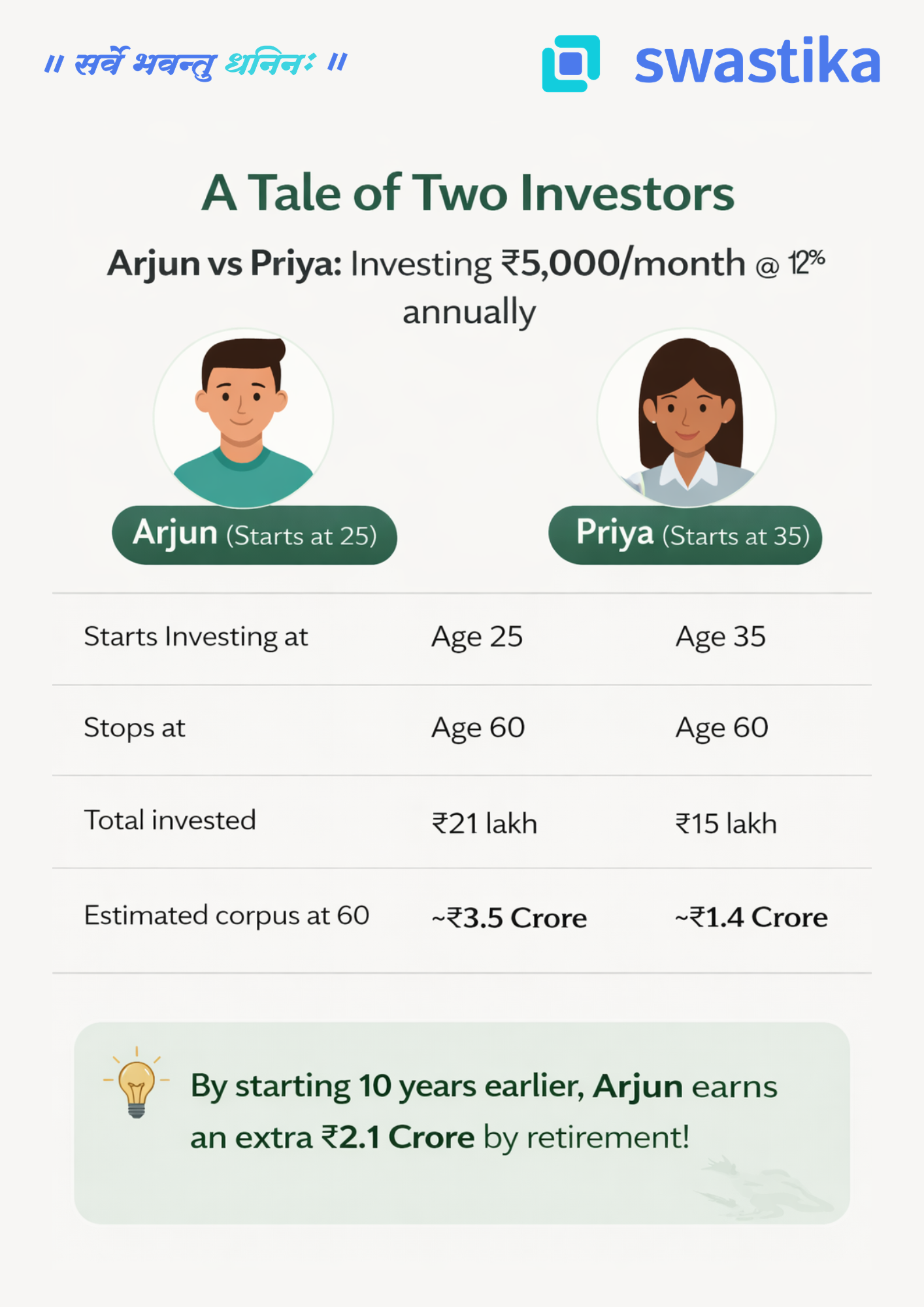
The numbers are striking. Arjun invests just ₹6 lakh more than Priya in absolute terms — yet walks away with ₹2.1 Crore more at retirement.
That extra ₹2.1 Crore didn't come from investing more aggressively or taking bigger risks. It came purely from starting 10 years earlier.
Why Does Time Make Such a Huge Difference?
This is where the magic of compounding reveals itself.
In the early years of investing, growth looks modest and almost unimpressive. But as the years pass, your corpus grows not just on your original investment, but on all the accumulated returns from previous years. The curve goes from almost flat to steeply exponential — and that steep climb happens in the later years.
When Arjun starts at 25, his money has 35 years to ride that exponential curve. Priya's money, starting at 35, only catches the last 25 years — and critically, it misses the steepest part of the climb in the final decade.
Think of it this way: the last 10 years of compounding are worth more than the first 20. That is the counterintuitive truth at the heart of long-term investing.
The Real Cost of Waiting
Many young earners tell themselves, "I'll start investing once I'm more settled — once the salary improves, once the EMI is paid off, once life is a bit easier."
But the numbers show that every year of delay is extraordinarily expensive — far more expensive than any EMI or lifestyle expense. Priya didn't invest carelessly. She invested faithfully for 25 years. Yet she ends up with less than half of what Arjun accumulated — not because she did anything wrong, but simply because she started a decade late.
The cost of waiting 10 years wasn't ₹6 lakh in additional contributions. The cost was ₹2.1 Crore in lost wealth.
Three Principles to Remember
1. Start now, not later.The best time to start investing was yesterday. The second best time is today. Even a SIP of ₹1,000–₹2,000 per month in your 20s is infinitely better than waiting for the "right time."
2. Consistency beats intensity.You don't need to invest large sums all at once. A small, steady, monthly commitment — maintained without interruption — is what unlocks the full power of compounding over decades.
3. Stay invested through market cycles.Compounding works only if you let it work. Exiting during market corrections or stopping your SIP in tough months breaks the chain. Time in the market, not timing the market, is what builds wealth.
The Bottom Line
If you are in your 20s or early 30s, you hold an asset that no amount of money can buy later: time. Use it. Start a SIP today — even a small one. Let compounding do its slow, steady, powerful work.
Because the difference between starting at 25 and starting at 35 is not just 10 years. As Arjun and Priya's story shows, that difference is ₹2.1 Crore.
Big Budget









.webp)
.webp)
.webp)
.webp)
.webp)















.webp)
.webp)
.webp)
.webp)
Latest Articles
.png)
Jewellery Stocks Surge After Gold Import Price Cut: What It Means for Investors Today 6 April 2026


 Add Swastika as preferred source
The Indian stock market witnessed a sharp rally in jewellery stocks after the government reduced the base import prices of gold and silver. This move is expected to lower raw material costs and improve profit margins for jewellery companies. Stocks like Senco Gold Ltd and Kalyan Jewellers India Ltd reacted strongly, reflecting growing investor optimism in the sector.
Key Highlights
- Gold and silver import price cut reduces input costs for jewellers
- Senco Gold shares surged 11 percent, Kalyan Jewellers gained over 5 percent
- Margin expansion expected in upcoming quarters
- Positive sentiment driven by policy support and festive demand outlook
Why Jewellery Stocks Are Rising
Lower Import Prices Improve Margins
Gold is the primary raw material for jewellery companies. When the government reduces base import prices, it directly lowers procurement costs. This leads to better operating margins, especially for companies with strong inventory management.
For example, Senco Gold’s sharp 11 percent rally signals that investors expect immediate earnings improvement. Similarly, Kalyan Jewellers saw steady gains, reflecting confidence in its pan-India retail presence.
Government Policy and Market Impact
The base import price is periodically revised by the government based on global price trends. While it does not change customs duty directly, it influences valuation and tax calculations.
Regulatory bodies like the Securities and Exchange Board of India ensure transparency in such market movements, while the Reserve Bank of India plays a broader role in managing currency stability, which indirectly affects gold prices.
Demand Tailwinds in India
India is one of the largest consumers of gold globally. Demand typically rises during wedding seasons and festivals like Diwali and Akshaya Tritiya. Lower gold prices can further boost consumer buying, benefiting jewellery retailers.
This creates a dual advantage for companies
- Lower input costs
- Higher sales volume
Stock Performance Snapshot
Senco Gold Leads the Rally
Shares of Senco Gold jumped to ₹320.6, gaining around 11 percent in a single session. The rally reflects strong investor expectations around margin expansion and demand recovery.
Kalyan Jewellers Shows Steady Growth
Kalyan Jewellers climbed 5.4 percent to ₹415.65. The company’s strong brand recall and expansion strategy continue to attract long-term investors.
What Should Investors Watch Next
Earnings Growth in Coming Quarters
The real impact of lower gold import prices will be visible in quarterly results. Investors should track
- Gross margin expansion
- Same-store sales growth
- Inventory turnover
Global Gold Price Trends
Even though domestic policies help, global gold prices remain a key driver. Any sharp rise internationally could offset local benefits.
Currency Movements
Since gold is imported, INR volatility plays a crucial role. A stronger rupee further reduces import costs.
Role of Smart Investing Platforms
Navigating such sector-specific opportunities requires strong research and timely insights. Platforms like Swastika Investmart Ltd help investors make informed decisions through
- SEBI-registered advisory services
- Advanced research tools and reports
- User-friendly, tech-enabled trading platforms
- Dedicated customer support
- Focus on investor education
This becomes especially valuable when market movements are driven by policy changes and macroeconomic factors.
FAQs
Why did jewellery stocks rise today
Jewellery stocks surged due to the government reducing base import prices of gold and silver, which lowers costs and improves profit margins.
Is this rally sustainable
It depends on future earnings, global gold prices, and demand trends. If margins improve as expected, the rally could sustain.
Which jewellery stocks benefited the most
Senco Gold and Kalyan Jewellers were among the top gainers, showing strong investor confidence.
Should investors buy jewellery stocks now
Investors should evaluate valuations, earnings outlook, and macro trends before investing. A staggered approach may reduce risk.
Conclusion
The recent surge in jewellery stocks highlights how policy changes can quickly impact market sentiment. Lower gold import prices are a strong positive for the sector, improving both margins and demand outlook. However, investors should remain cautious and track global cues and earnings performance.
For those looking to explore such opportunities with expert guidance, consider using a reliable platform like Swastika Investmart to stay ahead in the market.

CII’s 20-Point Plan: Can It Shield Indian Businesses from Global Supply Shocks? Copy
Add Swastika as preferred source
Summary
- Global conflicts are disrupting supply chains, raising costs for Indian businesses
- MSMEs and exporters are the most vulnerable segments
- CII has proposed a 20-point plan focusing on credit, cost relief, and liquidity
- Government and RBI support will be crucial to stabilize markets
- Investors should track sector-wise impact, especially in energy and exports
Introduction
Global geopolitical tensions, especially in West Asia, are once again testing the resilience of India’s economic ecosystem. Rising oil prices, disrupted shipping routes, and volatile trade flows are creating cost pressures across industries. In response, the Confederation of Indian Industry (CII) has proposed a 20-point action plan to support businesses.
But the key question remains: Can this plan वास्तव में Indian businesses ko global supply shocks se protect kar payega?
Let’s break it down in a simple and practical way.
What Is Driving the Current Supply Chain Stress?
The ongoing conflict in West Asia has triggered multiple disruptions:
- Energy supply uncertainty
- Higher crude oil and gas prices
- Shipping delays due to rerouted trade paths
- Increased insurance and freight costs
India, being heavily dependent on imports for energy, is particularly vulnerable. Around 85–90% of crude oil demand is met through imports, and a significant portion comes from this region.
Real-world example:
When crude oil prices rise, transportation costs increase. This directly impacts everything from FMCG products to construction materials, making goods more expensive for end consumers.
Which Sectors Are Feeling the Heat?
Not all sectors are impacted equally. The pressure is concentrated in:
1. MSMEs (Micro, Small & Medium Enterprises)
- Limited pricing power
- High dependence on working capital
- Vulnerable to input cost fluctuations
MSMEs contribute nearly 30–36% of India’s manufacturing output and about 45% of exports. Any disruption here has a multiplier effect on the economy.
2. Export-Oriented Businesses
- Facing delays in shipments
- Rising logistics costs
- Currency volatility risks
3. Energy-Intensive Industries
- Steel
- Cement
- Chemicals
For these sectors, even a small rise in input costs can significantly impact margins.
Key Challenges Businesses Are Facing
The current situation has created multiple operational and financial challenges:
- Rising fuel and logistics expenses
- Shortage of key raw materials like gas and chemicals
- Increased working capital requirements
- Pressure on export commitments and timelines
Market impact:
These factors can lead to lower corporate earnings, which often results in stock price corrections, especially in cyclical sectors.
What Does CII’s 20-Point Plan Propose?
CII’s recommendations focus on three key pillars: liquidity, cost relief, and operational flexibility.
1. Credit Support Measures
- Collateral-free loans backed by government guarantees
- Focus on MSMEs and export-driven sectors
This step aims to ensure businesses have access to funds during stress periods.
2. Loan Relief Initiatives
- Temporary moratorium on loan repayments
- Restructuring options for stressed companies
This can prevent defaults and reduce financial pressure.
3. RBI Intervention
- Special refinance windows
- Measures to ensure affordable credit flow
Liquidity support from the central bank can stabilize financial markets.
4. Cost Reduction Strategies
- Lower import duties on energy inputs like LNG
- Temporary reduction in electricity tariffs
This directly reduces production costs for industries.
5. Operational Flexibility
- Extension of government contract deadlines
- Reduction in bank guarantees and security deposits
This helps businesses manage execution risks without penalties.
Can This Plan Really Work?
The effectiveness of the plan depends on timely implementation and coordination between policymakers.
Positive Factors
- Immediate liquidity support can prevent business closures
- Cost relief measures can stabilize margins
- RBI backing can improve credit availability
Limitations
- Global factors like oil prices are beyond domestic control
- Supply chain disruptions may persist longer than expected
- Smaller businesses may still struggle with demand slowdown
Historical context:
During the COVID-19 pandemic, similar liquidity and credit support measures helped businesses survive, but recovery took time. A similar pattern could play out here.
Impact on Indian Stock Markets
From an investor’s perspective, supply chain disruptions create both risks and opportunities.
Sectors That May Face Pressure
- Auto and ancillary (due to input cost rise)
- Aviation (fuel costs)
- MSME-heavy segments
Sectors That May Benefit
- Oil and gas companies (higher realizations)
- Domestic-focused businesses with low import dependence
Investor insight:
Market volatility tends to increase during such global uncertainties. However, long-term investors often find opportunities in fundamentally strong stocks during corrections.
What Should Investors Do Now?
- Focus on companies with strong balance sheets
- Prefer businesses with pricing power
- Diversify across sectors to reduce risk
- Track policy announcements from RBI and government
A disciplined investment approach becomes even more important in such uncertain times.
FAQs
1. What is the main goal of CII’s 20-point plan?
The plan aims to provide liquidity, reduce costs, and support businesses facing supply chain disruptions.
2. Which sectors are most affected by global supply shocks?
MSMEs, exporters, and energy-intensive industries are the most impacted.
3. Will this impact stock markets in India?
Yes, increased costs and uncertainty can lead to market volatility, especially in affected sectors.
4. Can government measures fully control the situation?
They can reduce the impact, but global factors like oil prices remain outside domestic control.
5. How should investors respond to such situations?
Investors should stay diversified, focus on quality stocks, and avoid panic-driven decisions.
Conclusion
The ongoing global supply disruptions highlight how interconnected today’s economies are. CII’s 20-point plan is a timely step that focuses on providing immediate relief to businesses, especially MSMEs and exporters. While it may not completely eliminate the impact of global shocks, it can certainly cushion the downside and support economic stability.
For investors, this phase calls for cautious optimism. Market volatility may continue, but it also opens doors to long-term opportunities in strong businesses.
If you are looking to navigate such market conditions with expert research, advanced tools, and reliable support, consider starting your investment journey with Swastika Investmart.

Strong Growth Trends in Banking Stocks: AU Small Finance Bank & RBL Bank in Focus
Add Swastika as preferred source
Quick Summary
- AU Small Finance Bank and RBL Bank have reported strong growth in deposits and advances
- Credit growth remains healthy despite global uncertainties
- Banking sector resilience is supporting overall market stability
- Asset quality and CASA growth are key factors to watch
- Investors should focus on fundamentals and long-term trends
Introduction
The Indian banking sector has been showing remarkable resilience even in a volatile global environment. Amid rising geopolitical tensions and supply chain disruptions, domestic-focused financial institutions are emerging as relative outperformers.
Two such banks that have recently come into focus are AU Small Finance Bank and RBL Bank. Both have reported strong growth in deposits and advances, indicating improving business momentum.
But what is driving this growth, and does it signal a broader trend in banking stocks?
Understanding the Growth Momentum in Banking Stocks
India’s banking sector is closely linked to economic activity. When credit demand rises, it often reflects improving consumption, investment, and business confidence.
In recent months, several factors have supported banking growth:
- Strong retail loan demand
- Increased government spending on infrastructure
- Stable interest rate environment
- Improved balance sheets post NPA clean-up
This has created a favorable backdrop for banks to expand their loan books while maintaining asset quality.
AU Small Finance Bank: Consistent Growth Story
AU Small Finance Bank continues to deliver steady performance across key metrics.
Key Highlights
- Deposits grew around 22.8 percent year on year to approximately ₹1.5 lakh crore
- CASA deposits increased nearly 19.6 percent
- Advances rose about 25 percent to ₹1.3 lakh crore
What This Means
Strong deposit growth indicates customer trust and stable funding. At the same time, higher advances show that the bank is successfully deploying capital.
Real-world insight:
A growing CASA ratio helps reduce the cost of funds, which directly improves profitability for banks.
AU Small Finance Bank has also focused on retail lending and diversified its portfolio, which reduces risk concentration.
RBL Bank: Revival and Growth in Focus
RBL Bank has gone through a transition phase over the past few years, but recent numbers suggest a positive turnaround.
Key Highlights
- Total business grew around 24 percent year on year to ₹2.5 lakh crore
- Advances increased by 22 percent
- Deposits rose by 25 percent
What Is Driving This Growth
- Improved governance and management focus
- Better asset quality control
- Balanced growth between retail and wholesale segments
RBL Bank’s recovery highlights how strategic changes and regulatory oversight can restore investor confidence.
Why Deposit Growth Matters More Than Ever
Deposits are the backbone of any banking institution. In a rising interest rate environment, banks with strong deposit franchises have a clear advantage.
Key Benefits of Strong Deposits
- Lower cost of funds
- Better liquidity position
- Ability to lend more competitively
Both AU Small Finance Bank and RBL Bank have demonstrated healthy deposit growth, which strengthens their long-term outlook.
Impact on Indian Stock Markets
Banking stocks play a significant role in India’s benchmark indices. Strong performance in this sector often supports overall market sentiment.
Positive Signals for Investors
- Healthy credit growth indicates economic stability
- Strong banking performance supports index levels
- Improved asset quality reduces systemic risk
Risks to Watch
- Rising interest rates can impact loan demand
- Global uncertainties may affect capital flows
- Any deterioration in asset quality can pressure valuations
Market context:
Historically, banking stocks tend to lead market recoveries after periods of volatility. This makes them an important sector for investors to track.
Regulatory Environment and RBI’s Role
The Reserve Bank of India plays a crucial role in maintaining banking stability.
Recent regulatory focus areas include:
- Maintaining adequate capital adequacy ratios
- Monitoring asset quality and NPAs
- Ensuring liquidity in the system
Banks like AU Small Finance Bank and RBL Bank have aligned well with these regulatory expectations, which adds to their credibility.
What Should Investors Look At Before Investing
Before investing in banking stocks, it is important to evaluate:
1. Asset Quality
Low NPAs indicate better loan recovery and lower risk.
2. CASA Ratio
Higher CASA improves profitability.
3. Credit Growth
Sustainable loan growth reflects strong demand.
4. Management Quality
Consistent strategy and governance are key for long-term success.
A balanced approach helps investors make informed decisions rather than chasing short-term momentum.
How Swastika Investmart Supports Smart Investing
In a dynamic market environment, having the right guidance and tools can make a big difference.
Swastika Investmart, a SEBI registered stock broker, offers:
- Advanced research tools for stock analysis
- Strong customer support for investors
- Tech-enabled platforms for seamless trading
- Investor education to help make informed decisions
These features help investors navigate market trends with confidence.
FAQs
1. Why are banking stocks performing well recently?
Strong credit growth, improved asset quality, and stable economic conditions are supporting banking sector performance.
2. Is AU Small Finance Bank a good long-term investment?
It has shown consistent growth in deposits and advances, making it a strong candidate for long-term consideration, subject to individual risk appetite.
3. What is driving RBL Bank’s turnaround?
Improved governance, better asset quality management, and balanced growth strategy are key factors.
4. How do interest rates impact banking stocks?
Higher rates can improve margins but may slow down loan demand if they rise too much.
5. What should investors monitor in banking stocks?
Key factors include asset quality, deposit growth, credit expansion, and regulatory compliance.
Conclusion
The strong growth trends in AU Small Finance Bank and RBL Bank highlight the underlying strength of India’s banking sector. Despite global uncertainties, domestic-focused banks continue to benefit from rising credit demand and improving financial stability.
For investors, banking stocks remain a critical part of portfolio allocation, offering both growth and stability when chosen carefully.
If you are looking to explore such opportunities with reliable research and a seamless investing experience, you can get started with Swastika Investmart.
.png)
Stock Market Midday Live Updates 6 April 2026: Nifty Bank Strong Momentum Above 52,000 and What’s Driving the Rally?
Add Swastika as preferred source
The Nifty Bank index is showing strong upward momentum, trading above the crucial 52,000 mark. With steady gains during the session, the index reflects renewed investor confidence in India’s banking sector. This rally comes amid improving macroeconomic signals, stable interest rates, and continued institutional participation.
For traders and long-term investors alike, this move signals potential strength in financial stocks, which often act as a backbone of the broader market.
Key Takeaways
- Nifty Bank trades above 52,000 with solid intraday gains
- PSU and private banks both contributing to the rally
- Strong institutional buying supports upward momentum
- Positive macro trends and RBI policy stability aiding sentiment
What’s Driving the Nifty Bank Rally?
Strong Institutional Participation
Foreign Institutional Investors and Domestic Institutional Investors have shown renewed interest in banking stocks. This is a crucial signal because FIIs often drive large-cap movements in indices like Nifty Bank.
The recent buying trend suggests confidence in India’s economic growth outlook and banking sector fundamentals.
Stable RBI Policy Outlook
The Reserve Bank of India (RBI) has maintained a relatively stable stance on interest rates. A predictable rate environment helps banks manage margins effectively.
Lower volatility in policy decisions also improves investor sentiment, especially for rate-sensitive sectors like banking.
Improved Asset Quality
Indian banks have significantly cleaned up their balance sheets over the past few years. Non-performing assets have reduced, and credit growth remains healthy.
This improvement boosts earnings visibility and strengthens long-term valuations.
Credit Growth Momentum
Retail lending, MSME financing, and infrastructure credit demand continue to rise. This sustained credit growth is a key earnings driver for banks.
Sector-Wise Performance Snapshot
Private Banks Leading the Charge
Large private sector banks are driving the index higher. Strong quarterly expectations and stable net interest margins are supporting stock prices.
PSU Banks Gaining Strength
Public sector banks are no longer laggards. With improved governance and capital adequacy, PSU banks are attracting both retail and institutional investors.
Technical Outlook for Nifty Bank
From a technical perspective, the index has broken past a key resistance zone near 51,500. Sustaining above 52,000 could open the door for further upside toward 52,500–53,000 levels.
Support levels are now seen near 51,500, making it a crucial zone for short-term traders.
How Should Investors Approach This Rally?
For Short-Term Traders
Momentum traders can look for buying opportunities on dips. However, maintaining stop-loss discipline is essential due to potential volatility.
For Long-Term Investors
Long-term investors should focus on fundamentally strong banks with consistent earnings growth. Banking remains a core sector in India’s growth story.
Role of SEBI and Market Transparency
The Securities and Exchange Board of India (SEBI) plays a critical role in maintaining market integrity. Regulations around disclosures, insider trading, and corporate governance ensure that investors can trust market movements.
This transparency strengthens participation and supports sustained rallies like the current one.
Where Swastika Investmart Adds Value
For investors navigating such market trends, Swastika Investmart offers a strong edge:
- SEBI-registered broker ensuring compliance and trust
- Advanced research tools and advisory insights
- Reliable customer support for retail investors
- Tech-driven platform for seamless trading
- Strong focus on investor education
Their insights can help investors make informed decisions, especially during high-momentum phases like the current Nifty Bank rally.
Frequently Asked Questions
What is Nifty Bank?
Nifty Bank is an index that tracks the performance of major banking stocks listed on the NSE, including both private and public sector banks.
Why is Nifty Bank rising today?
The rally is driven by institutional buying, stable RBI policy outlook, improved asset quality, and strong credit growth.
Is this a good time to invest in banking stocks?
It depends on your investment horizon. Long-term investors may benefit from sector growth, while short-term traders should watch technical levels closely.
What risks should investors consider?
Key risks include interest rate changes, global economic uncertainty, and sudden FII outflows.
Final Thoughts
The Nifty Bank index crossing 52,000 is more than just a number. It reflects improving fundamentals, strong institutional backing, and confidence in India’s banking system.
While the momentum looks promising, disciplined investing remains key. Tracking macro trends, RBI policy signals, and sector earnings will help investors stay ahead.
If you want to take advantage of such opportunities with expert-backed insights, you can explore trading and investing with Swastika Investmart:
.png)
HDFC Bank Meltdown? FIIs Offload ₹48 Cr Shares as Stock Sees Massive 26% Fall
Add Swastika as preferred source
The recent buzz around HDFC Bank meltdown has caught the attention of investors across India. With Foreign Institutional Investors offloading ₹48 crore worth of shares and the stock witnessing a sharp 26% decline, market participants are asking one key question: Is this a temporary correction or a deeper concern?
Let’s break down what’s really happening and what it means for investors.
Key Takeaways
- HDFC Bank stock has corrected nearly 26% amid FII selling pressure
- Profit booking and valuation concerns are major triggers
- Banking sector fundamentals remain stable despite short-term volatility
- Long-term investors may find opportunities in corrections
What Triggered the HDFC Bank Stock Fall?
The sharp decline in HDFC Bank is largely linked to aggressive selling by Foreign Institutional Investors. FIIs play a crucial role in Indian markets, and even moderate selling can create ripple effects due to sentiment shifts.
FII Selling Pressure
FIIs reportedly offloaded shares worth ₹48 crore in a short span. While this may not seem massive relative to the bank’s size, it signals cautious global sentiment toward emerging markets, including India.
Valuation Concerns
HDFC Bank has historically traded at premium valuations compared to peers. With rising interest rates globally and tighter liquidity conditions, investors often rebalance portfolios, moving funds from high-valuation stocks to safer or undervalued options.
Post-Merger Adjustments
Following the HDFC Ltd merger, integration challenges and balance sheet adjustments have also influenced investor perception. While the merger strengthens long-term fundamentals, short-term uncertainties can weigh on stock performance.
Is This a Structural Problem or Temporary Correction?
It is important to distinguish between panic-driven narratives and actual financial stress.
Strong Fundamentals Remain Intact
Despite the correction, HDFC Bank continues to maintain:
- Healthy asset quality
- Strong capital adequacy
- Consistent earnings growth
Regulatory oversight by Securities and Exchange Board of India and Reserve Bank of India ensures that large banks operate within strict risk frameworks, reducing the likelihood of systemic issues.
Market Cycles Are Normal
Corrections of 15–30% are not unusual in equity markets, especially after prolonged rallies. In fact, such phases often reset valuations and create better entry points for long-term investors.
Impact on the Indian Banking Sector
The fall in HDFC Bank stock has also impacted broader banking indices, given its significant weightage. However, the overall sector outlook remains stable.
Spillover Effect
Large-cap stocks like HDFC Bank influence index movements. A sharp fall can drag indices down even if other banks remain stable.
Investor Sentiment
Short-term sentiment may turn cautious, but domestic institutional investors often step in during such corrections, providing support to fundamentally strong stocks.
What Should Investors Do Now?
Avoid Panic Selling
Reacting emotionally to market volatility can lead to poor investment decisions. Instead, assess whether the company’s fundamentals have changed.
Focus on Long-Term Goals
If your investment horizon is long-term, short-term price swings should not derail your strategy.
Use Corrections as Opportunities
Many seasoned investors view corrections as buying opportunities, especially in fundamentally strong companies like HDFC Bank.
Platforms like Swastika Investmart offer research-backed insights, advanced tools, and reliable advisory support to help investors navigate such volatile phases with confidence.
Frequently Asked Questions
Why did HDFC Bank stock fall 26%?
The fall is primarily due to FII selling, valuation concerns, and short-term uncertainties post-merger.
Is HDFC Bank fundamentally weak now?
No, the bank continues to have strong fundamentals, stable asset quality, and robust earnings.
Should I invest in HDFC Bank after the fall?
It depends on your investment horizon. Long-term investors may consider accumulating during corrections after proper analysis.
How do FIIs impact stock prices?
FIIs influence market sentiment and liquidity. Large buying or selling activity can significantly move stock prices.
Conclusion
The so-called HDFC Bank meltdown appears more like a market-driven correction than a fundamental breakdown. While FII selling and valuation adjustments have triggered a sharp fall, the bank’s core strength remains intact.
For investors, this phase highlights the importance of staying informed, avoiding panic, and focusing on long-term wealth creation. If you are looking for expert guidance and a tech-enabled investing experience, consider exploring opportunities with Swastika Investmart.
Start your investment journey here:
.png)
Market Opening Updates for Today 6 April 2026: Nifty 50, Sensex, Bank Nifty Signal Strong Recovery and Volatility Ahead?
Add Swastika as preferred source
The India stock market outlook April 6, 2026 signals a cautious start as global tensions and macroeconomic uncertainty continue to influence investor sentiment. After a brief rebound, benchmark indices like Nifty 50 and Sensex are expected to face pressure, driven largely by geopolitical developments and energy price concerns.
For Indian investors, this is a time to stay informed, avoid impulsive decisions, and focus on fundamentally strong opportunities.
Key Takeaways
- Nifty 50 and Sensex may open weak amid global uncertainty
- Banking and IT sectors show relative resilience
- Geopolitical tensions remain a major market driver
- Long-term investors can find selective buying opportunities
Market Overview: What’s Driving the Trend?
The Indian equity market is entering the new week with mixed signals. While domestic fundamentals remain stable, global cues are creating short-term volatility.
The ongoing geopolitical tensions, especially involving energy-producing regions, are pushing crude oil prices higher. This directly impacts inflation expectations in India, which is closely monitored by the Reserve Bank of India.
Higher inflation could delay rate cuts, affecting market liquidity and valuations.
At the same time, foreign institutional investors are showing cautious behavior, leading to intermittent selling pressure.
Sector-Wise Performance Outlook
Banking and Financial Services
The Nifty Bank index has shown relative strength. Strong balance sheets and improving credit growth support the sector. However, rising bond yields may impact margins in the short term.
IT Sector
The IT sector is witnessing mild gains, supported by a stable US outlook. Companies with strong deal pipelines are likely to outperform.
Pharma and FMCG
Defensive sectors like pharma and FMCG are gaining attention. Investors often shift to these sectors during uncertain times for stability.
Metals and Auto
Metal stocks remain sensitive to global demand and commodity prices. Auto stocks may face pressure if fuel prices continue to rise.
Global Factors Impacting Indian Markets
The Indian stock market does not operate in isolation. Several global factors are shaping the India stock market outlook April 6, 2026:
- Rising crude oil prices due to geopolitical tensions
- US Federal Reserve policy expectations
- Currency fluctuations impacting import costs
- Global equity market sentiment
These elements create a ripple effect, influencing both institutional and retail investors in India.
Regulatory Environment and Investor Confidence
Market stability in India is strongly supported by regulatory bodies like the Securities and Exchange Board of India. SEBI’s strict norms ensure transparency and protect investor interests.
Additionally, RBI’s monetary policies play a key role in controlling inflation and maintaining liquidity.
For investors, understanding these regulatory frameworks helps in making informed decisions rather than reacting emotionally to short-term volatility.
Investment Strategy for April 2026
Given the current outlook, investors should adopt a balanced approach:
Focus on Quality Stocks
Companies with strong earnings visibility and low debt are better positioned to weather volatility.
Avoid Overleveraging
Using excessive margin during uncertain times can amplify losses.
Diversify Portfolio
Spread investments across sectors to reduce risk.
Stay Updated
Track global developments and policy announcements regularly.
Platforms like Swastika Investmart offer research-backed insights, helping investors navigate such uncertain phases with confidence.
How Swastika Investmart Adds Value
In volatile markets, having the right partner matters. Swastika Investmart stands out with:
- SEBI-registered credibility
- Advanced research and advisory tools
- Reliable customer support
- Tech-driven trading platform
- Strong focus on investor education
These features empower both new and experienced investors to make smarter decisions.
Frequently Asked Questions
What is the India stock market outlook for April 6, 2026?
The market is expected to open cautiously due to global uncertainties, particularly geopolitical tensions and rising oil prices.
Which sectors are safer during market volatility?
Defensive sectors like FMCG and pharma tend to perform better during uncertain conditions.
Should investors buy stocks during market dips?
Yes, but selectively. Focus on fundamentally strong companies with long-term growth potential.
How do RBI policies affect the stock market?
RBI policies influence interest rates, liquidity, and inflation, all of which directly impact stock valuations.
Conclusion
The India stock market outlook April 6, 2026 highlights a phase of short-term volatility driven by global factors. While the near-term trend may remain uncertain, India’s strong economic fundamentals continue to support long-term growth.
Investors should remain patient, disciplined, and focused on quality investments rather than reacting to daily market swings.
If you are looking to navigate the markets with expert guidance, consider exploring opportunities with Swastika Investmart.


.webp)
.webp)

.webp)





START YOUR INVESTMENT JOURNEY
Get personalized advice from our experts
- Dedicated RM Support
- Smooth and Fast Trading App
