

The Power of Compounding – Why Starting Early Matters




Introduction
Albert Einstein reportedly called compound interest the "eighth wonder of the world." Whether or not he actually said it, the math is undeniable. Compounding is the process where your investment returns begin earning their own returns — and over time, this snowball effect becomes truly extraordinary.
The catch? Compounding needs one essential ingredient: time.
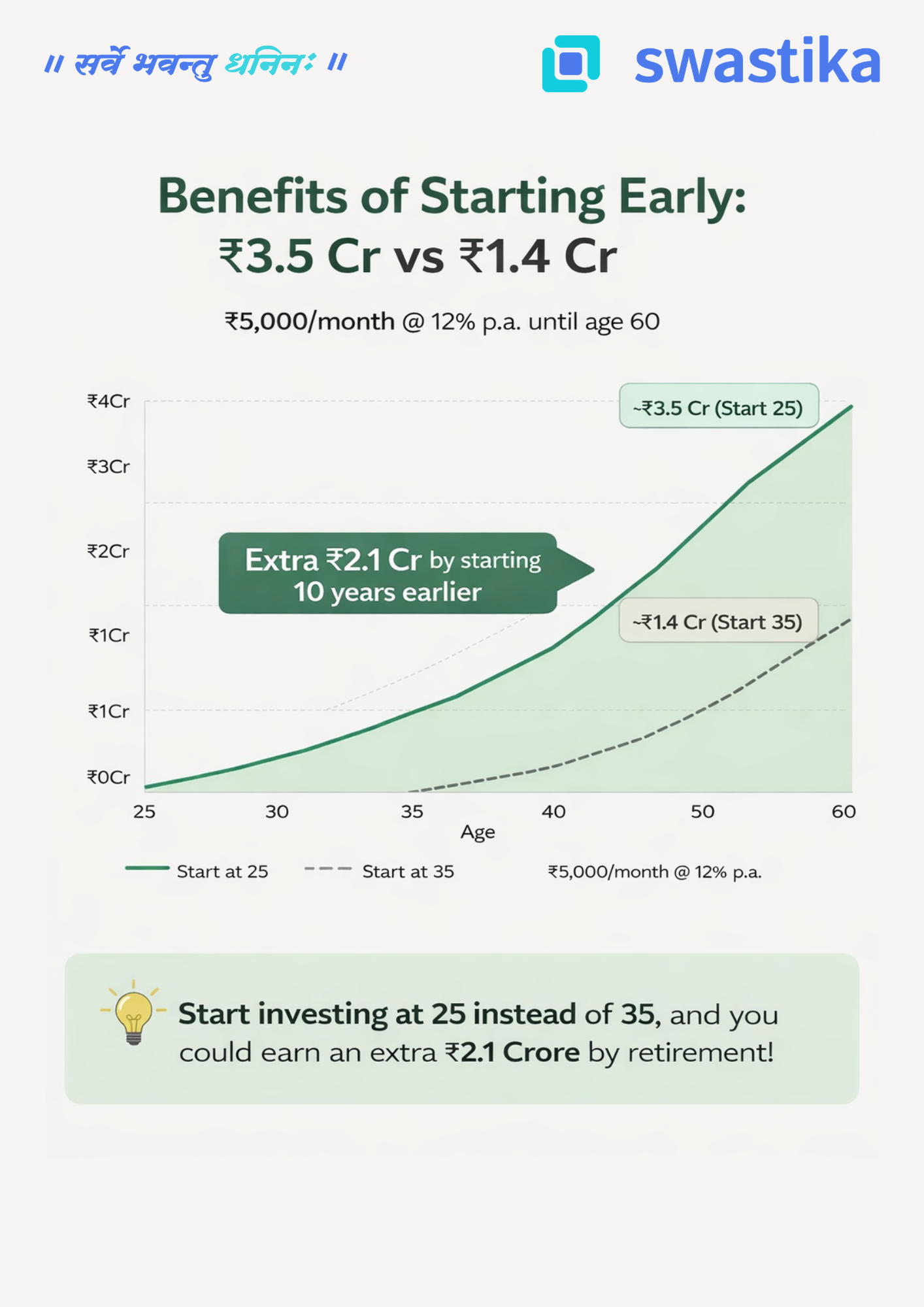
The more years you give your money to grow, the more dramatic — and life-changing — the results become. This is exactly why starting your investment journey early, even with a modest amount, can make a difference of crores by the time you retire.
A Tale of Two Investors: Arjun vs Priya
Let's bring this concept to life with a simple, real-world example.
Meet Arjun and Priya. Both are sensible, disciplined investors. Both invest ₹5,000 every month through a SIP (Systematic Investment Plan) in equity mutual funds, earning an average annual return of 12%. Both stop investing at age 60.
The only difference? Arjun starts at 25. Priya starts at 35.
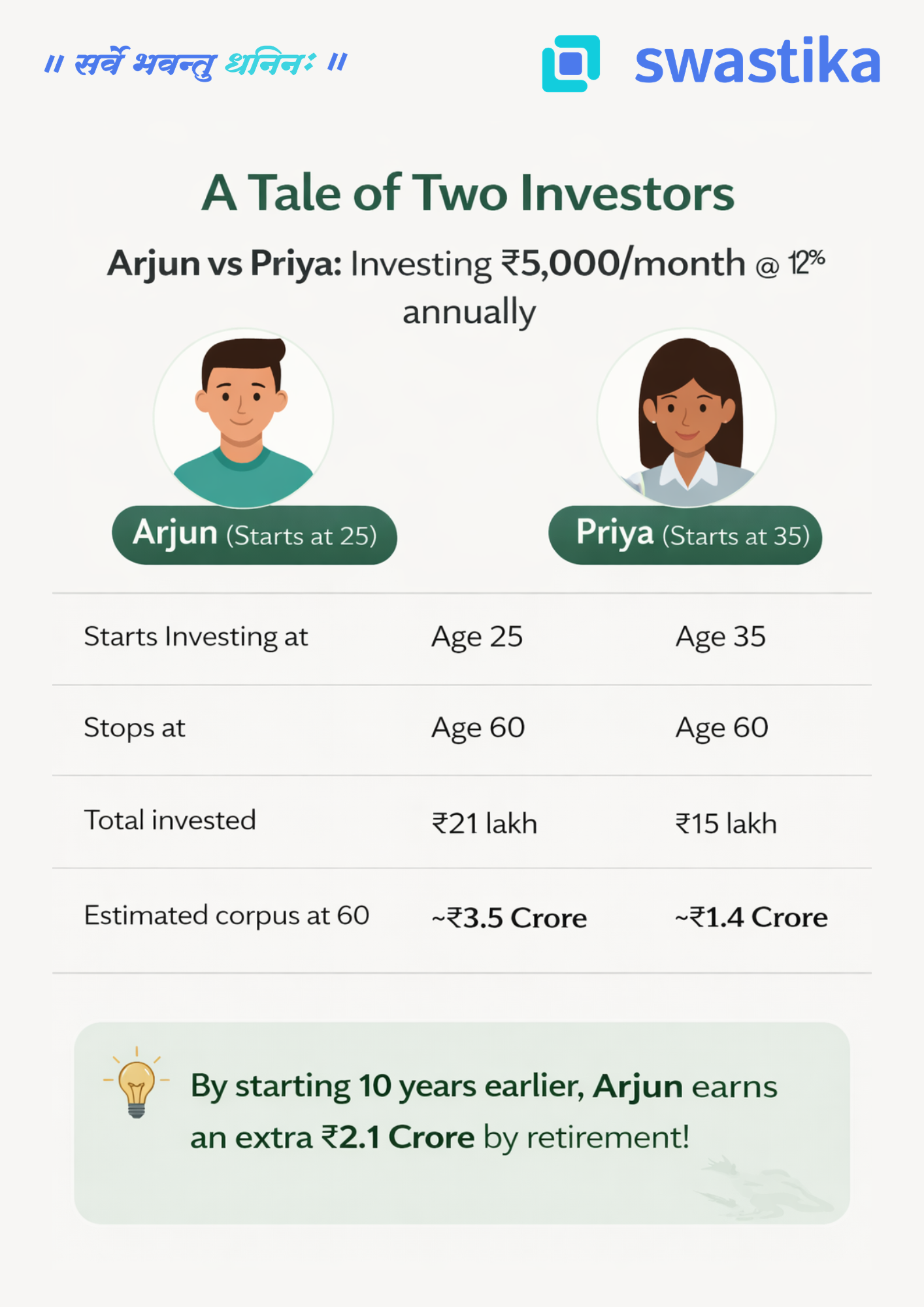
The numbers are striking. Arjun invests just ₹6 lakh more than Priya in absolute terms — yet walks away with ₹2.1 Crore more at retirement.
That extra ₹2.1 Crore didn't come from investing more aggressively or taking bigger risks. It came purely from starting 10 years earlier.
Why Does Time Make Such a Huge Difference?
This is where the magic of compounding reveals itself.
In the early years of investing, growth looks modest and almost unimpressive. But as the years pass, your corpus grows not just on your original investment, but on all the accumulated returns from previous years. The curve goes from almost flat to steeply exponential — and that steep climb happens in the later years.
When Arjun starts at 25, his money has 35 years to ride that exponential curve. Priya's money, starting at 35, only catches the last 25 years — and critically, it misses the steepest part of the climb in the final decade.
Think of it this way: the last 10 years of compounding are worth more than the first 20. That is the counterintuitive truth at the heart of long-term investing.
The Real Cost of Waiting
Many young earners tell themselves, "I'll start investing once I'm more settled — once the salary improves, once the EMI is paid off, once life is a bit easier."
But the numbers show that every year of delay is extraordinarily expensive — far more expensive than any EMI or lifestyle expense. Priya didn't invest carelessly. She invested faithfully for 25 years. Yet she ends up with less than half of what Arjun accumulated — not because she did anything wrong, but simply because she started a decade late.
The cost of waiting 10 years wasn't ₹6 lakh in additional contributions. The cost was ₹2.1 Crore in lost wealth.
Three Principles to Remember
1. Start now, not later.The best time to start investing was yesterday. The second best time is today. Even a SIP of ₹1,000–₹2,000 per month in your 20s is infinitely better than waiting for the "right time."
2. Consistency beats intensity.You don't need to invest large sums all at once. A small, steady, monthly commitment — maintained without interruption — is what unlocks the full power of compounding over decades.
3. Stay invested through market cycles.Compounding works only if you let it work. Exiting during market corrections or stopping your SIP in tough months breaks the chain. Time in the market, not timing the market, is what builds wealth.
The Bottom Line
If you are in your 20s or early 30s, you hold an asset that no amount of money can buy later: time. Use it. Start a SIP today — even a small one. Let compounding do its slow, steady, powerful work.
Because the difference between starting at 25 and starting at 35 is not just 10 years. As Arjun and Priya's story shows, that difference is ₹2.1 Crore.
Big Budget










.webp)
.webp)
.webp)
.webp)
.webp)
















.webp)
.webp)
.webp)
.webp)
Latest Articles
.webp)
Stocks in News Today 6 April 2026: LG Electronics, AU Small Finance Bank, RBL Bank, Nalco News


 Add Swastika as preferred source
The stocks in news India April 6 2026 highlight strong business momentum across sectors like consumer durables, banking, and metals. From impressive sales milestones to robust balance sheet growth, these updates provide valuable signals for investors tracking short-term trends and long-term opportunities.
Understanding these developments can help investors align their strategies with evolving market dynamics, especially in a data-driven environment shaped by RBI policies and SEBI regulations.
Key Takeaways
- LG Electronics crossed a major sales milestone in air conditioners
- AU Small Finance Bank reported strong deposit and loan growth
- RBL Bank posted healthy FY26 business expansion
- Nalco saw sharp growth in alumina sales, boosting outlook
LG Electronics: Strong Demand in Consumer Durables
Sales Momentum Signals Sector Strength
LG Electronics achieved a milestone by crossing 1 million air conditioner unit sales in Q1 CY2026. This reflects strong consumer demand, especially during early summer months.
India’s rising middle class, increasing disposable income, and growing urbanization are driving demand for cooling appliances. Additionally, energy efficiency norms under the Bureau of Energy Efficiency continue to push premium product adoption.
What It Means for Investors
- Indicates robust demand in consumer durables
- Positive for companies with strong distribution networks
- Seasonal tailwinds could support near-term revenue growth
AU Small Finance Bank: Deposit Growth Stands Out
Strong Balance Sheet Expansion
AU Small Finance Bank reported a 22.8 percent YoY increase in deposits, reaching ₹1.5 lakh crore. CASA deposits also grew by nearly 20 percent, showing improved funding quality.
Loan growth remains strong at 25 percent, reflecting healthy credit demand across retail and MSME segments.
Regulatory Context
The Reserve Bank of India continues to monitor liquidity and lending standards closely. Banks maintaining a strong CASA ratio and prudent lending practices are better positioned in this environment.
Investor Insight
- High deposit growth supports lending expansion
- CASA improvement enhances profitability margins
- Strong fundamentals align with long-term banking sector growth
RBL Bank: Balanced Growth Across Segments
Business Growth Gains Momentum
RBL Bank reported 24 percent YoY growth in total business, reaching ₹2.5 lakh crore. Advances grew by 22 percent, while deposits rose by 25 percent.
This balanced growth suggests improving asset quality and better risk management, which are crucial in the current interest rate cycle.
Market Perspective
Banks with diversified loan books and stable deposit growth tend to outperform during uncertain macroeconomic conditions.
What Investors Should Watch
- Asset quality trends in upcoming quarters
- Net interest margin stability
- Impact of RBI policy changes on lending rates
National Aluminium Company: Metals Sector in Focus
Alumina Sales Drive Growth
Nalco reported a 30.7 percent surge in alumina sales, while aluminium sales grew modestly at 2.8 percent. This divergence highlights strong demand in raw material segments.
India’s push toward infrastructure and manufacturing under initiatives like Make in India continues to support metals demand.
Sectoral Insight
- Alumina demand often leads aluminium production cycles
- Global commodity prices remain a key driver
- Government policies can influence export and pricing dynamics
How These Stocks Fit into Market Trends
The stocks in news India April 6 2026 reflect broader themes shaping the market:
- Consumer demand recovery supporting durable goods
- Banking sector resilience driven by credit growth
- Metals sector benefiting from industrial expansion
Platforms like Swastika Investmart help investors track such developments with research-backed insights, making it easier to interpret market signals and make informed decisions.
As a SEBI-registered broker, Swastika Investmart offers a tech-enabled investing platform along with strong advisory support, helping both beginners and experienced investors navigate market opportunities.
Frequently Asked Questions
What are stocks in news and why do they matter
Stocks in news are companies that have recent developments impacting their business. These updates often influence short-term price movements and investor sentiment.
Should I invest based on news alone
No. News should be combined with fundamental and technical analysis before making investment decisions.
How does RBI policy affect banking stocks
RBI policies impact interest rates, liquidity, and lending norms, which directly affect bank profitability and growth.
Are metal stocks good for long-term investment
Metal stocks can be cyclical. Long-term investment depends on global demand, pricing trends, and government policies.
Conclusion
The latest updates from LG Electronics, AU Small Finance Bank, RBL Bank, and Nalco highlight strong sectoral momentum across consumer, banking, and metals industries. These developments provide useful cues for investors tracking market trends in FY26.
Staying informed about such stocks in news India April 6 2026 can help you identify emerging opportunities and manage risks effectively.
If you want deeper insights, expert research, and a reliable investing experience, explore Swastika Investmart’s platform here
.webp)
Share Market Setup Today 6 April 2026: Nifty, Bank Nifty Outlook, understanding key levels, FII activity, and derivatives data
Add Swastika as preferred source
The stock market outlook today India reflects a cautious and slightly bearish tone, with mixed global cues and continued pressure from foreign institutional investors. As traders and investors prepare for the session, understanding key levels, FII activity, and derivatives data becomes crucial for informed decision-making.
Quick Takeaways
- Global markets remain mixed, offering limited directional cues
- FIIs continue selling, putting pressure on indices
- Nifty shows early signs of bear fatigue but trend remains weak
- Key support at 22500 and resistance near 22940
Global Market Overview
The global backdrop remains uncertain. US markets ended on a mixed note, with slight weakness in the Dow. Asian markets are also trading without a clear direction, reflecting investor caution.
For Indian markets, GIFT Nifty indicates a negative opening bias, suggesting a soft start to the trading session. This aligns with the broader trend of cautious sentiment across global equities.
FII and DII Activity: What It Signals
Foreign Institutional Investors have remained aggressive sellers, offloading nearly ₹9931 crore in the cash market. On the other hand, Domestic Institutional Investors provided some support by buying ₹7208 crore worth of equities.
The net outflow of ₹2723 crore highlights continued pressure from global investors. This trend is important because FIIs often influence short-term market direction, especially in large-cap stocks.
Derivatives Data Insights
- Nifty PCR stands at 1.09, indicating slightly bullish positioning but not strong conviction
- India VIX rose to 25.52, signaling increased volatility
- Highest Open Interest seen at 24000 Call and 20200 Put
- Max Pain level is at 22800, suggesting a likely consolidation zone
Interestingly, FII data in derivatives shows mixed positioning. There is strong buildup in both call and put sides, indicating uncertainty and possible range-bound movement.
Nifty Technical Outlook
The Nifty index continues to follow a lower highs and lower lows pattern, which is a classic sign of a downtrend. However, early signs of bear fatigue are emerging, hinting at a possible short-term pause or bounce.
Key Levels to Watch
- Immediate resistance at 22940
- Next upside targets at 23300 and 23500
- Immediate support at 22500
- Strong support near 22182
If Nifty manages to break above 22940 with strong volume, a short covering rally could push the index higher. However, failure to hold 22500 may lead to further downside.
Bank Nifty Outlook
Bank Nifty is also under pressure but shows relative strength compared to the broader market. The index is currently testing a crucial psychological support zone.
Important Levels
- Strong support at 50000
- Resistance levels at 52000, 52500, and 53000
- Immediate support at 51000 and 50500
The 50000 mark is critical. Holding above this level could attract buying interest, while a breakdown may accelerate selling pressure.
What Should Investors Do?
Given the current stock market outlook today India, traders should remain cautious and avoid aggressive positions. Volatility is rising, and markets may remain range-bound with a negative bias.
Short-term traders can focus on:
- Trading within defined support and resistance levels
- Watching FII activity closely
- Avoiding over-leveraged positions
Long-term investors should not panic. Instead, they can use corrections to accumulate fundamentally strong stocks, keeping in mind guidelines from regulators like SEBI and macro cues influenced by RBI policies.
How Swastika Investmart Helps You Stay Ahead
In volatile markets like these, having access to reliable research and tools makes a big difference. Swastika Investmart, a SEBI-registered broker, offers:
- In-depth market research and daily insights
- Advanced trading platforms for seamless execution
- Strong customer support for retail investors
- Educational resources to build long-term investing skills
This combination helps both beginners and experienced traders navigate uncertain market conditions with confidence.
Frequently Asked Questions
1. What is the outlook for Nifty today?
Nifty remains in a downtrend but may see short-term consolidation near 22800. Key support is at 22500.
2. Why are FIIs selling heavily?
FIIs may be reacting to global uncertainties, interest rate concerns, and risk-off sentiment in emerging markets.
3. Is Bank Nifty stronger than Nifty right now?
Yes, Bank Nifty shows relative strength but is still under pressure. The 50000 level is crucial.
4. Should beginners trade in such volatile markets?
Beginners should be cautious, trade with limited capital, and focus on learning rather than aggressive trading.
Final Thoughts
The stock market outlook today India suggests a cautious approach as markets deal with mixed global cues and persistent FII selling. While technical indicators show early signs of stabilization, the broader trend remains weak.
Staying disciplined, tracking key levels, and focusing on risk management are essential in such conditions. If you are looking to trade smarter with expert insights, you can explore Swastika Investmart’s platform here
.png)
Income Tax Rules 2026 Explained: Save More Tax with These Hidden Updates
Add Swastika as preferred source
Understanding the latest Income Tax Rules 2026 can make a big difference to your financial planning. With subtle changes and lesser-known provisions, taxpayers in India now have more opportunities to legally reduce their tax burden. Whether you are a salaried individual, freelancer, or investor, staying updated can help you save more and invest smarter.
Key Highlights at a Glance
- New tax regime continues to gain preference with simplified slabs
- Deductions under old regime still beneficial for specific taxpayers
- Standard deduction adjustments improve salaried income relief
- Increased focus on digital reporting and compliance
- Investment-linked savings remain a powerful tax-saving tool
What’s New in Income Tax Rules 2026
Shift Towards the New Tax Regime
The government continues to promote the new tax regime by making it more attractive. Lower tax rates and fewer exemptions simplify filing, especially for individuals who do not claim multiple deductions.
However, the old regime still works well for those investing in instruments like ELSS, PPF, or claiming housing loan interest.
Standard Deduction Benefits
Salaried individuals and pensioners benefit from a standard deduction, which reduces taxable income without requiring proof of expenses. This continues to be a key relief feature under both regimes.
Updated Compliance and Reporting
With increasing digitization, the Income Tax Department now tracks financial transactions more closely. High-value transactions, stock market trades, and mutual fund investments are automatically reported.
This makes accurate filing essential and reduces chances of tax evasion.
Smart Ways to Save Tax in 2026
Maximize Section 80C Investments
Investments under Section 80C still offer deductions up to ₹1.5 lakh. Popular options include:
- Equity Linked Savings Scheme
- Public Provident Fund
- Tax-saving fixed deposits
For example, a salaried individual investing ₹1.5 lakh in ELSS can significantly reduce taxable income while also gaining exposure to equity markets.
Use Health Insurance Deductions
Under Section 80D, premiums paid for health insurance policies provide additional deductions. This is especially useful for families and senior citizens.
Capital Gains Planning
Investors in stocks and mutual funds should plan their capital gains strategically. Long-term investments often enjoy lower tax rates compared to short-term gains.
Using tools and research platforms from brokers like Swastika Investmart can help investors optimize their portfolio and reduce tax liability through better planning.
Real-World Example
Consider Rahul, a salaried employee earning ₹12 lakh annually.
- Under the new regime, he benefits from lower tax rates but fewer deductions
- Under the old regime, he claims deductions for PPF, insurance, and home loan interest
After comparison, Rahul finds the old regime saves him more due to his disciplined investments. This highlights why choosing the right regime is crucial.
Role of Regulations and Financial Platforms
Indian regulatory bodies like the Income Tax Department, along with frameworks influenced by institutions such as SEBI and RBI, ensure transparency and compliance in financial transactions.
Platforms like Swastika Investmart support investors with research-backed insights, tax-efficient strategies, and easy-to-use tools. Their SEBI-registered status and strong advisory services make them a reliable partner for both beginners and experienced investors.
Common Mistakes to Avoid
Ignoring Regime Comparison
Many taxpayers choose the default regime without evaluating which one benefits them more.
Missing Investment Deadlines
Failing to invest before the financial year ends can lead to missed deductions.
Incorrect Reporting
With automated tracking, mismatched income reporting can trigger notices.
Frequently Asked Questions
1. Which tax regime is better in 2026?
It depends on your financial profile. The new regime suits those with fewer deductions, while the old regime benefits investors and homeowners.
2. Are tax-saving investments still useful?
Yes, especially under the old regime. They reduce taxable income and help build long-term wealth.
3. How are stock market gains taxed?
Short-term gains are taxed higher, while long-term gains enjoy concessional rates after a threshold.
4. Is filing income tax more complex now?
Not necessarily. While reporting has become stricter, digital tools have made filing easier and faster.
Final Thoughts
The Income Tax Rules 2026 bring both simplicity and opportunity. By understanding the differences between tax regimes, leveraging deductions, and planning investments wisely, you can significantly reduce your tax outgo.
If you want to take smarter financial decisions backed by research and technology, consider exploring Swastika Investmart’s platform for better tax planning and investment strategies.
.png)
Silver Rate Today: Why ₹2 Lakh Could Be a Strong Floor
Add Swastika as preferred source
The silver rate today has become a hot topic among Indian investors after a sharp correction from record highs. After touching ₹4.2 lakh per kg on MCX, prices have dropped nearly 45 percent to around ₹2.32 lakh. Despite global tensions and volatility, experts believe silver may not fall below ₹2 lakh anytime soon.
So what’s really happening in the market? And should you consider investing now? Let’s break it down in simple terms.
Key Takeaways
- Silver has corrected nearly 45 percent from its peak, creating value-buying opportunities
- Strong US dollar and inflation fears limited upside during geopolitical tensions
- ₹2 lakh per kg is emerging as a strong support level
- A potential global recovery could push prices toward ₹2.8 to ₹3 lakh
Why Silver Prices Fell Despite Global Tensions
Traditionally, precious metals rise during geopolitical conflicts. However, this time the trend has been different.
Strong Dollar Impact
The rise in crude oil prices increased global inflation concerns. This reduced expectations of interest rate cuts by the US Federal Reserve, strengthening the US dollar.
A strong dollar usually puts pressure on commodities like silver, making them less attractive globally.
Margin Changes and Market Correction
One major reason behind the fall was the increase in trading margins earlier in 2026.
On platforms like Multi Commodity Exchange of India, higher margin requirements reduced speculative trading. This led to a sharp correction.
Now that margins have eased:
- Trading has become more accessible
- Retail participation is improving
- Fresh buying interest is returning
This creates a solid base for prices.
Why ₹2 Lakh Is a Strong Support Level
Value Buying by Investors
After a steep correction, silver is now seen as relatively affordable compared to its peak. Many investors are entering the market at lower levels.
Industrial Demand Remains Strong
Silver is not just a precious metal. It is widely used in:
- Solar panels
- Electric vehicles
- Electronics manufacturing
India’s push toward renewable energy and manufacturing growth continues to support demand.
Role of Global Developments
Recent geopolitical developments and policy signals from leaders like Donald Trump indicate efforts to stabilize global supply chains.
If tensions ease:
- Oil prices may cool down
- Inflation pressure may reduce
- The US dollar could weaken
This would support silver prices and trigger a recovery rally.
Technical Outlook for Silver Rate Today
Resistance Levels
- ₹2,33,000 to ₹2,34,000
- ₹2,55,000 (major breakout zone)
Support Levels
- ₹2,30,000 (immediate support)
- ₹2,20,000 to ₹2,22,000 (strong base)
A breakout above ₹2.55 lakh could push prices toward ₹2.8 lakh or even ₹3 lakh in the near term.
Indian Market Perspective
For Indian investors, silver plays a dual role:
- Hedge against inflation
- Opportunity for tactical trading
Regulatory bodies like Securities and Exchange Board of India ensure transparency and investor protection in commodity markets.
With increasing participation through digital platforms, silver investing is becoming more accessible than ever.
How Swastika Investmart Adds Value
For investors looking to explore commodities like silver, Swastika Investmart offers:
- SEBI-registered brokerage services
- Strong research and advisory insights
- Tech-driven trading platforms
- Reliable customer support
- Focus on investor education
This makes it easier for both beginners and experienced traders to navigate volatile markets.
Frequently Asked Questions
Is it a good time to invest in silver in India?
Yes, many experts believe current levels offer value buying opportunities, especially for long-term investors.
Why is silver not rising despite global tensions?
A strong US dollar and inflation concerns have limited the upside, offsetting safe-haven demand.
Can silver fall below ₹2 lakh?
While short-term volatility is possible, strong demand and market structure make ₹2 lakh a key support level.
What factors will drive silver prices next?
Global economic recovery, industrial demand, interest rate decisions, and currency movements will play a major role.
Conclusion
The silver rate today reflects a market in transition. While prices have corrected sharply, strong fundamentals, industrial demand, and improving global conditions are likely to support silver above ₹2 lakh.
For investors, this phase offers a balanced opportunity to accumulate cautiously while keeping an eye on global cues.
If you’re planning to explore silver or other investment opportunities, you can get started here:
.png)
SpaceX IPO Could Break History with $75 Billion Raise : Is This the Biggest Listing Ever?
Add Swastika as preferred source
The buzz around the SpaceX IPO is growing rapidly, and for good reason. Reports suggest that SpaceX could raise up to $75 billion, making it one of the largest public listings in global financial history. For Indian investors tracking global opportunities, this potential IPO is more than just hype. It signals a shift in how private tech giants are approaching capital markets.
Let’s break down what this means, how it compares to past IPOs, and whether Indian investors should pay attention.
Quick Takeaways
- SpaceX IPO could raise up to $75 billion, potentially the largest ever
- Strong interest from sovereign funds like Public Investment Fund
- May surpass historic IPOs like Saudi Aramco
- Indian investors may gain indirect exposure through global funds and platforms
Why the SpaceX IPO Is a Big Deal
Unprecedented Valuation and Demand
SpaceX, led by Elon Musk, has remained private for years despite massive growth. Its valuation has surged due to innovations in reusable rockets, satellite internet via Starlink, and strong government contracts.
If the IPO raises $75 billion, it could surpass the record set by Saudi Aramco’s $29.4 billion listing in 2019. That would make it the biggest IPO ever globally.
Anchor Investors and Global Interest
Reports indicate that Saudi Arabia’s Public Investment Fund is considering a $5 billion anchor investment. This level of institutional backing shows confidence in SpaceX’s long-term growth story.
Large IPOs often rely on anchor investors to stabilize demand and pricing. This is similar to how IPOs in India are supported under Securities and Exchange Board of India guidelines.
How Does It Compare to Previous Mega IPOs?
Historically, the biggest IPOs have come from energy and tech sectors. Saudi Aramco still holds the top position, followed by companies like Alibaba.
However, SpaceX stands out because it operates in the emerging space economy. This includes satellite internet, space exploration, and defense contracts, making it a unique investment opportunity.
For Indian investors, this is comparable to how tech IPOs like Zomato or Paytm reshaped local markets, though on a much larger global scale.
Can Indian Investors Invest in SpaceX IPO?
Direct Investment Challenges
Indian investors cannot directly invest in US IPOs unless they use international brokerage platforms and comply with Reserve Bank of India regulations under the Liberalised Remittance Scheme.
Indirect Investment Routes
There are still ways to gain exposure:
- Investing in global mutual funds or ETFs that may include SpaceX
- Tracking listed companies with partnerships or exposure to SpaceX
- Using international investing platforms offered by brokers
Platforms like Swastika Investmart help investors explore global opportunities with research-backed insights, making it easier to understand such complex investments.
Risks to Consider Before Investing
Even though the hype is strong, investors should remain cautious.
High Valuation Risk
A $75 billion raise implies a massive valuation. If growth slows, returns may not justify the price.
Regulatory and Geopolitical Risks
SpaceX operates in sensitive sectors like defense and satellite communications, which can face regulatory scrutiny.
Market Volatility
Large IPOs often see price swings post-listing. Investors should avoid rushing in during peak hype.
This is where research-driven platforms like Swastika Investmart add value through expert analysis and advisory tools.
Why This IPO Matters for Indian Markets
The SpaceX IPO reflects a broader trend of innovation-driven companies dominating capital markets. It also highlights increasing global participation from sovereign funds and retail investors.
Indian regulators like SEBI are also pushing for more transparency and investor protection, ensuring that local IPO markets evolve alongside global trends.
For Indian investors, staying informed about such mega listings helps in building a diversified and future-ready portfolio.
Frequently Asked Questions
What is the expected size of the SpaceX IPO?
The SpaceX IPO could raise up to $75 billion, potentially making it the largest IPO in history.
Can Indian investors buy SpaceX shares?
Yes, but only through international investment routes under RBI’s Liberalised Remittance Scheme.
Is SpaceX IPO bigger than Saudi Aramco?
If it reaches $75 billion, it will surpass Saudi Aramco’s $29.4 billion IPO.
Is it safe to invest in SpaceX IPO?
Like any IPO, it carries risks including valuation concerns and market volatility. Proper research is essential.
Final Thoughts
The SpaceX IPO could redefine global capital markets if it achieves its projected scale. While it presents exciting opportunities, it also comes with significant risks that investors must evaluate carefully.
For Indian investors, the key is not just access but understanding. Platforms like Swastika Investmart provide the research, tools, and support needed to navigate such global opportunities with confidence.
If you are looking to explore smarter investing strategies and stay ahead of market trends, you can get started here:
.png)
Elon Musk’s SpaceX IPO Buzz: $75Billion Mega Deal & Saudi Billion-Dollar Bet Explained
Add Swastika as preferred source
The buzz around a potential SpaceX IPO has taken global markets by storm. Led by visionary entrepreneur Elon Musk, SpaceX is reportedly exploring investor interest for a massive $75 billion public offering. Adding to the excitement, Saudi Arabia’s Public Investment Fund is said to be considering a multi-billion-dollar anchor investment.
For Indian investors tracking global opportunities, this development raises an important question: what does this IPO hype really mean?
Key Takeaways
- SpaceX IPO could become one of the largest public offerings ever
- Saudi PIF may invest around $5 billion as an anchor investor
- The deal reflects rising global interest in the space economy
- Indian investors may gain indirect exposure via global markets
What Is Driving the SpaceX IPO Buzz
Rapid Growth in the Space Economy
SpaceX has transformed the aerospace sector with reusable rockets and cost-efficient launches. Its flagship programs like Starlink and Falcon rockets have positioned the company as a leader in commercial space innovation.
The global space economy is expected to grow significantly over the next decade, attracting institutional investors worldwide. This growth narrative is one of the key drivers behind IPO speculation.
Strong Investor Interest
Reports suggest that SpaceX is in early discussions with institutional investors, including sovereign wealth funds. The involvement of Saudi Arabia’s Public Investment Fund highlights the scale and seriousness of the potential deal.
Anchor investors play a crucial role in IPO success. Their participation builds confidence and stabilizes early demand.
Why a $75 Billion IPO Matters
If the IPO materializes at this scale, it could rival or even surpass some of the biggest listings in history. For context, such a valuation reflects not just current revenues but also future growth expectations tied to satellite internet, defense contracts, and interplanetary ambitions.
For Indian investors, this signals a shift in global capital markets toward high-tech and innovation-driven companies.
Can Indian Investors Participate
Direct Investment Challenges
Currently, Indian investors cannot directly invest in SpaceX as it is a private company. Even after an IPO, access may depend on listing location, likely the United States.
Indirect Exposure Options
Indian investors can still benefit through:
- International mutual funds investing in US equities
- ETFs tracking global tech or aerospace sectors
- Stocks of listed companies linked to the space supply chain
The Securities and Exchange Board of India regulates overseas investments through the Liberalised Remittance Scheme, allowing individuals to invest up to a certain limit abroad.
Risks to Consider
While the excitement is justified, investors should remain cautious:
- Space businesses are capital-intensive with long gestation periods
- Valuations may be stretched due to hype
- Regulatory and geopolitical risks can impact growth
A balanced approach is essential, especially when investing in emerging sectors.
Role of Research and Advisory Platforms
Navigating global opportunities requires strong research support. Platforms like Swastika Investmart help investors stay informed with:
- In-depth market research and insights
- Tech-enabled trading platforms
- Reliable customer support
- Investor education initiatives
As a SEBI-registered broker, Swastika Investmart ensures compliance and transparency, which is crucial when exploring international investment themes.
Frequently Asked Questions
Is SpaceX officially announcing an IPO
As of now, SpaceX has not confirmed an IPO. Discussions are still speculative and based on market reports.
Why is Saudi PIF interested in SpaceX
The Public Investment Fund invests in high-growth global assets to diversify Saudi Arabia’s economy beyond oil.
Can Indian retail investors invest in SpaceX IPO
Direct participation may be limited, but indirect exposure through global funds is possible.
Is SpaceX a profitable company
SpaceX has strong revenue streams, but like many tech-driven firms, it reinvests heavily for future growth.
Conclusion
The SpaceX IPO buzz reflects a larger trend of innovation-driven investing reshaping global markets. While the potential $75 billion deal and Saudi backing add credibility, investors should approach with informed caution.
For Indian investors, the opportunity lies not just in direct participation but in understanding the broader space economy and positioning portfolios accordingly.
To explore smart investment opportunities and stay ahead in global market trends, you can check out Swastika Investmart’s platform here:


.webp)
.webp)

.webp)






START YOUR INVESTMENT JOURNEY
Get personalized advice from our experts
- Dedicated RM Support
- Smooth and Fast Trading App
