

BSE, Infosys & ICICI Bank — 5 Stocks to Buy for Your Portfolio — Should You Act Now?


Key Takeaways
- What happened — Swastika Investmart highlighted 5 buy-worthy stocks: BSE, Infosys, Coforge, Sun Pharma, and ICICI Bank.
- Direct impact on investor portfolio — potential tilt toward IT, financials, pharma and market infrastructure with diversification.
- Top priority sector to watch — IT services remains the key driver for the near term.
- One clear action investor should take today — review your watchlist and consider small starter positions if prices pull back.
What Happened
In today’s market pulse, Swastika Investmart spotlights five stocks as potential buys. The list centers on a mix of a key market infrastructure player (BSE), leading IT services names (Infosys and Coforge), a pharma heavyweight (Sun Pharma), and a robust private sector lender (ICICI Bank). For you, this signals a deliberate tilt toward steadier earnings engines across technology, financials, and healthcare, rather than a broad-based swing into any single corner of the market.
Why This Matters
The market context remains favorable for diversified quality franchises with visible earnings trajectories. Information technology continues to offer resilience as digital demand sustains revenues, while financials benefit from improving credit metrics and consumer finance demand. Drug makers like Sun Pharma add defensive ballast amidst macro uncertainty. For you, this mix offers a potential risk-adjusted path to growth, provided you manage exposure and time your entries carefully.
What This Means For Your Portfolio
This selection implies a strategic tilt toward IT services, financials, and pharma within your equity sleeve. If you currently overweight non-IT value plays or cyclicals, you might consider a measured shift toward these five names, prioritizing quality businesses with durable moats. For you, the key is to balance potential upside with risk by avoiding over-concentration in any one stock or sector. You should maintain a disciplined approach to position sizing and use stop-loss discipline to protect gains.
Stock-specific considerations
BSE represents a proxy for market infrastructure—a defensive anchor in a rising-rate environment. Infosys and Coforge capture the enduring demand for digital services and cloud-enabled solutions. Sun Pharma adds a traditional defensive element with steady cash flows and global generics exposure. ICICI Bank, as a leading private lender, offers growth alongside improving asset quality. For you, the combination provides a blend of growth and stability, suitable for a calibrated entry plan.
Sectors To Watch — Priority Order
1st Priority: IT services — riding ongoing digital transformation tailwinds and resilient earnings. 2nd Priority: Financials — bank profitability improving with better credit metrics and retail loan growth. Avoid Now: Highly cyclical commodity sectors — these may introduce volatility without clear near-term earnings visibility.
Action Points For Investors
- SIP investors: Keep your regular contributions steady and consider a modest tilt toward IT and financials if your existing exposure is skewed towards other sectors. - Lumpsum investors: Deploy in tranches; wait for brief pullbacks (2-3%) in the five stocks before initiating fresh positions to improve average entry price. - Traders: Watch for short-term dips to initiate small positions with defined stop losses and predefined profit targets.
Swastika Investmart believes in keeping you informed rather than selling you a story. The picks reflect a belief in durable franchises that can withstand near-term macro noise while offering earnings visibility over the next 12–18 months. The approach is to blend IT, financials, and pharma exposure so your portfolio can navigate a range of market conditions with a more balanced risk profile.
Key Risks To Watch
1) Execution and margin pressure in IT services due to global demand shifts. 2) Asset quality risk and cyclicality in financials, particularly if macro stress worsens. 3) Pharma pricing and regulatory changes that could impact Sun Pharma’s margins or drug launches. For you, these risks translate to the need for prudent position sizing and ongoing rebalancing as new information arrives.
FAQ Details
Which sectors are most impacted by these five stock picks?
IT services and financials become the primary drivers, with pharma adding defensive ballast; your portfolio should reflect a balanced tilt rather than overexposure to any single sector.
Should you buy all five stocks now?
Consider a phased entry strategy; initiate small positions on brief price pullbacks and add gradually as the stocks demonstrate relative strength.
What is the risk of concentration in a few names?
Concentration risk can magnify losses if a few names falter; maintain diversification and use position sizing to limit downside.
What is the recommended time horizon for these picks?
A medium to long-term horizon (12–18 months) is appropriate, with periodic reviews to adjust allocations as earnings drive outcomes.
Conclusion
These five stocks offer a balanced set of growth and defensive traits. Start with a measured entry and monitor earnings visibility and macro signals to guide further allocation changes.
Big Budget





.avif)
.avif)
.avif)
.avif)
.avif)















.avif)
.avif)
.avif)
.avif)
Latest Articles

ABB India Results: Should Investors Stay Bullish?


TL;DR
- Q4 revenue of ₹3,557 crore beats estimates, but net profit declines 18% YoY.
- EBITDA falls 17%, operating margin contracts to 15.3% amid cost pressures.
- Q4 orders surge 52%, highest in five years, indicating strong demand momentum.
- FY25 sees record orders of ₹14,115 crore and revenue of ₹13,203 crore.
- Dividend declared at ₹29.59/share, reflecting confidence despite margin pressures.
ABB India Results: Should Investors Stay Bullish?
ABB India Ltd recently announced its Q4 FY25 results, stirring discussions among investors and analysts. While revenue growth exceeded market expectations, profitability faced headwinds due to rising input and labor costs. With a record order book and a healthy dividend, the question remains: is ABB India a stock to stay bullish on for the medium-to-long term?
Revenue and Profit Performance
ABB India reported revenue of ₹3,557 crore in Q4, up 5.7% YoY and exceeding the CNBC-TV18 estimate of ₹3,436.2 crore. This is a positive indicator of sustained demand for ABB’s automation, electrification, and robotics solutions in India’s industrial and infrastructure sectors.
However, net profit fell 18% YoY to ₹433 crore, missing analyst expectations of ₹442.6 crore. EBITDA declined 17% to ₹545.6 crore, and operating margins contracted sharply to 15.3% from 19.5% last year, reflecting pressures from material-cost inflation and higher labor costs, including compliance with new labor codes.
While profitability took a hit, the revenue beat demonstrates that ABB’s core business demand remains resilient, driven by automation and electrification needs in Indian industries.
Record Order Inflow Signals Growth
A standout feature of ABB India’s Q4 results was the 52% jump in order inflows, marking the highest Q4 order intake in five years. This was fueled by broad-based demand across sectors and the timing of certain large projects.
For the full calendar year 2025, ABB India reported record orders of ₹14,115 crore and revenue of ₹13,203 crore, both up 8% YoY. Profit before tax margin stood at 16.9%, and return on capital employed reached 21%, reflecting strong operational efficiency despite margin pressures.
This order momentum indicates healthy pipeline visibility, which could translate into sustained revenue growth in upcoming quarters. For comparison, companies like Siemens India and Schneider Electric India also rely on order book growth as a proxy for long-term revenue potential. ABB’s robust order inflow positions it well relative to peers in industrial automation.
Dividend Highlights and Investor Confidence
The board recommended a final dividend of ₹29.59 per share, subject to shareholder approval. This is significant as it signals management confidence in cash flows and financial health, even during a period of margin pressure.
For long-term investors, consistent dividend payouts combined with strong order books enhance ABB India’s attractiveness as a blue-chip industrial stock.
Market and Cost Pressures
The decline in margins and net profit is largely due to:
- Material-cost inflation: Rising steel, copper, and electronics prices impact manufacturing costs.
- Labor costs: New labor codes and increased workforce expenses add to operating costs.
- Margin compression: Despite strong revenue, input costs reduce profitability.
Investors should consider these factors in the context of India’s industrial growth and renewable energy infrastructure spending, which continue to support ABB’s core business.
Expert Analysis: Bullish or Cautious?
ABB India’s results highlight a classic scenario of revenue growth versus margin pressure. Key takeaways for investors:
Positives:
- Record order inflows indicate strong future revenue visibility.
- Revenue growth exceeded market expectations.
- Healthy dividend signals management confidence.
Concerns:
- Profitability and operating margins under pressure.
- Input-cost inflation and labor expenses may persist.
- Competitive pressures in industrial automation could limit pricing power.
Overall, the stock appears suitable for medium-to-long-term investors, especially those bullish on India’s industrial automation and infrastructure expansion. Short-term traders or margin-focused investors may want to exercise caution.
Real-World Context and Market Impact
India is currently experiencing robust industrial activity and infrastructure spending, supported by government initiatives like Make in India, National Infrastructure Pipeline (NIP), and renewable energy expansion. ABB India, with its automation and electrification portfolio, is well-positioned to benefit.
For example, ABB’s solutions in industrial robotics, smart grids, and renewable energy integration align with India’s push for efficiency, sustainability, and digital transformation. Investors should view ABB’s results as a barometer for industrial automation trends in India rather than short-term stock performance.
FAQs
1. Why did ABB India’s net profit decline despite higher revenue?
Profit fell due to material-cost inflation and higher labor expenses, which compressed EBITDA margins.
2. How significant is the 52% Q4 order growth?
It represents the highest Q4 order intake in five years, signaling strong demand visibility for the next quarters.
3. Is ABB India a good stock for dividend income?
Yes, the company declared a final dividend of ₹29.59 per share, showing consistent shareholder returns.
4. Should investors focus on short-term gains from this stock?
ABB India is more suited for medium-to-long-term investors due to strong order pipelines but margin pressures limit short-term upside.
5. How does ABB India compare with peers in industrial automation?
ABB’s diversified portfolio and record order book position it competitively, though margin pressures are industry-wide challenges affecting all peers.
Conclusion
ABB India’s Q4 FY25 results demonstrate a resilient revenue growth story, robust order inflows, and shareholder-friendly dividends, though profitability remains under pressure. Investors with a long-term view on India’s industrial automation and electrification may find ABB India an attractive addition to their portfolio.
For reliable research, market insights, and seamless investing, platforms like Swastika Investmart offer SEBI-registered tools, strong customer support, tech-enabled trading, and investor education resources to make informed investment decisions.

Clean Max Enviro Energy Solutions IPO: Should You Subscribe or Avoid?
Clean Max Enviro Energy Solutions IPO: Should You Subscribe or Avoid?
TL;DR
- IPO priced at ₹1000–1053 values the company at very high earnings multiples.
- Revenue growth is strong, and EBITDA margins exceed 60%.
- Long-term power purchase agreements provide revenue visibility.
- Suitable mainly for long-term investors, not listing gain seekers.
Company Overview
Clean Max Enviro Energy Solutions Limited, incorporated in 2010 and headquartered in Mumbai, is a commercial and industrial renewable energy company. It operates across solar, wind, and hybrid solutions, serving corporate clients under long-term power contracts.
The company’s model covers the entire renewable energy lifecycle: project development, engineering, procurement, construction, operation, maintenance, and power sales. Its focus on long-duration agreements, asset ownership, and multi-location infrastructure ensures recurring revenue visibility.
IPO Snapshot
FeatureDetails
Price Band₹1000 – ₹1053 per share
Minimum Lot Size14 shares
Total Issue Size₹3100 crore (₹1200 crore fresh issue + ₹1900 crore OFS)
ListingBSE & NSE
Issue Open- February 23, 2026
Issue Close- February 25, 2026
Tentative Listing- March 2, 2026
Reservation Split- QIB 50%, NII 15%, Retail 35%
Financial Performance Overview
- Revenue: ₹960.98 crore (FY23) → ₹1425.31 crore (FY24) → ₹1610.34 crore (FY25)
- Net Profit: Turned profitable at ₹19.43 crore in FY25 after previous losses
- Net Worth: ₹1209.93 crore → ₹2545.44 crore over 3 years
- EBITDA Margin: 42.2% → 63.1%
The turnaround from losses to profitability highlights improving operating leverage.
Business Model Strength
Clean Max’s contract-driven revenue provides predictable cash flows, unlike merchant power companies. Its model resembles subscription-based revenue, ensuring strong income visibility once agreements are signed.
Industry Context
India’s renewable energy sector is rapidly expanding to meet 2030 clean power targets. Corporates increasingly adopt renewable energy contracts for cost savings and ESG compliance. Companies offering turnkey renewable solutions (EPC, O&M, power supply) are best positioned to benefit. Clean Max operates across all these segments.
Key Strengths
- Integrated Capabilities: End-to-end project management reduces reliance on third parties
- Diversified Portfolio: Solar, wind, and hybrid assets across multiple locations
- Long Experience: 15 years of operations enhances execution credibility
- Institutional Backing: Strong investor support improves capital access
Risks Investors Must Evaluate
- High Debt Levels: May affect cash flows and financial flexibility
- Regulatory Dependency: Reliant on policy support and open access regulations
- Execution Challenges: Land acquisition, approvals, and grid connectivity delays possible
- Weather Variability: Power generation depends on sunlight and wind
Valuation Perspective
The IPO trades at an extremely high P/E of over 600x based on FY25 earnings. Compared with peers like ACME Solar Holdings, NTPC Green Energy, Adani Green Energy, and ReNew Energy Global PLC, the valuation appears steep.
While strong margins and scalable models sometimes justify premiums, future growth must validate this price.
Investor Suitability
Suitable for:
- Investors bullish on renewable energy
- Long-term structural theme investors
- Those comfortable with valuation risk
Not suitable for:
- Conservative investors
- Short-term traders
- Listing gain seekers
Expert Verdict
Positives:
- Strong revenue growth
- Exceptional EBITDA margins
- Long-term corporate contracts
Concerns:
- Aggressive valuation
- Debt exposure
- Policy dependency
Overall: Neutral. Avoid if seeking short-term gains; consider only for long-term renewable sector belief.
FAQs
1. Is Clean Max Enviro IPO good for listing gains?
Probably not. High valuation limits immediate upside potential.
2. What is the minimum investment amount?
One lot of 14 shares at ₹1053 equals about ₹14,742.
3. Is the company profitable now?
Yes. It reported a net profit of ₹19.43 crore in FY25 after earlier losses.
4. What makes this IPO attractive?
Strong EBITDA margins and long-term corporate power contracts.
5. What is the biggest risk?
High valuation combined with regulatory and execution risks.
Final Thoughts
Clean Max Enviro Energy Solutions is a fast-growing renewable energy platform benefiting from India’s clean energy transition. Its business model is strong and margins impressive, but valuation leaves little room for error. Investors should carefully assess before applying.
For advanced IPO research and seamless investing, platforms like Swastika Investmart Limited offer SEBI-registered, reliable tools, customer support, and investor education resources.
Shree Ram Twistex IPO Review: Textile Player Turning Green Energy Story
TL;DR
- IPO priced at ₹95–104 values the company at about 29–30x earnings.
- Revenue and profit show steady growth with improving margins.
- Green energy capex may support cost savings and long term efficiency.
- Valuation appears fully priced, limiting short term upside.
Shree Ram Twistex IPO Review: Textile Player Turning Green Energy Story



4
The Shree Ram Twistex IPO Review is attracting investor attention because it combines two themes markets like right now: manufacturing growth and renewable energy integration. Textile companies are cyclical by nature, but firms that reduce costs through captive power often gain a competitive edge.
So the key question investors are asking is simple. Is this IPO worth subscribing to, or should you stay cautious?
Let’s examine the fundamentals, valuation, risks, and outlook in detail.
About the Company
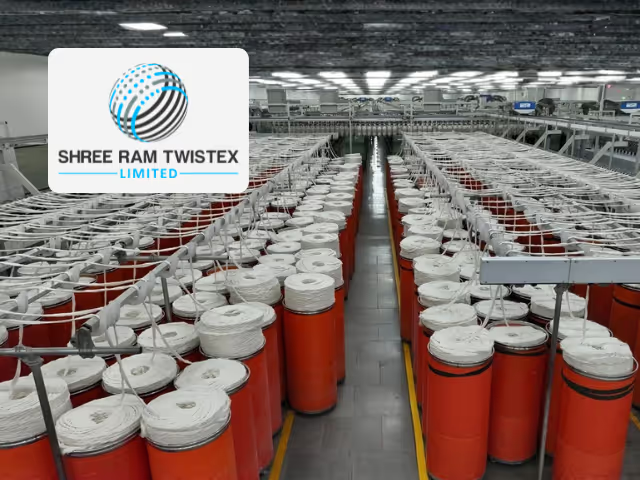
Shree Ram Twistex Limited is a Gujarat based cotton yarn manufacturer incorporated in 2013. It operates a manufacturing facility in Gondal, Rajkot and produces compact ring spun yarn and carded yarn in both combed and carded varieties.
Its product portfolio also includes value added yarn such as Eli Twist yarn, compact slub yarn, and Lycra blended yarn used in denim, towels, shirting, home textiles, and industrial fabrics.
The company primarily follows a B2B model supplying institutional buyers including textile manufacturers and garment exporters.
IPO Details Investors Should Know
Here are the key issue facts explained simply:
- Price band is ₹95 to ₹104 per share.
- Minimum lot size is 144 shares.
- Total IPO size is about ₹110 crore.
- Shares will list on the BSE and NSE.
- Issue opens February 23, 2026 and closes February 25, 2026.
- Tentative listing date is March 2, 2026.
Allocation breakup
- QIB portion 75 percent
- NII portion 15 percent
- Retail portion 10 percent
Lower retail allocation often means limited listing liquidity for individual investors.
Financial Performance Snapshot
The company’s numbers show steady growth:
- Total income increased from ₹213.58 crore in FY23 to ₹231.72 crore in FY24 and ₹256.32 crore in FY25.
- Net profit rose from ₹2.05 crore in FY23 to ₹6.55 crore in FY24 and ₹8.00 crore in FY25.
- Net worth improved from ₹61.11 crore to ₹74.03 crore across three years.
- EBITDA margin remained stable around 8 to 9 percent.
Margins are modest because textile manufacturing is a competitive, price sensitive industry. Still, steady improvement signals better cost control and operational discipline.
Why the Green Energy Shift Matters
A major highlight of this IPO is the company’s plan to invest in renewable power for captive consumption:
- 6.1 MW solar power plant
- 4.2 MW wind power plant
Electricity is one of the biggest costs for spinning mills. By generating its own power, the company could reduce operating expenses and protect margins from energy price volatility.
For example, several textile companies that installed captive renewable power have historically reported better cost stability during periods of rising electricity tariffs. If executed efficiently, this strategy can strengthen profitability over time.
Strengths That Support the Business
Scale expansion
Production capacity has increased to about 9,855 MT per annum, improving efficiency and cost leverage.
Operational track record
The company reports no history of strikes, lockouts, or major disruptions.
Experienced promoters
Management has strong textile industry experience, which is crucial in a cyclical sector.
No accumulated losses
This indicates financial stability and disciplined capital management.
Risks Investors Should Consider
No IPO is risk free, especially in manufacturing.
Customer concentration risk
The company depends heavily on a few large customers for revenue.
No long term contracts
Orders are received on a purchase order basis, which reduces revenue visibility.
No dividend history
The company has not declared dividends in the past and does not have a formal dividend policy.
Technology upgrade risk
Textile machinery requires periodic upgrades, which can increase capital expenditure.
Valuation Check
The IPO is valued at roughly 29 to 30 times earnings.
Its pre IPO EPS stands at ₹2.72 with a P/E near 38.21.
Compared with listed textile companies such as Ambika Cotton Mills Limited, Damodar Industries Limited, and Rajapalayam Mills Limited, the valuation appears relatively expensive.
This suggests that much of the expected growth is already factored into the issue price.
Market Perspective
The textile sector in India is highly cyclical and influenced by global demand, cotton prices, and export trends. When global apparel demand slows, spinning mills often face pricing pressure.
However, companies that focus on efficiency and energy optimization tend to outperform peers during downturns. Shree Ram Twistex’s renewable energy strategy could help it stand out if execution remains strong.
Investor Suitability
This IPO may be suitable for:
- High risk investors
- Long term investors willing to wait for growth
- Investors interested in manufacturing plus green energy themes
It may not suit conservative investors or those seeking quick listing gains because the valuation leaves limited margin of safety.
Expert Verdict
The Shree Ram Twistex IPO Review indicates a cautious stance.
Positives
- Improving financial performance
- Green energy integration
- Strong operational track record
Concerns
- Premium valuation
- Cyclical industry risks
- Low retail allocation
Overall view: Avoid for conservative or short term investors. Consider only if you have a long term horizon and high risk appetite.
FAQs
Is Shree Ram Twistex IPO good for listing gains?
It appears unlikely because the valuation already factors in future growth expectations.
What is the minimum investment amount?
One lot of 144 shares at ₹104 equals about ₹14,976.
What makes this IPO unique?
Its plan to install captive solar and wind power plants to reduce costs.
Is the company profitable?
Yes. Net profit increased steadily to ₹8 crore in FY25.
What is the biggest risk?
Dependence on a few customers and lack of long term contracts.
Final Thoughts
Shree Ram Twistex presents an interesting story of a traditional textile manufacturer evolving into a more efficient, energy optimized business. While fundamentals show improvement, valuation leaves little room for error. Investors should approach carefully and align decisions with their risk tolerance.
For detailed IPO analysis, advanced research tools, and seamless investing experience, Swastika Investmart Limited offers a reliable platform backed by SEBI registration, powerful analytics, strong customer support, and investor education resources.

Gaudium IVF & Women Health IPO Review: Should You Subscribe or Avoid?
TL;DR
- Gaudium IVF IPO priced at ₹75–79 values the company at about 28–30x FY25 earnings.
- Strong revenue growth and ~40% EBITDA margin show healthy profitability.
- Company operates 30+ fertility centers using a scalable hub-and-spoke model.
- Key risks include tax dispute, skilled staff dependency, and healthcare litigation exposure.
Gaudium IVF & Women Health IPO Review: Should You Subscribe or Avoid?



4
The Gaudium IVF & Women Health IPO Review is gaining attention among investors looking for niche healthcare listings. India’s fertility services industry is expanding quickly due to rising infertility awareness, delayed parenthood, and improving affordability. Companies operating in specialized healthcare segments often command premium valuations because of strong margins and entry barriers.
But does this IPO truly deserve a place in your portfolio, or is it priced too aggressively? Let’s break down everything investors should know before applying.
Company Overview
Gaudium IVF & Women Health Limited operates in assisted reproductive technology services, offering treatments such as IVF, ICSI, and IUI. The company has built a pan India presence with more than 30 centers structured through a hub-and-spoke model, allowing centralized expertise while expanding reach efficiently.
Founded by fertility specialist Dr. Manika Khanna, the company positions itself as a specialized fertility brand with standardized clinical protocols and stage wise treatment processes.
Unlike diversified hospital chains, Gaudium focuses only on fertility care, giving it a niche identity and operational specialization.
IPO Details at a Glance
Here are the key IPO details explained simply:
- Price band is ₹75 to ₹79 per share.
- Total issue size is ₹575.02 crore.
- Minimum lot size is 189 shares.
- Shares will list on the BSE and NSE.
- Issue opens on February 20, 2026 and closes on February 24, 2026.
- Tentative listing date is February 27, 2026.
Reservation structure
- Qualified Institutional Buyers receive 50 percent allocation.
- Non Institutional Investors receive 15 percent.
- Retail investors receive 35 percent.
Financial Performance Snapshot
The company has demonstrated strong growth over the last three financial years.
- Revenue grew from ₹44.23 crore in FY23 to ₹47.89 crore in FY24 and jumped to ₹70.72 crore in FY25.
- Net profit was ₹13.53 crore in FY23, dipped to ₹10.32 crore in FY24, and rose sharply to ₹19.13 crore in FY25.
- Net worth increased from ₹22.73 crore in FY23 to ₹26.99 crore in FY24 and reached ₹46.30 crore in FY25.
- EBITDA margin remained strong at about 45.36 percent in FY23, 40.25 percent in FY24, and 40.48 percent in FY25.
A major highlight is profit growth of about 85 percent year on year in FY25, showing operational leverage as the company scales.
High margins near 40 percent are uncommon in healthcare services and indicate strong pricing power and efficient cost control.
Objects of the Issue
IPO proceeds will be used for:
- Setting up new IVF centers
- Repayment of certain loans
- General corporate purposes
Expansion funding is often viewed positively because it supports revenue visibility. However, debt repayment suggests previous capital intensity.
Competitive Positioning
Interestingly, there are no direct listed peers in India operating purely in fertility services.
For comparison, international players include:
- Progyny Inc.
- Inspire IVF Public Company
This lack of domestic peers gives Gaudium a scarcity premium. Investors often pay higher multiples for companies operating in underrepresented sectors on stock exchanges.
Key Strengths Investors Should Note
Strong clinical expertise
Specialist driven fertility treatment enhances success rates and builds patient trust.
Scalable expansion model
The hub-and-spoke strategy allows rapid geographic growth without proportionate cost escalation.
Digital adoption
Telemedicine and lab automation improve operational efficiency and patient reach.
Growing market opportunity
India’s fertility industry is expanding quickly due to rising infertility rates, lifestyle changes, and increasing awareness.
Risks You Should Not Ignore
Every IPO carries uncertainties, and this one is no exception.
Tax dispute
The company faces a ₹31 crore tax dispute, which could affect earnings visibility if unfavorable outcomes occur.
Dependence on skilled professionals
Fertility treatment success depends heavily on experienced doctors and embryologists. High attrition could impact operations.
Healthcare sector risks
Litigation, regulatory scrutiny, and compliance requirements are inherent to medical businesses.
Past cash flow pressure
Historical negative cash flows and rising borrowings could affect financial flexibility.
Valuation Analysis
At the upper band price of ₹79, the IPO is valued at around 28–30 times FY25 earnings.
For context, this valuation is considered premium for a small healthcare company. However, investors often accept higher multiples for niche healthcare leaders with high margins and strong growth visibility.
Its pre IPO EPS stands at ₹3.12 with a post issue P/E of about 25.36.
So the valuation debate comes down to one question:
Are you willing to pay a premium today for future growth?
Market Context: Why This IPO Matters
Healthcare IPOs in India have historically attracted strong investor interest, especially when they represent unique segments. Fertility services are still underpenetrated in India compared with developed countries.
If the company executes its expansion well, it could become a dominant listed fertility platform. For investors seeking sector diversification beyond IT, banking, or FMCG, this IPO offers exposure to a niche healthcare theme.
Who Should Consider Applying
This IPO may suit investors who:
- Prefer niche sector opportunities
- Have a medium to long term horizon of 2 to 3 years
- Can tolerate moderate risk
It may not suit short term listing gain seekers because premium valuations can limit upside on debut.
Expert Verdict
The Gaudium IVF & Women Health IPO Review suggests a balanced outlook.
Positives
- Strong profitability
- Growing industry
- Scalable model
Concerns
- Premium pricing
- Legal and operational risks
Overall, the issue appears suitable for investors willing to hold long term rather than those seeking quick gains.
FAQs
Is Gaudium IVF IPO good for listing gains?
Not ideal. Premium valuation reduces chances of sharp listing upside.
What is the minimum investment amount?
One lot of 189 shares at ₹79 equals about ₹14,931.
Is the company profitable?
Yes. It reported ₹19.13 crore net profit in FY25.
What is the biggest risk?
The ₹31 crore tax dispute and dependence on specialized doctors.
Does it have listed competitors in India?
No. It is currently a rare pure play fertility services listing.
Final Thoughts
The IPO presents a classic growth versus valuation tradeoff. The business fundamentals are strong, but pricing leaves limited margin of safety. Investors who believe in India’s fertility healthcare growth story may consider subscribing with patience.
For data driven IPO analysis, research backed insights, and seamless investing tools, Swastika Investmart Limited offers a reliable platform backed by SEBI registration, advanced analytics, investor education resources, and responsive support.

PM Modi’s ‘MANAV’ Vision: Big Boost for India’s AI & Tech Stocks?
PM Modi’s ‘MANAV’ Vision: Big Boost for India’s AI & Tech Stocks?
India’s artificial intelligence narrative just received a major policy push. At the India AI Impact Summit 2026, Prime Minister Narendra Modi unveiled the MANAV Vision, a framework aimed at making AI ethical, inclusive, and accountable.
For investors and market watchers, the big question is clear: Will this policy momentum translate into real gains for India’s AI and technology stocks?
In this blog, we decode what the MANAV Vision means, which sectors could benefit, and how investors should approach this emerging theme.
TL;DR
• MANAV Vision focuses on ethical, inclusive and sovereign AI development
• Positive long term sentiment for IT services, data centers and digital infrastructure
• No immediate earnings trigger but strong thematic tailwind
• Investors should track AI focused companies and policy execution closely
What Is the MANAV Vision for AI?
The MANAV Vision is India’s policy framework to guide the responsible development of artificial intelligence. The government’s intent is to ensure that AI growth remains human centric and does not become concentrated in the hands of a few global players.
MANAV stands for:
• Moral and ethical AI systems
• Accountable governance and transparent rules
• National sovereignty over data
• Accessible and inclusive AI
• Valid and lawful AI deployment
The broader message is simple. India wants AI to scale rapidly, but with strong guardrails around data protection, transparency, and public benefit.
Why the MANAV Vision Matters for Indian Markets
From a stock market perspective, policy direction often shapes long term capital flows. While the MANAV announcement is not an immediate earnings catalyst, it strengthens the structural case for India’s AI ecosystem.
Three key market implications stand out.
Policy Support for the AI Ecosystem
Government backing reduces regulatory uncertainty. When policymakers clearly support a technology theme, companies tend to increase investments, partnerships, and capacity building.
We saw a similar trend in the past with digital payments after UPI promotion and with renewables after PLI schemes. AI could follow a comparable trajectory.
Boost to India’s Global Tech Positioning
India hosting a major AI summit signals intent to become a serious player in the global AI race. This improves investor perception of the country’s technology ecosystem.
Global clients may increasingly view Indian IT firms not just as cost efficient service providers but as AI solution partners.
Long Term Capex Cycle in Digital Infrastructure
AI adoption requires heavy investments in:
• Data centers
• Cloud infrastructure
• High performance computing
• Semiconductor ecosystem
Any sustained push in these areas typically benefits multiple listed players across the value chain.
Sectors Likely to Benefit
While the impact will be gradual, some segments of the market are better positioned than others.
IT Services and AI Solution Providers
Large Indian IT companies are already investing heavily in generative AI, automation, and enterprise AI solutions. The MANAV Vision strengthens the long term demand outlook.
Companies offering:
• AI consulting
• cloud migration
• data engineering
• automation platforms
could see improved deal pipelines over time.
However, investors should remember that global tech spending cycles will still drive near term performance.
Data Center and Digital Infrastructure Players
AI workloads are extremely compute intensive. This directly increases demand for data center capacity and power infrastructure.
India is already witnessing rising announcements in hyperscale data centers. Policy support for AI could accelerate this trend further.
Semiconductor and Electronics Ecosystem
Although India’s semiconductor journey is still evolving, the AI push adds strategic urgency. Over the medium term, companies linked to electronics manufacturing and chip ecosystem development may benefit from policy tailwinds.
What Are the Key Risks?
A balanced view is important. Not every policy announcement translates into immediate stock market gains.
Execution Gap Risk
India has announced several ambitious technology missions in the past. The real impact depends on:
• budget allocation
• private sector participation
• speed of implementation
Investors should track actual project announcements rather than relying only on policy headlines.
Global Tech Demand Still Matters
Indian IT stocks remain heavily dependent on US and European tech spending. Even with strong domestic AI push, weak global demand can cap near term upside.
Valuation Comfort
Many frontline IT stocks already trade at premium valuations. Any AI driven rerating may take time unless earnings growth accelerates meaningfully.
How Should Investors Approach the AI Theme?
For long term investors, the AI theme in India is clearly strengthening. However, timing and stock selection remain critical.
A practical approach could be:
• Focus on companies with proven AI capabilities
• Track deal wins and order pipelines, not just announcements
• Avoid chasing momentum after sharp rallies
• Maintain a staggered investment strategy
Remember, structural themes often play out over multiple years, not weeks.
Real World Parallel: Lessons from the Digital Payments Boom
A useful comparison is India’s digital payments story.
When UPI was launched and promoted aggressively, the immediate stock market impact was limited. But over time, companies aligned with the digital ecosystem saw significant rerating as adoption scaled.
AI in India may follow a similar path. Early policy support builds the foundation, but earnings visibility comes gradually.
The Road Ahead for India’s AI Story
The MANAV Vision signals that India wants to balance innovation with responsibility. If executed well, this framework could:
• attract global AI investments
• strengthen India’s tech exports
• deepen domestic digital infrastructure
• create new high skill employment
For the stock market, this translates into a positive long term narrative, especially for technology and digital infrastructure players.
However, investors should stay realistic about timelines. The AI opportunity is real, but it will unfold in phases.
Conclusion
PM Modi’s MANAV Vision is an important strategic step in India’s AI journey. While it may not trigger an immediate rally in AI and tech stocks, it clearly strengthens the long term structural story for the sector.
For investors, the key is to track execution, valuations, and company specific fundamentals rather than reacting purely to headlines.
If you are looking to identify strong AI and technology opportunities with research backed insights, having the right platform matters. Swastika Investmart, a SEBI registered broker, offers robust research tools, tech enabled investing platforms, and dedicated customer support to help investors make informed decisions.
Frequently Asked Questions
Is the MANAV Vision immediately bullish for IT stocks?
Not immediately. It is a long term positive but near term performance will still depend on global tech demand and company earnings.
Which sectors may benefit the most from India’s AI push?
IT services, data centers, cloud infrastructure, and parts of the electronics ecosystem are likely to gain over time.
Should investors buy AI stocks right now?
Investors should avoid impulsive buying. A staggered approach based on valuations and fundamentals is more prudent.
Does the MANAV Vision include regulation of AI?
Yes. The framework emphasizes ethical AI, accountability, lawful usage, and national data sovereignty.
How can retail investors track AI opportunities?
Monitor company disclosures on AI deals, partnerships, capex plans, and management commentary during earnings calls.

Bharti Airtel Raises Indus Towers Stake to 51.22% — Bullish Trigger?
Bharti Airtel Raises Indus Towers Stake to 51.22%: What Investors Should Know
Quick Takeaways
- Bharti Airtel increased its stake in Indus Towers through market purchases.
- Total 32.73 lakh shares were bought between February 5 and 10, 2026.
- The move aligns with earlier board approval to raise ownership.
- Investors see promoter buying as a confidence signal, though price reaction may vary.
Strategic Move: Bharti Airtel Tightens Control
Bharti Airtel has strengthened its ownership in Indus Towers to about 51.22% after acquiring additional shares from the open market. Between February 5 and February 10, 2026, the telecom giant purchased a total of 32.73 lakh shares, including a fresh lot of 20 lakh shares.
This acquisition was not sudden. In November 2025, Airtel’s board approved a plan to increase its stake by up to 5%. The recent purchases fall within that limit, signaling a structured and pre planned strategy rather than opportunistic buying.
Promoter stake increases often draw investor attention because they reflect management’s conviction about future prospects.
Why Indus Towers Matters in India’s Telecom Ecosystem
Indus Towers operates one of the largest telecom tower portfolios in the country. These towers form the backbone of wireless communication, supporting multiple telecom operators that lease space to install antennas and equipment.
In simple terms, telecom companies compete for customers, but they often share tower infrastructure. This model reduces costs and speeds up network rollout, especially for technologies like 5G.
As data consumption grows across India, demand for tower infrastructure rises. More users streaming video, gaming, or using digital services means operators need stronger networks. Stronger networks require more towers and better coverage.
Reading the Signal: Why Promoter Buying Matters
Confidence Indicator
When promoters buy shares from the market instead of selling, it often indicates confidence in the company’s growth prospects. They usually have deeper insight into operational trends, upcoming contracts, and industry direction.
Long Term Commitment
Increasing ownership strengthens promoter control and aligns management interests with shareholders. Higher stake means promoters benefit directly from value creation.
Market Interpretation
Investors often track promoter transactions closely. Positive sentiment can emerge if markets interpret the move as a signal of undervaluation or growth potential.
However, share prices do not always rise immediately. Market reaction depends on broader sentiment, sector outlook, and macroeconomic conditions.
Stock Performance Snapshot
As of February 13, 2026, at 2:31 PM, Indus Towers shares were trading around ₹465.95 on NSE, down about 1.70% from the previous close. Short term price movement can be influenced by profit booking, market volatility, or sector rotation rather than company specific fundamentals.
Seasoned investors usually focus less on daily fluctuations and more on structural trends such as earnings growth, contract wins, and debt levels.
Industry Context: Telecom Infrastructure Is a Long Game
Tower companies operate on long term leasing contracts with telecom operators. This provides predictable cash flow compared to many other sectors.
Consider a real world analogy. Owning telecom towers is similar to owning commercial real estate. Instead of retail tenants, tower firms lease space to telecom providers. As long as tenants remain, revenue continues.
India’s telecom sector is still expanding. Rural penetration, 5G rollout, and digital adoption are key drivers. Infrastructure providers stand to benefit from these structural trends.
Potential Benefits for Bharti Airtel
Increasing stake in a strategic partner can offer several advantages:
Operational synergy
Closer coordination between network rollout and tower deployment can reduce delays.
Cost optimization
Stronger control may help negotiate better infrastructure costs.
Strategic flexibility
Higher ownership gives Airtel greater influence over business decisions and long term planning.
Risks Investors Should Keep in Mind
Even positive developments come with uncertainties. Investors should evaluate:
- Sector competition among telecom operators
- Debt levels within infrastructure companies
- Regulatory changes affecting telecom tariffs or spectrum pricing
- Technological shifts that alter infrastructure needs
Balanced analysis helps investors avoid reacting emotionally to headlines.
Regulatory Oversight and Transparency
India’s capital markets operate under strict disclosure norms monitored by the Securities and Exchange Board of India. Promoter transactions must be reported, ensuring transparency for investors.
This regulatory framework builds trust because shareholders can verify whether insiders are buying or selling shares. Such transparency is essential for fair market functioning.
What This Means for the Indian Market
Large promoter purchases often improve sentiment across related sectors. Telecom infrastructure companies, equipment suppliers, and network service providers may attract renewed investor interest.
The move also reflects confidence in India’s digital growth story. Rising data consumption, smartphone adoption, and enterprise digitization continue to expand the telecom ecosystem.
Institutional investors frequently track such signals when deciding sector allocations.
How Investors Can Approach Such Developments
Instead of reacting instantly, investors often benefit from structured evaluation:
- Compare valuation with historical averages
- Review quarterly earnings trends
- Assess debt and cash flow metrics
- Track management commentary
Using professional research platforms like Swastika Investmart can help investors interpret corporate actions with deeper data insights, advanced tools, and responsive support. Access to structured research makes it easier to separate meaningful signals from market noise.
Common Questions
Why did Bharti Airtel increase its stake in Indus Towers
The purchases align with its earlier board approved plan to raise ownership and strengthen strategic control.
Is promoter buying always bullish
It is often viewed positively, but it should be analyzed alongside fundamentals and sector outlook.
Does this affect telecom sector stocks
Such moves can improve sentiment across telecom and infrastructure stocks, though broader market trends still matter.
Will Indus Towers share price rise immediately
Not necessarily. Short term price movements depend on market sentiment, liquidity, and investor expectations.
Should investors act on this news alone
No. Investment decisions should be based on detailed research, valuation analysis, and financial performance.
Final Thoughts
Bharti Airtel’s decision to raise its stake to 51.22% in Indus Towers reflects strategic intent rather than short term speculation. It signals confidence in the long term growth of telecom infrastructure, a sector that forms the backbone of India’s digital economy.
For investors, developments like these provide useful clues about where corporate leaders see future value. Tracking such signals with reliable research tools can improve decision making and reduce guesswork.
If you want access to professional grade insights, advanced analytics, and a seamless investing experience, you can begin here:


.avif)
.avif)

.avif)




START YOUR INVESTMENT JOURNEY
Get personalized advice from our experts
- Dedicated RM Support
- Smooth and Fast Trading App
