

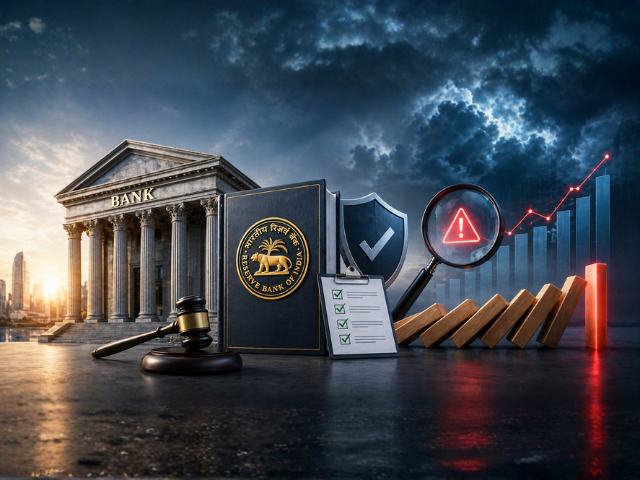
RBI’s New Rulebook: Banks Must Predict Losses Before They Happen



Key Takeaways
- Reserve Bank of India introduces forward-looking provisioning norms
- Banks must estimate potential losses before defaults occur
- Likely short-term pressure on profits but long-term stability boost
- Positive for risk management, transparency, and investor confidence
RBI’s New Rulebook: Banks Must Predict Losses Before They Happen
India’s banking system is entering a more disciplined and globally aligned phase. In a significant move, the Reserve Bank of India has introduced a new rulebook that requires banks to anticipate and provide for potential losses well in advance.
This shift marks a move from reactive accounting to proactive risk management.
But what does this really mean for banks, investors, and the broader market?
Let’s decode.
What Is RBI’s New Rulebook All About?
Traditionally, banks recognized bad loans only after clear signs of stress appeared. This often led to delayed provisioning and sudden spikes in NPAs.
The new framework changes that approach.
Forward-Looking Provisioning
Banks will now:
- Estimate expected credit losses early
- Set aside provisions in advance
- Continuously reassess borrower risk
This model is similar to global standards like IFRS 9, which emphasizes expected credit loss rather than incurred loss.
Why RBI Introduced This Change
The move is not random. It is rooted in lessons from past crises.
1. Learning from the NPA Cycle
India witnessed a major NPA surge between 2015 and 2018, where:
- Corporate loans turned bad
- Banks reported sudden losses
- Capital adequacy came under pressure
Early recognition could have reduced the shock.
2. Strengthening Financial Stability
By forcing banks to prepare in advance, the Reserve Bank of India aims to:
- Avoid sharp earnings volatility
- Improve balance sheet transparency
- Build resilience in the banking system
3. Aligning with Global Practices
Global banking systems already follow forward-looking models. India adopting similar norms enhances:
- Credibility among foreign investors
- Ease of capital inflows
- Confidence in the financial ecosystem
How Will This Impact Banks?
The new rulebook will have both short-term and long-term effects.
Short-Term Impact
Banks may face:
- Higher provisioning requirements
- Lower reported profits
- Pressure on return ratios
Example:
If a bank anticipates that a borrower might default in the future, it must start provisioning today even if the loan is currently standard.
Long-Term Benefits
Over time, the benefits can be substantial:
- Smoother earnings cycle
- Better risk pricing
- Stronger capital buffers
This ultimately leads to a healthier banking system.
Impact on Indian Stock Market
The market reaction to such regulatory changes is usually mixed.
1. Banking Stocks May See Volatility
In the near term:
- Profitability concerns may weigh on stock prices
- Investors may react cautiously to higher provisions
2. Long-Term Positive Re-rating
Over time:
- Improved transparency attracts institutional investors
- Stronger balance sheets command premium valuations
3. Sector-Wide Standardization
Both public and private sector banks will follow the same framework, creating a level playing field.
Real-World Scenario: How This Works
Imagine a bank that has given a large loan to a mid-sized company.
Earlier:
- The bank would wait for missed payments before classifying it as a bad loan
Now:
- If early warning signs appear such as declining revenues or rising debt
- The bank must estimate potential loss and start provisioning immediately
This proactive approach reduces future shocks.
What Should Investors Watch?
For investors, this regulatory shift is crucial.
Key factors to track:
- Provision coverage ratios
- Asset quality trends
- Management commentary on risk outlook
- Capital adequacy levels
Using a research-driven platform like Swastika Investmart can help investors analyze such changes with:
- Expert insights
- Advanced screening tools
- Real-time updates
- Investor education resources
Challenges in Implementation
While the framework is beneficial, execution is not easy.
1. Data and Technology Requirements
Banks need:
- Advanced analytics
- Strong credit risk models
- Continuous monitoring systems
2. Subjectivity in Estimates
Predicting future losses involves assumptions, which may vary across banks.
This could lead to:
- Differences in provisioning levels
- Variations in reported profits
3. Transition Phase Pressure
During the initial phase:
- Earnings may appear weaker
- Investors may misinterpret the impact
Patience is key here.
What This Means for India’s Financial Future
This move by the Reserve Bank of India signals a clear intent:
Build a stronger, more transparent, and globally competitive banking system.
It also reflects a broader shift toward:
- Risk-aware lending
- Sustainable growth
- Better governance
FAQs
1. What is RBI’s new provisioning rule?
It requires banks to estimate and provide for expected credit losses in advance instead of waiting for actual defaults.
2. Will this reduce bank profits?
In the short term, yes, as higher provisions may impact earnings. However, it improves long-term stability.
3. How does this benefit investors?
It enhances transparency, reduces surprises, and builds confidence in bank financials.
4. Which banks will be most affected?
Banks with riskier loan books or lower provision coverage may see a bigger impact initially.
5. How can investors track these changes effectively?
Investors can use platforms like Swastika Investmart for research insights and data-driven analysis.
Conclusion
The RBI’s new rulebook is a bold and necessary step toward strengthening India’s banking system. While the transition may bring short-term discomfort in terms of lower profits and market volatility, the long-term benefits far outweigh the challenges.
For investors, this is a reminder that regulatory changes often shape the future of industries. Staying informed and focusing on fundamentals is the smartest strategy.
If you want to navigate such important market developments with expert guidance, you can open your trading account here:
Big Budget





.avif)
.avif)
.avif)
.avif)
.avif)














.avif)
.avif)
.avif)
.avif)
Latest Articles
%20(3).avif)
Market Closing Summary for 13 January 2026: Nifty 50 Ends Lower, Bank & IT Stocks Support Markets


Summary
- On 13 January 2026, Nifty 50 closed at 25,732.30, down 0.22%
- Sensex declined 0.30%, reflecting profit booking in heavyweight stocks
- Bank Nifty gained 0.22%, showing resilience in banking counters
- Nifty IT and broader indices outperformed, indicating selective buying
Market Closing Summary: How Indian Markets Performed on 13 January 2026
Indian equity markets ended Tuesday, 13 January 2026, on a mixed note as investors balanced profit booking at higher levels with selective sectoral buying. While frontline indices such as the Nifty 50 and Sensex witnessed mild corrections, strength in banking, IT, and broader market stocks helped limit overall downside.
The session reflected a familiar market behaviour seen near record zones, where investors rotate capital from overextended large-cap stocks into sectors showing relative value and earnings visibility.
Benchmark Indices Performance on 13 January 2026
On 13 January 2026, benchmark indices closed as follows:
- Nifty 50 closed at 25,732.30, down 0.22%
- Sensex ended at 83,627.69, declining 0.30%
- Nifty Bank closed at 59,578.80, up 0.22%
- Nifty IT gained 0.65%, ending at 38,236.55
- S&P BSE Smallcap rose 0.46%, indicating positive market breadth
The divergence between benchmarks and sectoral indices highlights a phase of consolidation rather than broad-based weakness.
Why Did Nifty 50 Close Lower on 13 January 2026?
The Nifty 50 faced pressure on 13 January 2026 primarily due to profit booking in select heavyweight stocks across FMCG, metals, and energy sectors. After a strong rally in recent weeks, investors preferred to book partial profits ahead of upcoming macro data and corporate earnings announcements.
Additionally, cautious global cues and range-bound Asian markets contributed to subdued sentiment during the latter half of the trading session.
However, the decline remained controlled, suggesting that underlying market structure continues to stay strong.
Bank Nifty Shows Strength Amid Volatility
One of the key positives on 13 January 2026 was the performance of the banking index. Bank Nifty closed at 59,578.80, registering a 0.22% gain, supported by buying interest in private sector banks and select PSU lenders.
Lower credit risk concerns, stable asset quality expectations, and consistent loan growth outlook continue to attract investors toward banking stocks. For long-term participants, the banking sector remains a core pillar of the Indian equity market.
IT and Broader Markets Outperform on 13 January 2026
The Nifty IT index gained 0.65% on 13 January 2026, outperforming broader benchmarks. The sector benefited from a marginally weaker rupee and renewed interest in export-oriented stocks ahead of global tech earnings.
At the same time, broader markets showed resilience. The positive close in the S&P BSE Smallcap index signals healthy participation beyond large-cap stocks, often viewed as a constructive sign for market sustainability.
What This Means for Indian Investors
The market action on 13 January 2026 reflects a classic consolidation phase rather than a trend reversal. For retail investors and traders, this environment encourages a stock-specific approach instead of aggressive index-level bets.
Long-term investors may view such dips as opportunities to accumulate quality stocks aligned with their risk profile, while short-term traders can focus on sectors showing relative strength, such as banking and IT.
From a regulatory standpoint, SEBI’s continued emphasis on transparency, risk disclosures, and investor protection has strengthened confidence in Indian capital markets, especially during volatile phases.
How Swastika Investmart Helps Navigate Such Market Phases
Market sessions like 13 January 2026 underline the importance of disciplined investing backed by research and risk management. Swastika Investmart, a SEBI-registered full-service brokerage, empowers investors with:
- In-depth equity and derivatives research
- Tech-enabled trading platforms for faster execution
- Dedicated customer support for retail and HNI clients
- Strong focus on investor education and market awareness
By combining research-driven insights with modern trading tools, Swastika Investmart helps investors stay prepared across market cycles.
👉 Open your trading account today
FAQs
What was the Nifty 50 closing level on 13 January 2026?
Nifty 50 closed at 25,732.30, down 0.22% on 13 January 2026.
Why did Sensex underperform the broader market today?
Sensex was dragged down by profit booking in heavyweight stocks despite positive cues from select sectors.
Which sector performed best on 13 January 2026?
The IT sector outperformed, with Nifty IT gaining 0.65% during the session.
Is this correction a sign of market weakness?
The current movement appears to be consolidation rather than structural weakness, supported by positive broader market participation.
Conclusion: Staying Prepared Beyond 13 January 2026
The market closing summary for 13 January 2026 highlights a healthy pause in the rally, supported by sectoral rotation and selective buying. As Indian markets evolve, staying informed, diversified, and research-backed remains key to long-term wealth creation.
If you are looking to invest or trade with confidence backed by expert research and reliable platforms, consider opening an account with Swastika Investmart.

Gold, Silver at Record Highs: What’s Driving the Bullion Rally in India?
Key Takeaways at a Glance
- Gold and silver prices in India have touched fresh lifetime highs
- Global uncertainty, central bank buying, and currency moves are key drivers
- Indian demand is supported by investment flows despite high prices
- Silver is gaining traction due to industrial demand and green energy trends
- Bullion remains a hedge, not a momentum trade, for long-term investors
A New Peak for Precious Metals in India
Gold and silver at record highs have become one of the most talked-about themes in Indian financial markets. Walk into a jewellery store or check commodity quotes online, and the surge is impossible to miss. Gold prices have crossed previous peaks, while silver has surprised many by outperforming expectations.
This rally is not driven by a single factor. Instead, it reflects a mix of global economic signals, policy uncertainty, and shifting investor behaviour. For Indian investors, bullion has always carried emotional as well as financial value. What makes this phase different is how strongly global cues are feeding into domestic prices.
Global Triggers Behind the Bullion Rally
One of the biggest drivers of gold and silver at record highs is global uncertainty. Slowing growth in major economies, geopolitical tensions, and concerns around long-term inflation have pushed investors toward safe-haven assets.
Central banks across the world have also played a role. Several emerging market central banks have steadily increased gold reserves to diversify away from dollar dependence. This structural demand supports prices even when short-term sentiment fluctuates.
Interest rate expectations are another factor. When markets anticipate rate cuts or lower real yields, non-interest-bearing assets like gold become more attractive. Silver benefits as well, especially when economic slowdowns do not fully derail industrial activity.
The Rupee Effect and Why Indian Prices Look Even Higher
Indian gold and silver prices do not move only on global benchmarks. Currency movement matters. A softer rupee against the US dollar amplifies gains in domestic bullion prices, even if international prices rise modestly.
For example, a global gold rally combined with rupee depreciation can push Indian prices sharply higher within weeks. This is why Indian investors sometimes see record highs even when global markets appear relatively stable.
From a regulatory angle, import duties and GST also influence final prices. Any changes in trade policy or tax structure can quickly reflect in retail bullion rates.
Silver’s Silent Comeback
While gold grabs headlines, silver’s rally deserves equal attention. Silver prices have climbed alongside gold, supported by strong industrial demand. Electric vehicles, solar panels, and electronics all rely on silver, making it both a precious and industrial metal.
In India, silver has traditionally been seen as a more volatile cousin of gold. That volatility cuts both ways. During rallies, silver often outpaces gold, attracting traders and investors looking for higher upside.
The current environment, where green energy investment continues alongside economic uncertainty, creates a sweet spot for silver demand.
How Indian Investors Are Responding
Despite gold and silver at record highs, investor interest in India has not faded. Instead of heavy jewellery buying, demand has shifted toward investment-oriented products. Gold ETFs, digital gold, and sovereign gold bonds have seen steady participation.
Retail investors increasingly view bullion as portfolio insurance rather than a quick profit tool. Financial advisors often recommend a measured allocation to precious metals to balance equity and debt exposure.
At the same time, high prices have tempered discretionary jewellery purchases, especially in urban markets. This shift highlights how investment demand is now playing a bigger role than consumption demand.
Impact on Indian Financial Markets
The bullion rally has indirect effects on Indian equity markets. Companies linked to jewellery, refining, and bullion trading may see margin pressure if price volatility increases. On the other hand, higher prices can improve inventory valuation for some players.
From a broader market perspective, rising gold prices often signal risk aversion. Investors tend to increase exposure to defensive assets when they are cautious about equities. However, this does not automatically mean equity markets will fall. In many cases, both can rise together, driven by liquidity and diversification needs.
Regulatory and Policy Context in India
Indian regulators keep a close watch on gold imports due to their impact on the current account deficit. The Reserve Bank of India uses policy tools to manage currency volatility, which indirectly influences bullion prices.
Products like sovereign gold bonds reflect the government’s effort to channel savings away from physical gold into financial instruments. These initiatives aim to balance investor interest with macroeconomic stability.
Making Sense of the Rally as an Investor
The key lesson from gold and silver at record highs is perspective. Sharp rallies can tempt investors to chase prices, but bullion works best as a long-term hedge. Timing the peak is difficult, and short-term corrections are always possible.
This is where informed guidance matters. Swastika Investmart supports investors with SEBI-registered research, strong analytical tools, and a tech-enabled platform that simplifies commodity tracking. Combined with responsive customer support and a focus on investor education, it helps investors make sense of complex market moves without reacting emotionally.
Frequently Asked Questions
Why are gold and silver prices rising together in India?
Both metals are benefiting from global uncertainty, central bank buying, and currency movements that amplify gains in domestic prices.
Is it too late to invest in gold at record highs?
Gold is better viewed as a long-term hedge. Investing gradually rather than in one lump sum can reduce timing risk.
Why is silver gaining attention now?
Silver has strong industrial demand, especially from green energy and electronics, which supports prices alongside investment demand.
How does the rupee impact bullion prices?
A weaker rupee increases the cost of imported gold and silver, pushing Indian prices higher even if global prices are stable.
What is a prudent allocation to bullion?
Many advisors suggest a limited allocation as part of a diversified portfolio rather than an aggressive bet.
Final Word
Gold and silver at record highs reflect a world searching for stability amid uncertainty. For Indian investors, the rally highlights bullion’s role as a hedge rather than a speculative asset. While prices may fluctuate in the short term, the structural drivers behind precious metals remain relevant.
If you are looking to track commodity trends, evaluate portfolio allocation, or invest with clarity, Swastika Investmart offers the right mix of trusted research, advanced tools, and investor-first support.

Trump’s 25% Iran Trade Tariff: What It Means for India’s Exports and Chabahar Port
Key Takeaways at a Glance
- A proposed 25% US tariff on Iran-linked trade raises fresh geopolitical and economic concerns
- India’s exports face indirect risks, especially in commodities, engineering goods, and logistics
- Chabahar Port remains strategically vital, but operational momentum could slow
- Indian markets may see short-term volatility in select sectors tied to trade and logistics
- Long-term impact depends on diplomatic negotiations and regulatory clarity
Why Trump’s Iran Trade Tariff Is Back in Focus
Global markets are once again paying attention to US trade policy after former President Donald Trump reiterated a hardline stance on Iran, including a proposed 25% tariff on trade linked to the country. While the US already maintains strict sanctions on Iran, this move signals a tougher enforcement regime that could have spillover effects beyond direct US Iran trade.
For India, the issue is not about direct exports to Iran alone. It is about secondary effects on supply chains, regional connectivity projects, and strategic trade routes, particularly the Chabahar Port, which India has invested in as a gateway to Central Asia and Afghanistan.
Understanding the 25% Iran Trade Tariff
The proposed tariff aims to penalize trade flows connected to Iran by raising costs for goods and services moving through or sourced from the country. While India has largely reduced direct oil imports from Iran due to existing sanctions, several Indian companies still have exposure through infrastructure projects, shipping routes, and regional trade partnerships.
A higher tariff environment discourages global firms from engaging with Iran-linked logistics, even when exemptions exist. This creates uncertainty for Indian exporters who rely on stable routes and predictable costs.
India’s Export Exposure: Where the Risks Lie
India’s exports to Iran have already moderated in recent years, but the broader concern is indirect exposure. Engineering goods, agricultural commodities, pharmaceuticals, and chemicals often move through complex regional networks. Any disruption in shipping insurance, freight availability, or payment mechanisms can raise transaction costs.
For example, Indian exporters using West Asian shipping corridors may face higher freight rates or longer transit times if shipping companies become cautious. This does not stop trade, but it reduces competitiveness, especially for price-sensitive goods.
From a regulatory perspective, Indian exporters must also comply with Reserve Bank of India guidelines on trade settlement and foreign exchange. Heightened sanctions scrutiny can delay payments or complicate documentation, adding working capital stress for small and mid-sized exporters.
Chabahar Port: Strategic Asset Under Pressure
Chabahar Port holds long-term strategic value for India. It provides access to landlocked Central Asian markets without routing trade through Pakistan. India has invested in port development and operations to strengthen regional connectivity and energy security.
Trump’s 25% Iran trade tariff does not directly target Chabahar, especially since India has previously received limited waivers for the project due to its geopolitical importance. However, tougher enforcement raises uncertainty. Private logistics players, insurers, and financiers may adopt a cautious stance, slowing cargo movement.
In the real world, even a small increase in perceived risk can reduce port throughput. This affects not just trade volumes but also the commercial viability of allied infrastructure such as rail links and warehousing.
Impact on Indian Markets and Sectors
Indian equity markets tend to react quickly to geopolitical headlines, even when the economic impact is indirect. Sectors that could see near-term volatility include logistics, shipping, metals, and export-oriented manufacturing.
That said, the broader market impact is likely to remain contained unless policy actions escalate. Large-cap exporters with diversified geographic exposure are better insulated, while smaller firms with regional concentration may face earnings pressure.
Historically, markets have shown resilience once clarity emerges. Investors often differentiate between headline risk and fundamental earnings impact, especially when India’s domestic demand remains strong.
How India May Navigate the Challenge
India’s approach is likely to remain pragmatic. Diplomatic engagement with the US, along with careful compliance with international regulations, will be key. India has previously balanced strategic autonomy with economic realism, and similar calibration can be expected here.
From a policy standpoint, export diversification and alternative trade routes continue to be priorities. Government initiatives supporting exporters through credit guarantees and digital trade facilitation also help mitigate external shocks.
Why Informed Investing Matters in Such Phases
Geopolitical developments like Trump’s Iran trade tariff highlight the importance of context-driven investing. Knee-jerk reactions often create noise, while long-term opportunities emerge for those who understand sectoral linkages and regulatory nuances.
This is where platforms like Swastika Investmart add value. With SEBI-registered research, strong analytical tools, and a focus on investor education, Swastika helps investors interpret global events through an Indian market lens. Tech-enabled investing and responsive customer support further empower investors to act with confidence rather than emotion.
Common Questions Investors Are Asking
Does the 25% Iran trade tariff directly affect Indian exports?
Not directly in most cases, but indirect effects through logistics, insurance, and payment channels can impact costs and timelines.
Is Chabahar Port at risk because of this policy?
The port remains strategically important, but operational momentum could slow if global partners adopt a cautious stance.
Will Indian stock markets see a major impact?
Any impact is likely to be sector-specific and short-term unless geopolitical tensions escalate significantly.
How can exporters reduce risk in such situations?
Diversifying markets, strengthening compliance, and managing currency exposure can help reduce vulnerability.
What should long-term investors focus on now?
Investors should focus on fundamentals, balance sheet strength, and companies with diversified revenue streams.
Final Thoughts
Trump’s 25% Iran trade tariff proposal adds another layer of uncertainty to an already complex global trade environment. For India, the challenge lies in managing indirect risks to exports and safeguarding the strategic relevance of projects like Chabahar Port. While short-term volatility is possible, the long-term impact will depend on diplomacy, regulatory clarity, and global trade realignments.
For investors looking to stay ahead of such developments, informed analysis and disciplined decision-making are essential. Swastika Investmart supports this journey with trusted research, advanced tools, and a strong commitment to investor education.

TCS Q3 Results: One-Time Labour Code Cost Weighs on Profit as Margins Hold Firm
Summary
- TCS reported steady operational performance in Q3 despite a one-off cost linked to new labour codes
- Operating margins remained resilient, reflecting strong cost controls
- Revenue growth stayed broad-based across key verticals and geographies
- The impact is accounting-led rather than structural, with no long-term margin shock
- The results reinforce TCS’s reputation as a defensive large-cap IT stock
Setting the Context: Why TCS Q3 Results Matter
Tata Consultancy Services, India’s largest IT services company, often sets the tone for the entire IT sector each quarter. Its Q3 results are closely watched by institutional investors, retail participants, and analysts alike because they provide early signals on demand trends, hiring conditions, and margin sustainability in global technology spending.
In the latest quarter, TCS Q3 results reflected a familiar pattern. Core operations remained stable, client spending held up reasonably well, and margins stayed firm. However, reported profit came under pressure due to a one-time cost related to the implementation of new labour codes in India. This led to a short-term dent in net profit but did not alter the company’s long-term financial trajectory.
Understanding the One-Time Labour Code Cost
India is in the process of rolling out four new labour codes that consolidate multiple existing laws covering wages, social security, industrial relations, and occupational safety. For large employers like TCS, this transition involves accounting adjustments, higher provisioning, and changes in employee-related benefits.
In Q3, TCS absorbed a one-time labour code cost linked to these regulatory changes. This expense was largely non-recurring and accounting-driven, rather than a reflection of rising operational inefficiency. Such costs typically arise when companies align gratuity, provident fund, or other long-term employee benefit provisions with revised legal frameworks.
From an investor’s perspective, this distinction is critical. A structural increase in employee costs would warrant concern, but a one-off regulatory adjustment is usually treated as a temporary hit that cleans up the balance sheet.
Margin Performance: A Key Positive in TCS Q3 Results
Despite the additional cost, TCS managed to keep its operating margins largely intact. This highlights the company’s strong execution capabilities and disciplined cost management.
Several factors supported margin stability:
- Efficient utilization of workforce through optimized staffing
- Controlled subcontracting expenses
- Stable offshore delivery mix
- Pricing discipline in ongoing client contracts
In a global environment where IT companies are facing pricing pressure and cautious client budgets, margin resilience stands out as a positive surprise. It reinforces TCS’s ability to defend profitability even when external headwinds emerge.
Revenue Growth and Deal Momentum
TCS Q3 results also reflected steady revenue growth, supported by continued demand in key verticals such as banking, financial services, retail, and manufacturing. While discretionary tech spending remains selective globally, core digital transformation and cost optimization projects continue to move forward.
Large deal wins during the quarter added visibility to future revenue streams. These long-term contracts provide earnings stability and help cushion short-term volatility caused by macroeconomic uncertainty or currency movements.
Impact on the Indian IT Sector and Markets
The Indian stock market often reacts sharply to IT earnings, especially those of bellwether stocks like TCS. In this case, the one-time labour code cost was largely anticipated by analysts, limiting negative surprises.
For the broader IT sector, the results send a balanced signal. Demand is not booming, but it is far from collapsing. Companies with scale, strong client relationships, and diversified portfolios are better positioned to navigate this phase.
From a regulatory standpoint, the labour code implementation represents a transition cost for corporate India. Over time, clearer compliance frameworks may actually improve transparency and predictability in employee-related expenses.
How Investors Should Read These Results
For long-term investors, TCS Q3 results underline the importance of looking beyond headline profit numbers. Adjusting for the one-off labour code cost provides a clearer picture of underlying performance.
TCS continues to be viewed as a defensive large-cap stock, offering stability during periods of market volatility. While near-term upside may be capped by global IT spending trends, downside risks appear limited due to strong cash flows and a solid order book.
Using Research Tools to Track Such Developments
Quarterly results often trigger short-term price movements that may not fully reflect long-term fundamentals. This is where disciplined research and timely insights matter.
Platforms like Swastika Investmart support investors with SEBI-registered research, detailed earnings analysis, and tech-enabled tools that help separate noise from meaningful signals. For investors navigating earnings season, access to structured data and expert commentary can make a real difference in decision-making.
Frequently Asked Questions
Why did TCS profit decline in Q3 despite stable margins?
The decline was mainly due to a one-time labour code related cost, not because of operational weakness.
Is the labour code cost a recurring expense?
No, it is largely a one-off adjustment linked to regulatory changes in India.
How did TCS margins hold firm during the quarter?
Strong cost controls, efficient workforce management, and stable pricing supported margins.
Does this impact TCS’s long-term outlook?
Not materially. The underlying business remains stable with healthy deal wins and cash flows.
What does this mean for Indian IT stocks overall?
It suggests resilience, especially for large, diversified players with strong balance sheets.
Closing Thoughts
TCS Q3 results highlight a classic case of short-term accounting impact versus long-term business strength. While the one-time labour code cost weighed on reported profit, operational performance and margins remained steady. For investors focused on fundamentals, this quarter reinforces TCS’s role as a stable anchor within the Indian IT space.
If you are looking to track such earnings trends, analyze sector-wide implications, or build a disciplined investment approach, Swastika Investmart offers a robust ecosystem backed by SEBI registration, strong research capabilities, responsive customer support, and a focus on investor education.
.avif)
Stocks in News Today: Key Market Movers to Watch 13 January 2026
Summary
- NBCC partners with Bharat Electronics to enter healthcare infrastructure.
- KP Energy signs renewable energy projects with Gujarat government worth Rs 4,000 crore.
- Adani Energy’s smart metering revenue potential reaches Rs 29,519 crore.
- TVS Supply secures a 3-year logistics contract with Daimler India.
- These developments indicate positive long-term growth opportunities in Indian markets.
Blog Title: Stocks in Focus: NBCC, KP Energy, Adani Energy, and TVS Supply Make Headlines
Indian Stock Market Highlights: 13 January 2026
The Indian stock market continues to witness strategic expansions and contracts across key sectors. Today’s noteworthy developments involve NBCC, KP Energy, Adani Energy, and TVS Supply, reflecting opportunities for investors in infrastructure, renewable energy, and smart metering solutions. Here’s a detailed look at these updates and what they mean for the Indian financial markets.
NBCC Enters Healthcare Infrastructure with Bharat Electronics
NBCC recently signed a Memorandum of Understanding (MoU) with Bharat Electronics, aiming to develop a healthcare manufacturing and service ecosystem. This strategic move marks NBCC’s foray into the healthcare infrastructure sector, a segment with promising long-term growth potential.
Market Context:
India’s healthcare infrastructure is witnessing accelerated growth, supported by government initiatives such as the National Health Mission (NHM) and increased private sector participation. Companies expanding into this space are poised to benefit from rising demand for quality healthcare facilities and equipment.
Investor Takeaway:
NBCC’s collaboration with Bharat Electronics combines NBCC’s project management expertise with Bharat Electronics’ technological capabilities. Investors may view this as a positive development for NBCC’s diversified growth strategy.
KP Energy Signs Rs 4,000 Crore Renewable Energy Projects with Gujarat
KP Energy has partnered with the Gujarat government to develop renewable energy projects worth Rs 4,000 crore, reinforcing India’s renewable energy goals under the National Solar Mission and the broader push for sustainable power.
Market Impact:
Renewable energy has become a cornerstone of India’s energy policy, with strong incentives for solar, wind, and hybrid projects. Public-private collaborations like this signal government support, which may boost investor confidence in KP Energy’s long-term revenue prospects.
Real-World Example:
Similar initiatives, like ReNew Power’s large-scale solar projects in Rajasthan, have demonstrated significant revenue growth and enhanced market credibility for participating firms.
Adani Energy’s Smart Metering Expansion
Adani Energy reported an installed base of 18.88 lakh smart meters, bringing its total to 92.5 lakh meters. The company’s smart metering order book stands at 2.46 crore meters, with a revenue potential of Rs 29,519 crore.
Why It Matters:
Smart meters are pivotal to India’s electricity distribution reform and digital grid modernization. By expanding its smart metering infrastructure, Adani Energy is well-positioned to benefit from improved energy efficiency, regulatory incentives, and increased revenue from digital energy services.
Investor Insight:
For investors looking for long-term growth in the energy sector, Adani Energy’s smart metering business represents a scalable and technologically forward-looking opportunity.
TVS Supply Secures 3-Year Logistics Contract with Daimler India
TVS Supply has signed a 3-year contract to manage warehouse operations for Daimler India’s commercial vehicles at its Chennai unit. This logistics deal highlights TVS Supply’s growing presence in industrial supply chain solutions.
Market Relevance:
The Indian logistics and warehousing sector is projected to reach USD 215 billion by 2030, driven by e-commerce, industrial growth, and efficient supply chain operations. Contracts with established manufacturers like Daimler signal credibility and revenue stability for TVS Supply.
Investor Perspective:
This deal emphasizes TVS Supply’s operational expertise and the potential for recurring income through long-term logistics partnerships.
Conclusion: Opportunities Across Sectors
The developments in NBCC, KP Energy, Adani Energy, and TVS Supply underscore diversified growth opportunities in India’s infrastructure, renewable energy, smart grid technology, and logistics sectors. For investors, staying informed about such corporate strategies and contracts can guide informed decision-making.
Invest Smarter with Swastika Investmart
Swastika Investmart offers SEBI-registered trading platforms, research-driven insights, and tech-enabled tools for seamless investing. Explore market opportunities and make confident investment choices.
👉 Open Your Account now
Frequently Asked Questions (FAQs)
Q1: What is the significance of NBCC’s MoU with Bharat Electronics?
A: It marks NBCC’s entry into healthcare infrastructure, leveraging Bharat Electronics’ technology for long-term growth opportunities.
Q2: How does KP Energy’s project with Gujarat impact its business?
A: The Rs 4,000 crore renewable energy project enhances KP Energy’s revenue potential and positions it as a key player in India’s sustainable energy transition.
Q3: Why are Adani Energy’s smart meters important for investors?
A: Smart meters improve energy efficiency, support digital grids, and offer substantial revenue potential, making them a strategic growth area.
Q4: What does TVS Supply’s Daimler contract indicate?
A: The 3-year logistics contract shows TVS Supply’s operational capability and potential for steady revenue in India’s expanding warehousing sector.
Q5: How can Swastika Investmart help investors?
A: Swastika provides research-backed recommendations, advanced trading tools, investor education, and a SEBI-registered platform to invest confidently.
👉 Open Your Account now
.avif)
Market Set-Up for 13 January 2026: What Indian Investors Should Watch Today
Summary
- Global markets are mixed, with GIFT Nifty indicating a mildly positive start
- FIIs remain net sellers in cash but derivatives data shows a mixed stance
- Nifty faces resistance near 25900–26100 with strong support around 25500
- Bank Nifty holds above key moving averages, keeping the bias cautiously positive
Market Set-Up for 13 January 2026: What Indian Investors Should Watch Today
The Indian stock market enters the trading session of 13 January 2026 with a cautiously optimistic tone. Global cues are stable, derivatives data is mixed, and domestic indices are attempting to consolidate after recent volatility. For traders and investors, today’s market set-up provides important clues on momentum, key levels, and sector-specific behaviour.
In this blog, we break down the market set-up for 13 January 2026 in a simple, actionable way, covering global markets, FII and DII activity, derivatives positioning, and technical levels for Nifty and Bank Nifty. The analysis is designed to help Indian investors align their strategy with real market data rather than noise.
Global Market Cues: Supportive but Not Decisive
Global markets remain an important sentiment driver for Indian equities, especially for short-term traders.
US markets closed higher overnight, with the Dow Jones gaining around 86 points. This reflects steady investor confidence, although futures are currently trading flat to mildly negative. Asian markets are showing mixed trends, suggesting a lack of strong directional cues.
For Indian markets, GIFT Nifty is indicating a positive start of around 40 points. This signals that the domestic market may open slightly higher, but follow-through will depend on institutional flows and index-heavy stocks.
From an Indian investor’s perspective, such global conditions usually favour a range-bound to mildly positive opening rather than a sharp trending move.
Institutional Activity: Reading Between the Lines
Cash Market Flows
Foreign Institutional Investors continue to remain net sellers in the cash market, with selling of approximately ₹3,638 crore. Domestic Institutional Investors, on the other hand, have provided strong support by buying nearly ₹5,839 crore worth of equities. This results in a net positive institutional flow.
This pattern has been visible over recent weeks, where DIIs such as mutual funds and insurance companies are cushioning the market during phases of FII selling. For long-term investors, this reflects confidence in India’s economic growth and corporate earnings visibility.
Derivatives Positioning and Its Meaning
In index derivatives, FII data presents a mixed picture. There is an increase in futures longs but also a significant rise in futures shorts. In options, FIIs have added put longs and put shorts while reducing call positions.
Such a structure often indicates uncertainty rather than outright bearishness. Traders typically interpret this as a market preparing for consolidation with sharp intraday moves on news or global cues.
The India VIX has moved up by over 4 percent to around 11.37, indicating a mild rise in expected volatility. However, this level is still relatively low by historical standards, suggesting panic is absent.
Nifty Outlook: Key Levels That Matter Today
Nifty has shown a smart recovery from the 25470 zone, which has emerged as a short-term base. This bounce highlights the presence of buying interest at lower levels.
Important Resistance Zones
The immediate resistance lies at 25900, followed by 26000 and 26100. These levels are psychologically important and also align with options open interest concentrations. If Nifty manages to sustain above 26000 with volume, it could trigger short covering and momentum buying.
Crucial Support Levels
On the downside, the 25500 to 25450 zone remains an important support area. A decisive break below this could drag the index towards 25400 to 25300, where fresh buying interest is expected.
For positional traders, the current structure suggests a buy-on-dips approach near support rather than aggressive buying near resistance.
Bank Nifty Outlook: Strength with Caution
Bank Nifty continues to outperform the broader market and has managed to close above the 59400 level, which coincides with the 20-day moving average. This is a positive technical sign.
Resistance Levels
Immediate resistance is seen at 59800 and the psychological 60000 mark. A breakout above 60000 could open the door for further upside, especially if private banking stocks participate.
Support and Demand Zone
The 59000 to 58700 range is a strong demand zone. As long as Bank Nifty holds above this band, the medium-term structure remains constructive.
Given the heavy weight of banking stocks in Nifty, Bank Nifty’s behaviour will be critical in deciding whether the broader market sustains higher levels.
What This Market Set-Up Means for Indian Investors
For short-term traders, the market set-up for 13 January 2026 suggests a range-bound session with stock-specific opportunities. Volatility may rise intraday, making risk management essential.
For long-term investors, the continued support from DIIs and stable macro conditions reinforce the case for staggered investing rather than timing the market. Regulatory oversight by SEBI and improving transparency in Indian markets further strengthen investor confidence.
Platforms that offer strong research, timely insights, and easy execution can make a meaningful difference in such environments.
Why Many Investors Prefer Swastika Investmart
Swastika Investmart, a SEBI-registered intermediary, stands out for its disciplined research approach and investor-first philosophy. The firm combines experienced market professionals with technology-driven tools to help investors navigate both calm and volatile markets.
Key strengths include detailed market insights, derivative analysis, responsive customer support, and a strong focus on investor education. For traders tracking daily market set-ups, such structured guidance can be especially valuable.
Frequently Asked Questions
What is the market set-up in the stock market?
Market set-up refers to a pre-market assessment that includes global cues, institutional activity, derivatives data, and technical levels to understand possible market direction.
Is today’s market outlook bullish or bearish?
The outlook for 13 January 2026 is cautiously positive with a range-bound bias, supported by DII buying and stable global cues.
Why is FII and DII data important for Indian markets?
FIIs and DIIs influence liquidity and sentiment. Their buying or selling patterns often impact short-term trends in indices like Nifty and Bank Nifty.
How should retail investors use daily market set-ups?
Retail investors should use them as a guidance tool, not a prediction. Combining market set-up insights with risk management and long-term goals is crucial.
Conclusion: Trade with Clarity, Not Emotion
The market set-up for 13 January 2026 points towards cautious optimism backed by domestic institutional support and improving technical structure. While global cues remain mixed, Indian markets continue to show resilience.
Whether you are a trader looking for short-term opportunities or an investor building long-term wealth, staying informed is key. With its research-driven approach and SEBI-registered credibility, Swastika Investmart helps investors make confident, well-informed decisions.
Ready to take the next step?
Open your trading and investment account today with Swastika Investmart and access expert insights, smart tools, and reliable support.


.avif)
.avif)

.avif)




START YOUR INVESTMENT JOURNEY
Get personalized advice from our experts
- Dedicated RM Support
- Smooth and Fast Trading App
