


India Stock Market Outlook: Nifty50 Range 23,800–24,200 and Sensex at 76,803




Key Takeaways
- Sensex closed at 76,802.90 and Nifty50 at 24,013.10 after a volatile week.
- Nifty50 trades in 23,800–24,200 range with immediate support 23,850–23,800 and resistance 24,150–24,200; a break below 23,800 could push toward 23,500.
- FII inflows around Rs 3,400 crore and DII inflows around Rs 7,100 crore provided market support amid volatility.
- Rupee at 94.32 per USD; Brent at 80.57 and WTI around 77.54; RSI 58 and ADX DI- crossing DI+ signal caution.
The week delivered a sharp reminder: Indian equities can swing on global headlines even after a strong run. The Sensex settled at 76,802.90 and the Nifty50 closed at 24,013.10, after both indices had surged as much as 5% across the previous five trading sessions. For retail investors, the question is not just what happened today, but what comes next in a market defined by geopolitical headlines, macro data, and shifting flows. Here is a practical, price-focused read on what these levels imply for your portfolio and how to navigate the coming sessions with discipline.
What the Sensex close at 76,802.90 and Nifty50 close at 24,013.10 tell you about near-term market direction
The close numbers anchor the near-term narrative: Sensex at 76,802.90 and Nifty50 at 24,013.10 mark a consolidation phase after a run higher. The index remains below key short- and long-term moving averages, and the RSI has slipped below 40, signaling bearish momentum in the immediate term. The ADX indicator shows DI- has crossed above DI+, reflecting growing seller dominance. Yet the broader momentum isn’t uniformly negative; the index has to reclaim momentum on the upside to sustain a fresh leg higher. In practical terms, retail investors should watch whether price action can reclaim the 20-day EMA and the 50-day EMA as proof of renewed buying interest, and avoid chasing moves that break below major support levels without confirmation.
How to read Nifty50's immediate support and resistance: 23,800–23,850 and 24,150–24,200
From a technical standpoint, the near-term range is well defined. Immediate support sits in the 23,850–23,800 band, which coincides with both the 50-day EMA and the 50% Fibonacci retracement of the latest rally. A decisive break below 23,800 could push the index toward the next support around 23,500, opening more downside. For resistance, 24,150–24,200 aligns with the 100-day EMA and is likely to cap gains in the short run. A sustainable move above 24,200 would improve bullish sentiment and could open the path toward 24,500 in the near term. This setup argues for a cautious, range-trading mindset rather than aggressive breakout plays until there is a clear price-action signal.
The 27,050–27,000 zone and 28,250–28,300 zone: what they imply for the medium term
Despite the current price residing around 24,000, the longer-term chart highlights meaningful structural levels. The 27,050–27,000 zone is described as a crucial support region in the broader context, while 28,250–28,300 represents a meaningful resistance barrier above the current range. For retail investors, this implies markets may stay in a wide range for the intermediate term, with meaningful breakout requiring sustained participation from global funds and a favorable macro backdrop. The upshot is a reminder to spread risk and prepare for two-way moves rather than chase a single directional bet from here.
Rupee movement and RBI measures: how currency moves influence Indian equity returns
The rupee closed at 94.32 per dollar after a volatile session, with an intraday high of 94.21 as traders trimmed long-dollar positions before global and domestic cues took hold. Gains from the unwinding of long-dollar positions were offset by weakness in regional currencies and index-related outflows. RBI measures introduced two weeks ago aimed at attracting dollar inflows appear to support the rupee in a risk-on backdrop, but the overarching dynamic–global dollar strength versus local flows–keeps currency moves a key variable for Indian equities. For retail investors, this means that currency movements will often interact with earnings visibility and export-led sectors in ways that aren’t always predictable, so hedging and diversification remain important tools.
FII net buying and DII support: what flows say about sentiment
Foreign institutional investors turned net buyers during the week, bringing cumulative inflows of around Rs 3,400 crore. Domestic institutional investors continued to purchase around Rs 7,100 crore, providing steady market support during periods of volatility. This dual flow pattern suggests a broader risk-appetite stabilization and a willingness among both foreign and domestic participants to maintain exposure to Indian equities amid geopolitical tensions and oil-price volatility. Retail investors can take this as evidence that the market environment remains data-driven and liquidity-driven rather than fragile, though individual stock risk remains.
What momentum indicators are signaling for the near term
Technical setup indicates a mixed but cautiously constructive backdrop. The broader Nifty trend remains positive as the index trades above its 20-day and 50-day EMAs. The daily RSI sits at 58 and remains above its nine-day moving average, signaling underlying momentum is still favorable despite consolidation. However, the ADX indicator shows DI- crossing above DI+, which points to rising seller strength in the absence of a decisive price action to the upside. In practical terms, this combination advises traders to favor stocks with strong earnings visibility and to use price action around the EMA clusters as a guide for entry and exit, rather than relying solely on momentum alone.
Oil, geopolitics, and global risk appetite: why crude prices matter for Indian stocks
Global headlines continue to influence risk appetite in Indian markets. Brent crude prices advanced 0.9% to close at 80.57 per barrel, while West Texas Intermediate futures were around 77.54 earlier in the day. Although a 60-day ceasefire framework between the United States and Iran aimed to facilitate negotiations, tensions persisted after Iran’s IRGC announced the closure of the Strait of Hormuz. The U.S. military stated that commercial shipping traffic remained uninterrupted. Brent and WTI movements add a layer of energy-price risk to equities, particularly for industrials and energy-linked stocks, and a sustained rise in oil prices can compress margins for import-dependent sectors while benefiting energy exporters. Retail investors should consider these macro energy dynamics when evaluating sector allocations and stock-level exposure.
Putting it all together: practical steps for Indian retail investors
Against this composite backdrop, a disciplined, risk-conscious approach is prudent. Favor high-quality names with robust balance sheets and recurring earnings, and be mindful of concentration in IT or energy sectors that can experience outsized moves in volatile weeks. IT heavyweights such as Infosys, TCS, Tech Mahindra, and HCL Tech tumbled as much as 7% in the session, underscoring the need for diversification and risk controls. A practical way forward is to use clearly defined stop losses, limit leverage, and allocate capital in a way that aligns with your risk tolerance and investment horizon. If you want precise, stock-level research aligned to your risk profile, consider Swastika Investmart’s Sarthi – an AI stock assistant that delivers institutional-grade research for retail investors. Learn how Sarthi can tailor ideas and risk controls to your portfolio here: https://www.swastika.co.in/sarthi.
FAQ
What do the Sensex close of 76,802.90 and Nifty50 close of 24,013.10 indicate for near-term market direction?
The close indicates consolidation after a prior rally and suggests caution unless prices reclaim key moving averages; momentum indicators point to potential downside pressure unless price action strengthens.
Where are the immediate support and resistance levels for Nifty50, and how can they guide trading?
Immediate support sits around 23,850–23,800, coinciding with the 50-day EMA and 50% retracement. Immediate resistance sits around 24,150–24,200, aligning with the 100-day EMA. A break below 23,800 could target 23,500, while a move above 24,200 could aim for 24,500.
How do FII net buying and DII support affect sentiment in this environment?
FII inflows totaling around Rs 3,400 crore and DII purchases around Rs 7,100 crore indicate broad institutional support despite volatility, signaling that liquidity and risk appetite remain constructive for Indian equities in the near term.
What is the significance of the rupee level and oil prices for Indian stocks now?
The rupee closed at 94.32 per dollar with intraday highs around 94.21, influenced by RBI measures to attract dollars. Brent crude at 80.57 and WTI around 77.54 add macro headwinds, especially for energy-intensive sectors, making currency and commodity dynamics important considerations for stock selection and hedging.
What do RSI and ADX readings imply about near-term momentum?
RSI at 58 indicates continued momentum to the upside, but ADX shows DI- crossing DI+ signaling growing seller strength and a potential risk to price action without a reaffirmation above key moving averages.
Conclusion
For the retail investor, the story is less about chasing the next breakout and more about trading the range with discipline. The Nifty50’s near-term axis of 23,800–24,200, paired with the larger 27,000–27,050 support and 28,250–28,300 resistance anchors, points to a market that may continue to oscillate in the absence of a decisive macro signal. The immediate next step is to watch how prices behave around 23,800 and 24,200, and to adjust risk exposure accordingly using a probability-based framework that accounts for both global cues and domestic flows. In parallel, use a tool like Sarthi to refine stock ideas, risk controls, and time horizons so your decisions stay aligned with your financial goals and risk tolerance in this evolving environment.
Open your trading and demat account here
Big Budget





.avif)
.avif)
.avif)
.avif)
.avif)















.avif)
.avif)
.avif)
.avif)
Latest Articles

Old vs New Tax Regime: Which Is Better for Stock Market Investors?


Quick Summary
- The new tax regime offers lower slab rates but removes most deductions and exemptions.
- The old regime allows deductions under 80C, 80D, HRA, and more, which can reduce taxable income significantly.
- For active stock market investors with capital gains, the choice depends on your income level, investment style, and eligible deductions.
- LTCG above Rs. 1.25 lakh is taxed at 12.5% and STCG at 20%, applicable under both regimes.
- Doing a proper tax comparison before filing can save you thousands, sometimes lakhs.
Why Your Tax Regime Choice Matters More Than You Think
Most investors spend hours researching which stock to buy but barely ten minutes thinking about their tax structure. That is a costly mistake.
With India's dual tax regime system now firmly in place, every salaried investor, trader, and market participant needs to make a conscious decision: do you go with the old tax regime or the new one? The answer is not the same for everyone.
Let us break this down properly.
Understanding the Two Regimes at a Glance
The government introduced the new tax regime in the Union Budget 2020 and made it the default option from FY 2023-24 onwards. Here is how the slabs currently compare:
New Tax Regime (FY 2025-26)

Old Tax Regime
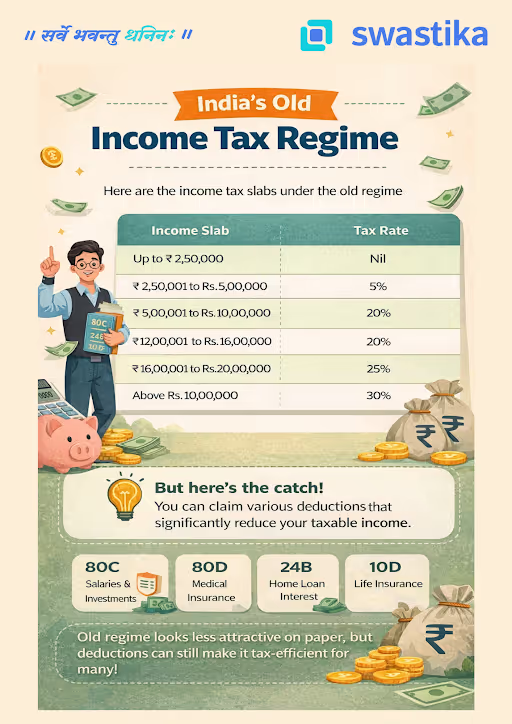
The Deductions Game: Where Old Regime Wins
Under the old regime, a salaried investor can typically claim:
- Section 80C — Up to Rs. 1.5 lakh (ELSS, PPF, life insurance, home loan principal)
- Section 80D — Up to Rs. 25,000 on health insurance premiums (Rs. 50,000 for senior citizens)
- HRA — House Rent Allowance exemption if you live in a rented home
- Standard Deduction — Rs. 50,000 for salaried individuals
- Home Loan Interest (Section 24b) — Up to Rs. 2 lakh deduction
- NPS (Section 80CCD(1B)) — Additional Rs. 50,000 deduction
If you are a salaried investor who regularly contributes to ELSS, pays rent, has a home loan, and invests in NPS, the old regime can reduce your taxable income by Rs. 4 to 5 lakh easily. That is a meaningful difference.
How Capital Gains Fit Into the Picture
Here is something many investors miss: capital gains from stocks and equity mutual funds are taxed at fixed rates regardless of which regime you choose.
- Short-Term Capital Gains (STCG) — Gains from equity held for less than 12 months are taxed at 20% (revised in Budget 2024, effective July 23, 2024)
- Long-Term Capital Gains (LTCG) — Gains from equity held for more than 12 months, above Rs. 1.25 lakh, are taxed at 12.5% without indexation
This applies under both the old and new tax regimes. So if you are primarily an investor with capital gains as your main income, the regime choice matters more for your salary or business income component than for the investment gains themselves.
However, here is where it gets interesting: under the old regime, you can use your deductions to offset your salary income, effectively freeing up more investable surplus. That indirectly benefits your wealth-building journey.
Real-World Example: Rahul's Dilemma
Let us take Rahul, a 35-year-old IT professional in Pune with a gross salary of Rs. 15 lakh per annum. He is also an active equity investor.
Under the Old Regime:
- Gross income: Rs. 15,00,000
- Less: Standard Deduction: Rs. 50,000
- Less: 80C (ELSS + PPF): Rs. 1,50,000
- Less: 80D (health insurance): Rs. 25,000
- Less: HRA (living on rent): Rs. 1,20,000
- Less: NPS 80CCD(1B): Rs. 50,000
- Net Taxable Income: Rs. 11,05,000
- Approximate tax liability: Rs. 1,67,000 + cess
Under the New Regime:
- Gross income: Rs. 15,00,000
- Less: Standard Deduction: Rs. 75,000 (enhanced from FY 2024-25)
- Net Taxable Income: Rs. 14,25,000
- Approximate tax liability: Rs. 1,50,000 + cess (using new slabs)
In this case, the new regime may actually work out marginally better for Rahul because the new slabs are more generous at this income level. But change his income to Rs. 18 lakh or add a home loan, and the old regime pulls ahead clearly.
The math changes with every individual situation.
When Should a Stock Market Investor Pick the Old Regime?
The old regime tends to work better for investors who:
- Have a home loan with significant interest outgo
- Live in a rented house and claim HRA
- Consistently max out 80C through ELSS, PPF, or insurance
- Have income above Rs. 15 lakh and can claim total deductions above Rs. 3.75 lakh
- Are contributing to NPS and want the additional Rs. 50,000 deduction
If ELSS is your preferred SIP instrument for equity investing, the old regime gives you the dual benefit of tax saving and market participation. That combination is genuinely hard to ignore.
When Does the New Regime Make More Sense?
The new regime is a better fit if you:
- Have minimal deductions to claim
- Prefer simplicity and reduced paperwork during tax filing
- Are a young professional just starting out without a home loan or insurance commitments
- Have income below Rs. 12 lakh (effectively zero tax under the new regime with the 87A rebate)
- Are a trader with primarily business income rather than salaried income
For traders who report F&O income as business income, the tax structure is different altogether. Their taxable income is calculated after allowing business expenses, and regime selection depends on total income minus allowable business costs.
A Word on Advance Tax and ITR Filing for Investors
Whether you choose old or new, if your total tax liability exceeds Rs. 10,000 in a year, you are required to pay advance tax. For active investors with significant capital gains, this means tracking your profits quarterly and paying accordingly.
Failing to do so attracts interest under Sections 234B and 234C of the Income Tax Act.
Also, equity investors with capital gains are required to file ITR-2, while traders declaring business income need to file ITR-3. Choosing the right ITR form is as important as choosing the right tax regime.
The One Step Most Investors Skip
Before you file your return, actually run both calculations. Do not assume. Tax planning software, a qualified CA, or even a detailed Excel sheet can help you see the exact difference for your income profile.
Many investors blindly continue with the default new regime without realising they are leaving real money on the table.
FAQs
Q1. Can I switch between old and new tax regimes every year?Salaried individuals can switch between the two regimes every financial year at the time of filing their ITR. However, if you have business income, you can switch back to the old regime only once in your lifetime after opting for the new one.
Q2. Are LTCG and STCG taxed differently under old vs new regime?No. The tax rates on equity capital gains (LTCG at 12.5% above Rs. 1.25 lakh and STCG at 20%) are fixed and apply regardless of which regime you choose.
Q3. Is ELSS still worth investing in under the new tax regime?If you are under the new regime, ELSS does not offer a tax deduction. But it still remains a solid equity mutual fund option for wealth creation. The tax-saving benefit is specifically an old regime advantage.
Q4. What happens to my carried-forward capital losses if I switch regimes?Capital loss carry-forward rules are not affected by regime choice. You can still carry forward short-term and long-term capital losses for up to 8 assessment years under both regimes.
Q5. Is there any benefit for senior citizen investors in the new regime?The new regime currently does not offer higher basic exemption limits for senior or super senior citizens. The old regime, however, allows Rs. 3 lakh exemption for senior citizens and Rs. 5 lakh for super senior citizens above 80 years, making it potentially more beneficial for retirees with investment income.
Conclusion
There is no universal winner in the old vs new tax regime debate. The right answer depends on your salary structure, investment habits, life stage, and how many legitimate deductions you can claim. For serious stock market investors who use ELSS, claim HRA, or service a home loan, the old regime often delivers better tax efficiency. For those just starting out or with simpler finances, the new regime offers ease and savings at lower income levels.
The bottom line: do not leave this decision to chance or default settings. Run the numbers, consult a tax professional if needed, and file smart.
If you are looking to invest in the stock market with clarity and confidence, Swastika Investmart offers a SEBI-registered platform with powerful research tools, real-time market data, and dedicated customer support to help you make informed decisions at every step of your investment journey.

Tax on Dividend Income in India: What Investors Must Know
Tax on Dividend Income in India: What Investors Must Know
Dividend income has always been a favorite among Indian investors looking for steady cash flow from their equity investments. Whether you hold shares of blue-chip companies or invest in dividend-paying mutual funds, understanding how this income is taxed is crucial.
Over the past few years, there have been important changes in how dividends are taxed in India. These changes directly impact your net returns and overall investment strategy.
Let’s break down everything you need to know about tax on dividend income in India in a simple and practical way.
Quick Takeaways
• Dividend income is now taxed in the hands of investors as per their income slab
• Companies deduct TDS if dividend exceeds a specified threshold
• Proper tax planning can help improve post-tax returns
• High-income investors may face higher tax liability on dividends
• Understanding tax rules is essential for long-term portfolio planning
What is Dividend Income?
Dividend is the portion of a company’s profits distributed to its shareholders.
For example, if you own shares of Infosys or HDFC Bank, and these companies declare dividends, the amount credited to your bank account is your dividend income.
This income is often seen as passive income, but it is not tax-free.
How Dividend Taxation Works in India
Earlier, companies used to pay Dividend Distribution Tax. Investors received dividends tax-free in their hands.
However, after the changes introduced in the Union Budget 2020, this system was abolished.
Now, dividend income is taxed in the hands of the investor.
Tax Rate on Dividend Income
Dividend income is added to your total income and taxed as per your applicable income tax slab.
Example
Let’s say:
• You earn ₹50,000 as dividend income
• Your income tax slab is 30%
In this case, you will pay ₹15,000 as tax on dividend income.
This makes dividend taxation less attractive for high-income investors compared to earlier.
TDS on Dividend Income
Companies are required to deduct Tax Deducted at Source if the dividend exceeds ₹5,000 in a financial year.
This deduction is done as per rules defined by the Income Tax Department.
Key Points
• TDS is usually deducted at 10%
• If PAN is not provided, TDS can be higher
• You can claim TDS credit while filing your income tax return
Impact on Retail Investors
The shift in dividend taxation has changed how investors view dividend-paying stocks.
Earlier, dividends were tax-free, making them highly attractive. Now, since they are taxed as per slab rates:
• High-income investors may prefer growth stocks
• Dividend yield becomes less attractive post-tax
• Portfolio strategy may need adjustment
However, for investors in lower tax brackets, dividends can still be a useful source of income.
Dividend vs Capital Gains: What’s Better?
Investors often compare dividend income with capital gains.
Dividend Income
• Taxed at slab rate
• Regular income stream
• No control over payout timing
Capital Gains
• Lower tax rates in many cases
• Tax payable only on selling
• More control over timing
For example, long-term capital gains on equities are taxed at 10% above a certain limit, which may be lower than slab rates for many investors.
Smart Tax Planning Tips
Understanding tax rules can help you optimize returns.
1. Use Lower Tax Bracket Advantage
If your income falls in a lower slab, dividend income may still be tax-efficient.
2. Invest Through Family Members
Some investors distribute investments among family members in lower tax brackets to reduce overall tax liability.
3. Consider Growth-Oriented Investments
Instead of high dividend stocks, growth stocks can help defer taxes.
4. Track TDS Properly
Always reconcile TDS in your Form 26AS before filing returns.
Real Market Context
Many Indian companies continue to reward shareholders through dividends.
For example, IT and banking companies like Infosys and HDFC Bank have a consistent dividend payout history.
However, post-tax returns have become a key consideration. Investors are now evaluating:
• Dividend yield vs tax liability
• Growth potential vs income generation
• Overall portfolio allocation
This shift is gradually changing investment behavior in Indian equity markets.
Regulatory Framework
Dividend taxation in India is governed by the Income Tax Act.
Key provisions include:
• Dividend taxed under “Income from Other Sources”
• TDS rules applicable for payments above threshold
• Reporting mandatory while filing returns
Investors must stay updated with changes announced in budgets and policy updates.
How Swastika Investmart Helps Investors
Navigating taxation along with investments can be complex, especially for beginners.
Swastika Investmart, a SEBI registered broker, supports investors with:
• Research-backed stock recommendations
• User-friendly trading platforms
• Dedicated customer support
• Investor education on taxation and financial planning
• Tools to track portfolio performance and returns
Frequently Asked Questions
Is dividend income tax-free in India?
No, dividend income is taxable in the hands of investors as per their income tax slab.
What is the TDS limit on dividend income?
TDS is applicable if dividend income exceeds ₹5,000 in a financial year.
How is dividend income taxed?
It is added to your total income and taxed according to your applicable slab rate.
Can I avoid tax on dividend income?
You cannot avoid tax completely, but proper planning can help reduce tax liability.
Is dividend better than capital gains?
It depends on your tax slab and investment goals. Capital gains may be more tax-efficient for high-income investors.
Conclusion
Dividend income remains an important part of investing, especially for those seeking regular cash flow. However, the change in taxation rules has made it essential to look beyond just dividend yield.
Investors now need to consider post-tax returns, overall portfolio strategy, and long-term financial goals.
With the right knowledge and tools, you can make smarter investment decisions and optimize your returns.
Swastika Investmart provides the research, technology, and support needed to help you navigate both markets and taxation efficiently.

Reliance’s Green Fuel Strategy: A Game Changer for the Energy Sector
Reliance’s Green Fuel Strategy: A Game Changer for the Energy Sector
India’s energy transition story is gaining momentum, and one of the biggest developments in this space comes from Reliance Industries Limited. The company recently announced a long-term agreement to supply green ammonia to Samsung C&T Corporation, marking a significant step in the global green fuel ecosystem.
This move is not just another corporate deal. It reflects a deeper strategic shift toward clean energy and positions India as a serious player in the global energy transition.
Quick Takeaways
• Reliance has entered a major green ammonia supply deal with Samsung C&T
• Green fuel is emerging as a key pillar of future energy security
• The deal strengthens India’s position in global clean energy markets
• It can accelerate investments in hydrogen and renewable infrastructure
• Long-term impact could reshape the valuation of energy companies
Understanding Reliance’s Green Fuel Strategy
Reliance Industries has been actively transforming itself from a traditional oil and petrochemical giant into a diversified energy company.
The focus is now shifting toward clean fuels such as green hydrogen and green ammonia. These fuels are produced using renewable energy sources and have the potential to significantly reduce carbon emissions.
The recent deal with Samsung C&T is a clear signal that Reliance is moving from planning to execution.
What is Green Ammonia and Why Does It Matter?
Green ammonia is produced using green hydrogen, which is generated through electrolysis powered by renewable energy like solar or wind.
Unlike conventional ammonia, which relies on fossil fuels, green ammonia is carbon-free. It is gaining attention globally as:
• A clean fuel for shipping and heavy industries
• A storage medium for hydrogen
• A key component in the decarbonisation of industrial sectors
Countries like Japan and South Korea are actively looking to import green ammonia to meet their climate targets. This creates a massive export opportunity for India.
Strategic Importance of the Samsung C&T Deal
The agreement between Reliance and Samsung C&T is one of the largest of its kind in the green fuel space.
This deal is important for several reasons:
1. Validates India’s Green Energy Capabilities
India is emerging as a low-cost producer of renewable energy. This gives companies like Reliance a competitive edge in producing green fuels at scale.
2. Opens Global Revenue Streams
By supplying green ammonia to international markets, Reliance is diversifying its revenue beyond domestic operations.
3. Strengthens Long-Term Visibility
Long-term contracts provide earnings visibility and reduce business uncertainty, which is highly valued by investors.
Impact on the Indian Energy Sector
Reliance’s aggressive push into green fuels could have a ripple effect across the energy sector.
Shift Toward Clean Energy
Traditional energy companies may accelerate their transition strategies to remain competitive.
Boost to Renewable Ecosystem
Demand for solar, wind, and electrolyser infrastructure is expected to increase, benefiting multiple sectors.
Increased Investor Interest
Green energy themes are already attracting global capital. This move could further strengthen investor sentiment toward Indian energy companies.
Market Perspective: What It Means for Investors
For equity investors, this development is significant.
Energy companies are no longer being valued only on traditional metrics like refining margins. Instead, future growth potential in clean energy is becoming a key factor.
Reliance’s strategy could lead to:
• Re-rating of energy stocks
• Increased institutional participation
• Higher long-term growth expectations
This also aligns with global ESG investing trends, where investors prefer companies focused on sustainability.
Regulatory and Policy Support in India
India’s government has been actively promoting green energy initiatives.
Policies such as the National Green Hydrogen Mission aim to make India a global hub for hydrogen production and export.
Supportive regulations, incentives, and infrastructure development are likely to accelerate the adoption of green fuels.
This creates a favorable environment for companies like Reliance to scale their operations.
Challenges to Watch
While the opportunity is massive, there are challenges as well:
High Initial Costs
Green hydrogen and ammonia production require significant capital investment.
Technology and Infrastructure
Scaling production and building export infrastructure will take time.
Global Competition
Countries like Australia and the Middle East are also investing heavily in green fuels.
Investors should keep these factors in mind while evaluating the sector.
Role of Swastika Investmart for Investors
For investors looking to capitalize on emerging themes like green energy, research and timing are critical.
Swastika Investmart, a SEBI registered broker, offers:
• Strong research insights on emerging sectors
• Advanced tools for tracking market trends
• Reliable customer support
• A tech-enabled investing platform
• Investor education to make informed decisions
Frequently Asked Questions
What is Reliance’s green fuel strategy?
Reliance is focusing on producing and exporting green hydrogen and green ammonia using renewable energy sources to reduce carbon emissions and tap into global clean energy demand.
Why is the Samsung C&T deal important?
The deal provides long-term revenue visibility, validates Reliance’s green energy capabilities, and strengthens India’s position in the global energy market.
How does green ammonia impact the energy sector?
Green ammonia offers a clean alternative to fossil fuels and is expected to play a key role in decarbonising industries and transportation.
Is this good news for investors?
Yes, it signals long-term growth potential and could lead to a re-rating of energy stocks, especially those investing in clean energy.
What risks should investors consider?
Investors should watch for high capital costs, execution challenges, and increasing global competition in the green fuel space.
Conclusion
Reliance’s green fuel strategy is more than just a business expansion. It represents a shift in how energy companies will operate in the future.
The deal with Samsung C&T highlights the growing importance of clean fuels and positions India as a key player in the global energy transition.
For investors, this opens up a new dimension of opportunities in the energy sector. However, a balanced approach with proper research is essential.
With platforms like Swastika Investmart offering strong research and technology-driven solutions, investors can stay ahead in identifying such long-term themes and make smarter investment decisions.

Power Stocks Rally: What’s Driving FII Interest in India?
Power Stocks Rally: What’s Driving FII Interest in India?
India’s power sector is once again in the spotlight. At a time when broader markets have shown volatility, power stocks have quietly delivered strong returns. What is even more interesting is the rising interest from foreign institutional investors.
Recent data from the National Securities Depository Limited highlights that FIIs have significantly increased their exposure to India’s power sector. This trend is not random. It reflects deeper structural shifts in both the global and domestic energy landscape.
So, what exactly is driving this rally in power stocks, and should investors pay attention?
Quick Takeaways
• FIIs are increasing allocation to power stocks due to energy security themes
• Rising electricity demand and AI driven infrastructure are key growth drivers
• Power companies are outperforming broader indices like Nifty 50
• Global geopolitical risks are pushing capital toward stable energy markets like India
• Long term growth outlook remains strong, though valuations are rising
Strong FII Inflows Signal Confidence
Foreign institutional investors are often seen as smart money in the market. When they increase exposure to a sector, it usually indicates confidence in long term fundamentals.
In recent months, FIIs have poured hundreds of millions of dollars into power stocks. This comes despite volatility in benchmark indices like the BSE Sensex and Nifty 50.
This divergence clearly shows that investors are selectively rotating capital into sectors that offer both stability and growth.
Power Stocks Outperforming the Market
While the broader market has seen mixed trends, several power companies have delivered impressive returns.
Companies like NTPC, Tata Power, and JSW Energy have shown steady gains. Meanwhile, renewable focused players such as Adani Green Energy have also attracted strong investor interest.
This outperformance suggests that investors are viewing power companies not just as traditional utilities, but as long term growth opportunities.
AI and Data Centres Driving Demand
One of the biggest structural drivers behind this trend is the rapid growth of data centres and artificial intelligence infrastructure.
As India moves toward a digital economy, demand for data storage and processing is rising sharply. Data centres require uninterrupted and large scale electricity supply.
Government data indicates that India’s data centre capacity has expanded multiple times in the last few years. This growth is expected to continue, creating a strong demand pipeline for power companies.
In simple terms, electricity is becoming the backbone of the digital economy.
Rising Electricity Demand in India
India’s electricity consumption continues to grow steadily due to industrial expansion, urbanisation, and increasing household demand.
Peak power demand has already touched record levels and is expected to rise further in the coming years. This provides strong revenue visibility for power generation and distribution companies.
For investors, this means predictable cash flows and relatively stable earnings compared to more cyclical sectors.
Global Energy Risks Boost Sector Appeal
Global geopolitical tensions have played a major role in shaping investment flows.
Events like the Russia Ukraine War and tensions in the Middle East have disrupted global energy supply chains. As a result, investors are increasingly looking for stable energy markets.
India, with its growing domestic demand and improving infrastructure, is emerging as an attractive destination.
Power companies, therefore, are being seen as strategic assets rather than just utility providers.
Energy Security Becomes a Priority
Energy security is now a key theme for governments and investors worldwide.
Countries want reliable and affordable electricity supply to support economic growth. India’s push toward renewable energy, along with expansion in thermal and hydro capacity, is strengthening its position.
This combination of growth and stability is making Indian power stocks appealing to global investors.
Valuations Are Rising But Momentum Continues
The recent rally has led to higher valuations for many power companies.
Stocks like NTPC, Tata Power, and JSW Energy are now trading above their historical averages. However, investors seem willing to pay a premium due to strong future growth prospects.
That said, investors should remain cautious and avoid chasing stocks purely based on momentum.
What Should Retail Investors Do?
For retail investors, the key is to focus on long term fundamentals rather than short term price movements.
Power stocks offer a mix of stability and growth, but proper research is essential before investing.
Platforms like Swastika Investmart help investors with research driven insights, advanced tools, and reliable customer support. Being a SEBI registered broker, it ensures transparency and trust while offering a tech enabled investing experience.
Frequently Asked Questions
Why are FIIs investing in power stocks?
FIIs are investing due to rising electricity demand, energy security themes, and strong long term growth prospects driven by digital infrastructure and industrial expansion.
Which power stocks are attracting investor interest?
Companies like NTPC, Tata Power, JSW Energy, and Adani Green Energy are among the key stocks gaining attention.
How does AI impact the power sector?
AI and data centres require massive electricity, increasing demand for power generation and distribution.
Are power stocks safe for long term investment?
Power stocks are generally considered stable due to predictable demand, but investors should evaluate valuations and company fundamentals.
What risks should investors consider?
Key risks include high valuations, regulatory changes, and execution challenges in large scale projects.
Conclusion
The rally in power stocks is backed by strong fundamentals, not just market momentum. Rising electricity demand, global energy concerns, and the growth of digital infrastructure are creating a powerful long term story.
FII inflows further reinforce confidence in the sector, but investors should remain disciplined and focus on quality companies.
With the right research and tools, investors can take advantage of these opportunities. Swastika Investmart offers a reliable platform with strong research capabilities and investor focused services to help you make informed decisions.

Short-Term vs Long-Term Capital Gains Tax on Shares
Short Term vs Long Term Capital Gains Tax on Shares
Investing in the stock market can help build long term wealth, but every investor must understand the tax implications of their investments. One of the most important aspects of stock market taxation in India is the difference between short term and long term capital gains tax on shares.
Whether you are an active trader or a long term investor, knowing how gains are taxed can help you plan your investments better and avoid surprises during tax filing.
The taxation rules for capital gains on shares are governed under the Income Tax Act 1961, which clearly defines how profits from equity investments are classified and taxed.
Quick Takeaways
• Short term capital gains apply when shares are sold within one year of purchase.
• Long term capital gains apply when shares are held for more than one year.
• Short term gains on listed shares are taxed at a fixed rate.
• Long term gains above a certain limit are taxed at a concessional rate.
• Smart tax planning can improve overall investment returns.
Understanding Capital Gains in the Stock Market
Capital gains refer to the profit earned when an investor sells shares at a price higher than the purchase price.
For example, suppose you buy shares of a company for ₹1 lakh and sell them later for ₹1.3 lakh. The ₹30,000 profit is considered a capital gain and is subject to taxation.
The tax treatment depends on how long you hold the shares before selling them.
What Is Short Term Capital Gains Tax on Shares
Short term capital gains arise when listed equity shares are sold within 12 months of purchase.
Under current tax rules, short term gains on listed shares are taxed under Section 111A.
Tax Rate on Short Term Capital Gains
Short term capital gains on equity shares are taxed at a flat rate of 15 percent, provided that the transaction is executed through a recognized stock exchange and Securities Transaction Tax has been paid.
Example of Short Term Capital Gains
Imagine an investor buys shares of a listed company for ₹2 lakh and sells them after six months for ₹2.5 lakh.
The ₹50,000 profit is treated as short term capital gain and taxed at 15 percent, excluding surcharge and cess.
This means the investor will pay approximately ₹7,500 as tax on the gain.
What Is Long Term Capital Gains Tax on Shares
Long term capital gains occur when shares are held for more than one year before selling.
The taxation of these gains is covered under Section 112A.
Tax Rate on Long Term Capital Gains
Long term capital gains on listed equity shares are taxed at 10 percent if the total gains exceed ₹1 lakh in a financial year.
If the total gains remain within the ₹1 lakh exemption limit, no tax is payable.
Example of Long Term Capital Gains
Suppose an investor buys shares worth ₹3 lakh and sells them after two years for ₹4.5 lakh.
The total gain is ₹1.5 lakh.
Since the first ₹1 lakh of long term gains is exempt, tax applies only to the remaining ₹50,000 at 10 percent.
In this case, the investor pays ₹5,000 as tax.
Key Differences Between Short Term and Long Term Capital Gains
Holding Period
Short term gains apply when shares are sold within one year.
Long term gains apply when shares are held for more than one year.
Tax Rate
Short term gains are taxed at 15 percent.
Long term gains above ₹1 lakh are taxed at 10 percent.
Tax Planning Opportunities
Long term investing offers better tax efficiency because of the exemption limit and lower tax rate.
Impact on Investment Strategy
Understanding capital gains tax is important because taxes directly affect net returns.
For example, frequent traders who buy and sell stocks within months may face higher tax liabilities due to short term taxation.
Long term investors, on the other hand, benefit from the lower tax rate and exemption threshold.
This is one reason why many financial experts encourage long term investing in equities.
Market Perspective and Investor Behavior
Tax rules often influence how investors approach the stock market.
Many investors hold quality stocks for longer periods to take advantage of favorable long term tax treatment. This behavior supports stability in the market and encourages disciplined investing.
For instance, investors who held shares of major Indian companies over multiple years have historically benefited from both price appreciation and tax efficiency.
Practical Tips to Manage Capital Gains Tax
Investors can take a few practical steps to manage their tax liabilities.
Track Your Holding Period
Always check whether the investment qualifies for long term treatment before selling.
Plan Profit Booking
If your long term gains are close to the ₹1 lakh exemption limit, you can plan partial profit booking to minimize tax.
Maintain Proper Records
Keep records of purchase price, sale price, brokerage charges, and taxes paid to ensure accurate reporting during tax filing.
How the Right Investment Platform Can Help
Successful investing is not only about selecting stocks but also about managing taxes and maintaining proper records.
Platforms that provide strong research tools, portfolio tracking, and investor education can make this process easier.
Frequently Asked Questions
What is the holding period for long term capital gains on shares?
For listed equity shares, the holding period must be more than 12 months to qualify as long term capital gains.
What is the tax rate for short term capital gains on shares?
Short term capital gains on listed shares are taxed at 15 percent when transactions are executed through a recognized stock exchange.
Is there any exemption for long term capital gains?
Yes, long term capital gains up to ₹1 lakh in a financial year are exempt from tax.
Do intraday trades attract capital gains tax?
No. Intraday trading profits are considered speculative business income and are taxed according to the individual’s income tax slab.
Can losses from stocks be adjusted against gains?
Yes, capital losses can generally be adjusted against capital gains according to income tax rules, subject to specific conditions.
Conclusion
Understanding the difference between short term and long term capital gains tax on shares is essential for every stock market investor. Taxes can significantly influence the final return from investments, so planning ahead is crucial.
Short term gains come with higher tax rates, while long term investing offers better tax efficiency and exemption benefits. By aligning investment decisions with tax rules, investors can improve their overall portfolio performance.
Platforms like Swastika Investmart make investing simpler with research driven insights, technology enabled tools, and investor focused services.
If you are ready to begin your investment journey or want a smarter trading platform, you can open your account here

Best Ways to Save Income Tax Under Section 80C
Best Ways to Save Income Tax Under Section 80C
Tax planning is an important part of financial management for salaried individuals and investors in India. One of the most popular provisions that helps taxpayers legally reduce their tax liability is Section 80C under the Income Tax Act 1961.
Section 80C allows taxpayers to claim deductions of up to ₹1.5 lakh per financial year by investing in specific financial instruments or making eligible payments. For many individuals, this section forms the backbone of tax planning strategies.
The key is to choose options that not only reduce taxes but also help build long term wealth.
Quick Takeaways
• Section 80C allows tax deductions of up to ₹1.5 lakh annually.
• Popular options include ELSS mutual funds, PPF, life insurance premiums, and tax saving fixed deposits.
• Some investments offer higher returns but involve market risk.
• Smart tax planning combines safety, liquidity, and long term growth.
• Choosing the right investment depends on financial goals and risk tolerance.
Understanding Section 80C of the Income Tax Act
Section 80C is one of the most widely used deductions available to individual taxpayers. It allows deductions from taxable income for certain investments and expenses.
For example, if your annual taxable income is ₹10 lakh and you invest ₹1.5 lakh in eligible Section 80C instruments, your taxable income effectively reduces to ₹8.5 lakh.
This deduction can significantly lower the total tax payable, especially for individuals in higher tax brackets.
However, it is important to remember that the deduction limit is capped at ₹1.5 lakh per financial year.
Equity Linked Savings Scheme
One of the most popular tax saving investments under Section 80C is the Equity Linked Savings Scheme.
ELSS mutual funds invest primarily in equities and have the shortest lock in period among Section 80C options, which is three years.
Why investors prefer ELSS
ELSS funds offer the potential for higher returns compared to traditional tax saving instruments. Since these funds invest in the stock market, they can benefit from long term equity growth.
For example, during strong market cycles, many ELSS funds have historically delivered returns that outperform fixed income instruments.
However, investors should also understand that returns are market linked and may fluctuate in the short term.
Public Provident Fund
Another popular option is the Public Provident Fund.
PPF is a government backed savings scheme that offers stable returns and tax benefits.
Key benefits of PPF
It provides guaranteed returns declared annually by the government. Contributions, interest earned, and maturity proceeds are all tax free under existing rules.
The main limitation is the lock in period of 15 years, which makes it suitable for long term goals such as retirement planning.
Tax Saving Fixed Deposits
Many conservative investors prefer tax saving fixed deposits offered by banks.
These deposits typically have a lock in period of five years and provide fixed interest income.
Although returns may be lower than market linked investments, they offer predictability and capital protection.
For individuals who prefer stability over volatility, tax saving FDs remain a reliable choice.
Life Insurance Premiums
Premiums paid toward eligible life insurance policies also qualify for deductions under Section 80C.
Life insurance not only provides tax benefits but also ensures financial protection for family members in case of unforeseen events.
However, investors should avoid purchasing insurance purely for tax savings. The primary purpose of life insurance should always be financial protection.
National Savings Certificate
Another traditional option under Section 80C is the National Savings Certificate.
This government backed instrument offers fixed returns and is commonly used by risk averse investors.
The lock in period typically ranges around five years, and interest earned is considered taxable.
Real Life Example of Section 80C Tax Planning
Consider a salaried professional earning ₹12 lakh annually.
If this individual invests ₹1.5 lakh in Section 80C eligible instruments such as ELSS or PPF, their taxable income reduces to ₹10.5 lakh.
Depending on the tax slab, this could translate into substantial tax savings every year.
Over time, if these investments generate returns, the taxpayer not only saves tax but also builds long term wealth.
Choosing the Right Section 80C Investment
Selecting the best tax saving option depends on several factors including age, financial goals, and risk tolerance.
Younger investors often prefer equity linked options such as ELSS because they have a longer investment horizon and can benefit from market growth.
Investors closer to retirement may prefer safer instruments like PPF or tax saving fixed deposits.
A balanced strategy may include a mix of equity and fixed income investments to manage risk while pursuing growth.
Why Market Linked Investments Are Gaining Popularity
In recent years, many investors have shifted toward market linked tax saving instruments.
Equity based investments have historically delivered higher long term returns compared to traditional fixed income products.
As financial awareness grows, investors are increasingly focusing on tax planning strategies that combine tax efficiency with wealth creation.
This shift is also supported by better access to investment platforms, research insights, and digital trading tools.
Smart Investing Requires the Right Platform
Tax saving investments should be part of a larger financial plan rather than a last minute decision before the tax filing deadline.
Investors benefit from platforms that offer strong research tools, reliable customer support, and investor education resources.
Frequently Asked Questions
What is the maximum deduction allowed under Section 80C?
Taxpayers can claim deductions of up to ₹1.5 lakh per financial year for eligible investments and expenses under Section 80C.
Which investment under Section 80C offers the highest return?
Equity Linked Savings Schemes often have the potential for higher returns because they invest in the stock market, though returns are not guaranteed.
Is PPF better than ELSS for tax saving?
PPF offers safety and guaranteed returns, while ELSS offers higher growth potential but involves market risk. The best option depends on the investor’s risk tolerance.
Can life insurance premiums be claimed under Section 80C?
Yes, eligible life insurance premiums paid for policies covering self, spouse, or children can be claimed under Section 80C.
Are tax saving fixed deposits risk free?
Tax saving fixed deposits provide predictable returns and capital protection, but interest earned is taxable.
Conclusion
Section 80C remains one of the most effective tools for reducing income tax liability in India. From ELSS mutual funds and PPF to life insurance and tax saving fixed deposits, taxpayers have several options to choose from.
The key is to align tax saving investments with long term financial goals rather than focusing solely on deductions. A well planned approach can help investors reduce taxes while building wealth over time.
With strong research capabilities, technology driven platforms, and dedicated investor education initiatives, Swastika Investmart supports investors in making smarter financial decisions.
If you are planning to begin your investment journey or optimize your tax saving strategy, you can open your account here
Popular Articles



.avif)
.avif)

.avif)





START YOUR INVESTMENT JOURNEY
Get personalized advice from our experts
- Dedicated RM Support
- Smooth and Fast Trading App
