Trent ₹6 Dividend — Buy Before Jun 11, 2026 — Should You?


Key Takeaways
- Trent Limited declares a ₹6 dividend per share with the record date of 12-Jun-2026.
- To qualify for the dividend, you must buy before 11-Jun-2026 and ensure settlement.
- Top priority sectors: Consumer discretionary (retail) and dividend-focused equity strategies.
- Action: If you want the payout, consider buying before 11-Jun-2026; otherwise wait and assess fundamentals.
What Happened
Trent Limited announced a dividend of ₹6 per share for equity shareholders. The payout comes with a record date of 12-Jun-2026, and the last date to buy the stock to qualify is 11-Jun-2026. In practical terms, investors need to own the shares before 11-Jun to be eligible for the cash payout.
Key Details
Dividend payments are cash returns on top of any price appreciation. The settlement cycle in India suggests you should consider the T+2 timeline when placing orders to ensure settlement before or on the cut-off date. If you currently own the stock, this dividend increases your yield for the next 1-2 quarters, though price movements around payout can offset some gains.
Why This Matters
Dividend announcements indicate cash generation capability and can attract income-focused investors. For Trent, a ₹6 per-share payout may modestly improve total returns for holders, especially if the stock price doesn't swing wildly around the payout window. For you, the practical takeaway is to assess whether this dividend aligns with your income goals and risk profile, and whether you are comfortable with potential price volatility in the near term.
Market Context
In the current retail landscape, Trent's dividend yield should be weighed against its earnings growth, store expansions, and competitive dynamics with peers. If you already own Trent, the payout could slightly boost your realized return; if you're contemplating entry, you must factor in valuation and the stock's longer-term earnings trajectory. Your decision should hinge on fundamentals rather than chasing a cash yield alone.
What This Means For Your Portfolio
MOST IMPORTANT SECTION — direct investor impact: - Which stocks or sectors are affected: Trent's dividend affects your exposure to consumer discretionary and adds a cash component to returns for holders. - Should investor buy, hold, or wait: If you need income and the stock's fundamentals look solid, buying before 11-Jun-2026 can be reasonable; otherwise, consider your overall risk and diversify. - Any risk to existing portfolio: Dividend-driven moves can lead to concentration risk; price adjustments around the payout can create temporary drawdowns if not managed carefully.
Direct Implications
For you, the central question is whether to add or maintain a position in Trent to capture the ₹6 per share payout. If you already hold the stock, the dividend enhances your yield but do not rush to pay a higher entry price. If you are new to the stock, weigh the dividend along with business prospects such as store expansion, brand strength, and consumer demand trends.
Swastika Investmart notes that dividend announcements can lead to short-term price moves. If you are a retail investor, assess whether the yield justifies the risk and whether you already own the stock. The long-term case for Trent depends on its earnings, store expansion, and consumer demand, not just the dividend.
Sectors To Watch — Priority Order
1st Priority: Consumer Discretionary / Retail — aligned with Trent's core business and potential dividend-driven returns. 2nd Priority: Equity Markets / Dividend Income — compare yields and payout stability across the sector. Avoid Now: Fixed Income Funds — if you chase this dividend for income, you may miss better risk-adjusted opportunities in a balanced portfolio.
Action Points For Investors
- SIP investors: Rebalance gradually; don't overweight Trent solely for the dividend; keep your systematic plans intact. - Lumpsum investors: If you plan to deploy cash, align your entry with your risk tolerance and desired yield; don't chase the dividend alone. - Traders: Monitor price moves around the payout window; consider take-profit levels or hedging as needed.
Key Risks To Watch
2-3 risks investor should monitor: Dividend expectations may not sustain, price can drop around payout, and overall market volatility can impact both yield and valuation.
FAQ Details
What is the eligibility date for Trent's ₹6 dividend?
To receive ₹6 per share, you must own Trent shares before the last date to buy (11-Jun-2026) and have your trade settled.
How does this dividend affect my portfolio?
If you qualify, you will receive ₹6 per share as cash; the stock price may adjust near the payout, so total return depends on price movement as well as the dividend.
Should you buy Trent now for dividend income?
If your goal is dividend income and you are comfortable with the stock's fundamentals, buying before 11-Jun-2026 can be reasonable, but beware price risk and tax implications.
What other factors should investors consider with Trent?
Consider Trent's earnings growth, store expansion, consumer demand, competition, and overall market conditions; dividend alone should not drive allocation.
Conclusion
Trent's ₹6 dividend offers a potential income boost for shareholders, but entry decisions should hinge on your risk tolerance and the stock's fundamentals. If you aim to capture the payout, consider your timing carefully and balance with a view on long-term growth.
Big Budget





.avif)
.avif)
.avif)
.avif)
.avif)














.avif)
.avif)
.avif)
.avif)
Latest Articles

Gold Hits Record High Near $4,600 as Fed Subpoenas and Iran Tensions Shake Markets


Summary
- Gold prices surged to record highs near $4,600 amid global uncertainty
- Legal pressure on the US Federal Reserve and rising Iran tensions rattled risk assets
- Safe haven demand pushed global and Indian gold prices higher
- Indian markets saw increased interest in gold ETFs and sovereign gold bonds
- The rally highlights gold’s role as a hedge in volatile times
Global financial markets are on edge, and gold is once again proving why it is considered the ultimate safe haven. Gold prices surged to record highs near $4,600, driven by a rare combination of political uncertainty, geopolitical tension, and growing distrust in traditional monetary institutions.
Two developments stood out. First, reports of subpoenas linked to the US Federal Reserve reignited concerns about policy credibility. Second, escalating tensions involving Iran added a fresh geopolitical risk premium to global assets. Together, these factors triggered a sharp flight to safety, pushing gold to levels few had anticipated.
For Indian investors, the rally is more than just an international headline. It has real implications for portfolios, currency dynamics, and investment strategies.
What Is Driving Gold to Record Highs
Uncertainty around the US Federal Reserve
Markets rely heavily on the credibility and independence of central banks. News around subpoenas and legal scrutiny involving the US Federal Reserve unsettled investors, even if operational policy remained unchanged.
Whenever confidence in monetary governance weakens, investors tend to seek assets that are not tied to any government or balance sheet. Gold fits that role perfectly. As fears of policy disruptions grew, demand for bullion surged across global exchanges.
Iran tensions add geopolitical risk
Geopolitical stress has historically been a powerful driver for gold prices. Rising tensions involving Iran, particularly around regional security and energy routes, added another layer of uncertainty.
Oil prices firmed up, equity markets turned volatile, and capital flowed into defensive assets. Gold benefitted directly, as global funds increased allocations to hedge against potential escalation.
Weakening faith in paper assets
Another subtle but important factor is the growing unease around paper currencies and debt heavy economies. With high fiscal deficits and prolonged periods of tight monetary conditions, investors are reassessing long term risks.
Gold’s appeal lies in its scarcity and historical role as a store of value. In times when macro risks converge, even long term investors tend to raise their exposure.
How the Gold Rally Played Out in Global Markets
The move toward $4,600 was sharp and broad based. Futures markets saw heightened volumes, while gold backed exchange traded funds recorded strong inflows.
Equity markets, especially in the US and parts of Europe, remained choppy. Bond yields showed mixed signals as investors balanced inflation concerns against slowing growth. In this environment, gold stood out as a relatively stable anchor.
Large institutional investors, including hedge funds and pension managers, reportedly increased their strategic gold allocations rather than short term trades. This suggests the rally is being driven by deeper concerns, not just speculative momentum.
Impact on Indian Gold Prices and Markets
Domestic gold prices surge
In India, gold prices closely track global trends, adjusted for currency movements and import duties. As international prices surged, domestic gold rates crossed new highs in rupee terms as well.
The rupee’s movement against the US dollar amplified the impact. A slightly weaker rupee meant higher landed costs, pushing up prices in the physical market.
Jewellers in major cities reported cautious buying, with consumers preferring smaller quantities or opting for coins and bars over heavy jewellery.
Rising interest in gold ETFs and digital gold
High prices did not deter investment demand. In fact, many investors shifted toward gold ETFs and digital gold platforms, seeing them as more flexible ways to gain exposure.
Gold ETFs listed on Indian exchanges witnessed higher trading volumes. This trend reflects a growing preference for transparent and regulated instruments, especially among younger investors.
Sovereign Gold Bonds also gained attention, given their interest component and capital gains benefits if held till maturity, under current tax rules.
Regulatory and Policy Context in India
Gold investments in India operate within a clear regulatory framework. Gold ETFs are regulated by the Securities and Exchange Board of India, while Sovereign Gold Bonds are issued by the Reserve Bank of India on behalf of the government.
Import duties and GST continue to influence domestic pricing, but recent years have seen relatively stable policy treatment. This stability helps investors plan long term allocations without sudden regulatory shocks.
For market participants, regulatory clarity enhances confidence, especially during periods of global volatility.
Should Investors Chase Gold at Record Levels
The big question is whether gold still makes sense near record highs. The answer depends on intent.
For short term traders, volatility is likely to remain high as markets react to geopolitical headlines and policy signals. Price swings could be sharp in both directions.
For long term investors, gold continues to serve as a portfolio stabiliser rather than a return chasing asset. Even small allocations can reduce overall volatility during market stress.
A balanced approach, rather than aggressive positioning, often works best at elevated price levels.
Platforms like Swastika Investmart support investors by offering research driven insights, technical tools, and easy access to gold related instruments. With SEBI registration, robust customer support, and a strong focus on investor education, Swastika Investmart helps investors navigate volatile markets with clarity.
Frequently Asked Questions
Why did gold prices rise to near $4,600
Gold rallied due to heightened global uncertainty, including concerns around the US Federal Reserve’s credibility and escalating geopolitical tensions involving Iran.
How does global gold pricing affect Indian investors
Indian gold prices track international rates, adjusted for currency and duties. A global rally usually leads to higher domestic prices.
Is it risky to invest in gold at record highs
Gold can be volatile in the short term, but it remains a useful hedge and diversification tool in uncertain markets.
Which gold investment options are popular in India
Gold ETFs, Sovereign Gold Bonds, and digital gold are widely used due to transparency and ease of access.
Does gold protect against inflation and market crashes
Historically, gold has helped preserve value during inflationary periods and financial market stress.
Conclusion: Gold Reclaims Its Safe Haven Status
The surge in gold prices near $4,600 is a reminder that global markets remain vulnerable to political, legal, and geopolitical shocks. When confidence in institutions wavers and tensions rise, gold often becomes the asset of choice.
For Indian investors, the rally reinforces gold’s role as a strategic hedge rather than a speculative bet. Staying informed, disciplined, and diversified is key.
If you are looking to track gold, commodities, and broader market trends with confidence, Swastika Investmart offers a reliable, tech enabled investing platform backed by strong research and investor focused support.

GST Relief Sparks 40% Surge in Life Insurance Premiums in December: LIC, SBI Life Lead Growth
Summary
- Life insurance premiums jumped nearly 40% in December after GST relief on certain policies
- LIC and SBI Life Insurance emerged as clear growth leaders
- Tax clarity revived demand for protection and long term savings products
- Higher premium collections strengthen insurers’ balance sheets and investor sentiment
- Insurance sector outlook improves amid regulatory stability and rising financial awareness
GST Relief Sparks 40% Surge in Life Insurance Premiums in December: LIC, SBI Life Lead Growth
India’s life insurance industry ended the year on a high note. December witnessed an almost 40% year on year surge in life insurance premium collections, driven largely by GST relief on specific insurance products. The sudden spike surprised many market participants, but for industry insiders, it was a long awaited reaction to tax clarity and improved affordability.
Large insurers such as Life Insurance Corporation of India and SBI Life Insurance were at the forefront of this growth, reinforcing their dominant position in the sector. Beyond headline numbers, the surge offers valuable insights into consumer behaviour, regulatory impact, and what this means for investors tracking insurance stocks.
This blog breaks down why GST relief mattered, how LIC and SBI Life capitalised on the opportunity, and what the trend signals for Indian financial markets.
Why GST Relief Changed the Game for Life Insurance
Understanding the GST angle
Life insurance premiums in India attract GST, typically 18 percent on risk cover and related charges. Over the past few years, industry bodies had flagged that high indirect taxes were discouraging first time buyers, especially in pure protection and annuity products.
Recent GST relief measures and clarifications around taxation of certain insurance policies reduced ambiguity and effective tax burden for policyholders. While not a blanket exemption, the relief was enough to tilt purchasing decisions in favour of insurance, particularly towards the end of the calendar year.
Timing worked perfectly
December is traditionally strong for life insurers due to year end tax planning under sections like 80C of the Income Tax Act. With GST relief coinciding with this period, many individuals accelerated policy purchases.
For example, a salaried professional planning to exhaust their 80C limit found term insurance more cost effective post tax clarity. Multiply this behaviour across millions of households and the result was a sharp jump in premium collections.
December Premium Data: What the Numbers Indicate
Industry data shows that total life insurance premiums grew close to 40 percent year on year in December. New business premiums, a key metric for future profitability, also recorded strong double digit growth.
This was not restricted to one segment. Growth was visible across term insurance, non linked savings plans, and select annuity products. Importantly, the momentum was led by established players with wide distribution networks.
LIC and SBI Life Lead from the Front
LIC’s scale advantage
Life Insurance Corporation of India remains the backbone of the Indian insurance sector. With its unmatched agent network and brand trust, LIC was a natural beneficiary of the renewed demand.
GST relief helped LIC push traditional and protection oriented products more aggressively. Rural and semi urban markets, where price sensitivity is high, responded positively. Strong December collections improved LIC’s annual premium trajectory and reassured investors about its ability to defend market share despite private competition.
SBI Life’s focused growth strategy
SBI Life Insurance combined tax tailwinds with efficient bancassurance distribution. Its partnership with State Bank of India allowed it to quickly tap into customers seeking tax efficient financial products.
SBI Life’s emphasis on protection and annuity products aligned well with changing consumer preferences. As a result, it reported robust growth in both individual rated premiums and overall new business.
Broader Impact on the Indian Insurance Sector
Improved balance sheets
Higher premium inflows directly strengthen insurers’ solvency positions and future cash flows. This is particularly important in a rising interest rate environment, where investment income dynamics can shift.
Positive signal for insurance stocks
From a market perspective, strong premium growth often translates into better earnings visibility. Insurance stocks tend to react positively when growth is driven by protection products rather than only savings linked policies.
Investors tracking the Nifty Financial Services index or insurance specific stocks viewed December data as a sign that regulatory stability can unlock structural growth.
Push towards financial protection
Beyond markets, the surge reflects a broader shift in household priorities. Post pandemic awareness around life cover and income protection continues to rise. GST relief simply removed a friction point that was holding demand back.
Regulatory Context and Policy Stability
The Insurance Regulatory and Development Authority of India continues to focus on increasing insurance penetration while ensuring consumer protection. Clear taxation rules complement these efforts by making products easier to understand and compare.
Consistency in GST treatment is critical for long term planning, both for insurers designing products and for households making multi year commitments. December’s surge may encourage policymakers to further streamline indirect tax structures for insurance.
What This Means for Investors
For investors, the December premium jump highlights three key themes:
- Large insurers with strong distribution benefit most from regulatory changes
- Protection led growth is healthier and more sustainable than short term savings driven spikes
- Policy clarity can act as a catalyst for re rating insurance stocks
Long term investors may see this as validation of the insurance sector’s role in India’s financialisation story.
Platforms like Swastika Investmart help investors track such sectoral trends through research driven insights, sector reports, and stock specific analysis. With SEBI registration, strong research tools, and tech enabled investing platforms, Swastika Investmart supports informed decision making without pushing speculative narratives.
Frequently Asked Questions
What caused the 40 percent rise in life insurance premiums in December
GST relief and tax clarity made insurance products more affordable, leading to a surge in year end policy purchases.
Which insurers benefited the most from this trend
LIC and SBI Life Insurance emerged as key beneficiaries due to their scale, distribution strength, and product mix.
Does higher premium growth mean higher profits for insurers
Not immediately, but strong new business premiums improve long term earnings visibility and balance sheet strength.
Is this growth sustainable in the coming months
While December is seasonally strong, continued demand depends on policy stability, interest rates, and consumer confidence.
How does this impact insurance stocks in India
Positive premium growth generally supports valuations, especially when driven by protection oriented products.
Conclusion: A Structural Tailwind for Indian Life Insurers
The December surge in life insurance premiums shows how policy clarity and affordability can unlock latent demand. GST relief acted as a trigger, but the underlying driver remains India’s growing awareness of financial protection.
LIC and SBI Life have once again demonstrated why scale, trust, and distribution matter in financial services. For investors, the trend reinforces the insurance sector’s long term relevance within Indian markets.
If you are looking to track such opportunities with research backed insights and a reliable trading platform, Swastika Investmart offers a comprehensive ecosystem for informed investing.
%20(3).avif)
DMart Q3FY26 Results: Strong Margin Surprise, But Valuation Debate Continues
Summary
- DMart reported over 20% EBITDA growth, far above street estimates
- Margin expansion drove profit growth despite modest revenue growth
- Brokerages remain split, citing sustainability concerns
- Store expansion and DMart Ready performance remain key focus areas
DMart Q3FY26 Results: Strong Margin Surprise, But Valuation Debate Continues
Avenue Supermarts, the operator of the popular DMart retail chain, delivered a strong operational performance in Q3FY26, surprising the Street with significantly higher-than-expected profitability. While revenue growth remained moderate, sharp improvement in margins helped the company report robust growth in EBITDA and profit, triggering mixed reactions from brokerages.
The results highlight a critical shift in DMart’s near-term narrative from pure growth to profitability and margin discipline.
Key Highlights from DMart Q3FY26 Earnings
DMart’s third-quarter performance reflected resilience in a challenging consumption environment, especially amid deflation in staples.
Financial Performance Snapshot
- Revenue rose 13.3% year-on-year to ₹18,100.88 crore
- EBITDA increased 20.2% to ₹1,463.37 crore
- Profit after tax grew 18.3% to ₹855.78 crore
- EBITDA margin expanded to 8.1%, up from 7.6% last year
- Gross margin improved to 15.3% from 14.7%
The EBITDA growth came in sharply ahead of analyst expectations of 8 to 10 percent, marking a clear operational beat.
What Drove the Margin Expansion?
The standout feature of the quarter was the improvement in margins.
Gross Margin Gains
Management attributed the margin expansion to better sourcing efficiencies and changes in discounting strategies. Reduced price competition in certain categories and benefits from GST rate adjustments also supported gross margins.
Focus on Profitability
Under the current management approach, DMart appears to be prioritising profit stability over aggressive discounting, especially as competition intensifies from quick commerce players.
However, this shift has also raised questions about sustainability, particularly in a price-sensitive retail market like India.
Store Expansion and Operating Metrics
DMart continued its steady store expansion strategy.
- Total stores stood at 442 at the end of Q3FY26
- 10 stores added during the quarter
- 27 stores added in the first nine months of FY26
Sales Metrics
- Sales per square foot stood at ₹9,290 compared to ₹9,317 last year
- Like-for-like growth came in at 5.6%
While these metrics reflect stable performance, they also point to moderating same-store growth, a concern flagged by several brokerages.
DMart Ready and E-commerce Push
DMart Ready, the company’s online grocery platform, showed signs of revival.
Brokerage estimates suggest around 20% year-on-year growth, marking a return to a healthier trajectory after a period of muted performance. This is encouraging, especially as competition from quick commerce platforms continues to intensify.
That said, analysts remain cautious about long-term scalability and margin impact in the online segment.
What Brokerages Are Saying About DMart
CLSA: Bullish on Profit Momentum
CLSA reiterated its High Conviction Outperform rating and raised its price target to ₹6,185. The brokerage increased its FY26 to FY28 earnings estimates by up to 7 percent, citing stronger-than-expected profitability and operational efficiency.
Citi: Margin Sustainability a Key Risk
Citi maintained a Sell rating with a price target of ₹3,150. It flagged concerns that the margin expansion could be driven by one-off factors such as inventory liquidation by FMCG companies ahead of GST changes.
Citi also highlighted that DMart’s profit growth has lagged revenue growth in most quarters over the past three years due to competitive pressures and rising costs.
Nuvama: Balanced View
Nuvama retained a Hold rating with a target price of ₹4,351. While it acknowledged the near-term margin improvement, the brokerage remains cautious on long-term growth, trimming revenue assumptions while upgrading near-term profitability forecasts.
Analyst Consensus Snapshot
Out of 29 analysts tracking Avenue Supermarts:
- 9 have a Buy rating
- 12 recommend Hold
- 8 maintain a Sell rating
This split reflects the broader debate between earnings visibility versus valuation comfort.
Stock Market Reaction
Shares of Avenue Supermarts ended 0.45% higher at ₹3,807 following the results. The stock is up 1.2% year-to-date, underperforming broader market benchmarks, reflecting investor caution despite strong earnings.
What This Means for Indian Investors
For long-term investors, DMart remains a high-quality retail franchise with strong execution and balance sheet discipline. However, current valuations already price in a significant portion of future growth.
Short-term performance will likely hinge on:
- Sustainability of margin expansion
- Same-store sales growth trends
- Competitive intensity from quick commerce
- Store expansion pace
SEBI’s disclosure norms ensure transparency, but investors must still evaluate whether recent margin gains are cyclical or structural.
Why Research-Driven Investing Matters
In stocks like DMart, where fundamentals are strong but valuations are debated, research-backed decision-making becomes critical. Understanding earnings quality, margin drivers, and long-term competitive positioning helps investors avoid emotional reactions to headline numbers.
Platforms offering in-depth research and professional guidance can significantly improve investment outcomes in such cases.
How Swastika Investmart Helps Investors Stay Ahead
Swastika Investmart supports investors with:
- SEBI registered and compliant advisory framework
- Fundamental and technical research coverage
- Earnings analysis and sector insights
- Advanced trading platforms and responsive support
- Continuous investor education initiatives
Such support enables investors to interpret results beyond surface-level numbers.
Frequently Asked Questions
Did DMart beat expectations in Q3FY26?
Yes, EBITDA growth of over 20% was significantly higher than analyst estimates of 8 to 10 percent.
Why are brokerages divided on DMart?
While profitability improved, concerns remain about margin sustainability and slowing same-store growth.
Is DMart Ready showing improvement?
Yes, DMart Ready reported an implied growth of around 20% year-on-year, indicating a revival.
Is DMart a long-term investment?
DMart remains a strong business, but current valuations and competitive pressures warrant a cautious, research-driven approach.
Conclusion
DMart’s Q3FY26 results highlight a strong profitability surprise, driven by margin expansion and disciplined execution. However, sustainability of these gains remains the key question, as reflected in mixed brokerage views.
For investors, this is a stock that demands careful analysis rather than blind optimism.
If you are looking to invest with clarity, supported by strong research and expert insights, consider starting your journey with Swastika Investmart.
In markets, informed decisions always outperform noise.
%20(2).avif)
Market Opening Updates: Nifty 50 and Bank Nifty Edge Lower
Summary
- Nifty 50 and Bank Nifty opened marginally lower with cautious sentiment
- Early trade reflects profit booking after recent volatility
- Global cues are stable but not strong enough to trigger buying
- Markets may remain range-bound unless fresh triggers emerge
Market Opening Updates: Nifty 50 and Bank Nifty Edge Lower
Indian equity markets opened on a cautious note today, reflecting a wait-and-watch approach among investors. Both benchmark indices started the session slightly in the red, indicating mild pressure rather than broad-based selling.
At the opening bell, market participants appeared hesitant, balancing mixed global cues with domestic valuation concerns and recent volatility.
Market Opening Snapshot
Here is how the key indices opened today:
Nifty 50 Opening Update
Nifty 50 opened at 25,669.05, down 0.06 percent, showing marginal weakness in early trade.
Bank Nifty Opening Update
Nifty Bank started the session at 59,217.25, also lower by 0.06 percent, indicating muted sentiment in banking and financial stocks.
The near-identical decline in both indices suggests a lack of directional conviction, rather than panic or aggressive selling.
Why Did the Market Open Lower Today?
The soft opening can be attributed to a combination of domestic and global factors.
Muted Global Cues
Overnight global markets were largely stable, but without strong positive triggers. While US markets held firm, Asian peers traded mixed, limiting upside enthusiasm for Indian equities.
Profit Booking After Volatility
Recent sessions have seen heightened volatility across indices. Traders appear to be booking profits at higher levels, especially in stocks that rallied sharply over the past few weeks.
Valuation Sensitivity at Higher Levels
With Nifty trading near record zones, investors are becoming increasingly valuation-conscious. This often leads to cautious openings and selective buying instead of broad-based rallies.
Sectoral Trends to Watch in Early Trade
While headline indices opened marginally lower, sectoral performance is expected to remain mixed.
- Banking and financial stocks may see selective buying but lack aggressive momentum
- IT stocks could react to global tech cues and currency movement
- Metals and capital goods may remain volatile amid global growth concerns
- Mid and small-cap stocks could continue to see stock-specific action
Such market phases typically reward stock selection over index-based trading.
Nifty 50 Technical View for the Day
From a short-term technical perspective, Nifty remains in a consolidation phase.
- Immediate support lies near recent intraday lows
- Resistance is placed near the previous session’s high
- A sustained move above resistance is required for fresh upside
Until then, Nifty may continue to trade within a narrow range, making disciplined intraday strategies essential.
Bank Nifty Technical Outlook
Bank Nifty’s marginal decline indicates hesitation rather than weakness.
- Private banking stocks are showing resilience
- PSU banks may remain range-bound after recent moves
- Any decisive move will depend on heavyweight participation
Traders should avoid over-leveraged positions and focus on clearly defined levels.
What This Means for Indian Investors
For retail investors, a marginally lower opening should not be mistaken for a negative trend. Such openings are common when markets digest recent moves and await fresh triggers.
Long-term investors may use volatility to review portfolios and focus on fundamentally strong stocks aligned with their investment horizon. Short-term traders, on the other hand, should remain agile and data-driven.
SEBI’s robust market surveillance and risk management frameworks continue to ensure orderly market functioning, even during volatile phases.
Why a Research-Driven Approach Matters Now
In range-bound and uncertain markets, relying on research-backed insights becomes crucial. Random trades often lead to emotional decisions, especially during flat or choppy sessions.
This is where platforms offering strong research, timely market updates, and reliable execution add significant value to investors.
How Swastika Investmart Supports Smart Investing
Swastika Investmart empowers Indian investors through:
- SEBI registered and compliance-focused operations
- Daily market insights and technical research
- Advanced trading platforms suited for Indian market dynamics
- Dedicated customer support and investor education initiatives
Such support helps traders and investors navigate uncertain openings with confidence and clarity.
Frequently Asked Questions
Why did Nifty and Bank Nifty open slightly lower today?
The marginal dip reflects cautious sentiment due to mixed global cues, profit booking, and valuation sensitivity at higher levels.
Does a 0.06 percent fall indicate weakness in the market?
No, such a small decline indicates consolidation rather than a bearish trend.
Should traders avoid trading today?
Not necessarily. Traders should focus on range-based strategies and strict risk management.
Is this a good time for long-term investing?
Long-term investors can continue systematic investing while focusing on fundamentally strong stocks.
Conclusion
Today’s market opening reflects caution, not fear. With Nifty 50 and Bank Nifty slipping just 0.06 percent each, the broader trend remains intact, though momentum is currently subdued.
In such conditions, informed decision-making, disciplined strategies, and reliable research support can make all the difference.
If you are looking to trade or invest with confidence in evolving market conditions, consider opening your account with Swastika Investmart.
Staying informed is the first step toward smarter investing.
.avif)
Market Set-Up for Indian Stock Market Today (12 January 2026)
Summary
- Global markets are mildly supportive, but domestic cues remain mixed
- FIIs turned net buyers in cash, yet derivatives data signals caution
- Nifty and Bank Nifty show short-term weakness below key moving averages
- Option data suggests limited upside with strong resistance zones
- Traders should remain selective and focus on risk-managed strategies
Market Set-Up for Indian Stock Market Today (12 January 2026)
The Indian stock market enters the 12 January 2026 trading session with mixed global signals and cautious domestic undertones. While Wall Street ended the previous session on a positive note, derivatives data and technical indicators at home suggest that upside momentum remains fragile.
For traders and investors, today’s market setup highlights the importance of discipline, data-backed decisions, and close monitoring of key levels on Nifty and Bank Nifty.
Global Market Cues and Their Impact on India
Overnight, US equity markets closed higher, with the Dow Jones gaining over 200 points. This reflects optimism around economic resilience and stable bond yields. Dow futures also traded higher in early Asian hours, offering mild support to global risk sentiment.
However, Asian markets opened on a mixed note, indicating hesitation ahead of key global macro cues. For Indian markets, this means global support exists, but it is not strong enough to override domestic technical weakness.
GIFT Nifty trading marginally higher suggests a flat-to-slightly-positive opening, but sustained buying will depend on domestic participation.
FII and DII Activity Explained Simply
Institutional flows remain a critical driver for Indian equities.
- Foreign Institutional Investors were net sellers earlier but turned net buyers of nearly ₹1,800 crore in the cash market
- Domestic Institutional Investors continued to provide steady support
At first glance, this appears positive. However, a deeper look into derivatives data paints a more nuanced picture.
What Derivatives Data Signals for Traders
FII Positioning in Index Derivatives
FII activity in index futures and options remains mixed and cautious:
- Net short positions in index futures indicate lack of confidence in near-term upside
- Significant build-up in both call and put options suggests range-bound expectations
- High call writing at upper levels reflects strong resistance zones
This combination typically signals limited upside with intermittent volatility, rather than a trending market.
Nifty Technical Outlook for Today
From a technical perspective, Nifty has weakened further.
Key Observations
- Nifty has broken below its earlier consolidation range
- The index is trading below important short-term averages, indicating bearish pressure
- Any pullback is likely to face selling at higher levels
Important Levels to Watch
- Support zone around the lower end of the recent range may attract short covering
- Immediate resistance lies near recent breakdown levels
- A sustained move above resistance is required for trend reversal
Until then, traders should avoid aggressive long positions and focus on short-term, level-based trades.
Bank Nifty Technical Outlook
Bank Nifty continues to underperform the broader market.
What the Charts Indicate
- The index has slipped below its 20-day moving average
- Momentum indicators suggest short-term weakness
- Banking stocks may see selective buying but lack broad-based strength
Key Zones for Bank Nifty
- Demand is expected near lower support zones where short covering may occur
- Immediate resistance near psychological round numbers could cap upside
For intraday traders, Bank Nifty remains a sell-on-rise candidate unless it reclaims key levels decisively.
Real Market Context for Indian Traders
This phase of the market is typical when global optimism clashes with domestic technical weakness. Retail traders often get trapped by gap-up openings that fail to sustain.
A practical example seen repeatedly in such setups is:
- Flat or positive opening
- Early attempt to move higher
- Selling pressure emerging near resistance
- Range-bound or mildly negative close
Understanding this pattern helps traders avoid emotional entries and focus on risk management over prediction.
How SEBI Regulations Protect Retail Investors
Indian markets operate under strict SEBI regulations that ensure transparency in derivatives data, institutional disclosures, and broker compliance.
Choosing a SEBI-registered broker with strong research support becomes crucial in such uncertain environments, especially when markets lack clear direction.
Why Many Traders Rely on Swastika Investmart
In volatile and range-bound markets, informed decision-making matters more than speed.
Swastika Investmart stands out due to:
- SEBI registered and compliance-driven operations
- In-depth daily market research and derivatives analysis
- Advanced trading platforms designed for Indian market conditions
- Strong customer support for both new and experienced traders
- Continuous investor education initiatives
These strengths help investors stay disciplined even when markets test patience.
👉 Open your trading account today
Frequently Asked Questions
Is today a good day for intraday trading?
Yes, but only for disciplined traders who focus on defined levels and strict stop losses.
Should investors buy the dip in Nifty?
Long-term investors may wait for confirmation of stability. Short-term traders should avoid aggressive dip buying.
What does mixed FII data mean?
It indicates uncertainty. FIIs are selectively active rather than fully bullish or bearish.
Is Bank Nifty weaker than Nifty today?
Yes, Bank Nifty shows relatively higher weakness due to technical breakdown below key averages.
How important is derivatives data for retail traders?
Derivatives data provides early signals about institutional expectations and helps manage risk effectively.
Conclusion
The Indian stock market setup for 12 January 2026 suggests a cautious approach. While global cues are mildly supportive, domestic technical indicators and derivatives positioning advise restraint. This is a market for selective trading, not aggressive bets.
Having access to reliable research, timely insights, and a compliant trading ecosystem can make all the difference during such phases.
If you are looking to trade or invest with confidence, supported by strong research and technology, consider starting your journey with Swastika Investmart.
👉 Open your trading account today
Smart investing begins with informed decisions.
Decision Day for Trump Tariffs: How the Supreme Court Ruling Could Reshape U.S. Trade Policy
Key Takeaways at a Glance
- The U.S. Supreme Court ruling on Trump-era tariffs could redefine executive power on trade
- Outcomes may alter tariff structures on China and other trading partners
- Global supply chains and emerging markets are watching closely
- Indian exporters and equity markets could see indirect ripple effects
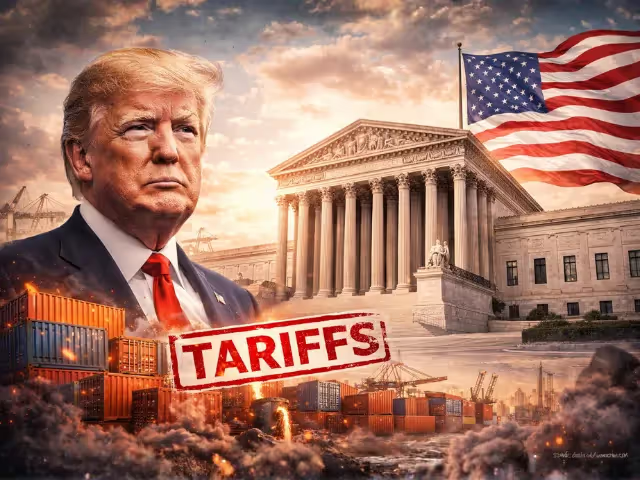
Global markets are closely tracking a crucial decision day in the United States as the Supreme Court weighs in on the legality and scope of tariffs imposed during the Trump administration. While these duties were introduced years ago, their legal review now has far-reaching implications for U.S. trade policy, presidential authority, and global commerce.
For investors, this is not just a legal headline. It is a potential inflection point that could influence currencies, commodities, export driven sectors, and emerging market flows, including India.
Why Trump Tariffs Are Back in Focus
The Trump administration used broad executive powers to impose tariffs on billions of dollars worth of imports, particularly from China, citing national security and unfair trade practices. These measures reshaped global trade flows and triggered retaliatory actions.
Over time, businesses and trade bodies challenged whether such sweeping tariffs required greater congressional oversight. The Supreme Court’s ruling now aims to clarify how much authority the U.S. President has in shaping trade policy without legislative approval.
This decision could either reinforce or restrict the future use of tariffs as a policy tool.
What the Supreme Court Is Deciding
Scope of Executive Power
At the core of the case lies a constitutional question. Can the President impose wide ranging tariffs under existing trade laws without explicit approval from Congress?
A ruling that limits executive power could make future tariff actions slower and more predictable. A ruling in favour of broad authority could preserve tariffs as a quick response tool.
Precedent for Future Trade Actions
The verdict will set a benchmark for how future administrations approach trade disputes. It may influence negotiations, bilateral agreements, and the use of trade as a geopolitical lever.
Possible Outcomes and Market Reactions
If Tariffs Are Upheld
Markets may interpret this as continuity. Existing tariffs could remain in place, keeping pressure on global manufacturing costs. Export oriented economies may continue to face uncertainty, but with clarity on rules.
If Tariffs Are Curtailed
A rollback or dilution could ease global trade tensions. Risk assets may benefit as supply chains adjust and cost pressures soften. Currency and commodity markets could react swiftly.
Impact on Global Trade and Supply Chains
Trump tariffs accelerated the shift of manufacturing away from China toward alternative hubs. Countries like India, Vietnam, and Mexico gained incremental opportunities as companies diversified sourcing.
A change in tariff policy could either strengthen this diversification trend or slow it down. For multinational companies, planning clarity matters more than the tariff level itself.
What It Means for Indian Markets
Export Oriented Sectors
Indian sectors such as pharmaceuticals, IT services, chemicals, and engineering goods track U.S. trade policy closely. Any easing of global trade friction could support export volumes and margins.
Currency and Capital Flows
A stable global trade environment often supports risk appetite toward emerging markets. This can influence foreign institutional investment flows into Indian equities and bonds.
Regulatory Perspective in India
Indian regulators, including SEBI and the Reserve Bank of India, closely monitor global developments that may impact capital flows and market stability. Clearer global trade rules reduce external volatility risks for domestic markets.
Investor Sentiment and Market Volatility
Global legal decisions often influence markets indirectly. The immediate impact may be seen in futures, commodities, and currencies before equities adjust.
For Indian investors, such events reinforce the importance of global awareness. Even domestically focused portfolios are not insulated from international policy shifts.
Why a Research Led Approach Matters
Complex developments like Supreme Court rulings on trade policy cannot be interpreted through headlines alone. Understanding second order effects on sectors, earnings, and valuations requires structured research.
SEBI registered platforms that combine global market insights, strong analytical tools, and investor education help investors navigate uncertainty with discipline. Technology enabled investing and responsive customer support further add confidence during volatile periods.
This is where long term investing frameworks outperform reactive decision making.
Frequently Asked Questions
Why is the Supreme Court ruling on Trump tariffs important?
It defines the limits of presidential authority on trade policy and sets precedent for future tariff actions.
Can this decision affect Indian stock markets?
Indirectly yes. Changes in global trade policy influence capital flows, export demand, and investor sentiment.
Will tariffs be removed immediately after the ruling?
Not necessarily. Even if restricted, policy changes may be gradual and subject to administrative processes.
Which Indian sectors are most sensitive to U.S. trade policy?
IT services, pharmaceuticals, engineering exports, and specialty chemicals are closely linked to U.S. demand.
Is this a short term or long term market trigger?
The ruling has long term implications, but market reactions may play out over time rather than instantly.
Final Thoughts
Decision day for Trump tariffs is more than a legal milestone. It is a moment that could reshape how the world’s largest economy approaches trade, negotiations, and economic diplomacy. While outcomes remain uncertain, the direction will influence global markets and emerging economies alike.
For Indian investors, staying informed and research driven is key when global policy decisions create ripple effects across asset classes. Swastika Investmart, with its SEBI registration, robust research capabilities, technology enabled platforms, and strong focus on investor education, aims to help investors navigate such global developments with confidence and clarity.
If you are looking to invest with a disciplined, insight led approach in an increasingly interconnected world, you can take the next step here:


.avif)
.avif)

.avif)




START YOUR INVESTMENT JOURNEY
Get personalized advice from our experts
- Dedicated RM Support
- Smooth and Fast Trading App