

The Power of Compounding – Why Starting Early Matters




Introduction
Albert Einstein reportedly called compound interest the "eighth wonder of the world." Whether or not he actually said it, the math is undeniable. Compounding is the process where your investment returns begin earning their own returns — and over time, this snowball effect becomes truly extraordinary.
The catch? Compounding needs one essential ingredient: time.
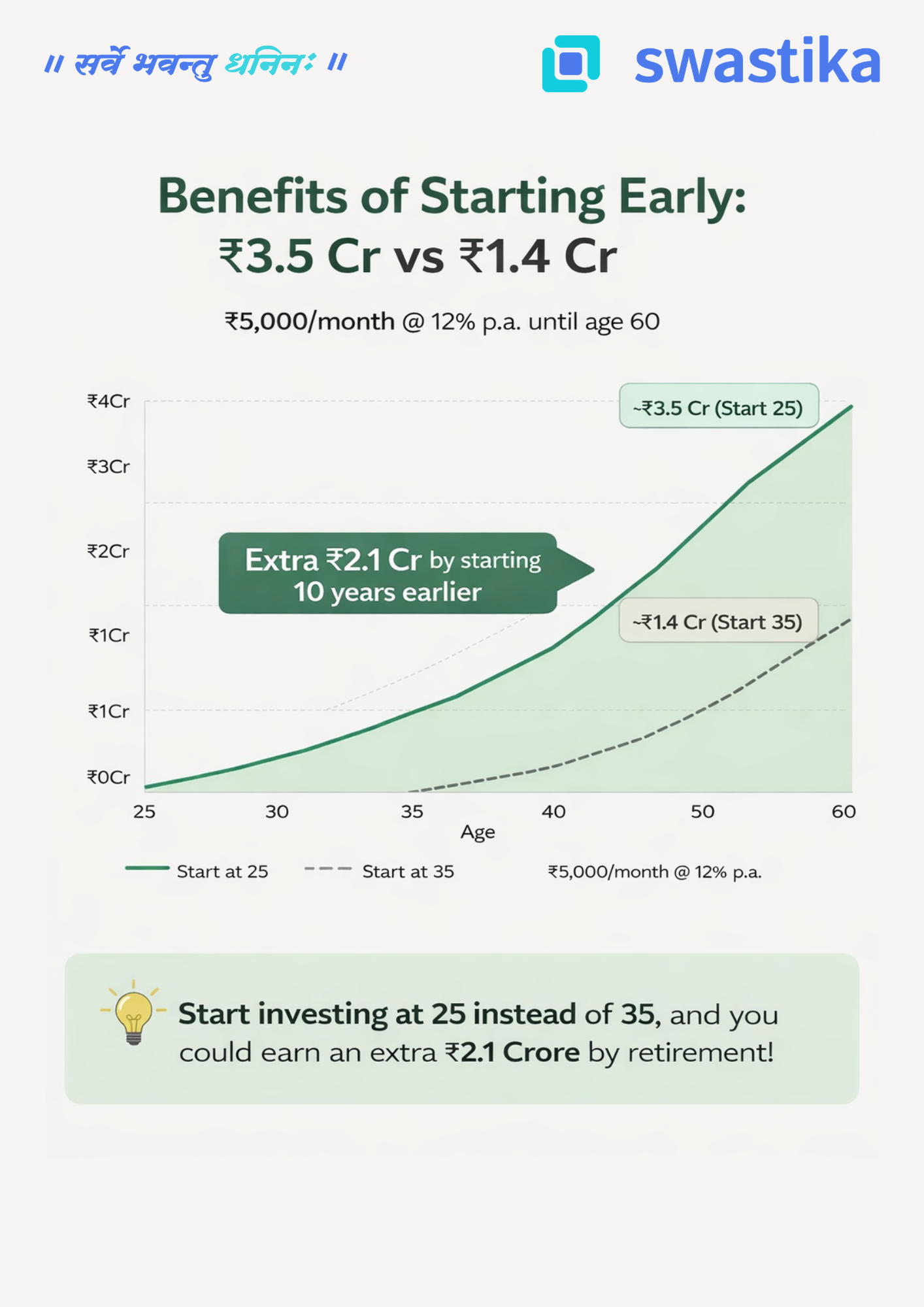
The more years you give your money to grow, the more dramatic — and life-changing — the results become. This is exactly why starting your investment journey early, even with a modest amount, can make a difference of crores by the time you retire.
A Tale of Two Investors: Arjun vs Priya
Let's bring this concept to life with a simple, real-world example.
Meet Arjun and Priya. Both are sensible, disciplined investors. Both invest ₹5,000 every month through a SIP (Systematic Investment Plan) in equity mutual funds, earning an average annual return of 12%. Both stop investing at age 60.
The only difference? Arjun starts at 25. Priya starts at 35.
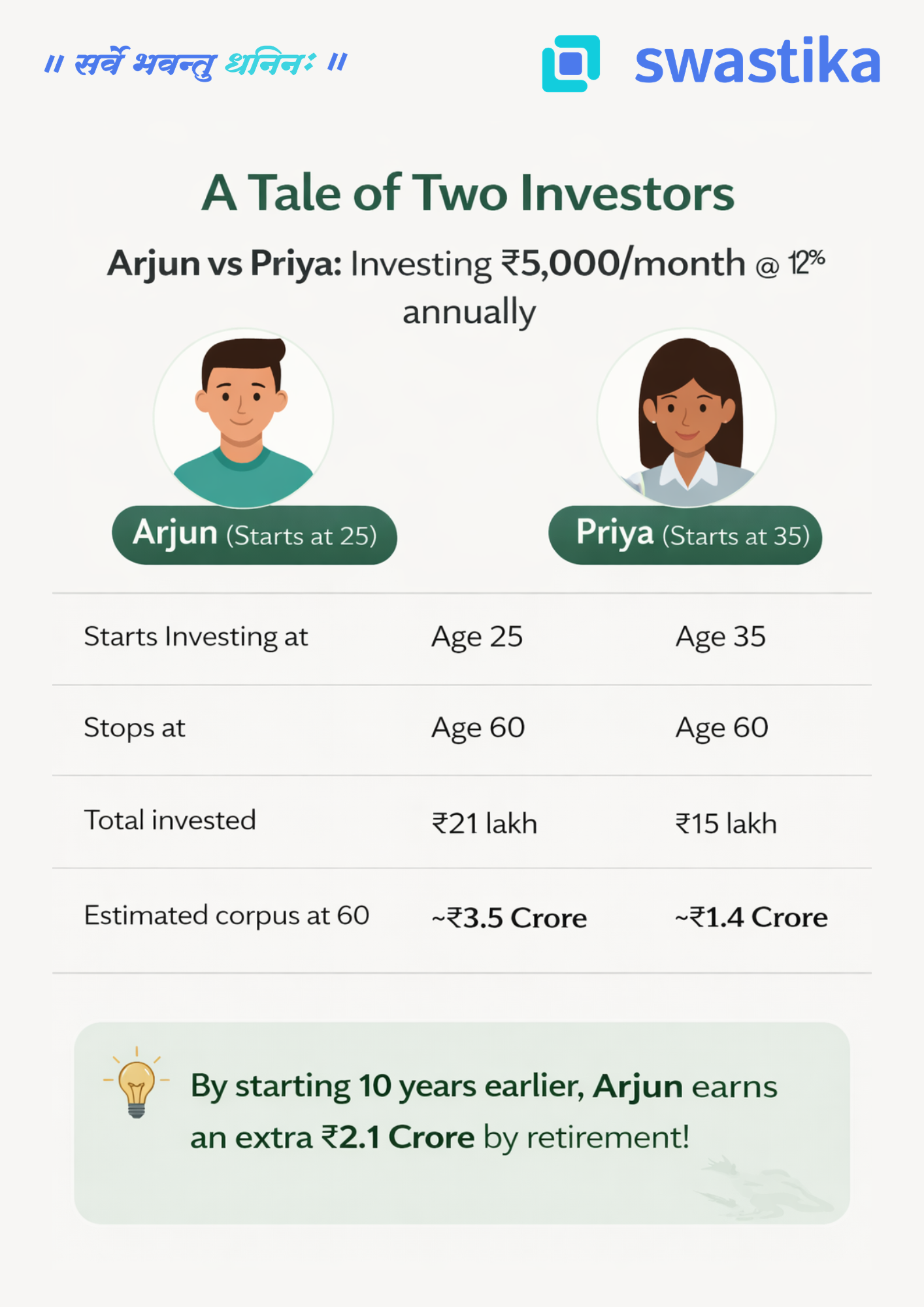
The numbers are striking. Arjun invests just ₹6 lakh more than Priya in absolute terms — yet walks away with ₹2.1 Crore more at retirement.
That extra ₹2.1 Crore didn't come from investing more aggressively or taking bigger risks. It came purely from starting 10 years earlier.
Why Does Time Make Such a Huge Difference?
This is where the magic of compounding reveals itself.
In the early years of investing, growth looks modest and almost unimpressive. But as the years pass, your corpus grows not just on your original investment, but on all the accumulated returns from previous years. The curve goes from almost flat to steeply exponential — and that steep climb happens in the later years.
When Arjun starts at 25, his money has 35 years to ride that exponential curve. Priya's money, starting at 35, only catches the last 25 years — and critically, it misses the steepest part of the climb in the final decade.
Think of it this way: the last 10 years of compounding are worth more than the first 20. That is the counterintuitive truth at the heart of long-term investing.
The Real Cost of Waiting
Many young earners tell themselves, "I'll start investing once I'm more settled — once the salary improves, once the EMI is paid off, once life is a bit easier."
But the numbers show that every year of delay is extraordinarily expensive — far more expensive than any EMI or lifestyle expense. Priya didn't invest carelessly. She invested faithfully for 25 years. Yet she ends up with less than half of what Arjun accumulated — not because she did anything wrong, but simply because she started a decade late.
The cost of waiting 10 years wasn't ₹6 lakh in additional contributions. The cost was ₹2.1 Crore in lost wealth.
Three Principles to Remember
1. Start now, not later.The best time to start investing was yesterday. The second best time is today. Even a SIP of ₹1,000–₹2,000 per month in your 20s is infinitely better than waiting for the "right time."
2. Consistency beats intensity.You don't need to invest large sums all at once. A small, steady, monthly commitment — maintained without interruption — is what unlocks the full power of compounding over decades.
3. Stay invested through market cycles.Compounding works only if you let it work. Exiting during market corrections or stopping your SIP in tough months breaks the chain. Time in the market, not timing the market, is what builds wealth.
The Bottom Line
If you are in your 20s or early 30s, you hold an asset that no amount of money can buy later: time. Use it. Start a SIP today — even a small one. Let compounding do its slow, steady, powerful work.
Because the difference between starting at 25 and starting at 35 is not just 10 years. As Arjun and Priya's story shows, that difference is ₹2.1 Crore.
Big Budget



.webp)
.webp)
.webp)
.webp)
.webp)







.webp)
.webp)
.webp)
.webp)
Latest Articles
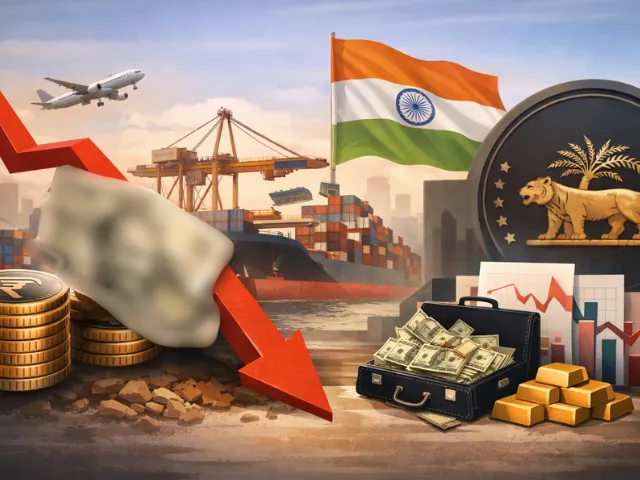
Why Is the Indian Rupee Weak in FY2025–26? Trade Deficit, Capital Flows & RBI Explained


Key Takeaways
- The Indian Rupee’s weakness in FY2025–26 is driven more by global and macro factors than domestic instability
- A widening trade deficit and uneven capital flows have increased pressure on the currency
- The US dollar’s strength and global interest rate trends are key external factors
- RBI follows a market-determined exchange rate and intervenes only to curb excess volatility
- Currency movements have mixed implications for Indian investors and markets
Introduction: Why the Rupee’s Movement Matters to Investors
The Indian Rupee is one of the most closely tracked macro indicators in the financial markets. Even small movements in the USD-INR exchange rate influence inflation, foreign investment flows, corporate earnings, and stock market sentiment.
In FY2025–26, the Rupee has remained under depreciation pressure, raising concerns among investors and import-dependent businesses. However, this weakness is not a standalone event. It reflects a combination of global developments, trade dynamics, and capital flow trends that are shaping most emerging market currencies.
Understanding these drivers is essential before drawing conclusions or reacting emotionally to currency headlines.
Trade Deficit: A Key Pressure Point
One of the primary reasons behind the Rupee’s weakness in FY2025–26 is the widening trade deficit. When a country imports more goods and services than it exports, the demand for foreign currency increases, putting pressure on the domestic currency.
India’s trade deficit has been influenced by:
- Higher crude oil imports amid volatile global energy prices
- Strong domestic demand for electronics, machinery, and capital goods
- Slower export growth in certain sectors due to global economic uncertainty
Since crude oil is priced in dollars, even moderate price increases directly increase India’s dollar demand. This structural factor continues to weigh on the Rupee despite healthy domestic consumption.
Capital Flows: Support That Has Been Uneven
Capital flows play a crucial role in offsetting trade deficits. In FY2025–26, support from the capital account has been relatively weak and uneven.
Foreign Portfolio Investors have shown selective risk appetite, influenced by:
- Higher interest rates in developed markets
- Shifts in global asset allocation toward safer assets
- Short-term volatility in emerging market currencies
While foreign direct investment inflows remain stable in the long term, portfolio flows tend to be more sensitive to global interest rate cycles. This has reduced near-term dollar inflows, adding pressure on the Rupee.
Global Factors Driving Dollar Strength
The Rupee’s movement cannot be analysed in isolation. Global factors have played a decisive role.
Key global drivers include:
- A strong US Dollar Index supported by global risk aversion
- Monetary policy actions by major central banks
- Geopolitical developments affecting commodity prices
- Currency movements across G-10 and emerging market economies
When the dollar strengthens globally, most emerging market currencies face depreciation pressure. In this context, the Rupee’s movement has been relatively orderly compared to peers.
RBI’s Approach: Stability, Not Targeting a Level
A common misconception among retail investors is that the RBI targets a specific exchange rate. In reality, the Rupee is market-determined, with no fixed band or level.
The Reserve Bank of India:
- Monitors currency markets closely
- Intervenes only during periods of excessive volatility
- Focuses on maintaining orderly market conditions
- Tracks global macroeconomic and geopolitical developments
In FY2025–26, RBI has taken several steps to support foreign exchange inflows and improve liquidity, including easing export credit norms, extending timelines for forex outflows in trade transactions, and allowing better utilisation of Special Rupee Vostro accounts.
These measures aim to improve dollar availability without distorting market pricing.
What a Weak Rupee Means for Indian Markets
A depreciating Rupee has both positives and negatives for Indian markets.
Potential benefits include:
- Improved competitiveness for exporters
- Higher rupee earnings for IT and pharma companies with dollar revenues
- Support for sectors with overseas operations
However, challenges remain:
- Higher import costs can fuel inflation
- Pressure on companies with high foreign currency debt
- Short-term volatility in equity and bond markets
For investors, sectoral impact matters more than the headline currency number.
How Investors Should Respond to Rupee Volatility
Instead of reacting to daily currency movements, investors should focus on fundamentals and asset allocation.
Practical steps include:
- Maintaining diversification across asset classes
- Avoiding panic decisions based on short-term currency swings
- Tracking RBI communication and macro data releases
- Understanding sector-wise impact rather than index-level noise
Currency cycles tend to be mean-reverting over the long term, especially for economies with strong growth prospects like India.
Where Swastika Investmart Helps Investors Navigate Macro Volatility
Macro events such as currency movements require context-driven analysis rather than speculation. Swastika Investmart, a SEBI-registered stockbroker, empowers investors with:
- Research-backed insights on macro and market trends
- Tech-enabled platforms for seamless investing
- Strong customer support across market cycles
- Ongoing investor education to decode complex developments
This structured approach helps investors stay disciplined even during volatile phases.
Conclusion: Is the Weak Rupee a Structural Concern?
The Indian Rupee’s weakness in FY2025–26 is largely driven by global forces, trade dynamics, and capital flow trends rather than domestic instability. RBI’s calibrated approach has ensured orderly market conditions without artificial intervention.
For long-term investors, currency movements should be viewed as part of a broader macro cycle, not as standalone signals. Staying informed, diversified, and research-focused remains the most effective strategy.
Frequently Asked Questions
Why is the Indian Rupee weakening in FY2025–26?
The weakness is due to a combination of trade deficit expansion, uneven capital flows, global dollar strength, and higher commodity import costs.
Does RBI control the Rupee’s exchange rate?
No. The Rupee is market-determined. RBI intervenes only to manage excessive volatility.
Is a weak Rupee bad for Indian investors?
Not always. Export-oriented sectors may benefit, while import-heavy businesses may face cost pressure.
Will the Rupee continue to depreciate?
Currency movements depend on global and domestic factors. Long-term trends are influenced by growth, inflation, and capital flows.
How can investors protect against currency volatility?
Diversification, long-term investing, and sector-aware strategies help manage currency-related risks.

Vedanta Demerger Gets NCLT Nod: What the Five-Entity Split Means for Investor
Key Takeaways
- NCLT has approved Vedanta’s plan to demerge into five separately listed companies
- Existing shareholders will receive shares in all new entities
- Demerger aims to unlock value and improve operational focus
- Debt allocation and execution remain key monitorables
- Long-term impact depends on cash flows and governance discipline
Introduction: Why Vedanta’s Demerger Is a Big Market Event
Corporate demergers are often viewed as catalysts for value unlocking in Indian equity markets, especially when large and complex conglomerates are involved. Vedanta’s long-awaited restructuring plan has now crossed a crucial milestone, with the National Company Law Tribunal granting approval for its demerger into five independent listed entities.
The announcement marks a turning point for the oil-to-metals major, which has faced investor concerns around debt, complexity, and transparency in recent years. With regulatory clearance now in place, investors are shifting focus from approval risk to execution and long-term value creation.
What Exactly Has Been Approved by NCLT
Vedanta will demerge its diversified operations into five separate companies, each focused on a distinct business vertical. These include aluminium, oil and gas, zinc, iron ore and steel, and power.
Once the demerger is completed:
- Each business will operate as a standalone listed entity
- Existing Vedanta shareholders will receive shares in all demerged companies
- Shareholding ratios will remain proportionate across entities
The NCLT approval follows earlier concerns raised by government authorities regarding the recovery of outstanding dues. These concerns were addressed during the approval process, paving the way for restructuring.
Why Vedanta Chose the Demerger Route
Large conglomerates often trade at a discount due to complexity and capital allocation inefficiencies. Vedanta’s businesses span commodities with very different risk profiles, cash flows, and investment cycles.
By splitting into focused entities, Vedanta aims to:
- Improve transparency and segment-level accountability
- Allow investors to value each business independently
- Enable better capital allocation and strategic decision-making
- Potentially attract sector-specific institutional investors
Similar value-unlocking attempts have been seen earlier in Indian markets, such as Tata Group’s restructuring initiatives and conglomerate simplification strategies adopted globally.
What This Means for Existing Shareholders
For current shareholders, the demerger does not require any action. Shares will be credited automatically once the process is completed.
Key implications include:
- No immediate dilution of shareholding
- Portfolio exposure to multiple commodity businesses
- Potential re-rating if individual entities command better valuations
However, it is important to note that a demerger itself does not create value overnight. Market perception, earnings visibility, and balance sheet strength of each new entity will drive long-term returns.
Debt, Cash Flows, and the Key Risk Factor
One of the biggest investor concerns around Vedanta has been leverage. Post-demerger, how debt is allocated across the five companies will be critical.
Investors should closely track:
- Which entities carry higher debt burdens
- Ability of each business to generate sustainable cash flows
- Dividend policies post restructuring
Commodity cycles can be volatile, and companies with weaker balance sheets may face pressure during downturns. This makes post-demerger financial discipline a crucial factor.
Market Reaction and Broader Impact on Indian Markets
Demerger announcements often trigger short-term volatility as markets reassess valuations and future earnings. Over the medium term, stocks tend to stabilise once clarity emerges on financials, management strategy, and capital structure.
For Indian markets, Vedanta’s move reinforces a broader trend of corporate simplification and governance-led restructuring. Regulators such as SEBI and NCLT continue to play a vital role in ensuring shareholder interests are protected during such transitions.
How Should Investors Approach Vedanta Post Demerger
Instead of reacting to price movements alone, investors should adopt a structured approach:
- Evaluate each demerged entity independently
- Track management commentary and guidance
- Monitor debt reduction and dividend consistency
- Assess long-term demand outlook for each commodity
This is where research-backed investing becomes essential, as interpreting complex corporate actions requires experience and sector understanding.
Where Swastika Investmart Adds Value
Navigating corporate restructurings like Vedanta’s demerger can be challenging for retail investors. Swastika Investmart, a SEBI-registered stockbroker, supports investors with:
- In-depth equity research and corporate action analysis
- Tech-enabled trading and investment platforms
- Strong customer support for informed decision-making
- Continuous investor education to decode market events
Rather than relying on headlines, investors benefit from structured insights and professional research frameworks.
Conclusion: Is Vedanta’s Demerger Positive for Investors
The NCLT approval removes a major regulatory overhang for Vedanta. While the demerger has the potential to unlock value and improve transparency, its success will depend on execution, balance sheet strength, and governance across the new entities.
For long-term investors, this restructuring marks the beginning of a new phase rather than an end result. Careful monitoring and disciplined investing will be key.
If you want to track such high-impact corporate actions with clarity and confidence, consider investing through a platform that combines research, technology, and investor-first practices.
Frequently Asked Questions
What is Vedanta’s demerger plan?
Vedanta plans to split into five separately listed companies, each focused on a specific business segment.
Do shareholders need to apply for new shares?
No, existing shareholders will automatically receive shares in all demerged entities.
Will the demerger reduce Vedanta’s debt?
The demerger itself does not reduce debt. How debt is allocated and managed post split is crucial.
Is the demerger positive for stock price?
It can unlock value over time, but short-term price movement depends on market sentiment and execution clarity.
When will the demerger be completed?
Timelines will depend on regulatory filings and operational readiness, which the company will communicate.

Should Investors Worry About Promoter Stake Sale? Ola Electric Case Explained
Key Takeaways
- Promoter stake sales are not always negative if control and conviction remain intact.
- Ola Electric’s transaction was promoter-level, not company-driven.
- Removal of pledged shares reduces risk and stock volatility.
- Investors should focus on intent, structure, and post-transaction shareholding.
Introduction: Why Promoter Stake Sales Trigger Investor Anxiety
In Indian equity markets, few disclosures trigger instant panic like the words “promoter stake sale”. Retail investors often associate promoter selling with weakening confidence, business stress, or future dilution. While this fear is understandable, it is not always accurate.
The recent announcement involving Ola Electric founder Bhavesh Agarwal offers a textbook case of why investors must look beyond headlines. A one-time monetisation of a small portion of his personal stake was undertaken to fully repay a Rs 260-crore promoter-level loan. This move resulted in the release of all previously pledged 3.93 percent shares, while the promoter continues to hold nearly 34 percent stake.
So the key question remains: should investors really worry?
Understanding the Ola Electric Promoter Stake Sale
Before drawing conclusions, it is important to understand what actually happened.
Bhavesh Agarwal monetised a limited part of his personal shareholding to repay a loan that was taken at the promoter level. This was not a fundraise by Ola Electric, nor was it linked to operational cash flow needs or business stress.
More importantly, the transaction led to the complete removal of pledged shares. Promoter pledging is often viewed negatively in Indian markets because it can amplify downside risk during periods of stock volatility.
Post the transaction:
- Promoter stake remains around 34 percent
- There is no dilution of control
- No impact on Ola Electric’s operations, strategy, or governance
- Promoter pledges stand eliminated
This distinction between promoter-level financial housekeeping and company-level distress is critical for investors.
Promoter Stake Sale vs Promoter Pledge: Why the Difference Matters
In India, SEBI disclosures require promoters to report both shareholding changes and pledging activity. However, markets often react more sharply to pledges than to outright stake sales.
Promoter pledging can become risky when:
- Share prices fall sharply
- Lenders invoke pledged shares
- Forced selling increases volatility
By eliminating all pledges, Ola Electric’s promoter has reduced a key structural risk. This is generally viewed as a governance-positive step, even if it involves limited stake monetisation.
In contrast, a gradual reduction in promoter holding without clarity on usage of funds or intent may raise concerns. In this case, the purpose was clearly stated and time-bound.
Does Promoter Selling Always Signal Weak Confidence?
Not necessarily.
There are multiple real-world examples in Indian markets where promoter stake sales did not hurt long-term shareholder value. Promoters sell stakes for reasons such as:
- Debt reduction
- Personal liquidity needs
- Estate planning
- Diversification
The key factors investors should evaluate include:
- Size of the stake sale relative to total holding
- Whether control is retained
- Whether the sale is recurring or one-off
- Whether company fundamentals remain unchanged
In Ola Electric’s case, the promoter continues to remain deeply invested with a significant ownership stake and has reiterated long-term conviction in the business.
Market Impact and Investor Sentiment
From a market perspective, such announcements often create short-term volatility. Algorithmic trades and headline-driven reactions can pressure the stock briefly, even when fundamentals remain intact.
However, over the medium to long term, markets tend to reward:
- Cleaner balance sheets
- Lower governance risk
- Transparent disclosures
By eliminating promoter pledges, Ola Electric potentially improves investor perception, especially among institutional investors who closely track pledge levels as part of risk assessment.
Regulatory Context: Why Disclosure Quality Matters
SEBI’s disclosure norms around promoter transactions aim to ensure transparency and protect retail investors. Clear communication regarding the nature, purpose, and impact of such transactions plays a vital role in shaping market confidence.
Ola Electric’s disclosure clearly stated:
- The transaction was at the promoter’s personal level
- There is no operational or governance impact
- Control remains unchanged
Such clarity reduces speculation and aligns with good corporate governance practices encouraged by Indian regulators.
How Should Investors Analyse Promoter Stake Sales Going Forward?
Instead of reacting emotionally, investors should ask structured questions:
- Is the promoter reducing stake materially or marginally
- Is the business funding this sale or is it personal
- Are pledges increasing or reducing
- Does management communication inspire confidence
A single data point should never outweigh long-term fundamentals, execution capability, and industry outlook.
For electric vehicle companies like Ola Electric, investors should continue to track factors such as market share, cost control, product pipeline, and regulatory developments in India’s EV ecosystem.
Where Swastika Investmart Adds Value for Investors
Interpreting corporate actions correctly requires experience, data, and context. This is where a research-driven approach becomes essential.
Swastika Investmart, a SEBI-registered stockbroker, supports investors with:
- In-depth equity research and corporate action analysis
- Advanced tech-enabled trading and investing platforms
- Strong customer support for both new and seasoned investors
- Continuous investor education focused on long-term wealth creation
Rather than reacting to headlines, informed investors rely on structured insights and professional research tools.
Conclusion: Should Investors Worry About Ola Electric’s Promoter Stake Sale?
The Ola Electric case highlights why promoter stake sales should not be viewed in isolation. A one-time monetisation to eliminate pledges, without loss of control or dilution of conviction, is not inherently negative.
For long-term investors, this development appears more like risk reduction than a red flag. As always, sustained business execution will matter far more than short-term shareholding adjustments.
If you want to track such corporate actions with clarity and confidence, consider investing with a platform that prioritises research, transparency, and investor education.
Frequently Asked Questions
Is promoter stake sale always bad for a stock?
No. It depends on intent, size, frequency, and whether control is retained.
Did Ola Electric raise funds through this transaction?
No. The transaction was executed entirely at the promoter’s personal level.
What happens when promoter pledges are removed?
It reduces the risk of forced selling and lowers stock volatility during market stress.
Should retail investors exit when promoters sell shares?
Not automatically. Investors should analyse the context and company fundamentals.
Does this impact Ola Electric’s long-term prospects?
There is no direct operational or strategic impact from this transaction.
%20(3)%20(1).webp)
Indian Economy in 2025: What Happened and What 2026 May Bring
How the Indian Economy Shaped Up in 2025
As 2025 draws to a close, the Indian economy stands on a foundation of resilience rather than exuberance. This year was not about flashy rallies or one sided optimism. It was about balance, recalibration and maturity.
India navigated global headwinds ranging from volatile US bond yields to uneven growth in Europe, while maintaining domestic momentum. The Nifty 50 and Sensex reflected this reality with phases of consolidation interspersed with selective sectoral leadership rather than broad based froth.
Banking and financial services emerged as stabilisers. Capital goods, defence and infrastructure mirrored the government’s capex push. Technology stocks saw valuation resets early in the year but gradually regained investor confidence as global tech indices like the Nasdaq stabilised.
What truly defined 2025 was the strength of domestic participation. Systematic investment flows, growing retail discipline and improving corporate balance sheets helped Indian markets absorb global shocks better than many emerging peers.
Global Indices and Their Influence on India
Indian markets in 2025 did not move in isolation. Global indices played a crucial psychological and liquidity driven role.
The S&P 500’s performance influenced risk appetite during the first half of the year, especially when expectations around US rate cuts kept shifting. The Dow Jones reflected industrial cycle signals, impacting metals and export oriented stocks in India.
Meanwhile, movements in Asian indices like the Nikkei and Hang Seng affected sentiment around manufacturing, electronics and supply chain diversification. India benefited as global investors increasingly viewed it as a structural growth story rather than a tactical trade.
This global linkage reinforced one key trend. India is no longer just reacting to global cues. It is increasingly shaping its own narrative.
What Could 2026 Look Like for the Indian Economy
Growth with Selective Acceleration
Heading into 2026, expectations remain constructive but realistic. GDP growth is likely to stay supported by domestic demand, infrastructure execution and private investment recovery. However, growth will be more quality driven than quantity driven.
Sectors aligned with productivity, digitisation, renewable energy and advanced manufacturing are expected to lead. Consumption may grow steadily but without excess leverage.
Market Outlook for 2026
Indian equity markets in 2026 are expected to reward discipline. Stock selection will matter more than sector chasing. Earnings visibility, balance sheet strength and governance will separate long term winners from speculative noise.
Global indices will continue to influence short term volatility, especially around US elections, geopolitical developments and commodity cycles. However, India’s relative insulation through domestic liquidity and policy stability could keep downside risks contained.
Bond markets may see increased participation as interest rate clarity improves, offering investors a more balanced portfolio approach.
Policy and Regulatory Environment
From a policy standpoint, continuity is likely to be the biggest advantage going into 2026. Regulatory clarity from SEBI, stable RBI communication and ongoing reforms in capital markets, investor protection and financial inclusion strengthen trust.
Digital compliance, faster disclosures and improved transparency further enhance India’s credibility among global investors.
Why This Phase Matters for Investors
The transition from 2025 to 2026 represents a shift from recovery mode to consolidation and compounding mode. This is where informed decision making matters more than timing the market.
Investors who focus on asset allocation, risk management and long term themes are better positioned than those chasing short term momentum. This environment favours research backed investing rather than noise driven trading.
Conclusion: Connecting the Dots for 2026 and Beyond
The Indian economy in 2025 proved one thing clearly. Stability is the new strength. As we move into 2026, the opportunity lies not in predicting every market move but in aligning with India’s structural growth journey.
With strong regulatory oversight, improving corporate quality and expanding investor participation, India continues to stand out in a complex global landscape.
For investors looking to navigate this transition with confidence, having the right research, tools and guidance makes all the difference. Swastika Investmart, a SEBI registered entity, combines in depth market research, tech enabled investing platforms and strong customer support to help investors stay informed and prepared.
If you are planning to align your investments with India’s next phase of growth, this is the right time to take the first step.
Open your account today and stay ahead of the curve
How Does Election Affect Stock Market in India?
Every election season brings a familiar question among investors. Does election affect stock market in India or is it just noise created by short term traders?
The answer is nuanced. Elections do impact Indian stock markets, but not always in the way headlines suggest. While volatility often rises, long term wealth creation depends more on economic policies, reforms, and governance continuity than on who wins or loses.
Understanding this relationship helps investors stay calm, avoid emotional decisions, and spot opportunities when markets overreact.
Why Indian Elections Influence Stock Markets
India is a policy driven economy. Government decisions directly affect taxation, infrastructure spending, banking reforms, and foreign investment flows. Because of this, elections become a period of uncertainty.
Markets generally dislike uncertainty. When investors are unsure about future policies, they tend to reduce exposure, leading to short term volatility.
Key factors that move markets during elections include:
• Expectations of economic reforms or policy reversals
• Stability of the incoming government
• Impact on fiscal deficit and public spending
• Signals on privatization, disinvestment, and infrastructure push
For example, the 2014 and 2019 general elections saw strong market rallies as investors expected policy continuity and reform oriented governance.
Pre Election vs Post Election Market Behavior
Market Trends Before Elections
In the months leading up to elections, markets often turn range bound and volatile. Traders react to opinion polls, political speeches, and exit survey speculation.
Foreign Institutional Investors may reduce risk exposure temporarily, while domestic investors remain relatively steady. Banking, PSU stocks, and infrastructure companies often see sharp price swings during this phase.
However, historical data shows that major corrections purely due to elections are rare unless accompanied by global or economic shocks.
Market Reaction After Election Results
Once results are announced, uncertainty fades quickly. Markets respond decisively to the clarity.
If the outcome signals political stability and reform continuity, markets tend to rally sharply. If results point to coalition instability or unclear policy direction, short term corrections may follow.
Importantly, these reactions usually stabilize within weeks, reinforcing that elections create volatility, not permanent damage.
Sector Wise Impact of Elections in India
Different sectors react differently to election outcomes.
Banking and Financial Services
Banks react positively when investors expect policy stability, controlled NPAs, and capital reforms. PSU banks are especially sensitive to changes in government stance.
Infrastructure and Capital Goods
Election manifestos focusing on roads, railways, housing, and energy typically boost infrastructure stocks. A strong mandate often leads to higher government capex expectations.
FMCG and Consumption
Consumer goods companies remain relatively defensive during elections. Rural spending promises and subsidy announcements influence this sector.
Defense and Manufacturing
Sectors aligned with Make in India, defense indigenization, and PLI schemes gain when policy continuity is expected.
Role of SEBI and Market Safeguards During Elections
One reason Indian markets remain resilient during elections is strong regulation.
SEBI ensures transparency, prevents excessive speculation, and monitors abnormal trading patterns. Circuit limits, disclosure norms, and surveillance mechanisms help protect retail investors from extreme volatility.
This regulatory stability ensures that even during politically charged periods, Indian markets function efficiently and fairly.
Should Retail Investors Change Strategy During Elections?
This is where experience matters.
Seasoned investors do not overhaul portfolios based on election outcomes alone. Instead, they focus on:
• Asset allocation aligned with risk profile
• Quality companies with strong fundamentals
• Long term growth themes independent of politics
Short term traders may find opportunities during volatility, but for long term investors, staying invested has historically delivered better outcomes.
For example, investors who stayed invested through election years like 2009, 2014, and 2019 benefited from strong post election rallies.
Real World Example from Indian Markets
During the 2019 general elections, markets were volatile ahead of results due to uncertainty around seat projections. Once the results confirmed a stable government, benchmark indices rallied sharply in the following weeks.
Similarly, state elections often cause limited market impact unless they signal a shift in national political momentum.
These patterns reinforce one truth. Markets reward clarity, not speculation.
How Swastika Investmart Helps Investors Navigate Election Volatility
Navigating election driven markets requires discipline, research, and reliable support.
Swastika Investmart stands out with:
• SEBI registered credibility and compliance
• In depth research tools covering equities, derivatives, and commodities
• Tech enabled trading platforms designed for clarity and speed
• Strong customer support to guide investors during volatile phases
• Continuous investor education to build long term confidence
Rather than reacting to noise, Swastika helps investors make informed decisions backed by data and experience.
Open your trading account today and invest with confidence
Frequently Asked Questions
Does election affect stock market in India every time?
Elections increase volatility, but long term market direction depends on economic growth, earnings, and reforms.
Is it safe to invest during election periods?
Yes, for long term investors. Volatility can even create buying opportunities in quality stocks.
Do FIIs exit Indian markets during elections?
Some FIIs reduce exposure temporarily due to uncertainty, but they usually return once clarity emerges.
Which sectors are safest during elections?
FMCG, pharmaceuticals, and utilities tend to be more stable compared to cyclical sectors.
Should I wait for election results before investing?
Timing the market is difficult. A systematic and goal based approach is more effective.
Conclusion
So, does election affect stock market in India? Yes, but mostly in the short term through volatility and sentiment shifts. History shows that Indian markets reward patience, policy clarity, and economic growth rather than political speculation.
For investors, elections are less about predicting winners and more about staying disciplined.
If you want expert research, stable platforms, and guidance that cuts through election noise, Swastika Investmart is well positioned to support your investing journey.
%20(1).webp)
Market Performance Today Indian Markets Open Positive on 17 December 2025
The Indian stock market performance today on 17 December 2025 began on a positive note, reflecting steady investor confidence amid mixed global cues. Benchmark indices opened in the green, indicating that market participants are cautiously optimistic while keeping an eye on both domestic and international developments.
At the opening bell, the Sensex stood at 84,856.26, marking a gain of 0.21 percent. The Nifty 50 opened at 25,902.40, up by 0.16 percent, while the Nifty Bank index traded slightly higher at 59,072.80, registering a modest increase of 0.06 percent.
Although the gains were not aggressive, the positive opening set a constructive tone for the trading session.
What Drove the Positive Opening Today
Global Market Signals
Global markets provided a relatively supportive backdrop for Indian equities on 17 December 2025. Asian markets were largely stable during early trade, while overnight cues from US markets showed limited volatility. This helped domestic markets avoid sharp opening swings.
Such global stability often leads to measured buying rather than sharp rallies, which was evident in today’s opening trend.
Institutional Investor Positioning
Institutional activity remains a key driver of Indian market performance. Both Foreign Institutional Investors and Domestic Institutional Investors appeared cautious but supportive at the open.
When institutional flows remain balanced, markets tend to open positive but trade within a range, offering stability rather than sharp momentum.
Banking Stocks Offer Support
Banking stocks played a stabilising role in today’s market opening. While Bank Nifty gains were limited, heavyweight private banks helped keep the index above key levels.
A stable banking sector often acts as a foundation for broader market strength, especially during consolidation phases.
Key Index Levels to Watch Today
Sensex Above 84,800
The Sensex opening above 84,800 is technically significant. Holding this level during the day could encourage incremental buying, especially in large cap stocks.
Any sustained move above this zone may improve short term sentiment.
Nifty 50 Near 25,900
Nifty opening near the 25,900 mark reflects resilience in index heavyweights. This zone is seen as an important support area for traders and investors.
If the index holds above this level, it may continue to attract stock specific participation.
Bank Nifty Around 59,000
Bank Nifty trading near 59,000 indicates consolidation. While momentum is currently muted, stability in banking stocks reduces downside risk for the overall market.
What This Means for Indian Investors
For long term investors, today’s market performance reinforces the importance of staying disciplined. Positive openings like this often signal underlying strength, even if immediate gains are limited.
For short term traders, confirmation through volumes and price action after the first hour of trade becomes crucial. Range bound strategies often work better in such market conditions.
Retail investors should focus on fundamentally strong stocks rather than reacting to intraday noise.
Regulatory and Economic Perspective
Indian equity markets continue to operate under a robust regulatory framework guided by SEBI. Transparency, investor protection, and risk management remain central to market operations.
On the economic front, investors are closely tracking inflation trends, RBI policy outlook, and upcoming corporate updates. A positive opening on 17 December 2025 suggests that markets are factoring in stable macroeconomic expectations.
How Swastika Investmart Supports Investors in Such Markets
In markets that open positive but remain cautious, informed decision making becomes critical. Swastika Investmart, a SEBI registered stock broker, offers strong research backed insights, advanced trading platforms, and responsive customer support to help investors navigate such conditions.
With a focus on investor education, technology enabled investing, and timely market analysis, Swastika Investmart empowers both new and experienced investors to stay confident even during range bound sessions.
Whether you are tracking index levels or planning long term investments, having access to reliable research and professional support makes a meaningful difference.
👉 Open your trading account today
Frequently Asked Questions
Why did the Indian market open positive today on 17 December 2025
The positive opening was driven by stable global cues, balanced institutional activity, and support from banking and large cap stocks.
Is a positive opening a signal of a strong rally
Not necessarily. A positive opening indicates sentiment support, but sustained gains depend on volumes, sector participation, and broader market cues.
How important is Bank Nifty for overall market direction
Bank Nifty plays a crucial role as banking stocks have significant weightage in benchmark indices and often influence overall sentiment.
What should long term investors do in such markets
Long term investors should remain invested, focus on quality stocks, and avoid reacting to short term market fluctuations.
Final Thoughts
The market performance today on 17 December 2025 reflects cautious optimism rather than aggressive bullishness. With benchmark indices opening in the green and key sectors offering stability, the broader trend remains constructive.
For investors looking to navigate such market phases with confidence, partnering with a trusted and research driven platform like Swastika Investmart can add clarity and discipline to investment decisions.
Stay informed, stay invested, and invest with confidence.


.webp)
.webp)

.webp)





START YOUR INVESTMENT JOURNEY
Get personalized advice from our experts
- Dedicated RM Support
- Smooth and Fast Trading App
