

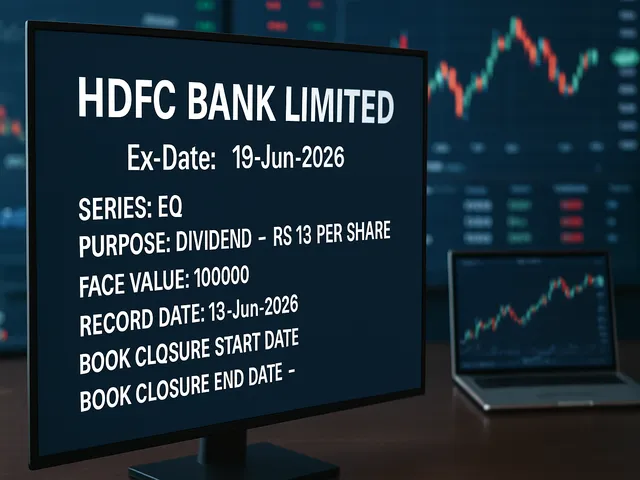
HDFC Bank Limited - Ex-Date: 19-Jun-2026



Quick Takeaways
• HDFC Bank announces a Rs 13 per share dividend for the EQ series with ex-date and record date on 19-Jun-2026.
• Ex-date explains eligibility: ownership before 19-Jun-2026 qualifies for the payout.
• Dividend yield depends on the stock price and may affect short-term price movements around the ex-date.
• Book closure dates aren’t specified in the notice; verify timings through official filings and exchanges.
HDFC Bank Dividend Alert: Rs 13 Per Share Ex-Date 19-Jun-2026
Overview of the announcement
HDFC Bank has announced a dividend on its equity shares for the series EQ, with a payout of Rs 13 per share. The ex-date and the record date are both set for 19 June 2026. The notice lists the face value as Rs 100,000 per share, a nominal value used in regulatory filings. No book-closure dates are specified in the notice, so investors should verify the final dates with the exchange or the bank's investor relations portal. This dividend reflects the bank's ongoing practice of returning capital to shareholders at regular intervals, a common feature among large Indian lenders.
What ex-date means and why it matters
Ex-date is the key cutoff for eligibility. If you buy shares on or after the ex-date, you will not receive the declared dividend for this cycle. Those who hold shares before the ex-date qualify for the payout, subject to being registered as a shareholder on the record date. On or around the ex-date, the stock price often adjusts downward to reflect the impending dividend, though market moves can overshadow this adjustment. The record date confirms who is entitled to receive the dividend, and in this case it is 19 June 2026. For investors, understanding these dates helps avoid missing out on expected income and ensures correct settlement timing across brokers and exchanges.
Dividend yield and portfolio impact
The Rs 13 per-share dividend provides a clear income component, but the realized benefit depends on the share price at the ex-date. Yield is calculated as annual dividend divided by the market price, so higher prices reduce the percentage yield and lower prices increase it, all else equal. Remember that total return includes price movement and taxes, not just the dividend amount. This means a stock could deliver a modest dividend but strong price appreciation, or vice versa, influencing overall performance. For those comparing dividend opportunities, it helps to look at historical payout consistency and the longer-term trend in the stock's returns rather than a single payout event.
Yield calculation basics
As a simple illustration, if a share trades around Rs 6,000 and pays Rs 13 in annualized dividend, the nominal yield from this payout is about 0.22% before tax and after price effects are considered. That figure would change with the actual trading price on the ex-date. In practice, many investors weigh such dividends against alternative income options and volatility risk, while also considering how the dividend aligns with their investment horizon and risk profile.
Practical steps for investors
To qualify for the Rs 13 dividend, you should hold HDFC Bank shares before the ex-date of 19 June 2026 and remain registered on the record date. If you acquire shares on or after the ex-date, you would typically miss this payout. Since the notice does not provide book closure dates, it is wise to confirm the exact timeline from official filings or the exchange. Aligning trading plans with corporate actions helps ensure you receive expected income without disrupting other parts of your strategy.
For retail investors, platforms like Swastika Investmart provide research snippets and market updates that help track corporate actions such as dividends. These resources can simplify understanding of when payouts are expected and how to position your portfolio accordingly. By staying informed, investors can avoid missing out on eligible dividends due to timing issues.
It is also worth noting the tax implications of cash dividends. In India, dividend incomes are generally taxable as part of total income, and tax treatment can vary across regimes and years. Investors should consult a tax advisor to understand how the Rs 13 per share payout fits into their personal tax situation and overall investment plan.
Tax considerations and corporate actions
Dividend payments are a form of shareholder value distribution and are distinct from capital gains. Regulatory filings and exchange notices remain the most reliable source for payout timing and any related corporate actions, including changes in capital structure or shareholder registers. Keeping an eye on these sources can help investors adjust expectations and avoid surprises around payout timing or eligibility.
Conclusion
The Rs 13 per share dividend for HDFC Bank, with ex-date and record date lined up for 19 June 2026, provides a defined income event for shareholders. While the headline amount is straightforward, the real takeaways include understanding eligibility, the interaction with stock price on the ex-date, and how this payout fits into a broader investment plan. Staying informed through official channels and reliable market updates supports a disciplined approach to dividend investing.
Frequently Asked Questions
What is the ex-date for HDFC Bank's dividend?
The ex-date is 19 June 2026, which determines who qualifies to receive the Rs 13 per share dividend.
How much dividend is being paid per share?
Rs 13 per equity share for the series EQ.
Why is the record date important?
The record date identifies shareholders who are eligible to receive the dividend; you must be registered as a holder by the record date.
Big Budget




.avif)
.avif)
.avif)
.avif)
.avif)













.avif)
.avif)
.avif)
.avif)
Latest Articles
.avif)
Infosys and GHCL Announce Share Buybacks — Here’s What Investors Should Know


Key Takeaways
- Infosys announces ₹18,000 crore buyback via tender offer at ₹1,800 per share.
- GHCL launches ₹725 per share buyback opening on 6 Nov 2025.
- Record date for both buybacks: 14 November 2025.
- Buybacks aim to reward shareholders and boost return ratios.
- Investors should review eligibility, acceptance ratio, and tax implications before participating.
Buyback Season Returns: Infosys and GHCL Lead the Way
Two notable Indian companies—Infosys Ltd. and GHCL Ltd.—have rolled out share buybacks in November 2025, rekindling investor interest in the ongoing market rally.
Buybacks are often viewed as a strong signal of management confidence, indicating that the company believes its stock is undervalued or has surplus cash to distribute to shareholders.
Infosys, a large-cap IT giant, and GHCL, a mid-cap chemicals and textiles player, have both announced buybacks with attractive premiums, giving investors an opportunity to realize quick gains while reinforcing long-term confidence in the businesses.
Infosys Buyback 2025: Returning ₹18,000 Crore to Shareholders
Buyback Type: Tender Offer
Buyback Price: ₹1,800 per share
Issue Size: ₹18,000 crore (10 crore shares)
Last Date to Buy Shares: 13 November 2025
Record Date: 14 November 2025
Infosys’ buyback announcement comes at a time when the IT sector is navigating global uncertainties but remains cash-rich and operationally strong.
The tender offer route allows investors to tender some or all of their shares at the buyback price. With the stock trading below ₹1,800 before the announcement, the buyback provides an attractive premium, creating short-term arbitrage potential.
From a fundamental standpoint, Infosys’ robust free cash flow, high return on equity, and consistent dividend policy underline its commitment to capital efficiency and shareholder value creation.
Why This Matters:
- Reinforces Infosys’ healthy balance sheet.
- Supports the stock price by reducing outstanding shares.
- Enhances earnings per share (EPS) post-buyback.
Historically, Infosys has executed buybacks in 2017, 2019, and 2022—all resulting in positive investor sentiment and short-term price appreciation.
GHCL Buyback 2025: Midcap Confidence in Focus
Open Date: 6 November 2025
Record Date: 14 November 2025
Buyback Price: ₹725 per share
GHCL Ltd., known for its chemicals and textiles business, announced a buyback at ₹725, a notable premium to its prevailing market price around ₹650–₹675 before the announcement.
The move highlights GHCL’s strong cash reserves and strategic focus on rewarding shareholders amid steady financial performance. The company’s chemicals division, particularly in soda ash and industrial products, has been witnessing healthy demand, while its textile arm continues to contribute steadily.
For mid-cap investors, such buybacks are particularly appealing as they:
- Improve stock liquidity and investor perception.
- Reflect management confidence in long-term prospects.
- Offer potential short-term returns through premium realization.
What Buybacks Indicate About the Market
Buybacks serve as a vote of confidence from management, suggesting that companies view their current valuations as attractive.
In an era of rising global volatility and shifting interest rate cycles, cash-rich Indian firms are increasingly using buybacks as a strategic capital allocation tool.
According to SEBI’s framework, companies opting for the tender offer route must treat all shareholders equitably, ensuring that retail investors (holding shares worth ≤ ₹2 lakh) receive priority allocation.
In 2025, buybacks are emerging as a preferred way for companies to balance shareholder rewards and financial prudence, especially with dividend distribution tax reforms already in place.
Impact on Investors and Market Sentiment
Both Infosys and GHCL’s buybacks have added positive momentum to their respective stock prices. For Infosys, it enhances stability amid subdued global tech demand, while GHCL’s move signals mid-cap sector confidence.
However, investors must note that buybacks are not risk-free.
- The acceptance ratio—the percentage of shares accepted in the buyback—depends on overall shareholder participation.
- There could be post-buyback corrections, especially if the stock rallies sharply beforehand.
- Tax implications under Section 115QA (for companies) and capital gains tax (for shareholders) should be reviewed before participating.
Investor Perspective: How to Participate
If you’re eligible based on the record date, here’s how to participate in a buyback:
- Check Eligibility: Ensure you hold shares before the record date.
- Receive Offer Letter: Companies send buyback offers to eligible shareholders.
- Tender Shares: Submit your shares via your broker platform (like Swastika Investmart).
- Wait for Allotment: Once accepted, funds are credited to your account, and unaccepted shares are returned.
For first-time investors, this process can be confusing—but platforms like Swastika Investmart simplify participation with expert guidance, intuitive digital tools, and real-time tracking.
Real-World Example: Infosys’ 2019 Buyback
In its 2019 buyback, Infosys offered shares at ₹800, a ~15% premium to the market price. Investors who participated not only realized gains but also benefited from a short-term price rally post-buyback closure.
A similar pattern could unfold in 2025, although the acceptance ratio will depend on overall participation.
FAQs
Q1. What is a share buyback?
A share buyback is when a company repurchases its shares from existing shareholders, reducing the number of outstanding shares and rewarding investors.
Q2. What is Infosys’ buyback price and record date?
Infosys has set a buyback price of ₹1,800 per share, with a record date of 14 November 2025.
Q3. How much is GHCL offering in its buyback?
GHCL’s buyback is priced at ₹725 per share, with the same record date—14 November 2025.
Q4. Is it beneficial to participate in a buyback?
Buybacks can offer attractive short-term gains if the company offers a premium price. However, investors should assess fundamentals and acceptance ratio expectations.
Q5. How can investors apply for a buyback through Swastika Investmart?
Swastika Investmart provides an easy online process to tender shares, track buyback offers, and get expert advice on corporate actions.
Conclusion: Buybacks Reflect Confidence, Not Just Cash Surplus
The twin buyback announcements from Infosys and GHCL underline a broader trend—Indian corporates are prioritizing shareholder value creation through efficient capital management.
Whether you’re a long-term investor or seeking short-term opportunities, understanding buyback dynamics is essential.
For expert guidance, research-driven insights, and a smooth trading experience, Swastika Investmart offers everything you need to make informed investment decisions.
.avif)
Corporate Action Update: Sampre Nutrition, HDFC AMC, and Others Cheer Investors with Splits & Bonuses.
Key Takeaways
- Sampre Nutrition, HDFC AMC, and Websol Energy announce splits and bonus shares in November 2025.
- Sampre Nutrition declares a 1:1 bonus and a 10:5 stock split.
- HDFC AMC rewards shareholders with a 1:1 bonus issue.
- Websol Energy and Unison Metals announce stock splits to enhance liquidity.
- These corporate actions reflect strong fundamentals and investor-friendly policies.
Corporate Actions 2025: The Season of Splits and Bonuses Begins
The Indian stock market is buzzing again, this time not because of volatility or new listings, but due to a wave of corporate actions from established and emerging companies. As of November 2025, several companies—including Sampre Nutrition, HDFC Asset Management Company (HDFC AMC), Websol Energy, and Unison Metals—have announced stock splits and bonus shares to reward their shareholders.
These moves have caught the attention of both retail and institutional investors, signaling strong balance sheets, confidence in future growth, and a desire to improve liquidity in the market.
Let’s decode what these actions mean, their timelines, and how they could impact investor sentiment.
What Are Stock Splits and Bonus Shares?
Before diving into the company-wise details, it’s essential to understand the difference:
- Stock Split:
A stock split divides existing shares into multiple units, lowering the stock’s face value but keeping the overall market capitalization unchanged. It improves liquidity by making shares more affordable. - Bonus Issue:
A bonus issue gives existing shareholders additional shares free of cost, typically drawn from the company’s reserves. This rewards long-term investors and signals management confidence.
Both actions often indicate financial stability, sound growth prospects, and a commitment to shareholder value creation.
1. Sampre Nutrition: Double Delight for Investors
LTP: ₹141.40 (-1.98%)
Stock Split Ratio: 10:5
Bonus Ratio: 1:1
Announcement Date: 19 September 2025
Ex-Date: 11 November 2025
Sampre Nutrition surprised investors with not one but two shareholder-friendly announcements—a stock split and a bonus issue.
- The 10:5 stock split effectively doubles the number of shares, reducing the face value and increasing liquidity.
- The 1:1 bonus issue means investors receive one additional share for every share they hold.
This combination is rare and typically reflects high confidence in business expansion. Sampre’s strong presence in the nutrition and FMCG segment, coupled with robust quarterly results, positions it as a promising mid-cap contender.
Post-corporate action, analysts expect higher retail participation and improved trading volumes in the stock.
2. HDFC AMC: Rewarding Long-Term Shareholders
LTP: ₹5,388.50 (-0.26%)
Bonus Ratio: 1:1
Announcement Date: 15 October 2025
Ex-Date: 26 November 2025
HDFC AMC, one of India’s largest and most respected asset management companies, announced a 1:1 bonus issue to reward its loyal investors.
This move reflects HDFC AMC’s steady revenue growth, strong asset base, and consistent dividend record. By doubling the number of shares held by investors, the company aims to make its stock more accessible while maintaining its strong market capitalization.
From a market standpoint, this decision underlines the AMC’s long-term commitment to shareholder wealth creation, especially as the mutual fund industry in India crosses ₹60 trillion in AUM.
3. Websol Energy: Riding the Renewable Boom
LTP: ₹1,337.60 (+10.37%)
Stock Split Ratio: 10:1
Announcement Date: 1 September 2025
Ex-Date: 14 November 2025
Websol Energy’s 10:1 stock split comes amid India’s renewable energy revolution. The company’s stock price has been on a strong upward trajectory, mirroring the sector’s bullish outlook.
This split will significantly improve liquidity, allowing smaller investors to participate in the green energy wave. With government support for solar manufacturing and production-linked incentives, Websol’s corporate action appears both timely and strategic.
4. Unison Metals: Improving Market Participation
LTP: ₹24.00 (-2.40%)
Stock Split Ratio: 10:1
Announcement Date: 22 August 2025
Ex-Date: 28 November 2025
Unison Metals’ decision to implement a 10:1 stock split aims to make its shares more affordable and attract broader market participation.
The company, which operates in the industrial metals segment, has been focusing on operational efficiency and product diversification. The stock split is expected to bring fresh retail interest and support long-term liquidity on the exchanges.
What These Corporate Actions Indicate About Market Sentiment
These announcements aren’t isolated—they reflect a broader optimism across sectors. Whether it’s renewable energy, financial services, or FMCG, companies are signaling robust health and confidence.
Such actions often precede expansion plans or higher profitability phases, aligning with SEBI’s emphasis on transparency and equitable shareholder participation.
In addition, these corporate actions are a positive sign for retail investors, as they improve accessibility and trading flexibility.
How Investors Should Approach Corporate Actions
While bonus issues and stock splits create excitement, investors must evaluate:
- Company Fundamentals: Is the growth backed by earnings, not just sentiment?
- Valuation: Does the post-split/bonus valuation still make sense?
- Liquidity Impact: More shares don’t always mean more value—watch volume patterns.
- Long-Term Vision: Focus on companies using these actions to support expansion.
This is where Swastika Investmart stands out. As a SEBI-registered financial services firm with decades of experience, Swastika offers strong research tools, robust customer support, and AI-powered investing platforms that help you analyze such corporate events with clarity.
FAQs
Q1. What is the difference between a stock split and a bonus issue?
A stock split increases the number of shares by reducing their face value, while a bonus issue distributes additional shares from reserves without changing the face value.
Q2. Do stock splits or bonus issues change a company’s valuation?
No. They do not alter the company’s overall market capitalization; they simply redistribute value across more shares.
Q3. Is it a good time to buy Sampre Nutrition or HDFC AMC after the corporate action?
It depends on your investment horizon. Evaluate fundamentals, profitability, and future growth before making decisions.
Q4. How do corporate actions affect liquidity?
Corporate actions like splits typically increase liquidity by making shares more affordable to retail investors.
Q5. How can investors track upcoming corporate actions?
You can monitor announcements via NSE/BSE portals or use Swastika Investmart’s research tools for timely updates.
Conclusion: A Bullish Signal for Investors
The recent series of stock splits and bonus issues from Sampre Nutrition, HDFC AMC, Websol Energy, and Unison Metals highlight the growing confidence of Indian corporates. These actions, while not altering intrinsic value, reflect strong financial health and investor-centric strategies.
For investors, such developments signal opportunities to reassess portfolio holdings and capitalize on upcoming growth phases.
If you’re looking to navigate corporate actions with expert guidance, Swastika Investmart offers the perfect blend of technology, experience, and trust to help you make smarter investment decisions.

Paytm Check-in Takes Off! AI-Powered Travel Bookings Now at Your Fingertips
Key Takeaways
- Paytm introduces AI-powered Check-in to revolutionize travel booking in India.
- Offers seamless, personalized flight, hotel, and travel deals within the app.
- Uses artificial intelligence to optimize prices, timing, and itineraries.
- Strengthens Paytm’s diversification beyond fintech into travel tech.
- Investors eye positive sentiment around India’s growing digital travel market.
The AI Revolution Arrives in Travel: Paytm’s Smart Move
India’s travel industry is entering a new digital phase—and this time, Paytm is at the forefront. The fintech giant, best known for transforming digital payments, has now expanded into AI-driven travel bookings through its “Paytm Check-in” platform.
This new feature harnesses artificial intelligence and data analytics to simplify how Indians plan, book, and manage their trips. Whether it’s spotting the best airfare deal or suggesting hotels based on your preferences, Paytm’s AI Check-in aims to make travel as effortless as booking a UPI transaction.
With India’s travel sector projected to reach $125 billion by 2027, the timing couldn’t be better. The integration of AI in travel booking apps is no longer futuristic—it’s essential.
Why Paytm’s AI Check-in Matters
1. Smart, Personalized Travel Planning
The AI engine in Paytm Check-in analyzes user behavior, travel history, and pricing trends to curate custom suggestions. Imagine getting alerts when fares for your preferred route drop, or when a hotel you stayed at last year offers discounts.
This move mirrors global trends—companies like Booking.com and Expedia have already adopted machine learning to improve user experience. Paytm’s localized approach, however, could give it a powerful edge in India’s competitive travel market.
2. Seamless Integration with Paytm Ecosystem
One of Paytm’s greatest strengths lies in its ecosystem. Users can book tickets, make payments, and access insurance or EMI options—all within one app.
This integrated experience reduces friction and enhances user trust, something international players still struggle to replicate in the Indian market.
3. Boost to India’s Digital Travel Economy
The launch reinforces India’s position as one of the fastest-growing travel-tech markets globally. With rising disposable incomes, increasing smartphone penetration, and a strong post-pandemic travel rebound, AI-powered platforms like Paytm Check-in could accelerate digital adoption even further.
According to IBEF, digital travel sales in India crossed ₹1.2 lakh crore in 2024, with a large portion driven by mobile-first users. Paytm’s AI push perfectly aligns with this growth trajectory.
Investor View: Diversification Beyond Payments
Paytm’s pivot into AI-enabled services is a clear signal of its strategic diversification. As regulatory scrutiny and competition in the fintech space intensify, expanding into travel and commerce offers new monetization avenues.
Market experts believe this move could:
- Strengthen Paytm’s non-fintech revenue streams.
- Improve customer retention through cross-selling.
- Enhance data-driven insights for personalized marketing.
While competitors like MakeMyTrip and EaseMyTrip have deep travel domain expertise, Paytm’s advantage lies in its massive user base and AI-driven personalization—two elements that could redefine how Indians book their next vacation.
What It Means for the Indian Market
AI Adoption in Indian Travel-Tech
India’s AI adoption rate in travel has accelerated sharply post-2023. From chatbots assisting with itinerary queries to AI engines predicting peak pricing, the industry is shifting toward automation and intelligence.
Paytm’s Check-in feature could act as a catalyst, pushing smaller travel platforms to follow suit and integrate AI into their services.
Regulatory & Consumer Data Context
As AI tools process vast amounts of user data, data privacy and transparency will be crucial. Paytm’s compliance with RBI and SEBI guidelines, along with adherence to India’s Digital Personal Data Protection Act, 2023, will play a pivotal role in maintaining consumer trust.
The Competitive Edge: How Paytm Stands Out
Despite fierce competition, Paytm’s edge lies in its multi-vertical integration. Few players offer:
- Unified payments and bookings in one ecosystem
- AI-based dynamic pricing predictions
- Reward programs tied to travel and payments
- Seamless wallet and UPI integration
Moreover, Paytm’s brand recall and existing user loyalty provide a head start that pure-play travel apps might envy.
Investor Insight: What Should You Watch?
For investors tracking the digital economy, Paytm’s AI Check-in marks a significant development. Here’s what to monitor next:
- Adoption rate – How quickly users embrace this new feature.
- Revenue diversification – The impact on non-fintech income.
- Partnerships – Collaborations with airlines, hotels, and tourism boards.
- Regulatory updates – Compliance with emerging AI and data regulations.
A strong performance in these areas could signal long-term value creation, especially as Paytm continues to rebrand itself as a technology-driven consumer ecosystem.
Real-World Impact Example
Imagine Riya, a young professional from Mumbai, planning a Diwali trip to Goa. With Paytm Check-in, she receives:
- AI-suggested flight options based on her budget and timing preferences.
- Hotel recommendations using her previous stay data.
- Instant payment and cashback through Paytm Wallet.
In under five minutes, her trip is planned—no multiple apps, no manual comparison.
This is precisely the kind of AI-driven simplicity that defines the next phase of India’s digital economy.
FAQs
Q1. What is Paytm Check-in?
Paytm Check-in is an AI-powered feature that simplifies travel bookings—covering flights, hotels, and trip planning—within the Paytm app.
Q2. How does the AI in Paytm Check-in work?
It uses machine learning to analyze user preferences, pricing trends, and travel data to offer real-time, customized recommendations.
Q3. Is Paytm Check-in secure?
Yes. Paytm follows stringent RBI and data protection norms, ensuring all transactions and personal information remain secure.
Q4. Will this affect competitors like MakeMyTrip or EaseMyTrip?
It could intensify competition by pushing others to adopt AI-driven personalization and better pricing algorithms.
Q5. How can investors benefit from this development?
If successful, Paytm’s diversification into AI-based travel tech could enhance its revenue mix and support long-term growth potential.
Conclusion: A Smarter Way to Travel—and Invest
Paytm’s AI-powered Check-in isn’t just another feature—it’s a strategic evolution reflecting how India’s digital economy is fusing technology, convenience, and intelligence.
For travelers, it means effortless trip planning.
For investors, it signals Paytm’s intent to expand beyond payments into a full-fledged consumer-tech ecosystem.
And for those seeking a smarter way to invest in this evolving digital landscape—Swastika Investmart provides the expertise, tools, and guidance to help you make informed decisions.

Pine Labs IPO Review 2025: Should Investors Apply or Avoid?
Key Takeaways
- Pine Labs is a leading merchant commerce and payments platform with a large merchant footprint but still reports recent losses.
- IPO size around ₹3,900 crore at a price band of ₹210–221, consisting of a mix of fresh issue and offer for sale.
- FY25 shows strong revenue growth and improving EBITDA margins, though the company remains loss-making.
- Key risks include high valuation, profitability visibility, and rising competition in the fintech sector.
- Best suited for long-term, high-risk investors; conservative investors may prefer to wait for post-listing stability.
Pine Labs: The Fintech Giant Enters the Market
Pine Labs is one of India’s most established fintech names in the merchant commerce space. The company provides point-of-sale (PoS) systems, payment processing, merchant financing, and a suite of value-added services to offline and online merchants across India and overseas markets.
With over one million merchants on its platform and billions of transactions processed annually, Pine Labs plays a vital role in India’s digital payment ecosystem. Its IPO has generated buzz because it offers retail investors exposure to a fast-growing fintech infrastructure story at a time when digital payments and merchant services are seeing exponential adoption.
IPO Snapshot: Key Details Investors Should Know
The IPO proceeds from the fresh issue are expected to be used primarily for growth initiatives, technology investments, and strengthening the balance sheet, while the OFS allows existing investors to partially exit.
Financial Snapshot: Growth with Caution
Pine Labs has showcased steady revenue growth in recent years as digital adoption expands among small and mid-sized businesses. Revenue rose to over ₹2,300 crore in FY25, and EBITDA margins improved to nearly 14%, reflecting strong operating leverage.
However, the company still reported a net loss of around ₹145 crore, and its net worth remains negative — a concern for value-focused investors. While revenue momentum is encouraging, profitability remains a key milestone yet to be achieved.
Strengths: Why Pine Labs Stands Out
- Market Leadership in Merchant Payments
Pine Labs enjoys a dominant position in the merchant commerce technology space, with an integrated platform combining hardware, software, and lending solutions. - Strong Merchant Ecosystem
Its large merchant base enables cross-selling of high-margin services like EMIs, loyalty programs, and working capital loans — expanding revenue streams. - International Footprint
The company’s growing presence in Southeast Asia and the Middle East adds geographical diversification and reduces dependence on the Indian market. - Tech-Driven Innovation
Focus on digital-first solutions, cloud-based PoS systems, and data analytics keeps Pine Labs ahead in terms of scalability and efficiency.
Risks: What Investors Should Watch
- Profitability Uncertainty
Despite rising revenues, the path to sustainable profitability is unclear, with ongoing technology and expansion-related costs. - High Valuation
The asking valuation implies high growth expectations. Any slowdown in transaction volumes or merchant acquisition could trigger re-rating risks. - Competitive Landscape
Pine Labs faces intense competition from fintech giants like Paytm, Razorpay, PhonePe, and traditional banks expanding into the merchant payment ecosystem. - Operational Risks
Exposure to frauds, chargebacks, and disputes inherent to payment processing can affect margins and trust. - Regulatory Environment
The fintech industry operates under evolving RBI guidelines. Compliance costs and new digital payment regulations may impact growth.
Real-World Context and Market Impact
Pine Labs’ IPO comes at a time when India’s fintech ecosystem is maturing. Investors are increasingly cautious after seeing volatility in previously listed new-age companies. However, Pine Labs differentiates itself through its B2B focus — serving merchants rather than end consumers.
If the company successfully monetizes its large merchant network through lending, analytics, and subscription services, it could transition toward profitability faster than peers. Conversely, failure to control operating expenses or regulatory tightening could slow progress.
The IPO also reflects India’s growing role as a fintech innovation hub, attracting global investors and reinforcing confidence in the digital payments sector.
Should You Apply for the Pine Labs IPO?
- For Long-Term Investors:
The company’s scale, technology leadership, and long-term market opportunity make it attractive for investors who can handle short-term volatility. - For Traders or Short-Term Investors:
Listing gains will depend on demand, subscription levels, and overall market sentiment during the IPO window. - For Conservative Investors:
Given the high valuation and current losses, it may be wiser to wait for the company to achieve profitability and observe post-listing performance.
Frequently Asked Questions
Q1: Is Pine Labs profitable?
Not yet. The company has reduced its losses and improved margins but still reports a net loss as of FY25.
Q2: What makes Pine Labs different from other fintechs?
Unlike consumer-facing payment firms, Pine Labs focuses on merchant solutions and infrastructure, providing more diversified and recurring revenue opportunities.
Q3: How does the IPO valuation look?
At a post-issue market cap of around ₹25,000 crore, valuations appear premium considering the lack of consistent profitability — a factor investors should evaluate closely.
Q4: What are the main risks of investing in Pine Labs?
Key risks include profitability uncertainty, regulatory changes, competition from other fintechs, and operational exposure to fraud and chargebacks.
Q5: Should retail investors apply for this IPO?
Avoid this IPO for now, considering the high valuation and limited short-term visibility.
Conclusion: A Fintech Play for the Patient Investor
The company is engaged in providing digital payments and related solutions across the e-commerce platform. Although the Government’s Digital India initiative supports future potential, Pine Labs still faces challenges in achieving stable profitability. Based on current financials, the IPO seems aggressively valued. Hence, investors are advised to avoid this IPO for now, considering the high valuation and limited short-term visibility.
%20(4)%20(2).avif)
November Market Outlook 2025: Can Bulls Sustain the Momentum?
Key Takeaways
- Indian markets entered November with strong bullish momentum post-Q2 earnings.
- Key triggers: Fed policy cues, crude oil trends, festive demand, and election outcomes.
- PSU banks, metals, auto, and FMCG sectors led the October rally.
- Stable macros and easing inflation support positive sentiment.
- Bihar elections and global liquidity trends could influence near-term direction.
India’s Market Carries Forward a Bullish Tone
The Indian stock market ended October on a strong note, powered by robust domestic growth, healthy Q2 earnings, and an improvement in global sentiment.
The Nifty surged 4.51%, while the Sensex climbed 4.57%, marking one of the best monthly performances of 2025.
The Bank Nifty hit a record high at 57,776.35, driven by PSU banks and financials, while Nifty PSU outperformed with an impressive 8.74% gain.
Several macroeconomic factors worked together to keep the market buoyant —
- Falling crude oil prices,
- Strong festive demand,
- Improving India–U.S. trade ties, and
- Renewed optimism around GST 2.0 rollout.
As we step into November, investors are keenly watching whether this bullish momentum can sustain amid evolving domestic and global triggers.
Key Triggers for November 2025
1. Q2 Earnings Wrap-up
The final leg of quarterly results will determine whether markets extend the rally or face mild profit-booking.
Sectors like banking, auto, and FMCG continue to report healthy earnings, reflecting strong consumption and credit growth.
2. FII Flows & Fed Outlook
Global liquidity and the U.S. Federal Reserve’s policy stance remain crucial.
A dovish Fed could further boost foreign institutional inflows, while any hawkish surprise might trigger short-term volatility.
3. Crude Oil Prices
Persistently low crude oil prices are supporting India’s fiscal and inflation outlook.
Refining companies and oil marketing firms may continue to benefit from better margins, providing further sectoral strength.
4. Domestic Macro Data
Upcoming IIP (Index of Industrial Production) and CPI (Consumer Price Index) readings will guide RBI’s next policy move.
A stable inflation trajectory strengthens the case for sustained policy support and investor confidence.
5. India–U.S. Trade Progress
Ongoing trade negotiations have shown progress, especially in technology and manufacturing cooperation.
Improved bilateral ties could enhance India’s export outlook and attract long-term FDI.
6. State Election Outcomes
The results of key Bihar elections may impact policy continuity and market mood.
A favorable outcome for the NDA could further reinforce investor confidence in India’s economic reforms and fiscal discipline.
October Month Wrap-up: Bulls Back in Charge
Key October Highlights
- Strong Market Recovery: Nifty held firm above 26,000, driven by earnings and positive sentiment.
- Sectoral Strength: PSU banks and metals were top performers, supported by global demand and Q2 numbers.
- Crude Relief: Declining oil prices boosted refining margins for energy companies.
- Festive Boost: Robust consumption trends and GST 2.0 optimism added tailwinds.
Sectors to Watch in November
Metals
Metals may extend their outperformance amid a weakening dollar index and steady global demand recovery.
Steel and aluminum producers are likely to benefit from improved export orders and domestic infrastructure spending.
Auto & FMCG
These sectors are expected to gain from festive season sales, GST 2.0 rollout, and easing input costs.
Companies like Maruti Suzuki, Tata Motors, HUL, and Nestlé India are well-positioned to benefit from sustained consumer demand.
Banking & Financials
With improving credit demand, stable interest rates, and robust asset quality, banking remains a cornerstone of the rally.
PSU banks have seen a sharp recovery in valuations, supported by better-than-expected earnings.
Oil & Gas
Energy majors are likely to sustain momentum as lower crude prices and strong refining margins enhance profitability.
Improved refining spreads could continue to lift companies like Reliance Industries and ONGC.
Investor Outlook: November’s Risk–Reward Balance
While the market sentiment is constructive, investors should remain mindful of potential risks such as:
- Sudden spikes in global crude oil prices,
- Hawkish surprises from the Fed,
- Global geopolitical tensions, or
- Profit-booking in overbought segments like midcaps.
However, strong macro fundamentals, festive consumption, and steady liquidity suggest that India’s market could maintain its upward bias through November.
FAQs
Q1: What are the main market triggers for November 2025?
A: The key triggers include Q2 earnings wrap-up, FII flows, crude oil prices, domestic macro data, and election outcomes.
Q2: Which sectors are expected to perform well in November?
A: Metals, banking, auto, FMCG, and oil & gas sectors may continue to see positive momentum.
Q3: How will the Fed’s outlook impact Indian markets?
A: A dovish stance could attract more FII inflows, while a hawkish tone may lead to short-term volatility.
Q4: Will festive demand sustain the rally?
A: Yes, festive consumption combined with GST 2.0 rollout is expected to support near-term growth.
Q5: Should investors book profits or stay invested?
A: Long-term investors can stay invested with a focus on high-quality large-cap and sector leaders, while traders may consider partial profit-taking.
Conclusion: Festive Cheer Meets Market Optimism
With banking strength, festive demand, and supportive global cues, India’s equity market enters November on a strong footing.
While short-term volatility cannot be ruled out, the overall setup remains constructive for equities.
Swastika Investmart, with its SEBI registration, expert research team, and tech-enabled investing platform, offers investors the tools and insights needed to navigate these dynamic markets confidently.
%20(2)%20(2).avif)
Wedding Bells Ring for Dalal Street: Stocks Set to Shine This Shaadi Season
Key Takeaways
- India’s wedding season lifts spending across jewellery, travel, hotels and apparel — a tailwind for select listed stocks.
- Titan, Vedant Fashions, IndiGo, Lemon Tree, and Indian Hotels are well-placed to benefit from higher demand.
- Look at fundamentals and valuations; seasonal boosts can be short-lived.
- Swastika Investmart offers research, customer support and tech tools to help investors evaluate these plays.
Why the wedding season matters for markets
Every year millions of weddings in India trigger a surge in discretionary spending: jewellery, ethnic clothing, footwear, hospitality, travel and gifting. For listed companies with strong brands or scale, this translates into higher sales and improved quarterly numbers. Investors often spot short-term trading and long-term thematic opportunities from the seasonal uptick — but only when fundamentals align.
The five wedding-season stocks to watch and why
Titan - the jewellery & lifestyle leader
Titan’s marquee jewellery brands attract brides, grooms and families. Branded jewellery sales are less volatile than unbranded alternatives because consumers prefer trusted labels for large purchases. A strong festival and wedding season often means higher footfalls at showrooms and a better mix of gold versus lightweight jewellery, which can expand margins.
Real-world scenario: A wedding shopping weekend in a tier-2 city sees a surge in store visits to Tanishq outlets, lifting weekend revenue and same-store sales growth — a number analysts track closely.
Vedant Fashions Ltd - manyavar & ethnic wear
Vedant Fashions (Manyavar) directly targets the wedding wardrobe market. Their focus on bridal and groom wear, franchise roll-outs, and category expansion make them a natural beneficiary when demand for ethnic wear rises.
IndiGo - travel demand and destination weddings
IndiGo benefits from increased travel for weddings, especially destination ceremonies. Rising passenger volumes and improved load factors during peak wedding months can raise airline revenue per available seat. For investors, look at capacity additions, fuel costs and fare mix to judge the sustainability of gains.
Lemon Tree Hotels - mid-market wedding venues
Mid-scale hotels often capture banquet and room demand during wedding season. Lemon Tree’s pan-India presence, cost control and banquet offerings make it a good proxy for domestic wedding hospitality demand. Higher occupancy and banquet bookings typically lift margins for such players.
Indian Hotels - luxury and destination weddings
Indian Hotels (Taj) is a play on high-end and destination weddings. Luxury properties command premium rates and see sizeable event revenues. Large marquee weddings that book entire properties can materially boost quarterly revenue for city-leading hotels.
How to use these ideas - short term vs long term
- Short term (trading): Seasonal momentum can create short windows of price appreciation. Traders often position ahead of peak booking periods but should manage risk with stop-loss rules.
- Long term (investing): Look for companies with healthy balance sheets, consistent return ratios, and scalable distribution. A one-season bump does not replace structural growth.
What investors should check before buying
- Valuation: Is the price already factoring in the wedding season? High multiples can reduce upside.
- Margins & inventory: Retailers with bloated inventory may not convert seasonal interest into profit.
- Leverage: Hotels and airlines with high debt are more sensitive to cost shocks.
- Regulatory environment: GST, consumer protection norms and SEBI rules affect listed companies and investor protections. Always factor in compliance and governance.
Indian market context & regulation
Seasonal demand translates to macro signals: higher rural and urban consumption, GST collections upticks in hospitality/retail, and improved earnings for consumer-facing companies. For listed stocks, SEBI’s disclosure norms and quarterly reporting provide transparency on how companies capture seasonal gains. Investors should read statutory filings and rely on registered brokers for compliant execution and research.
Why use Swastika Investmart for wedding-season ideas
Swastika Investmart is SEBI-registered and combines strong research tools, tech-enabled platforms and investor education to help you separate noise from signal. Whether you need a fundamental report on Titan or real-time alerts on hotel occupancy data, Swastika’s support and customer service can help you act with confidence.
FAQs
Q: Do wedding seasons always lift stock prices?
Not always. Seasonal demand can boost revenue, but stock moves depend on expectations, valuations and broader market sentiment.
Q: Which sector benefits most from weddings?
Jewellery and apparel usually see the clearest impact, followed by hospitality and travel.
Q: Should I buy all five stocks listed here?
Diversify and study each company’s fundamentals. Buying a basket makes sense only if you understand the risk profile of each stock.
Q: How can Swastika Investmart help me act on these ideas?
Swastika provides SEBI-registered brokerage services, research reports, tech tools and customer support to guide both investors and traders.
Conclusion
Wedding season is a recurring, predictable demand driver that offers both trading and investment opportunities. Titan, Vedant Fashions, IndiGo, Lemon Tree and Indian Hotels each capture different parts of the wedding ecosystem — jewellery, apparel, travel and hospitality. But remember: a seasonal tailwind is not a substitute for solid fundamentals. Use reliable research, check valuations, and consider Swastika Investmart’s tools and support before you decide.


.avif)
.avif)

.avif)




START YOUR INVESTMENT JOURNEY
Get personalized advice from our experts
- Dedicated RM Support
- Smooth and Fast Trading App
