The Power of Compounding – Why Starting Early Matters




Introduction
Albert Einstein reportedly called compound interest the "eighth wonder of the world." Whether or not he actually said it, the math is undeniable. Compounding is the process where your investment returns begin earning their own returns — and over time, this snowball effect becomes truly extraordinary.
The catch? Compounding needs one essential ingredient: time.
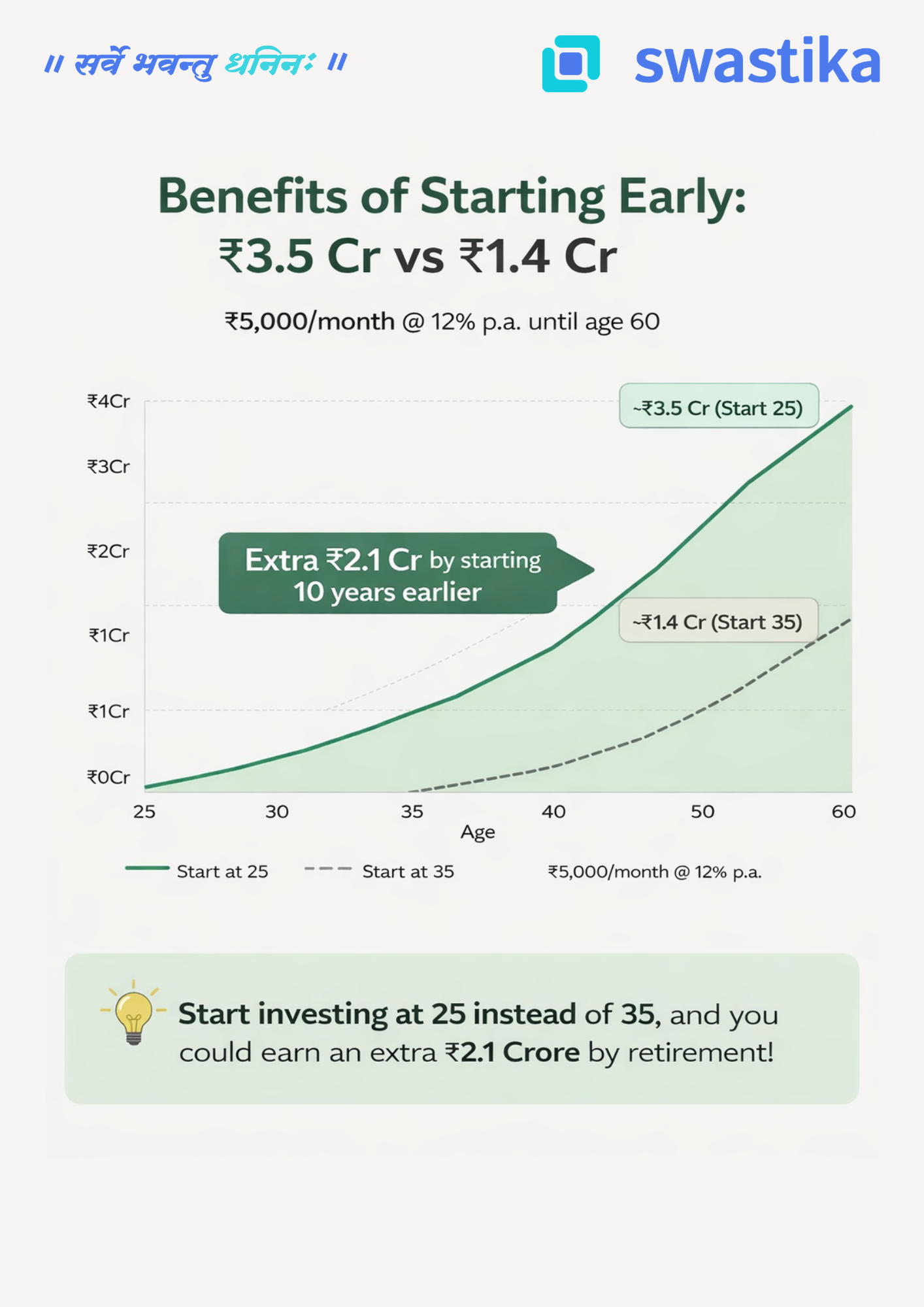
The more years you give your money to grow, the more dramatic — and life-changing — the results become. This is exactly why starting your investment journey early, even with a modest amount, can make a difference of crores by the time you retire.
A Tale of Two Investors: Arjun vs Priya
Let's bring this concept to life with a simple, real-world example.
Meet Arjun and Priya. Both are sensible, disciplined investors. Both invest ₹5,000 every month through a SIP (Systematic Investment Plan) in equity mutual funds, earning an average annual return of 12%. Both stop investing at age 60.
The only difference? Arjun starts at 25. Priya starts at 35.
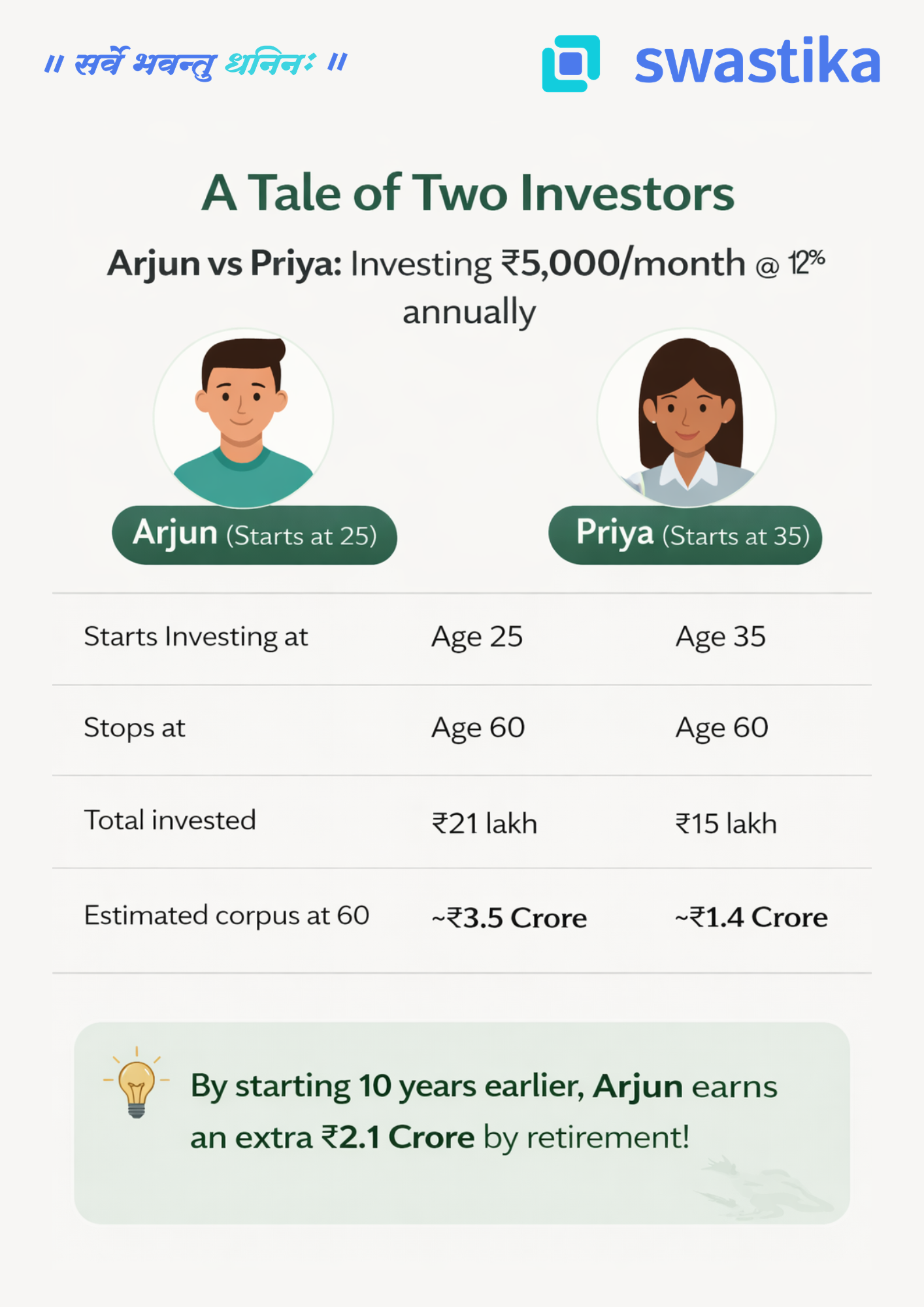
The numbers are striking. Arjun invests just ₹6 lakh more than Priya in absolute terms — yet walks away with ₹2.1 Crore more at retirement.
That extra ₹2.1 Crore didn't come from investing more aggressively or taking bigger risks. It came purely from starting 10 years earlier.
Why Does Time Make Such a Huge Difference?
This is where the magic of compounding reveals itself.
In the early years of investing, growth looks modest and almost unimpressive. But as the years pass, your corpus grows not just on your original investment, but on all the accumulated returns from previous years. The curve goes from almost flat to steeply exponential — and that steep climb happens in the later years.
When Arjun starts at 25, his money has 35 years to ride that exponential curve. Priya's money, starting at 35, only catches the last 25 years — and critically, it misses the steepest part of the climb in the final decade.
Think of it this way: the last 10 years of compounding are worth more than the first 20. That is the counterintuitive truth at the heart of long-term investing.
The Real Cost of Waiting
Many young earners tell themselves, "I'll start investing once I'm more settled — once the salary improves, once the EMI is paid off, once life is a bit easier."
But the numbers show that every year of delay is extraordinarily expensive — far more expensive than any EMI or lifestyle expense. Priya didn't invest carelessly. She invested faithfully for 25 years. Yet she ends up with less than half of what Arjun accumulated — not because she did anything wrong, but simply because she started a decade late.
The cost of waiting 10 years wasn't ₹6 lakh in additional contributions. The cost was ₹2.1 Crore in lost wealth.
Three Principles to Remember
1. Start now, not later.The best time to start investing was yesterday. The second best time is today. Even a SIP of ₹1,000–₹2,000 per month in your 20s is infinitely better than waiting for the "right time."
2. Consistency beats intensity.You don't need to invest large sums all at once. A small, steady, monthly commitment — maintained without interruption — is what unlocks the full power of compounding over decades.
3. Stay invested through market cycles.Compounding works only if you let it work. Exiting during market corrections or stopping your SIP in tough months breaks the chain. Time in the market, not timing the market, is what builds wealth.
The Bottom Line
If you are in your 20s or early 30s, you hold an asset that no amount of money can buy later: time. Use it. Start a SIP today — even a small one. Let compounding do its slow, steady, powerful work.
Because the difference between starting at 25 and starting at 35 is not just 10 years. As Arjun and Priya's story shows, that difference is ₹2.1 Crore.
Big Budget









.webp)
.webp)
.webp)
.webp)
.webp)















.webp)
.webp)
.webp)
.webp)
Latest Articles

Reserve Bank of India’s New FX Rules: Why Banks Are Worried About a $30 Billion Unwinding


Key Takeaways
- Reserve Bank of India caps forex positions at $100 million
- Banks may need to unwind nearly $30 billion positions
- Could strengthen rupee but hurt bank trading books
- Short-term volatility expected in currency and markets
RBI’s New FX Rules: A Turning Point for Forex Markets
India’s currency markets are witnessing a major shift after the Reserve Bank of India introduced tighter rules on foreign exchange exposure. The move has triggered concern among banks, as it may force them to unwind positions worth nearly $30 billion.
At first glance, this may sound like a technical regulatory change. But in reality, it has the potential to impact the rupee, banking stocks, and even overall market sentiment.
What Are RBI’s New FX Rules?
The central bank has instructed authorised dealer banks to ensure that their open positions in the rupee do not exceed $100 million at the end of each trading day.
Earlier framework
- Banks could maintain open positions up to 25 percent of their capital base
- This allowed greater flexibility in currency trading and hedging
What has changed now?
- A strict cap of $100 million per day
- Applies to onshore currency markets
- Forces banks to reduce large speculative or arbitrage positions
This is a significant tightening of liquidity and risk-taking capacity in the forex market.
Understanding the $30 Billion Unwinding
The biggest concern is the scale of positions that may need to be closed.
Where are these positions?
- Offshore non-deliverable forwards market
- Some exposure in currency futures
- Strategy involved buying dollars onshore and selling offshore
Over time, banks built large positions to benefit from price differences between markets. Now, with stricter limits, they may have to unwind these trades quickly.
What does unwinding mean?
In simple terms, banks will need to:
- Sell dollars in the domestic market
- Close existing contracts
- Absorb potential losses if prices move against them
This is where the $30 billion figure becomes critical.
Why Are Banks Concerned?
Banks are not opposing regulation, but they are worried about the timing and scale.
Key concerns
1. Potential losses
If banks unwind positions at unfavorable rates, it can lead to mark-to-market losses on their books.
2. Market disruption
A sudden unwinding of large positions can cause sharp moves in the rupee.
3. Short timeline
Banks have requested more time beyond the April deadline to manage this transition smoothly.
4. Impact on treasury operations
Forex trading is a key revenue stream for banks, and tighter limits may affect profitability.
Impact on the Indian Rupee
Interestingly, what worries banks could benefit the rupee in the short term.
How?
When banks unwind positions, they will likely:
- Sell dollars in the onshore market
- Increase supply of dollars
- Strengthen the rupee
Recently, the rupee weakened past the 94 per dollar mark due to global factors like rising crude oil prices and geopolitical tensions. This unwinding could reverse some of that pressure.
Expert view
Market participants expect the rupee to move towards the 92.50 to 92.80 range in the near term if large-scale unwinding takes place.
Global Context: Why This Move Now?
The timing of RBI’s decision is not random.
Key global triggers
- Rising oil prices due to Middle East tensions
- Increased volatility in global currency markets
- Pressure on emerging market currencies
India, being a major oil importer, is particularly sensitive to these factors. A weaker rupee can increase import costs and inflation.
By tightening forex exposure, RBI aims to:
- Reduce speculative pressure
- Stabilize the currency
- Maintain financial system stability
Impact on Stock Markets
Currency movements often have a ripple effect on equities.
Banking stocks
- Short-term pressure due to potential trading losses
- Volatility in treasury income
IT and export-oriented sectors
- A stronger rupee may reduce export competitiveness
- Margins could be slightly impacted
Oil and import-heavy sectors
- Benefit from a stronger rupee
- Lower input costs
Overall, markets may remain volatile in the short term as participants adjust to the new regime.
Real-World Example
Imagine a bank holding a large dollar position expecting the rupee to weaken further. Suddenly, new rules force it to reduce that position.
If the rupee strengthens during this process:
- The bank sells dollars at a lower price
- It incurs losses
- Multiple banks doing the same creates a chain reaction
This is exactly the scenario markets are trying to assess right now.
Regulatory Perspective
The Reserve Bank of India has always prioritized financial stability over short-term market comfort.
This move reflects:
- A proactive approach to risk management
- Strong regulatory oversight
- Focus on long-term stability of the rupee
While it may cause temporary disruption, such steps are often necessary to prevent larger systemic risks.
What Should Investors Do?
For retail investors, this is more about understanding the broader picture than reacting immediately.
Key takeaways
- Expect short-term volatility in currency and banking stocks
- Focus on fundamentally strong companies
- Avoid panic-driven decisions
Having access to reliable research and real-time insights becomes crucial during such phases.
Platforms like Swastika Investmart provide:
- SEBI-registered credibility
- Advanced research tools
- Tech-driven investing experience
- Strong customer support and investor education
FAQs
1. What is the new FX rule introduced by RBI?
Banks must keep their open rupee positions within $100 million at the end of each trading day.
2. Why is there concern about $30 billion unwinding?
Banks may need to close large forex positions, which can lead to losses and market volatility.
3. How will this impact the rupee?
It may strengthen the rupee in the short term due to increased dollar selling.
4. Which sectors are most affected?
Banking, IT, and import-heavy sectors may see short-term impact.
5. Is this a positive move overall?
Yes, from a long-term stability perspective, it helps control risk in the financial system.
Conclusion
The Reserve Bank of India’s new FX rules mark an important shift in how currency risk is managed in India. While the immediate concern revolves around a potential $30 billion unwinding, the broader objective is to ensure stability in an increasingly volatile global environment.
For investors, this is a reminder that policy changes can create both risks and opportunities. Staying informed and using the right tools can make all the difference.
If you want expert insights, reliable research, and a seamless investing experience, consider starting your journey with Swastika Investmart.

PC Jeweller’s Strategic MoU with NSDC: Boosting Skill Development in the Gems & Jewellery Sector
Key Takeaways
- PC Jeweller Ltd partners with National Skill Development Corporation
- Aim: Develop 2 lakh micro-entrepreneurs in 5 years
- Strengthens India’s gems & jewellery ecosystem
- Positive long-term impact on organized jewellery players
PC Jeweller’s Strategic MoU with NSDC: A Game-Changer for Skill Development
India’s gems and jewellery sector is one of the largest contributors to employment and exports. In a significant move, PC Jeweller Ltd has signed a Memorandum of Understanding with the National Skill Development Corporation.
This partnership aims to create a structured ecosystem for skill development and entrepreneurship in the jewellery industry. At a time when India is focusing on employment generation and formalization of sectors, this initiative could play a crucial role.
Understanding the PC Jeweller and NSDC Partnership
The MoU positions PC Jeweller as an industry and franchise partner in the gems and jewellery segment. The primary objective is to onboard and train nearly 2,00,000 micro-entrepreneurs across India over the next five years.
What does this mean in simple terms?
- Individuals will be trained in jewellery-related skills
- They can become franchise partners or independent entrepreneurs
- The initiative promotes self-employment in smaller towns and cities
This is aligned with the government’s broader vision of Skill India and entrepreneurship development.
Why Skill Development Matters in the Jewellery Sector
India’s jewellery market is largely unorganized, especially at the grassroots level. Many artisans lack formal training, certification, and access to organized retail networks.
Key challenges in the sector:
- Lack of standardized training
- Limited access to capital and branding
- Fragmented supply chain
By addressing these gaps, this initiative can bring a large part of the industry into the formal economy.
Real-world example
Consider a small-town goldsmith in Madhya Pradesh. Traditionally, he relies on local demand and word-of-mouth marketing. With structured training and franchise support, he can:
- Improve design and quality standards
- Access branded distribution channels
- Increase income and scale operations
This transformation is exactly what the MoU aims to achieve.
Strategic Benefits for PC Jeweller
This move is not just about social impact; it also has strong business logic.
1. Expansion of Franchise Network
By onboarding micro-entrepreneurs, PC Jeweller can expand its presence in Tier 2 and Tier 3 cities without heavy capital expenditure.
2. Brand Penetration
A larger network means higher visibility and trust, especially in semi-urban markets.
3. Supply Chain Strengthening
Training and standardization can improve quality control across the value chain.
Impact on the Indian Economy
The gems and jewellery sector contributes significantly to India’s GDP and exports. Initiatives like this can have a multiplier effect.
Economic implications:
- Job creation at scale
- Boost to rural and semi-urban economies
- Increased formalization and tax compliance
This aligns with the broader push by regulators and policymakers to bring more sectors under the formal economy.
Stock Market Perspective: What Should Investors Watch?
From an investor’s point of view, such strategic partnerships can indicate long-term growth potential.
Positive signals:
- Focus on scalable business model
- Expansion without heavy capital investment
- Alignment with government initiatives
However, investors should also keep in mind:
- Execution risks
- Time required to see financial impact
- Overall market sentiment
In the short term, such news may lead to positive sentiment, but the real impact will depend on execution.
Industry-Wide Impact
This move could set a precedent for other jewellery companies to invest in skill development and structured expansion.
Possible ripple effects:
- Increased competition in organized jewellery retail
- Better quality standards across the industry
- Higher consumer trust in branded players
Over time, this could accelerate the shift from unorganized to organized players.
Role of Technology and Modern Investing Platforms
As sectors evolve, investors need reliable platforms and research tools to make informed decisions.
Platforms like Swastika Investmart stand out with:
- SEBI-registered credibility
- Advanced research and analytics tools
- Strong customer support
- Focus on investor education
Whether you are tracking stocks like PC Jeweller or exploring sectoral opportunities, having the right platform can make a significant difference.
FAQs
1. What is the objective of PC Jeweller’s MoU with NSDC?
The aim is to train and onboard 2 lakh micro-entrepreneurs in the jewellery sector over five years.
2. How will this impact the jewellery industry?
It will promote skill development, improve quality standards, and help formalize the sector.
3. Is this positive for PC Jeweller stock?
It is a positive long-term development, but investors should track execution and financial impact.
4. Who benefits the most from this initiative?
Small artisans, aspiring entrepreneurs, and semi-urban markets are expected to benefit the most.
5. Does this align with government initiatives?
Yes, it supports Skill India and entrepreneurship development programs.
Conclusion
The partnership between PC Jeweller Ltd and National Skill Development Corporation is a forward-looking step that blends business expansion with social impact. While the immediate financial impact may take time, the long-term potential is significant, both for the company and the industry.
For investors, this is a reminder that structural changes and strategic initiatives often create the biggest opportunities.
If you want to stay ahead in the market with expert insights, smart tools, and a trusted platform, consider starting your investment journey with Swastika Investmart.
%20(3).webp)
Market Opening Updates for Today 30 March 2026: Nifty, Sensex Slide Amid Global Volatility
The Indian stock market is set for a weak opening as global uncertainty continues to weigh on investor sentiment. Benchmarks like Nifty 50 and BSE Sensex are under pressure following sharp declines in global markets and rising geopolitical tensions in the Middle East.
With GIFT Nifty indicating a gap-down opening, traders and investors are preparing for heightened volatility and cautious trading conditions.
Key Takeaways
- Indian markets likely to open sharply lower amid global sell-off
- Banking and IT sectors expected to remain under pressure
- Rising geopolitical tensions impacting risk appetite
- Defensive sectors may outperform in the short term
- Investors advised to stay cautious and focus on quality stocks
Why Indian Markets Are Falling Today
The primary reason behind today’s expected decline is global market weakness triggered by geopolitical tensions and uncertainty in crude oil prices. As India is a major oil importer, any spike in crude prices directly impacts inflation and corporate margins.
Additionally, foreign institutional investors continue to show cautious behavior, leading to sustained outflows. This has added pressure on indices like Nifty Bank and Nifty IT, both of which are sensitive to global economic trends.
Sector-Wise Market Impact
Banking and Financial Services
The financial sector is witnessing selling pressure due to concerns over rising interest rates and global instability. Stocks in this space often react sharply to FII movements and macroeconomic cues.
IT Sector Slow
The IT sector is particularly vulnerable due to its heavy reliance on global demand, especially from the US and Europe. A slowdown in these economies can directly impact earnings visibility.
FMCG and Pharma Stability
Defensive sectors like FMCG and pharma are expected to show relative resilience. These sectors typically perform better during uncertain times as they cater to essential consumption.
Role of Global Cues and RBI Outlook
Global cues remain the dominant driver for Indian equities in the short term. Investors are closely watching central bank actions, especially from the US Federal Reserve.
On the domestic front, the Reserve Bank of India continues to monitor inflation and liquidity conditions. Any shift in policy stance could influence market direction.
Regulatory oversight by Securities and Exchange Board of India ensures market stability, but short-term volatility is inevitable in such global scenarios.
What Should Investors Do Now
In times of market volatility, a disciplined approach becomes essential. Here are some practical strategies:
- Avoid panic selling and stick to long-term investment goals
- Focus on fundamentally strong companies with stable earnings
- Consider staggered buying instead of lump sum investments
- Diversify across sectors to reduce risk
Investors using platforms like Swastika Investmart benefit from strong research-backed insights, helping them navigate uncertain markets with confidence. As a SEBI-registered broker, it offers reliable advisory tools, a tech-driven trading experience, and a strong focus on investor education.
Market Outlook for the Coming Days
The near-term outlook remains volatile, with markets likely to react to global developments and crude oil price movements. However, India’s strong macroeconomic fundamentals, stable GDP growth, and policy support provide a cushion against prolonged downturns.
Long-term investors may find selective opportunities during corrections, especially in sectors aligned with India’s growth story such as infrastructure, banking, and digital services.
Frequently Asked Questions
Q1. Why is the Indian stock market falling today?
The decline is mainly due to global market weakness, geopolitical tensions, and cautious investor sentiment.
Q2. Which sectors are most affected right now?
Banking, IT, and financial services are under pressure, while FMCG and pharma are relatively stable.
Q3. Should I invest during market corrections?
Yes, but adopt a staggered approach and focus on fundamentally strong stocks.
Q4. How do global events impact Indian markets?
Global events influence foreign investments, currency movements, and commodity prices, all of which affect Indian equities.
Q5. Is this a good time for long-term investors?
Market corrections can offer good entry points for long-term investors if approached strategically.
Final Thoughts
Market volatility is a natural part of investing, especially in a globally interconnected economy. While short-term movements may seem unsettling, disciplined investing and a long-term perspective can help you navigate uncertainty effectively.
If you’re looking for a reliable platform to make informed investment decisions, explore Swastika Investmart and take advantage of its research-driven tools and investor-first approach.
.webp)
Stocks in News Today 30 March 2026: PC Jeweller, Ceigall India, GR Infra & RailTel news
The Indian stock market continues to react to company-specific developments, and Stocks in News 30 March 2026 highlights several firms making headlines due to major business updates. From infrastructure wins to strategic partnerships, these announcements can influence short-term price movements and long-term investor sentiment.
Understanding these triggers is essential for traders and investors who want to stay ahead in a fast-moving market.
Key Takeaways
- PC Jeweller partners with NSDC to expand entrepreneurship in India
- Ceigall India secures a major ₹603 crore infrastructure project
- GR Infraprojects wins a highway upgrade bid in Gujarat
- RailTel bags a ₹444 crore network project in Karnataka
PC Jeweller Signs Strategic MoU with NSDC
PC Jeweller has entered into a Memorandum of Understanding with the National Skill Development Corporation to boost entrepreneurship in the gems and jewellery sector.
The initiative aims to onboard up to 2,00,000 micro-entrepreneurs over five years under the PC Jeweller brand. This move aligns with India's broader push toward skill development and self-employment.
Why This Matters
This partnership is not just about expansion. It reflects a shift toward organized retail in the jewellery sector. With increasing regulatory oversight from bodies like the Securities and Exchange Board of India, such structured initiatives can enhance transparency and trust.
For investors, this signals long-term growth potential, especially if execution remains strong.
Ceigall India Secures ₹603 Crore Project
Ceigall India has received a Letter of Award for a ₹603 crore project under the hybrid annuity model.
The project includes an 18-month construction timeline, which is relatively fast for infrastructure developments in India.
Market Perspective
Infrastructure companies benefit significantly from government spending. With India's focus on highways and logistics, such contracts can improve revenue visibility.
The hybrid annuity model also reduces financial risk, as part of the funding comes from the government, making it attractive for companies and investors alike.
GR Infraprojects Emerges as Lowest Bidder
G R Infraprojects has emerged as the lowest bidder for upgrading a 60.21 km stretch of NH-56 in Gujarat.
The project involves converting a two-lane road into a four-lane divided highway, which is critical for improving regional connectivity.
Investment Insight
Winning bids is crucial, but execution quality matters more. GR Infra has a strong track record in timely project completion, which enhances investor confidence.
Such developments also align with the government’s infrastructure push under initiatives like Bharatmala, further strengthening the sector outlook.
RailTel Bags ₹444 Crore Karnataka Project
RailTel Corporation of India has secured a ₹444 crore Letter of Intent for the Karnataka State Wide Area Network 3.0 project.
The project involves system integration and is expected to be completed by 2031.
What Investors Should Watch
RailTel operates in a niche segment combining telecom and government infrastructure. Long-term projects like KSWAN 3.0 ensure stable revenue streams.
Additionally, digital infrastructure is a key growth area, supported by government initiatives and increasing demand for connectivity.
Broader Market Context
These developments come at a time when the Indian markets are balancing global uncertainties with strong domestic fundamentals. Regulatory bodies like Reserve Bank of India and SEBI continue to ensure liquidity and market stability.
Company-specific triggers often drive short-term price action, but long-term investors should focus on fundamentals such as order book strength, execution capability, and sector tailwinds.
How Investors Can Approach These Stocks
Investors should avoid chasing stocks purely based on news. Instead, consider:
- Evaluating financial health and debt levels
- Understanding project execution timelines
- Tracking order book growth
- Monitoring sector trends and government policies
Platforms like Swastika Investmart provide research-backed insights, helping investors make informed decisions. As a SEBI-registered broker, it offers reliable advisory services, advanced tools, and a strong focus on investor education.
Frequently Asked Questions
1. What does “Stocks in News” mean?
It refers to companies that are in the spotlight due to recent developments like contracts, partnerships, or regulatory updates.
2. Should I invest in stocks based on news alone?
No. News can trigger short-term movement, but long-term decisions should be based on fundamentals and research.
3. What is the hybrid annuity model in infrastructure?
It is a funding model where the government and private players share project costs, reducing financial risk for companies.
4. Why are infrastructure stocks gaining attention in India?
Government spending on roads, railways, and digital infrastructure is driving growth in this sector.
5. Is RailTel a good long-term play?
It has potential due to its niche positioning in telecom infrastructure, but investors should assess financials and execution capability.
Final Thoughts
The Stocks in News 30 March 2026 list highlights how strategic deals and project wins can influence market sentiment. While these updates create opportunities, disciplined investing remains key.
A balanced approach combining news tracking with fundamental analysis can help investors navigate volatility more effectively.
If you want deeper insights and research-backed recommendations, you can explore opportunities with Swastika Investmart’s platform here:
.webp)
Share Market Setup Today 30 March 2026: Nifty50, Sensex, BankNifty is set for a cautious start
The Indian stock market is set to open on a cautious note on 30 March 2026, tracking weak global cues and mixed institutional activity. Traders and investors should stay alert as volatility remains elevated, with important support and resistance zones coming into play.
Key Takeaways
- Global markets are weak, signaling a negative start for Indian indices
- FIIs remain net sellers while DIIs provide partial support
- Nifty and Bank Nifty continue to show a downtrend structure
- Volatility is rising, indicating cautious trading sentiment
Global Market Cues Impacting India
Global sentiment remains under pressure. US markets closed lower, with the Dow Jones declining sharply. Futures are also trading in the red, reflecting continued bearish sentiment.
Asian markets are following suit, trading with a negative bias. Meanwhile, GIFT Nifty indicates a gap-down opening of around 200 points, suggesting early weakness in Indian equities.
Such global cues often influence short-term market direction in India, especially for index-heavy stocks and sectors like IT, banking, and metals.
Institutional Activity: FIIs vs DIIs
Institutional flows provide crucial insights into market direction.
- Foreign Institutional Investors recorded heavy selling of ₹4367 crore
- Domestic Institutional Investors offset some pressure with buying of ₹3566 crore
- Net outflow stands at ₹801 crore, indicating cautious sentiment
This divergence shows that while global investors are reducing exposure, domestic institutions continue to provide stability. However, persistent FII selling can weigh on market momentum.
Derivatives Data and Market Sentiment
The derivatives segment reflects a mixed to negative outlook:
- Nifty PCR stands at 0.94, indicating slightly bearish positioning
- India VIX surged to 26.80, signaling increased volatility
- Highest Open Interest is at 24000 CE and 20000 PE
- Max Pain level is around 23000
FIIs’ positioning in index derivatives shows increased call writing and short positions, hinting at resistance at higher levels. This suggests traders should remain cautious on aggressive long positions.
Nifty Outlook for 30 March 2026
Nifty continues to trade in a clear downtrend, with selling pressure visible at higher levels.
Key Support Levels
- Immediate support at 22500 to 22470
- Stronger support zone at 22270 to 22150
Key Resistance Levels
- Immediate resistance at 22800 to 23000
- Next hurdle near 23200
If Nifty breaks below 22470, further downside could be seen. On the upside, sustained movement above 23000 is needed for trend reversal.
Bank Nifty Outlook
Bank Nifty is also showing a weak structure, aligned with the broader market trend.
Support Zones
- 51300 to 50700 is a crucial support range
- Below 50700, next support is around 50000
Resistance Zones
- 52000 and 53000 will act as key resistance levels
Banking stocks often drive market direction, so traders should closely watch these levels for intraday opportunities.
Volatility and Risk Management
India VIX rising above 26 suggests heightened uncertainty. This typically leads to sharp intraday swings. Traders should:
- Use strict stop losses
- Avoid over-leveraging in F&O
- Prefer hedged strategies like spreads
As per SEBI guidelines, retail investors should exercise caution in derivatives trading and ensure proper risk management.
Role of RBI and Macro Factors
The Reserve Bank of India’s stance on inflation and liquidity continues to influence market sentiment. Any unexpected policy changes or global macro developments can further impact market direction.
Interest rate trends, currency fluctuations, and crude oil prices remain key variables to monitor.
How Swastika Investmart Helps Traders Navigate Markets
In volatile markets like these, having the right tools and insights becomes critical. Swastika Investmart, a SEBI-registered broker, offers:
- Strong research-backed market insights
- Advanced trading platforms for seamless execution
- Dedicated customer support for investors
- Educational resources to improve trading strategies
Their focus on technology and investor awareness makes them a reliable partner for both beginners and experienced traders.
FAQs
What is the expected opening for Nifty on 30 March 2026?
Nifty is expected to open lower due to weak global cues and negative GIFT Nifty indications.
Why are FIIs selling heavily?
FIIs often react to global uncertainties, interest rate trends, and currency movements, leading to selling in emerging markets like India.
What does a high India VIX indicate?
A high VIX reflects increased market volatility and uncertainty, often leading to sharp price movements.
What is Max Pain in options trading?
Max Pain is the price level where option writers incur the least loss, often acting as a magnet for expiry.
Is it safe to trade in a volatile market?
Yes, but only with proper risk management, stop losses, and disciplined strategies.
Conclusion
The stock market outlook for 30 March 2026 remains cautious, with global weakness, FII selling, and rising volatility shaping sentiment. Key support and resistance levels will play a crucial role in determining the next move.
For traders, this is a time to stay disciplined, focus on risk management, and avoid emotional decisions. Markets may offer opportunities, but only for those who approach them with a clear strategy.
To explore smart trading tools and expert insights, you can get started here:
.png)
Stock Market Holiday on March 31, 2026: NSE, BSE Closed for Mahavir Jayanti Full Trading & Settlement Impact Explained
The Indian stock market will remain closed on March 31, 2026, on account of Mahavir Jayanti, impacting trading across equity, derivatives, and currency segments. Both National Stock Exchange and Bombay Stock Exchange will observe a full-day holiday, while commodity markets will operate partially.
For traders and investors, understanding how this holiday affects trading, settlement cycles, and fund availability is crucial to avoid confusion and missed opportunities.
Quick Summary
- NSE and BSE will remain closed on March 31, 2026
- Equity, F&O, and currency trading will not take place
- Commodity market opens only in the evening session
- It is also a settlement holiday impacting fund credits
- Investors should plan trades and withdrawals in advance
Why the Stock Market Is Closed on March 31, 2026
Mahavir Jayanti is a significant religious holiday in India, celebrating the birth of Lord Mahavir, the 24th Tirthankara in Jainism. As per the official trading holiday calendar issued by exchanges, this day is observed as a non-trading day.
Both major exchanges, NSE and BSE, suspend operations across key segments to align with national observances and ensure uniformity in market functioning.
Segments Affected by the Holiday
Equity Market
No trading will take place in equities, including delivery-based and intraday trades.
Derivatives Market
Futures and options contracts will remain inactive for the entire day.
Currency Market
Currency derivatives trading will also be closed.
Commodity Market
Commodity trading will be partially impacted:
- Morning session will remain closed
- Evening session will open from 5:00 PM onwards
This split session is common for commodity markets during holidays.
Settlement Impact: What Investors Must Know
March 31, 2026, is not just a trading holiday but also a settlement holiday, which can affect your fund flow and stock delivery timelines.
Delayed Fund Credits
If you sell stocks before the holiday, the funds may not be credited on the usual T+1 or T+2 basis due to the non-settlement day.
Payout Postponement
Stock and fund payouts scheduled around this date may be delayed by one working day.
Impact on Margin Availability
Traders relying on margins should note that reduced fund availability could affect their positions once markets reopen.
These settlement rules are governed under regulations set by Securities and Exchange Board of India, ensuring transparency and investor protection.
How This Affects Financial Year-End Planning
March 31 marks the end of the financial year in India, making this holiday particularly important.
Tax Planning Considerations
- Last-minute tax-saving investments in stocks will not be possible on this day
- Capital gains realization must be planned before the holiday
Portfolio Rebalancing
Investors looking to rebalance portfolios before year-end must execute trades in advance.
Banking and Fund Transfers
Since banks operate under Reserve Bank of India guidelines, some banking services may also be limited, affecting fund transfers to trading accounts.
Practical Tips for Traders and Investors
Plan Trades Early
Execute any important trades at least one day before the holiday to avoid settlement delays.
Monitor Open Positions
If you hold F&O positions, ensure adequate margin is available to avoid penalties after reopening.
Check Broker Notifications
Brokers often provide detailed holiday updates. Staying informed can help avoid confusion.
Frequently Asked Questions
Is the stock market completely closed on March 31, 2026?
Yes, NSE and BSE will remain fully closed for equity, F&O, and currency segments.
Will commodity trading happen on this day?
Commodity markets will remain closed in the morning but will open in the evening session from 5:00 PM.
What is a settlement holiday?
A settlement holiday is a day when fund and stock settlements are not processed, leading to delays in payouts.
Can I receive funds if I sell shares before March 31?
There may be a delay in receiving funds due to the settlement holiday, depending on the trade date.
Does this affect mutual fund transactions?
Yes, NAV calculation and transaction processing may shift to the next working day.
Conclusion
The stock market holiday on March 31, 2026, is more than just a day off from trading. It directly impacts settlements, fund availability, and financial year-end planning. Investors who understand these nuances can avoid unnecessary delays and make better decisions.
Planning ahead is the key. Whether it is executing trades early or ensuring sufficient margin, small steps can make a big difference.
If you want a smoother investing experience with timely updates and expert insights, explore trading with Swastika Investmart


.webp)
.webp)

.webp)





START YOUR INVESTMENT JOURNEY
Get personalized advice from our experts
- Dedicated RM Support
- Smooth and Fast Trading App