

Income Tax Rules 2026 Explained: Save More Tax with These Hidden Updates


.png)

 Add Swastika as preferred source
Understanding the latest Income Tax Rules 2026 can make a big difference to your financial planning. With subtle changes and lesser-known provisions, taxpayers in India now have more opportunities to legally reduce their tax burden. Whether you are a salaried individual, freelancer, or investor, staying updated can help you save more and invest smarter.
Key Highlights at a Glance
- New tax regime continues to gain preference with simplified slabs
- Deductions under old regime still beneficial for specific taxpayers
- Standard deduction adjustments improve salaried income relief
- Increased focus on digital reporting and compliance
- Investment-linked savings remain a powerful tax-saving tool
What’s New in Income Tax Rules 2026
Shift Towards the New Tax Regime
The government continues to promote the new tax regime by making it more attractive. Lower tax rates and fewer exemptions simplify filing, especially for individuals who do not claim multiple deductions.
However, the old regime still works well for those investing in instruments like ELSS, PPF, or claiming housing loan interest.
Standard Deduction Benefits
Salaried individuals and pensioners benefit from a standard deduction, which reduces taxable income without requiring proof of expenses. This continues to be a key relief feature under both regimes.
Updated Compliance and Reporting
With increasing digitization, the Income Tax Department now tracks financial transactions more closely. High-value transactions, stock market trades, and mutual fund investments are automatically reported.
This makes accurate filing essential and reduces chances of tax evasion.
Smart Ways to Save Tax in 2026
Maximize Section 80C Investments
Investments under Section 80C still offer deductions up to ₹1.5 lakh. Popular options include:
- Equity Linked Savings Scheme
- Public Provident Fund
- Tax-saving fixed deposits
For example, a salaried individual investing ₹1.5 lakh in ELSS can significantly reduce taxable income while also gaining exposure to equity markets.
Use Health Insurance Deductions
Under Section 80D, premiums paid for health insurance policies provide additional deductions. This is especially useful for families and senior citizens.
Capital Gains Planning
Investors in stocks and mutual funds should plan their capital gains strategically. Long-term investments often enjoy lower tax rates compared to short-term gains.
Using tools and research platforms from brokers like Swastika Investmart can help investors optimize their portfolio and reduce tax liability through better planning.
Real-World Example
Consider Rahul, a salaried employee earning ₹12 lakh annually.
- Under the new regime, he benefits from lower tax rates but fewer deductions
- Under the old regime, he claims deductions for PPF, insurance, and home loan interest
After comparison, Rahul finds the old regime saves him more due to his disciplined investments. This highlights why choosing the right regime is crucial.
Role of Regulations and Financial Platforms
Indian regulatory bodies like the Income Tax Department, along with frameworks influenced by institutions such as SEBI and RBI, ensure transparency and compliance in financial transactions.
Platforms like Swastika Investmart support investors with research-backed insights, tax-efficient strategies, and easy-to-use tools. Their SEBI-registered status and strong advisory services make them a reliable partner for both beginners and experienced investors.
Common Mistakes to Avoid
Ignoring Regime Comparison
Many taxpayers choose the default regime without evaluating which one benefits them more.
Missing Investment Deadlines
Failing to invest before the financial year ends can lead to missed deductions.
Incorrect Reporting
With automated tracking, mismatched income reporting can trigger notices.
Frequently Asked Questions
1. Which tax regime is better in 2026?
It depends on your financial profile. The new regime suits those with fewer deductions, while the old regime benefits investors and homeowners.
2. Are tax-saving investments still useful?
Yes, especially under the old regime. They reduce taxable income and help build long-term wealth.
3. How are stock market gains taxed?
Short-term gains are taxed higher, while long-term gains enjoy concessional rates after a threshold.
4. Is filing income tax more complex now?
Not necessarily. While reporting has become stricter, digital tools have made filing easier and faster.
Final Thoughts
The Income Tax Rules 2026 bring both simplicity and opportunity. By understanding the differences between tax regimes, leveraging deductions, and planning investments wisely, you can significantly reduce your tax outgo.
If you want to take smarter financial decisions backed by research and technology, consider exploring Swastika Investmart’s platform for better tax planning and investment strategies.
Big Budget





.webp)
.webp)
.webp)
.webp)
.webp)








.webp)
.webp)
.webp)
.webp)
Latest Articles

Union Budget 2024-25


Understanding the Union Budget
The Union Budget of India is the comprehensive financial plan of the government for the fiscal year, outlining its revenue and expenditure projections. Presented annually by the Finance Minister in Parliament, it serves as a blueprint for the country's economic policies and priorities. Beyond financial allocations, the budget addresses key aspects such as taxation, borrowing, and expenditure management, shaping the socio-economic landscape of India. It reflects the government's strategies to stimulate growth, promote development, and address fiscal challenges while aiming to achieve sustainable economic progress. As a critical policy document, the Union Budget influences sectors ranging from agriculture and infrastructure to healthcare and education, impacting the lives of millions across the nation.
Budget 2024-25
The Union Budget 2024-25 is set to be an important event for India, scheduled for presentation on July 23, 2024, by Finance Minister Nirmala Sitharaman. As the first budget of the re-elected government's new term, it carries significant weight and anticipation among various stakeholders, including investors, economists, and the general public.
Why is this Budget Special?
This budget is the first financial plan of the re-elected government's new term. There is great anticipation about the government's fiscal policies and economic strategies.
Post-election, the political scenario emphasizes the importance of addressing both regional aspirations and national priorities, ensuring a balanced approach to governance and development.
Economic Context and Expectations
Economic indicators, including robust GST collections and substantial dividends from the Reserve Bank of India (RBI), are expected to strengthen the budgetary framework. These factors provide a solid foundation for improving fiscal health and implementing growth-oriented policies.
In the last ten years, each budget has shown how the government aims to double farmers' incomes and increase money flow directly to them. Budgets have set aside more funds for agriculture, focusing on rural development and improving farming methods.
Initial indications suggest that in FY25, the government will continue focusing on consolidating finances to boost economic growth and control inflation. Meeting the fiscal deficit goal of 4.5% of GDP by FY26 is crucial, requiring careful allocation of resources to sectors such as Minimum Support Price (MSP), food, fertilizers, and LPG subsidies.
Key Focus Areas
Union Budget 2024-25 is expected to align closely with the Modi government's inclusive development agenda, prioritizing initiatives such as:
- Ujjwala Scheme: Ensuring clean cooking fuel access for rural households.
- Jal Jivan Mission: Facilitating water supply and sanitation in rural areas.
- PM Kisan: Providing income support to small and marginal farmers.
- Swachh Bharat Abhiyan: Promoting cleanliness and sanitation nationwide.
The railway sector is set to receive increased funding for capital projects, continuing the government's efforts to rejuvenate infrastructure. In the Interim Budget 2024, the railway ministry secured unprecedented financial support, highlighting the government's dedication to improving railway infrastructure.
Impact on the Stock Market and Sectors
Expectations of a favorable budget, without negative tax changes, are likely to maintain a positive trend in the stock market. Sectors like FMCG, infrastructure, renewable energy, housing, and railways, which stand to gain from rural sector improvements, are anticipated to see favorable market responses after the budget is announced.
Conclusion
As we await Finance Minister Nirmala Sitharaman's budget speech on July 23, 2024, expectations are focused on the Union Budget reinforcing the core policies of the re-elected government, while steering clear of significant long-term expenses. Robust revenue streams from GST and RBI dividends are set to enhance fiscal flexibility, facilitating targeted investments in rural infrastructure and agriculture. The budget aims to prioritize inclusive growth and revive sectors, though it is not anticipated to introduce major reforms or extensive expenditures in this fiscal cycle. All eyes are on how the government addresses economic challenges and charts a path towards sustainable development and prosperity in India.

What are Derivatives
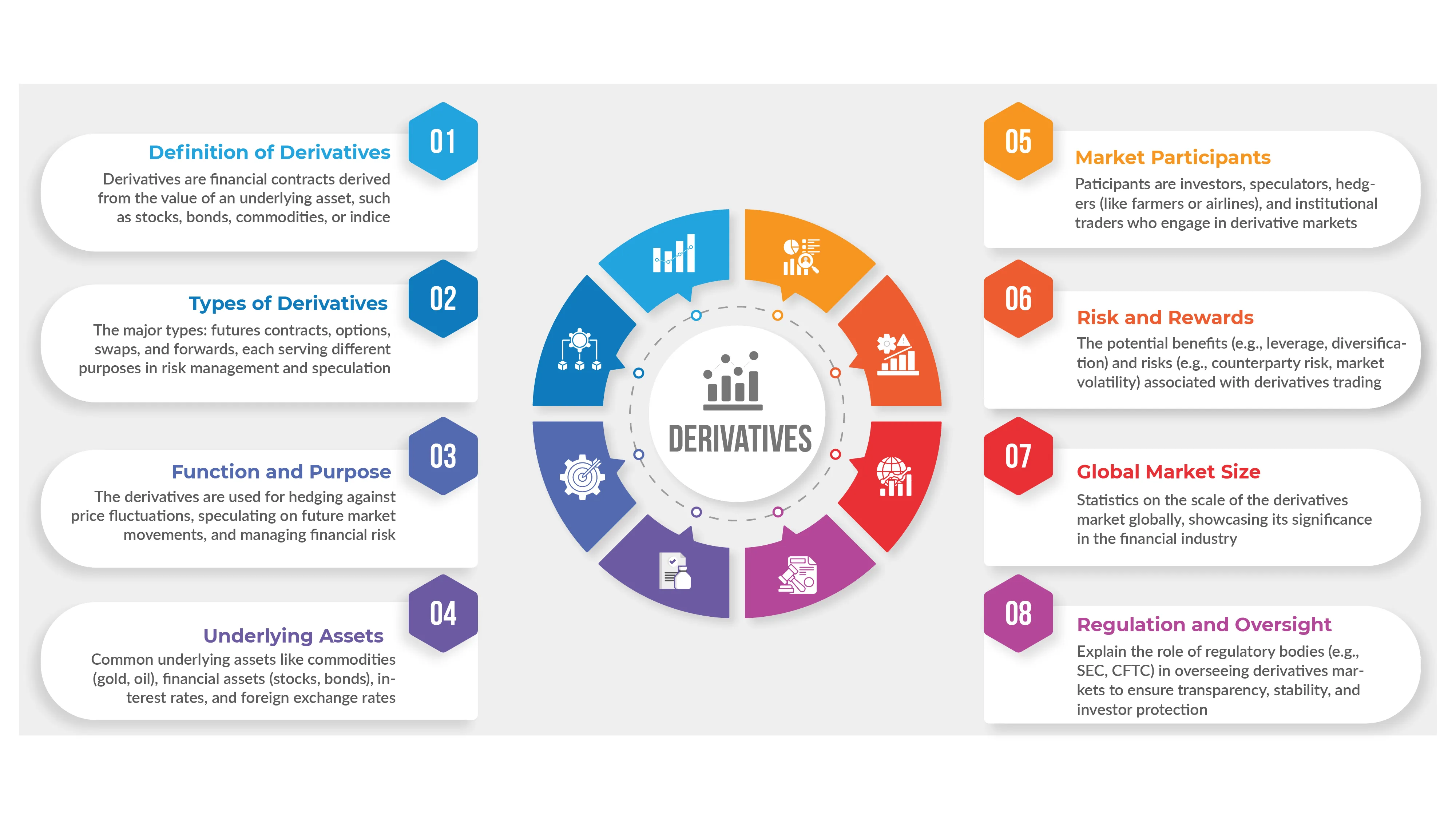
Within the financial sector, derivatives trading plays an important role in enabling investors to manage risk, speculate on market movements, and potentially enhance returns. While the term "derivatives" might sound complex, their underlying concepts are crucial for anyone looking to delve into financial markets. This guide aims to explain derivatives trading, explaining its basics, types, strategies, and significance in a simple and engaging manner.
What are Derivatives?
Derivatives are financial contracts whose value is derived from the performance of an underlying asset, index, or interest rate. They serve as instruments for investors to either hedge against risks or speculate on future price movements. Unlike stocks or bonds, which represent ownership or debt, derivatives offer a way to bet on or protect against price fluctuations without owning the underlying asset itself.
Types of Derivatives
- Futures Contracts: These agreements obligate the buyer to purchase and the seller to deliver a specific asset at a predetermined future date and price. Futures are commonly used for commodities like oil, gold, or agricultural products.
Example: Crude Oil Futures
- Contract Specifications: 1,000 barrels of crude oil
- Current Price: ₹5,000 per barrel
- Contract Expiry: 3 months from today
Scenario:
- A trader takes a long futures position by agreeing to buy 1,000 barrels of crude oil at ₹5,000 per barrel in 3 months.
- If the price of crude oil rises to ₹6,000 per barrel at expiry, the trader can buy at ₹5,000 and sell at ₹6,000.
- Profit: (₹6,000 - ₹5,000) × 1,000 = ₹1,000,000
- Options Contracts: Options give the buyer the right (but not the obligation) to buy (call option) or sell (put option) an asset at a specified price within a predetermined time frame. They are versatile tools used for hedging or speculating on price movements.
Example: Nifty 50 Call Option
- Underlying Asset: Nifty 50 Index
- Current Nifty 50 Level: 15,000 points
- Strike Price: 16,000 points
- Premium: ₹200 per contract
- Expiry: 1 month from today
Scenario:
- A trader buys a call option with a strike price of 16,000 points.
- If the Nifty 50 index rises to 17,000 points by expiry, the trader can exercise the option to buy at 16,000 and sell at 17,000.
- Profit: (17,000 - 16,000 - 200) = 800 points per contract. If each point is worth ₹100, the profit is 800 × ₹100 = ₹80,000 per contract.
- Swaps: Swaps involve exchanging cash flows or other financial instruments with another party over a set period. Common types include interest rate swaps and currency swaps, used to manage risks associated with fluctuations in interest rates or exchange rates.
Example: Interest Rate Swap
- Party A: Pays fixed interest rate of 5% per annum
- Party B: Pays floating interest rate (LIBOR + 2%) per annum
- Principal Amount: ₹10,000,000
- Duration: 5 years
Scenario:
- Party A and Party B agree to swap interest payments annually for 5 years.
- If the LIBOR rate is 3% at the end of the first year, Party B will pay (3% + 2%) = 5% interest.
- In the first year, both parties pay the same amount (5% of ₹10,000,000), so no net payment is made.
- If LIBOR rises to 4% in the second year, Party B will pay (4% + 2%) = 6% interest.
- Net Payment in Year 2: Party B pays an additional (6% - 5%) of ₹10,000,000 = ₹100,000 to Party A.
- Forwards: Similar to futures contracts but traded over-the-counter (OTC), forwards are customized agreements between two parties to buy or sell an asset at a future date at an agreed-upon price.
Example: Currency Forward
- Agreement: To buy $100,000 in 6 months
- Current Spot Rate: ₹75 per USD
- Forward Rate: ₹77 per USD
Scenario:
- A company enters into a forward contract to buy $100,000 at ₹77 per USD in 6 months.
- If the spot rate at expiry is ₹80 per USD, the company saves money by buying at the forward rate.
- Savings:
- (₹80 - ₹77) × $100,000 = ₹300,000
Why Trade Derivatives?
- Risk Management: Derivatives allow businesses and investors to hedge against adverse price movements in commodities, currencies, interest rates, and more. For instance, a wheat farmer might use futures contracts to lock in a price for their harvest, minimizing the impact of price fluctuations.
- Speculation: Investors can use derivatives to speculate on the direction of asset prices without owning the underlying asset. This ability to leverage positions can amplify potential returns but also increases risks.
- Enhanced Market Efficiency: By enabling participants to manage risks more effectively, derivatives contribute to market liquidity and price discovery, fostering overall market efficiency.
Basic Strategies in Derivatives Trading
- Hedging: This strategy involves taking an offsetting position in a derivative to minimize the impact of adverse price movements in the underlying asset. For example, an airline might hedge against rising fuel costs by buying futures contracts for oil.
- Speculation: Traders use derivatives to capitalize on anticipated price movements. For instance, a trader might buy call options on a stock if they expect its price to rise, potentially yielding significant profits if the prediction is correct.
- Arbitrage: Arbitrageurs exploit price differentials between related assets or markets to make risk-free profits. This strategy relies on quick execution and market inefficiencies.
Risks Associated with Derivatives Trading
While derivatives offer opportunities for profit and risk management, they also carry inherent risks:
- Leverage Risk: Derivatives often involve trading on margin, which amplifies both potential gains and losses.
- Market Risk: Prices of underlying assets can fluctuate unexpectedly, affecting the value of derivatives positions.
- Counterparty Risk: OTC derivatives expose parties to the risk of default by their counterparties, necessitating careful credit assessment.
Conclusion
Derivatives trading is a powerful tool in the financial markets, providing avenues for risk management, speculation, and market efficiency. Understanding the basics of futures, options, swaps, and forwards equips investors with the knowledge to navigate these instruments effectively. Whether you're a seasoned investor or a newcomer to finance, grasping the fundamentals of derivatives trading is essential for smart decision-making in today's interconnected global economy.
In essence, derivatives are not just financial instruments but essential components of modern market dynamics, shaping how risks are managed and opportunities are seized in the ever-evolving landscape of global finance.
Unlock trading potential with swastika!

What is Nifty and Sensex?
Introduction
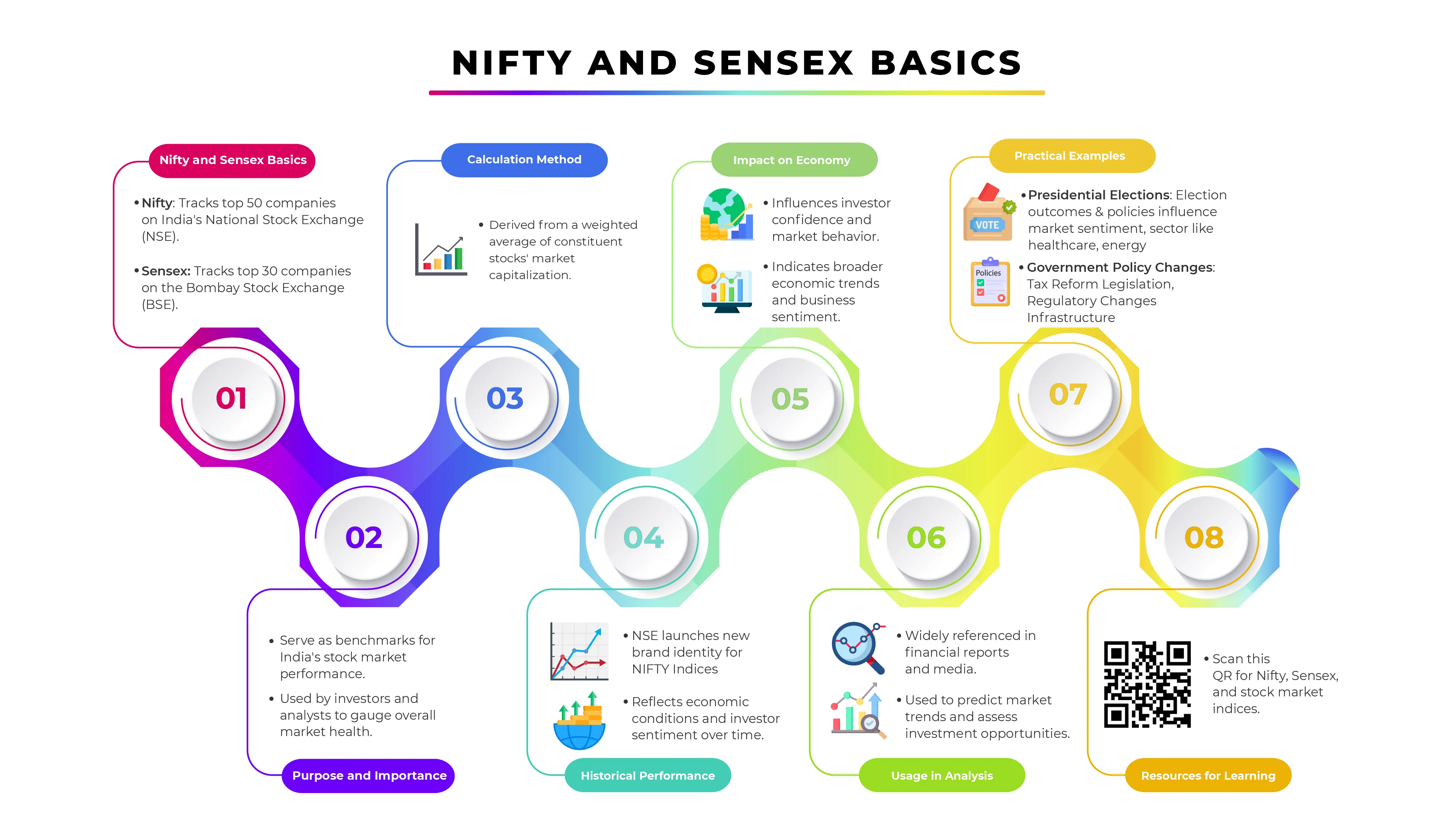
Nifty and Sensex are India's primary stock market indices, representing the performance of the National Stock Exchange (NSE) and the Bombay Stock Exchange (BSE) respectively. They are crucial for investors to measure the health and trends of the stock market.
What is Nifty?
Nifty, also known as the Nifty 50, is India's leading index of the National Stock Exchange (NSE). Launched in 1996, it represents the weighted average of the 50 largest and most liquid stocks traded on the NSE, making it a crucial barometer of the Indian capital markets and a reflection of the overall market performance. The Nifty 50 includes companies across various sectors, ensuring a comprehensive view of the market.
In addition to the Nifty 50, the NSE offers several other indices to provide a broader and more detailed understanding of market dynamics:
- Nifty 100: This index includes the top 100 companies listed on the NSE in terms of market capitalization and liquidity. It encompasses all the companies in the Nifty 50 as well as 50 additional companies, providing a wider perspective on the large-cap segment of the market.
- Nifty 500: As the name suggests, the Nifty 500 index includes the top 500 companies listed on the NSE, covering approximately 96% of the market capitalization of all the companies listed on the exchange. This index offers a comprehensive overview of the Indian equity market, including large, mid, and small-cap companies.
- Nifty Next 50: This index represents the performance of the 50 companies that rank just below the Nifty 50 in terms of market capitalization and liquidity. It serves as a benchmark for mid-cap stocks and provides insights into the potential candidates for inclusion in the Nifty 50.
- Nifty Midcap 100: This index captures the performance of the top 100 mid-cap companies listed on the NSE, offering insights into the mid-cap segment, which often includes companies with significant growth potential.
- Nifty Smallcap 100: This index comprises the top 100 small-cap companies listed on the NSE, focusing on the smaller and emerging companies in the market.
Key Features:
- Representation: Tracks 50 large-cap companies across various sectors.
- Market Capitalization: Based on free-float market capitalization.
- Sectoral Diversity: Includes sectors like IT, finance, energy, etc.
Recent Developments
The NSE has recently introduced a new index focused on the electric vehicle (EV) sector, reflecting this industry's growing importance and potential. This index aims to capture the performance of companies involved in the manufacturing, development, and supply chain of electric vehicles, highlighting the shift towards sustainable and eco-friendly transportation solutions.
Sectoral Weights in the Nifty 50
The Nifty 50 index is diversified across various sectors, with the top five sectors contributing significantly to its overall performance. As of the latest data, the sectoral weightage in the Nifty 50 is as follows:
- Financial Services: This sector has the highest weightage in the Nifty 50, reflecting the dominance of banks, non-banking financial companies (NBFCs), and insurance companies in the Indian market.
- Information Technology (IT): The IT sector, comprising major software services and technology companies, holds a significant portion of the index, underscoring India's strength in the global IT landscape.
- Consumer Goods: This sector includes companies involved in producing and distributing consumer products, both durable and non-durable, highlighting the importance of consumer demand in driving economic growth.
- Oil & Gas: The presence of leading oil and gas companies in the index signifies the critical role of energy resources in the Indian economy.
- Pharmaceuticals: The pharmaceutical sector's weightage reflects India's position as a major player in the global pharmaceuticals and healthcare industry.


Source - https://scripbox.com/pf/what-is-nifty/
What is Sensex?
Sensex or Sensitive Index, is India's benchmark index of the Bombay Stock Exchange (BSE). Launched in 1986, it is one of the oldest stock market indices in the country. Sensex comprises 30 well-established and financially sound companies across various sectors. These companies are selected based on their market capitalization and liquidity, representing the overall performance and health of the stock market.
Key Features:
- Historical Significance: Established in 1986, it's one of India’s oldest indices.
- Market Capitalization: Based on free-float market capitalization.
- Sectoral Coverage: Represents various key sectors of the economy.
Differences Between Nifty and Sensex
- Number of Stocks: Nifty has 50 stocks; Sensex has 30.
- Stock Exchange: Nifty is from NSE; Sensex is from BSE.
- Calculation Method: Both use free-float market capitalization but have different compositions.
Importance of Nifty and Sensex
- Market Barometer: Reflect overall market trends and investor sentiment.
- Benchmark: Used for comparing portfolio and mutual fund performances.
- Economic Indicator: Measure economic health and sectoral performance.
How Are They Calculated?
Both indices use free-float market capitalization, considering only the shares available for public trading. The formula involves stock prices and the number of publicly traded shares.
Why Follow Nifty and Sensex?
- Investment Decisions: Make better investment choices based on market trends.
- Market Trends: Provide insights into economic health and sector performance.
- Risk Management: Help in assessing market volatility and managing risk.
Detailed Aspects
- Sector Representation
Both indices cover diverse sectors. Nifty includes companies from sectors such as IT, finance, consumer goods, and energy. Sensex also represents a wide array of sectors, providing a holistic view of the market.
- Market Capitalization and Free-Float Methodology
Market capitalization is the total market value of a company's outstanding shares. The free-float methodology calculates market cap by excluding promoter and insider holdings, focusing only on shares available for public trading.
The formula for calculating the free float market capitalization is:
Free-Float Market Capitalization = Share Price × Number of Free-Float Shares
To determine the number of free-float shares:
Free-Float Shares = Total Outstanding Shares − Restricted Shares
Restricted shares include those held by promoters, insiders, and other strategic investors that are not available for public trading.
- Historical Performance
Nifty and Sensex have shown significant growth over the years, reflecting the overall economic development of India. Historical performance data can help investors identify long-term trends and investment opportunities.
- Economic Indicators
These indices are not only indicators of stock market performance but also reflect the economic conditions of the country. They are influenced by various factors, including economic policies, geopolitical events, and global market trends.
Practical Tips for Investors
- Regular Monitoring: Keep an eye on the daily movements of Nifty and Sensex.
- Diversification: Use these indices to diversify your investment portfolio.
- Long-Term Trends: Focus on long-term trends rather than short-term fluctuations.
- Better Decisions: Make investment decisions based on comprehensive market research and analysis.
Conclusion
Nifty and Sensex are essential tools for anyone involved in the Indian stock market. They provide a snapshot of market trends, economic health, and sectoral performances, helping investors make informed decisions. Understanding these indices can enhance your investment strategies and lead to better financial outcomes.

Understanding Ex Dividends in the Indian Share Market
Dividends are a way for companies to share their profits with people who own their stock. But to receive a dividend pay-out, timing is key. Let’s break down what dividends are and the important dates you need to know if you're investing in the Indian stock market.
What is a Dividend?
A dividend is a payment made by a company to its shareholders from its profits. When a company grows and decides to go public, it allows people to buy its shares through an Initial Public Offering (IPO). Once people buy shares, they become shareholders and can receive dividends from the company’s profits. These payments are often made regularly, such as every three months or once a year.
What is the Ex-Dividend Date?
The ex-dividend date is an important date for anyone buying stocks. It’s the deadline by which you must own the stock to get the next dividend payment. If you buy the stock on or after this date, you won't get the upcoming dividend; the previous owner will.
- Understanding the Ex-Dividend Date: This is the first business day after which new stock buyers become ineligible for the upcoming dividend pay-out.
- The Deadline: If you purchase a stock before the ex-dividend date, you'll be included in the company's record of shareholders who receive the dividend.
- Buying After the Ex-Dividend Date? No Dividend for You: Purchasing shares on or after the ex-dividend date means you won't be eligible for the upcoming pay-out. The seller in this case will receive the dividend.
So in simple words, If you purchase a stock before the ex-dividend date, you're considered a shareholder of record. This means you'll be entitled to receive the next dividend pay-out.
If you buy the stock on or after the ex-dividend date, you won't be eligible for the upcoming dividend. The seller in this case will receive the pay-out.
How it Affects Share Prices
When a stock goes ex-dividend, its price usually drops by the amount of the dividend. For example, if a company pays a ₹10 dividend and the stock price was ₹1000, it might drop to ₹990 on the ex-dividend date. This drop happens because the dividend is no longer included in the stock price.
Difference between the Ex-Dividend Date and the Record Date
- Ex-Dividend Date: The last day you can buy the stock to be eligible for the next dividend. If you buy the stock on or after this date, you won’t get the next dividend.
- Record Date: The date the company checks its records to see who owns the stock and is eligible for the dividend. To be on this list, you need to have bought the stock before the ex-dividend date due to the two-day settlement period (T+2).
Key Dates for Dividends
There are three key dates to remember when it comes to dividends:
- Ex-Dividend Date: The last day to buy the stock to get the next dividend.
- Record Date: The day the company looks at its records to see who gets the dividend.
- Payment Date: The day the company actually pays out the dividend to shareholders.
Conclusion
Knowing about dividends and the important dates can help you make better decisions when investing in stocks. The date is especially important because it determines whether you get the next dividend payment. By keeping track of these dates, you can manage your investments more effectively.

Understanding Dividends in the Indian Share Market
Dividends are a way for companies to share their profits with people who own their stock. But to receive a dividend pay-out, timing is key. Let’s break down what dividends are and the important dates you need to know if you're investing in the Indian stock market.
What is a Dividend?
A dividend is a payment made by a company to its shareholders from its profits. When a company grows and decides to go public, it allows people to buy its shares through an Initial Public Offering (IPO). Once people buy shares, they become shareholders and can receive dividends from the company’s profits. These payments are often made regularly, such as every three months or once a year.
What is the Ex-Dividend Date?
The ex-dividend date is an important date for anyone buying stocks. It’s the deadline by which you must own the stock to get the next dividend payment. If you buy the stock on or after this date, you won't get the upcoming dividend; the previous owner will.
- Understanding the Ex-Dividend Date: This is the first business day after which new stock buyers become ineligible for the upcoming dividend pay-out.
- The Deadline: If you purchase a stock before the ex-dividend date, you'll be included in the company's record of shareholders who receive the dividend.
- Buying After the Ex-Dividend Date? No Dividend for You: Purchasing shares on or after the ex-dividend date means you won't be eligible for the upcoming pay-out. The seller in this case will receive the dividend.
So in simple words, If you purchase a stock before the ex-dividend date, you're considered a shareholder of record. This means you'll be entitled to receive the next dividend pay-out.
If you buy the stock on or after the ex-dividend date, you won't be eligible for the upcoming dividend. The seller in this case will receive the pay-out.
How it Affects Share Prices
As an example, a company that is trading at 60 per share declares a 2 dividend on the announcement date. As the news becomes public, the share price may increase by 2 and hit 62.
If the stock trades at 63 one business day before the ex-dividend date. On the ex-dividend date, it's adjusted by 2 and begins trading at 61 at the start of the trading session on the ex-dividend date, because anyone buying on the ex-dividend date will not receive the dividend.
Difference between the Ex-Dividend Date and the Record Date
- Ex-Dividend Date: The last day you can buy the stock to be eligible for the next dividend. If you buy the stock on or after this date, you won’t get the next dividend.
- Record Date: The date the company checks its records to see who owns the stock and is eligible for the dividend. To be on this list, you need to have bought the stock before the ex-dividend date due to the two-day settlement period (T+2).
Key Dates for Dividends
There are three key dates to remember when it comes to dividends:
- Ex-Dividend Date: The last day to buy the stock to get the next dividend.
- Record Date: The day the company looks at its records to see who gets the dividend.
- Payment Date: The day the company actually pays out the dividend to shareholders.
Conclusion
Knowing about dividends and the important dates can help you make better decisions when investing in stocks. The date is especially important because it determines whether you get the next dividend payment. By keeping track of these dates, you can manage your investments more effectively.
.webp)
Types of Orders
What Is an Order?
An order is an instruction given to a broker or brokerage firm to buy or sell a security for an investor. It's the basic way to trade in the stock market. Orders can be placed by phone, online, or through automated systems and algorithms. Once an order is placed, it goes through a process to be completed.
There are different types of orders, allowing investors to set conditions like the price at which they want the trade to happen or how long the order should stay active. These conditions can also determine whether an order is triggered or cancelled based on another order.
Types of Orders
Market Order
A market order is an instruction to buy or sell a stock at the current price available in the market. With a market order, the investor doesn't control the exact price they pay or receive—the market decides the price. In a fast-moving market, the price can change quickly, so you might end up paying more or receiving less than expected.
For example, if an investor wants to buy 100 shares of a stock, they will get those 100 shares at whatever the current asking price is at that moment. If the price is ₹500 per share, they’ll buy 100 shares for ₹500 each. However, if the price changes before the order is executed, they might pay a different amount.
Limit Order
A limit order is an instruction to buy or sell a stock at a specific price or better. This allows investors to avoid buying or selling at a price they don't want. If the market price doesn't match the price set in the limit order, the trade won't happen. There are two types of limit orders: a buy limit order and a sell limit order.
Buy Limit Order:
A buy limit order is placed by a buyer, specifying the maximum price they are willing to pay. For example, if a stock is currently priced at ₹900, and an investor sets a buy limit order for ₹850, the order will only go through if the stock price drops to ₹850 or low
Sell Limit Order:
A sell limit order is placed by a seller, specifying the minimum price they are willing to accept. For example, if a stock is currently priced at ₹900, and an investor sets a sell limit order for ₹950, the order will only go through if the stock price rises to ₹950 or higher.
Stop Order
A stop order, also known as a stop-loss order, is a trade order that helps protect an investor from losing too much money on a stock. It automatically sells the stock when its price drops to a certain level. While stop orders are commonly used to protect a long position (where the investor owns the stock), they can also be used with a short position (where the investor has sold a stock they don't own yet). In that case, the stock would be bought if its price rises above a certain level.
Example for a Long Position:
Imagine an investor owns a stock currently priced at ₹1,000. They're worried the price might drop, so they place a stop order at ₹800. If the stock price falls to ₹800, the stop order will trigger, and the stock will be sold. However, the stock might not sell exactly at ₹800—it could be sold for less if the price is dropping quickly.
Example for a Short Position:
If an investor has shorted a stock at ₹1,000 and doesn't want to lose too much if the price rises, they might set a stop order at ₹1,200. If the price goes up to ₹1,200, the stop order will trigger, and the investor will buy the stock at that price (or higher if the price is rising quickly) to cover their short position.
To avoid selling at a much lower price than expected, investors can use a stop-limit order, which sets both a stop price and a minimum price at which the order can be executed.
Stop-limit order
A stop-limit order is a trade order that combines features of both a stop order and a limit order. It involves setting two prices: the stop price and the limit price. When the stock reaches the stop price, the order becomes a limit order. This means the stock will only be sold if it can meet or exceed the limit price, giving the investor more control over the selling price.
Example:
Let's say an investor owns a stock currently priced at ₹2,500. They want to sell the stock if the price drops below ₹2,000, but they don't want to sell it for less than ₹1,900. To do this, the investor sets a stop-limit order with a stop price of ₹2,000 and a limit price of ₹1,900.
If the stock price falls to ₹2,000, the stop order triggers, but the stock will only be sold if it can get at least ₹1,900 per share. If the price drops too quickly and falls below ₹1,900 before the order can be executed, the stock won’t be sold until it reaches ₹1,900 or higher.
In contrast, a regular stop order would sell the stock as soon as it hits ₹2,000, even if the price continues to fall rapidly and ends up selling for less. The stop-limit order gives the investor more control over the price, but there’s a chance the stock won’t sell if the limit price isn’t met.
Trailing stop order
A trailing stop order is a type of stop order that adjusts automatically based on the stock's price movement. Instead of setting a specific price, the trailing stop is based on a percentage change from the stock's highest price. This helps protect profits while allowing the stock to rise in value. If the stock's price falls by the set percentage, the order is triggered and the stock is sold.
Example for a Long Position:
Imagine an investor buys a stock at ₹1,000 and sets a trailing stop order with a 20% trail. If the stock price goes up to ₹1,200, the trailing stop will automatically move up to ₹960 (20% below ₹1,200). If the stock price then drops to ₹960 or lower, the trailing stop order will trigger, and the stock will be sold.
Example for a Short Position:
If an investor has shorted a stock at ₹1,000 and sets a trailing stop of 10%, the stop price would move down as the stock price falls. If the stock price rises by 10% from its lowest point, the trailing stop order will trigger, and the stock will be bought to cover the short position.
The trailing stop order allows the investor to lock in gains as the stock price moves favorably, while still providing protection if the market turns.
Immediate or Cancel (IOC) order
An Immediate or Cancel (IOC) order is a type of stock order that must be executed immediately. If the full order cannot be filled right away, whatever portion can be filled will be completed, and the rest will be canceled. If no part of the order can be executed immediately, the entire order is canceled.
Example:
Suppose an investor places an IOC order to buy 500 shares of a stock at ₹1,000 per share. If only 300 shares are available at ₹1,000 right away, the IOC order will purchase those 300 shares, and the remaining 200 shares will be canceled. If no shares are available at ₹1,000 immediately, the entire order will be canceled.
Good Till Cancelled (GTC) order
A Good Till Cancelled (GTC) order is a type of stock order that stays active until you choose to cancel it. Unlike other orders that expire at the end of the trading day, a GTC order remains open until you either cancel it or it gets executed. However, most brokerages set a limit on how long you can keep a GTC order open, usually up to 90 days.
Example:
Let's say an investor wants to buy a stock at ₹500, but the current price is ₹600. They place a GTC order to buy 100 shares at ₹500. This order will stay active until the stock price drops to ₹500 and the order is filled, or until the investor cancels the order. If the price never drops to ₹500 and the investor doesn't cancel the order, it will automatically expire after 90 days (or whatever time limit the brokerage sets).
Good 'Till Triggered (GTT) order
A Good 'Till Triggered (GTT) order is similar to a Good 'Til Canceled (GTC) order but with a key difference: a GTT order only becomes active when a specified trigger condition is met. Once the trigger price is reached, the order is placed in the market. If the trigger price is not reached, the order stays inactive.
Example:
Imagine an investor wants to buy a stock currently priced at ₹600, but only if it drops to ₹550. They set a GTT order with a trigger price of ₹550. If the stock price falls to ₹550, the order is activated and placed in the market. If the price never drops to ₹550, the order remains inactive until it reaches the trigger price or the investor cancels it.
GTT orders can also have a time limit, so if the trigger price isn’t reached within a certain period, the order will expire.
Conclusion
In the stock market, an order is a fundamental instruction to buy or sell a security, tailored to an investor's strategy and market conditions. The various types of orders—such as market, limit, stop, stop-limit, trailing stop, IOC, GTC, and GTT—offer flexibility to manage price, timing, and risk. Understanding these order types empowers investors to execute trades more effectively, ensuring alignment with their financial goals and risk tolerance.
Learn how to optimize your trades and manage risk with Swastika!


.webp)
.webp)

.webp)





START YOUR INVESTMENT JOURNEY
Get personalized advice from our experts
- Dedicated RM Support
- Smooth and Fast Trading App
