Q4 Results After Market Hours: Which Stocks Could React Strongly?


.webp)

Q4 Results After Market Hours: Which Stocks Could React Strongly?
Key Takeaways
- Several major companies announced Q4 earnings after market hours, including Berger Paints, Dixon Technologies, Tata Power, and Neuland Laboratories.
- Strong profit growth and margin expansion may support select stocks in the next trading session.
- Weak profitability and margin pressure could trigger volatility in certain counters.
- Dividend announcements and expansion plans may influence investor sentiment.
- Traders are likely to track margin performance, guidance, and management commentary closely.
Q4 Results After Market Hours: Which Stocks Could React Strongly?
The Q4 earnings season continues to remain one of the biggest drivers of stock-specific action in the Indian stock market. Several companies across sectors announced their March quarter earnings after market hours, and many of these results could lead to sharp moves in the next trading session.
From strong margin expansion in Neuland Laboratories and MTAR Technologies to profit pressure in Dixon Technologies and Tata Power, the latest earnings announcements have delivered mixed signals for investors and traders.
Earnings season is important because quarterly results provide insights into:
- Revenue growth
- Profitability trends
- Demand conditions
- Management outlook
- Sector-specific challenges
Stocks often react sharply after earnings announcements, especially when numbers differ significantly from market expectations.
Berger Paints Delivers Healthy Profit Growth
Berger Paints reported stable quarterly growth with improvement in profitability.
Key Highlights
- Revenue up 6.1% at Rs 2,868 crore versus Rs 2,704 crore
- EBITDA up 12.7% at Rs 482 crore versus Rs 427 crore
- EBITDA margin up 100 bps at 16.8% versus 15.8%
- Net profit up 27.9% at Rs 335 crore versus Rs 262 crore
The company also declared a dividend of Rs 4 per share and reappointed Abhijit Roy as MD & CEO for four years.
The improvement in margins may support investor sentiment as raw material costs across the paint sector have remained volatile.
Dixon Technologies Faces Margin Pressure
Dixon Technologies delivered revenue growth but profitability weakened sharply.
Key Highlights
- Revenue up 2.1% at Rs 10,511 crore versus Rs 10,293 crore
- EBITDA down 7.8% at Rs 408 crore versus Rs 443 crore
- EBITDA margin down 40 bps at 3.9% versus 4.3%
- Net profit down 36% at Rs 256 crore versus Rs 401 crore
The company announced a final dividend of Rs 10 per share.
Investors may closely track management commentary around margins and electronics manufacturing demand, especially after the company reported its first profit decline in 17 quarters.
Neuland Laboratories Posts Exceptional Growth
Neuland Laboratories delivered one of the strongest earnings performances among the companies reporting results.
Key Highlights
- Revenue up 134.8% at Rs 788.7 crore versus Rs 335.8 crore
- EBITDA up 446.6% at Rs 319.8 crore versus Rs 58.5 crore
- EBITDA margin up 2310 bps at 40.5% versus 17.4%
- Net profit up 665.1% at Rs 212.7 crore versus Rs 27.8 crore
The company also announced:
- Final dividend of Rs 34 per share
- Rs 143 crore investment in its Telangana unit
The sharp margin expansion and profit growth may keep the stock in focus among pharma investors.
Tata Power and Torrent Power Deliver Mixed Numbers
Tata Power Q4 Highlights
- Revenue down 12.9% at Rs 14,900 crore
- EBITDA down 19.9% at Rs 2,599 crore
- Net profit down 4.5% at Rs 996 crore
- Final dividend declared at Rs 2.50 per share
The decline in profitability could lead to cautious sentiment in the near term despite long-term renewable energy optimism.
Torrent Power Q4 Highlights
- Revenue down 0.8% at Rs 6,406 crore
- EBITDA up 1.7% at Rs 1,149 crore
- Net profit down 70% at Rs 318 crore
Torrent Power also approved raising up to Rs 10,000 crore via NCDs and declared a Rs 5 per share dividend.
MTAR Technologies and Stove Kraft Show Strong Momentum
MTAR Technologies
- Revenue up 67.2%
- EBITDA up 81.1%
- Net profit up 223.3%
The strong earnings growth reflects improving demand in precision engineering and manufacturing.
Stove Kraft
- Revenue up 32.4%
- EBITDA up 34.1%
- Net profit up 335.7%
The company also declared a final dividend of Rs 3.5 per share.
Consumer durable stocks showing healthy earnings growth may continue attracting investor interest.
Nazara Technologies Impresses With Margin Expansion
Nazara Technologies reported a mixed operational performance.
Key Highlights
- Revenue down 23.5% at Rs 398 crore
- EBITDA up 113.8% at Rs 74 crore
- EBITDA margin up sharply to 18.6%
- Net profit up 195.5% at Rs 47 crore
The company redesignated Nitish Mittersain as MD & CEO.
Even though revenue declined, the strong improvement in margins and profitability may keep traders active in the stock.
Pharma and Healthcare Stocks Remain in Focus
Pfizer
- Revenue up 6.3%
- EBITDA up 3.7%
- Net profit down 39.6%
- Final dividend of Rs 75 per share announced
Indraprastha Medical
- Revenue up 9.3%
- Net profit up 1.7%
- Margins remained slightly under pressure
Healthcare and pharma companies continue to witness steady demand, though margin performance remains closely watched.
Stocks That Could See Strong Reaction
Positive Earnings Momentum
Stocks that may witness positive sentiment:
- Neuland Laboratories
- MTAR Technologies
- Stove Kraft
- Berger Paints
- Gopal Snacks
Stocks Facing Pressure
Stocks that may remain under pressure:
- Dixon Technologies
- Tata Power
- Torrent Power
- Thomas Cook
- Religare Enterprises
Market reaction will also depend on:
- Future guidance
- Margin outlook
- Sector trends
- Broader market sentiment
Why Earnings Season Matters for Investors
Quarterly earnings help investors evaluate:
- Business performance
- Sector trends
- Future growth potential
- Valuation comfort
For traders, earnings season creates opportunities because stocks can witness sharp moves based on earnings surprises.
However, reacting only to headline numbers can sometimes be risky. Investors should also track:
- Cash flow trends
- Margin sustainability
- Debt levels
- Management commentary
Impact on Indian Markets
Strong earnings from multiple sectors can improve overall market sentiment and support benchmark indices like Nifty and Sensex.
At the same time:
- Weak guidance
- Margin pressure
- Slower demand
can trigger volatility in individual stocks and sectors.
Q4 results are especially important because they help investors understand how companies ended the financial year and what management expects for FY27.
How Swastika Investmart Helps Investors During Earnings Season
Tracking multiple earnings announcements and understanding their impact can be difficult for retail investors.
Swastika Investmart provides:
- SEBI-registered research services
- Technical and fundamental market insights
- Advanced trading platforms
- Investor education resources
- Dedicated customer support
With earnings season driving volatility across sectors, informed decision-making becomes more important than ever.
Open your investment account today:
Open Account with Swastika Investmart
Final Thoughts
The latest batch of Q4 earnings has highlighted a mixed picture across Indian companies. While some businesses delivered strong profit growth and margin expansion, others faced pressure from slowing demand and operational challenges.
Stocks like Neuland Laboratories, MTAR Technologies, Berger Paints, and Nazara Technologies may remain in focus due to strong profitability trends. Meanwhile, Dixon Technologies, Tata Power, and Torrent Power could see cautious sentiment after weaker operational performance.
As earnings season continues, investors and traders should focus not only on profit numbers but also on future growth guidance, margin sustainability, and sector-specific trends.
Frequently Asked Questions
Why do stocks react strongly after quarterly earnings?
Stocks react because earnings reports reveal a company’s financial performance, profitability, growth trends, and future outlook.
Which stocks reported strong Q4 earnings?
Neuland Laboratories, MTAR Technologies, Berger Paints, and Stove Kraft reported strong growth in revenue and profitability.
Why did Dixon Technologies stock remain under pressure?
Despite revenue growth, Dixon Technologies reported weaker margins and a sharp decline in net profit.
What is EBITDA margin and why is it important?
EBITDA margin measures operating profitability and helps investors evaluate business efficiency and cost management.
How can investors track earnings season effectively?
Investors should monitor revenue growth, margins, management commentary, guidance, and sector trends instead of focusing only on headline profit numbers.
Big Budget





.avif)
.avif)
.avif)
.avif)
.avif)













.avif)
.avif)
.avif)
.avif)
Latest Articles

How AI-Powered Brokers Are Changing Demat Services in India


Quick Highlights
- AI is making Demat services faster, safer, and more personalized.
- Investors benefit from robo-advisory, predictive insights, and risk analysis.
- AI helps reduce human errors, automate compliance, and improve fraud detection.
- Swastika Investmart blends SEBI-registered trust with tech-enabled investing.
The Evolution of Demat Services in India
In the late 1990s, India transitioned from physical share certificates to Demat accounts, simplifying stock ownership and trading. Today, over 150 million Demat accounts exist, reflecting the rise of retail participation.
But now, a new wave of transformation is underway—AI-powered brokers. These platforms are not just execution providers; they are becoming intelligent investing companions.
What Makes a Broker “AI-Powered”?
An AI-powered broker uses artificial intelligence, machine learning, and automation to enhance the trading and investing journey. Instead of just offering Demat services, they:
- Analyze market patterns in real time
- Provide robo-advisory suggestions based on risk appetite
- Automate repetitive tasks like KYC updates and portfolio tracking
- Detect fraud and unusual activity to ensure investor safety
Key Ways AI Is Changing Demat Services in India
1. Personalized Investment Insights
Traditional brokers often provide standard research notes. With AI, recommendations are customized to an investor’s goals, risk appetite, and behavior. For example:
- A new investor may get suggestions around blue-chip stocks or mutual funds.
- An active trader might receive alerts on intraday opportunities.
2. Robo-Advisory & Portfolio Optimization
AI-powered robo-advisors in India are helping investors build and rebalance portfolios automatically. They consider factors like:
- Market volatility
- Tax efficiency
- Asset diversification
This ensures investors don’t just buy and hold but actively optimize their holdings.
3. Fraud Detection & Compliance Automation
Regulatory compliance is critical in India under SEBI’s oversight. AI brokers use:
- Biometric verification for KYC
- Pattern recognition to detect unusual transactions
- Automated reporting for transparency
This reduces the risk of fraudulent activities and human oversight errors.
4. Predictive Analytics for Smarter Trading
AI models track macro indicators such as:
- FII/DII flows
- Corporate earnings data
- Global events like Fed decisions or crude oil prices
By spotting patterns, these tools provide investors with early signals, helping them stay ahead of the market.
5. Enhanced Customer Support with AI Chatbots
AI-enabled brokers now offer 24/7 support through chatbots that can:
- Resolve account queries
- Help place orders
- Educate investors with FAQs and tutorials
This makes financial markets more accessible to first-time investors.
Real-World Impact on Indian Markets
- Retail participation surge: More Indians are entering the markets through easy-to-use, AI-backed trading apps.
- Better decision-making: Investors can compare risk-adjusted returns, not just raw stock picks.
- Sector insights: AI helps highlight opportunities in emerging themes like EVs, renewables, and digital economy stocks.
For example, during August 2025, AI-driven insights flagged strong potential in metal and consumption stocks amid global shifts, helping investors navigate volatility.
Swastika Investmart – Blending AI With Trust
While many new-age fintech players are entering the space, Swastika Investmart stands out because it combines:
- SEBI registration & regulatory compliance – ensuring safety and trust.
- AI-driven research tools – for smarter decision-making.
- Tech-enabled platforms – for seamless trading and Demat management.
- Investor education programs – empowering retail investors to make informed choices.
This balance of technology + human expertise ensures that investors don’t rely solely on algorithms but also have access to seasoned market research and dedicated support.
FAQs
Q1. How are AI-powered brokers different from traditional brokers?
They use AI to offer personalized insights, predictive analytics, and automated compliance, while traditional brokers mainly provide execution.
Q2. Is it safe to use AI-based Demat services?
Yes, especially with SEBI-regulated brokers like Swastika that combine AI tools with strong compliance frameworks.
Q3. Will AI replace human advisors?
Not entirely. AI assists in data-driven decisions, but human advisors add context, experience, and emotional intelligence.
Q4. Do AI brokers charge higher fees?
Not necessarily. Many AI-enabled platforms are competitively priced and often reduce costs by automating processes.
Q5. Can AI really predict stock market moves?
AI doesn’t guarantee profits but helps identify patterns and probabilities, improving the odds of better decision-making.
Conclusion
AI-powered brokers are redefining how Indians invest by making Demat services smarter, safer, and more accessible. From personalized portfolio advice to fraud detection and round-the-clock support, the integration of AI is no longer a luxury—it’s becoming the norm.
As India moves deeper into tech-driven investing, brokers like Swastika Investmart offer the perfect blend of AI-powered tools and trustworthy market expertise.
👉 Take your first step toward future-ready investing by opening a Demat account with Swastika Investmart.
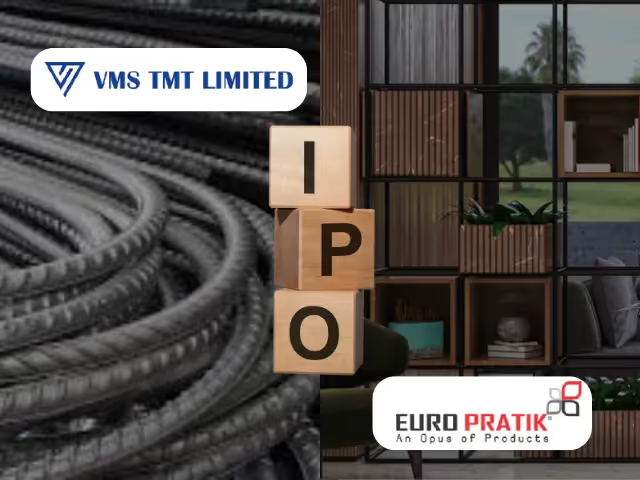
IPO Alert 2025: VMS TMT & Euro Pratik Sales – Should You Apply or Stay Away?
Quick Highlights
- Both IPOs are rated "Avoid" by leading analysts due to aggressive pricing and operational concerns.
- VMS TMT focuses on manufacturing TMT bars but shows declining revenue.
- Euro Pratik Sales operates in the decorative laminates sector with high competition.
- Despite strong FY25 projections, recent financial history raises red flags.
- Investors are advised caution and should evaluate IPOs via SEBI-registered platforms like Swastika Investmart.
Introduction: AI Meets Commodities in 2025
2025 has been buzzing with IPO activity, with investors eyeing opportunities across manufacturing, fintech, and consumer sectors. Two upcoming IPOs—VMS TMT Limited and Euro Pratik Sales Limited—have drawn attention from both retail and institutional investors.
But are these IPOs worth your money?
Let’s break it down, compare the fundamentals, and help you make an informed decision.
VMS TMT Limited: Strong Base, Weak Momentum
What Does VMS TMT Do?
VMS TMT Limited manufactures Thermo Mechanically Treated (TMT) bars, essential in construction. It also trades in binding wires and scrap metal, operating primarily in Gujarat.
IPO Details
- IPO Opens: September 17, 2025
- Price Band: ₹94–99
- Issue Size: ₹148.50 Cr (entirely fresh issue)
- Listing on: BSE SME
- Market Cap Post Listing: ₹491.35 Cr
Financial Snapshot
- FY23 Revenue: ₹477.44 Cr
- FY24 Revenue: ₹571.01 Cr
- FY25 EBITDA Margin: 6.50%
- FY25 PAT: ₹15.42 Cr
- ROCE: 12.79%
- EPS FY25: ₹4.45
- P/E (FY25): 22.24x
Analysis
Although the company has a reasonable ROCE and is reducing debt through IPO proceeds, the sharp decline in revenue in FY23, followed by a slight recovery, signals volatility. The valuation at over 22x P/E appears expensive for an SME with inconsistent growth and a regional market.
The TMT bar industry is highly price-sensitive, with raw material cost fluctuations significantly affecting margins.
Euro Pratik Sales Limited: Attractive Design, But Risky Execution
What Does Euro Pratik Do?
Euro Pratik Sales sells and markets decorative wall panels and laminates, operating as a B2B and B2C distributor. The firm specializes in design-oriented interiors, appealing to real estate and renovation sectors.
IPO Details
- IPO Opens: September 16, 2025
- Price Band: ₹235–247
- Issue Size: ₹451.31 Cr (offer for sale only)
- Listing on: BSE SME
- Market Cap Post Listing: ₹2534.24 Cr
Financial Snapshot
- FY23 Revenue: ₹259.71 Cr
- FY24 Revenue: ₹308.86 Cr
- FY25 PAT: ₹76.44 Cr
- ROCE: 44.58%
- EPS FY25: ₹6.91
- P/E (FY25): 33.02x
Analysis
While financial metrics for FY25 look stellar, the valuation of 33x P/E is aggressive. High margins (37.77% EBITDA) are impressive, but sustainability is questionable in a fragmented and low-entry-barrier industry.
The IPO is entirely an offer for sale, so no capital will flow into the company. It raises red flags for investors looking for growth and reinvestment.
Market Context: What Should Retail Investors Keep in Mind?
The IPO market in India has become increasingly valuation-driven, and many new listings post-2021 have seen initial spikes followed by price corrections.
In the case of VMS TMT and Euro Pratik Sales:
- Both are SME listings, meaning they are not on the main boards and hence carry higher liquidity risk.
- Valuations are not supported by historical performance.
- Market sentiment is already cautious due to global economic uncertainty and inflationary pressures.
Investors should prioritize IPOs with clear growth visibility, reasonable pricing, and capital utilization plans that benefit long-term operations.
Real-World Scenario
Consider an investor in Gujarat looking to diversify their portfolio with regional companies. While VMS TMT seems geographically aligned, its declining FY23 numbers and small customer base could hinder long-term growth. Meanwhile, Euro Pratik Sales, despite a premium product image, may struggle with pricing pressure from unorganized sector players.
How Can Swastika Investmart Help?
Swastika Investmart, a SEBI-registered brokerage firm, empowers investors with:
- Research-backed IPO insights
- Tech-enabled platforms for effortless IPO applications
- Dedicated customer support
- Investor education tools to guide first-time investors
Whether you’re applying for an SME IPO or exploring mutual funds, Swastika ensures you make informed, confident decisions.
👉 Open a Free Demat Account with Swastika Investmart
FAQs
Q1. Are SME IPOs riskier than main board IPOs?
Yes, SME IPOs tend to have lower liquidity and higher volatility. They often lack institutional backing, making due diligence essential.
Q2. Why are both VMS TMT and Euro Pratik rated ‘Avoid’?
Despite strong future projections, both companies have aggressive valuations and red flags in past performance or industry dynamics.
Q3. What should investors look for before applying to any IPO?
Check for revenue consistency, valuation vs. peers, capital utilization plans, and post-IPO promoter holding.
Q4. Is it safe to apply to IPOs through Swastika Investmart?
Absolutely. Swastika is a SEBI-registered broker offering a secure, tech-enabled, and transparent IPO application process.
Q5. Can I invest in these IPOs using UPI?
Yes, through Swastika’s platform, you can apply for IPOs using UPI directly linked to your bank account.
Final Verdict: Stay Cautious, Stay Informed
While IPOs like VMS TMT and Euro Pratik Sales may seem attractive at first glance, a deeper dive reveals valuation mismatches and execution risks. Retail investors should prioritize fundamentals over hype.
For those looking to participate in safer, well-researched IPOs or need help navigating complex markets, Swastika Investmart is your trusted partner.
.avif)
AI-Powered Intraday Trading – The Future of Day Trading in India
Quick Highlights
- Swastika Investmart combines AI Assistance with SEBI-compliant platforms for safe trading.
- AI enables better decision-making in intraday trading.
- Predictive analytics and algorithms reduce emotional bias and improve accuracy.
- Retail traders gain access to AI-driven insights and risk management tools.
Introduction: Why AI is Revolutionizing Intraday Trading
Intraday trading requires split-second decisions based on market movements. Traditional methods often struggle with volatility, sudden price swings, and high-stress decision-making.
Enter Artificial Intelligence (AI)—the game-changer for day traders in India. By analyzing massive amounts of historical and real-time data, AI algorithms can predict short-term price movements, optimize trades, and manage risk, giving traders an edge.
How AI Enhances Intraday Trading
Real-Time Market Analysis
AI systems process live stock prices, news, and global events simultaneously.
- Example: Detecting bullish patterns in Nifty or Bank Nifty within seconds.
Predictive Analytics & Price Forecasting
Machine learning models forecast support and resistance levels, volatility, and trend reversals.
- Traders can plan entries and exits with higher probability of success.
Automated Trade Execution
AI allows algorithmic trading and high-frequency execution, minimizing human error.
Risk Management & Stop-Loss Automation
Algorithms automatically adjust stop-loss levels and position sizes based on market volatility, ensuring disciplined trading.
Sentiment Analysis
AI uses NLP to interpret news, corporate announcements, and social media, providing actionable insights for intraday trades.
Benefits of AI in Intraday Trading
Real-World Applications in India
- Nifty & Bank Nifty Intraday: AI predicts micro-trends to guide day traders.
- Commodity Futures: Gold, crude, and silver trades benefit from AI-driven sentiment and trend analysis.
- Retail Participation: Platforms like Swastika Investmart enable retail traders to access AI insights without needing coding skills.
Why Choose Swastika Investmart?
- AI-Backed Assistance: Real-time market updates and predictions.
- SEBI Compliance: Ensuring safe and regulated trading.
- User-Friendly Platforms: Web and mobile apps for seamless intraday execution.
- Advisory Support: Combining human expertise with AI for better decision-making.
👉 Open Your AI-Powered Intraday Trading Account with Swastika
📲 Download the Swastika App – Android | iOS
FAQs
Q1. Can beginners use AI for intraday trading?
Yes, AI-powered platforms like Swastika simplify complex strategies for retail traders.
Q2. Is AI trading legal in India?
Yes, SEBI permits algorithmic and AI-driven trading under regulatory compliance.
Q3. Does AI guarantee profits in intraday trading?
No, AI improves decision-making probabilities but cannot eliminate market risks.
Q4. Which markets benefit most from AI intraday trading?
Liquid and volatile markets like Nifty, Bank Nifty, gold, crude oil, and select commodities.
Conclusion
AI is transforming intraday trading in India by offering real-time insights, predictive analytics, and disciplined execution. While it reduces emotional trading and improves efficiency, risk management remains crucial.
With Swastika Investmart’s AI-enabled, SEBI-compliant platforms, both beginners and experienced traders can leverage advanced technology to trade smarter and faster.
✅ Start AI-Powered Intraday Trading with Swastika
📲 Download the Swastika App – Android | iOS

How AI is Changing Commodity Trading in India
Quick Highlights
- AI is revolutionizing commodity trading with predictive models and automation.
- Algorithms process global data, news, and price trends faster than humans.
- Traders benefit from better risk management, reduced bias, and improved accuracy.
- Swastika Investmart supports investors with AI-driven assistance and SEBI-compliant platforms.
Introduction: AI Meets Commodities in 2025
Commodity trading has always been influenced by global supply-demand dynamics, geopolitical events, and currency movements. In 2025, Artificial Intelligence (AI) is emerging as a game-changer in the Indian commodity markets—be it gold, silver, crude oil, or agri-commodities.
From forecasting prices to executing trades in milliseconds, AI-driven systems are helping both retail and institutional traders make smarter, faster, and more informed decisions.
How AI is Transforming Commodity Trading
1. Predictive Price Forecasting
AI models use machine learning algorithms to study historical price trends, seasonal cycles, and macroeconomic indicators.
- Example: Predicting gold price rallies during inflationary cycles.
2. Sentiment & News Analysis
Natural Language Processing (NLP) helps AI scan thousands of global news articles, OPEC updates, and geopolitical events.
- Example: Detecting early bearish signals in crude oil when supply restrictions ease.
3. Real-Time Risk Management
AI systems calculate volatility levels, stop-loss triggers, and margin requirements in real-time.
- Example: Protecting traders during sudden commodity price swings caused by global conflicts.
4. Algorithmic & High-Frequency Trading (HFT)
AI enables automated execution of trades within milliseconds, capturing micro-movements in commodity futures.
5. Supply Chain & Weather Data Integration
For agri-commodities, AI integrates satellite weather data, crop yield forecasts, and logistics reports.
- Example: Predicting sugar or wheat futures prices after monsoon performance.
Benefits of AI in Commodity Trading
✅ Faster & more accurate price forecasts
✅ Data-driven risk management strategies
✅ Removal of emotional trading biases
✅ Ability to process global data at scale
✅ Democratization of advanced tools for retail traders
Challenges Ahead
⚠️ Overreliance on models can lead to risks in black swan events
⚠️ High infrastructure costs for HFT setups
⚠️ SEBI regulations require compliance in algo-trading
Commodity Trading in India – AI in Action
- Gold Futures: AI models anticipate moves during rupee-dollar volatility.
- Crude Oil: Algorithms track OPEC data, US shale production, and shipping flows.
- Agri-Commodities: AI predicts seasonal demand-supply shifts in crops like soybean and sugar.
These insights help both professional traders and beginners position themselves strategically.
Why Swastika Investmart?
While global hedge funds use expensive AI tools, Swastika Investmart empowers Indian investors with:
- Expert-Backed Research & Insights: Actionable calls in gold, silver, and crude oil.
- Smart Trading Platforms: Easy, seamless execution with advanced analytics.
- Trusted Assistance: Human expertise + AI-driven assistance.
- SEBI-Registered Safety: Ensuring compliance and investor protection.
✅ Start AI-Driven Commodity Trading with Swastika
📲 Download the Swastika App – Android | iOS
FAQs
Q1. Can AI predict commodity prices with 100% accuracy?
No, AI improves probabilities but markets remain influenced by global shocks.
Q2. Is AI-based commodity trading allowed in India?
Yes, SEBI permits algo-trading under regulatory frameworks, ensuring transparency.
Q3. Can beginners use AI in commodity trading?
Yes, through AI-powered research platforms provided by brokers like Swastika.
Q4. Which commodities benefit most from AI analysis?
Gold, crude oil, silver, and agricultural products due to their volatility and global impact.
Conclusion
AI is reshaping commodity trading in India, offering traders predictive insights, automation, and improved efficiency. While risks remain, AI-driven trading is creating opportunities for both seasoned investors and retail traders.
With Swastika Investmart’s AI-powered research and SEBI-compliant platforms, Indian traders can embrace the future of commodity trading with confidence and precision.

Infosys ₹18,000 Crore Buyback 2025: Key Details Every Investor Must Know
Quick Highlights
- Infosys approves a record ₹18,000 crore share buyback in 2025.
- The buyback size equals 2.41% of equity capital.
- 26 lakh retail investors stand to benefit.
- Part of Infosys’ capital allocation strategy to boost shareholder value.
- Investors must track eligibility dates and tendering process closely.
Introduction
Infosys, India’s second-largest IT services company, has once again made headlines with its ₹18,000 crore share buyback program in 2025. For over 26 lakh shareholders, this buyback isn’t just corporate news—it’s a direct opportunity to unlock value.
With India’s stock markets touching new highs in 2025, buybacks have become a powerful tool for companies to return wealth to shareholders, improve earnings per share (EPS), and boost investor sentiment. But what exactly does the Infosys buyback mean for you as an investor, and how should you approach it? Let’s break it down.
What is a Share Buyback?
A share buyback (also called share repurchase) is when a company repurchases its own shares from existing shareholders, usually at a price higher than the market value. This benefits investors by:
- Offering them a chance to book profits at a premium.
- Reducing the number of outstanding shares, thereby improving EPS and ROE.
- Reflecting management’s confidence in the company’s growth and financial health.
Infosys Buyback 2025: Key Highlights
- Buyback Size: ₹18,000 crore
- Equity Impact: 2.41% of Infosys’ total equity
- Shareholder Base: ~26 lakh investors eligible
- Strategic Context: Announced alongside a 10-year alliance with HanesBrands to accelerate AI-driven modernization in IT operations
This dual move signals Infosys’ intent to reward shareholders while investing in long-term digital transformation initiatives.
Why is Infosys Opting for a Buyback Now?
Infosys’ decision aligns with its capital allocation strategy, where surplus cash is returned to investors. Several factors support the timing:
- Robust Cash Reserves: Infosys continues to generate strong free cash flow, enabling large-scale buybacks without financial strain.
- Market Sentiment: Buybacks are often used to boost investor confidence, especially during periods of market volatility.
- AI and Tech Investment: While rewarding shareholders, Infosys also positions itself as a leader in AI-first platforms—a global trend shaping the IT services sector.
- Regulatory Alignment: Buybacks are governed by SEBI regulations, ensuring transparency, investor protection, and a fair tendering process.
How Can Shareholders Benefit?
If you hold Infosys shares, here’s what it could mean for you:
- Tendering Shares at a Premium: Buybacks are typically priced above market value, offering short-term gains.
- Long-Term Value Creation: With fewer shares in circulation, EPS and stock valuations may rise.
- Retail Quota Advantage: SEBI mandates a specific reservation for small investors (holding shares worth up to ₹2 lakh), improving participation chances.
Example: In Infosys’ previous 2022 buyback, shares were offered at a premium of ~20% to market price. Retail investors who tendered shares benefited significantly.
Market Impact: What Does This Signal?
- Positive Sentiment for IT Sector: Infosys’ move could inspire similar actions from other IT majors like TCS and Wipro.
- Institutional Interest: FIIs and DIIs often participate actively in such large buybacks, creating liquidity.
- Retail Focus: With 26 lakh shareholders, this buyback underscores the growing retail participation in India’s equity markets.
What Should Investors Keep in Mind?
- Check Record Date: Only shareholders as on the record date can participate.
- Evaluate Tax Implications: Gains may attract capital gains tax; consult a tax advisor.
- Don’t Rush: Tendering all shares isn’t always ideal—evaluate allocation ratios from past buybacks for guidance.
- Stay Informed: Track official updates via Infosys filings on NSE, BSE, and SEBI.
FAQs on Infosys Buyback 2025
1. What is the Infosys buyback size in 2025?
Infosys announced a ₹18,000 crore buyback, representing 2.41% of its equity.
2. Who can participate in the buyback?
All shareholders as on the record date, including retail investors (holding shares worth up to ₹2 lakh), can tender shares.
3. How is the buyback price decided?
Infosys typically announces a premium price above the current market rate, in line with SEBI guidelines.
4. What’s the benefit for long-term investors?
Beyond tendering gains, reduced equity capital may enhance EPS and support higher valuations over time.
5. Where can investors get updates?
Official updates are available on Infosys’ investor relations site, NSE, BSE, and SEBI circulars.
Conclusion
The Infosys ₹18,000 crore buyback of 2025 is more than a financial event—it’s a statement of confidence in the company’s future while rewarding investors today. For retail investors, this is a valuable opportunity, but it requires careful tracking of timelines, tendering windows, and market dynamics.
At Swastika Investmart, we help investors make informed decisions with SEBI-registered research, advanced trading tools, dedicated customer support, and investor education initiatives. Whether you’re planning to participate in this buyback or looking to build a long-term portfolio, our expert team is here to guide you.
👉 Open a Demat & Trading Account with Swastika Investmart and take smarter steps in your investment journey.

Unlisted Gems: How India’s Private Market is Creating the Next Wave of Billion-Dollar Companies
Unlisted Gems: How India’s Private Market is Creating the Next Wave of Billion-Dollar Companies
Quick Highlights
- India’s unlisted space is buzzing with high-growth companies preparing for IPOs.
- Sectors like fintech, retail, and renewable energy are driving investor interest.
- Unlisted shares offer early access but come with liquidity and regulatory risks.
- Strong research, SEBI-registered advisors, and tech tools make investing smarter.
- Swastika Investmart empowers investors with expert insights and safe investing platforms.
India’s Unlisted Market: The Quiet Revolution
When most investors think about wealth creation, they picture stock exchanges like NSE or BSE. But some of India’s most exciting stories are unfolding outside the listed markets. Companies like Reliance Retail, HDB Financial Services (HDFC Bank’s arm), and Ola Electric are making headlines long before their IPOs.
This growing market of unlisted shares has caught the eye of high-net-worth individuals, family offices, and savvy retail investors. The appeal is simple: early access to potential unicorns and future multibaggers.
Why Are Unlisted Companies in Demand?
Early-Stage Growth Opportunities
Investors can buy into businesses before they go public, often at valuations that may look attractive compared to post-IPO prices. For example, Ola Electric was trading actively in the unlisted space before announcing its IPO roadmap.
Sectoral Tailwinds
- Fintech: HDB Financial and One97 (Paytm, pre-IPO days) showed how fintech reshapes banking.
- Retail: Reliance Retail continues to expand aggressively, attracting private market interest.
- Energy Transition: Companies in renewable energy and EV sectors are getting strong traction.
Limited Public Access
Since these shares aren’t listed on exchanges, only informed and well-connected investors get access. That exclusivity adds to the demand.
Risks Investors Should Not Ignore
While the rewards can be high, unlisted shares carry risks:
- Liquidity Constraints: Unlike listed stocks, selling unlisted shares is not easy.
- Valuation Uncertainty: Prices are based on private transactions, making fair valuation tricky.
- Regulatory Oversight: SEBI governs unlisted space, but disclosures are not as transparent as listed companies.
This makes research and guidance critical before making any move.
Real-World Examples from India
- Reliance Retail – With a valuation crossing $100 billion in private markets, it’s among the most valuable unlisted entities globally.
- OYO Rooms – Despite delays in its IPO, OYO has remained one of the most traded unlisted shares.
- HDB Financial Services – Expected to list in the coming years, it is already considered a “blue-chip” in the unlisted space.
These examples highlight how the private market is building the billion-dollar companies of tomorrow.
The Impact on Indian Capital Markets
Unlisted activity is reshaping investor strategies:
- Pre-IPO Participation: Investors seek allocations before companies list to benefit from potential IPO premiums.
- Diversification: Portfolio managers use unlisted shares to diversify away from traditional equities.
- Market Depth: A growing private market shows the maturity of India’s financial ecosystem, aligning with SEBI’s efforts to deepen capital markets.
How Investors Can Participate Safely
For retail investors, entering the unlisted space requires trusted partners who provide:
- SEBI-registered advisory services for compliance and credibility.
- Research-based recommendations instead of speculation.
- Transparent pricing and execution through tech-enabled platforms.
This is where Swastika Investmart Pvt. Ltd. stands out. With its SEBI registration, robust research desk, investor education initiatives, and customer-first approach, Swastika ensures that investors don’t just access opportunities but also understand the risks.
👉 Open your account with Swastika Investmart and explore a smarter way to invest in both listed and unlisted opportunities.
FAQs
1. What are unlisted shares?
Unlisted shares are equity shares of companies not listed on stock exchanges like NSE or BSE. They trade in the private market.
2. How can investors buy unlisted shares in India?
Through SEBI-registered brokers and research firms like Swastika Investmart, which ensure compliance and transparency.
3. Are unlisted shares riskier than listed ones?
Yes, mainly due to liquidity issues, limited disclosures, and valuation uncertainty. However, they can deliver strong returns if chosen wisely.
4. Do all unlisted companies eventually go for an IPO?
Not necessarily. Some remain private, while others may take years before listing.
5. What is the minimum investment required?
It varies by company and broker, but typically starts from a few thousand to a few lakhs, depending on the share price and lot size.
Conclusion
The Indian private market is quietly minting the next set of billion-dollar companies. For investors, this is both an opportunity and a challenge—early access to growth stories, but with risks that demand careful evaluation.
With the right partner like Swastika Investmart, investors get access to trusted research, compliance-driven execution, and strong customer support, making the journey into unlisted shares more secure and rewarding.
👉 Open your account today with Swastika Investmart and take the first step towards discovering India’s next unlisted gems.

.avif)
.avif)
.avif)




START YOUR INVESTMENT JOURNEY
Get personalized advice from our experts
- Dedicated RM Support
- Smooth and Fast Trading App