

The Power of Compounding – Why Starting Early Matters




Introduction
Albert Einstein reportedly called compound interest the "eighth wonder of the world." Whether or not he actually said it, the math is undeniable. Compounding is the process where your investment returns begin earning their own returns — and over time, this snowball effect becomes truly extraordinary.
The catch? Compounding needs one essential ingredient: time.

The more years you give your money to grow, the more dramatic — and life-changing — the results become. This is exactly why starting your investment journey early, even with a modest amount, can make a difference of crores by the time you retire.
A Tale of Two Investors: Arjun vs Priya
Let's bring this concept to life with a simple, real-world example.
Meet Arjun and Priya. Both are sensible, disciplined investors. Both invest ₹5,000 every month through a SIP (Systematic Investment Plan) in equity mutual funds, earning an average annual return of 12%. Both stop investing at age 60.
The only difference? Arjun starts at 25. Priya starts at 35.

The numbers are striking. Arjun invests just ₹6 lakh more than Priya in absolute terms — yet walks away with ₹2.1 Crore more at retirement.
That extra ₹2.1 Crore didn't come from investing more aggressively or taking bigger risks. It came purely from starting 10 years earlier.
Why Does Time Make Such a Huge Difference?
This is where the magic of compounding reveals itself.
In the early years of investing, growth looks modest and almost unimpressive. But as the years pass, your corpus grows not just on your original investment, but on all the accumulated returns from previous years. The curve goes from almost flat to steeply exponential — and that steep climb happens in the later years.
When Arjun starts at 25, his money has 35 years to ride that exponential curve. Priya's money, starting at 35, only catches the last 25 years — and critically, it misses the steepest part of the climb in the final decade.
Think of it this way: the last 10 years of compounding are worth more than the first 20. That is the counterintuitive truth at the heart of long-term investing.
The Real Cost of Waiting
Many young earners tell themselves, "I'll start investing once I'm more settled — once the salary improves, once the EMI is paid off, once life is a bit easier."
But the numbers show that every year of delay is extraordinarily expensive — far more expensive than any EMI or lifestyle expense. Priya didn't invest carelessly. She invested faithfully for 25 years. Yet she ends up with less than half of what Arjun accumulated — not because she did anything wrong, but simply because she started a decade late.
The cost of waiting 10 years wasn't ₹6 lakh in additional contributions. The cost was ₹2.1 Crore in lost wealth.
Three Principles to Remember
1. Start now, not later.The best time to start investing was yesterday. The second best time is today. Even a SIP of ₹1,000–₹2,000 per month in your 20s is infinitely better than waiting for the "right time."
2. Consistency beats intensity.You don't need to invest large sums all at once. A small, steady, monthly commitment — maintained without interruption — is what unlocks the full power of compounding over decades.
3. Stay invested through market cycles.Compounding works only if you let it work. Exiting during market corrections or stopping your SIP in tough months breaks the chain. Time in the market, not timing the market, is what builds wealth.
The Bottom Line
If you are in your 20s or early 30s, you hold an asset that no amount of money can buy later: time. Use it. Start a SIP today — even a small one. Let compounding do its slow, steady, powerful work.
Because the difference between starting at 25 and starting at 35 is not just 10 years. As Arjun and Priya's story shows, that difference is ₹2.1 Crore.
Big Budget











.webp)
.webp)
.webp)
.webp)
.webp)
















.webp)
.webp)
.webp)
.webp)
Latest Articles

How to Start Investing in Stock Market in 2024


Whether you’re new to the investing world or have some experience under your belt, understanding the stock market can be a difficult task. With so many options, strategies, and risks involved, it’s important to have a clear understanding of how to invest wisely. In this blog post, we’ll break down the basics of investing in the Indian stock market for beginners, providing you with the knowledge and tools you need to get started.
Understanding the Stock Market
Before diving into stock investing, it’s important to understand what the stock market is and how it works. Simply put, the stock market is a place where you can buy and sell shares of publicly traded companies. It plays a vital role in the global economy by allowing companies to raise capital and enabling investors to own a piece of these companies and potentially profit from their success.
In India, the major stock exchanges facilitating these transactions are the Bombay Stock Exchange (BSE) and the National Stock Exchange (NSE). These exchanges provide a platform for trading shares, making it easier for investors to participate and for companies to secure funding.
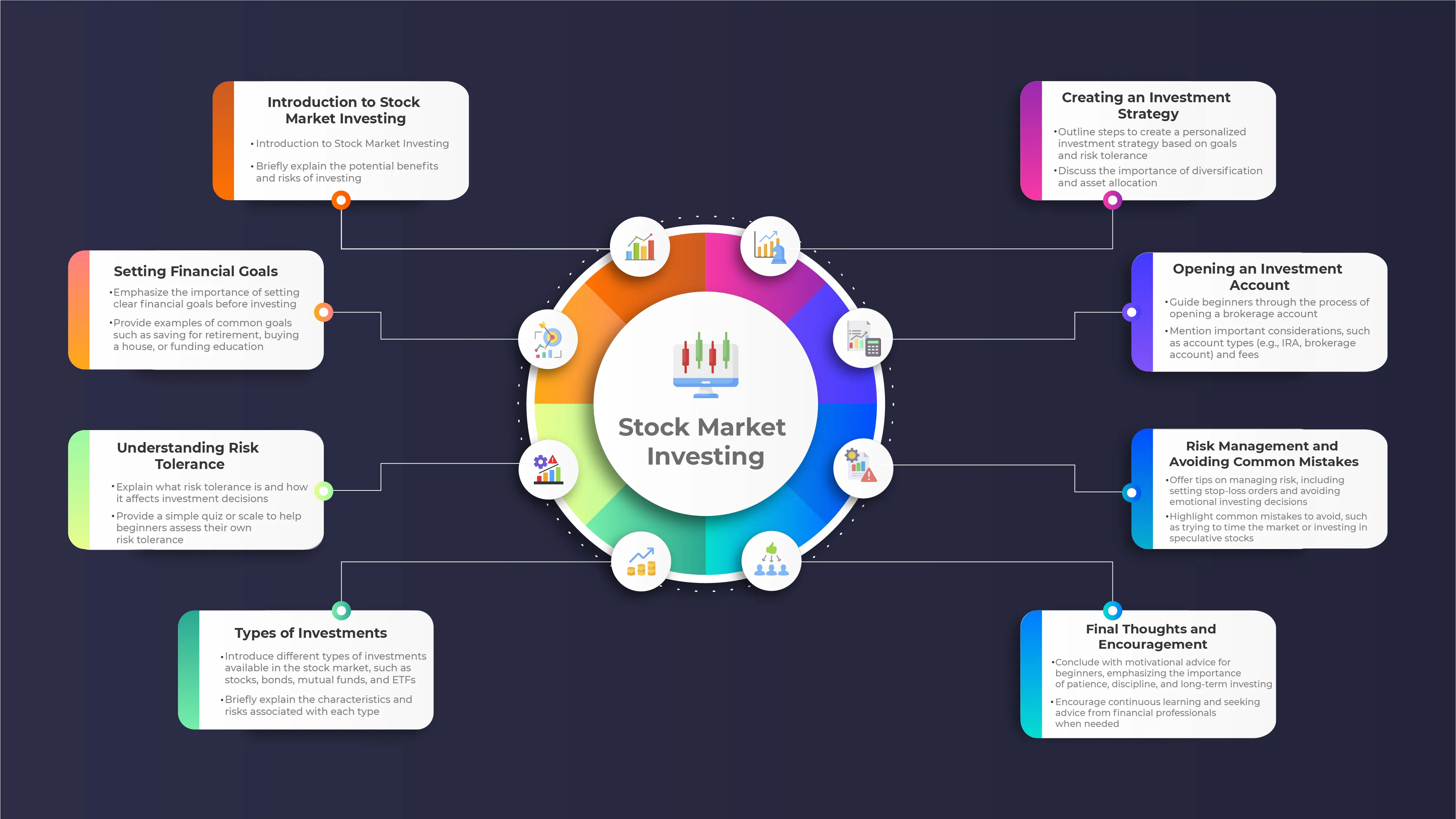
Why Invest in Stocks?
Step 1. Set Your Investment Goals
Before you start investing, it’s important to define your investment goals. Are you looking to build long-term wealth, save for retirement, or generate passive income? By setting clear goals, you can develop a strategy that aligns with your objectives and risk tolerance.
Step 2.Determine How Much You Can Afford to Invest in Stocks
Before you start investing in stocks, it's important to figure out how much money you can comfortably set aside. First, look at your monthly income and expenses to see how much you have left over. Then, decide on an amount that won’t affect your day-to-day finances or other financial goals. Only invest money you won't need soon, as the market can be unpredictable. This careful planning helps you invest without risking your financial stability.
Step 3. Determine Your Investing Style
Your investing style shapes how you approach the market. Consider your preference: do you enjoy researching stocks and market trends, or do you prefer a more hands-off strategy?
There are three main investing styles:
- Active Investing: You actively manage your portfolio, choosing and trading stocks, bonds, and other assets using advanced brokerage tools. Pros include potential for higher returns and full control, but it's time-consuming and requires extensive research.
- Passive Investing: You invest in index funds, ETFs, or mutual funds through low-cost brokerage accounts. Pros include less time commitment, lower fees, and diversification, though potential returns may be lower compared to active trading.
- Professional Guidance: Working with a financial advisor offers personalized advice and expert management of your investments. Pros include tailored guidance, but cons include advisory fees and less direct control over investment decisions. Choose the style that best fits your goals and comfort level with risk and involvement.
Step 4: Choose the Right Investment Accounts
Selecting the right type of investment account is crucial for maximizing your returns and achieving your financial goals.
Types of Investment Accounts
- Demat Account: A Demat account holds your shares electronically instead of physical certificates. It's necessary for trading in the Indian stock market, providing convenience and security. However, there may be maintenance charges associated with maintaining this account.
- Trading Account: A trading account is used specifically for buying and selling securities in the stock market. It's essential for executing trades and managing your investments effectively. However, brokerage charges may apply for each transaction made through this account.
These accounts serve different purposes and cater to varying financial goals. Choosing the right one depends on your investment horizon, risk tolerance, and financial objectives.
5: Choose Your Investments
- Stocks: Stocks are pieces of ownership in individual companies. They can give you high returns, but they come with higher risk and you need to do your homework to choose wisely.
- Bonds: Bonds are like loans you give to companies or the government. They are safer than stocks and give you steady income, but the returns are usually lower.
- Mutual Funds: Mutual funds collect money from many people to invest in a variety of stocks and bonds. They spread out the risk and are managed by professionals, making them easier for beginners. However, you have to pay management fees and have less say in what gets bought or sold.
- Exchange-Traded Funds (ETFs): ETFs are funds that you can buy and sell on the stock exchange, just like stocks. They offer a mix of investments, usually at lower fees. However, they can have trading costs and can be a bit tricky to understand at first.
6: Tax Implications on Different Account Types
Consider the Tax Implications: Different accounts have different tax rules:
- Taxable Accounts: You pay taxes on any profits you make from selling investments, but you can add or take out money whenever you want.
- Tax-Deferred Accounts: Contributions to traditional IRAs and 401(k) s lower your taxable income now. You pay taxes on the money later when you take it out.
- Tax-Free Accounts: Roth IRAs and Roth 401(k) s are funded with money you've already paid taxes on. Your money grows tax-free, and you won't owe taxes when you take it out in retirement.
Choosing the right investment account depends on your financial goals, how much risk you're comfortable with, and the tax implications you prefer. Each account type has its own benefits and considerations that can impact your investment strategy and long-term financial plans.
Open a Brokerage Account
To begin investing, opening a brokerage account is essential. A brokerage account allows you to buy and sell stocks, bonds, ETFs, and mutual funds through a platform provided by the brokerage firm.
Swastika Investmart offers a range of investment options and personalized services, making it suitable for investors seeking customized solutions and local market expertise. However, its platform may be perceived as less technologically advanced compared to other brokerages listed. Choosing the right brokerage account depends on your specific needs and preferences, whether you prioritize low fees, advanced tools, or specialized customer support.
7: Build a Diversified Portfolio
Diversification helps manage risk by spreading investments across various asset classes.
How to Diversify
- By Asset Class:
- Stocks: Invest in a mix of different sectors and industries.
- Bonds: Include a variety of corporate, government, and municipal bonds.
- Other Assets: Consider real estate, commodities, and alternative investments.
- By Geography:
- Domestic: Invest in companies within your own country.
- International: Include investments in foreign market.
8: Monitor and Rebalance Your Portfolio
Regularly monitoring and rebalancing your portfolio ensures it stays aligned with your goals.
- Monitoring Your Portfolio
- Performance Review: Check the performance of your investments periodically.
- News and Updates: Stay informed about market trends and news affecting your investments.
- Rebalancing
- Frequency: Review and rebalance your portfolio annually or semi-annually.
- Adjustments: Sell over performing assets and buy underperforming ones to maintain your target allocation.
9. Stay Updated &Educate Yourself
One of the most important steps in investing is educating yourself about the basics of investing, different investment options, and the risks involved. There are plenty of resources available online, such as blogs, books, and investment websites like Investopedia, where you can learn more about investing.
Finally, it’s important to stay informed about the stock market and economic trends that may impact your investments. Read financial news, follow market updates, and stay up-to-date on company earnings reports to make informed investment decisions. By staying informed, you can make smarter investment choices and take advantage of profitable opportunities.
Conclusion
Starting to invest in stocks in 2024 requires a clear understanding of the basics, a determination of how much you can afford to invest, an assessment of your risk tolerance, and a defined investing style. By choosing the right investment accounts, selecting diversified investments, and continuously educating yourself, you can build a robust investment portfolio that helps you achieve your financial goals. Remember to regularly monitor and rebalance your portfolio to ensure it stays aligned with your objectives.
.webp)
Difference Between FDI and FII
Introduction
In the world of finance and investment, you might come across terms like Foreign Direct Investment (FDI) and Foreign Institutional Investment (FII). Both are crucial for a country's economy, but they serve different purposes and have distinct characteristics. In this blog, we’ll break down what FDI and FII are, their differences, and their impact on the economy.
What is Foreign Direct Investment (FDI)?
Foreign Direct Investment (FDI) refers to investments made by a company or individual in one country in business interests in another country, in the form of either establishing business operations or acquiring business assets in the foreign country.
Key Features of FDI:
- Long-Term Investment: FDI usually involves a long-term commitment to the foreign market. It is often used to set up manufacturing plants, sales offices, or other business operations.
- Control and Management: The investor often has a significant degree of control over the operations in the foreign country.
- Examples: Multinational companies like Tata Motors setting up manufacturing units in other countries or Samsung investing in a new production facility abroad.
What is Foreign Institutional Investment (FII)?
Foreign Institutional Investment (FII) refers to investments made by foreign institutions in the financial markets of a country. These institutions could be mutual funds, pension funds, insurance companies, or other large investment firms.
Key Features of FII:
- Short-Term Investment: FIIs typically make short-term investments in a country’s stock market or other financial markets. They are more focused on achieving high returns on their investments in a shorter time frame.
- No Control: FIIs do not have any management control or significant influence over the companies they invest in. They invest in securities but do not participate in the day-to-day management.
- Examples: Foreign investment in Indian stock markets by entities like Goldman Sachs or Morgan Stanley.
Differences Between FDI and FII
Impact on the Economy
- FDI Impact: FDI can lead to economic growth, job creation, and infrastructure development. For instance, when companies like Volkswagen invest in manufacturing units in India, it boosts local employment and contributes to technological advancements.
- FII Impact: While FIIs contribute to market liquidity and help in the efficient functioning of financial markets, they can also lead to market volatility due to their short-term investment nature. For example, large-scale sell-offs by FIIs can lead to sharp declines in stock market indices.
Conclusion
Both FDI and FII play important roles in the global economy. FDI provides long-term benefits and fosters economic development, while FII adds liquidity to financial markets and can influence market dynamics. Understanding the differences between them helps in grasping how foreign investments impact economic growth and market stability.

What is PE Ratio? Understanding the Price-to-Earnings Ratio
The Price-to-Earnings (PE) ratio is one of the most widely used metrics in the world of investing. It helps investors evaluate whether a stock is overvalued, undervalued, or fairly priced. In this detailed blog, we will explore what the PE ratio is, how it is calculated, its significance, types, and limitations, and provide some practical examples to help you understand this fundamental concept better.
What is PE Ratio?
The PE ratio, or Price-to-Earnings ratio, is a valuation metric that compares a company's current share price to its per-share earnings. It essentially tells investors how much they are paying for each dollar of earnings.
Formula:
PE Ratio = Market Price per Share Earning per Share (EPS)
Example:
If a company's stock is trading at ₹100 and its Earnings per Share (EPS) is ₹10, the PE ratio would be:
PE Ratio = ₹1oo₹1o = 10
This means investors are willing to pay ₹10 for every ₹1 of earnings.
Why is the PE Ratio Important?
The PE ratio is important because it provides a quick snapshot of a company's valuation relative to its earnings. Here are a few reasons why it matters:
- Valuation Measure: It helps determine if a stock is overvalued, undervalued, or fairly valued compared to its earnings.
- Comparative Tool: Investors can use the PE ratio to compare the valuation of companies within the same industry or sector.
- Investment Decisions: It assists investors in making informed decisions by indicating the market's expectations of a company's future earnings growth.
Types of PE Ratios
There are two main types of PE ratios: the trailing PE ratio and the forward PE ratio.
- Trailing PE Ratio: This is calculated using the earnings per share (EPS) from the past 12 months. It provides a historical perspective on the company's performance.
- Forward PE Ratio: This uses projected earnings for the next 12 months. It gives an insight into what investors expect the company's earnings will be in the future.
Example:
If a company's stock is trading at ₹150, its trailing 12-month EPS is ₹15, and its projected EPS for the next 12 months is ₹20:
Trailing PE Ratio: ₹15o₹15 = 10
Forward PE Ratio: ₹15o₹20 = 7.5
How to Interpret the PE Ratio?
Interpreting the PE ratio involves understanding what a high or low PE ratio signifies:
High PE Ratio:
- Indicates that investors are ready to pay more expecting higher growth in the future.
- Can also suggest that the stock is overvalued.
- Common in high-growth industries like technology.
Low PE Ratio:
- Suggests that the stock might be undervalued.
- Could also indicate that the company is experiencing difficulties or is in a low-growth industry.
- Often found in mature industries like utilities.
Limitations of the PE Ratio
While the PE ratio is a useful tool, it has its limitations:
- Earnings Manipulation: Companies can manipulate earnings through accounting practices, affecting the reliability of the PE ratio.
- Industry Differences: The PE ratio varies across industries, making it less effective for comparing companies in different sectors.
- Growth Rates: It does not account for differences in growth rates between companies.
- Debt Levels: Companies with high debt levels may have artificially inflated or deflated PE ratios.
Example:
A high-growth tech company and a stable utility company will naturally have different PE ratios due to their differing growth prospects and risk profiles. Comparing them directly using PE ratios might lead to incorrect conclusions.
Practical Examples
Let's look at some practical examples to understand how to use the PE ratio:
- Comparing Two Companies in the Same Industry
- Company X: Current stock price is ₹200, EPS is ₹20, PE ratio is 10.
- Company Y: Current stock price is ₹150, EPS is ₹15, PE ratio is 10.
Both companies have the same PE ratio of 10, indicating they are valued similarly based on their earnings. Investors might look at other factors like growth prospects, management quality, and market conditions to make investment decisions.
- Identifying Overvaluation or Undervaluation
- Company A: PE ratio is 30.
- Industry Average PE Ratio: 15.
Company A's PE ratio is significantly higher than the industry average, suggesting it might be overvalued unless it has substantial growth prospects to justify the higher valuation.
- Evaluating Growth Prospects
- Company B: Trailing PE ratio is 8, Forward PE ratio is 5.
Company B's forward PE ratio is lower than its trailing PE ratio, indicating that investors expect higher earnings in the future, possibly making it an attractive investment opportunity.
PE Ratio and Market Sentiment
The PE ratio can also reflect market sentiment:
- Bull Markets: PE ratios tend to be higher as investor optimism drives up stock prices.
- Bear Markets: PE ratios tend to be lower as investor pessimism leads to lower stock prices.
Example:
During a bull market, investors might accept higher PE ratios because they expect continued growth and higher future earnings. Conversely, in a bear market, even strong companies might have lower PE ratios due to widespread negative sentiment.
Conclusion
The PE ratio is a vital tool for investors to assess the valuation of a company relative to its earnings. By understanding the PE ratio, its types, and how to interpret it, investors can make savvy decisions. However, it's essential to consider the limitations of the PE ratio and use it in conjunction with other financial metrics and qualitative factors for a comprehensive analysis.
Remember, the PE ratio is just one piece of the puzzle. To make well-rounded investment decisions, it's crucial to look at the bigger picture, including a company's growth prospects, industry trends, and overall market conditions. Staying informed and using a variety of tools will help you navigate the complex world of investing more effectively.

What is Right Issue of Shares? Meaning, Examples, Features
The right issue of shares is a common method used by companies to raise additional capital. This strategy offers existing shareholders the opportunity to purchase additional shares at a discounted price before the company offers them to the general public. In this blog, we'll explore the meaning of the right issue of shares, provide examples, and outline its key features in simple language to help you understand this important financial concept.
What is a Right Issue of Shares?
A right issue of shares is a way for companies to raise additional capital by offering existing shareholders the right to buy more shares at a discounted price. This method is often used when companies need to fund new projects, pay off debt, or improve their balance sheets.
Key Points:
- Rights: Existing shareholders are given the right (but not the obligation) to buy additional shares.
- Discount: These shares are offered at a price lower than the current market price.
- Proportionate: The number of new shares that a shareholder can buy is usually proportionate to their existing holdings.
Example: If you own 100 shares of a company and the company announces a 1:2 right issue, you have the right to buy 50 additional shares (1 new share for every 2 existing shares you own) at a discounted price.
Why Do Companies Opt for a Right Issue?
Companies choose to go for a right issue for various reasons:
- Raising Capital: The primary reason is to raise capital for expansion, new projects, or acquisitions.
- Debt Reduction: Companies might use the proceeds from a right issue to pay off existing debt.
- Strengthening Balance Sheets: Improving the company’s financial health by increasing equity.
- Avoiding Loans: A right issue is an alternative to taking loans, thus avoiding interest payments and increasing debt burden.
How Does a Right Issue Work?
Here’s a step-by-step breakdown of how a right issue typically works:
- Announcement: The company announces the right issue, detailing the number of shares to be issued, the price, and the ratio (e.g., 1:2, 1:3).
- Record Date: A record date is set to determine which shareholders are eligible to receive the rights.
- Offer Period: Shareholders are given a specific period during which they can exercise their rights to buy the new shares at the discounted price.
- Trading of Rights: Sometimes, the rights themselves can be traded on the stock exchange. Shareholders who do not wish to buy more shares can sell their rights to other investors.
- Subscription: Eligible shareholders subscribe to the new shares by paying the required amount.
- Issuance: The new shares are issued to the shareholders who exercised their rights.
Features of a Right Issue
Several features define a right issue of shares:
- Discounted Price: Shares are offered at a price lower than the current market price.
- Proportionate Allocation: The number of shares offered is proportionate to the shareholder's existing holdings.
- No Obligation: Shareholders are not obligated to buy the new shares; they can choose to let their rights lapse or sell them.
- Capital Structure Impact: A right issue increases the company's share capital and can dilute the ownership percentage of existing shareholders who do not participate.
- Market Reaction: The announcement of a right issue can impact the company’s stock price, often leading to a temporary decline due to the anticipated dilution.
Examples of Right Issue
Tata Motors
In 2020, Tata Motors announced a right issue to raise capital to strengthen its balance sheet. The company offered its shareholders the right to buy 1 new share for every 6 existing shares they held at a discounted price. This allowed Tata Motors to raise the necessary funds without taking on additional debt.
Reliance Industries
Reliance Industries announced one of the largest right issues in India in 2020. The company offered its shareholders the right to buy 1 new share for every 15 existing shares at a discounted price. This move helped Reliance Industries raise substantial capital to reduce its debt and invest in new ventures.
Advantages of Right Issue
- Cost-Effective: Raising capital through a right issue is generally more cost-effective compared to other methods like public offerings.
- Loyalty Reward: It rewards existing shareholders by giving them the opportunity to buy additional shares at a discount.
- Debt-Free Capital: Helps the company raise capital without increasing its debt burden.
- Positive Signal: It can signal the company’s confidence in its future prospects, as it relies on existing shareholders for funding.
Disadvantages of Right Issue
- Dilution of Ownership: Shareholders who do not participate in the right issue may see their ownership percentage diluted.
- Market Perception: Sometimes, a right issue may be perceived as a sign of financial distress, leading to a negative impact on the company’s stock price.
- Temporary Price Drop: The stock price often drops temporarily after a right issue announcement due to the anticipated dilution.
Impact on Shareholders
For Participating Shareholders:
Benefit: They can buy additional shares at a discount, potentially increasing their total investment value if the stock price rises.
Maintaining Ownership: By exercising their rights, they can maintain their ownership percentage in the company.
For Non-Participating Shareholders:
- Dilution: Their ownership percentage may decrease, which can dilute their voting power and future dividends.
- Opportunity Cost: They miss out on the opportunity to buy shares at a discounted price.
Conclusion
A right issue of shares is an effective way for companies to raise additional capital by offering existing shareholders the opportunity to purchase more shares at a discounted price. It can be beneficial for both the company and participating shareholders. However, it also has potential downsides, such as dilution of ownership for those who do not participate. Understanding the mechanics and implications of a right issue can help investors make decisions easily and take advantage of the opportunities it presents.
Whether you're a seasoned investor or just starting, being aware of corporate actions like the right issue is essential for making informed investment choices. As always, it's important to stay updated and consider both the potential benefits and risks associated with such financial strategies.
Learn more about financial terminologies with Swastika!

What is Short Covering? Meaning & Examples in the Indian Stock Market
Short covering is a crucial concept in the world of trading and investing, especially in the stock market. Whether you are a beginner or an experienced trader, understanding short covering can help you make more smart decisions. In this blog, we'll delve into the meaning of short covering, why traders engage in it, its effects on the market, and provide some clear examples to illustrate the concept. Let’s break it down into simple language and cover it comprehensively.
Understanding Short Selling
Before diving into short covering, it’s essential to understand short selling:
Short Selling: This is a strategy where a trader borrows shares of a stock and sells them on the market, with the intention of buying them back later at a lower price. The aim is to profit from a decline in the stock’s price.
Example: Suppose a trader believes that the stock of Reliance Industries, currently priced at ₹2,000, will drop to ₹1,800. The trader borrows 100 shares and sells them at ₹2,000 each, making ₹2,00,000. If the stock price falls to ₹1,800, the trader buys back the 100 shares for ₹1,80,000, returns the borrowed shares, and pockets the ₹20,000 difference.
What is Short Covering?
Short Covering: This occurs when traders who have sold stocks short decide to buy them back. This buying back is done to close their short positions. Essentially, it’s the act of purchasing shares to return the borrowed ones, thus closing the short trade.
Why Do Traders Cover Their Shorts?
There are several reasons why traders might decide to cover their shorts:
- To Lock in Profits: If the stock price has fallen as expected, traders will cover their shorts to realize their gains. This means they are buying back the shares at a lower price than they sold them for.
- To Cut Losses: If the stock price starts to rise instead of fall, traders may cover their shorts to prevent further losses. Unlike a standard stock purchase where the loss is limited to the amount invested, the potential loss in short selling is theoretically unlimited because there is no cap on how high the stock price can go.
- Changing Market Conditions: New information or changes in market sentiment can lead to short covering. For example, if a company reports unexpectedly strong earnings, the stock price may rise, prompting short sellers to cover their positions to avoid larger losses.
- Short Squeeze: Sometimes, a large number of short sellers may all try to cover their positions simultaneously, causing the stock price to spike even higher. This scenario is known as a short squeeze, and it can create a feedback loop where rising prices force more short sellers to cover, further driving up the price.
How Does Short Covering Affect the Market?
Short covering can have a significant impact on the market, particularly in stocks that are heavily shorted. Here’s how it works:
- Price Increase: When short sellers buy back shares to cover their positions, it increases demand for the stock, which can drive the price higher.
- Volatility: Short covering can add to market volatility, especially during a short squeeze. Rapid price increases can create panic buying among other traders, further escalating the stock price.
- Market Sentiment: The need for short covering can sometimes signal a shift in market sentiment. For example, if many traders are covering shorts because a stock is no longer expected to fall, it might indicate a more bullish outlook for that stock.
Examples of Short Covering in the Indian Stock Market
Example 1: Profitable Short Covering
A trader shorts 100 shares of Tata Motors at ₹500 per share, expecting the price to fall.
The stock price drops to ₹400 per share.
The trader decides to cover their short position by buying back the 100 shares at ₹400 each.
The trader sells at ₹500 and buys back at ₹400, making a profit of ₹100 per share, or ₹10,000 total.
Example 2: Short Covering to Cut Losses
A trader shorts 100 shares of Infosys at ₹1,000 per share, expecting the price to fall.
Contrary to expectations, the stock price rises to ₹1,200 per share.
To prevent further losses, the trader decides to cover their short position by buying back the 100 shares at ₹1,200 each.
The trader sells at ₹1,000 and buys back at ₹1,200, resulting in a loss of ₹200 per share, or ₹20,000 total.
Example 3: Short Squeeze Scenario
Positive news about the company, such as a major investment, causes the stock price to rise rapidly.
Short sellers scramble to cover their positions to avoid larger losses, creating a surge in buying activity.
This buying pressure pushes the stock price even higher, exacerbating the situation for other short sellers and creating a feedback loop.
Conclusion
Short covering is an essential concept in trading that can significantly impact stock prices and market dynamics. It involves buying back previously shorted shares to close a short position, either to lock in profits or to cut losses. Understanding short covering and its implications can help traders make decisions and better navigate the complexities of the stock market. In the Indian stock market, where volatility can be high, being aware of strategies like short selling and short covering is crucial for successful trading.
Whether you're a beginner or an experienced trader, understanding short covering can empower you to respond effectively to market movements and protect your investments. As always, staying informed and applying disciplined trading principles are key to navigating the dynamic world of stock trading.

Top 12 Books on Investment, Trading, and the Stock Market
Investing and trading in the stock market can be daunting, especially for beginners. Fortunately, numerous books written by experts offer valuable insights and guidance. Here, we present the top 12 books on investment, trading, and the stock market that cater to both novice and experienced investors. These books cover various strategies, principles, and real-life experiences that can help you make educated decisions and build wealth.
1. "The Intelligent Investor" by Benjamin Graham
Often recognized as the bible of investing, this classic book emphasizes the importance of value investing and the concept of "margin of safety." Benjamin Graham's timeless principles are essential for anyone looking to build a solid foundation in investing.
Key Takeaways:
Focus on long-term value rather than short-term gains.
Protect yourself from significant losses by investing with a margin of safety.
2. "A Random Walk Down Wall Street" by Burton G. Malkiel
Burton Malkiel argues that stock prices are unpredictable and that trying to time the market is useless. He advocates for a diversified portfolio and explains various investment strategies.
Key Takeaways:
Embrace the unpredictability of the market.
Diversify your investments to minimize risk.
3. "One Up On Wall Street" by Peter Lynch
Peter Lynch shares his investment philosophy of finding undervalued companies with growth potential. He emphasizes the importance of doing thorough research and understanding the companies you invest in.
Key Takeaways:
Invest in what you know and understand.
Look for companies with growth potential that the market has overlooked.
4. "The Little Book of Common Sense Investing" by John C. Bogle
John Bogle, the founder of Vanguard Group, advocates for low-cost index fund investing. This book is perfect for beginners looking to understand the benefits of passive investing.
Key Takeaways:
Index funds offer a low-cost way to achieve market returns.
Keep investment costs low to maximize your returns.
5. "Market Wizards" by Jack D. Schwager
Jack Schwager interviews some of the most successful traders and investors, uncovering their strategies, mindsets, and experiences. This book offers valuable insights into the world of professional trading.
Key Takeaways:
There are many ways to succeed in trading.
Discipline and risk management are crucial for success.
6. "The Essays of Warren Buffett" by Warren Buffett and Lawrence A. Cunningham
This compilation of Warren Buffett's letters to shareholders offers a deep dive into his investment philosophy and principles. It's a must-read for anyone interested in understanding the mindset of one of the greatest investors of all time.
Key Takeaways:
Focus on long-term value and quality companies.
Maintain a disciplined and patient approach to investing.
7. "Reminiscences of a Stock Operator" by Edwin Lefèvre
A fictionalized account of the life of Jesse Livermore, a famous stock trader, this book provides timeless lessons on trading psychology, market speculation, and risk management.
Key Takeaways:
Learn from both successes and failures.
Understand the psychological aspects of trading.
8. "Common Stocks and Uncommon Profits" by Philip Fisher
Philip Fisher introduces the concept of growth investing and explains how to identify companies with long-term growth potential. His insights are valuable for those looking to invest in innovative and forward-thinking companies.
Key Takeaways:
Focus on companies with strong growth prospects.
Conduct thorough research to understand a company's potential.
9. "The Psychology of Investing" by John R. Nofsinger
This book delves into the psychological factors that influence investment decisions. Understanding these factors can help investors avoid common pitfalls and make more rational choices.
Key Takeaways:
Be aware of emotional biases that can affect your decisions.
Develop a disciplined approach to investing.
10. "Flash Boys" by Michael Lewis
Michael Lewis explores the rise of high-frequency trading and its impact on the stock market. This book offers a fascinating look into the complexities and ethical issues surrounding modern trading practices.
Key Takeaways:
Understand the impact of technology on trading.
Be aware of the ethical considerations in the financial markets.
11. "The Big Short" by Michael Lewis
Another masterpiece by Michael Lewis, "The Big Short" tells the story of the 2008 financial crisis through the eyes of traders who saw it coming. This book provides valuable insights into market dynamics and the importance of skepticism and due diligence.
Key Takeaways:
Question conventional wisdom and do your research.
Be prepared to act on your convictions, even if they go against the mainstream.
12. "Rich Dad Poor Dad" by Robert T. Kiyosaki
While not exclusively about stock market investing, this book provides essential lessons on financial literacy, asset management, and building wealth. It's an excellent starting point for anyone looking to improve their financial knowledge.
Key Takeaways:
Invest in assets that generate income.
Focus on building long-term wealth through smart financial decisions.
Conclusion
These top 12 books offer a wealth of knowledge on investment, trading, and the stock market. Whether you're a beginner looking to get started or an experienced investor seeking to refine your strategies, these books provide valuable insights and practical advice. By learning from the experiences and philosophies of successful investors and traders, you can enhance your understanding of the markets and make smarter choices on your journey to financial success. Happy reading!


.webp)
.webp)

.webp)






START YOUR INVESTMENT JOURNEY
Get personalized advice from our experts
- Dedicated RM Support
- Smooth and Fast Trading App
