


NLC India stock to watch today: Dr Reddy's, JSW Energy, Power Grid, and Meesho


Key Takeaways
- Five stocks to watch: NLC India, Dr Reddy's, JSW Energy, Power Grid, Meesho.
- Catalysts include policy signals, pipeline momentum, capacity expansion, and grid upgrades.
- Investors should treat this as a watchlist, not a buy list, with risk controls and defined triggers.
- Use Swastika's Sarthi AI stock assistant to access institutional-grade insights on these stocks.
Is the next big move in India's stock market hiding in a list of five highly watched names? A group of five stocks–NLC India, Dr Reddy's, JSW Energy, Power Grid, and Meesho–are drawing attention from traders and long-term investors alike. Here's what matters for a retail investor right now.
NLC India stock to watch today for value and volatility in the lignite sector
NLC India Limited is a government-owned lignite mining and power generation company. Its stock typically moves with coal supply dynamics, lignite reserve utilization, and energy policy developments in India. Investors eye near-term catalysts such as improved coal supply to generation assets, potential updates to pricing frameworks, and any capex announcements tied to capacity expansion. The stock can offer value if policy signals and operational improvements align with a favorable macro backdrop, but it also carries commodity- and policy-driven volatility. If you want a deeper, data-driven view of NLC India and the other names on this list, Swastika's Sarthi AI stock assistant can deliver institutional-grade insights on demand.
Dr Reddy's Laboratories stock momentum: pipeline and US market catalysts
Dr Reddy's Laboratories is a leading Indian pharma player with a diversified pipeline spanning generics, specialty drugs, and potential new launches. The near-term catalysts cited include progress in its drug pipeline and potential approvals in the US market, which could drive upside and improve earnings visibility. The stock's momentum often tracks the pace of regulatory clearances, price normalization in key markets, and the performance of its US generics portfolio. However, regulatory risk, competitive pressure, and currency movements remain important considerations for risk-aware investors.
JSW Energy stock near-term catalysts: capacity expansion and renewables mix
JSW Energy offers a focused play on electricity generation with a portfolio spanning thermal and renewable assets. Near-term catalysts may come from capacity expansions and a growing renewables mix, which can help improve earnings visibility amid a volatile energy price backdrop. The stock's performance tends to reflect the broader energy cycle, project execution risk, and interest-rate dynamics that affect project funding. For retail investors, watching the pace of project commissioning and the company’s ability to integrate renewables is essential.
Power Grid stock to watch: why India's top transmission utility remains resilient
Power Grid Corporation of India stands out as a stabilizing core in a volatile market, thanks to its regulated transmission business and historically reliable dividend profile. The near-term story often centers on transmission network expansions, capex plans, and regulatory approvals that can support earnings visibility in the medium term. The stock is typically favored by risk-conscious investors seeking steady returns, though it is not without regulatory and policy exposure. If you're weighing a risk-balanced approach to electricity-sector exposure, this name deserves a closer look.
Meesho stock to watch: listing status and growth prospects for Indian e-commerce
Meesho represents an India-focused digital commerce narrative. The stock’s near-term story can hinge on listing dynamics, growth trajectory in a competitive e-commerce landscape, and monetization progress. High-growth expectations are paired with elevated valuation risk, so retail investors should weigh the potential for expansion against the price one is willing to pay. As with the other names on this list, keep a watchful eye on competitive intensity, profitability milestones, and user growth trends.
FAQ
Which stocks are highlighted as 'Stocks to Watch' in the article?
NLC India, Dr Reddy's Laboratories, JSW Energy, Power Grid Corporation of India, and Meesho.
What catalysts are driving these stocks?
Catalysts include policy signals and improved coal supply for NLC India, a robust pipeline and US market opportunities for Dr Reddy's, capacity expansion and renewables mix for JSW Energy, transmission network upgrades for Power Grid, and Meesho's growth trajectory and potential listing dynamics.
Are these stocks suitable for retail investors?
Yes, as part of a diversified watchlist, but each carries sector-specific risks and requires due diligence, risk controls, and proper position sizing.
What are the main risks to watch for these stocks?
NLC India's coal price and policy exposure; Dr Reddy's regulatory and competitive pressures; JSW Energy's commodity and financing risks; Power Grid's regulatory environment; and Meesho's listing risk and competition in Indian e-commerce.
Where can retail investors get deeper research on these stocks?
Swastika's research resources and Sarthi AI stock assistant provide institutional-level insights on these stocks and index constituents.
Conclusion
Retail investors today can view these five names as a curated watchlist rather than a ready-made buy list. The common thread across NLC India, Dr Reddy's, JSW Energy, Power Grid, and Meesho is that catalysts–policy shifts, pipeline milestones, capacity expansions, and grid upgrades–could create tradable signals in the weeks ahead. Keep the focus on risk controls and clear entry criteria as you monitor these momentum-driven ideas in India’s growing equity market.
Big Budget





.avif)
.avif)
.avif)
.avif)
.avif)














.avif)
.avif)
.avif)
.avif)
Latest Articles
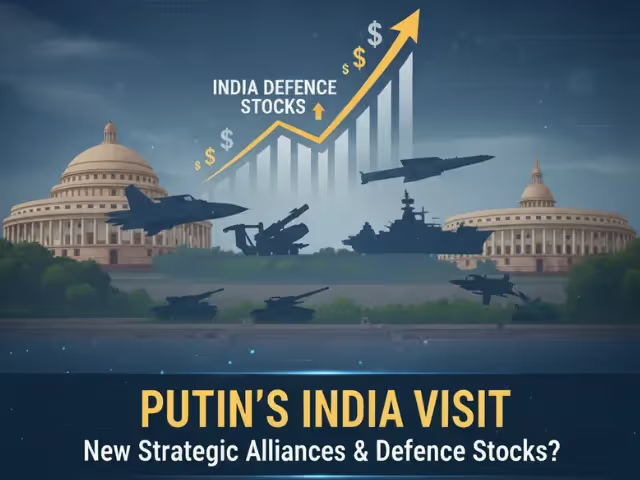
Putin’s India Visit: Could New Strategic Alliances Re-rate India’s Defence Stocks?


Key Takeaways
- Putin’s India visit may strengthen defence, energy, space, and technology cooperation.
- Possible long-term defence contracts could benefit domestic defence manufacturers.
- Markets may see sentiment-driven rallies in defence stocks in the short term.
- India’s Make in India and Atmanirbhar Bharat push limits reliance on imports.
- Investors should track policy announcements, orders, and valuations before acting.
India–Russia ties have historically been rooted in defence cooperation, spanning aircraft, submarines, missiles, and joint technology development. With President Vladimir Putin’s latest visit to India, markets are once again buzzing about whether fresh strategic alliances could spark a re-rating in Indian defence stocks.
While geopolitics doesn’t always translate into immediate market moves, strategic defence collaboration often influences long-term capital flows, order pipelines, and investor expectations. In this blog, we decode what Putin’s visit could mean for India’s defence sector and how investors may position themselves amid policy shifts and market sentiment.
Why Putin’s Visit Matters for India’s Defence Outlook
Russia has been one of India’s biggest defence partners for decades, and the relationship continues to evolve. During major bilateral summits, defence and strategic technology are typically top-priority agenda topics. This visit arrives at an important time:
- India is pushing aggressively for defence indigenization.
- Global supply chains face disruptions due to ongoing geopolitical tensions.
- India aims to become a net defence exporter by 2028–2030.
- Russia is actively looking to strengthen Asian partnerships.
Together, these trends create an environment where Indo–Russian cooperation could reshape both procurement and domestic manufacturing opportunities.
Possible Areas of Collaboration Discussed During the Visit
1. Joint Development of Defence Platforms
India and Russia have earlier co-developed systems like BrahMos, which has now become an export-ready platform. Renewed focus on joint development could involve:
- Advanced missile systems
- Fighter jet modernization
- Submarine technologies
- Air defence systems
Such collaborations typically bring multi-year order visibility to companies involved in integration, components, and systems development.
2. Expansion of Local Manufacturing Under Make in India
India has been pushing global defence partners to establish manufacturing bases locally. Any new deals with Russia may include:
- Deeper localisation of spares and components
- Transfer of technology agreements
- JV announcements benefiting Indian defence PSUs and private players
This aligns with India’s Atmanirbhar Bharat vision, potentially unlocking higher revenue streams for domestic players in aerospace, electronics, and heavy engineering.
3. Strengthening Supply Chain Resilience
Geopolitical tensions have made defence supply chain reliability a strategic priority. Agreements improving logistics, maintenance, spare-part stockpiling, and quicker delivery timelines could help:
- Bharat Dynamics
- Hindustan Aeronautics
- Bharat Electronics
- Cochin Shipyard
- Mishra Dhatu Nigam
Investors often interpret such outcomes as positive, as stable supply chains reduce execution risk.
Impact on Indian Defence Stocks: What the Markets May Look At
Market Sentiment Boost
Historically, major diplomatic visits involving defence discussions often result in short-term rallies. For example, during previous India–Russia and India–US summits, defence stocks such as HAL, BEL, and BDL saw intraday jumps on hopes of future orders.
A similar sentiment play may occur this time as well, especially if joint statements emphasize defence or technology cooperation.
Long-Term Order Pipeline Visibility
Defence manufacturing cycles stretch across years. Even a single large contract—like the S-400 system deal or Akula-class submarine leasing—creates multi-year revenue streams for multiple listed players involved at various stages.
If Putin’s visit results in:
- R&D partnerships
- New co-production initiatives
- Agreements for local upgrades of Russian-origin platforms
…investors can anticipate more predictable order flow.
Exports: The Big Story for Re-rating
India’s defence exports have jumped from ₹1,500 crore in 2016 to over ₹21,000 crore+ recently, according to MoD data. If Indo–Russian collaborations help India export more platforms (like BrahMos), it could contribute to re-rating potential for:
- HAL
- Bharat Electronics
- Bharat Dynamics
- Solar Industries
- Data Patterns
Global exports make valuations richer, similar to how US and European defence firms are valued.
Regulatory and Policy Context Supporting the Sector
- India’s Positive Indigenisation Lists restrict imports and boost domestic manufacturing.
- The Defence Acquisition Procedure (DAP) encourages Make in India.
- The government has increased defence capital outlay consistently.
- Strategic partnerships with Russia may accelerate technology transfer, reinforcing policies.
These structural trends ensure that markets react not just to geopolitics but also to the underlying policy framework.
Should Investors Buy Defence Stocks Based on Putin’s Visit?
Diplomatic visits should not be the sole reason to invest. However, they can be a trigger that adds confidence to the long-term sector story.
Consider the following:
What Works in Favour
- Multi-year visibility of defence spending
- India’s push for self-reliance
- Rising exports
- Strong order books for HAL, BEL, BDL
What Investors Must Watch
- Valuations, which are already elevated in many defence stocks
- Execution capacity and delivery timelines
- Geopolitical risks influencing supply chains
- Actual agreements vs announcements
A disciplined, research-backed approach is essential.
FAQs
1. Will Putin’s India visit immediately impact defence stocks?
Markets may see a short-term sentiment boost, but long-term impact depends on actual deals and policy outcomes.
2. Which Indian defence companies could benefit the most?
PSUs like HAL, BEL, BDL, and firms involved in aerospace and missile systems could gain from deeper collaboration or new joint projects.
3. Does this visit reduce India’s dependence on defence imports?
If the visit leads to local manufacturing and technology transfer, it strengthens India’s indigenisation goals.
4. Are defence stocks overvalued right now?
Some are trading at premium valuations. Investors should assess order books, earnings growth, and balance sheets before investing.
5. What should retail investors do next?
Track official announcements from the Ministry of Defence and stay focused on fundamentals rather than speculation.
Conclusion
Putin’s India visit comes at a pivotal moment in global geopolitics and India’s push toward defence self-reliance. While immediate market reactions are usually sentiment-driven, the real story lies in potential long-term collaboration, local manufacturing, and expanding defence exports.
For investors, the defence theme remains structurally strong, but careful research is key. Platforms like Swastika Investmart, backed by SEBI registration, robust research tools, and tech-enabled investing solutions, help investors navigate such evolving sectors with clarity.
%20(6).avif)
Which IPO Matches Your Portfolio Style? A Comparative Guide to Meesho, Aequs and Vidya Wires
Key Takeaways
- Meesho, Aequs, and Vidya Wires represent three different sectors: tech, aerospace manufacturing, and specialty wires
- Meesho suits growth-focused and aggressive investors
- Aequs fits stable, long-horizon investors seeking industrial expansion
- Vidya Wires is ideal for value-seekers wanting steady earnings
- Your choice depends on risk tolerance, sector preference, and investment horizon
Indian markets have entered a phase where IPOs are no longer just about chasing listing gains. Retail investors today are more informed, more selective, and more conscious about matching IPOs with their long-term goals. With three major offerings—Meesho, Aequs, and Vidya Wires—opening doors to very different sectors, choosing the right one depends entirely on your portfolio style.
This guide simplifies the decision, compares business fundamentals, and helps you decide which IPO fits your investment strategy.
India’s Dynamic IPO Landscape
In FY25–26, India witnessed strong IPO participation driven by robust domestic liquidity, expanding demat account numbers, and higher retail awareness. Sectors like tech, manufacturing, and industrial components continue to attract investor attention thanks to government initiatives, Make in India, and rising digital adoption.
Meesho, Aequs, and Vidya Wires each ride different mega-trends:
- India’s booming value e-commerce market
- Rising demand for precision aerospace manufacturing
- Expansion of power & electrical infrastructure
Understanding where you fit in this growth curve is the key.
Overview of the Three IPOs
Meesho IPO: A Play on India’s Value E-Commerce Boom
Meesho is one of India’s most awaited tech IPOs. Built around affordability, social commerce, and AI-driven efficiency, it has carved a niche among Tier-2 and Tier-3 consumers.
Investor fit:
✔ Growth-driven investors
✔ Those who understand tech cycles
✔ Higher-risk, long-term investors
Meesho is still loss-making but has strong revenue growth, improving margins, and a rising user base. Its valuation remains competitive compared to peers like Zomato and Nykaa.
Aequs IPO: Aerospace Manufacturing with Global Partnerships
Aequs, known for aerospace precision components, benefits from Make in India, increasing defence spending, and supply chain diversification by global OEMs.
Investor fit:
✔ Long-term investors
✔ Those seeking industrial growth
✔ Investors preferring predictable cash flows
Aequs serves major global customers with recurring orders. The company’s visibility and strong industry tailwinds make it suitable for investors who prefer stability over rapid growth.
Vidya Wires IPO: Stable Earnings from a Niche Market
Vidya Wires operates in a traditional but essential segment: copper and aluminium winding wires. With applications across motors, EV components, transformers, and appliances, demand remains steady and cyclical.
Investor fit:
✔ Value investors
✔ Those wanting consistent earnings
✔ Investors seeking low-risk, manufacturing-focused exposure
Vidya Wires shows solid profitability metrics such as ROE and margin stability, making it a good fit for conservative investors.
Comparative Snapshot: Meesho vs Aequs vs Vidya Wires
Below is the simplified text-based comparison:
Company: Meesho
Sector: Value E-Commerce
Strength: High growth, AI-driven scale, Tier-2/3 dominance
Risk: Competition, losses, regulatory sensitivity
Best for: Aggressive investors
Company: Aequs
Sector: Aerospace & Manufacturing
Strength: Global client base, Make-in-India support, stable demand
Risk: High capex cycles, export dependency
Best for: Long-term moderate investors
Company: Vidya Wires
Sector: Electrical & Metal Wires
Strength: Strong ROE, stable margins, diversified demand
Risk: Commodity dependence, price volatility
Best for: Conservative or value-oriented investors
Which IPO Suits Which Portfolio Style?
1. If Your Portfolio Focuses on High Growth
You prefer companies with scalable models, rapid user expansion, and optionalities from tech and brand play.
Best choice: Meesho IPO
Why:
- Fastest revenue growth among the three
- Asset-light business model
- Large upside if profitability improves
2. If You Prefer Stability and Manufacturing Exposure
Your strategy revolves around steady cash flows, tangible assets, and long-term contracts.
Best choice: Aequs IPO
Why:
- Aerospace demand is structurally growing
- Government push for defence & manufacturing
- Predictable order books
3. If You Value Earnings Consistency and Lower Volatility
You want companies that are financially sound with strong unit economics.
Best choice: Vidya Wires IPO
Why:
- Stable demand from electrical, EV and infrastructure sectors
- Strong profitability and manageable debt
- Clear visibility in operations
Real-World Market Context
Recent policy measures such as the Production Linked Incentive (PLI) schemes, defence reforms, and investments in renewable energy have strong spillover effects on Aequs and Vidya Wires. Meanwhile, the rapid digitalisation of Bharat and rising smartphone penetration directly benefit Meesho.
Additionally, SEBI’s framework for transparency in tech IPO valuations encourages better pricing and deeper investor trust.
In the secondary market, investors have shown a stronger appetite for manufacturing IPOs in the past year, but tech IPOs with strong growth potential continue to find demand among aggressive investors.
FAQs
1. Which IPO is best for short-term listing gains?
Listing gains depend on market sentiment, but manufacturing and specialty wire companies often see stronger short-term traction due to profitability.
2. Is Meesho suitable for conservative investors?
Not typically. It suits long-term and growth-focused investors comfortable with volatility.
3. Which IPO offers the most stable fundamentals?
Vidya Wires and Aequs offer stronger financial stability compared to Meesho.
4. Can I apply to all three IPOs?
Yes. Diversifying across sectors reduces concentration risk.
5. Is SEBI regulating these IPOs?
All IPOs undergo SEBI scrutiny, ensuring investor protection, transparent disclosures, and compliance with listing rules.
Conclusion
Choosing between Meesho, Aequs, and Vidya Wires is not about which IPO is “best”. It’s about which one fits your investing style.
Tech-focused growth investors may lean toward Meesho, stability-seekers may prefer Aequs, while conservative investors might find Vidya Wires a better value play.
No matter your choice, always invest through a trusted platform with strong research support and transparent processes.
Swastika Investmart, a SEBI-registered broker, offers expert insights, portfolio tools, and a seamless IPO application experience.
%20(5).avif)
Meesho IPO Review: Apply or Avoid? A Practical Investor’s Guide
Key Takeaways
- Meesho IPO size: ₹5,421 crore
- FY25 revenue jumped sharply, but Net Profit remains negative due to one-offs
- Company turned FCF positive; operates an asset-light, AI-driven, zero-commission model
- At ~5.5× FY25 Sales, valuation is attractive vs premium tech peers
- Suitable for aggressive, long-term investors
Meesho IPO Overview
India’s value-driven e-commerce space is rapidly expanding, and Meesho has emerged as a dominant disruptor—serving Tier-2 & Tier-3 buyers underserved by Amazon and Flipkart. With the IPO opening on December 3, 2025, here’s an in-depth analysis for investors.
Meesho IPO Details
Issue Open: December 3, 2025
Issue Close: December 5, 2025
Total Issue Size: ₹5,421.20 crore
Fresh Issue: ₹4,250 crore
Offer for Sale: ₹1,171.20 crore
Price Band: ₹105–₹111
Market Lot: 135 shares
Estimated M-Cap: ₹50,095.75 crore
Listing: BSE & NSE
Issue Allocation:
- QIBs – 75%
- NIIs – 15%
- Retail – 10%
Use of Funds:
- Cloud infrastructure for subsidiaries
- Branding & marketing
- Acquisitions and general corporate expenses
- Hiring for AI/ML & tech teams
Understanding Meesho’s Business Model
Founded in 2015, Meesho is a multi-sided value-commerce marketplace connecting:
- Non-metro consumers
- Small sellers & micro entrepreneurs
- Logistics providers (including in-house Valmo)
- Influencers/content creators
Key Advantages
- Zero-commission model
- Asset-light structure
- AI-based personalization
- Strong Tier-2/3 penetration
- 30% share of India’s e-commerce shipments
Financial Performance (Restated Consolidated)
Revenue Growth
- FY23: ₹5,897.69 crore
- FY24: ₹7,859.24 crore
- FY25: ₹9,900.90 crore
Strong, consistent rise in volume & efficiency.
Net Profit / Loss
- FY23: –₹1,671.90 crore
- FY24: –₹327.64 crore
- FY25: –₹3,941.71 crore
FY25 losses reflect one-time accounting items, not operational weakness.
EBITDA Margin
- FY23: –28.72%
- FY24: –2.93%
- FY25: –2.22%
Margins improving steadily.
Net Worth
- FY23: ₹2,548.31 crore
- FY24: ₹2,301.64 crore
- FY25: ₹1,561.88 crore
Valuation Ratios (FY25)
- EPS: –₹9.98
- P/E: –11.63×
- P/B: 30.16×
Negative earnings are typical during the scaling phase of digital platforms.
Why Investors Are Interested
1. Free Cash Flow Positive in FY25
Shows solid unit economics despite accounting losses.
2. Dominance in Tier-2 & Tier-3 Markets
India’s most underpenetrated and fastest-growing segment.
3. Zero-Commission Model
Boosts seller margins → drives affordability.
4. Scarcity Premium
Meesho is the only pure-play value e-commerce listed/going public.
5. AI-Led Flywheel
AI helps across:
- Recommendations
- Fraud detection
- Logistics planning
- Seller monetization
Competitive Strategy Going Forward
- Increase product catalog and transaction frequency
- Deepen AI/ML capabilities
- Strengthen affordability and cost innovation
- Scale monetization
- Invest in Horizon 2 businesses (media, fintech, content commerce)
Key Risks to Consider
- Tough competition from Amazon, Flipkart, Jiomart, Ajio, D2C brands
- Small-seller dependence → risk of low-quality goods
- High reliance on Cash-on-Delivery
- Sensitive to e-commerce regulation changes
- Counterfeit risk → brand perception issues
Peer Comparison
Meesho vs Key Listed/New-Age Peers (FY25)
Meesho
- Revenue: ₹9,389.9 crore
- P/E: –11.63
- NAV: 3.68
- RoNW: –252.37%
Zomato
- High P/S (10×+), strong RoNW, positive earnings
Swiggy
- Loss-making, NAV ~40.98
Brainbees (FirstCry)
- Loss-making, global listing candidate
Nykaa (FSN)
- P/E 1,168×; profitable but premium priced
Trent
- Strong profitability, P/E 100.87
Avenue Supermarts (DMart)
- Retail leader; P/E ~98.43
Conclusion:
Meesho’s ~5.5× Sales valuation is reasonable compared to premium peers.
FAQs
1. Is Meesho profitable?
Not yet. Losses continue due to one-off items, but cash flow is positive.
2. Why is the Meesho IPO attractive?
Affordable valuation, strong growth, and value-commerce dominance.
3. Main risks for investors?
Competition, quality issues, COD dependency.
4. Is the valuation reasonable?
Yes—~5.5× Sales, cheaper than Zomato & Nykaa.
5. Who should apply?
Aggressive, long-term tech investors.
Conclusion
- Meesho has successfully carved out a niche in Tier-2/3 cities where Amazon and Flipkart struggle to penetrate deeply
- Meesho has turned Free Cash Flow (FCF) positive in FY25, even though reported Net Profit is still negative due to one-off items.
- At a valuation of ~$6 Billion (₹50,000 Cr), it is priced at roughly 5.5x Price-to-Sales (FY25). This is attractive compared to Zomato (trading often at >10x Sales).
- It has "scarcity premium" as it is the only pure-play "value e-commerce" stock in India.
- Aggressive investors can subscribe for both listing gain and long term.
Aequs IPO Review: Attractive Valuation or Risky Bet : A Retail Investor’s Guide
Key Takeaways
- Aequs operates a unique aerospace-focused SEZ with vertically integrated manufacturing.
- The company is loss-making with negative ROE and ROCE, increasing risk.
- Valuation is cheaper vs niche peers on Price-to-Book, but P/E is highly negative.
- IPO proceeds largely go toward debt repayment, not expansion.
- Suitable only for high-risk, long-term investors looking to play the aerospace theme.
India’s aerospace and defence manufacturing ecosystem is strengthening with Make in India, rising localisation, and global export demand. Aequs Ltd., a vertically integrated aerospace components manufacturer, is tapping the capital markets with a ₹921.81 crore IPO.
However, with volatile financials and dependence on debt, is the IPO attractive or too risky?
This detailed review covers financials, valuation, strengths, risks, and industry comparison.
Aequs IPO Details
- Issue Opens: December 3, 2025
- Issue Closes: December 5, 2025
- Total Issue Size: ₹921.81 crore
- Fresh Issue: ₹670 crore
- Offer for Sale: ₹251.81 crore
- Price Band: ₹118–₹124
- Market Lot: 120 shares
- Estimated Market Cap: ₹8,316.06 crore
- Listing: NSE & BSE
Issue Allocation
- QIBs: 75%
- NIIs: 15%
- Retail: 10%
Use of Funds
- Repayment/prepayment of borrowings
- Investments into three wholly owned subsidiaries
- Machinery & equipment capex
Note: Majority of funds focus on debt reduction, not growth.
Company Overview: What Does Aequs Do?
Founded in 2000, Aequs Ltd. operates a dedicated aerospace SEZ, one of the few integrated ecosystems in India.
Aerospace Product Portfolio
- Structures: brackets, fittings, floorboards
- Cargo & Interiors: panels, trays, seat components
- Landing Systems: landing gear brackets, rims, wheel assemblies
- Actuation Systems: manifolds, housings, pistons
Aequs also leverages its precision engineering capabilities to serve consumer electronics, plastics, and durables, with manufacturing across three continents, offering proximity to global OEMs.
Financial Performance: Three-Year Snapshot
(All values from restated consolidated statements)
Revenue
- FY23: ₹812.1 crore
- FY24: ₹965 crore
- FY25: ₹924.6 crore
Insight: Revenue rose sharply in FY24 but dipped slightly in FY25.
Profitability
- Net Profit FY23: –₹109.50 crore
- Net Profit FY24: –₹14.24 crore
- Net Profit FY25: –₹102.35 crore
Margins temporarily improved but slipped again.
EBITDA Margin
- FY23: 7.77%
- FY24: 15.08%
- FY25: 11.68%
Key Ratios (FY25)
- ROCE: 0.87%
- EPS: –₹1.80
- P/E: –74.71×
- RoNW: –14.47%
Net Worth
- FY23: ₹251.91 crore
- FY24: ₹807.17 crore
- FY25: ₹707.53 crore
FY24 saw a restructuring-led jump, followed by erosion in FY25Interpretation
- Aequs is loss-making, unlike all comparable peers.
- On P/B (~9.9x), it is cheaper than several precision engineering stocks trading at 15–20x P/B.
Key Strengths
- Vertically integrated precision manufacturing ecosystem
- Production spread across multiple continents
- Strong relationships with global aerospace OEMs
- Deep engineering capability across key aerospace systems
- High entry barriers due to specialised infrastructure
Key Risks & Concerns
- All major manufacturing operations based in Karnataka
- Negative operating cash flows
- Heavy dependence on global aerospace cycles
- Persistent losses and negative return ratios
- IPO proceeds primarily for deleveraging, not growth
Strategic Roadmap
Aequs aims to:
- Deepen aerospace client engagement
- Expand consumer product categories
- Improve margins through higher-value manufacturing
- Leverage capabilities to enter adjacent sectors
Execution risk remains high due to financial volatility.
Valuation & Analyst Outlook: Subscribe or Avoid?
Positives
- Unique aerospace SEZ ecosystem
- Sticky client relationships
- Cheaper than peers on Price-to-Book
- Aligned with India’s aerospace manufacturing push
Negatives
- Loss-making for three consecutive years
- High debt, low profitability
- Poor short-term visibility
- Only 10% retail quota, limiting listing momentum
Analyst View
- A unique, high-barrier entry into the aerospace & defense supply chain.
- The company is currently loss-making with negative return ratios
- The majority of IPO proceeds will be used to pay off debt, not for new expansion.
- Priced significantly lower than peers on a Price-to-Book basis (~9.9x vs peers at 15-20x).
- Aggressive investors can park some money for the long term to play niche theme.
FAQs
- Is Aequs IPO good for retail investors?
Suitable only for high-risk investors with long-term horizons. - What is the price band for the Aequs IPO?
₹118–₹124 per share. - How will the IPO proceeds be used?
Mainly debt repayment, subsidiary investments, and machinery capex. - Is Aequs profitable?
No. Aequs has reported losses in FY23, FY24, and FY25. - How does Aequs compare with peers?
Peers are profitable with high P/E valuations; Aequs is loss-making but cheaper on P/B.
Conclusion
The Aequs IPO offers a rare aerospace SEZ ecosystem but comes with high financial risk. While long-term structural opportunity exists, persistent losses, negative returns, and debt dependence make the IPO suitable only for risk-tolerant investors.
For those looking to invest with expert-backed research and a trusted experience, Swastika Investmart offers a SEBI-registered platform with strong tools and support.
.avif)
Vidya Wires Ltd. Going Public: Analyst’s Take on the IPO
Key Takeaways
- Vidya Wires Ltd launches a ₹300 crore IPO backed by strong profitability and 24.57% ROE.
- Financials show consistent revenue growth and superior margins vs peers.
- IPO priced at ~20.36x P/E, far lower than listed wire manufacturers.
- Strengths: diversified product mix, backward integration, and 370+ clients.
- Medium to long-term investors may consider subscribing based on fundamentals.
Vidya Wires Ltd., a long-standing manufacturer of copper and aluminium winding wires, is set to enter the capital markets with its ₹300 crore IPO. The company serves a wide range of sectors—electrical equipment, industrial applications, renewable energy, and EV components—and has built a strong market reputation with steady expansion and a large customer base.
This blog covers detailed IPO insights including business analysis, financials, valuations, risks, and the overall investment outlook.
Vidya Wires Ltd IPO Details
- Total Issue Size: ₹300 crore
- Fresh Issue: ₹274 crore
- OFS: ₹26.01 crore
- Issue Window:
- Opens: December 3, 2025
- Closes: December 5, 2025
- Price Band: ₹48–₹52 per share
- Lot Size: 288 shares
- Listing: BSE & NSE
- Estimated Market Cap: ₹1,106 crore
Issue Allocation
- QIBs: 50%
- NIIs: 15%
- Retail: 35%
Use of Funds
- Setting up a new subsidiary project under ALCU
- Repayment of borrowings
- General corporate purposes
Company Overview
Vidya Wires Ltd is one of India’s established suppliers of conductivity-based copper and aluminium products used in transformers, motors, renewable power systems, and EV components.
Product Portfolio
- Winding wires
- Conductors
- Busbars
- Copper & aluminium strips
- Aluminium paper-covered strips
- PV ribbons
- Custom conductivity-engineered solutions
The company services 370+ clients, making it a key player in India’s electrical manufacturing ecosystem.
Key IPO Financial Ratios (FY25)
- ROCE: 19.72%
- ROE: 24.57%
- EPS: ₹2.55
- P/E (Pre-IPO): 20.36×
These indicate strong profitability and efficient capital deployment.
Industry Comparison
Vidya Wires is priced at nearly half the P/E multiple of listed peers while delivering superior ROE, making the IPO valuation extremely attractive.
Competitive Strategy
Vidya Wires aims to strengthen its industry position through:
- Capacity expansion (ALCU project)
- Broader product diversification
- Growth in EV and renewable segments
- Enhanced cost-efficiency through backward integration
- Wider domestic & international reach
Key Strengths
- 370+ diversified customer base
- Presence across multiple industries reduces cyclicality
- Backward-integrated operations ensure cost & quality control
- Manufacturing in a logistically favourable region
- Strong client relationships with repeat business
- Stable financial performance with consistent margin growth
Key Concerns
- Heavy dependence on a few raw material suppliers
- Limited insurance coverage for operational risks
- Exposure to ongoing legal proceedings
- Industry-wide margin sensitivity to copper & aluminium price fluctuations
Valuation & Outlook: Should You Subscribe?
Vidya Wires operates in a structurally strong sector driven by India’s rising consumption of electrical infrastructure, EV components, and renewable energy systems.
Key Positives
- Attractive valuation compared to peers
- High ROE of 24.57%
- Structural demand growth in power & EV sectors
- Upcoming capacity expansion to support revenues
Our View
- The company operates in a competitive, thin-margin segment
- It has delivered consistent growth in both revenue and profitability over the reported periods.
- Its ROE of 24.57% is superior to both Precision Wires and Ram Ratna Wires.
- Vidya Wires is priced at roughly 50% of the industry average P/E. Even if we account for the "small-cap discount" or liquidity risks, the valuation gap is substantial.
- Investors can consider subscribing for a medium to long-term perspective.
Frequently Asked Questions (FAQs)
1. Is Vidya Wires Ltd IPO good for long-term investors?
Yes. Strong ROE, profitability, and sector tailwinds make it attractive for long-term investors.
2. What is the price band of the IPO?
₹48–₹52 per share.
3. How does the company compare with peers?
It is priced much lower in terms of P/E while delivering better ROE.
4. What will the IPO funds be used for?
ALCU project setup, debt repayment, and general corporate needs.
5. What are the key risks?
Raw material dependency, limited insurance, and margin pressures.
Conclusion
Vidya Wires Ltd’s IPO offers a combination of strong fundamentals, attractive valuations, and sector-driven growth opportunities. Though risks exist, the company’s long-term prospects look positive.
If you're planning to invest in the IPO or build a long-term equity portfolio, Swastika Investmart provides a SEBI-regulated, research-backed platform with powerful tools and expert support.
%20(1).avif)
Vodafone Idea’s AGR Relief: How Government Intervention Can Impact Telecom Stocks
Key Takeaways
- Government AGR relief offers short-term breathing room to Vodafone Idea (Vi).
- Relief helps improve cash flow but does not fully resolve long-term liabilities.
- Telecom sector sentiment may stabilize, but competitive pressures remain.
- Vi still needs sustained fundraising and tariff hikes to stay viable.
- Investors should track government policy, ARPU trends, and 5G capex cycles.
The Indian telecom sector often stands at the intersection of policy, technology, and intense competition. Vodafone Idea (Vi), once a dominant player, has struggled for years under the weight of its Adjusted Gross Revenue (AGR) dues—a long-standing regulatory dispute that reshaped the industry’s financial landscape.
With the government recently extending AGR-related relief, investor interest has once again surged. But the key question remains: Does this relief materially change the future of Vodafone Idea and the telecom sector—or is it just a temporary lifeline?
This blog breaks down the implications for investors, telecom stocks, and market sentiment.
What Exactly Is Vodafone Idea’s AGR Relief?
AGR dues originate from a long legal battle where telecom operators were asked to pay levies on a broader revenue definition. Operators like Vi were hit the hardest.
Government relief measures have generally focused on:
- Extending payment timelines
- Moratoriums on AGR and spectrum dues
- Conversion of dues into equity
- Lowering interest burden through adjusted repayment structures
The recent relief package continues this policy approach—offering Vi more breathing space to rebuild operations without the immediate pressure of large outflows.
Why This Relief Matters for Vodafone Idea
Vodafone Idea has been facing:
- Heavy debt burden
- Declining subscriber share
- Intense price competition
- Large 4G and 5G capex requirements
- Shrinking ARPU (Average Revenue Per User)
A payment moratorium or restructured AGR timeline significantly impacts Vi’s near-term:
Cash Flow Stability
Immediate payments reduce operational risk and free up capital for network investments.
Fundraising Ability
Investors—both domestic and foreign—are more willing to fund a telecom player with policy support and enhanced solvency.
Market Perception
Government backing signals the intent to maintain a three-player market structure, avoiding duopoly.
Operational Continuity
Greater capital can flow into upgrading networks, improving service quality, and regaining competitive footing.
Impact on Indian Telecom Stocks
Government intervention in telecom typically triggers movement across the sector. Let’s break it down.
1. Positive Sentiment for Vodafone Idea
Short-term sentiment often improves due to:
- Reduction in bankruptcy risk
- Hope of fresh equity infusion
- Market confidence in policy continuity
Historically, Vi’s stock has reacted quickly to AGR-related announcements, especially during the 2021 telecom reform package.
2. Stability Boost for the Sector
Investors worry when a major player nears collapse. Relief reduces the risk of industry disruption, which is positive for the entire telecom ecosystem—from tower companies to equipment suppliers.
3. Limited Impact on Jio and Airtel
While Vi benefits disproportionately, rivals like Airtel and Jio continue to dominate due to:
- Stronger balance sheets
- Better spectrum holdings
- Faster 5G rollout
- Superior ARPU growth
They benefit indirectly through healthier industry structure, but their financial metrics remain unaffected by Vi’s relief.
4. Tariff Hike Cycle: The Real Game-Changer
Regardless of AGR relief, telecom sustainability depends heavily on tariff hikes.
India still has one of the lowest data prices globally, making periodic tariff adjustments vital.
If the relief allows Vi to remain competitive, the chance of coordinated tariff hikes increases—a powerful earnings catalyst for all telecom stocks.
Telecom Sector Outlook: What Should Investors Track?
ARPU Growth Trends
A small ARPU jump can dramatically expand profitability given the large user base.
Fundraising Progress
Vi must raise capital to maintain 4G expansion and 5G entry. Delays could negate the benefits of AGR relief.
Government Policy Continuity
The sector remains policy-heavy. TRAI recommendations, spectrum pricing changes, and further relief measures will shape valuations.
Market Share Dynamics
Subscriber movement between operators is a leading indicator of competitive strength.
Capex Cycles
5G rollout, fiber networks, and rural expansion still require large investments.
Real-World Example: Market Reaction to Past AGR Relief
In 2021, after the government approved a moratorium and allowed conversion of dues into equity:
- Vodafone Idea surged nearly 25–30% in a few days.
- Telecom tower companies like Indus Towers saw a relief rally.
- Brokerages revised short-term sector outlooks to “neutral to positive.”
This shows how sensitive telecom stocks are to regulatory decisions.
A similar pattern could emerge now—but sustaining gains requires fundamental improvement.
Does AGR Relief Make Vodafone Idea a Strong Investment?
The honest answer: It improves viability, but does not guarantee revival.
Strengthened Outlook
- Lower short-term financial pressure
- Higher chances of fundraising
- Improved service quality potential
Challenges Still Persist
- Intense duopoly from Airtel and Jio
- Losses and high debt
- Large capex needs
- Need for consistent tariff hikes
For investors, this becomes a calculated risk—not a clear turnaround story yet.
FAQs
1. What is AGR relief and why does it matter to Vodafone Idea?
AGR relief offers extended payment timelines and reduced financial pressure, improving Vi’s cash flows and operational stability.
2. Will Vodafone Idea become profitable because of this relief?
Not immediately. Profitability still depends on tariff hikes, subscriber retention, and successful fundraising.
3. How does this impact other telecom stocks like Airtel and Jio?
Indirectly positive. A stable three-player market reduces disruption and supports tariff discipline.
4. Should retail investors buy telecom stocks now?
Investors should focus on ARPU trends, financial health, and market share sustainability before committing.
5. Does this change long-term sector fundamentals?
Yes, to the extent that regulatory stability strengthens earnings visibility, but competition remains intense.
Conclusion
Vodafone Idea’s AGR relief is an important development that improves the sector’s financial stability and sustains competitive balance. But for Vi, it’s just the first step—successful fundraising, network upgrades, and ARPU growth are essential for a full turnaround.
Investors who want to participate in India’s telecom story should evaluate fundamentals carefully and rely on trusted research-backed platforms.
Swastika Investmart, a SEBI-registered broker with advanced tools, strong research capabilities, and dedicated customer support, helps investors navigate complex sectors like telecom with confidence.


.avif)
.avif)

.avif)






START YOUR INVESTMENT JOURNEY
Get personalized advice from our experts
- Dedicated RM Support
- Smooth and Fast Trading App
