

The Power of Compounding – Why Starting Early Matters




Introduction
Albert Einstein reportedly called compound interest the "eighth wonder of the world." Whether or not he actually said it, the math is undeniable. Compounding is the process where your investment returns begin earning their own returns — and over time, this snowball effect becomes truly extraordinary.
The catch? Compounding needs one essential ingredient: time.
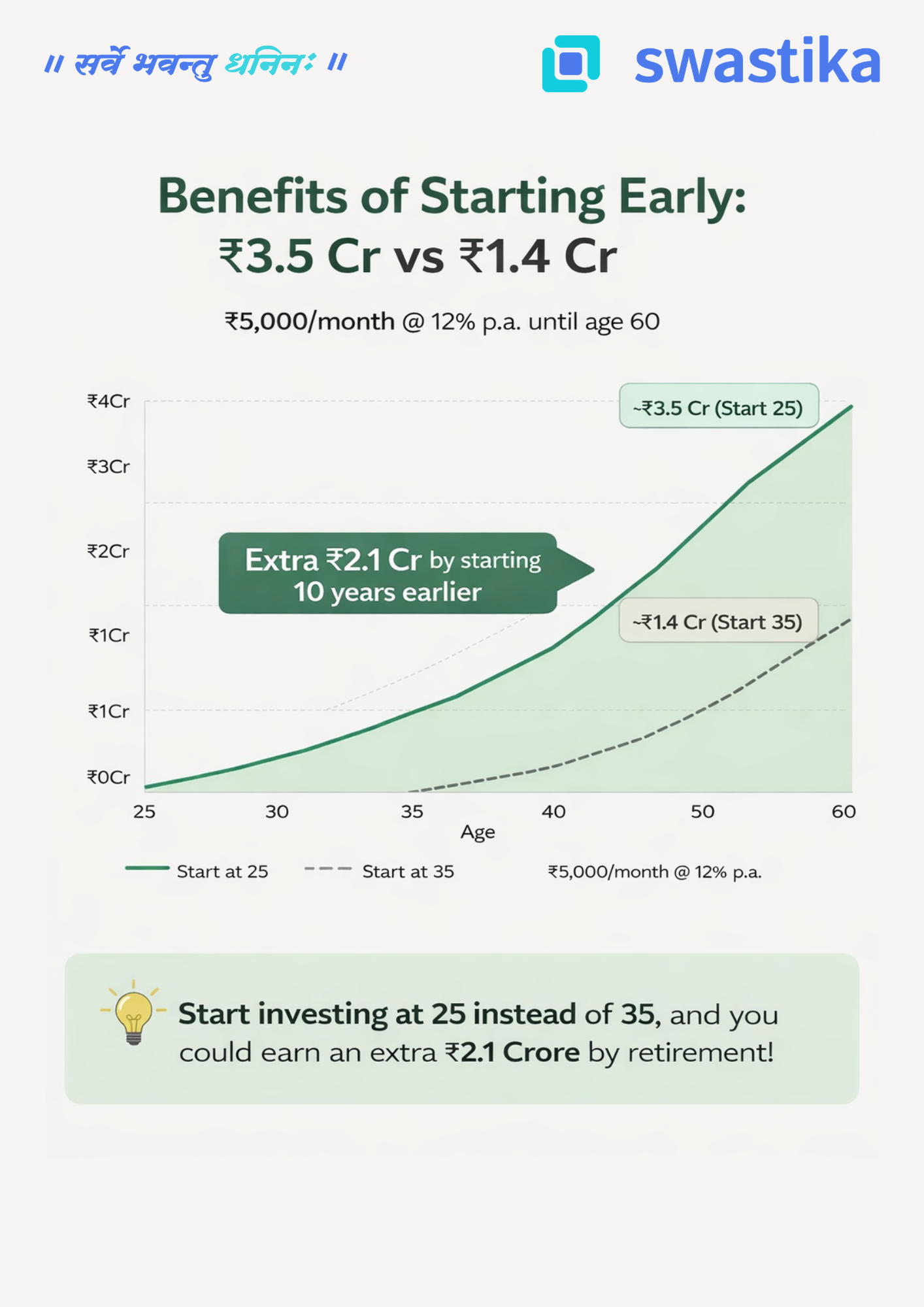
The more years you give your money to grow, the more dramatic — and life-changing — the results become. This is exactly why starting your investment journey early, even with a modest amount, can make a difference of crores by the time you retire.
A Tale of Two Investors: Arjun vs Priya
Let's bring this concept to life with a simple, real-world example.
Meet Arjun and Priya. Both are sensible, disciplined investors. Both invest ₹5,000 every month through a SIP (Systematic Investment Plan) in equity mutual funds, earning an average annual return of 12%. Both stop investing at age 60.
The only difference? Arjun starts at 25. Priya starts at 35.
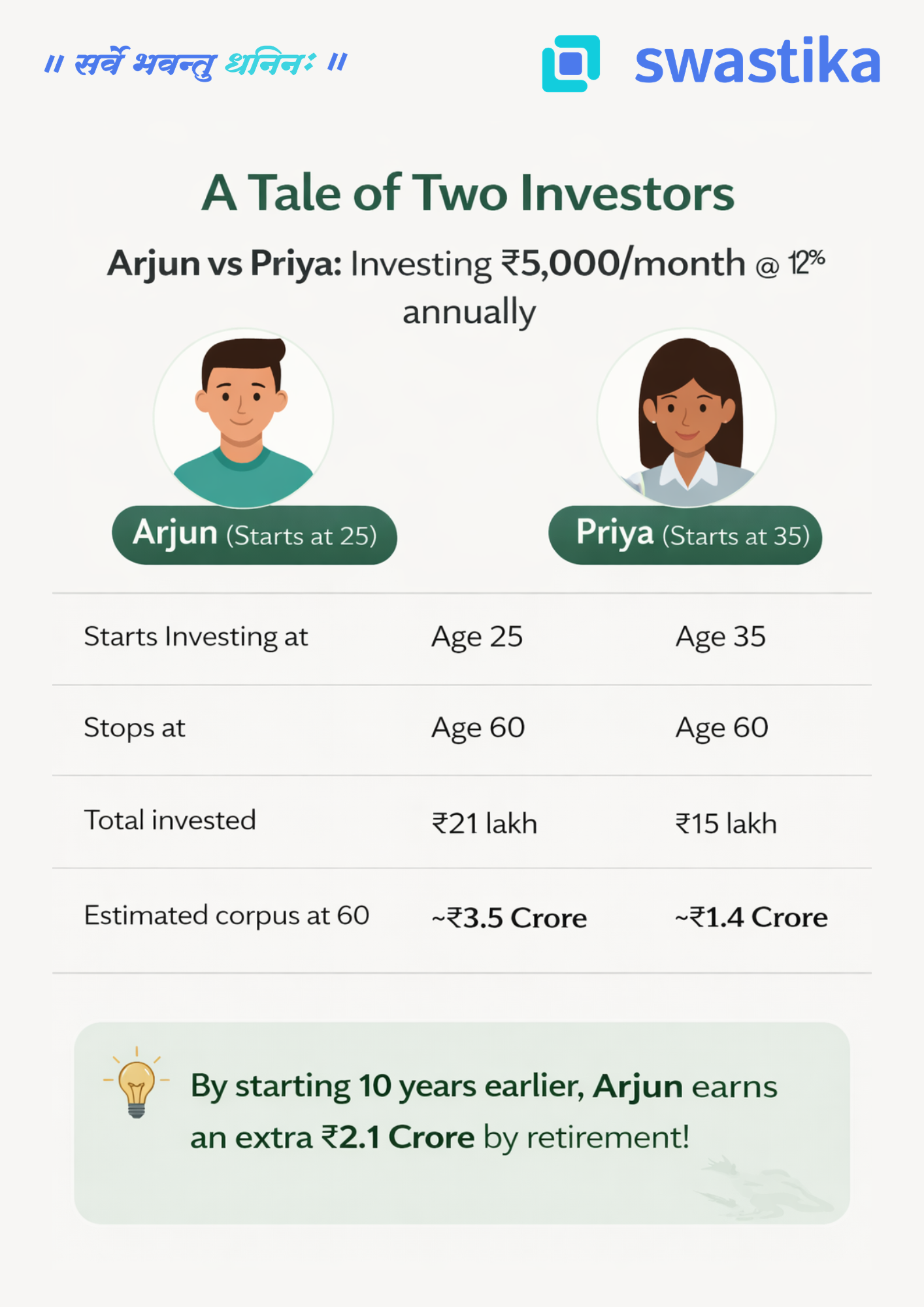
The numbers are striking. Arjun invests just ₹6 lakh more than Priya in absolute terms — yet walks away with ₹2.1 Crore more at retirement.
That extra ₹2.1 Crore didn't come from investing more aggressively or taking bigger risks. It came purely from starting 10 years earlier.
Why Does Time Make Such a Huge Difference?
This is where the magic of compounding reveals itself.
In the early years of investing, growth looks modest and almost unimpressive. But as the years pass, your corpus grows not just on your original investment, but on all the accumulated returns from previous years. The curve goes from almost flat to steeply exponential — and that steep climb happens in the later years.
When Arjun starts at 25, his money has 35 years to ride that exponential curve. Priya's money, starting at 35, only catches the last 25 years — and critically, it misses the steepest part of the climb in the final decade.
Think of it this way: the last 10 years of compounding are worth more than the first 20. That is the counterintuitive truth at the heart of long-term investing.
The Real Cost of Waiting
Many young earners tell themselves, "I'll start investing once I'm more settled — once the salary improves, once the EMI is paid off, once life is a bit easier."
But the numbers show that every year of delay is extraordinarily expensive — far more expensive than any EMI or lifestyle expense. Priya didn't invest carelessly. She invested faithfully for 25 years. Yet she ends up with less than half of what Arjun accumulated — not because she did anything wrong, but simply because she started a decade late.
The cost of waiting 10 years wasn't ₹6 lakh in additional contributions. The cost was ₹2.1 Crore in lost wealth.
Three Principles to Remember
1. Start now, not later.The best time to start investing was yesterday. The second best time is today. Even a SIP of ₹1,000–₹2,000 per month in your 20s is infinitely better than waiting for the "right time."
2. Consistency beats intensity.You don't need to invest large sums all at once. A small, steady, monthly commitment — maintained without interruption — is what unlocks the full power of compounding over decades.
3. Stay invested through market cycles.Compounding works only if you let it work. Exiting during market corrections or stopping your SIP in tough months breaks the chain. Time in the market, not timing the market, is what builds wealth.
The Bottom Line
If you are in your 20s or early 30s, you hold an asset that no amount of money can buy later: time. Use it. Start a SIP today — even a small one. Let compounding do its slow, steady, powerful work.
Because the difference between starting at 25 and starting at 35 is not just 10 years. As Arjun and Priya's story shows, that difference is ₹2.1 Crore.
Big Budget











.webp)
.webp)
.webp)
.webp)
.webp)













.webp)
.webp)
.webp)
.webp)
Latest Articles

Understanding Central Bank Policies and Their Impact on Forex Trading


Central banks play a pivotal role in the global economy, wielding significant influence over currency values through their monetary policies. For forex traders, understanding the decisions and actions of central banks is essential for making informed trading decisions. In this article, we'll delve into the intricacies of central bank policies and explore their profound impact on the forex market.
The Role of Central Banks in Forex Trading:
Central banks are responsible for setting monetary policies aimed at achieving various economic objectives, such as price stability, full employment, and economic growth. These policies primarily involve managing interest rates, controlling money supply, and intervening in currency markets when necessary.
Interest Rate Decisions:
One of the most crucial tools in a central bank's arsenal is the manipulation of interest rates. By raising or lowering interest rates, central banks can influence borrowing costs, inflation rates, and ultimately, currency values. For example, when a central bank raises interest rates, it attracts foreign capital seeking higher returns, leading to an appreciation of the domestic currency.
Conversely, cutting interest rates can stimulate economic activity by reducing borrowing costs, but it may also weaken the currency as investors seek higher yields elsewhere. Forex traders closely monitor central bank announcements regarding interest rate decisions, as they can trigger significant movements in currency pairs.
Quantitative Easing (QE) and Asset Purchases:
In times of economic distress, central banks may resort to unconventional monetary policies, such as quantitative easing (QE) or asset purchases. QE involves the central bank buying government bonds or other financial assets to inject liquidity into the economy and lower long-term interest rates.
While QE can bolster economic growth and asset prices, it can also devalue the currency if investors perceive it as a form of currency debasement. Forex traders must assess the scale and duration of QE programs to gauge their impact on currency pairs.
Forward Guidance and Communication:
Central banks also rely on forward guidance, which involves communicating their future policy intentions to guide market expectations. The tone and clarity of central bank communications can significantly influence investor sentiment and currency valuations.
For instance, hawkish rhetoric indicating a willingness to tighten monetary policy can strengthen the domestic currency, while dovish signals suggesting a more accommodative stance may weaken it. Forex traders analyze central bank statements, speeches, and press conferences for clues about future policy actions.
Case Studies: Impact of Central Bank Policies on Forex Markets:
To illustrate the real-world impact of central bank policies on forex trading, let's examine recent examples:
European Central Bank (ECB) Stimulus Measures: The ECB's aggressive QE programs and negative interest rates have weighed on the euro, contributing to its depreciation against major currencies like the US dollar and Japanese yen.
Federal Reserve Rate Hikes: The Federal Reserve's series of interest rate hikes in 2018 strengthened the US dollar as investors flocked to higher-yielding assets denominated in USD, leading to significant gains against currencies of emerging market economies.
Central bank policies wield considerable influence over forex markets, shaping currency valuations and online stock trading opportunities. Forex traders must stay abreast of central bank decisions, economic data releases, and geopolitical developments to navigate the complexities of the forex market successfully. By understanding central bank policies and their implications, traders can enhance their trading strategies and mitigate risks in an ever-evolving financial landscape.

Profit with Precision: Leveraging Algo Trading Platforms for Consistent Returns
In the ever-evolving landscape of financial markets, the quest for consistent returns remains a perennial pursuit for investors. Traditional methods of trading often rely on human intuition, market sentiment, and extensive research. However, in recent years, there has been a significant shift towards leveraging technology to enhance trading strategies. Algo trading platforms have emerged as powerful tools that enable investors to execute trades with precision and efficiency, ultimately aiming for consistent returns.
Algorithmic trading, involves the use of computer algorithms to automate trading decisions. These algorithms are designed to analyze vast amounts of data, identify patterns, and execute trades at optimal times and prices. Algo trading platforms utilize advanced mathematical models, statistical analysis, and machine learning algorithms to make informed trading decisions in real-time.
One of the key advantages of algo trading platforms is their ability to eliminate human emotions from the trading process. Fear, greed, and other emotions often cloud judgment and lead to irrational decision-making. By relying on algorithms, investors can remove these emotional biases and execute trades based solely on predefined parameters and criteria.
Consistency is paramount in the world of trading, and algo trading platforms excel in delivering consistent results over time. These platforms can continuously monitor the market, execute trades at lightning speed, and react to changing market conditions without hesitation. As a result, investors can achieve a more predictable and stable return on their investments.
Another significant benefit of algo trading platforms is their ability to backtest trading strategies. Before deploying a strategy in live markets, investors can simulate its performance using historical data. This allows them to evaluate the strategy's effectiveness, identify potential flaws, and make necessary adjustments to optimize performance. By backtesting strategies, investors can have greater confidence in their trading approach and enhance the likelihood of achieving consistent returns.
Furthermore, algo trading platforms offer unparalleled speed and efficiency in trade execution. In today's fast-paced markets, milliseconds can make a significant difference in trade outcomes. Algo trading platforms can execute trades with precision and accuracy at speeds that far exceed human capabilities. This not only minimizes the risk of slippage but also ensures that trades are executed at the best possible prices, maximizing potential returns.
Moreover, algo trading platforms provide investors with access to a wide range of markets and asset classes. Whether trading stocks, currencies, commodities, or derivatives, these platforms offer versatility and flexibility to cater to diverse investment strategies. Additionally, many algo trading platforms offer advanced features such as portfolio optimization, risk management tools, and customizable dashboards, empowering investors to tailor their trading experience to their specific needs and preferences.
Conclusion:
Algo trading platforms represent a paradigm shift in the world of investing, offering investors a powerful tool to achieve consistent returns. By leveraging advanced algorithms, data analysis, and automation, these platforms enable investors to eliminate emotional biases, backtest strategies, execute trades with precision, and access a diverse range of markets. As technology continues to evolve, algo trading platforms will likely play an increasingly integral role in the investment landscape, empowering investors to navigate markets with confidence and efficiency.

Role of Technical Analysis in Currency Trading
Currency trading, also known as forex trading, is a dynamic market where traders buy and sell currencies with the aim of making profits. Among the various tools and techniques available to traders, technical analysis stands out as a powerful method for predicting price movements and making informed trading decisions. In this blog, we'll delve into the role of technical analysis in currency trading and how it can help traders navigate the complexities of the forex market.
Understanding Technical Analysis:
Technical analysis involves analyzing past market data, primarily price and volume, to forecast future price movements. Unlike fundamental analysis, which focuses on economic factors and news events, technical analysis relies on charts and technical indicators to identify patterns and trends in price behavior.
Key Concepts in Technical Analysis:
Price Patterns: Technical analysts study chart patterns such as head and shoulders, triangles, and flags to identify potential trend reversals or continuations.
Support and Resistance Levels: These are price levels where the price tends to find barriers in its movement. Traders use support and resistance levels to determine entry and exit points.
Technical Indicators: Indicators like moving averages, Relative Strength Index (RSI), and MACD (Moving Average Convergence Divergence) help traders gauge the strength and momentum of price movements.
Application in Currency Trading:
Technical analysis plays a crucial role in currency trading for several reasons:
Identifying Trends: By analyzing price charts, traders can identify trends in currency pairs, whether they are trending upwards (bullish), downwards (bearish), or moving sideways (consolidating). This helps traders align their positions with the prevailing trend, increasing their chances of profitability.
Timing Trades: Technical analysis helps traders time their trades effectively by identifying entry and exit points based on chart patterns and indicators. For example, a trader may wait for a pullback in an uptrend before entering a long position, or they may use overbought/oversold indicators to anticipate reversals.
Managing Risk: Technical analysis provides traders with tools to manage risk effectively. By setting stop-loss orders based on support and resistance levels or using volatility indicators to adjust position sizes, traders can limit potential losses and protect their capital.
Confirmation of Fundamental Analysis: While fundamental analysis focuses on the intrinsic value of currencies, technical analysis can provide confirmation or validation of fundamental factors by reflecting market sentiment and investor behavior.
Case Study:
Let's consider an example of how technical analysis can be applied while doing forex trading online. Suppose a trader wants to trade the EUR/USD currency pair. By analyzing the price chart using technical indicators such as moving averages and MACD, the trader identifies a bullish trend with strong upward momentum. Based on this analysis, the trader decides to enter a long position, setting a stop-loss below a key support level and a take-profit target based on resistance levels identified on the chart.
Conclusion:
Technical analysis is an indispensable tool for currency traders seeking to gain insights into market trends, identify profitable trading opportunities, and manage risk effectively. By mastering the principles of technical analysis and applying them judiciously, traders can enhance their trading performance and achieve their financial goals in the dynamic world of currency trading.

Choosing the Right Online Trading Platform: Key Factors to Consider
In today's fast-paced world, online trading platforms have become indispensable tools for investors. Whether you're a seasoned trader or just starting out, selecting the right platform is crucial for your success. With so many options available, it can be overwhelming to make the right choice. However, by considering a few key factors, you can narrow down your options and find the platform that best suits your needs.
User-Friendly Interface:
One of the most important factors to consider when choosing an online trading platform is its user interface. A user-friendly interface makes it easy for you to navigate the platform, execute trades, and access important information. Look for platforms that offer intuitive design and clear layout, ensuring that you can quickly find what you need without any confusion.
Asset Variety:
Different traders have different investment preferences. Some may be interested in stocks, while others prefer currency trading, bonds, or commodities. Before selecting a platform, consider the range of assets it offers for trading. Choose a platform that provides access to the markets and assets you're interested in trading, allowing you to diversify your portfolio and seize opportunities across different sectors.
Research and Analysis Tools:
Successful trading requires thorough research and analysis. Therefore, it's essential to choose a platform that provides robust research and analysis tools. Look for features such as real-time market data, customizable charts, technical indicators, and research recommendation. These tools can help you make informed trading decisions and stay ahead of market trends.
Security Measures:
Security is paramount when trading online. You'll be entrusting your funds and personal information to the platform, so it's crucial to ensure that it offers robust security measures. Look for platforms that use encryption technology to protect your data and have measures in place to prevent unauthorized access to your account. Additionally, check if the platform is regulated by reputable authorities, which adds an extra layer of security and ensures compliance with industry standards.
Trading Fees and Commissions:
Trading fees and commissions can have a significant impact on your trading profitability. Before choosing a platform, carefully consider its fee structure. Some platforms offer commission-free trading, while others may charge fees per trade or spread costs. Additionally, be aware of any hidden fees or inactivity charges that may apply. Calculate the overall cost of trading on each platform to determine which one offers the best value for your investment.
Customer Support:
In the world of online trading, issues and questions can arise at any time. Therefore, it's essential to choose a platform that offers reliable customer support. Look for platforms that provide multiple channels of support, such as phone, email, and live chat. Additionally, consider the responsiveness and helpfulness of the support team by reading reviews and testimonials from other users.
Mobile Compatibility:
With the rise of mobile trading, having access to a mobile-compatible platform is essential for traders on the go. Choose a platform that offers a mobile app or a responsive mobile website, allowing you to trade conveniently from your smartphone or tablet. Ensure that the mobile platform offers the same features and functionality as the desktop version, enabling seamless trading experiences across devices.
In conclusion, choosing the right online trading platform is a critical decision that can significantly impact your trading success. By considering factors such as user-friendliness, asset variety, research tools, security measures, fees, customer support, and mobile compatibility, you can find the platform that best aligns with your trading goals and preferences. Take the time to research and compare different online trading platforms before making your decision, ensuring that you're well-equipped to navigate the financial markets effectively.

How Algo Trading is useful for Day Traders
In the fast-paced world of day trading, every second counts. Traders are constantly seeking an edge, a way to stay ahead of the curve and increase their profits in the ever-changing financial markets. One powerful tool that has revolutionized the way day traders operate is algo trading. With its ability to execute trades at lightning speed and analyze vast amounts of data in real-time, algo trading has become an indispensable asset for day traders seeking to gain an edge in the market.
Algo trading involves the use of computer algorithms to automate trading decisions, from determining when to enter or exit a trade to managing risk and executing orders. These algorithms are programmed to follow predefined sets of rules and criteria, allowing traders to execute trades with precision and efficiency. Unlike human traders, algorithms can process vast amounts of market data in milliseconds, enabling them to identify profitable trading opportunities and execute trades at optimal prices.
Eliminate Human Emotions from Trading
One of the key benefits of algo trading for day traders is its ability to eliminate human emotions from the trading process. Emotions such as fear and greed can often cloud a trader's judgment and lead to irrational decision-making. By automating trading decisions, algo trading removes the emotional element from the equation, allowing traders to stick to their predetermined trading strategies and avoid making impulsive decisions based on emotions.
Speed and Efficiency
Another advantage of algo trading is its speed and efficiency. In the fast-paced world of day trading, every second counts, and being able to execute trades quickly can make all the difference. Algorithms can analyze market data and execute trades in a fraction of the time it would take a human trader to do so manually, allowing day traders to capitalize on fleeting opportunities and react to market changes in real-time.
Backtest & Optimize Trading Strategies with Historical Data
Algo trading allows day traders to backtest and optimize their intraday trading strategies with historical data. By simulating trades using past market data, traders can evaluate the performance of their strategies and make necessary adjustments to improve their profitability. This data-driven approach to trading enables traders to make more informed decisions and refine their strategies over time, increasing their chances of success in the market.
Trade in Multiple Markets Simultaneously
Additionally, algo trading enables day traders to diversify their trading strategies and trade multiple markets simultaneously. With the ability to monitor and execute trades across various asset classes and markets, traders can spread their risk and capitalize on opportunities in different sectors. This diversification not only helps to reduce risk but also allows traders to take advantage of market movements across a broader range of assets.
Ability to Implement Complex Trading Strategies
Furthermore, algo trading offers day traders the ability to implement complex trading strategies that would be difficult or impossible to execute manually. Whether it's high-frequency trading, arbitrage strategies, or statistical arbitrage, algorithms can automate the execution of sophisticated trading strategies that require split-second timing and precise execution. This level of automation not only frees up time for traders but also allows them to focus on developing and refining their trading strategies rather than getting bogged down in the mechanics of trade execution.
In conclusion, algo trading has emerged as a game-changer for day traders, providing them with a powerful tool to gain an edge in the competitive world of financial markets. With its ability to automate trading decisions, eliminate emotions, and execute trades with speed and efficiency, algo trading platforms have become an indispensable asset for day traders seeking to increase their profits and stay ahead of the curve. By harnessing the power of algorithms, day traders can take their trading to the next level and unlock new opportunities for success in the dynamic world of day trading.

Types of Algo Trading Based on Frequency
Algo trading has revolutionized the way financial markets operate. It involves using computer programs to automate trading decisions, executing orders at lightning speed based on predefined criteria. One crucial aspect of algo trading is the frequency at which trades are executed. Let's explore the different types of algo trading based on frequency and how they impact the trading landscape.
High-Frequency Trading (HFT):
High-frequency trading is the fastest and most dynamic form of algo trading. It involves executing a large number of trades within milliseconds or even microseconds. HFT firms use advanced algorithms and high-speed connections to capitalize on small price discrepancies across markets. These trades often involve buying and selling large volumes of assets, profiting from tiny price differentials. HFT strategies can include market making, arbitrage, and statistical arbitrage.
HFT has sparked debate due to concerns about market stability and fairness. Critics argue that HFT firms may gain an unfair advantage over traditional traders and exacerbate market volatility. Regulators have implemented measures such as minimum resting times for orders to address some of these concerns.
Low-Frequency Trading:
Low-frequency trading involves executing trades over longer timeframes, ranging from minutes to days or even weeks. Unlike HFT, which relies on rapid-fire trades, low-frequency trading strategies focus on capturing larger price movements over time. These strategies often involve fundamental analysis, technical analysis, or a combination of both.
Low-frequency trading is more accessible to individual investors and smaller institutional players compared to HFT. It allows traders to take a more thoughtful and strategic approach to decision-making, considering broader market trends and fundamentals.
Medium-Frequency Trading:
Medium-frequency trading occupies the middle ground between high and low-frequency trading. Trades are executed with a frequency that falls between the rapid-fire pace of HFT and the longer holding periods of low-frequency trading. Medium-frequency trading strategies can vary widely, depending on the specific objectives and timeframes of the trader.
Medium-frequency trading strategies often leverage a combination of technical and fundamental analysis to identify opportunities. Traders may seek to capitalize on short to medium-term trends or market inefficiencies, adjusting their positions accordingly as market conditions evolve.
Each type of algo trading frequency has its advantages and challenges. High-frequency trading offers the potential for rapid profits but requires sophisticated technology and infrastructure. Low-frequency trading allows for more deliberate decision-making but requires patience and discipline. Medium-frequency trading strikes a balance between the two, offering flexibility and adaptability.
Regardless of the chosen frequency, algo trading requires careful planning, robust risk management, and continuous monitoring. Traders must stay abreast of market developments, refine their strategies, and adapt to changing conditions. By understanding the different types of algo trading based on frequency and their respective characteristics, traders can choose the approach that best aligns with their objectives and risk tolerance.
In conclusion, algo trading platforms have transformed the financial landscape, offering unprecedented speed and efficiency in executing trades. By categorizing algo trading strategies based on frequency, traders can gain insights into the various approaches and their implications. Whether it's high-frequency, low-frequency, or medium-frequency trading, each type offers unique opportunities and challenges for traders seeking to navigate the complexities of modern markets.


.webp)
.webp)

.webp)






START YOUR INVESTMENT JOURNEY
Get personalized advice from our experts
- Dedicated RM Support
- Smooth and Fast Trading App
