

The Power of Compounding – Why Starting Early Matters




Introduction
Albert Einstein reportedly called compound interest the "eighth wonder of the world." Whether or not he actually said it, the math is undeniable. Compounding is the process where your investment returns begin earning their own returns — and over time, this snowball effect becomes truly extraordinary.
The catch? Compounding needs one essential ingredient: time.
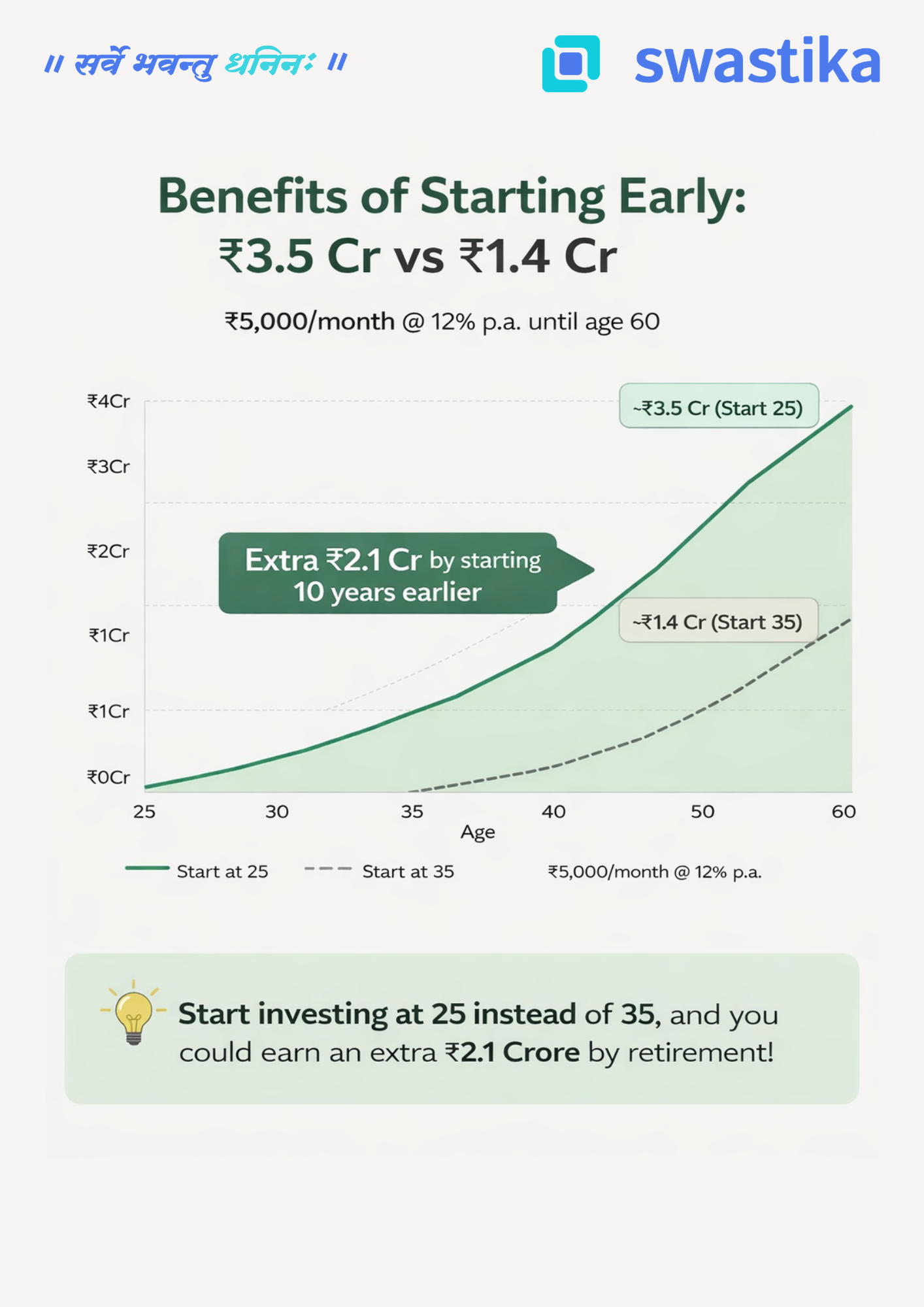
The more years you give your money to grow, the more dramatic — and life-changing — the results become. This is exactly why starting your investment journey early, even with a modest amount, can make a difference of crores by the time you retire.
A Tale of Two Investors: Arjun vs Priya
Let's bring this concept to life with a simple, real-world example.
Meet Arjun and Priya. Both are sensible, disciplined investors. Both invest ₹5,000 every month through a SIP (Systematic Investment Plan) in equity mutual funds, earning an average annual return of 12%. Both stop investing at age 60.
The only difference? Arjun starts at 25. Priya starts at 35.
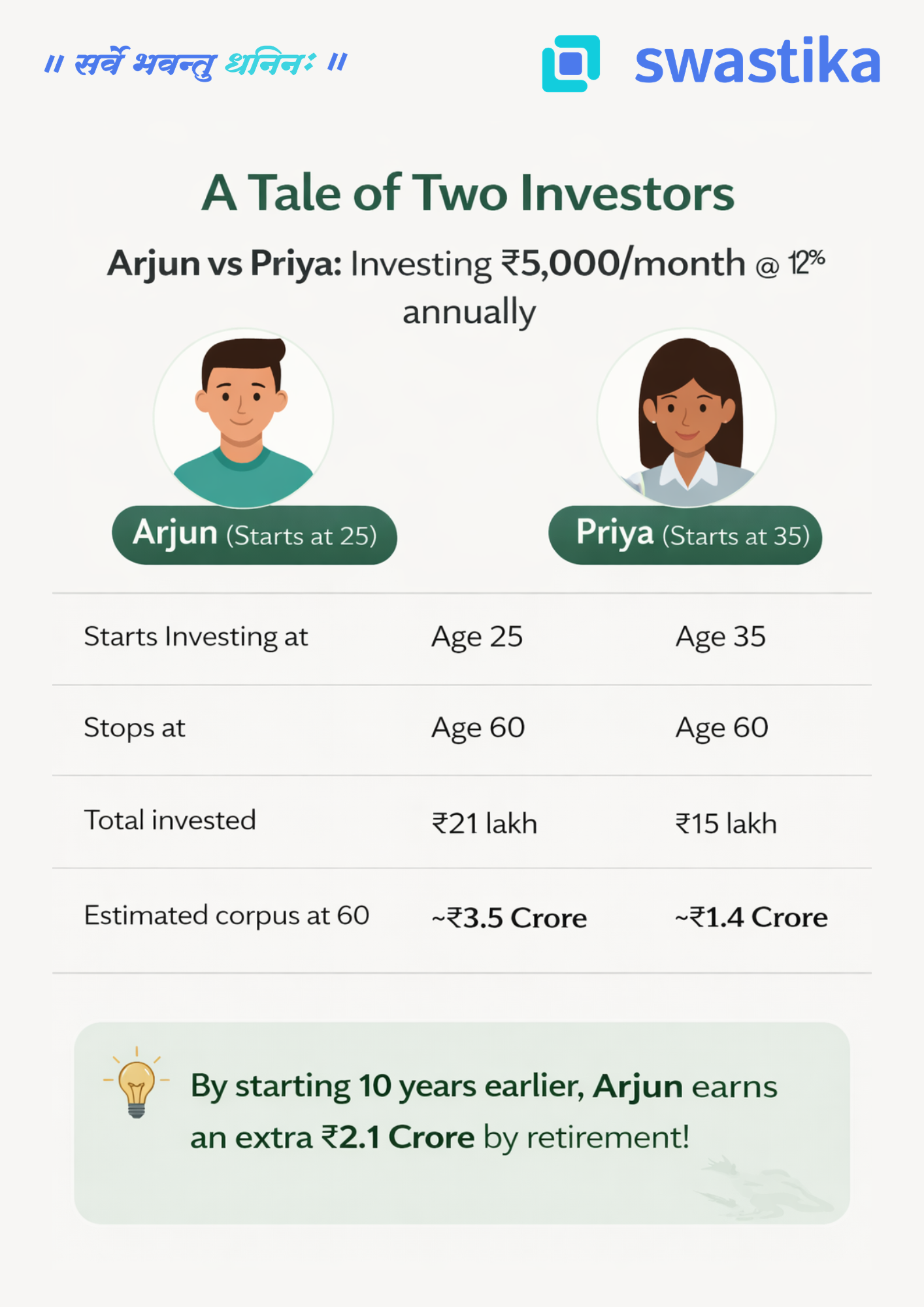
The numbers are striking. Arjun invests just ₹6 lakh more than Priya in absolute terms — yet walks away with ₹2.1 Crore more at retirement.
That extra ₹2.1 Crore didn't come from investing more aggressively or taking bigger risks. It came purely from starting 10 years earlier.
Why Does Time Make Such a Huge Difference?
This is where the magic of compounding reveals itself.
In the early years of investing, growth looks modest and almost unimpressive. But as the years pass, your corpus grows not just on your original investment, but on all the accumulated returns from previous years. The curve goes from almost flat to steeply exponential — and that steep climb happens in the later years.
When Arjun starts at 25, his money has 35 years to ride that exponential curve. Priya's money, starting at 35, only catches the last 25 years — and critically, it misses the steepest part of the climb in the final decade.
Think of it this way: the last 10 years of compounding are worth more than the first 20. That is the counterintuitive truth at the heart of long-term investing.
The Real Cost of Waiting
Many young earners tell themselves, "I'll start investing once I'm more settled — once the salary improves, once the EMI is paid off, once life is a bit easier."
But the numbers show that every year of delay is extraordinarily expensive — far more expensive than any EMI or lifestyle expense. Priya didn't invest carelessly. She invested faithfully for 25 years. Yet she ends up with less than half of what Arjun accumulated — not because she did anything wrong, but simply because she started a decade late.
The cost of waiting 10 years wasn't ₹6 lakh in additional contributions. The cost was ₹2.1 Crore in lost wealth.
Three Principles to Remember
1. Start now, not later.The best time to start investing was yesterday. The second best time is today. Even a SIP of ₹1,000–₹2,000 per month in your 20s is infinitely better than waiting for the "right time."
2. Consistency beats intensity.You don't need to invest large sums all at once. A small, steady, monthly commitment — maintained without interruption — is what unlocks the full power of compounding over decades.
3. Stay invested through market cycles.Compounding works only if you let it work. Exiting during market corrections or stopping your SIP in tough months breaks the chain. Time in the market, not timing the market, is what builds wealth.
The Bottom Line
If you are in your 20s or early 30s, you hold an asset that no amount of money can buy later: time. Use it. Start a SIP today — even a small one. Let compounding do its slow, steady, powerful work.
Because the difference between starting at 25 and starting at 35 is not just 10 years. As Arjun and Priya's story shows, that difference is ₹2.1 Crore.
Big Budget







.webp)
.webp)
.webp)
.webp)
.webp)














.webp)
.webp)
.webp)
.webp)
Latest Articles
Adani Wilmar IPO


Incorporated in 1999, Adani Wilmar limited a joint venture between Adani Group and the Wilmar Group.
Adani Wilmar is an FMCG food company offering most of the essential kitchen commodities for Indian consumers, including edible oil, wheat flour, rice, pulses, and Sugar.
The Company also offers a diverse range of industry essentials, including oleochemicals, castor oil and its derivatives, and de-oiled cakes. The company's products are offered under a diverse range of brands across a broad price spectrum and cater to different customer groups.
The company's product portfolio is categorized into (i) edible oil, (ii) packaged food and FMCG, and (iii) industry essentials.
- "Fortune", the company's flagship brand, is the largest selling edible oil brand in India. Recently the company has included products such as edible oil products, rice bran health oil, fortified foods, ready-to-cook soya chunks, khichdi, etc. in its offerings.
- It is among the top 5 fastest growing packaged food companies in India, based on the growth in revenues during the last five years.
- The company has strong raw material sourcing capabilities and was India's largest importer of crude edible oil as of March 31, 2021. which provided it with bargaining power to source better quality raw materials on favorable commercial terms.
- The company operates 22 plants located across 10 states in India, comprising 10 crushing units and 19 refineries. The company's refinery in Mundra is one of the largest single-location refineries in India with a capacity of 5,000 MT per day.
- The company's distributors are in 28 states and 8 union territories throughout India, catering to over 1.6 million retail outlets. As of September 30, 2021, the company had 88 depots in India, with an aggregate storage space of approx. 1.8 million square feet across the country.
Outlook & Valuation
The Company has shown a strong growth in revenue where it grew from Rs 29,766 cr to Rs 37,195 cr over the period of FY20 to FY21 and during the same period, profit has grown from Rs 460 cr in FY20 to Rs 727 cr in FY21. Again, in the period ended, by September 21, the company reported tremendous growth.
It will be the seventh listed company of the Adani Group, which has already established itself as a brand in the FMCG sector. The company is a leader in branded edible oils and packaged foods in India. The IPO is priced at a P/BV of 7x on a NAV of 28.86 and PE of 36x on its FY21 earnings which are slightly lower than its listed peers. Thus we assign a "SUBSCRIBE" rating to the IPO for listing gain and long term.
KEY MANAGERIAL PERSONNEL
- Mr. Kuok Khoon Hong is the Non-Executive Chairman of the Company. He has over 40 years of experience in the agribusiness industry. He is the co-founder of Wilmar International Limited.
- Mr. Angshu Mallick is the Chief Executive Officer and Managing Director of the Company. He has over 35 years of experience in marketing and sales in the food industry.
- Mr. Shrikant Kanhere is the Chief Financial Officer of the Company. He is a fellow member of Institute of Chartered Accountants of India. He has over 18 years of experience in the field of finance and accounts.
- Mr.Siddhartha Ghosh is the Chief Human Resource Officer of the Company. Previously he also worked at Reliance Industries Limited, Aditya Birla Insulators, Jindal Steel & Power Limited and Coal India Limited.
- Mr. Satendra Aggarwal is the Business Head - Foods & FMCG and Marketing of the Company. Previously he worked as chief operating officer at Ruchi Soya Industries Limited and has also worked at Hindustan Unilever Limited.
- Mr. Ashim Mullick is the Vice President – R&D of the Company. Previously he worked at Tata Chemicals Limited, PepsiCo India Holdings Private Limited, GlaxoSmithKline and has also worked at Hindustan Unilever Limited.
- Mr. Darshil Lakhia is the Company Secretary and Compliance Officer of the Company. He is a member of the Institute of Company Secretaries of India. He has over 14 years of experience in corporate secretarial and other related compliances.
COMPETITIVE STRENGTHS
- Diversified product portfolio with strong brand recall and broad customer reach.
- Leadership in branded edible oil and packaged food business in India.
- Strong raw material sourcing capabilities from top global suppliers.
- Focus on environmental and social sustainability.
- Pan-India distribution network supported by a robust distribution infrastructure.
- Professional management and experienced board.
KEY STRATEGIES
- Become the leading packaged food and FMCG company in India.
- Further expand the distribution network with an omni-channel approach.
- Continue to launch new products and enhance the customer base.
KEY CONCERNS
- Significant dependence on imports of raw materials and/or finished goods in addition to domestic supply.
- Dependence on edible oil segment for a significant portion of revenue.
- Fluctuation in the prices of commodities affects profitability.
- Slowdown or shutdown in its manufacturing operations or under-utilization of its manufacturing facilities.
- Inability to introduce new products and respond to changing consumer preferences in a timely and effective manner.
COMPARISON WITH LISTED INDUSTRY PEERS (AS ON 31ST MARCH 2021)
Name of the Company Total Income for FY2021 (₹ Cr)EPS(Basic)NAV(₹)P/ERoNW (%)Adani Wilmar Ltd37195.76.3728.86[●]22.1% Peer Group Hindustan Unilever Ltd4702834.03202.9969.6316.8%Britannia Industries Ltd13136.177.4148.846.7951.6%Tata Consumer Products Ltd116029.3169.5778.656%Dabur India Ltd9561.79.5843.5759.0522%Marico Ltd80489.0825.2354.0336.8%Nestle India Ltd13350215.98209.4489.73103.1%
FINANCIALS (RESTATED CONSOLIDATED)
Particulars (Rs. In Millions)FY 2021FY 2020FY 2019Equity Share Capital1,142.951,142.951,142.95Other Equity31,838.4624,564.0219,967.12Net Worth32,981.4125,706.9721,110.07Total Borrowings19,040.0823,002.7618,294.56Revenue from Operations370,904.22296,570.36287,974.59EBITDA14,305.5914,194.7512,534.57Profit Before Tax7,566.416,090.135,672.52Net Profit for the year7,276.494,608.723,755.21
DISCLAIMER:
The information contained herein are strictly confidential and are meant solely for the information of the recipient and shall not be altered in any way, transmitted to, copied or distributed, in part or in whole, to any other person or to the media or reproduced in any form, without prior written permission of Swastika Investmart Ltd. (“SIL”). The contents of this document are for information purpose only. This document is not an investment advice and must not alone be taken as the basis for an investment decision. Before taking any decision to invest, the recipient of this document must read carefully the Red Herring Prospectus (“RHP”) issued to know the details of IPO and various risks and uncertainties associated with the investment in the IPO of the Company. All recipients of this document must before acting on the given information/details, make their own investigation and apply independent judgment based on their specific investment objectives and financial position. They can also seek appropriate professional advice from their own legal and tax consultants, advisors, etc. to understand the risks and investment considerations arising from such investment. The investor should possess appropriate resources to analyze such investment and the suitability of such investment to such investor’s particular circumstances before making any decisions on the investment. The Investor shall be solely responsible for any action taken based on this document. SIL shall not be liable for any direct or indirect losses arising from the use of the information contained in this document and accept no responsibility for statements made otherwise issued or any other source of information received by the investor and the investor would be doing so at his/her/its own risk. The information contained in this document should not be construed as forecast or promise or guarantee or assurance of any kind. The investors are not being offered any assurance or guaranteed or fixed returns on their investments. The users of this document must bear in mind that past performances if any, are not indicative of future results. The actual returns on investment may be materially different than the past. Investments in Securities market products and instruments including in the IPO of the Company are highly risky and they are generally not an appropriate avenue for someone with limited resources/ limited investment and low risk tolerance. Such Investments are subject to market risks including, without limitation, price, volatility and liquidity and capital risks. Therefore, the users of this document must carefully consider all the information given in the RHP including the risks factors before making any investment in the Equity Shares of the Company.
Swastika Investmart Ltd or its analysts did not receive any compensation or other benefits from the companies mentioned in the report or third party in connection with preparation of the research report. Accordingly, neither Swastika Investmart Ltd nor Research Analysts have any material conflict of interest at the time of publication of this report. Compensation of our Research Analysts is not based on any specific merchant banking, investment banking or brokerage service transactions. Swastika Investment Ltd may have issued other reports that are inconsistent with and reach different conclusion from the information presented in this report. Research entity has not been engaged in market making activity for the subject company. Research analyst has not served as an officer, director or employee of the subject company. We have not received any compensation/benefits from the Subject Company or third party in connection with the Research Report.
CORPORATE & ADMINISTRATIVE OFFICE - 48, Jaora Compound, M.Y.H. Road, Indore - 452 001 | Phone 0731 - 6644000
Compliance Officer: Ms. Sheetal Duraphe Email: compliance@swastika.co.inPhone: (0731) 6644 241
Swastika Investmart Limited, SEBI Reg. No. : NSE/BSE/MSEI: INZ000192732 Merchant Banking: INM000012102 Investment Adviser: INA000009843 MCX/NCDEX: INZ000072532 CDSL/NSDL: IN-DP-115-2015 RBI Reg. No.: B-03-00174 IRDA Reg. No.: 713.

How to Find the Best Stock Broker in India for Online Trading
According to SEBI requirements, all stock market trades must be placed through a Member of the Exchange - a stock brokerage company. A brokerage house, often known as a broker, is an institution that acts as an intermediary in transactions involving securities such as stocks, mutual funds, ETFs, and others. A top stockbroker will assist you with transactions, and provide investment advice, tax-saving ideas, retirement planning guidance, and asset management services. They will walk you through all the steps required to invest in the stock market.
A conventional stockbroker offers its clients a wide range of services, including trading (stocks, commodities, and currencies), advising, research, asset management, and retirement planning. A conventional broker often allows you to trade a wide range of financial instruments, including Forex trading online, mutual funds, pension plans, insurance, bonds, IPOs, and FDs. Because of these added features, if you wish to hire someone to manage your money and assets, a conventional or full-service broker.
About Our Stock Broking Services
Swastika Investmart is one of India's major full-service stock brokerage firms, serving individual and institutional clients across all capital market categories. Swastika has a strong research staff, a powerful digital online trading platforms Swastika 2.0, a huge branch network, and a franchisee base that helps it to conduct thousands of secondary market deals every day.
Swastika offers a wide range of services, including mutual funds, a wide range of choices for investing in stocks, and derivatives (stocks, commodities, and currencies). Additionally, it provides investment banking services, funding for margin trades, and third-party products like insurance.
Swastika has around 3 lakh accounts for customers and 80 + Branches located all over India. It is a SEBI-registered entity that is registered with the Bombay Stock Exchange (BSE) and the National Stock Exchange (NSE). We are also a depository participant with National Securities Depository Limited (NSDL) and Central Depository Services Limited (CDSL).
Why Swastika
Swastika app
You will get the greatest trading experience possible thanks to the best-in-industry trading app mixed with cutting-edge technology. Swastika app is an Indian stock market trading app that is suitable for both traders and newbies. It is simple to use and free.
When you are ready to begin trading stocks, one of the most important decisions you have to make is selecting a stock broker. With over a dozen share brokers in India offering incredible brokerage services, it might be difficult to find the brokerage business that works best for you. Before you can begin investing, you must register with a brokerage firm that handles all of your transactions. If you are one of the traders looking for the top online brokerage business, then Swastika Investmart might be the right choice for you.
Wide Variety of Investment Options
A top stock broker gives its clients the choice to invest in a wide range of securities, including stocks, bonds, ETFs, futures, options, and real estate investment trusts. Even if you simply want to trade stocks, for the time being, you should still think about the prospect of trading other assets in the future. Your brokerage business should be able to give you information on all of these options.
Research Advice
A top stockbroker in India would provide a wide range of recommendations, including investing and diversification suggestions, retirement plans, and tax-saving strategies. It is critical to select a broker that provides research advice that is valuable to you. When selecting an online stockbroker in India, This is one decision that must be made after careful consideration. The more time you are ready to devote to research, the easier it will be for you to trade in the share market.
24/7 Customer Support
Even experienced investors require assistance at times, therefore it is critical to select a stockbroker that provides the best customer support. Swastika Investmart support team is available 24/7. The helpdesk picks up your call in just 3 rings. This is one of the distinguishing features that make Swastika as an online stock broker stand apart from the best stockbrokers in India.
PAN India presence
If you are a trader who prefers physical places, you should select a stockbroking firm with many branches throughout India. One of the best stock broker in India would is Swastika Investmart which has over 80+ branches throughout India.
Personalized RM
A top stock broker in India would also provide you with a personalized relationship manager that will help you in guiding you through your trades.

मजबूत डॉलर से टूटे सोना-चांदी के भाव
घरेलु वायदा बाजार में सोना पिछले सप्ताह में 1000 रुपये और चांदी 3400 रुपये टूट गई जिससे सोने के भाव 47800 रुपये प्रति दस ग्राम और चांदी 61600 रुपये प्रति किलो के स्तरों पर पहुंच गए। फेड द्वारा ब्याज दरे जल्दी बढ़ाने के संकेत से सोने के विपरीत दिशा में चलने वाला डॉलर, पिछले सप्ताह करीब 2 प्रतिशत तेज़ हुआ और अमेरिकी बॉन्ड यील्ड भी 1.82 प्रतिशत के ऊपर निकल गई। हालांकि, वर्ल्ड गोल्ड कॉउंसिल ( डब्ल्यूजीसी ) के मुताबिक 2021 में सोने की मांग अच्छी रहने के बावजूद 2022 में इसकी मांग में और भी इजाफा होने का अनुमान लगाया है।
डब्ल्यूजीसी के भारतीय ऑपरेशन के क्षेत्रीय मुख्य कार्यकारी अधिकारी ने कहा कि इस साल सोने की खपत छह साल के उच्चतम स्तर 800 से 850 टन तक पहुंचने की संभावना है, जबकि 2021 में 797.3 टन थी और पांच साल की औसत खपत 667 टन है। भारत की सोने की खपत में पिछले साल 79 प्रतिशत की बढ़ोतरी दर्ज की गई है। डब्ल्यूजीसी की दिसंबर रिपोर्ट के मुताबिक भारत में उच्च आयात शुल्क होने के बावजूद सोने का आयात बढ़ा है और ज्वेलरी की मांग एक दशक में दोगुना हो चुकी है।
भारत में कीमती धातुओं को लेकर नई नीति का निर्धारण और उन्नत तकनीक लाने से इनमे पारदर्शिता बढ़ेगी जो एसेट क्लास के रूप में सोने के लिए महत्वपूर्ण होगी। कच्चे तेल में आपूर्ति पहले से बाधित है साथ ही रूस और यूक्रेन के बीच तनाव बढ़ने से तेल और गैस की आपुर्ती में आगे भी बाधा उत्पन्न होने की सम्भावना के चलते इनके भाव में लगातार बढ़ोतरी हो रही है जिससे मुद्रास्फीति भी बढ़ने के अनुमान है। भूराजनितिक तनाव में आगे भी बढ़ोतरी हुई तो यह सोने और चांदी को निचले स्तरों पर सपोर्ट कर सकता है।
सप्ताह के आर्थिक घटक
चीन में इस सप्ताह स्प्रिंग फेस्टिवल होने से बाजार बंद रहेंगे। बुधवार को ओपेक-नॉन ओपेक देशो की बैठक, गुरुवार को बैंक ऑफ़ इंग्लैंड और यूरोपियन सेंट्रल बैंक की मौद्रिक नीति और शुक्रवार को अमेरिकी पैरोल के आंकड़े महत्वपूर्ण है।
तकनिकी विश्लेषण
सोने और चांदी के भाव इस सप्ताह अस्थिरता के साथ दबाव में रह सकते है। सोने को 47300 रुपये पर सपोर्ट और 48300 रुपये पर प्रतिरोध है। चांदी को 60000 रुपये पर सपोर्ट और 63000 रुपये पर प्रतिरोध है।

How to Check the Credibility of Companies Before Investing
Investing in a company is a big decision, and it’s important to ensure that the company you’re considering is credible and trustworthy. This blog will guide you through simple steps to check the credibility of a company before you invest your hard-earned money.
1. Understand the Company’s Business Model
Before investing, it’s crucial to understand how the company makes money. Look at what products or services they offer, who their customers are, and how they stand out from their competitors. A clear and sustainable business model is a good sign that the company is reliable.
2. Review Financial Statements
A company’s financial health is a strong indicator of its credibility. Look at the company’s financial statements, including the balance sheet, income statement, and cash flow statement. Focus on the following:
- Revenue Growth: Is the company’s revenue increasing over time?
- Profit Margins: Is the company making a healthy profit?
- Debt Levels: Does the company have manageable debt?
You can find these financial statements on the company’s website, in their annual reports, or on financial news websites.
3. Check the Company’s Credit Rating
Credit rating agencies like CRISIL, ICRA, or CARE provide ratings that reflect the company’s creditworthiness. A higher credit rating indicates that the company is more likely to meet its debt obligations, which is a good sign of financial stability.
4. Research the Management Team
The company’s leadership plays a critical role in its success. Research the background of the CEO and other key executives. Look for:
- Experience: Do they have a strong track record in the industry?
- Reputation: Have they been involved in any scandals or unethical practices?
- Stability: Frequent changes in leadership can be a red flag.
5. Analyze Industry Position
Understanding how the company fits within its industry can give you insights into its potential for long-term success. Consider:
- Market Share: Is the company a leader in its industry?
- Competitive Advantage: Does it have unique strengths that give it an edge over competitors?
- Industry Trends: Is the industry growing, and does the company adapt well to changes?
6. Examine Stock Performance
While past stock performance doesn’t guarantee future results, it can provide useful insights. Look at the company’s stock price trends over time. Has it been stable, or has it been volatile? Consistent performance is generally a positive sign.
7. Read Analyst Reports
Financial analysts often provide detailed reports on companies, including their strengths, weaknesses, and future prospects. Reading these reports can give you a well-rounded view of the company’s credibility and potential.
8. Check for Legal Issues
A company with frequent legal issues or regulatory violations may not be a safe investment. Look up news articles, legal filings, or regulatory actions against the company. A clean legal history is a good indicator of credibility.
9. Look at Customer Reviews
Customer satisfaction can also be a measure of a company’s credibility. Look for reviews and testimonials from customers. A company with positive feedback and a strong reputation for quality and service is more likely to be trustworthy.
10. Assess Dividend History
If the company pays dividends, check its dividend history. Consistent dividend payments, especially during tough economic times, indicate a strong and reliable company.
11. Evaluate Corporate Governance
Good corporate governance practices ensure that a company is run in a fair, transparent, and accountable manner. Look at the company’s board structure, policies on executive compensation, and how they handle shareholder concerns. Companies with strong governance are usually more credible.
12. Check Insider Trading Activity
Insider trading refers to the buying or selling of a company’s stock by people within the company, like executives. Frequent insider selling might indicate that those who know the company best have concerns about its future.
Conclusion
Checking the credibility of a company before investing is essential to avoid potential risks. By following these simple steps—understanding the business model, reviewing financials, researching the management team, and more—you can make smart decisions and invest with confidence. Remember, a credible company is more likely to provide stable returns and long-term growth, making your investment worthwhile.

मुद्रास्फीति और भू-राजनीतिक मामलो से चमके सोना-चाँदी
पिछले सप्ताह अब तक सोने में लगभग 1.6 प्रतिशत तक की तेज़ी हुई और जनवरी में सोना लगातार दूसरे साप्ताहिक लाभ के लिए तैयार रहा। हालांकि 2022 में इसकी सकारात्मक शुरुआत हुई है, लेकिन यह सोने के लिए एक कठिन वर्ष हो सकता है। क्योकि ज्यादातर प्रमुख केंद्रीय बैंक ब्याज दरे बढ़ाने के लिए तैयार है।
हालांकि कीमती धातुओं के निवेशकों ने अमेरिकी. फेडरल रिजर्व के नीतिगत फैसले को अब तक पचा लिया है जिससे कीमती धातुओं ने लगातार दूसरे सप्ताह भी बढ़त दर्ज की है। निवेशक अब फेड के अगले नीतिगत फैसले का इंतजार कर रहे हैं, जो इस सप्ताह 26 जनवरी को दिया जाएगा। आर्थिक आकड़ो के मोर्चे पर, गुरुवार को जारी अमेरिकी आंकड़ों के मुताबिक पूरे सप्ताह में 286000 प्रारंभिक बेरोजगार दावे दायर किए गए, जो तीन महीने का उच्च स्तर है। जनवरी में फिलाडेल्फिया फेडरल रिजर्व मैन्युफैक्चरिंग इंडेक्स बढ़ कर 23.2 रहा। मौजूदा घरेलू बिक्री घट कर 6.18 मिलियन पर रही। चीन के तिमाही जीडीपी के आंकड़े अनुमान से बेहतर दर्ज किये गए। जापान से जारी आंकड़ों के मुताबिक राष्ट्रीय मुख्य उपभोक्ता मूल्य सूचकांक में साल-दर-साल 0.5 प्रतिशत की वृद्धि हुई है और राष्ट्रीय सीपीआई में दिसंबर में साल-दर-साल 0.8 प्रतिशत की वृद्धि हुई है। ब्रिटैन से जारी हुए मुद्रास्फीति (सीपीआई) के आकड़ो में भी वृद्धि दर्ज की गई है। कच्चे तेल के भाव में पिछले सप्ताह ₹250 रुपये प्रति बैरल की वृद्धि देखि गई। बढ़ते हुए कच्चे तेल के भाव से एक बार फिर मुद्रास्फीति बढ़ने का डर निवेशकों में रहा जिसके कारण शेयर बाज़ारो में बिकवाली का दबाव बना रहा और कीमती धातुओं में सुरक्षित निवेश की मांग मजबूत हुई है। रूस और यूक्रेन के बीच तनाव और ब्रिटैन में चल रही राजनितिक उठा पटक, कीमती धातुओं को सपोर्ट कर रही है। चीन ने पिछले सप्ताह अपनी एक और पांच साल की लोन प्राइम रेट पर कटौती कर दी और बैंक ऑफ़ चाइना के वाईस गवर्नर ने आगे भी राहत पैकेज देने के संकेत देकर बाजार की उम्मीद को बढ़ाया है। जिससे कीमती धातुओं की चमक बढ़ने लगी है।
तकनिकी विश्लेषण
सोने और चांदी के भाव इस सप्ताह अमेरिकी फ़ेडरल बैंक की बैठक होने से, सीमित दायरे में रह सकते है। सोने को ₹47000 रुपये पर सपोर्ट और ₹47800 रुपये पर प्रतिरोध है। चांदी को ₹63000 रुपये पर सपोर्ट और ₹66000 रुपये पर प्रतिरोध है।
How IPO Listing Price is Decided
There has been a lot of buzz in the stock market about IPOs as many IPOs came in the year 2021 and gave extraordinary returns to their shareholders.
Also, people take much interest in IPOs as they find them as a major investment product and provide new hopes to the people.
In other words, investors find new investment hope in these IPOs and as a result of this, the IPO of Zomato, which opened on July 14, was subscribed 1.05 times on the first day of its launching.
The retail investors subscribed to the Zomato IPO almost 2.69 times which is a history in itself. If we talk about the non-institutional investors, then they have put in bids of 13 per cent against the reservation which is a difficult thing to forget in the history of SME-IPOs.
Here, an important question often comes to the investor’s mind: How did the listing price of an IPO decide?
Before getting a dig deep into the whole scenario, let's take a sneak peek at the listing price:
What is the Listing Price?
When a private limited company wants to become public for the very first time, it needs to get its stock listed on the major stock exchanges. To complete a process, the company is required to decide the opening price of shares which is known as the listing price.
The launching period of IPO is of three days and post that the investors are allowed to purchase the shares at a given price. Here, the listing comes into place.
Please note that the allocation of shares takes place only after IPO launching.
The IPO listing price is different from the offer price and is decided majorly by the investment bank which is assisting the company during the IPO launching process.
After the successful launching of an IPO on the stock exchange, it becomes available for every shareholder to trade in the stock market.
Now, the shareholders can be actively involved in buying and selling shares in the secondary market.
How Is The IPO Listing Price Determined?
Several factors will impact how the good IPO gets listed on the stock exchange and how does it affect the IPO listing price:
1.Demand
Demand for a share makes a huge impact on the listing price of an IPO. Hence, the IPO price is also affected by the market demand of the company as the higher the demand, the higher will be the listing price.
The demand for the SME-IPO is affected by numerous factors including the potentiality of a company, its expected valuation, growth sector and more.
Let’s understand the listing process with a suitable example:
If the demand for an IPO is higher, then the chance of that IPO getting oversubscribed more, which in turn makes few of many get a chance to subscribe to it. If it is oversubscribed, many investors will get deprived of the IPO allotment process, and hence the demand surge.
The rising demand makes the IPO firm increase its listing price and hence more investors will trade it in the stock market.
Hence, a high demand, low availability of shares can result in great listing prices and hence great listing gains or vice-versa.
2. Growth Prospects of the Company
The listing price of an IPO is also affected by the growth prospects of a company. For instance, a company that wants to launch its IPO often comes with several objectives like paying debts, operational costs, which also plays a major role in the listing prices.
If a company comes with the objectives of growing and expanding its businesses, the majority of the retail investors will look forward to the same.
This will increase the orders, which in turn increase the demand of the IPO which eventually increases its listing price. The company is likely to list at a good price if there are any chances for good growth.
3. Grey Market Premium
A grey market is a place that is considered under regulated but often gets highlighted when it comes to a demand for IPO. It is the extra amount investors pay along with the offer price.
For example: if the offer price of an IPO is Rs 150 and its GMP is Rs 50. This indicated that the investor is willing to pay Rs 200 for the same IPO in the grey market.
4. The OFS (Offer for Sale) Value
An offer to sell an IPO indicates the number of shares that existing investors are willing to dilute in the IPO.
If OFS is more than a fresh issue, it certainly means that there is a reason why current investors no longer want to be part of the company.
This can be a turn-off for some investors. However, this is not always the case. If a company has high growth potential, it can prosper.
However, a large OFS value can adversely affect the list price.
5. Market Sentiments
Retail investors play a crucial role in deciding the IPO listing price. As more retailers are looking for an IPO, it further results in deciding the listing price.
A comparative analysis of the stock market analysts can also affect the market sentiments to a greater extent. If the investors are looking interested in a particular IPO and the market sentiments are positive, it is a good indication.
However, if there is a lack of interest of the retail investors, there are higher chances that the IPO listing price is considered low.
These are various factors that have a significant impact on the listing price of an IPO.
Therefore, always keep these factors in mind if you don't know how to choose an IPO listing time in India.
Conclusion
Good IPO listings are those which can give you attractive profits and also help you to increase the visibility of the company.
As stated above, numerous factors help promoters find the listing price of the company which includes investors’ interest, GMP, company valuation and most importantly the demand and supply of an IPO.


.webp)
.webp)
.webp)





START YOUR INVESTMENT JOURNEY
Get personalized advice from our experts
- Dedicated RM Support
- Smooth and Fast Trading App
