

Sensex Rises 790 Points - Should You Buy Now?


Sensex Rises 790 Points - Should You Buy Now?
TLDR
- Sensex recovers 790 points from the day’s low; Nifty closes above 23,650 as oil slips below $110 and bond yields ease.
- Rupee hits a fresh record low while foreign investors resume selling Indian equities, signaling continued currency risk.
- Top sector watch: Financials and IT; avoid real estate for now due to rate and currency sensitivity.
- Action: review your portfolio, maintain diversification, and consider measured deployment if you have a long horizon.
News Context and Market Impact
What Happened
The Sensex rebounded about 790 points from the day’s low, with the Nifty closing above 23,650. Oil prices slipped below $110 per barrel, aiding risk sentiment. Bond yields eased from recent highs, while the Rupee hit a fresh all-time low against the US dollar. Foreign institutions resumed selling Indian equities, keeping macro headwinds in view. Your portfolio may see a pullback in volatility, but currency and FII flows could cap gains.
Why This Matters
In the short term, this bounce reflects improved risk appetite even as macro overhangs persist. A weaker rupee can affect import costs and margins for listed firms, while softer yields can support equity valuations in rate-sensitive segments. For you, the key takeaway is that the market may move in fits and starts; stay nimble and avoid chasing momentum in individual names.
Portfolio and Strategy Focus
What This Means For Your Portfolio
For retail investors, the rebound offers a chance to recheck asset allocation. Favor quality large-cap names in banks and financials, and select IT exporters that can benefit from a softer rupee. Maintain diversification to cushion volatility and consider a modest hedge if your USD exposure is significant. Your risk controls should tighten when markets rally to prevent overexposure to any single name.
Swastika Investmart notes that retail investors should anchor to quality names and maintain diversified exposure during rebound periods. With currency moves and foreign flows in play, disciplined risk management and a long-term perspective remain essential for your portfolio.
Sectors To Watch - Priority Order
- 1st Priority: Financials - higher chance of leading gains as yields stabilize and loan growth supports profits
- 2nd Priority: IT - exporters benefit from rupee dynamics and potential earnings resilience
- Avoid Now: Real Estate - sensitivity to rates and foreign flow pressures
Action Points For Investors
- SIP investors: Continue disciplined monthly investments across broad-market funds to ride the rebound with risk control
- Lumpsum investors: If you have a long horizon, selectively add to high-quality financials or IT names while keeping stops
- Traders: Focus on liquidity and price action; use tight stops and avoid chasing momentum in mid-caps
In the current backdrop, a measured approach serves you best; avoid panic moves and stick to your plan rather than market rumors.
Risks and Cautions
Key Risks To Watch
- Continued rupee volatility could keep markets choppy, hurting sentiment and returns
- Persistent FII selling may cap upside momentum despite a rebound
- Oil price reversals or mixed macro data could reprice valuations quickly
Frequently Asked Questions
How will the Sensex rebound affect my portfolio?
The rebound can lift near-term holdings, especially large caps, but it doesn’t replace a solid plan—keep diversification and avoid over-concentration in momentum bets.
Is a weak rupee a risk for investments?
Rupee weakness usually benefits IT exporters and some importers; hedge if you have significant USD revenue exposure and monitor margins.
Which sectors look promising in this rebound?
Financials and IT may lead the rally if earnings hold up and currency moves stay favorable; stay selective and focus on quality names.
What should I do today about currency risk and foreign flows?
Review currency hedges and your USD exposure; rebalance toward diversified, high-quality stocks and maintain a cash reserve for liquidity needs.
Conclusion
The rebound presents opportunities in large-cap financials and IT, but currency volatility and ongoing foreign selling means you should stay diversified, use hedges where appropriate, and deploy capital in a measured, long-term manner.
Big Budget




.avif)
.avif)
.avif)
.avif)
.avif)












.avif)
.avif)
.avif)
.avif)
Latest Articles

Delta Variant Creates Emerging Market Gap as Outperformance Hits


The new delta variant of Covid 19, has gained much attention these days, as it is heavily spreading across numerous countries worldwide. The new variant, identified in India, is already spread in the U.K. and is growing rapidly in other services including Italy, France, and Germany. On Wednesday, The WHO said that the new variant has been detected in 96 countries while the Department of Disease Control and Prevention in the US called this variant a matter of concern as of June month, it accounts for 20% of all US cases. A handful of emerging market currencies have achieved many profits as compared to dollars this year. However, you may see the list may shrink as the excessive contagious delta variant heavily impacts the economies of developing countries. According to Credit Agricole CIB, countries that are already lagging in the vaccination rates may feel the pressure because they have already put restrictions that may hurt the economic activities of developing nations like South Africa. The best performers of 2021, the rand and rubble, were among the first that knocked an index of emerging market currencies lower in June for the first time in three months. Sebastien Barbe, the head of emerging market strategy at Credit Agricole, said that the achievement in terms of vaccination will be a differentiation factor among emerging markets in the second half. The impact of the further spread of this delta variant will significantly vary on the vaccination rates, and several economic and political factors, he added. Both the South African rand and Colombian Peso are currently experiencing the pain from a spike during the Covid 19 cases, which is keeping expectations for tiger monetary policy at bay. It also affected their economies: strict restrictions drastically affected African economic activities, Colombia, on the other hand, decided to postpone the plan to raise taxes to combat the crisis generated from the new variant.As per Al-Hussaini, a senior interest rate and currency analyst, the currencies of South Africa and Columbia, the weaker as compared to other countries. This is because the central banks of South Africa and Columbia have failed to hike interest rates so that they can build up a real rate cushion against the U.S.He further said: the prospect of higher fiscal spending and the risk of global outflows post-yield-hungry global investors flocked to the nations’ assets this year.If we compare the former two countries with Brazil and Mexico, then the peso will be more flexible because they kept their bank policy more strict than other countries.The real has outperformed all the developing nations even as the Covid 19 cases remains high. The consistent spread of new variant strain on Southeast Asia. MUFG Bank Limited expects a slight decline in the tourism revenue on Thailand’s baht.At the same time, Indonesia’s rupiah experienced a drastic fall since April, as the country imposed the strictest curbs yet on the economic centres of Java and Bali.
Deepening Divisions
Only a few developing nations - Chile, Israel, China and UAE and Central Eastern European countries - have successfully vaccinated half of their populations, which gives us an idea to control the spreading of the Delta variant," Bank of America Corp. said once in a report last Friday. Most major emerging markets should get there by year-end that includes Indonesia, Mexico, Turkey, Brazil, India said David Hauner, head of cross-asset strategy at Bofa. South Africa is the outlier, as only 5% of its population is vaccinated. As per the current situation, it would take around 2023, for the nation to reach 50%. In Columbia, approximately 11% of the total population gets vaccinated - a lower proportion than Chile, Brazil and Mexico. Economic data bears out the division: purchasing managers’ indexes in Russia and South Africa, along with those in Asian regions with relatively low vaccination rates, fell in June. Those in Eastern Europe and Latin America, where vaccination programs are more advanced, mostly rose.This may put pressure on developing-nation central banks to remain accommodative, another negative for the currencies because the federal reserve has discussed the withdrawal of stimulus.As it could heavily create the distance between emerging and developed markets.Many industrialized nations such as the U.K. continue to struggle to combat the virus despite having tight restrictions and ease of vaccine availability. Hence, the latest surge in infections in many developing countries is not driven by the new strain which in turn said that outcomes could be far worse now.Copenhagen based senior macro strategist, Witold Bahrke said: "We are watching the resurgence of infection numbers closely. It is one of the factors that lead us to EM currencies, mainly due to its potential impact on the growth of EM-DM.
Status Quo
Central bankers in Peru, Poland, Malaysia, and Romania are requested to keep borrowing costs at their current levels. Romanian policymakers are advised to keep the nation’s benchmark rate at 1.25%. The leu has slumped 4.2% in 2021.Another day, Malaysia’s central bank is requested to hold its policy rate at a record low of 1.75%, thus maintaining an accommodative stance after the government announced a new fiscal package worth $36 billion last week. On Thursday, Peruvian policymakers expected to keep the country’s benchmark rate at a record low of 0.25%. However, they might take a more cautious tone in their statement after a higher than expected inflation last week.
Inflation Clues
Inflation is due from countries like Thailand, the Philippines and Taiwan on Wednesday. On Friday, China is all set to publish gauges of consumer and producer price inflation. According to Bloomberg's intelligence report, China’s PPI may cool from a 13 month high of 9% in May due to the price fall of metal ore and coal. Taiwan will soon post foreign reserve data on Monday, followed by Indonesia, China, and Malaysia. On Thursday, Thailand will submit foreign reserves data to the respective authorities.

मिले-जुले वैश्विक रुझान से सोने और चांदी के भाव में सुधार।
पिछले सप्ताह सोना एक हफ्ते के निचले स्तर पर पहुंच गया। मजबूत डॉलर और बढ़ती जोखिम की क्षमता के बीच बढ़ते कोवीड -19 मामलों पर चिंता कम हो गई जिससे निवेशकों के लिए सोने की सेफ हेवन अपील को कम कर दिया है। बढ़ते शेयर बाज़ारो में भी डेल्टा संस्करण की चिंता को नज़र अंदाज़ कर दिया और जोखिम की तरफ निवेशकों का रुझान बना।सोने की कीमतें दबाव में हैं क्योंकि डॉलर अब तीन महीने के उच्चतम स्तर के आसपास मँडरा रहा है और शेयर बाज़ारो ने दूसरे दिन भी तेज़ी को बरक़रार रखा जिसका अर्थ है कि व्यापारी कोवीड -19 चिंताओं को दूर कर रहे हैं और पुनः मुद्रास्फीति बढ़ने की स्थिति बन रही है। लेकिन यूरोपियन सेंट्रल बैंक की बैठक के बाद सोने और चांदी में निचले स्तरों से सुधार देखा गया है।जिसमे उन्होंने अपने नीतिगत फैसले को सौंपते हुए ब्याज दरों को रिकॉर्ड निचले स्तर पर और भी अधिक समय तक बनाए रखने का वादा किया और मुद्रास्फीति पर माध्यम अवधि के लिए अपना नजरिया लक्ष्य के निचे रहना बताया।अमेरिका के आर्थिक आंकड़े पिछले सप्ताह कमजोर दर्ज किये गए और बांड यील्ड में भी निचले स्तरों से उछाल दर्ज किया गया जिससे डॉलर इंडेक्स में मजबूती रही और सोना-चांदी में बढ़त सीमित हो गई।इस सप्ताह अमेरिकी फ़ेडरल रिज़र्व बैंक की बैठक, सोने और चांदी के भाव के लिए एक महत्वपूर्ण ट्रिगर होगा। घरेलु वायदा सोना पिछले सप्ताह 2 प्रतिशत टूट कर 47600 रुपये प्रति दस ग्राम पर रहा। चांदी में 1.5 प्रतिशत की साप्ताहिक मंदी दर्ज की गई है।
तकनीकी विश्लेषण
इस सप्ताह सोना और चांदी के भाव में निचले स्तरों से उछाल आने की संभावना है। सोने में 46600 रुपये पर सपोर्ट है और 48000 रुपये पर प्रतिरोध है। चांदी में 66000 रुपये पर सपोर्ट और 68400 रुपये पर प्रतिरोध है।

Trading on Equity
Stock market on the one hand ropes in fundamental capital required by the companies and on the other hand it allows the buyers to enjoy ownership in businesses with the potential of availing gain in dividends form which would be in accordance with the company’s future performance. Therefore, it can be referred to as the core of the economic system.
Trading on equity with the purpose of investing is buying and selling company stock shares. The shares of distinct publicly traded companies are traded via a stock exchange or over the counter markets. Trading on Equity is a kind of trade-off. The firm makes use of its financing of debt or equity to buy new assets. In turn, it makes use of its new assets to pay for or finance its debt and equity obligations.
Trading on equity is carried out on two markets viz. The primary or the main markets – whereby new issues are first offered. The secondary markets – whereby subsequent buying and selling takes place.
Many buyers who assume common stock are too unstable are fascinated by the advantages of preferred shares. Depending on the company issuing preference shares is considered to be a good option rather than taking on greater debt.
With equity investors, there are no interest obligations and relying on the classification of shares being issued dividends don’t have to be paid annually. This approves the enterprise to reap the capital of which it wishes to increase besides on the spot money outlays for interest. It additionally provides the business enterprise time to make earnings with the new assets.
OBJECTIVES
- It is a means to raise fixed cost capital which is the combination of borrowed capital and preference share capital retaining equity share capital as the base to facilitate an increase in earnings of equity shareholders.
- It is when the organization is in contrast to the value of the interest of the debt.
- Incurs new money owed to gather assets which allow the corporation to earn a larger quantity of return.
TYPES
Trading on Thin Equity: If the equity capital is less than the debt capital of a company.
Trading on Thick Equity: If the equity capital is more than the debt capital of a company.
ADVANTAGES
- Payment of Dividend on higher rates
- With dividends, an individual Minimize his Tax Burden
- It results in an increase in Goodwill of the Company
- There is a Control on financial Sources hence the business also does not suffer
DISADVANTAGES
- The income is uncertain
- There might be a low rate of return
- Loan on the high rate of interest.
- There is fear of Over Capitalization.
- Under intervention of Loan providers.
DIFFERENT BETWEEN TRADING ON EQUITY AND EQUITY TRADING:-
Trading on equity is a simple approach in which the percentage of debt contents is increased in capital structure, however equity trading is buying and selling of shares in the stock market.
Investors are fascinated to buy shares whose rate of Interest is greater than fixed interest charges due to the fact investors can earn extra quantity of income in the form of dividends and it will additionally expand the price of shares.
TRADING ON EQUITY AND FINANCIAL LEVERAGE:-
Leverage means power. If an organization buys assets and its buy price is paid through getting a loan, then this system of trading on equity is known as financial leverage. Business enterprises do so because they are aware that the return on investment (ROI) is greater than fixed interest charges.
The company's tries to increase its financial power by purchasing all assets with the help of long term debt in order to earn a greater amount of profits with this system.
It is a well-known fact that option holders are always in all likelihood to cash in their options when there is a rise in earnings.
For this particular reason, buying and selling on equity leads to extra earnings, there are extra possibilities that options will earn a greater return for the holder. Since trading on equity may also lead to uneven earnings, it will increase the already known price of stock options.
The managers (not owners) are more likely to use such an option. Using the concept, managers have the danger of raising the price of stock options. On the other hand, family-run commercial enterprises will exhibit greater interest in financial stability, so they would keep away from this financing technique.
Primary Market
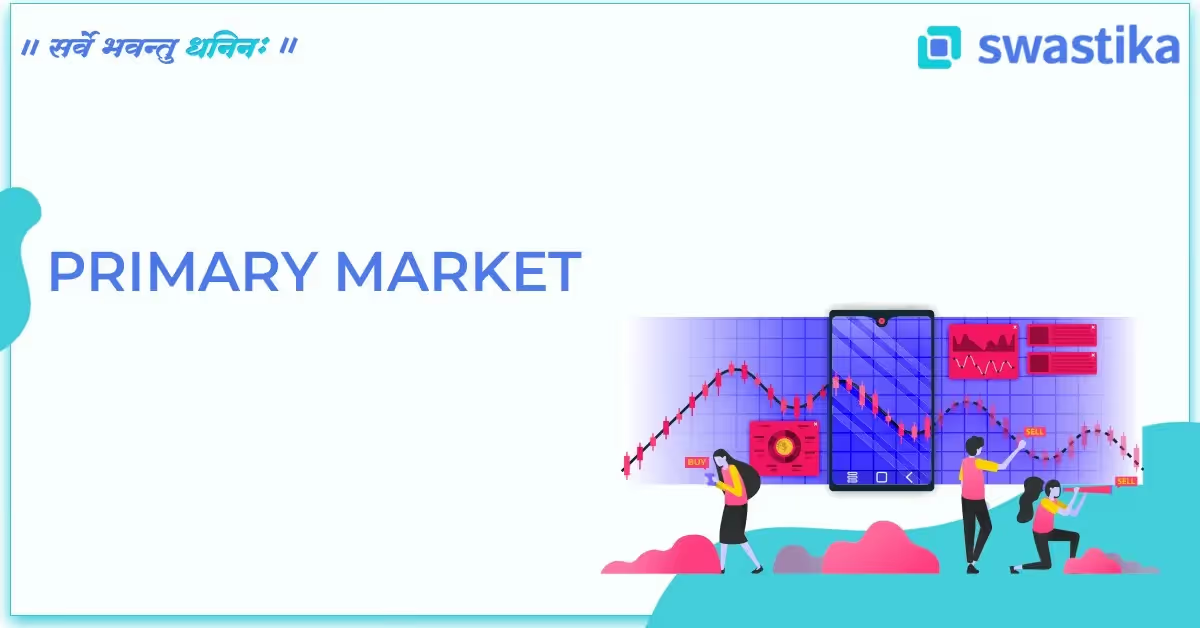
In the Primary or the New Issue Market, new issues of securities are raised, which are issued to the public for the first time. It is used by new and present companies. The company issues new shares and debentures for gathering lengthy-time period funds. The issue of securities is made thru the prospectus.
The purchaser of new shares and debentures can also be businessmen, clients of the company, personnel of the company, current shareholders, etc.
BENEFITS
- Less Price manipulation while in comparison to the secondary market.
- There is no brokerage payment, transaction fees, etc
- Market fluctuations do not affect it
- It helps in the diversification of the portfolio
- It helps in raising capital for the companies
- Investors get the share at the same prices
- It helps in cost Reduction
KEY PLAYERS
- Corporations - They require funds to grow and run their operations
- Institutions referred to as “Buy Side” Fund Managers
- Investment Banks are referred to as the “Sell Side”
- Public Accounting Firms
FUNCTIONING OF PRIMARY MARKETS
It enables capital formation through channelizing money from personal savers into perfect productive investments. It consists of a company, an investor, and an underwriter.
The company issues IPO: The securities for the first time are issued in the primary market. This system is acknowledged as an Initial Public Offering IPO. Since the securities are bought for the first time, the primary market is recognized as the New Issue Market.
Role of the underwriter: It is a whole method of raising capital by way of promoting new stock to investors through an IPO. The underwriter then decides the sale price of the new issue of securities. The underwriter enables and monitors the new issue offering. Financial establishments such as funding banks, insurance plan companies, and so on provide underwriting services.
Investors: They are the purchasers of the new securities in the primary market
PREREQUISITES FOR INVESTORS:
- PAN Number
- Bank Account
- Demat Account
TYPES OF ISSUES
Public Offering: A public offering happens when a listed company makes an offer document. The document may be of the fresh issue of securities or an offer for sale to the public.
Rights Issue: The right Issue is when a listed company issue fresh securities to the existing shareholder. It is best suitable for companies that would like to raise capital to fund their operations or looking for better growth opportunities.
Private Placement / Preferential Issue: Private placement is basically an issue of shares or convertible securities by listed companies which is neither a right issue nor a public issue. It is an effective way for the company to raise equity capital.
ROLE AND FEATURES OF PRIMARY MARKET:
- Organization
- Underwriting
- Distribution
1) The Organization of New Issues:
There are two types of investigation that are carried out:
The preliminary investigation includes designated learning about economical, financial, legal, and technical factors to make certain the soundness of the project.
The structure of financial arrangements involves requirements and availability of promoter’s equity, equity from the public, different ratios, and overseas exchange requirements.
The service provider bankers can be banks, financial institutions, private funding firms, etc.
An essential component of the company of new shares is the information about adequacy and structure of financial arrangements.
The second feature is carried out via sponsoring institutions. They supply advisory services. The advisory carrier includes Types of issue, Thug, Pricing, Methods of issue, etc.
2) Underwriting of New Issues:
The underwriting means guaranteed buy of a targeted quantity of new issues at a fixed price. The buy may additionally be for sale to the public, for solely one’s portfolio or for each purpose. Minimum subscription is assured by using underwriters. If the issue is absolutely subscribed, no legal responsibility would be left for the underwriters.
If the underwriter fails to promote the assured quantity of shares to the public, it will have to buy the unsold shares via itself. They can be banks or economic establishments or specialized underwriting firms.
3) Distribution of New Issue:
Distribution of new issues means the sale of the stock to the public. The distribution job is finally hand over to brokers and dealers. The stock broker or dealers hold direct contact with the supreme investors.
DISADVANTAGES
- During over subscription, small investors don't get an allocation.
- Money gets locked in for a long time.
- Quite expensive
- Disclosure of information
- Decision’s take time

Zomato IPO Review That You All Need to Know
Last week the Indian stock market was very interesting! The reason is the Zomato IPO. Needless to say, the much-awaited IPO knocked at your door last week!
Started as Foodiebay Online Service Private Limited, in 2008 by two IIT students Deepinder Goyal and Pankaj Chaddah, the company has grown much which is now extended to 24 countries.
As per the sources, Zomato brought a revolution to the Indian stock market. An Indian startup is a leading Online Food Service Company in terms of food sold as of December 31, 2020.
The company offers business customer services mainly food delivery and dine out where customers can search and find out the location of restaurants, restaurant menu, order food delivery, make payments for the online delivery etc.
Before we move ahead, we want you to go through the complete analysis of Zomato DRHP. It will give you an idea of the company's business and financials.
In this blog, we take a dig deep into Zomato’s IPO.
Brief Profile on Zomato IPO
Zomato Ltd is a leading online food service company in India that connects restaurants, customers and delivery partners. Zomato mainly works on business to consumer segment or B2C that offers online food delivery and dining out services. It allows customers to easily search, find restaurants, reserve a table, order online food and make payments through Zomato’s mobile application.
Zomato’s other B2B or business-to-business services generate revenue from Hyper pure. It supplies high-quality ingredients and kitchen products and restaurants. Also, it enables restaurants to buy fruits, vegetables, groceries, poultry, meat, seafood and beverages.
Hyperpure has direct contact with farmers, producers, and processors to source these products.
On August 1, 2020, Zomato offered a facility called Zomato Pro, a customer loyalty program. The subscription-based program offers discounts on the best restaurants across dine out and delivery.
Due to the highly successful business model, Zomato is able to generate more revenue, which helps restaurants to drive more sales. Furthermore, the company also host Zomaland, India’s greatest food carnival that brings some of the top eateries, DJs, musicians, and stands up comedians under one roof.
Due to its vast services that spread across the world, the Zomato brand is widely recognized across India. They are widespread and recognized across India. In 2020, the company popped up in the headlines when it acquired UberEats.
Ona recent basis, the company received approval from the CCI or Competition Commission of India to acquire a 9.3% stake in Grofers, an online delivery platform.
Now, they also ventured into cloud kitchen space in which multiple brands/restaurants can prepare food for takeaway or delivery.
Facts About Zomato
As of 2020, Zomato App has been the most downloaded application under the food and drink category in India. Keeping this in mind, restaurants pay a significant amount of fees to the company so that they can be easily available on Google Playstore and iOS App store.
Now, the company has 3.89 lakh active restaurant listings and more than 1.69 lakh delivery partners. It has 15 Lakh Zomato pro members and ~ 3.2 crore monthly active users.
The members are present in more than 500 cities in India. The company's operations are also spread across 24 countries including Canada, Australia, New Zealand, United Arab Emirates. Due to its vast spreading of operations, the company has decided to start the usage of Electric vehicles (EV) for delivery by 2030.
About the IPO
The issue was publicly opened on July 14 and closed on July 16. The price of Zomato IPO per lot was fixed at Rs 72-76 per share. The fresh issue of shares (of the face value of Re 1 each) aggregates to Rs 9000 Crore.
The IPO consists of an OFS or Offer For Sale by a promoter called Info Edge India Ltd, which aggregates up to Rs 375 Crore. Investors who want to invest in the Zomato IPO, are required to go through a bidding process with minimum equity shares of 195 (1 lot). You will need a minimum of Rs 14,820 to apply for the Zomato IPO. Retail investors apply for 2,535 equity shares (13 lots).
Zomato Utilizes the Income Generated from IPOs for the following purposes:
- It is estimated that 75% of the issue will be used for the funding of organic and inorganic initiatives.
- 25% of the net issue will be used to meet corporate purposes.
If we look at the overall structure of the IPO then, we will get to know that Zomato firmly prioritizes its duties towards the growth of the company. At the same time, the promoters of the company will continue to hold a fixed stake in the firm, which makes sense in the company’s future prospectus.
Financial Performance of Zomato IPO
FY 2018FY 2019FY 2020Revenue487.01,397.72,742.7Expenses594.03,607.95,006.3Comprehensive Income-104.1-1013.1-2,362.8Margin %-21.4-72.5-86.1
Risk Factors of Zomato IPO
One of the primary risk factors in Zomato DRHP is:
Zomato has seen exponential growth over the years. However, the company said that it may not be able to sustain its historical growth rate. At the same time, its historical performance may not depend on its future growth and financial results.
The company has experienced huge losses in the past few years. It expects a rise in costs and losses in the future.
The financial performance and operations of the company could be adversely affected if they are unable to increase revenue, growth and maintain cash flows.
The COVID 19 pandemic has impacted the company’s online food ordering business to a greater extent. It has been seen that many restaurants were temporarily closed due to heavy lockdown.
Zomato’s business would be negatively affected if they fail to retain the existing restaurant partners or food delivery partners.
The Bottom Line
Zomato’s IPO is heavily subscribed by the HNI and retail investors on the launching of its first day. This is because it is a brand that everyone loves, admires and depends on. As per the interview, Zomato delivery partners gave us a satisfactory note that they are happy with Zomato’s perks and remuneration.
Because of its oversubscription and GMP (Grey Market Premium), investors of the IPO received huge benefits through listing gains.
Applying for an IPO is quite subjective and if you are planning to buy Zomato’s shares, don't’ forget to check all the pros and cons.

Top Critically Acclaimed Companies in India | Stocks to Watch 2021
ANAND MILK UNION LTD (AMUL)

Founded in 1946 by Tribhuvandas Patel Headquartered at Anand, Gujarat, India it is responsible for India's White Revolution India the country of milk and milk products 13 District Milk Unions, widening across 13,000 towns of Gujarat.
MADRAS RUBBER FACTORY (MRF)
“MRF” stands for Madras Rubber Factory, incorporated on November 05, 1960, in India, while in Madras Chennai by KM Mammen Mappillai in 1946.
It is India's biggest Original Equipment Manufacturer (OEM) tire provider with a sweeping tire range from bikes to contender airplanes.
MRF is occupied with the manufacturing, distribution and sale of tires for different sorts of vehicles. The organization offers tire shopping, tyre drome and tire support administrations.
PRIYA VILLAGE ROADSHOW (PVR)

PVR Ltd is the market chief as far as screen counts are concerned in India. PVR is occupied with film shows and creation and works the biggest film circuit across India.
Established in 1995 by Ajay Bijli, the brand has changed the way in which individuals watch motion pictures in the country.
Along with re-defining the film business. The organization has, throughout added screens, both naturally and inorganically, through essential ventures and acquisitions. Its headquarters is located at Gurugram.
RATNAKAR BANK LTD (RBL Bank)
Recorded on both NSE and BSE (RBL BANK). The Bank is represented by the Banking Regulation Act, 1949 and the Companies Act, 2013. Founded in 1943 and headquartered in Mumbai Maharashtra. The Bank operates under a different administration to be specific: Corporate and Institutional Banking, Commercial Banking, Branch and Business Banking, Retail Assets and Treasury and Financial Markets Operations.
TVS Motor (THIRUKKURUNGUDI VENGARAM SUNDRAM)

Founded in 1978 by T.V. Sundaram Iyengar and headquartered in Chennai. TVS Motor Company Ltd. is the biggest 2-wheeler organization in India. It is engaged with the manufacturing of cruisers, bikes, mopeds, three-wheelers, parts and extras.
BRITISH PHYSICAL LABORATORIES (BPL)
Incorporated in 1963 by T.P.G Nambiar as a private limited it is currently a public limited company headquartered at Karnataka Bangalore under the name British Physical Laboratories India, the organization is prevalently known as BPL. The organization is engaged in the realm of clinical items turning into the country's premier in manufacturing electro-cardiographs.
HINDUSTAN COMPUTER LTD (HCL Tech.)

HCL Technologies is an IT administrations organization. Founded on 11 August 1976 by Shiv Nadar headquartered at Noida Uttar Pradesh, HCL gives modernized programming items to worldwide customers for their innovative and industry-explicit necessities.
DELHI LAND & FINANCE (DLF)

Delhi Land and Finance deals with the construction of private, office, and retail properties. It was incorporated in 1946 by Chaudhary Raghavendra Singh and headquartered in New Delhi, India.it is responsible for residential creation like Shivaji Park, South Extension, Hauz Khas in Delhi.
DAKTAR BURMAN (Dabur India)

Founded by S.K. Burman in 1884 headquartered at Ghaziabad Dabur India Limited is a main Indian multinational Consumer goods Company with interests in Hair Care, Oral Care, Health Care, Skin Care, Home Care and Foods. fades and healthy skin items.
CHEMICAL INDUSTRIES & PHARMACEUTICAL LABORATORIES (Cipla)

Cipla Limited is a worldwide drug organization zeroed in on dependable and practical development of manufacturing, exchanging in India and International business sectors
Founded in 1935 by Khawaja Abdul Hameid, headquartered in Mumbai the organization is engaged with manufacturing, creating, and marketing Active Pharmaceutical Ingredients (APIs).
INDIA TOBACCO COMPANY (ITC)

ITC was incorporated on August 24, 1910, its original name being Imperial Tobacco Company of India Limited. afterwards to I.T.C. limited in 1974.itis headquartered at Virginia house, Kolkata, West Bengal
ITC has its presence in FMCG, Hotels, Paperboards Packaging, and Specialty Papers and Agri-Business.
EXCELLENT OXIDE (Exide)

Exide Industries Limited is a public organization Limited in India the organization is principally occupied with the manufacturing of Storage Batteries and partnered items in India. Founded by Rajan Raheja Group headquartered in Kolkata West Bengal India it is consolidated under the arrangements of the Companies Act, 2013. Its offers are recorded on three perceived stock trades in India.
WESTERN INDIA PRODUCTS (Wipro)

Wipro is a main worldwide data innovation, consulting and business process services company. Founded by Azim Premji in 1945 and headquartered in Bengaluru the Company is engaged with IT Software, Services and related exercises
It is Globally recognized for its comprehensive portfolio of services, strong commitment to sustainability and Creating innovations to assist its customers with adjusting to the advanced world and make them fruitful.


.avif)
.avif)

.avif)




START YOUR INVESTMENT JOURNEY
Get personalized advice from our experts
- Dedicated RM Support
- Smooth and Fast Trading App
