


Newgen Software Technologies Stock Rally After CEO Change



Key Takeaways
- Newgen Software Technologies stock surged 14.63% to Rs 541.65, lifting the Nifty IT index.
- Leadership changes include Tarun Nandwani as CEO and Pramod Kumar as CGO, following Virender Jeet's resignation.
- RSI stands at 49.1 and the stock trades above six of eight key SMAs while P/E, P/S and P/B reflect a growth-friendly valuation.
- FII stake trimmed to 14.48% and MF stake to 3.33%, with Q1 FY27 results due on July 16.
When leadership changes collide with a broad IT rally, investors face a crucial question: Is the newgen software technologies stock poised for a sustained breakout or a short-lived swing? The stock jumped about 14.63% to Rs 541.65, fueling a broader IT bounce as the Nifty IT index climbed more than 2%. In the mix, infosys stock price and stock price of tcs also moved higher, reflecting a mood shift across large-cap software names.
Newgen Software Technologies Stock Rally After CEO Change
At its meeting held on July 2, 2026, the board approved a leadership transition following the resignation of Virender Jeet as Chief Executive Officer (CEO) and Key Managerial Personnel (KMP), effective from the close of business on August 31, 2026. The board appointed Tarun Nandwani as the new Chief Executive Officer and Key Managerial Personnel, while Pramod Kumar was named Chief Growth Officer (CGO) and designated as a Key Managerial Personnel.
The company also informed that Q1 FY27 results will be considered and approved by the board on July 16, 2026, for the unaudited standalone and consolidated financial results for the quarter ended June 30, 2026. Investors will closely monitor the earnings for cues on business momentum and management's outlook following the leadership transition.
Leadership Transition At Newgen Software Technologies Stock–What Retail Investors Should Watch
This leadership transition marks a significant milestone in the company's governance. Investors will watch for continuity in strategy, client gains, and the pace of deal execution under the new CEO. Tarun Nandwani's track record and Pramod Kumar's CGO role will likely shape the growth narrative, while the August 31 completion window adds a near-term uncertainty that markets discount in part. In addition, management clarity on order momentum, client diversification, and project mix will be crucial to sustain the rally beyond the current phase.
Beyond governance, the market will focus on how the company maintains client momentum and whether the leadership change translates into improved execution across projects. The coming quarters will reveal how strategy translates into revenue growth and margins, especially as the IT services space remains competitive. Retail investors should weigh execution capability and any shifts in pricing strategies or service mix as a guiding framework for the stock's medium-term path.
Upcoming Q1 FY27 Results For Newgen Software Technologies Stock: Timeline And Market Expectations
The upcoming Q1 FY27 results are a key catalyst and are scheduled around mid-July. The board will meet on July 16, 2026 to consider unaudited standalone and consolidated financial results for the quarter ended June 30, 2026. Market participants will look for momentum, margins, and the outlook beyond the leadership transition, with attention to client wins, project pipelines and any changes in operating efficiency.
Investors may also assess how management frames growth drivers, such as new client acquisitions, digital transformation initiatives, and any strategic partnerships that could influence the trajectory of the stock. A positive tone could support a near-term move toward resistance around Rs 550-560, while a cautious stance could keep the stock rangebound until earnings clarity emerges. The Q1 print will help calibrate expectations for the rest of the fiscal year and inform whether the leadership transition translates into a more aggressive growth plan.
Technical Setup: RSI And Moving Averages For Newgen Software Technologies Stock
The stock's technical outlook shows a 14-day Relative Strength Index (RSI) of 49.1, with readings below 30 considered oversold and above 70 considered overbought. The stock is trading above six of its eight key simple moving averages (SMAs), which suggests a buoyant near-term momentum if price sustains above these levels. A break above key resistance near Rs 560 could attract additional momentum traders looking for a breakout, while dips toward the 520-535 zone may present tactical buying opportunities for longer-term investors. The mixed technical picture implies that any directional move may hinge on the Q1 FY27 commentary and sector momentum rather than a single-factor trigger.
Valuation Snapshot For Newgen Software Technologies Stock: P/E, P/S, P/B And Implications
Valuation data indicate a P/E of 22.41, P/S of 3.61, and P/B of 3.79. These multiples place the stock in a growth-oriented zone within the software space, reflecting expectations of continued revenue momentum and profitability improvements. While these metrics are not unusually rich for software peers in a growth phase, the stock’s recent rally has lifted sentiment and encouraged a broader re-rating if earnings momentum sustains.
| Metric | Value |
|---|---|
| P/E | 22.41 |
| P/S | 3.61 |
| P/B | 3.79 |
Institutional Ownership And Market Momentum For Newgen Software Technologies Stock
Shareholding data for the March 2026 quarter show a moderation in institutional participation. FIIs trimmed their stake to 14.48% from 17.34%, and mutual funds reduced their holdings to 3.33% from 4.12%. This moderation suggests caution among larger participants even as the stock's recent rally reflects broader market momentum in the IT space. If institutional interest re-accelerates, a fresh leg higher could be possible, especially if Q1 FY27 results affirm a stable growth trajectory.
Infosys Stock Price And Stock Price Of Tcs In The IT Rally – Comparative Context
Within the same sector, larger IT names showed strength. infosys stock price rose up to 4% during the rally, and the stock price of tcs also moved higher after Tata Consultancy Services reported better-than-expected first-quarter earnings. This broad IT rally underscores that sentiment is being driven by sector-wide factors, not only company-specific triggers, which could have spillover effects on Newgen's stock trajectory. The overall IT index momentum provides a supportive backdrop, but stock-specific catalysts like leadership changes and quarterly results will ultimately determine the pace of any continued rally.
Moreover, the Nifty IT index gained over 2%, reflecting resilience in the sector even as individual stories like the leadership change at Newgen play out. Retail investors should parse the commentary from management and compare it with sector peers before deciding on exposure levels. For deeper stock-level insights, you can explore Swastika's Sarthi AI stock assistant for institutional-grade research at your fingertips.
Frequently Asked Questions
What triggered the surge in Newgen Software Technologies stock?
The stock rose 14.63% to Rs 541.65 as the broader IT rally gained steam following Tata Consultancy Services' stronger first-quarter earnings, and investors priced in the leadership transition at Newgen.
Who were the leadership changes announced at Newgen Software Technologies stock?
Virender Jeet resigned as Chief Executive Officer and Key Managerial Personnel, effective August 31, 2026. Tarun Nandwani was appointed as the new Chief Executive Officer and Key Managerial Personnel, while Pramod Kumar was named Chief Growth Officer and designated as Key Managerial Personnel.
When are the Q1 FY27 results due for Newgen Software Technologies stock?
The board will meet on July 16, 2026 to consider the unaudited standalone and consolidated financial results for the quarter ended June 30, 2026.
What is the RSI and moving average setup for the stock?
The 14-day RSI stands at 49.1, with readings below 30 considered oversold and above 70 overbought. The stock is trading above six of its eight key SMAs, indicating a positive near-term momentum bias.
What are the current valuation metrics for Newgen Software Technologies stock?
The stock trades at a P/E of 22.41, a P/S of 3.61, and a P/B of 3.79, reflecting a growth-oriented valuation within the software sector.
How have institutional holdings changed for the stock recently?
Foreign Institutional Investors trimmed their stake to 14.48% from 17.34%, and Mutual Funds reduced their holdings to 3.33% from 4.12% in the March 2026 quarter, signaling moderation in participation despite the rally.
Conclusion
Retail investors should treat this moment as a test of your risk framework for growth IT names. The near-term path for newgen software technologies stock depends on leadership alignment, execution on deals, and the tone of Q1 FY27 commentary. Consider calibrating position sizes and setting predefined triggers for profit-taking or add-on purchases as earnings approach.
If you want deeper, institution-level research to guide decisions in this fast-moving space, Swastika's Sarthi AI stock assistant can offer structured insights to support your investment process.
Open your trading and demat account here
Reference :
1 : Economictimes
Latest Articles

साल 2024 सोने-चांदी के लिए बेहतर रहने की सम्भावना।


2023 के मध्य के दौरान मौद्रिक नीति पर फेड का लहजा सख्त था, जिसने सोने में तेजी को सीमित कर दिया। हालांकि, 2023 के अंत में, फेड ने संकेत दिया कि उन्होंने दर वृद्धि पूरी कर ली है और 2024 में ब्याज दरों में कटौती शुरू कर देंगे, जिससे पिछले तीन सप्ताह से सोने की कीमतें बढ़ रही हैं। जब ब्याज दरें कम रहती हैं, तो मुद्रास्फीति बढ़ने लगती है, जिससे बाद में सोने की कीमतें बढ़ जाती हैं। 2024 में, फेड मौद्रिक नीति पर डोवीश रहेगा, जो सोने की तेजी के लिए अनुकूल स्थिति होगी। वर्तमान में सोना और इक्विटी दोनों रिकॉर्ड ऊंचाई पर चल रहे हैं, घटती ट्रेजरी यील्ड, अमेरिकी डॉलर में गिरावट और आगामी वर्ष में कम ब्याज दरों की उम्मीद के कारण सोने की कीमतों को समर्थन मिलता रह सकता है। साल 2023 के भू-राजनीतिक मुद्दे और क्षेत्रीय संघर्ष साल 2024 में भी जारी रह सकते है, जिससे सोने की कीमतें और भी ऊंचे स्तर पर पहुंच सकती हैं। साल 2023 में चांदी की कीमतें 70000 रुपये से 77000 रुपये के दायरे में रहीं, जो अगले वर्ष के लिए संचय का संकेत देते है। हालांकि, सोने-चांदी के अनुपात ने चांदी की धारणा को नुकसान पहुंचाया है। कम ब्याज दरें और भू-राजनीतिक कारक 2024 में चांदी की कीमतों का समर्थन कर सकते है। कम खदान उत्पादन, उच्च मांग की उम्मीद और मंदी की आशंका के बीच अर्थव्यवस्था की वृद्धि, चांदी की कीमतों का समर्थन कर सकती है। इस साल अर्थव्यवस्था में वृद्धि चांदी की कीमतों के लिए प्रमुख चालक हो सकती है। निवेशकों ने ब्याज दरों में बढ़ोतरी के दौरान मंदी का डर देखा है, लेकिन वह डर सच नहीं हुआ है। उच्च ब्याज दरों के बावजूद, अमेरिकी अर्थव्यवस्था अच्छा प्रदर्शन कर रही है, और फेड की नरम मौद्रिक नीति अर्थव्यवस्था को समर्थन देगी, जिससे आगामी वर्ष में चांदी की मांग बढ़ सकती है।
तकनिकी विश्लेषण
इस सप्ताह सोने और चांदी की कीमते सीमित दायरे में रह सकती है। एमसीएक्स फ़रवरी वायदा सोने में सपोर्ट 61500 रुपये पर है और रेजिस्टेंस 64000 रुपये पर है। मार्च वायदा चांदी में सपोर्ट 71000 रुपये पर है और रेजिस्टेंस 76000 रुपये पर है।

Azad Engineering IPO: Date, Price, GMP, Review, Details
Azad Engineering manufactures and supplies high-precision forged and machined components to global original equipment manufacturers (“OEMs”) in the energy, aerospace, defense, and oil and gas industries, manufacturing highly engineered, complex, and mission and life-critical components. The Company’s products include 3D rotating airfoil/ blade portions of turbine engines and other critical components.

OBJECTS OF THE ISSUE
- Funding capital expenditure of the Company.
- Payment of certain of the borrowings availed by the Company.
KEY MANAGERIAL PERSONNEL
Rakesh Chopdar
Chairman and CEO of the Company. He has completed his education until the 10th standard from Trinity Public School, Hyderabad, Telangana. He has been involved with the Company since 2003 and has more than two decades of experience in engineering and manufacturing activities.
Ronak Jajoo
Chief Financial Officer of the Company. He has previously worked with Pransa Financial Consultants Private Limited as vice president. He joined the Company on April 15, 2021.
Ful Kumar Gautam
Company Secretary and Compliance Officer of the Company. He has passed the examination in relation to bachelor’s degree in commerce (insurance) from Loyola Academy Degree & P.G. College and is an associate member of the Institute of Company Secretaries of India. He is also an associate member of the Insurance Institute of India.
COMPANY PROFILE
- Azad Engineering’s components have been supplied to countries such as the USA, China, Europe, the Middle East, and Japan since its inception.
- Its customers include global OEMs across the energy, aerospace, defense, and oil and gas industries such as General Electric, Honeywell International Inc., Mitsubishi Heavy Industries, Ltd., Siemens Energy, Eaton Aerospace, and MAN Energy Solutions SE.
- The demand for its precision, forged and machined components is driven by requirements relating to energy turbines (industrial, gas, nuclear, and coal), and aircraft (commercial and military), amongst others.
- In the energy industry, its Company produces high-precision rotating and stationary 3D airfoils/ blades, special machined parts, and combustion component assemblies.
- Its aerospace and defense products include airfoils/ blades and components for engines, auxiliary power units (“APUs”), hydraulics, actuating systems, flight controls, fuel, and inerting sections of commercial and defense aircraft and spacecraft.

COMPETITIVE STRENGTHS
- A preferred name in the manufacturing of highly engineered, complex, and mission and life-critical high- precision components for global OEMs.
- Supplying to OEMs with high global market penetration.
- Long-standing and deep customer relationships.
- Advanced manufacturing facilities with a diverse range of products and solutions.
- Consistent track record of financial performance.
- Experienced Promoter and management team backed by marquee investors.
KEY STRATEGIES
- Leverage its industry-leading capabilities by continuing to diversify its customer base.
- Augment its manufacturing capabilities, including by way of inorganic acquisitions.
- Strengthening its core capabilities across the focus industries.
- Further reduce operating costs, improve operating efficiencies, and deploy new technologies.
KEY CONCERNS
- Business is dependent on the sale of its products to key customers.
- The Company faces competition globally in its business against other manufacturers of high precision and mission-critical components manufacturing.
- The global nature of its operations exposes it to numerous risks that could materially adversely affect its business.
- There may be problems with the products it manufactures that could result in liability claims against it.
- It is subject to strict compliance with quality requirements which results in incurring significant expenses to maintain its product quality.
- The company had negative cash flows in prior periods and may continue to have negative cash flows in the future.
COMPARISON WITH LISTED INDUSTRY PEERS (AS ON 31ST MARCH 2023)

FINANCIALS (RESTATED CONSOLIDATED)

OUTLOOK & VALUATION
Azad Engineering stands as a prominent player within its segment, boasting strong, long-standing relationships with renowned global OEMs. Its diverse product offerings and technologically advanced manufacturing facilities position it for continued growth. Additionally, the company's consistent financial track record instills confidence.
However, investors should carefully consider potential risk factors. Stringent compliance and quality requirements inherent in the business, reliance on a limited number of key clients, and global market exposure all require careful monitoring.
Currently, the IPO is fully priced at a P/E ratio of around 50x. While this may appear fully priced, Azad Engineering's strong market position, promising future growth prospects, and current optimistic market sentiment could still present a potential opportunity for investors. Thus, we suggest Subscribe rating for this IPO.

डॉलर में दबाव से तेज़ सोना-चांदी।
पिछले सप्ताह सोने और चांदी की कीमतों में थोड़ी बढ़ोतरी हुई, जो एक स्थापित व्यापारिक दायरे पर कायम रही, क्योंकि बाजार इस बात को लेकर अटकलें लगा रहे है कि फेडरल रिजर्व ब्याज दरों में कटौती कब शुरू करेगा। इस बीच, क्रिसमस की छुट्टिओ के चलते कीमती धातुओं में कारोबार अभी कम है जिससे कीमते सीमित दायरे में बनी हुई है। एमसीएक्स में सोने की कीमते सीमित दायरे में बनी हुई है। हालांकि, सोने की कीमते पिछले सप्ताह 1.3 प्रतिशत तेज़ हो कर 63000 रुपये प्रति दस ग्राम के स्तरों पर रही और चांदी 1.80 प्रतिशत तेज़ हो कर 75800 रुपये प्रति किलो कर कारोबार करती रही। जबकि फेड के नरम संकेतों ने सोने को 2,000 डॉलर प्रति औंस के स्तर से ऊपर निकलने में मदद की, लेकिन जोखिम उठाने की क्षमता में सुधार होने और निवेशकों द्वारा फेड से जल्दी दर में कटौती की उम्मीदों के कारण इसे और अधिक बढ़त बनाने के लिए संघर्ष करना पड़ रहा है। कई फेड अधिकारियों ने यह भी चेतावनी दी कि केंद्रीय बैंक की ओर से शीघ्र दर में कटौती की उम्मीद जल्दबाजी होगी, क्योकि मुद्रास्फीति अभी भी फेड के 2 प्रतिशत वार्षिक लक्ष्य से काफी ऊपर चल रही है। फेड अधिकारियों की टिप्पणियों ने डॉलर को इस सप्ताह लगभग पांच महीने के निचले स्तर से उबरने में सक्षम बनाया, और सोने की तेज़ी को सीमित कर दिया। हालांकि, फेड फण्ड फ्यूचर प्रिंसेस के अनुमान के मुताबिक मार्च में 0.25 प्रतिशत की ब्याज दर कटौती हो सकती है। अमेरिका की तीसरी तिमाही और रोज़गार बाज़ार के कमजोर आकड़ो ने भी कीमती धातुओं के भाव को सपोर्ट किया है। सोने में साल 2023 में 14 प्रतिशत और चांदी ने 9 प्रतिशत की रिटर्न दिया है।
तकनिकी विश्लेषण
इस सप्ताह क्रिसमस और न्यू ईयर हॉलीडेज के चलते कीमती धातुओं में सीमित कारोबार रहेगा, हालांकि कारोबार का दायरा सकारात्मक रहने की सम्भावना है। एमसीएक्स फ़रवरी वायदा सोने में सपोर्ट 61000 रुपये पर है और रेजिस्टेंस 64000 रुपये पर है। मार्च वायदा चांदी में सपोर्ट 74000 रुपये पर है और रेजिस्टेंस 78000 रुपये पर है।

RBZ Jewellers Limited IPO: Date, Price, GMP, Review, Details
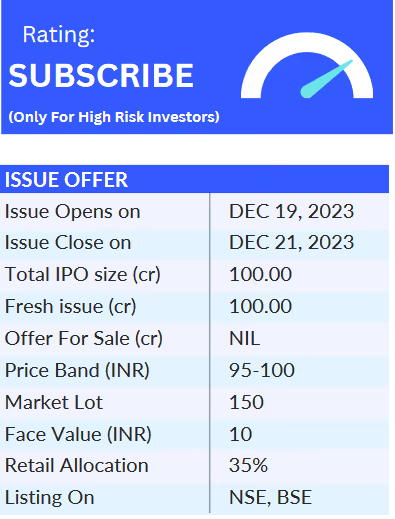
RBZ Jewellers Limited is one of the leading organized manufacturers of gold jewellery in India, specializing in Antique Bridal Gold Jewellery and distributing it to reputable nationwide retailers and significant regional players in India. It also operates its retail showroom under the brand name “Harit Zaveri” and is an established player in Ahmedabad.
OBJECTS OF THE ISSUE
- Funding working capital requirements of the Company.
- General Corporate Purposes.
KEY MANAGERIAL PERSONNEL
Rajendrakumar Kantilal Zaveri
Promoter and the Chairman & Managing Director of the Company. Being a Promoter, he has been associated with the Company since its incorporation. He has thirty-five years of experience in manufacturing and trading of gold jewellery.
Harit Rajendrakumar Zaveri
Promoter and the Joint Managing Director of the Company. Being a Promoter, he has been associated with the Company since its incorporation and has established a retail division of the Company under the name of “Harit Zaveri Jewellers” in 2014. He has over seventeen years of experience in jewellery industry and has contributed to the growth of the Company.
Heli Akash Garala
Company Secretary and Compliance Officer of the Company. She joined the Company on October 1, 2022. She has almost six years of experience in corporate secretarial, SEBI LODR and other related compliances. Prior to joining this Company, she was associated with Ushanti Colour Chem Limited, Amradeep Industries Limited, Sun and Shine Worldwide Limited and Ultra Denim Private Limited.
Harshvardhan Bhardwaj
Chief Financial Officer of the Company. He joined the Company with effect from March 10, 2023 and was subsequently appointed as Chief Financial Officer of the Company with effect from April 01, 2023. He has an experience of nearly nine years with competencies in the areas of finance and international trade remedies.
COMPANY PROFILE
- RBZ Jewellers Limited holds approximately 1% of the total organized wholesale gold jewelry market in India. It has a history of more than fifteen years in the jewellery industry.
- It designs and manufactures a wide range of Antique Bridal Gold Jewellery which consists of jadau, Meena, and Kundan work, and sells it on a wholesale and retail basis.
- Its customer base in wholesale business includes reputed national, regional, and local family jewellers spread across 20 States and 72 cities within India.
- It has a well-equipped and modern gold jewellery manufacturing facility situated at Sarkhej Gandhinagar Highway, Ahmedabad, Gujarat.
- The Company has a workforce of 189 employees. It also has a permitted capacity of 250 artisans for its manufacturing facility.

COMPETITIVE STRENGTHS
- Organized manufacturing setup under one roof. Client Mix and geographical spread.
- Design and Innovation in its product range.
- Brand is built on the core values of trust, transparency, and innovation. Established systems and procedures to mitigate risk.
- Experienced Promoters with young leadership.
KEY STRATEGIES
- Deepen and penetrate its existing customer relationships.
- Increase its production and enhance its product portfolio.
- Continue to invest in its marketing and brand-building initiatives.
- Strengthen its Inventory Management practices.
KEY CONCERNS
- The Company requires a significant amount of working capital for continued growth.
- It does not currently have exclusive or fixed supply arrangements with any of its suppliers of gold. The Company does not have any formal arrangement with its in-house artisans.
- Its manufacturing facility and showroom are located only in Ahmedabad, Gujarat.
- It derives a significant portion of its revenue from operations from its top 10 customers.
- The business may be subject to fluctuations in prices or any unavailability of gold that it use in its products.
- High Competition.
COMPARISON WITH LISTED INDUSTRY PEERS (AS ON 31ST MARCH 2023)

FINANCIALS (RESTATED CONSOLIDATED)

OUTLOOK & VALUATION
RBZ Jewellers manufactures and distributes gold jewelry, serving both wholesale and retail markets. The company's organized manufacturing infrastructure, geographical reach, and risk mitigation systems are promising strengths.
RBZ Jewellers has demonstrated consistent financial growth, reflected in its rising top- and bottom-line figures. However, potential investors should carefully consider key risks such as gold price volatility, significant dependence on a limited number of clients, the absence of formal arrangements with in-house artisans, and intense competition within the industry.
The IPO valuation of 13.4x P/E appears fair on the surface, but the aforementioned risks necessitate a cautious approach. We recommend this IPO only for high-risk investors.

Credo Brands Marketing Limited IPO: Launch Date, Offer Price, GMP, Review
Credo Brands Marketing Limited offers casual clothing for men with its flagship brand "Mufti". The company's product range consisted only of shirts, T-shirts and trousers. Today, however, the company offers a wide range of products including sweatshirts, jeans, cargos, chinos, jackets, blazers and sweaters. The company currently operates 1,773 retail outlets across India (as of May 31, 2023).

OBJECTS OF THE ISSUE
- The IPO is full of Offer for Sale.
KEY MANAGERIAL PERSONNEL
Kamal Khushlan
Chairman and Managing Director of the Company. He has been associated with the Company since its incorporation and has over 25 years of experience in the field of apparel retail.
Poonam Khushlani
Promoter and Whole-Time Director of the Company. Poonam Khushlani has been associated with the Company since its incorporation and is a co- founder of the Company. She has over 25 years of experience in the field of apparel retail.
Rasik Mittal
Chief Financial Officer of the Company. He was appointed as the first auditor of the Company on April 30, 1999. He was the statutory auditor of the Company from the year 2000 until the year 2009. He has also provided certification and advisory services until March 31, 2019.
Sanjay Kumar Mutha
Company Secretary and Compliance Officer of the Company. He previously worked with Mather & Platt Pumps Ltd., Mahindra and Mahindra Limited, CMI FPE Limited and Future Lifestyle Fashions Limited. He has been associated with the Company since January 16, 2023
Biswajeet Ghosa
Vice President of retail and business development of the Company. He has prior experience in working with various industries including textiles, telecom, and fashion. Prior to joining the Company, he was associated with organizations like The Arvind Mills Ltd, Levi Strauss Pvt. Ltd., Shoppers Stop Limited.
COMPANY PROFILE
- Credo Brands Marketing (CBMPL) is engaged in the marketing of men‘s fashion garments in the lifestyle category under the brand name `Mufti’.
- The company‘s product mix has evolved significantly since its inception from consisting of only shirts, t- shirts and trousers in the year 1998 to a wide range of products including sweatshirts, jeans, cargo, chinos, jackets, blazers and sweaters in relaxed holiday casuals, authentic daily casuals to urban casuals, party wear and also athleisure categories as on date.
- The company's reach extends from major metropolitan areas to Tier 3 cities. As of March 31, 2023, March 31, 2022, and March 31, 2021, the company is present in 582, 598 and 569 cities, respectively. The company currently operates 1,773 retail outlets across India (as of May 31, 2023). These include 379 exclusive brand stores (EBOs), 89 large format stores (LFSs) and 1,305 multi-brand stores (MBOs).

COMPETITIVE STRENGTHS
- Strong brand equity with presence across categories. Multi-channel pan-India distribution network.
- Strong in-house design competencies to deliver innovative and high-quality products with end-to- end tech-enabled supply chain capabilities.
- Scalable asset light model. Financially stable business model.
KEY STRATEGIES
- Expand the company’s domestic store network in existing and new cities.
- Deeper penetration to grow sales through online channels by capitalizing on the increasing e- commerce demand in Indian retail.
- Focused expansion of the product portfolio to become a men’s lifestyle brand.
- Leverage technology to improve supply-chain management and enhance customer experience.
KEY CONCERNS
- Company is unable to predict customer demands and maintain optimum inventory level there may be an adverse effect on our results of operations, financial condition, and cash flows.
- The company operates in highly competitive markets in each of the product segments in both offline and online channels and an inability to compete effectively may adversely affect the business.
- Negative reviews from customers may have an adverse impact on brand reputation and ability to market products.
- Business is subject to seasonality. Lower sales and revenue may adversely affect business, financial condition, and results of operations.
COMPARISON WITH LISTED INDUSTRY PEERS (AS ON 31ST MARCH 2023)

FINANCIALS (RESTATED CONSOLIDATED)

OUTLOOK & VALUATION
Under the brand name "Mufti," Credo Brands Marketing (CBMPL) is in the position of marketing men's fashion apparel in the lifestyle sector. The organization is present throughout India, including tier 3 cities as well as large metropolises.
Even though the company operates in a highly competitive market, its profits have grown significantly. The company had 1807 touchpoints operating in 591 cities.
The IPO is coming with a P/E of 23.22x which looks fairly priced when compared with the industry average. Therefore, we recommend considering this IPO for listing gains as well as for long-term.
DISCLAIMER:
The information contained herein are strictly confidential and are meant solely for the information of the recipient and shall not be altered in any way, transmitted to, copied or distributed, in part or in whole, to any other person or to the media or reproduced in any form, without prior written permission of Swastika Investmart Ltd. (“SIL”). The contents of this document are for information purpose only. This document is not an investment advice and must not alone be taken as the basis for an investment decision. Before taking any decision to invest, the recipient of this document must read carefully the Red Herring Prospectus (“RHP”) issued to know the details of IPO and various risks and uncertainties associated with the investment in the IPO of the Company. All recipients of this document must before acting on the given information/details, make their own investigation and apply independent judgment based on their specific investment objectives and financial position. They can also seek appropriate professional advice from their own legal and tax consultants, advisors, etc. to understand the risks and investment considerations arising from such investment. The investor should possess appropriate resources to analyze such investment and the suitability of such investment to such investor’s particular circumstances before making any decisions on the investment. The Investor shall be solely responsible for any action taken based on this document. SIL shall not be liable for any direct or indirect losses arising from the use of the information contained in this document and accept no responsibility for statements made otherwise issued or any other source of information received by the investor and the investor would be doing so at his/her/its own risk. The information contained in this document should not be construed as forecast or promise or guarantee or assurance of any kind. The investors are not being offered any assurance or guaranteed or fixed returns on their investments. The users of this document must bear in mind that past performances if any, are not indicative of future results. The actual returns on investment may be materially different than the past. Investments in Securities market products and instruments including in the IPO of the Company are highly risky and they are generally not an appropriate avenue for someone with limited resources/ limited investment and low risk tolerance. Such Investments are subject to market risks including, without limitation, price, volatility and liquidity and capital risks. Therefore, the users of this document must carefully consider all the information given in the RHP including the risks factors before making any investment in the Equity Shares of the Company.
Swastika Investmart Ltd or its analysts did not receive any compensation or other benefits from the companies mentioned in the report or third party in connection with preparation of the research report. Accordingly, neither Swastika Investmart Ltd nor Research Analysts have any material conflict of interest at the time of publication of this report. Compensation of our Research Analysts is not based on any specific merchant banking, investment banking or brokerage service transactions. Swastika Investment Ltd may have issued other reports that are inconsistent with and reach different conclusion from the information presented in this report. Research entity has not been engaged in market making activity for the subject company. Research analyst has not served as an officer, director or employee of the subject company. We have not received any compensation/benefits from the Subject Company or third party in connection with the Research Report.
CORPORATE & ADMINISTRATIVE OFFICE - 48, Jaora Compound, M.Y.H. Road, Indore - 452 001 | Phone 0731 - 6644000
Compliance Officer: Ms. Sheetal Duraphe Email: compliance@swastika.co.in Phone: (0731) 6644 241
Swastika Investmart Limited, SEBI Reg. No. : NSE/BSE/MSEI: INZ000192732 Merchant Banking: INM000012102 Investment Adviser: INA000009843 MCX/NCDEX: INZ000072532 CDSL/NSDL: IN-DP-115-2015 RBI Reg. No.: B-03-00174 IRDA Reg. No.: 713.

Happy Forgings Limited IPO: Launch Date, Offer Price, GMP, and Details
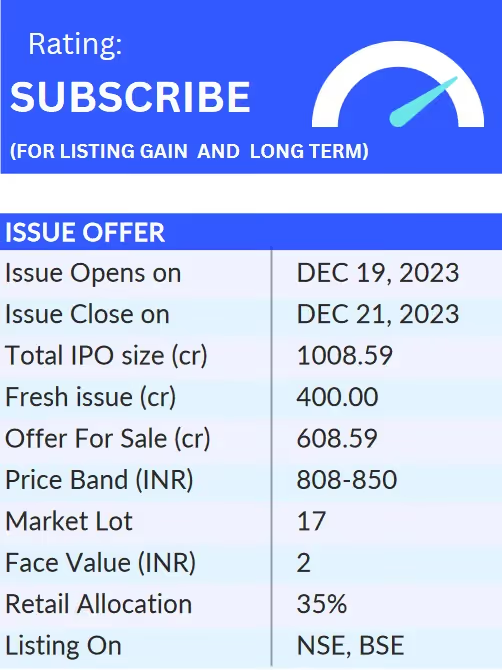
Happy Forgings Limited is an Indian manufacturer specializing in designing and manufacturing heavy forgings and high-precision machined components. The company manufactures, designs and tests various products such as crankshafts, front axle carriers, steering knuckles, differential housings, transmission parts, pinion shafts, suspension products and valve bodies for different industries and customers.
OBJECTS OF THE ISSUE
- Purchase of equipment, plant and machinery.
- Prepayment of all or a portion of certain outstanding borrowings.
KEY MANAGERIAL PERSONNEL
Paritosh Kumar
Chairman and Managing Director of the Company. He has been associated with the Company since incorporation and accordingly has over 44 years of experience in the industrial sector. He is involved in the strategic decision making of the Company, oversees the Company’s business activities and is involved in setting up the governance standards of the Company.
Ashish Garg
Managing Director of the Company. He has approximately 17 years of experience in the industrial sector. He currently manages the Company’s business operations, financial performance, growth strategies and investments in different capacities and product developments.
Narinder Singh Juneja
Chief Executive Officer and Whole- time Director of the Company. He has over 35 years of experience in the industrial sector. Prior to joining our Company, he served as the assistant engineer with Krishna Forgings.
Pankaj Kumar Goyal
Chief Financial Officer of the Company. He has been associated with the Company since April 1, 2013. In the Company, he handles finance and accounts department. He has over 10 years of experience in the finance sector.
Bindu Garg
Company Secretary and Compliance Officer of the Company. She has been associated with the Company since November 2, 2021 and was appointed as the Company Secretary of the Company since July 12, 2022. In the Company, she handles the secretarial functions. She has over 18 years of experience in the finance and secretarial sector.
COMPANY PROFILE
- The company's customer base includes AAM India Manufacturing Corporation Private Limited, Ashok Leyland Limited, Bonfiglioli Transmissions Private Limited, Dana India, IBCC Industries (India) Private Limited, International Tractors Limited, JCB India Limited, Liebherr CMCtec India Private Limited, Mahindra & Mahindra Limited, Meritor HVS AB, Meritor Heavy Vehicle Systems Cameri SPA, SML ISUZU Limited, Swaraj Engines Limited and others.
- With over 40 years of experience of manufacturing and supplying quality and complex components according to customers' specifications, it has emerged as a leading player in the domestic crank shaft manufacturing industry with the second largest production capacity.
- The company has served customers in various regions including Brazil, Italy, Japan, Spain, Sweden, Thailand, Turkey, the United Kingdom and the United States of America.
- Happy Forging Limited has three manufacturing facilities, two in Kanganwal and one in Dugri, all located in Ludhiana, Punjab. As of FY2023, the operational revenue of the company has increased by 43.02%.
COMPETITIVE STRENGTHS
- Fourth largest engineering-led manufacturer of complex and safety-critical, heavy forged, and high precision machined components in India.
- Integrated manufacturing operations coupled with in-house product and process design capabilities. Diversified business model, well placed to take advantage of potential alternative engine technologies. Long-standing relationships with customers across industries.
- Track record of consistently building capabilities and infrastructure, with a focus on capital efficiency.
- Experienced Promoters and senior management team.
KEY STRATEGIES
- Leverage in-house engineering and product development capabilities.
- Foray into light weight forging and machining with the introduction of aluminum components. Increase the wallet share and acquire new business.
- Capitalize on increasing demand from international markets to grow exports. Expand capacity at its existing manufacturing facilities.
KEY CONCERNS
- Its business largely depends upon its top 10 customers.
- The company does not have agreements having commitment on the part of its customers. It depends on a few suppliers for the supply of steel, its primary raw material.
- Its business is dependent on the performance of certain industries, particularly commercial vehicles. It faces competition in India and overseas in its business.
- Due to the geographic concentration of its manufacturing facilities, its operations are susceptible to local and regional factors.
- Pricing pressure from its customers may adversely affect its business.
COMPARISON WITH LISTED INDUSTRY PEERS (AS ON 31ST MARCH 2023)

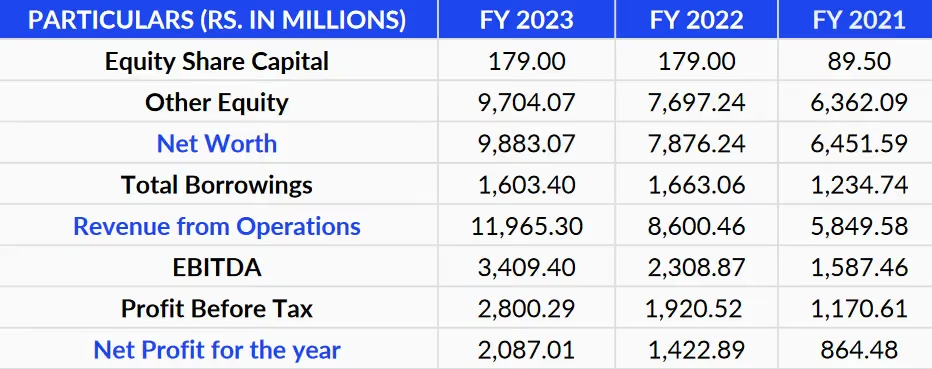
FINANCIALS (RESTATED CONSOLIDATED)
OUTLOOK & VALUATION
Happy Forging is a well-experienced and fourth-largest manufacturer of complex machine components. The company shares along-standing relationship with its large customer base. It has a diversified business model and a track record of consistent growth. The financial performance of the company has also been strong. Further, it has plans for capacity expansion and new business acquisitions.
However, investors should remain mindful of certain business dependencies. Reliance on the top 10 customers, potential pricing pressure from clients, and competition within the industry introduce some risks. Dependence on a limited number of suppliers also merits consideration.
Despite these considerations, Happy Forgings' attractive valuation of 36.44x P/E, coupled with its impressive track record and promising outlook, makes it a worthy investment option for investors seeking exposure to the manufacturing sector.
DISCLAIMER:
The information contained herein are strictly confidential and are meant solely for the information of the recipient and shall not be altered in any way, transmitted to, copied or distributed, in part or in whole, to any other person or to the media or reproduced in any form, without prior written permission of Swastika Investmart Ltd. (“SIL”). The contents of this document are for information purpose only. This document is not an investment advice and must not alone be taken as the basis for an investment decision. Before taking any decision to invest, the recipient of this document must read carefully the Red Herring Prospectus (“RHP”) issued to know the details of IPO and various risks and uncertainties associated with the investment in the IPO of the Company. All recipients of this document must before acting on the given information/details, make their own investigation and apply independent judgment based on their specific investment objectives and financial position. They can also seek appropriate professional advice from their own legal and tax consultants, advisors, etc. to understand the risks and investment considerations arising from such investment. The investor should possess appropriate resources to analyze such investment and the suitability of such investment to such investor’s particular circumstances before making any decisions on the investment. The Investor shall be solely responsible for any action taken based on this document. SIL shall not be liable for any direct or indirect losses arising from the use of the information contained in this document and accept no responsibility for statements made otherwise issued or any other source of information received by the investor and the investor would be doing so at his/her/its own risk. The information contained in this document should not be construed as forecast or promise or guarantee or assurance of any kind. The investors are not being offered any assurance or guaranteed or fixed returns on their investments. The users of this document must bear in mind that past performances if any, are not indicative of future results. The actual returns on investment may be materially different than the past. Investments in Securities market products and instruments including in the IPO of the Company are highly risky and they are generally not an appropriate avenue for someone with limited resources/ limited investment and low risk tolerance. Such Investments are subject to market risks including, without limitation, price, volatility and liquidity and capital risks. Therefore, the users of this document must carefully consider all the information given in the RHP including the risks factors before making any investment in the Equity Shares of the Company.
Swastika Investmart Ltd or its analysts did not receive any compensation or other benefits from the companies mentioned in the report or third party in connection with preparation of the research report. Accordingly, neither Swastika Investmart Ltd nor Research Analysts have any material conflict of interest at the time of publication of this report. Compensation of our Research Analysts is not based on any specific merchant banking, investment banking or brokerage service transactions. Swastika Investment Ltd may have issued other reports that are inconsistent with and reach different conclusion from the information presented in this report. Research entity has not been engaged in market making activity for the subject company. Research analyst has not served as an officer, director or employee of the subject company. We have not received any compensation/benefits from the Subject Company or third party in connection with the Research Report.
CORPORATE & ADMINISTRATIVE OFFICE - 48, Jaora Compound, M.Y.H. Road, Indore - 452 001 | Phone 0731 - 6644000
Compliance Officer: Ms. Sheetal Duraphe Email: compliance@swastika.co.in Phone: (0731) 6644 241
Swastika Investmart Limited, SEBI Reg. No. : NSE/BSE/MSEI: INZ000192732 Merchant Banking: INM000012102 Investment Adviser: INA000009843 MCX/NCDEX: INZ000072532 CDSL/NSDL: IN-DP-115-2015 RBI Reg. No.: B-03-00174 IRDA Reg. No.: 713.
Big Budget


Popular Articles


.avif)
.avif)
.avif)



START YOUR INVESTMENT JOURNEY
Get personalized advice from our experts
- Dedicated RM Support
- Smooth and Fast Trading App
