

Honda India's 6 Launches This Year - Should You Invest?




Honda India's 6 Launches This Year - Should You Invest?
TLDR
- Honda plans six model launches in India this fiscal, with two unveiled today.
- Direct impact on your portfolio: auto demand may firm up; monitor supplier names and earnings.
- Top priority sector to watch: Auto and Auto Components/EV supply chain.
- One clear action: review auto exposure and consider selective bets in strong, well‑funded names.
News Context and Market Impact
What Happened
Honda Motor Co.'s Indian arm announced six new models for this fiscal year, with two launches happening today. The plan includes the City and the ZR-V debut in India as part of a broader push to capture a larger share of the domestic market. The company aims to deliver double-digit growth and to outperform the broader industry, signaling a buoyant domestic auto demand story.
Why This Matters
The move underscores Honda's commitment to India as a key growth engine and could lift sentiment around auto players and their suppliers. For investors, a stronger product cadence can translate into improved earnings visibility for Honda and its peers, especially those with robust balance sheets and scalable supply chains. However, execution risk remains around supply chain constraints and macro headwinds; strong balance sheets and prudent capex will be key to sustain growth.
Portfolio and Strategy Focus
What This Means For Your Portfolio
The six-launch plan could be a positive catalyst for the auto space, particularly for manufacturers with solid earnings quality and competitive pricing. If you already have auto exposure, maintain exposure but avoid concentration in a single name; focus on financially sound players with improving margins and product cycles. For your portfolio, a measured tilt toward quality auto names could help you participate in the upside without taking on excess cyclicality risk.
Sectors To Watch - Priority Order
- 1st Priority: Auto Sector - Honda's expansion supports demand revival and potential stock upside.
- 2nd Priority: Auto Components & EV Supply Chain - Suppliers stand to benefit from a broader product lineup and digitization.
- Avoid Now: Real Estate - Less tied to auto growth and exposed to higher rate sensitivity.
Action Points For Investors
- SIP investors: Gradually allocate to high-quality auto names or auto-ancillary funds in small tranches to participate in the cycle.
- Lumpsum investors: Consider staggered entry after any near-term pullback or consolidation; avoid piling into momentum names.
- Traders: Look for volatility around launch events but set sensible stop-losses and avoid over-leveraging.
Swastika Investmart notes that Honda's aggressive India expansion reflects a broader push by automakers to localize production and broaden product portfolios. The development may lift near-term auto sentiment, but the path to sustained growth will depend on supply-chain resilience, semiconductor availability, and the overall macro environment. Your portfolio should stay anchored in companies with solid earnings, disciplined capital allocation, and strong cash flows, rather than chasing short-term headlines.
Risks and Cautions
Key Risks To Watch
- Supply-chain disruptions, especially semiconductors and logistics, could delay launches and dent margins.
- Rising input costs and currency fluctuations may affect profitability for auto manufacturers and suppliers.
- Competition from both legacy OEMs and new-age EV players could limit pricing power and market share gains.
Frequently Asked Questions
How will Honda India's six-launch plan affect stock valuations?
The cadence improves earnings visibility for Honda and peers in autos, potentially supporting valuations for quality names, but investors should avoid chasing momentum and focus on fundamentals.
Should you increase auto exposure now?
Only if you have a long-term horizon and can tolerate cyclicality; prefer quality names with strong balance sheets and visible product cycles.
Which auto sub-sectors look attractive?
Look at domestic OEMs with healthier balance sheets and improving margins, and auto components with exposure to EV and digitization efforts.
What are the main risks to Honda's India growth story?
Key risks include global semiconductor shortages, supply-chain bottlenecks, currency volatility, and competitive pressure from both traditional and EV players.
Conclusion
Honda India's six-launch strategy signals a positive auto cycle ahead, but investors should stay selective. Review your auto exposure, favor high-quality names with strong earnings and balance sheets, and wait for clearer earnings momentum before aggressively adding new positions.
Big Budget





.avif)
.avif)
.avif)
.avif)
.avif)















.avif)
.avif)
.avif)
.avif)
Latest Articles

5 Factors Which Affect Gold prices In India


Gold is the most important and precious financial asset for Indians and worldwide. It is also considered a symbol of wealth and prosperity among Indians because their emotional sentiments are connected with this.
People think that gold is the best investment form to deal with Inflation and they can convert it to cash in case of emergency need of money, it also helps people to take as a Mortgage loan.
But while investing in gold so many points come in our mind that what are the factors which influence the prices of gold? So, below are some important factors which affect gold prices:
Factors Affecting Gold Prices In India:
Demand & Supply:
As it’s very clear for anything which is traded that demand and supply play a vital role in influencing the price of those instruments. Similarly, the demand and supply of Gold play an important role in determining its price. Although gold is not a consumable commodity like Oil, Copper, etc. Historically, Gold mined till date from mines is still available in the world. Also, the production of the gold from the mines is not too high and if in this situation demand will increase so definitely it will increase the prices of the gold. Due to COVID-19 gold mines were impacted all over the world due to lockdown. Mining production fell almost 3% in the first quarter of 2020 from 2015.
Central Bank’s Gold Reserve:
Central banks of the major economies (like the US, China, India, UK, Australia) hold Gold & currency as a part of their reserves for managing trade war and cash flows in their countries. In this kind of situation due to sheer volume either buying or sell by banks may derive the price of gold up or downside.
Import Duty:
Since the contribution of India in world gold production is less than 1 per cent, but it’s the second-largest consumer of gold after China. So, it imports a huge amount of gold to fulfill demand. Therefore, Import Duty plays a crucial role to derive the gold price in India.
Interest Rate Relations:
There is an inverse relation between gold prices and interest rates. If the interest goes up then people start selling gold to get it to liquidate and they take more cash in their hand on the other hand if the interest rate goes down so people start buying gold due to having more cash in their hand to get a good price appreciation of the yellow metals.
Currency Exchange Fluctuation:
As gold is traded in US Dollar in the international market, therefore, when we import gold so all transactions are done in USD then there is a need to convert USD to INR, which fluctuates gold prices in India. If the INR starts depreciating it will make gold costlier and vice versa.

6 Things to Keep in Mind About Currency Trading
Commodities and equities trading is something that has become common in India by now. But a high potential market which most of the traders and investors are unaware of is the currency market. Currency trading holds great potential of earning profits if the traders are able to spot the right opportunity and can use those opportunities for their benefit.
Things to Know about Currency Trading
Here are 6 top things you should know about currency trading
What is the Currency Market?
The currency market is a market that involves participants from all across the world. The currency market facilitates the buying and selling of different currencies. The major participants of currency trading include commercial banks, the central bank, corporations, various investment management funds, hedge fund managers, forex brokers, and last but not the least investors and traders like you and me.
What is Currency Trading?
Currency trading, as the name suggests, is the buying and selling of international currencies. The banks and financial institutions are often involved in the act of currency trading. Individual investors can also indulge in currency trading as it is legitimate. The profit from currency trading is earned due to the variations in the exchange rate of the currencies.
What are Currency Futures?
Currency market derivatives comprise of currency futures. They are basically exchange-traded futures contracts. The price of the futures contract is set in a specific currency at which another currency can be bought or sold. It is bought or sold at a future pre-determined date just like in the case of futures contracts. They are also referred to as foreign exchange futures. Currency futures are considered to be financial derivatives as the value of the currency futures contracts is derived from the underlying currency exchange rate. Trading in currency futures calls for the initial margin requirement. If the margin falls below the initial margin requirement a margin call is made to the investor, which means, that the investor will be required to deposit the required amount of money to arrive at the maintenance margin.
What are the Currency Options?
Just like an options contract, a currency option is a contract that gives the buyer the right but not the obligation to buy or sell a certain currency at a specified exchange rate in the future. Hence, it gives the right to exercise the contract only if the investor finds the price favorable. This choice is not available in the case of currency futures where the investors have the option to exercise the right.
What are the risks involved in currency trading?
Trading in the currency market is not only risky but also complex at the same time. Some of the risks involved in currency trading in India are as follows:
Interest Rate Risk
Interest rates have an impact on the country’s currency. The difference in currency values can cause dramatic changes in forex prices. Hence, the interest rate plays a potential risk in currency trading.
Leverage Risk
Currency trading is different from equity and commodity trading. It also requires a margin amount as a small investment from the investor. This benefit of leverage allows the traders to have access to a large number of trades. Even a minor fluctuation can result in levying an additional margin requirement to be maintained by the investor. Hence, market volatility paired with aggressive leverage can be highly risky when talking about currency trading.
Credit Risk
The credit risk is related majorly with the banks and financial institutions and has an insignificant role to play in the case of individual traders. Credit risk is when a voluntary or an involuntary action from the counter party results in the non-repayment of the outstanding currency position.
Counterparty Risk
The counterparty is the investor’s asset provider. The risk caused due to defaults in the transactions by the dealers and the brokers is referred to as counterparty risk. An exchange house or a clearinghouse in case of currency trading does not guarantee spot and forward contracts.
The traders and investors must be well aware of these different risks related to forex-trading, before stepping into the market.
What things should one remember while trading in the currency market?
In order to be successful in currency trading, it is essential that the basics, goals, and risk management by the investor is right. There are certain things which currency traders should keep in mind when entering into currency trading.
- Be well aware of your trading style. Every trader has a unique trading style. The currency trading style of the trader is in line with his or her risk profile. Understand your risk and return profile well before you start trading in currencies.
- Be cautious while choosing your broker and the trading platform. In order to be successful in currency trading, it is essential you have a good broker. A good broker will provide you handholding support when talking about forex trading or currency trading in India. He also ensures that you are regularly updated on the live currency market news which further prevents you from suffering losses.
- Be careful about your entry and exit points before you start currency trading. None of the trades, be it equity trading, commodity trading, or currency trading is a sure shot success guarantee plan. You should always be prepared for exiting the market when things are not favorable for you. Always have a good idea about the possible trade scenarios to suffer minimum losses.
Bottom Line
Though forex trading online has started gaining popularity lately among traders and investors a set of relevant challenges makes it an equally competitive and risky as well. In order to be successful and make a profit from currency trading, it is essential for the trader to have thorough knowledge and understanding of the domestic as well as of global economies. Last but not the least, be cautious when choosing your broker for currency trading.

Why a Crisis is the Best Time to Invest
“Be fearful when others are greedy and greedy when others are fearful.”
-Warren Buffet
A falling knife is risky to catch as it may hurt, but the one who catches the falling knife perfectly without getting hurt is called a genius. Investing at a time of crisis is too risky but one who invests in a fundamentally sound company at the time of crisis can generate good wealth.
At the time of the COVID-19 pandemic outbreak when investors and traders were selling the stocks in bulk, it did create an opportunity for the new investors to build their portfolio. Globally, when stock markets were getting crashed, individuals were selling in bulks which did create a history for the fastest decline in history.
There has been a “V” shaped recovery across the board from the COVID-19 economic crisis on the back of the strong recovery in the economy. We have seen large swings in the market in this period of 9 months where the market crashed recovered and broke out its all-time high.
The stock market is speculative and always has a forward approach. In March, until when the lockdown was initiated market was getting crashed and made its low on 24th March it’s the same day when the lockdown was announced.
Having its forward outlook it NIFTY50 touched its new all-time high breaking the previous high of 12430.50 on 9th November. We saw a massive rally of approximately 5000 points in just 9 months which was the fastest recovery in the history including its high and low.
In this period of 9 months, fundamentally sound stocks have multiplied themselves and generated huge wealth for the investors. Below is the list of top 10 stocks from NIFTY200 which have generated ample wealth for the investors considering and individual have bought the shares around the close price of 24th March.
[caption id="attachment_194" align="alignnone" width="1102"]
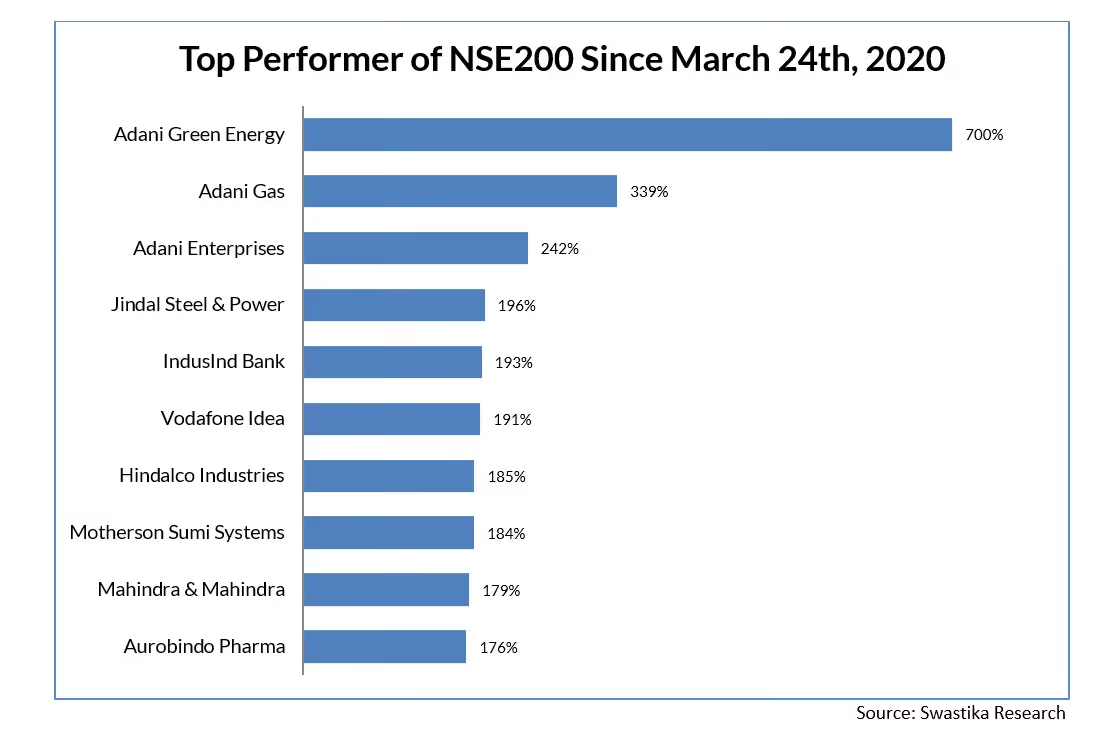
As we can see in the above graph, Adani Green Energy has rejoiced the wealth of investors by 700% which is the most NIFTY200 list of companies; the list is followed by two more companies from the Adani Group namely Adani Gas and Adani Enterprises.[/caption]
In the period of lockdown when everything came to a halt, we saw many new traders and investors entered the market and earned handsome money by investing in some of the good quality companies. The valuations were cheaper and they got an opportunity to be a long term investor.
At the time of crisis stocks were falling and buying at that price does need courage which is equivalent to catch a falling knife but the market has again proved that investing in a fundamentally sound company will always reward investors.
When we buy goods, lower prices are generally a good thing. That’s not the same case in terms of stocks as we never know how much a stock can fall. However, if you would have bought the dip in quality stocks then it will surely benefit the investors. While if an individual wants to invest for a long term then a crisis is the best time to buy because as soon as the economy will recovering it will benefit the investor.
Historically, there has been an economic crisis timely in the stock market. It can occur in the form of a pandemic, recession, or any bubble. People generally sell their portfolio when any crisis happens but as said earlier it does create an opportunity for the investors to average out their portfolio also it creates an opportunity for new investors to build their portfolio.
There have been twelve crises in the 20th century excluding the geopolitical event and the still market had hit an all-time high on 04th December 2020. Thus, a new investor should look for a dip or any crisis event to build a portfolio and invest in the long term.

Understanding the Concept of the Financial Market
The financial market plays a crucial role in any economy, and understanding its basic concepts is essential for anyone interested in investing or managing finances. In simple terms, the financial market is a platform where people buy and sell financial assets such as stocks, bonds, commodities, and currencies. It helps businesses raise capital, allows investors to make profits, and enables the economy to grow.
This blog will explain the financial market in easy-to-understand language, covering its types, key participants, and why it is important.
What is the Financial Market?
A financial market is a place where buyers and sellers come together to trade different types of financial assets. These assets can include:
- Stocks: Shares of a company that represent ownership.
- Bonds: Loans given to companies or governments in exchange for interest.
- Currencies: Trading of different currencies, such as U.S. Dollars, Euros, or Indian Rupees.
- Commodities: Physical items like gold, silver, oil, and agricultural products.
In the financial market, the prices of these assets fluctuate based on supply and demand. For example, if many people want to buy a particular stock, its price will go up. If fewer people are interested, the price will go down.
Types of Financial Markets
The financial market is broad and consists of several sub-markets that specialize in different types of trading. Here are the key types of financial markets:
1. Stock Market
The stock market is where shares of companies are bought and sold. When you buy a share, you become part-owner of the company. If the company grows and makes profits, the value of your shares can increase, and you may receive dividends. Stock markets are divided into two categories:
- Primary Market: When a company first issues shares to the public, this is called an IPO (Initial Public Offering), and it happens in the primary market.
- Secondary Market: After the IPO, the shares can be traded among investors on stock exchanges like the New York Stock Exchange (NYSE), the Bombay Stock Exchange (BSE), or the National Stock Exchange (NSE).
2. Bond Market
The bond market allows governments, municipalities, and companies to borrow money from investors by issuing bonds. When you buy a bond, you are essentially lending money to the issuer in exchange for periodic interest payments and the return of the principal amount at the end of the bond’s term.
Bonds are typically considered less risky than stocks, but the returns are also generally lower. This makes them a popular choice for conservative investors.
3. Foreign Exchange Market (Forex)
The foreign exchange market is where currencies are traded. It is the largest and most liquid financial market in the world. Investors trade currencies to make profits from changes in exchange rates. For example, if you believe the U.S. Dollar will strengthen against the Euro, you can buy Dollars and sell Euros. If the Dollar rises, you make a profit.
4. Commodities Market
In the commodities market, physical goods like gold, oil, and agricultural products are traded. Commodities can be traded either in their physical form or through financial contracts called futures, which are agreements to buy or sell a commodity at a future date for a predetermined price.
For example, a trader might buy gold futures if they believe the price of gold will increase in the coming months.
5. Derivatives Market
The derivatives market involves contracts whose value is derived from an underlying asset, such as stocks, bonds, currencies, or commodities. Common derivatives include options, futures, and swaps. These contracts allow traders to speculate on the future price movements of assets or to hedge against risk.
For instance, a wheat farmer might use a futures contract to lock in a price for their crop, protecting themselves from potential price drops in the future.
Key Participants in the Financial Market
The financial market consists of various participants, each playing a different role. The major players include:
- Investors: Individuals or institutions (like mutual funds or pension funds) that buy assets to make a profit.
- Companies: Businesses that raise money by issuing stocks or bonds.
- Governments: National and local governments that issue bonds to fund public projects.
- Financial Institutions: Banks, brokerage firms, and insurance companies that facilitate buying and selling of assets.
- Regulators: Authorities like the Securities and Exchange Commission (SEC) in the U.S. or the Securities and Exchange Board of India (SEBI) that ensure the financial markets operate fairly and transparently.
Importance of the Financial Market
The financial market plays a critical role in the global economy. Here are some of its key benefits:
1. Capital Formation
The financial market allows businesses to raise funds by selling stocks or issuing bonds. These funds are then used to invest in projects, expand operations, and create jobs, contributing to overall economic growth.
2. Investment Opportunities
The financial market offers individuals and institutions a wide range of investment options. Investors can diversify their portfolios by investing in different types of assets, helping to manage risk while aiming for higher returns.
3. Liquidity
One of the primary advantages of financial markets is liquidity. Liquidity refers to how quickly and easily an asset can be bought or sold. The financial market ensures that investors can buy or sell their assets when they need to, without significant price changes.
4. Price Discovery
In financial markets, prices are determined by supply and demand. This process of price discovery helps investors understand the fair value of an asset based on market conditions.
5. Risk Management
The financial market offers tools like derivatives that allow investors and companies to manage risks. For example, a company can use foreign exchange derivatives to hedge against currency fluctuations, protecting its profits from adverse movements in exchange rates.
Conclusion
The financial market is a dynamic system that brings together buyers and sellers of financial assets like stocks, bonds, currencies, and commodities. Understanding the different types of financial markets and how they function is essential for making smart investment decisions. Whether you’re a new investor or someone looking to expand your knowledge, the financial market offers various opportunities to grow wealth, manage risk, and achieve financial goals.
By including a mix of assets from different markets in your portfolio, you can diversify your investments and better manage risks, ensuring a more balanced approach to wealth creation.
Commodity Trading: Tips On How To Avoid Losses?
Commodity trading offers exciting opportunities, whether you’re dealing with agricultural products like corn and soybeans, or more popular markets such as oil, gas, gold, and silver. To increase your chances of making a profit and to manage risks effectively, follow these ten essential tips:
Use a Trailing Stop Loss:
A trailing stop loss is a tool that helps protect your gains by adjusting your stop loss order as the market price moves in your favor. For example, if you buy a commodity and its price increases, you can move your stop loss to the break-even point (the price at which you bought it) to ensure that you don't lose money if the price drops. While this strategy doesn't guarantee profits—since prices can fluctuate and hit your stop loss before moving further in your direction—it provides a safety net that locks in profits as the market trends in your favor.
Avoid Averaging Winning Trades:
Averaging down means buying more of a commodity at a lower price to reduce the average cost of your position. However, this can be risky if the market reverses. If you add to a winning trade at reversal points, it could increase your average entry price and make it harder to sell at a profit. Instead of averaging down, consider booking your profits once the market moves in your favor and wait for a more favorable entry point if you want to re-enter the trade later. This approach is particularly useful in range-bound markets where prices move within a certain range.
Trade Smaller Contracts:
If you have a smaller trading account, it’s wise to trade smaller contracts or mini contracts rather than standard ones. For example, if you have ₹1,00,000 in your trading account, trading 15-20 lots of mini Crude Oil futures (10 barrels per lot) is safer than trading just 2 lots of the standard Crude Oil futures (100 barrels per lot). Smaller contracts allow for greater flexibility in managing trades, scaling in and out of positions, and mitigating risks. This way, if a trade goes against you, the impact on your account is less severe.
Use Options for Protection:
Options can be an effective way to protect your gains or limit potential losses. Suppose you bought Crude Oil futures at ₹5200 and the price rises to ₹5500. To safeguard your profits, you can buy an At The Money (ATM) put option. This option gives you the right to sell at a specified price and costs less than the potential profit you could make. For instance, if the put option costs ₹100 per barrel, your total cost is ₹10,000, but it provides a safety net if the market turns against you. If prices continue to rise, the option can be sold for a profit, allowing you to benefit from further price increases.
Book Profits Regularly:
It’s important to take profits regularly rather than holding onto them for too long. While it’s common advice to let your profits run, this strategy may not always work, especially in volatile markets. By booking smaller, more frequent profits, you can build your account size and reduce the risk of losing all your gains. Regularly locking in profits also allows you to manage your risks better and take on new trades with a more stable financial base.
Track Inventories, but Don’t Trade Blindly:
Inventory reports, such as those for crude oil and natural gas, can lead to sudden price changes. However, these reports often cause unpredictable spikes that may not be rational for trading, especially if you lack detailed knowledge of the market’s supply and demand dynamics. Instead of making trades based solely on inventory numbers, use this information to inform your broader market strategy and avoid blind trading based on short-term data.
Follow Currency Trends:
Commodity prices are often influenced by currency trends. For example, if the rupee is depreciating, the price of commodities will be higher in rupee terms. This means it’s generally unwise to short commodities when the rupee is weakening, as the price in local currency is already higher. Always consider currency trends when making trading decisions to avoid losses due to currency fluctuations.
Watch Regulatory Changes:
Regulatory developments can impact commodity prices significantly. For instance, if the Indian government is considering imposing additional import duties on gold, the price of gold may rise even if international prices fall. Being aware of such regulatory changes helps you avoid trades that go against these trends and adjust your strategy accordingly.
Set a Daily Stop-Loss Limit:
To manage risk effectively, set a daily stop-loss limit that you are not willing to exceed. If you hit this limit, avoid trying to recover the losses on the same day. Emotional trading to recover losses can lead to poor decision-making and further losses. Stick to your pre-determined stop-loss limit to prevent significant damage to your trading account.
Diversify Your Trades:
Diversification helps reduce risk by spreading your trades across different commodities that are less correlated. Instead of trading commodities that move in the same direction, like gold and silver, consider trading a mix of commodities, such as crude oil and agricultural products. This approach can protect you from losses in one market and help balance your overall trading risk.
By following these tips, you can enhance your commodity trading strategy, manage risks more effectively, and increase your chances of making profitable trades. Remember, successful trading requires careful planning, constant learning, and a disciplined approach.

How to Choose the Best Mutual Funds?
If you are willing to invest in the best performing mutual funds but don't know how to get started, it's pretty easy to pick up the best one that suits your pocket. Before picking the best mutual funds, it is crucial to understand your investment objectives along with the risk tolerance.
Choosing best mutual funds involves a lot of factors such as expense ratio, past performance, fund manager’s experience and more. Once you are ready to go through with your research, you will get a clear idea of which mutual fund you would want to invest your money in.
Key Aspects to Select the Right Mutual Funds
In this blog, we will cover the key aspects to select the right mutual funds as per your requirements.
Identify Your Goals
Before investing in top mutual funds, it is crucial to identify your goal first. A goal can be anything, like short term purchasing utility goods, rent of a house or long term like providing for the school education for children.
Don't Neglect Risk Tolerance
You should also consider personal risk tolerance before starting investing in mutual funds. Ask these questions to yourself:
Are you able to tolerate dramatic swings in portfolios that may have huge ups and downs?
Is a conservative investment strategy suitable for you?
For how much time you need to invest your funds in mutual funds?
Remember, risks and returns are directly proportional to each other. Hence, it is suggested to get ready with the risks associated with these mutual funds.
Plan Investment Strategy
Planning a successful investment strategy is extremely crucial for better returns because a proper investment strategy helps you to know about the goals regarding investments and your willingness to take risks. Thus, you can find the best mutual funds for SIP.
Check Fund Performance
It is important to keep an eye on a mutual fund’s performance. This is because mutual fund cycles have to go through multiple market cycles. In a case, where the fund has not been able to beat its benchmark over 3 years, you need to understand that the mutual fund might not be an apt investment for future growth.
To check the fund’s better performance, it would be ideal to contact your fund manager as they hold a proven track record of all the mutual funds that may be beneficial for multiple investors.
Expense Ratio
Expense ratio is basically the commission, investors need to pay for the management of their funds. It is a fund manager’s fee that all clients have to pay for ensuring better gains. If you are targeting best mutual funds to invest in, it is suggested to target the mutual fund which has a low expense ratio.
Takeaway
Mutual funds tend to provide maximum profits if you choose the right one. Therefore. it is said to choose that fund which suits your requirements. Although there are a lot of options in hand, it is difficult to choose the best mutual funds for lumpsum investment. Therefore, all the factors should be taken into consideration while selecting the best mutual funds as it provides you with maximum gains with less time.


.avif)
.avif)

.avif)




START YOUR INVESTMENT JOURNEY
Get personalized advice from our experts
- Dedicated RM Support
- Smooth and Fast Trading App
