

Trent ₹6 Dividend — Buy Before Jun 11, 2026 — Should You?


Key Takeaways
- Trent Limited declares a ₹6 dividend per share with the record date of 12-Jun-2026.
- To qualify for the dividend, you must buy before 11-Jun-2026 and ensure settlement.
- Top priority sectors: Consumer discretionary (retail) and dividend-focused equity strategies.
- Action: If you want the payout, consider buying before 11-Jun-2026; otherwise wait and assess fundamentals.
What Happened
Trent Limited announced a dividend of ₹6 per share for equity shareholders. The payout comes with a record date of 12-Jun-2026, and the last date to buy the stock to qualify is 11-Jun-2026. In practical terms, investors need to own the shares before 11-Jun to be eligible for the cash payout.
Key Details
Dividend payments are cash returns on top of any price appreciation. The settlement cycle in India suggests you should consider the T+2 timeline when placing orders to ensure settlement before or on the cut-off date. If you currently own the stock, this dividend increases your yield for the next 1-2 quarters, though price movements around payout can offset some gains.
Why This Matters
Dividend announcements indicate cash generation capability and can attract income-focused investors. For Trent, a ₹6 per-share payout may modestly improve total returns for holders, especially if the stock price doesn't swing wildly around the payout window. For you, the practical takeaway is to assess whether this dividend aligns with your income goals and risk profile, and whether you are comfortable with potential price volatility in the near term.
Market Context
In the current retail landscape, Trent's dividend yield should be weighed against its earnings growth, store expansions, and competitive dynamics with peers. If you already own Trent, the payout could slightly boost your realized return; if you're contemplating entry, you must factor in valuation and the stock's longer-term earnings trajectory. Your decision should hinge on fundamentals rather than chasing a cash yield alone.
What This Means For Your Portfolio
MOST IMPORTANT SECTION — direct investor impact: - Which stocks or sectors are affected: Trent's dividend affects your exposure to consumer discretionary and adds a cash component to returns for holders. - Should investor buy, hold, or wait: If you need income and the stock's fundamentals look solid, buying before 11-Jun-2026 can be reasonable; otherwise, consider your overall risk and diversify. - Any risk to existing portfolio: Dividend-driven moves can lead to concentration risk; price adjustments around the payout can create temporary drawdowns if not managed carefully.
Direct Implications
For you, the central question is whether to add or maintain a position in Trent to capture the ₹6 per share payout. If you already hold the stock, the dividend enhances your yield but do not rush to pay a higher entry price. If you are new to the stock, weigh the dividend along with business prospects such as store expansion, brand strength, and consumer demand trends.
Swastika Investmart notes that dividend announcements can lead to short-term price moves. If you are a retail investor, assess whether the yield justifies the risk and whether you already own the stock. The long-term case for Trent depends on its earnings, store expansion, and consumer demand, not just the dividend.
Sectors To Watch — Priority Order
1st Priority: Consumer Discretionary / Retail — aligned with Trent's core business and potential dividend-driven returns. 2nd Priority: Equity Markets / Dividend Income — compare yields and payout stability across the sector. Avoid Now: Fixed Income Funds — if you chase this dividend for income, you may miss better risk-adjusted opportunities in a balanced portfolio.
Action Points For Investors
- SIP investors: Rebalance gradually; don't overweight Trent solely for the dividend; keep your systematic plans intact. - Lumpsum investors: If you plan to deploy cash, align your entry with your risk tolerance and desired yield; don't chase the dividend alone. - Traders: Monitor price moves around the payout window; consider take-profit levels or hedging as needed.
Key Risks To Watch
2-3 risks investor should monitor: Dividend expectations may not sustain, price can drop around payout, and overall market volatility can impact both yield and valuation.
FAQ Details
What is the eligibility date for Trent's ₹6 dividend?
To receive ₹6 per share, you must own Trent shares before the last date to buy (11-Jun-2026) and have your trade settled.
How does this dividend affect my portfolio?
If you qualify, you will receive ₹6 per share as cash; the stock price may adjust near the payout, so total return depends on price movement as well as the dividend.
Should you buy Trent now for dividend income?
If your goal is dividend income and you are comfortable with the stock's fundamentals, buying before 11-Jun-2026 can be reasonable, but beware price risk and tax implications.
What other factors should investors consider with Trent?
Consider Trent's earnings growth, store expansion, consumer demand, competition, and overall market conditions; dividend alone should not drive allocation.
Conclusion
Trent's ₹6 dividend offers a potential income boost for shareholders, but entry decisions should hinge on your risk tolerance and the stock's fundamentals. If you aim to capture the payout, consider your timing carefully and balance with a view on long-term growth.
Big Budget





.avif)
.avif)
.avif)
.avif)
.avif)














.avif)
.avif)
.avif)
.avif)
Latest Articles
RBI’s BRICS Digital Currency Proposal: A Step Towards De-Dollarisation?


Key Takeaways
- RBI is exploring a BRICS-linked digital currency to reduce reliance on the US dollar in trade.
- The move aligns with India’s push for currency diversification and digital public infrastructure.
- Impact could be gradual but meaningful for forex markets, trade settlements, and capital flows.
- Indian investors should watch currency trends, commodities, and global policy coordination closely.
RBI’s BRICS Digital Currency Proposal: A Step Towards De-Dollarisation?
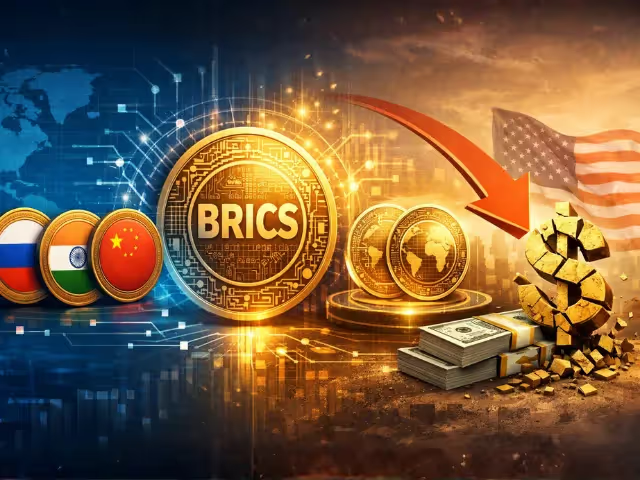
As global economic power slowly shifts eastwards, conversations around reducing dependence on the US dollar are getting louder. One such discussion has gained momentum after reports of the Reserve Bank of India supporting the idea of a BRICS digital currency for cross-border trade and settlements.
The proposal has sparked curiosity and debate across financial markets. Is this a real step towards de-dollarisation or just an exploratory move in a rapidly changing global financial system? More importantly, what does it mean for India and Indian investors?
This blog breaks it down in a simple, practical way.
Understanding the BRICS Digital Currency Idea
BRICS represents Brazil, Russia, India, China, and South Africa. Together, these economies account for a significant share of global GDP, population, and trade flows.
The idea under discussion is not a common currency like the euro but a shared digital settlement mechanism. This digital currency would primarily be used for cross-border trade, reducing the need to route transactions through the US dollar.
From RBI’s perspective, this fits well with India’s broader digital and financial strategy.
How It Might Work in Practice
Imagine an Indian exporter selling pharmaceuticals to Brazil. Instead of converting rupees to dollars and then to Brazilian real, the transaction could be settled directly using a BRICS digital unit.
This could lower transaction costs, reduce settlement time, and limit exposure to dollar volatility.
India already has experience in this space through:
- Digital Rupee pilots launched by RBI
- UPI-based cross-border payment linkages
- Local currency trade settlement mechanisms with select countries
Why De-Dollarisation Is Back in Focus
The US dollar has dominated global trade and reserves for decades. However, recent geopolitical tensions, sanctions, and aggressive rate cycles have pushed many countries to rethink this dependence.
For BRICS nations, the motivation is both economic and strategic.
Key Drivers Behind the Shift
- Sanction Risks: Countries want alternatives that reduce vulnerability to unilateral sanctions
- Currency Volatility: Dollar strength can distort trade balances and imported inflation
- Rising Trade Among BRICS: Growing intra-BRICS trade makes local or alternative settlement more logical
India’s stance has been cautious yet pragmatic. The RBI has repeatedly emphasized stability and gradualism rather than disruptive change.
RBI’s Approach and Regulatory Perspective
The Reserve Bank of India is known for its conservative and well-calibrated policy approach. Any participation in a BRICS digital currency framework would likely be:
- Limited to trade settlement, not domestic use
- Fully compliant with FEMA and RBI regulations
- Introduced in pilot phases before scaling up
India’s regulatory focus remains on financial stability, capital controls, and systemic risk management.
This is why the proposal is better viewed as an additional option rather than a replacement for existing systems.
Potential Impact on Indian Markets
Currency and Forex Markets
In the short term, the rupee is unlikely to see major movements purely due to this proposal. Dollar flows still dominate India’s trade, debt, and portfolio investments.
Over the long term, however:
- Reduced dollar demand for trade could marginally ease pressure during periods of global stress
- Currency diversification may improve India’s external resilience
Trade and Current Account
If implemented effectively, exporters and importers could benefit from:
- Lower hedging costs
- Faster settlements
- Reduced dependence on intermediary currencies
This could support sectors like pharmaceuticals, engineering goods, chemicals, and IT services that have strong exposure to emerging markets.
Equity Markets and Sectoral Impact
The impact on equities will be indirect but worth tracking:
- Banks with strong forex and trade finance operations could see operational efficiencies
- Commodity-linked sectors may benefit from smoother trade settlements
- Technology and fintech firms could gain from backend infrastructure development
How This Fits Into India’s Broader Digital Vision
India has consistently positioned itself as a leader in digital public infrastructure. From UPI to Aadhaar to the digital rupee, the focus has been on scalable, low-cost, and inclusive systems.
Supporting a BRICS digital settlement framework aligns with:
- India’s push for financial sovereignty
- Strengthening South-South trade
- Reducing systemic dependency risks
At the same time, RBI has made it clear that monetary autonomy and domestic financial stability will not be compromised.
What Investors Should Keep in Mind
For retail investors, this development is more strategic than tactical.
There is no immediate need to alter portfolios. However, it reinforces a few long-term themes:
- Currency diversification is becoming more relevant
- Global policy coordination impacts domestic markets
- Structural reforms often play out slowly but shape future opportunities
This is where research-backed investing becomes crucial.
Platforms like Swastika Investmart, a SEBI-registered brokerage, help investors navigate such macro trends with:
- In-depth market research and insights
- Strong customer support and advisory focus
- Tech-enabled investing platforms
- Continuous investor education initiatives
Frequently Asked Questions
Is the BRICS digital currency the same as cryptocurrency?
No. It is a proposed digital settlement mechanism backed by central banks, not a decentralized or speculative crypto asset.
Will this replace the US dollar in global trade?
Unlikely in the near future. The dollar will remain dominant, but alternatives may gain limited traction.
Is India committing fully to this proposal?
India is exploring the idea cautiously. Any adoption would be gradual and tightly regulated.
Does this impact the digital rupee?
The two are complementary. The digital rupee focuses on domestic use, while BRICS discussions are about cross-border settlements.
Should investors change their strategy because of this?
No immediate changes are needed. It is a long-term structural development worth tracking.
Final Thoughts
RBI’s support for exploring a BRICS digital currency reflects India’s evolving role in the global financial system. It is less about challenging the dollar overnight and more about creating optionality, resilience, and efficiency in cross-border trade.
For investors, the key takeaway is perspective. Structural shifts take time, and informed decision-making matters more than headlines.
If you want to stay ahead of such macro trends with trusted research and expert guidance, consider opening an account with Swastika Investmart.

The ‘Mother of All Deals’: What the India–EU FTA Really Means for India
The ‘Mother of All Deals’: What the India–EU FTA Really Means for India
When the President of the European Commission called the India–EU Free Trade Agreement the “mother of all deals”, it was not an exaggeration. This proposed trade pact between India and the European Union is set to become one of the largest and most influential trade agreements in the world, both in economic scale and strategic importance.
With negotiations almost complete and a formal announcement expected at the India–EU Summit on January 27, 2026, the deal is no longer a distant policy discussion. It is now a near-term reality with long-term consequences for India’s economy, businesses, and financial markets.
This blog breaks down what the India–EU FTA actually means, why it matters so much right now, and how it could shape India’s growth story over the next decade.
Quick Summary
- India and the EU are close to signing a comprehensive Free Trade Agreement after nearly 20 years of talks
- The deal covers goods, services, investments, and professional mobility
- India–EU trade already stands at about $135 billion and is expected to grow sharply
- Export-driven sectors like pharma, IT, textiles, and engineering could benefit the most
- The agreement has both economic and geopolitical significance for India
What is the India–EU Free Trade Agreement?
A Free Trade Agreement is a pact between two economies to reduce or eliminate trade barriers. In practical terms, the India–EU FTA aims to make it easier and cheaper for Indian and European companies to do business with each other.
The agreement is expected to focus on:
- Lower or zero customs duties on goods
- Easier access for services such as IT, consulting, and finance
- Clearer rules for foreign investment
- Smoother movement of professionals and skilled workers
- Regulatory cooperation to reduce compliance hurdles
For Indian exporters, this means fewer taxes at European borders. For European companies, it means better access to one of the fastest-growing consumer markets in the world.
Why Is This Deal So Important?
Scale That Few Deals Can Match
India and the EU together represent nearly 2 billion people and close to 25 percent of global GDP. Any agreement between these two blocs automatically becomes globally significant.
The EU is already India’s largest trading partner, overtaking the US and China in recent years. Goods trade alone touched around $135 billion in FY24. A full-fledged FTA could take this number much higher over time.
Timing Matters More Than Ever
The global trade environment is becoming increasingly uncertain. Rising tariffs, protectionist policies, and geopolitical tensions are reshaping supply chains worldwide.
Against this backdrop, India and the EU are looking for stable, long-term trade partners. For India, diversifying export markets beyond a few major economies reduces risk. For Europe, India offers scale, growth, and strategic balance in Asia.
Why Did It Take Nearly 20 Years?
The India–EU FTA talks began in 2007 but were suspended in 2013 due to disagreements on sensitive issues such as:
- Import duties on automobiles and wine
- Intellectual property rights in pharmaceuticals
- Market access for services
- Regulatory standards and data protection
Negotiations resumed in 2022 with renewed political will on both sides. The current version of the deal reflects compromises that balance domestic priorities with global competitiveness.
This long negotiation period is also why the agreement is being called historic. It is designed to be comprehensive rather than rushed.
Sector-wise Impact on India
Pharmaceuticals
India is one of the world’s largest suppliers of generic medicines. Easier access to European markets could boost exports and strengthen India’s role in global healthcare supply chains. Regulatory alignment may also reduce approval timelines.
IT and Services
Indian IT companies and professionals stand to gain from better access to the European services market. Simplified rules for cross-border services and professional mobility could create new revenue opportunities.
Textiles and Apparel
Textiles are highly sensitive to tariffs. Reduced duties can significantly improve the competitiveness of Indian exporters against rivals like Bangladesh and Vietnam.
Engineering and Manufacturing
Lower trade barriers could benefit capital goods, auto components, and engineering exports. This aligns well with India’s Make in India and production-linked incentive initiatives.
What Does This Mean for Indian Financial Markets?
From a market perspective, large trade deals tend to influence investor sentiment gradually rather than overnight. However, sectors linked to exports and global trade may attract renewed interest.
Historically, improved trade visibility supports earnings growth over time. Investors may closely track companies with strong European exposure, efficient supply chains, and regulatory readiness.
It is also worth noting that such agreements often encourage foreign direct investment. Increased European investment into Indian manufacturing and services could support long-term market stability.
More Than Just Trade: The Strategic Angle
The upcoming India–EU summit is expected to go beyond economics. Reports suggest announcements related to defence cooperation, a strategic roadmap till 2030, and closer political coordination.
In a world where trade, security, and geopolitics are increasingly interconnected, this agreement positions India as a key global partner rather than just an emerging market.
What Should Indian Investors Keep in Mind?
While the India–EU FTA offers long-term positives, investors should remain selective. Not every company will benefit equally. Execution, compliance with European standards, and cost competitiveness will matter.
This is where strong research and market understanding become crucial.
Platforms like Swastika Investmart, a SEBI-registered brokerage, support investors with in-depth research, tech-enabled investing tools, responsive customer support, and a strong focus on investor education. Such support helps investors navigate policy-driven opportunities with clarity and discipline.
Frequently Asked Questions
When is the India–EU FTA expected to be signed?
The final announcement is expected at the India–EU Summit on January 27, 2026, subject to formal approvals.
Will this deal immediately boost Indian exports?
The impact is likely to be gradual. Benefits usually play out over several years as businesses adjust and scale up.
Which sectors may benefit the most?
Pharmaceuticals, IT services, textiles, and engineering goods are among the key beneficiaries.
Does the deal affect Indian retail investors directly?
Indirectly, yes. Improved trade prospects can support corporate earnings and long-term market growth.
Final Thoughts
The India–EU Free Trade Agreement is not just another policy headline. It represents a long-term commitment between two major economies to work together in an uncertain global environment.
For India, it is about securing stable export markets, attracting investment, and strengthening its global economic position. For investors, it reinforces the importance of focusing on fundamentally strong companies aligned with global trade trends.
If you are looking to invest with confidence, backed by research, technology, and trusted support, explore the opportunities with Swastika Investmart.
.avif)
Stocks in News Today 21 January 2026: Key Developments Investors Are Tracking | Key Updates Before Union Budget
Summary
- HCL Technologies strengthens its US public sector presence through a strategic partnership
- Crompton Greaves expands its consumer product portfolio with new launches
- Delhivery steps into AI driven logistics automation
- Pace Digitek secures a significant lithium battery order from BSNL
- These updates may influence sector specific sentiment in Indian markets
Stocks in News Today 21 January 2026: What Matters for Indian Investors
Daily stock specific developments often set the tone for intraday and short term market movements. On 21 January 2026, several companies across IT services, consumer durables, logistics technology, and energy storage reported business updates that investors are closely watching.
While broader market direction is driven by global cues, FII flows, and macro data, such company level announcements often shape stock specific momentum. Let us break down today’s stocks in news and understand what they mean in a practical investing context.
HCL Technologies Strengthens US Public Sector Footprint
HCL Technologies announced a strategic partnership with Carahsoft Technology Corp to support digital transformation initiatives in the United States. Under this arrangement, Carahsoft will act as HCL Tech’s public sector distributor across the region.
Why this matters
The US public sector is a large and stable technology spender, covering federal, state, and local governments. Partnerships like these help Indian IT firms gain deeper access to regulated markets where direct entry is often complex.
For HCL Tech, this move aligns with its long term focus on cloud services, cybersecurity, and digital modernization. From an investor perspective, such deals support revenue visibility and diversification beyond traditional enterprise clients.
In the Indian market context, IT stocks often react positively to news that strengthens dollar revenue pipelines, especially during periods of currency volatility.
Crompton Greaves Expands Product Portfolio
Crompton Greaves Consumer Electricals announced the launch of a 20W mobile charger under its lighting segment. The company also introduced new lighting products under the Aquilla Plus and Delphinus brands.
Market relevance
Crompton Greaves has been steadily working on premiumisation and category expansion. Moving beyond traditional fans and lighting into adjacent consumer electronics reflects an effort to capture younger, urban demand.
For investors, this signals a focus on improving margins and brand recall. While the immediate financial impact may be limited, consistent product innovation supports long term earnings stability.
In the broader Indian market, consumer durable stocks tend to attract attention when discretionary spending expectations improve, especially ahead of festive or demand recovery phases.
Delhivery Enters AI Powered Logistics Automation
Delhivery, through its arm TransportOne, launched an autonomous transportation management system designed to automate logistics operations using AI agents.
Why investors are watching this closely
Logistics remains a cost intensive sector. Automation and AI driven routing, tracking, and capacity optimization can significantly improve operational efficiency.
Delhivery’s move reflects a shift from being just a logistics service provider to a technology led logistics platform. This aligns with global trends where data and AI play a critical role in supply chain management.
From an Indian equity market standpoint, technology led differentiation is crucial for logistics companies to improve profitability and reduce volatility linked to fuel costs and demand cycles.
Pace Digitek Secures Major Lithium Battery Order
Pace Digitek’s arm received an order worth ₹94.5 crore from Bharat Sanchar Nigam Limited (BSNL). The contract includes the supply and five year maintenance of 25,000 lithium ion battery modules.
Strategic importance
This order highlights growing adoption of lithium ion storage solutions in telecom infrastructure. With India pushing digital connectivity and backup power solutions, such contracts offer strong revenue visibility.
For investors, government backed orders reduce counterparty risk and support balance sheet strength. It also places Pace Digitek within the broader clean energy and energy storage theme, which continues to attract long term interest.
In Indian markets, companies linked to energy transition often see heightened attention during periods of policy focus or infrastructure expansion.
How Stocks in News Impact Indian Markets
Company specific updates like these usually influence:
- Short term price movement due to news based trading
- Sector sentiment, especially in IT, logistics, and consumer durables
- Medium term outlook if announcements translate into consistent execution
Retail investors often track such updates to identify momentum opportunities, while long term investors look for alignment with structural growth themes.
How Swastika Investmart Helps Investors Track Such Opportunities
Navigating daily stock specific developments requires reliable research and timely insights. Swastika Investmart, a SEBI registered brokerage, supports investors through:
- Well structured daily market and stock updates
- Sector focused research and technical insights
- Easy to use, tech enabled trading platforms
- Strong customer support and investor education initiatives
Whether you are a short term trader reacting to news or a long term investor building conviction, having access to credible research tools makes a meaningful difference.
Frequently Asked Questions
What does stocks in news mean for investors
Stocks in news refer to companies that have announced significant developments which may impact their share price or investor sentiment.
Do such announcements always move stock prices
Not always. Market reaction depends on valuation, broader market mood, and whether the news was already priced in.
Is it safe to trade only based on news
News should be combined with technical analysis, fundamentals, and risk management rather than used in isolation.
How can retail investors track daily stock news efficiently
Using broker research reports, official exchange disclosures, and verified financial news sources helps avoid misinformation.
Are government orders usually positive for stocks
Government orders often provide revenue stability, but execution capability and margins remain equally important.
Conclusion: Staying Ahead with Informed Market Tracking
The stocks in news today on 21 January 2026 reflect how diverse sectors from IT and consumer goods to logistics and energy storage are evolving. While each update carries its own implications, informed decision making remains the key to navigating market noise.
With its research driven approach, investor focused tools, and SEBI registered credibility, Swastika Investmart empowers traders and investors to act with confidence rather than speculation.
If you are looking to track market opportunities more efficiently, consider taking the next step.
Open your trading account today
Invest wisely. Stay informed.
.avif)
Market Setup Today 21 January 2026: Nifty, Bank Nifty Outlook and Budget Watch
Summary
• Global markets remain cautious after a sharp fall in US indices
• FIIs continue selling while DIIs provide partial support
• Nifty faces pressure below key moving averages
• Bank Nifty shows relative strength but momentum is slowing
Global Market Cues Driving Indian Sentiment
Global markets set a cautious tone for Indian equities today. US markets ended sharply lower, with the Dow Jones declining by nearly 870 points, reflecting risk aversion among global investors. However, Dow futures are trading marginally higher by around 86 points, offering mild relief.
Asian markets are trading on a negative note, suggesting that risk sentiment remains weak across the region. Despite this, GIFT Nifty is indicating a positive start with a gain of around 26 points, hinting at a potentially mixed opening for Indian indices.
For Indian traders, such global cues often result in range-bound or volatile sessions, especially when domestic technical levels are under pressure.
Institutional Activity and Market Data Analysis
Cash Market Overview
Foreign Institutional Investors continued their selling streak, offloading equities worth approximately ₹2,938 crore. On the other hand, Domestic Institutional Investors stepped in with buying of about ₹3,666 crore, resulting in a net positive flow of ₹728 crore.
This divergence highlights a familiar pattern in Indian markets where DIIs are acting as stabilizers during phases of foreign selling.
Derivatives and Volatility Indicators
The Nifty Put Call Ratio has declined to 0.72 from 0.77, suggesting cautious sentiment and limited confidence among option writers. India VIX has jumped to 12.73, rising over 7 percent, indicating an increase in near-term volatility expectations.
Higher volatility usually translates into sharp intraday swings, making disciplined risk management essential for traders.
FII Positioning in Index Derivatives
FII data in index derivatives presents a mixed picture. While there has been a marginal addition in futures long positions, futures short positions have increased significantly. In the options segment, FIIs have reduced both call and put positions, indicating uncertainty and lack of directional conviction.
Such positioning often points towards a market that may remain choppy, reacting sharply to global news and domestic technical triggers.
Technical View on Nifty 50
Nifty has witnessed a sharp decline after breaking below its 100 day moving average, which is a key medium-term trend indicator. This breakdown has weakened overall market structure.
The 200 day moving average, placed near 25,115, now becomes a critical support zone. A sustained hold above this level could trigger a technical bounce, but failure to defend it may open doors for deeper correction.
On the upside, any recovery is likely to face immediate resistance in the 25,400 to 25,500 zone. This area is expected to act as a strong supply zone where selling pressure may emerge.
Traders should remain cautious and avoid aggressive long positions unless the index shows strong follow-through above resistance levels.
Bank Nifty Technical Outlook
Bank Nifty continues to display relative strength compared to the broader market, although momentum has started to slow. This suggests selective buying rather than broad-based participation.
Immediate support levels are placed around 59,250 and 58,800. These levels are crucial for maintaining bullish structure. A breakdown below these zones could shift sentiment towards the bearish side.
On the upside, resistance is seen near 59,800 and 60,200. A decisive move above these levels could attract fresh buying interest, especially from short-covering.
Given the index’s heavyweight influence on Nifty, Bank Nifty’s behavior will remain a key driver for market direction today.
What This Means for Indian Investors and Traders
The current market setup reflects a phase of consolidation with heightened volatility. Global uncertainty, FII selling, and technical breakdowns suggest that traders should prioritize capital protection over aggressive returns.
Short-term traders may focus on range trading strategies, while positional investors should wait for clearer confirmation near major support levels. Long-term investors can use selective declines to accumulate fundamentally strong stocks, keeping asset allocation and risk profile in mind.
As per SEBI guidelines, investors should always align trading activity with their financial goals and risk tolerance.
Why Research Matters More in Volatile Markets
Periods like these highlight the importance of reliable research, disciplined strategies, and timely execution. SEBI registered brokers with strong research frameworks can help investors navigate uncertainty more effectively.
Swastika Investmart offers comprehensive market insights, technical research, derivatives analytics, and investor education tools that support informed decision-making across market cycles.
Frequently Asked Questions
What is the market outlook for today based on global cues?
Global cues remain cautious due to weakness in US and Asian markets, although positive GIFT Nifty signals suggest a mixed opening.
Why is India VIX rising and what does it indicate?
India VIX has risen due to increased uncertainty and selling pressure, indicating higher expected volatility in the near term.
Is FII selling a negative sign for Indian markets?
Sustained FII selling can create short-term pressure, but strong DII participation often helps stabilize markets.
What are the key levels to watch for Nifty today?
Support is placed near 25,115, while resistance is expected between 25,400 and 25,500.
Is Bank Nifty stronger than Nifty right now?
Yes, Bank Nifty is showing relative strength, but momentum is slowing and support levels must hold.
Final Thoughts
The market setup for 21 January 2026 suggests caution, discipline, and selective participation. With volatility rising and global cues remaining uncertain, a research-backed approach becomes essential.
If you are looking for structured market insights, advanced trading tools, and SEBI registered brokerage support, Swastika Investmart can be a reliable partner in your investment journey.
👉 Open your trading account here
Stay informed. Stay disciplined. Trade smart.
%20(3).avif)
Shanghai Futures Exchange (SHFE) Raises Trading Margins: What It Means for Commodities and Indian Markets
Summary
- Shanghai Futures Exchange announced margin and price limit hikes on January 20, 2026
- Changes take effect from January 22, 2026
- Copper futures margins raised to 8 percent from 7 percent
- Similar measures applied to aluminum, gold, and silver contracts
SHFE Raises Trading Margins: What It Means for Commodities and Indian Markets
On January 20, 2026, the Shanghai Futures Exchange (SHFE) stated that it will raise trading margins and daily price limits for several commodity futures contracts starting January 22, 2026, as part of its measures to manage market volatility.
The announcement covers key commodities including copper, aluminum, gold, and silver. For copper futures in particular, trading margins will be increased to 8 percent from the earlier 7 percent, while the daily price limit for contracts such as CU2603 and CU2604 will also be raised to 8 percent.
This move has drawn attention from global commodity participants, as SHFE is one of the most influential futures exchanges for industrial and precious metals pricing.
Why the Shanghai Futures Exchange Took This Step
Trading margins and price limits are essential tools used by exchanges to maintain orderly markets. When price volatility increases sharply, exchanges often raise margins to ensure participants maintain sufficient capital to cover potential losses.
In recent months, commodities have seen heightened volatility due to a mix of factors including global economic uncertainty, shifting interest rate expectations, geopolitical risks, and fluctuating demand from major economies.
Copper, often referred to as an economic barometer, has reacted to expectations around infrastructure spending, energy transition demand, and manufacturing activity. Precious metals such as gold and silver have also seen increased participation as investors hedge against uncertainty.
By adjusting margins and price limits, SHFE aims to balance efficient price discovery with risk control.
Impact on Key Commodity Segments
Copper Futures
Copper plays a critical role in construction, power transmission, renewable energy, and electric vehicles. Any regulatory change in copper futures trading tends to attract global attention.
Higher margins increase the cost of holding leveraged positions, which can reduce speculative activity in the short term. At the same time, higher daily price limits allow prices to move more freely during volatile sessions, reducing the likelihood of artificial trading halts.
For manufacturers and hedgers, these changes signal a more controlled trading environment rather than a shift in demand fundamentals.
Gold and Silver Futures
Gold and silver prices are sensitive to global interest rates, currency movements, and geopolitical developments. Margin hikes in precious metals typically reflect increased volatility rather than a directional price signal.
For investors, such measures may lead to temporary moderation in speculative volumes, while long-term price trends remain driven by macroeconomic factors.
Aluminum Futures
Aluminum is closely linked to industrial activity, packaging, transportation, and construction. Margin and price limit adjustments in aluminum futures suggest that the exchange is closely monitoring price swings tied to supply dynamics and energy costs.
What This Means for Indian Markets
Although SHFE operates in China, its decisions often influence global commodity sentiment. Indian commodity markets, particularly those trading on the Multi Commodity Exchange of India (MCX), frequently take cues from international price movements.
Copper, gold, and silver futures traded in India are impacted by global benchmarks, currency movements, and overseas exchange regulations. Increased margins on SHFE may lead to short-term volatility in global prices, which can reflect in Indian markets during overlapping trading hours.
For Indian manufacturers, especially those in power, infrastructure, and auto sectors, changes in copper and aluminum prices can affect input costs. For investors, precious metals may continue to attract attention as portfolio hedging instruments.
From a regulatory perspective, Indian commodity markets operate under SEBI guidelines, which emphasize risk management, margin adequacy, and investor protection, similar to global best practices.
How Traders and Investors Can Approach This Development
Short-term traders should be aware that margin changes often lead to shifts in liquidity and volatility. Sudden price movements may occur as positions are adjusted ahead of implementation dates.
Long-term investors, however, should focus on demand fundamentals rather than short-term regulatory changes. Commodity prices over time are driven by economic growth, supply constraints, and structural demand trends.
Using reliable research, disciplined risk management, and compliant trading platforms becomes especially important during periods of elevated volatility.
Swastika Investmart supports commodity traders and investors through SEBI-registered operations, strong research coverage, technology-enabled platforms, and responsive customer support. Its focus on investor education helps market participants make informed decisions rather than reactive trades.
Frequently Asked Questions
What is SHFE?
SHFE stands for Shanghai Futures Exchange, one of the world’s major commodity futures exchanges based in China.
When did SHFE announce the margin hike?
The announcement was made on January 20, 2026, with changes effective from January 22, 2026.
Which commodities are affected by the SHFE decision?
Copper, aluminum, gold, and silver futures contracts are covered under the revised margin and price limit rules.
Does this impact Indian commodity traders?
Yes, global price movements influenced by SHFE can impact Indian commodity markets, especially on MCX.
Is this a bearish or bullish signal for commodities?
Margin hikes are risk management measures and do not indicate a directional view on prices.
Conclusion
The decision by the Shanghai Futures Exchange to raise trading margins and daily price limits reflects the current volatility in global commodity markets. While such measures may influence short-term trading behavior, they do not alter the underlying demand and supply dynamics driving commodity prices.
For Indian investors and traders, staying informed, managing risk, and relying on credible research is key during such phases. With its SEBI registration, advanced trading tools, and strong research ecosystem, Swastika Investmart helps investors navigate global market developments with confidence.
.avif)
Budget Analysis 2026 vs Market Noise: What Should Investors Really Trust
Summary
- Budget Day volatility often reflects emotion and speculation, not fundamentals
- Real budget impact shows up over quarters, not minutes
- Long-term policy direction matters more than headline reactions
- Investors should rely on research-backed analysis, not social media noise
Budget Analysis vs Market Noise: What Should Investors Really Trust
Every Union Budget brings excitement, expectations, and extreme market reactions. As February 1, 2026 approaches, investors are once again caught between two powerful forces: budget analysis vs market noise.
On one side, there are detailed policy expectations based on macroeconomic data, fiscal math, and sector fundamentals. On the other, there is instant commentary, TV debates, social media predictions, and sharp intraday market swings.
For Indian investors, especially retail participants, the key question is simple but critical. What should you really trust when markets react to the Union Budget 2026-27?
Understanding Market Noise on Budget Day
Market noise refers to short-term price movements driven by emotions, speculation, and incomplete information. On Budget Day, this noise is amplified.
Within minutes of the Finance Minister beginning the speech, headlines flash phrases like big relief for taxpayers or disappointment for markets. Algorithms react, traders place rapid bets, and social media fills with stock tips.
For example, in past budgets, sectors like railways or defence have seen sharp initial rallies, only to correct once details were analysed. Similarly, stocks sometimes fall simply because expectations were unrealistic, not because policies were negative.
Noise is fast, loud, and often misleading.
What Real Budget Analysis Looks Like
Budget analysis focuses on substance rather than speed. It looks at numbers, intent, and execution potential.
With Union Budget 2026-27, analysts are closely studying expectations around economic growth of 7 to 7.5 percent, fiscal consolidation, and the long-term Viksit Bharat 2047 vision. These themes do not play out in one trading session.
For instance, if capital expenditure on infrastructure continues to rise while the fiscal deficit follows a credible reduction path, it supports long-term earnings growth. This benefits sectors like capital goods, cement, logistics, and banking over multiple years.
True analysis also considers how policies align with existing reforms like GST, PLI schemes, and digital public infrastructure.
Budget 2026 Expectations and How Noise Can Distort Them
Tax Reforms and Consumption
One of the biggest expectations from Budget 2026 is tax relief for the salaried and middle class. There is discussion around increasing the standard deduction and rationalising tax slabs.
Market noise may push consumption stocks sharply up or down based on perceived relief. However, the real impact depends on how much disposable income actually increases and whether it leads to sustained spending.
A measured analysis asks a better question. Will this support earnings growth for FMCG, retail, and auto companies over the next two to three years?
Fiscal Discipline vs Short-Term Populism
Another area prone to noise is the fiscal deficit. A slightly higher deficit number may trigger panic selling, even if it funds productive capital expenditure.
Experienced analysts look deeper. If higher spending is directed toward infrastructure, manufacturing, and employment generation, it strengthens the economy’s productive capacity. Markets usually reward this over time.
Sectoral Announcements and Knee-Jerk Reactions
Budget speeches often mention agriculture, defence, railways, EVs, MSMEs, and startups. Immediate stock reactions can be dramatic.
For example, an allocation increase for agriculture may cause fertilizer or agri-input stocks to spike. But long-term impact depends on execution, credit flow, and demand trends.
Similarly, incentives for AI, skilling, and manufacturing may not move stock prices instantly. Yet these policies can shape India’s competitiveness and corporate earnings over the next decade.
This is where budget analysis clearly beats market noise.
Role of Regulation and Investor Responsibility
SEBI has repeatedly emphasized informed investing and risk awareness. Budget Day trading based purely on headlines often leads to impulsive decisions, which may not align with an investor’s financial goals.
Indian markets reward patience. Investors who stayed focused on fundamentals during volatile budget sessions in the past were better positioned than those chasing intraday moves.
This is why access to credible research and disciplined guidance matters.
How Smart Investors Filter Signal from Noise
Smart investors do not ignore the budget, but they do not overreact either.
They track policy continuity, fiscal credibility, and sectoral direction. They understand that markets may digest budget proposals over days and weeks, not minutes.
Using research-backed insights, earnings forecasts, and macro indicators helps investors align decisions with long-term wealth creation rather than short-term excitement.
Platforms like Swastika Investmart support this approach through SEBI-registered research, strong analytical tools, investor education, and responsive customer support. This enables investors to interpret events like the Union Budget with clarity instead of confusion.
Budget Analysis vs Market Noise in Real Life
Consider a retail investor watching markets on Budget Day. If indices fall 1 percent due to perceived disappointment, panic selling may feel logical.
But if the budget maintains capex momentum, supports manufacturing, and keeps fiscal discipline intact, the long-term story remains positive. Those who relied on analysis instead of noise often benefit when markets stabilise.
This difference separates reactive traders from informed investors.
Frequently Asked Questions
Why do markets become volatile on Budget Day?
Markets react to expectations, not just announcements. When reality differs from assumptions, prices move sharply.
Is it wise to trade heavily on Budget Day?
Budget Day trading involves high risk due to volatility. It is better suited for experienced traders with strict risk management.
How long does it take for budget impact to reflect in markets?
Meaningful impact usually unfolds over quarters as policies are implemented and earnings adjust.
Do tax announcements immediately affect stock prices?
They can influence sentiment, but sustained stock performance depends on earnings growth and demand trends.
How can investors avoid market noise?
By focusing on fundamentals, long-term goals, and relying on credible research instead of headlines.
Conclusion
The debate between budget analysis vs market noise becomes intense every February. While noise dominates screens and conversations, analysis quietly shapes successful investment outcomes.
Union Budget 2026-27 is expected to balance consumption support with structural reforms and fiscal discipline. Investors who stay focused on long-term fundamentals are better positioned to benefit from India’s growth journey.
With SEBI-registered research, advanced trading tools, and a strong focus on investor education, Swastika Investmart helps investors cut through the noise and make informed decisions.


.avif)
.avif)

.avif)





START YOUR INVESTMENT JOURNEY
Get personalized advice from our experts
- Dedicated RM Support
- Smooth and Fast Trading App
