

The Power of Compounding – Why Starting Early Matters




Introduction
Albert Einstein reportedly called compound interest the "eighth wonder of the world." Whether or not he actually said it, the math is undeniable. Compounding is the process where your investment returns begin earning their own returns — and over time, this snowball effect becomes truly extraordinary.
The catch? Compounding needs one essential ingredient: time.
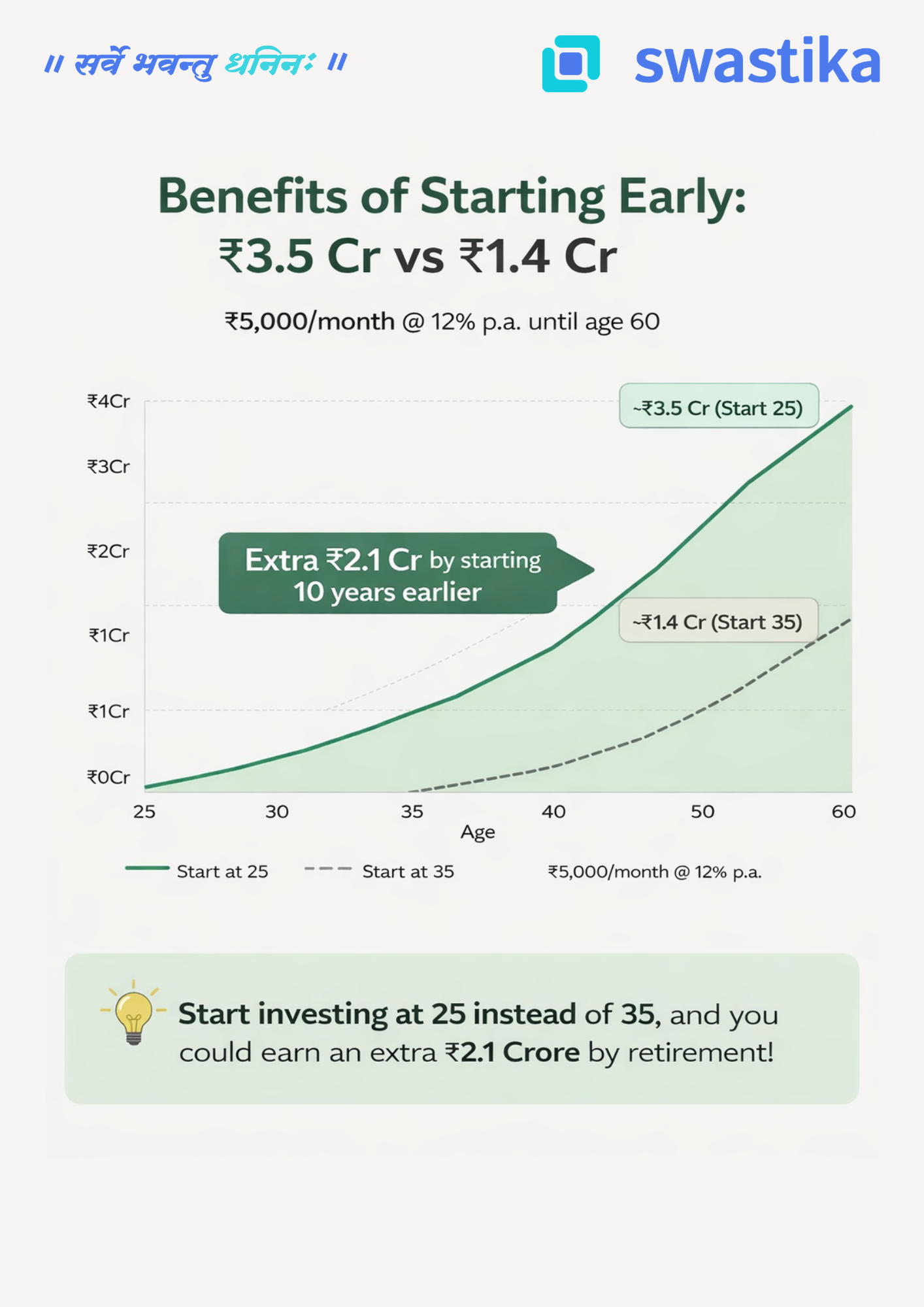
The more years you give your money to grow, the more dramatic — and life-changing — the results become. This is exactly why starting your investment journey early, even with a modest amount, can make a difference of crores by the time you retire.
A Tale of Two Investors: Arjun vs Priya
Let's bring this concept to life with a simple, real-world example.
Meet Arjun and Priya. Both are sensible, disciplined investors. Both invest ₹5,000 every month through a SIP (Systematic Investment Plan) in equity mutual funds, earning an average annual return of 12%. Both stop investing at age 60.
The only difference? Arjun starts at 25. Priya starts at 35.
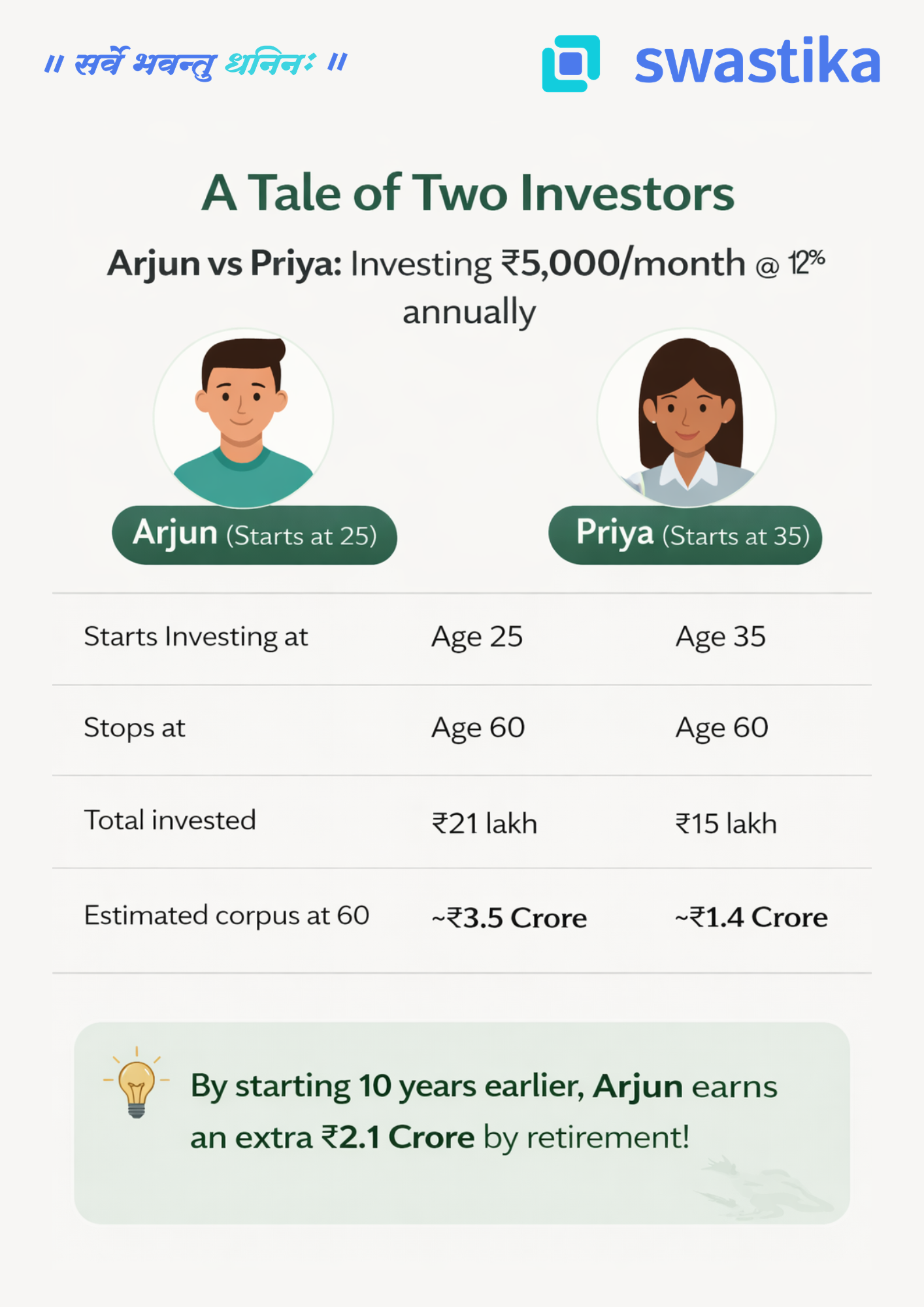
The numbers are striking. Arjun invests just ₹6 lakh more than Priya in absolute terms — yet walks away with ₹2.1 Crore more at retirement.
That extra ₹2.1 Crore didn't come from investing more aggressively or taking bigger risks. It came purely from starting 10 years earlier.
Why Does Time Make Such a Huge Difference?
This is where the magic of compounding reveals itself.
In the early years of investing, growth looks modest and almost unimpressive. But as the years pass, your corpus grows not just on your original investment, but on all the accumulated returns from previous years. The curve goes from almost flat to steeply exponential — and that steep climb happens in the later years.
When Arjun starts at 25, his money has 35 years to ride that exponential curve. Priya's money, starting at 35, only catches the last 25 years — and critically, it misses the steepest part of the climb in the final decade.
Think of it this way: the last 10 years of compounding are worth more than the first 20. That is the counterintuitive truth at the heart of long-term investing.
The Real Cost of Waiting
Many young earners tell themselves, "I'll start investing once I'm more settled — once the salary improves, once the EMI is paid off, once life is a bit easier."
But the numbers show that every year of delay is extraordinarily expensive — far more expensive than any EMI or lifestyle expense. Priya didn't invest carelessly. She invested faithfully for 25 years. Yet she ends up with less than half of what Arjun accumulated — not because she did anything wrong, but simply because she started a decade late.
The cost of waiting 10 years wasn't ₹6 lakh in additional contributions. The cost was ₹2.1 Crore in lost wealth.
Three Principles to Remember
1. Start now, not later.The best time to start investing was yesterday. The second best time is today. Even a SIP of ₹1,000–₹2,000 per month in your 20s is infinitely better than waiting for the "right time."
2. Consistency beats intensity.You don't need to invest large sums all at once. A small, steady, monthly commitment — maintained without interruption — is what unlocks the full power of compounding over decades.
3. Stay invested through market cycles.Compounding works only if you let it work. Exiting during market corrections or stopping your SIP in tough months breaks the chain. Time in the market, not timing the market, is what builds wealth.
The Bottom Line
If you are in your 20s or early 30s, you hold an asset that no amount of money can buy later: time. Use it. Start a SIP today — even a small one. Let compounding do its slow, steady, powerful work.
Because the difference between starting at 25 and starting at 35 is not just 10 years. As Arjun and Priya's story shows, that difference is ₹2.1 Crore.
Big Budget







.webp)
.webp)
.webp)
.webp)
.webp)










.webp)
.webp)
.webp)
.webp)
Latest Articles

ब्याज दर बढ़ोतरी से कीमती धातुओं पर दबाव।


बढ़ती हुई मुद्रास्फीति को नियंत्रित करने के लिए पिछले सप्ताह अमेरिकी फ़ेडरल बैंक की मौद्रिक नीति की बैठक के दौरान कीमती धातुओं के भाव में बिकवाली का दबाव बना रहा और सप्ताह भर में सोने के भाव 2.7 प्रतिशत और चांदी के भाव 3.5 प्रतिशत टूट गए। फेड द्वारा ब्याज दरों को 0.25 प्रतिशत से बढ़ा दिया गया है जिससे अब ब्याज दरे 0.50 प्रतिशत पर पहुंच गई है।
मार्च 2020 में कोविड -19 संकट के फैलने के बाद से यह पहली वृद्धि है। केंद्रीय बैंक ने यह भी आगाह किया कि इस साल छह बार और दरों में बढ़ोतरी हो सकती है, जो कि नीति-निर्माण फेडरल ओपन मार्केट की कैलेंडर बैठकों की संख्या के आधार पर हो सकती है। बैंक ऑफ़ इंग्लैंड ने भी पिछले सप्ताह हुई अपनी मौद्रिक नीति में ब्याज दरों को 0.25 प्रतिशत से बढ़ा दिया है जबकि बैंक ऑफ़ जापान ने ब्याज दरों में कोई बदलाव नहीं किया है।
अनिश्चितता ने सोने को लगातार दूसरे सप्ताह दबाव में रखा है, जो नवंबर के बाद से प्रतिशत के लिहाज से सबसे बड़ी साप्ताहिक गिरावट है। फिर भी, ब्याज दरों में बढ़ोतरी और रूस-यूक्रेन युद्ध के नतीजों के बारे में चिंताओं ने सोने के दोहरे आर्थिक-राजनीतिक बचाव को प्रभावित किया लेकिन कॉमेक्स वायदा सोने का सपोर्ट 1900 डॉलर, जो इस सप्ताह के शुरू में संक्षिप्त रूप से टूट गया था, बनाये रखने में कामयाब रहा है।
रूस और यूक्रेन के बीच चल रही शांति वार्ता के दौरान भी असल शांति की खबरों का आभाव रहा है, जो कीमती धातुओं के के भाव को निचले स्तरों पर सपोर्ट कर रही है। चीन में चल रही मंदी भी कीमती धातुओं के भाव को सपोर्ट कर रही है।
तकनीकी विश्लेषण
इस सप्ताह सोने और चांदी के भाव में निचले स्तरों से उछाल आने की सम्भावना है। अप्रैल वायदा सोने में 51000 रुपये पर सपोर्ट और 52000 रुपये पर प्रतिरोध है।मई वायदा चांदी में 67000 रुपये पर सपोर्ट और 69500 रुपये पर प्रतिरोध है।

LIC IPO Updates :10 Things to Know Before Investing
Updates on LIC IPO
LIC, India's biggest insurer and investment company, come with the most significant updates of LIC IPO. The company has filed DRHP with SEBI to increase its funds through an initial public offering.
The IPO consists of an offer by the Government of India to sell up to 316.25 million shares; LIC's IPO is expected to be the largest IPO in India to date.
After listing, LIC will become the largest company by market capitalization. It will surpass the largest issue by digital payments company One97 communications or Paytm, which raised Rs 18,300 Crore in November 2021.
What is LIC IPO?
LIC - India's largest investment and insurance corporation will launch its IPO on March 11, 2022.
The company is a big name in the insurance sector as it currently operates through 8 zonal and 113 divisional offices. Through its IPO, LIC first aims to address working capital requirements.
Secondly, it is required to meet its corporate purposes as well.
LIC IPO: When will it Happen?
In March, more than 31.6 billion shares (5% of government shares) were opened on D Street, giving insurance giant employees and policyholders a discount from the lowest rates.
What is the Expected Date of LIC IPO?
According to recent updates of LIC IPO, It is expected to launch its IPO on March 11, 2022.
How LIC IPO Will Benefit Its Policyholders?
According to the prospectus, employees and policyholders of the largest insurance company in the country will receive the lowest discount.
Shares to be booked for policyholders can reach up to 10 percent. "The total bookings for qualified policyholders must not exceed 10 percent of the offered size," DRHP explained.
Employee quotas are limited to 5%.
To invest in the long-awaited LIC IPO, policyholders need to have two things. The policyholder's PAN is updated on the LIC portal, and the policyholder must have a Demat account.
Policyholder’s Discount:
Potential discounts will be announced at least two business days in advance as the offer's start date approaches.
The policyholder assignment at the IPO (the first of its kind) requires the central government to designate LIC as one of the reserved categories under last year's amendment to the LIC Act of 1956.
How Can Policyholders Check LIC Policy PAN Link Status
- Go to https://linkpan.licindia.in/UIDSeedingWebApp/getPolicyPANStatus
- Enter your insurance number, date of birth, PAN information, and capture. Then press the Submit button.
How to Link Your PAN Card with LIC Policy
Policyholders can use the online process to link their policy to the PAN. However, policyholders who are new to technology can ask agents for technology.
What is the Market Share of LIC?
LIC holds a majority stake in the Indian life insurance market. The government wants to raise $ 12 billion by selling its shares in the IPO and hopes the proceeds will help close the deficit gap this year.
LIC is the world's largest domestic market share, accounting for more than 64.1% of total premiums as of 2020 and providing the highest return on equity of 82% in terms of life premiums. Crisil's report states.
About LIC IPO Financials
LIC reports that after-tax profit for the first half of the fiscal year 2021-22 is Rs 1,437 compared to Rs 6,14 in the year-ago quarter.
The growth rate of new business insurance premiums in the first half of 2010 was 554.1%, 394.76% in the same period of the previous year.
What is the Embedded Value of LIC IPO?
According to DRHP, the embedded value of LIC is set at 5.39 trillion rupees. Companies usually trade at about 34 times the EV.
How much LIC stake is the government selling?
The government has announced that it will sell 5% of its total capital in shares.
LIC was founded on September 1, 1956, by the merger and nationalization of 245 life insurance companies in India. The initial capital is 5 Crore rupees.
Although many private life insurers have entered the market, LIC is still the leading life insurer.
Steps to Apply for LIC IPO with Swastika
If you've been waiting for a LIC IPO and want to invest in it, Swastika offers investors several benefits such as security features, key conveniences, and more.
Below is how investors apply for LIC IPO using the Swastika
Step I. Mobile Application
- Tap the three lines in the upper left corner.
- Select IPO from the menu bar
- Select the IPO you need to apply for.
- Check Apply by Cutoff and select the lot size according to your requirements.
- Click Continue and select UPI ID.
- Enter the UPI ID and check the Terms of Service. After submitting the request, the client receives the mandate request in the UPI mobile application and chooses to accept or send it.
Step II.
- For applications as existing customers
- Please enter your customer code or mobile number.
- Enter the OTP and send
- Select IPO from the menu bar
- Select the IPO you need to apply for.
- Check Apply by Cutoff and select the lot size according to your requirements.
- Click Continue and select UPI ID. Enter UPI ID.
Enable the terms of use. After submitting the request, the client receives the mandate request in the UPI mobile application and chooses to accept or send it.
After successful registration, the investor will be required to enter the lot size and suggested price. You can click the submit button to place your order when you're done.

डीमैट फॉर्म के जरिए सोने और चांदी के निवेश पर सीधा लाभ
शेयर बाजार और स्थाई आय वाली प्रतिभूतियों के परंपरागत निवेश से अलग सोने और चांदी में लम्बी अवधि का निवेश बढ़ने लगा है। प्राकृतिक आपदा, महामारी, युद्ध, रजनीतिक और आर्थिक अनिश्चितता को टाला नहीं जा सकता, इन्ही परिस्थितियों के बीच अपने निवेश को सुरक्षित रखने के लिए सोने और चांदी में निवेश आवश्यक हो जाता है।
वर्तमान में देश की वार्षिक खपत सोना 800-1000 टन, और चांदी 6500-7000 टन है। पिछले 3 साल में सोना 56 प्रतिशत और चांदी 72 प्रतिशत का रिटर्न दिया है। ई - सोना और चांदी में निवेश सीधे तौर पर अब संभव हो चुका है।
कुछ साल पहले तक, सोने और चांदी के वायदा अनुबंध व्यापार करने के लिए एक्सचेंज में थे जिसके कारण लम्बी अवधि में निवेश के लिए भौतिक तौर पर सोने और चांदी को खरीदना होता था जिनको घरो में रखना जोखिम भरा हो सकता है।
वर्तमान में भारत की सभी एक्सचेंज (एमसीएक्स, एनएसई और बीएसई ) सोने और चांदी के वायदा की डिलीवरी देती है जिसको नेशनल स्टॉक एक्सचेंज (एनएसई) में इन्वेंटरी मैनेजमेंट सिस्टम या मल्टी कमोडिटी एक्सचेंज (एमसीएक्स) में कॉमरिस है, जो डीमैट खाते की तरह होते है। सभी एक्सचेंज लंदन बुलियन मार्किट एसोसिएशन से स्वीकृत सोने-चांदी की डिलीवरी उपलब्ध करवा रही है। बात जब लम्बी अवधि की है तो छोटा लाभ भी महत्वपूर्ण होता है।
सोने और चांदी के एटीएफ की तुलना में सीधे तौर पर एक्सचेंज में ली गई डिलीवरी का लाभ अधिक होता है क्योकि इसमें मैनेजमेंट फीस नहीं होती है और ईटीएफ का रिटर्न मैनेजमेंट की योग्यता पर निर्भर करता है। मल्टी कमोडिटी एक्सचेंज (एमसीएक्स) में सोने और चांदी की डिलीवरी 1 ग्राम सोना और 1 किलो चांदी से लेकर एक किलो सोना और 30 किलो चांदी के बड़ी इकाई में भी संभव है। सोने और चांदी में लंबी अवधि के रिटर्न की तुलना में डीमैट के रूप में डिलीवरी के खर्चे बहुत छोटे है।
एमसीएक्स में सोने की सबसे छोटी इकाई की डिलीवरी, गोल्ड पेटल (1 ग्राम ) और गोल्ड गुन्नी (8 ग्राम ) पर स्टोरेज चार्जेस लगभग 36 रुपये सालाना ,ट्रांसेक्शन चार्जेस 300 रुपये तक और 100 रुपये प्रति ग्राम मेकिंग चार्जेस के साथ जीएसटी 3 प्रतिशत होता है। * चार्जेस में लगभग

Strategies to Invest in Commodity Trading
Commodity Trading is the act of buying and selling commodities futures contracts on commodities such as crude oil, gold, silver, platinum, palladium, copper, corn, soybean and more.
A futures contract is a contractual agreement where one party agrees to buy a specified quantity of an asset at a specified price (the futures price) on a specified date (the expiration date).
The opposite side of the contract is sold by another party, who agrees to sell that same quantity at the same price and date.
To know more about Commodities talk to our expert - 0120 4400777
What to watch for While Investing in Commodities
1) Moving Average for Trading Commodities
Moving average in commodity trading is one of the trendiest strategies for trading. Investors generally use moving averages to find, analyze the market trend along with the support and resistance level.
Supply and Demand Rule
Supply and demand play an important role in commodity trading. If the demand for any commodity increase, the value of that commodity will definitely increase which in turn increase its price in the commodity market.
But commodity businesses work completely differently. In any individual commodity industry, the product is largely the same. Wheat is wheat, cattle are cattle.
Because of this, producers are all price-takers and in normal times aren't able to dictate prices.
Many commodity trading industries are prime examples of what's called perfectly competitive industries, with many buyers demanding an undifferentiated product and suppliers unable to offer differentiated products.
So what causes prices to fluctuate are imbalances in supply and demand, which may occur for many reasons.
Prices may spike if demand rises or supply becomes constrained.
2) Lowest Cost Wins in Commodities
In commodities, companies are price-takers and compete on price alone. In general, the companies that win here produce at the lowest cost—they generate the most profit per unit and can maintain that profit even if commodity trading prices drop.
The most precarious companies are those that produce at high costs. If prices fall, they won’t be able to produce at a profit and will go out of business if the market doesn’t turn around soon enough.
Of course, if you’re trading the price of the commodity itself, you may be uncertain about any individual producer. However, if supply goes offline, it could help push prices higher.
3) Price spikes are often short-lived
Commodity prices are very volatile. This can be bad news for the companies that produce these commodities: they will sometimes see short-term price spikes or declines that make it impossible to remain profitable.
But this volatility is not permanent, and it is part of the way commodity markets work.
The over-corrections that occur as a result of price volatility are what keep commodity supply and demand in line with one another.
If producers don't respond rapidly to changes in prices, then supply will not increase enough to meet demand, and prices will rise too high for consumers.
Similarly, if producers react too quickly by flooding the market with products, then there will be far more supply than consumers need, which pushes prices down so low that production cannot be cost-effective.
So the swings in commodity prices are often short-lived and represent a "shaking out" of marginal suppliers, those without the capacity or willingness to produce at an efficient rate.
Contact our expert analysts to know more about commodity trading, or email us at hello@swastika.co.in
4) Ways to Invest in Commodities
There are many ways you can invest in commodities. Here are five of the most common:
- Futures, a contract to buy or sell a commodity at a certain price on a certain date in the future
- Physical commodities, the physical goods themselves, such as gold, oil, or wheat
- Exchange-Traded Funds (ETFs), a fund that tracks an index or some other benchmark, which sometimes includes physical commodities
- The stock of commodities producers, the company that provides goods or services that deal with physical commodities, such as mining companies and oil drillers
- ETFs of commodities producers, an ETF that invests in stocks of companies involved in producing goods and services involving physical commodities
Conclusion
So far we have learned about commodities and strategies, and now we will discuss how to invest in commodities.

Forex/Currency Trading - Risk Factor and Strategies
What is Currency Trading?
The foreign exchange market, also known as currency trading, is the largest financial market globally.
It's more significant than the stock and bond markets combined, making it a very attractive market for investors.
Currency trading has a lot of appeal to beginning investors who are open to learning about the inner workings of various financial markets.
Forex (short for "foreign exchange") is a market where traders from all over the world buy and sell currencies, like dollars, euros, yen and Swiss francs.
Because currency prices fluctuate so much every day, there are many opportunities for traders to make a profit by buying and selling currencies on the foreign exchange market.
Whether you're a beginner at currency trading or have had an account for a long time, it can be difficult to know what you need to do to make the most of your account.
While there are many different strategies for currency traders, not all are good for beginners.
If you're new to forex trading, you may find that there are several things about the market that you may not be familiar with.
In this blog, we are going to discuss the risk factors and strategies that will help you to invest in Foreign exchange market trading.
However, it requires certain skills and expertise to be able to do it well. Contact our Experts for more information about currency/forex trading - 0120 4400700
Risk Factors in Forex/Currency Trading
Foreign Exchange Risk is a risk involved in foreign exchange due to unexpected changes in the exchange rate. There are three types of Risk engaged in Forex trading, which is as follows:
Transaction Risk in Currency Trading:
Transaction risk arises due to unexpected exchange rates between two currencies. This type of Risk affects both importers and exporters doing international business.
For example, a company in the United States exporting goods to another country may quote prices for its product based on the current exchange rate between that country's currency and the U.S. dollar.
Suppose the U.S. dollar depreciates against that other country's currency before settlement. In that case, the company will receive less money than it had hoped for when it set its price.
As a result, its profit margin may suffer or become a loss if it has not planned accordingly.
Similarly, an importer who has agreed to pay in U.S. dollars for goods coming from another country will find itself paying more than expected if there is an appreciation of the other country's currency about the U.S. dollar before payment and settlement.
Learn More About: 6 Things to Keep in Mind About Currency Trading
Economic/Operating Risk in Currency Trading:
Economic/Operating risks arise due to the uncertainty in foreign economies that can affect all MNCs doing business in those countries. Thus, all MNCs operating globally face this kind of operational Risk.
Factors of Economic Risk in Currency Trading:
Unemployment: a high unemployment rate generally means fewer people have jobs to spend money on goods and services. People with jobs will also be less likely to take risks, like starting a new business or buying a house.
Inflation: this is the general increase in prices and a fall in the purchasing value of money.
High inflation can deter investment because it reduces the likelihood of future profits, so businesses may be less willing to hire new employees or invest in new machinery.
Interest Rates: Higher interest rates make it more expensive for individuals and businesses to borrow money, so consumer spending and business investment decline.
Exchange Rate Fluctuations are changes in the value of one currency against another.
If the euro strengthens against the U.S. dollar, for example, then imported European goods will become more expensive for U.S. consumers than domestically produced ones, meaning domestic producers may lose sales.
Translation Risk in Currency Trading:
Translation risk arises due to unexpected exchange rates between two currencies.
This type of risk is faced by all MNCs with subsidiaries located in different countries and denominated their accounts in a different currency than their home country's currency.
For example, a U.S.-based company has subsidiaries in China and Hong Kong. The subsidiaries' accounts are denominated in Chinese Yuan (CNY) and Hong Kong Dollar (HKD).
When this company prepares financial statements, it will need to convert the subsidiaries' books into American Dollars (USD), the home currency.
The translation process involves taking the subsidiaries' books' assets, liabilities, revenues, and expenses into another currency.
These converted values are then used to prepare financial statements for reporting purposes.
Translation risk is similar to transaction risk as both arise due to exposure to foreign currencies.
However, translation risk is also known as accounting risk because it relates to how financial statements are prepared and reported for internal and external users.
Translation exposure is an important consideration for businesses seeking new opportunities in emerging markets where currency movements can be volatile or unpredictable.
If you have any confusion regarding translation Risk or Forex trading, feel free to mail us - hello@swastika.co.in
Some of the most popular Forex trading strategies include:
- Scalping
- Day Trading
- Trend Trading
- Swing Trading
- Position Trading
Scalping Strategy in Forex Trading
Scalping is a popular trading technique in forex trading. It involves trading currencies in real time, which means that positions are held for very short periods.
In scalping trading, a trader usually opens and liquidates a position within minutes or seconds of each other. The traders aim to make small profits by taking advantage of the bid-ask spread.
Scalping is one of the more popular trading styles because it allows for potentially high risk-reward payouts, and because trades happen very quickly, it can be an exciting way to trade.
Day Trading Strategy for Currency Trading:
Day trading is a way to play the markets to make a profit. For example, if you're buying U.S. treasury bonds (T-bonds), you can buy them at a lower price and then sell them at a higher one.
Many people who trade forex day-to-day are doing it for fun. Others do it to take advantage of price movements in the market. Either way, it's an exciting way to make money.
The type of forex trading strategy you choose depends on how much time you have.
There are very few suitable strategies for beginners because they require extensive research and experience to evaluate market movements accurately.
Trend Trading Strategy in Currency Trading:
Trend trading is one of the most popular and common forex trading strategies.
It involves identifying an upward or downward trend in a currency price movement and choosing trade entry and exit points to position the currency's price within the trend and the trend's relative strength.
Uptrends consist of higher highs and higher lows, while downtrends have lower highs and lower lows.
Identifying a trend depends on the time frame you are looking at. Short-term traders may look at shorter time frames, such as five minutes, while long-term traders may look at four-hour or daily charts with candlesticks.
The strongest trends have both price and momentum moving in the same direction.
Momentum is created when a trader decides to place an order to buy or sell, which adds to market activity and generates more momentum.
Swing Trading Strategy in Currency Trading:
Swing trading is a concept in financial markets that tries to take advantage of short-term waves (or swings) in asset prices.
The trader attempts to benefit from small moves in the market rather than larger gains seen in trend trading or day trading.
Swing trading attempts to capture gains in an asset over a few days to several weeks.
Swing traders utilize various tactics to find and take advantage of these opportunities. By the nature of the strategy, swing traders often hold an asset through many days, weeks, and even months before closing it out for a profit.
Swing traders try to see the big picture without constantly monitoring their computer screens.
Position Trading Strategy in Currency Trading:
The position trading strategy is one of the most widely used strategies in the foreign exchange market.
It involves holding a currency pair over a long time, often weeks or months, instead of just minutes or hours.
The idea is to focus on the underlying trend in the market rather than short-term fluctuations.
Position traders are usually most interested in fundamental factors that may affect currency values.
They look for large moves that can last for weeks or months, and they tend to be less concerned about small day-to-day price fluctuations.
Position traders may also use technical analysis techniques such as trend lines and moving averages to help them determine when to take positions in currencies. Still, their main focus is on fundamental factors.
Conclusion
Our overall conclusion is Forex trading is the best way to go if you are looking for a Good Return on Your Investments. Once you get the hang of it, it can be simple, profitable, and fun.

9 सप्ताह के बाद कच्चे तेल के भाव में बिकवाली।
कच्चे तेल की कीमतों में ऊपरी स्तरों से साप्ताहिक गिरावट दर्ज की गई है। क्योंकि ईरान से बाजार में अतिरिक्त आपूर्ति की संभावना ने यूक्रेन पर रूसी आक्रमण से उपजी संभावित आपूर्ति व्यवधान की आशंकाओं को कम कर दिया है।
ब्रेंट और अमेरिकी कच्चे तेल का वायदा पिछले सोमवार को सितंबर 2014 के बाद से अपने उच्चतम स्तर पर पहुंच गए, लेकिन विश्व शक्तियों के साथ ईरान के 2015 के परमाणु समझौते को लागू करने के लिए समझौते की रिपोर्ट के बीच, नौ सप्ताह में अपनी पहली साप्ताहिक गिरावट दर्ज की है। समझौते में उन कदमों की रूपरेखा है जो अंततः तेल प्रतिबंधों पर छूट देने की ओर ले जाएंगे।
इससे बाजार में प्रति दिन लगभग एक मिलियन बैरल कच्चा तेल वापस आ जाएगा, लेकिन इसका समय स्पष्ट नहीं है। अधिक ईरानी तेल बाज़ार में आने की संभावना के बावजूद , निकट भविष्य में कीमतों में अधिक गिरावट की उम्मीद तो नहीं है, क्योकि पेट्रोलियम निर्यातक देशों के संगठन (ओपेक) और सहयोगी दल, अपने उत्पादन लक्ष्यों को पूरा करने में असमर्थ रहे हैं। हवाई यात्रा और सड़क यातायात के रूप में तेल की मांग में भी सुधार है, लेकिन रूस और यूक्रेन के बीच तनाव बढ़ने पर कीमते 100 डॉलर के ऊपर भी जा सकती है।
तकनीकी विश्लेषण
अमेरिका ईरान में परमाणु सौदे पर हो रही बातचीत में अच्छी प्रगति रही है और इससे एमसीएक्स मार्च वायदा कच्चे तेल में बिकवाली का दबाव इस सप्ताह भी रहने की सम्भावना है। कच्चे तेल में 6400 रुपये के निचले स्तरों पर सपोर्ट है और 6800 रुपये पर इसका प्रतिरोध है।


.webp)
.webp)
.webp)





START YOUR INVESTMENT JOURNEY
Get personalized advice from our experts
- Dedicated RM Support
- Smooth and Fast Trading App
