Sensex Rises 790 Points - Should You Buy Now?


Sensex Rises 790 Points - Should You Buy Now?
TLDR
- Sensex recovers 790 points from the day’s low; Nifty closes above 23,650 as oil slips below $110 and bond yields ease.
- Rupee hits a fresh record low while foreign investors resume selling Indian equities, signaling continued currency risk.
- Top sector watch: Financials and IT; avoid real estate for now due to rate and currency sensitivity.
- Action: review your portfolio, maintain diversification, and consider measured deployment if you have a long horizon.
News Context and Market Impact
What Happened
The Sensex rebounded about 790 points from the day’s low, with the Nifty closing above 23,650. Oil prices slipped below $110 per barrel, aiding risk sentiment. Bond yields eased from recent highs, while the Rupee hit a fresh all-time low against the US dollar. Foreign institutions resumed selling Indian equities, keeping macro headwinds in view. Your portfolio may see a pullback in volatility, but currency and FII flows could cap gains.
Why This Matters
In the short term, this bounce reflects improved risk appetite even as macro overhangs persist. A weaker rupee can affect import costs and margins for listed firms, while softer yields can support equity valuations in rate-sensitive segments. For you, the key takeaway is that the market may move in fits and starts; stay nimble and avoid chasing momentum in individual names.
Portfolio and Strategy Focus
What This Means For Your Portfolio
For retail investors, the rebound offers a chance to recheck asset allocation. Favor quality large-cap names in banks and financials, and select IT exporters that can benefit from a softer rupee. Maintain diversification to cushion volatility and consider a modest hedge if your USD exposure is significant. Your risk controls should tighten when markets rally to prevent overexposure to any single name.
Swastika Investmart notes that retail investors should anchor to quality names and maintain diversified exposure during rebound periods. With currency moves and foreign flows in play, disciplined risk management and a long-term perspective remain essential for your portfolio.
Sectors To Watch - Priority Order
- 1st Priority: Financials - higher chance of leading gains as yields stabilize and loan growth supports profits
- 2nd Priority: IT - exporters benefit from rupee dynamics and potential earnings resilience
- Avoid Now: Real Estate - sensitivity to rates and foreign flow pressures
Action Points For Investors
- SIP investors: Continue disciplined monthly investments across broad-market funds to ride the rebound with risk control
- Lumpsum investors: If you have a long horizon, selectively add to high-quality financials or IT names while keeping stops
- Traders: Focus on liquidity and price action; use tight stops and avoid chasing momentum in mid-caps
In the current backdrop, a measured approach serves you best; avoid panic moves and stick to your plan rather than market rumors.
Risks and Cautions
Key Risks To Watch
- Continued rupee volatility could keep markets choppy, hurting sentiment and returns
- Persistent FII selling may cap upside momentum despite a rebound
- Oil price reversals or mixed macro data could reprice valuations quickly
Frequently Asked Questions
How will the Sensex rebound affect my portfolio?
The rebound can lift near-term holdings, especially large caps, but it doesn’t replace a solid plan—keep diversification and avoid over-concentration in momentum bets.
Is a weak rupee a risk for investments?
Rupee weakness usually benefits IT exporters and some importers; hedge if you have significant USD revenue exposure and monitor margins.
Which sectors look promising in this rebound?
Financials and IT may lead the rally if earnings hold up and currency moves stay favorable; stay selective and focus on quality names.
What should I do today about currency risk and foreign flows?
Review currency hedges and your USD exposure; rebalance toward diversified, high-quality stocks and maintain a cash reserve for liquidity needs.
Conclusion
The rebound presents opportunities in large-cap financials and IT, but currency volatility and ongoing foreign selling means you should stay diversified, use hedges where appropriate, and deploy capital in a measured, long-term manner.
Big Budget





.avif)
.avif)
.avif)
.avif)
.avif)















.avif)
.avif)
.avif)
.avif)
Latest Articles

10 Tried and Tested Trading Strategies to Always Stay in Profit


Stock trading can be very profitable, especially if you stick with it for a long time. To be successful, it's important to understand things like a company's financial health and its real value.
Trading has been around for a long time, starting with the barter system where people traded goods directly with each other. This old form of trading laid the groundwork for the modern stock market.
The stock market is a place where people buy and sell shares of companies. These shares represent part ownership in the business. The first modern stock exchange started in Amsterdam in 1602, where people traded shares of the Dutch East India Company.
Derivatives, which are contracts based on the value of an asset, were first traded in 1607 by a single company. Dividends, or profits shared with stockholders, were given out a few years later. Amsterdam was also the birthplace of futures and options trading.
Today, more and more people are getting interested in the stock market, even those who don’t have much experience. Many see trading as a good way to grow their wealth.
Staying consistently profitable in trading is the goal of every trader, but the journey isn’t always smooth. However, by following some proven strategies, you can increase your chances of staying in the green. Here are ten tried and tested trading strategies to help you stay in profit, explained in simple language.
1. Set Clear Goals and Stick to a Plan
The foundation of successful trading is having a clear goal and a solid plan. Before you even make your first trade, know what you want to achieve.
- Define your trading objectives: Are you looking for short-term gains, or is long-term growth your goal?
- Create a plan: Outline your entry and exit points, how much you’re willing to risk, and how you’ll respond to market changes.
- Stick to the plan: It’s easy to get swayed by emotions, but staying disciplined is key to long-term profitability.
2. Use Stop-Loss Orders
A stop-loss order is a tool that automatically sells your stock if it drops to a certain price, preventing further losses.
- Set your stop-loss: Determine the maximum loss you’re willing to take on a trade and set your stop-loss accordingly.
- Protect your capital: By using stop-loss orders, you can prevent a small loss from turning into a big one.
3. Diversify Your Portfolio
Diversification means spreading your investments across different assets or sectors to reduce risk.
- Avoid putting all your eggs in one basket: Invest in various sectors like technology, healthcare, and consumer goods. If one sector performs poorly, others might do well, balancing your overall returns.
- Include different asset types: Consider adding bonds, ETFs, or mutual funds to your portfolio for added stability.
4. Follow Market Trends
Trend trading is a strategy where you make decisions based on the direction of the market.
- Identify the trend: Use technical analysis tools like moving averages to determine whether the market is trending up, down, or sideways.
- Trade with the trend: If the market is going up, focus on buying (going long). If it’s going down, you might consider selling (going short).
5. Practice Risk Management
Risk management involves controlling the amount of money you expose to potential loss on any given trade.
- Use the 1% rule: Don’t risk more than 1% of your trading capital on a single trade. This way, even if a trade doesn’t go as planned, it won’t significantly impact your overall portfolio.
- Balance risk and reward: Always aim for a higher potential reward compared to the risk. For example, risking ₹10,000 to make ₹30,000 ensures that even if you lose occasionally, you’ll still come out ahead.
6. Keep Emotions in Check
Emotions like fear and greed can cloud your judgment and lead to poor trading decisions.
- Stay calm: Don’t let short-term market fluctuations affect your trading decisions. Stick to your plan and avoid making impulsive trades.
- Avoid emotional trading: If you feel overly stressed or emotional, it might be best to take a break from trading until you can approach it with a clear mind.
7. Regularly Review and Adjust Your Strategy
Markets are constantly changing, so it’s important to review your trading strategy regularly.
- Analyze past trades: Look at what worked and what didn’t. Learn from your mistakes and successes.
- Adjust your strategy: If market conditions change or you notice a pattern in your trading performance, don’t hesitate to tweak your strategy to better align with your goals.
8. Learn to Identify and Trade Support and Resistance Levels
Support and resistance levels are key concepts in technical analysis that can help you make better trading decisions.
- Support level: This is the price level where a stock tends to find support as it falls. Think of it as a floor that the price has trouble falling below.
- Resistance level: This is the price level where a stock often faces selling pressure as it rises, acting like a ceiling.
- Trade near these levels: Buy near support and sell near resistance for better profit potential.
9. Use Technical Indicators
Technical indicators like moving averages, Relative Strength Index (RSI), and MACD can provide insights into market trends and potential entry and exit points.
- Moving Averages: These smooth out price data to create a trend-following indicator.
- RSI: Helps identify whether a stock is overbought or oversold, which can indicate a potential reversal.
- MACD: Shows the relationship between two moving averages and can help signal buying or selling opportunities.
10. Stay Informed and Adapt to Market Conditions
The financial markets are influenced by various factors, including economic data, geopolitical events, and market sentiment. Staying informed helps you anticipate potential changes.
- Follow market news: Keep up with the latest financial news, earnings reports, and economic data releases.
- Be adaptable: Markets can change quickly. Be ready to adjust your strategy or portfolio if necessary to align with new market conditions.
Conclusion
Trading for profit requires discipline, knowledge, and the right strategies. By setting clear goals, managing risk, following trends, and staying updated, you can increase your chances of consistent profitability. Remember, no strategy guarantees success, but these ten tried and tested methods can significantly enhance your trading outcomes.

जैक्सन होल सिम्पोसियम से सोने-चांदी के भाव में उठापटक की संभावना।
वैश्विक स्तर पर बढ़ते कोवीड-19 मामलों के कारण चल रही अनिश्चितता और डेल्टा संस्करण के निरंतर प्रसार से, साथ ही अफगानिस्तान के भू राजनितिक मुद्दों के कारण अनिश्चितता बढ़ी है जिससे सोने के भाव को सपोर्ट मिला हुआ है। घरेलु बाजार में डॉलर 0.15 प्रतिशत साप्ताहिक तेज़ हुआ है।
लेकिन अमेरिका से अपेक्षाकृत सकारात्मक आर्थिक आंकड़ों ने डॉलर, जो सोने के विपरीत दिशा में चलता है को एक मजबूती दी है जिसके कारण सोने और चांदी के भाव में दबाव बना हुआ है। डॉलर उम्मीदों से अधिक तेज़ हुआ है जिसके पीछे की वजह अमेरिकी फेडरल रिजर्व है जो इस साल प्रोत्साहन को कम करना शुरू कर सकता है। जैसा कि पिछले सप्ताह प्रकाशित, जुलाई की बैठक के मिनटों से पता चलता है।
चीन में डेल्टा वेरिएंट के कारण आंशिक प्रतिबंध होने से औद्योगिक मांग घटी है जिसके कारण चांदी के भाव में तुलनात्मक रूप से अधिक मंदी पिछले कुछ सप्ताह में रही है। दूसरी तरफ, वैश्विक स्तरों पर प्रतिबंद होने के कारण कच्चे तेल की मांग भी घटने की सम्भावना होने से कीमतों में दबाव है। सोना-कच्चे तेल का अनुपात बढ़ने लगा है और कच्चे तेल की कीमते सपोर्ट स्तरों पर है।
कच्चे तेल में अगर आगे भी गिरावट होती है तो सोने के भाव में दबाव रह सकता है। एसपीडीआर गोल्ड ट्रस्ट में होल्डिंग्स अगस्त माह में घट कर 1015 टन के निचले स्तरों पर है। अमेरिका में नए बेरोजगारी दावों की संख्या पिछले सप्ताह गिरकर 17 महीने के निचले स्तर पर आ गई, जिसके मुताबिक एक और महीने में मजबूत रोजगार वृद्धि हुई है। अफगानिस्तान में बढ़ती चिंताओं के कारण सोने में सेफ हेवन मांग का सपोर्ट है।
साप्ताहिक आंकड़े
इस सप्ताह अमेरिका के प्रमुख आंकड़े है जिनमे : सोमवार को फ़्लैश मैन्युफैक्चरिंग पीएमआई, बुधवार को कोर दुरेबल गुड्स ऑर्डर्स, गुरुवार को बेरोज़गारी दावे, प्रिलिम जीडीपी, जैक्सनहोल सिम्पोसियम और शुक्रवार को आर्थिक नजरिये पर फेड प्रमुख जेरोम पॉवेल का बयान है।
तकनीकी विश्लेषण
इस सप्ताह सोने और चांदी के भाव पर दबाव रह सकता है। सोने में 48200 रुपये पर प्रतिरोध है और 47000 रुपये पर सपोर्ट है। चांदी में 64000 रुपये पर प्रतिरोध और 61000 रुपये पर सपोर्ट है।
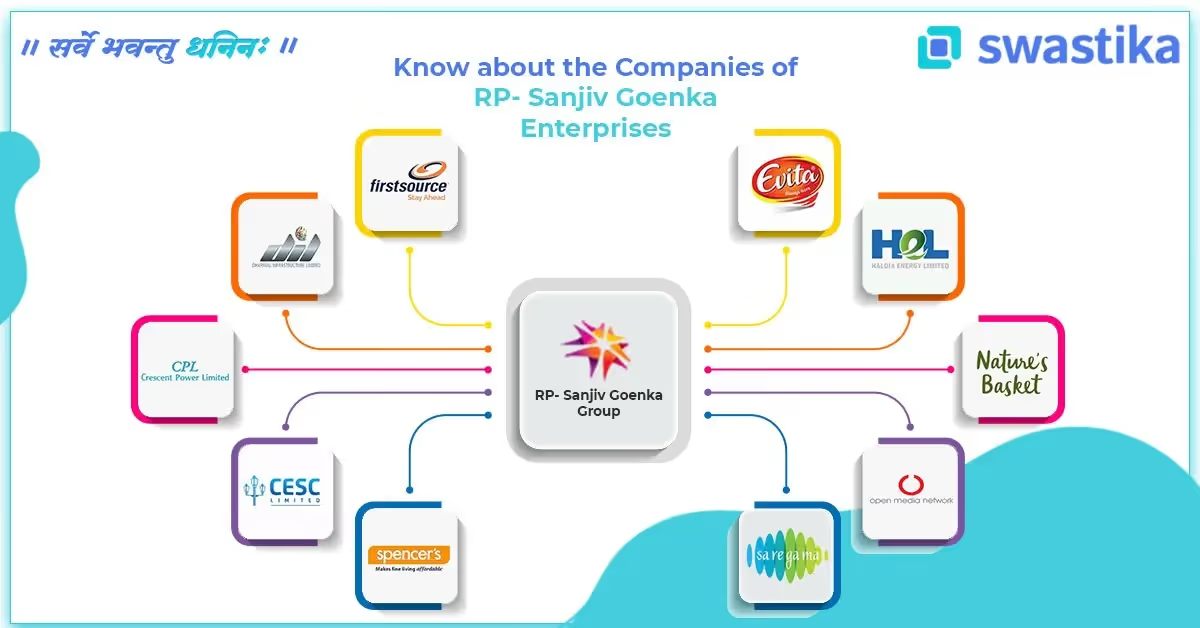
Knowledge Byte - RPSG Group of Companies
Since its commencement, Dr Sanjiv Goenka is the Chairman of RP-Sanjiv Goenka Group. With a US $6 billion resource base and US $4 billion income, the RP-Sanjiv Goenka Group is one of India's quickest developing aggregates with a critical worldwide presence.
The Group's organizations incorporate power and energy, carbon black manufacturing, retail, IT-enabled services, FMCG, media and entertainment, and agriculture.
POWER - CESC LIMITED, HALDIA ENERGY LIMITED, DHARIWAL INFRASTRUCTURE LIMITED, NOIDA POWER COMPANY LIMITED, INTEGRATED COAL MINING LTD, SURYA VIDYUT LIMITED, CRESCENT POWER LIMITED
POWER
CESC LIMITED

Founded in 1899 From coal mining to power generation and dissemination, CESC is a completely coordinated power utility with tasks spanning across the whole worth chain. It is established in Rajasthan.
HALDIA ENERGY LIMITED

An auxiliary of CESC, HEL works on two 300 MW coal-based nuclear energy stations at Haldia in West Bengal.
DHARIWAL INFRASTRUCTURE LIMITED

Another auxiliary, DIL, additionally works on two 300 MW coal-based thermal power plants at Chandrapur in Maharashtra.
NOIDA POWER COMPANY LIMITED

Founded in December 1993, and established at greater Noida it is a joint endeavour between RP-Sanjiv Goenka Group and Greater Noida Industrial Development Authority.
INTEGRATED COAL MINING LTD
Received numerous wellbeing grants for its safe and ecologically responsive ICML was framed by CESC to mine coal from the Aristotle coal block in Ranigunj, West Bengal, for hostage supply of coal to its organizations.
CRESCENT POWER LIMITED

CPL works on a coal washery and a thermal plant near Asansol in West Bengal.it cleans the coal mined at the ICML, further at CESC transporting to the power generating plants the rejected coal is sent to the other power plant.
CARBON BLACK – PHILLIPS CARBON BLACK LTD.
The organization has a presence in excess of 33 nations’ is the main player for carbon black with clients across the globe. It is India's biggest carbon black manufacturer, with four best in class plants at Durgapur, Pale, Kochi and Mundra.
IT SERVICES – FIRSTSOURCE SOLUTIONS LIMITED (FSL)
First source solutions limited (fall) is a BPM that is Business Process Management service provider group acquired it and it is their first IT venture.
MEDIA and ENTERTAINMENT - SAREGAMA INDIA LTD, OPEN MEDIA NETWORK, FORTUNE INDIA, EDITORJI
SAREGAMA INDIA LTD

Sarema is India's most seasoned music name, most youthful film studio and multi-language TV content maker.
OPEN MEDIA NETWORK

Open, the leader brand of Open Media Network, is a week after week magazine that catches the contemporary news on political, financial and social spirit messiness free, dynamic and visual configuration.
FORTUNE INDIA
It is one of the top business magazines. Founded in July 2010, RPSG Group obtained a selective license in 2020 for distributing both print and computerized configurations of Fortune India. It follows the economic and financial journey of India through its magazine and site.
EDITORJI

RPSG Group obtained a stake in Editor in July 2020. Dispatched in October 2018, Editorji is situated as a disruptive offering in the digital news space. multilingual video news stage that gives a totally different approach with the help of AI.
Purchaser AND RETAIL - SPENCER'S RETAIL, NATURE'S BASKET, TOO YUMM! - GUILTFREE INDUSTRIES LTD, EVITA - APRICOT FOODS LIMITED, DR. VAIDYA'S - HERBOLAB INDIA PVT LTD
SPENCER'S RETAIL
Spencer's is a multi-design retailer giving a wide scope of value items across classes like food, individual consideration, style, home fundamentals, electrical and hardware.
NATURE'S BASKET

Nature's Basket, with a focus on rebuilding India's fine food experience, is an auxiliary of Spencer's Retail, works with more than 35 stores in Mumbai, Pune, Kolkata and Bengaluru.
TOO YUMM! GUILTFREE INDUSTRIES LTD
Established as a superior for-you eating brand, Too Yummy! offers numerous items in the eating classification
VAIDYA'S - HERBOLAB INDIA PVT LTD
Dr Vaidya's is the centre ethos of the brand is to inventively offer India's antiquated information on Ayurveda trendy Ayurvedic items organization bringing 150 years of inheritance and
EVITA - APRICOT FOODS LIMITED

dispatched in 2004 and obtained by the RPSG Group in 2017. Apricot Foods Limited, under the brand name Evita, gives customary and western bites has a huge item portfolio with in t excess of 45 distinct variations and 80 SKUs. for the mass market.
SPORTS – RPSG SPORTS COMPANY, ATK MOHUN BAGAN
ATK MOHUN BAGAN

The permit for the club was gained in 2014 The Group's first games resource was ATK - a football club situated in Kolkata, which contends in the Indian Super League football rivalry.
RPSG SPORTS COMPANY
In a bid to improve the brandishing local area of India, RPSG Group has put resources into numerous sports since 2014.
RPSG VENTURES
It is an IT service management company which was Founded in 2017 and Headquarters situated in India. Its Subsidiaries include Herb lab India Pvt Ltd, Bowlopedia Restaurants India Limited

Advantages of Listing on Stock Exchange
We have seen a lot of companies listing on the stock exchange as they have got a lot of benefits by doing so.
Getting listed on the stock exchange stimulates liquidity thereby providing shareholders with an opportunity to realize the value of investments.
Also, listed companies get more exposure than unlisted companies. This is because the companies which are listed on the stock exchange give investors a choice to buy/sell the securities at a given time.
Likewise, the companies which are likely to get listed on the stock exchange get bountiful benefits.
Before discussing the advantages of listing on the Stock Exchange, let's go with the term Stock Exchange.
Stock Exchange is a place where securities such as stocks, bonds, commodities are traded. The stock exchange is a platform where financial instrument participants such as buyers and sellers come together and perform transactions (i.e. buying and selling of securities) during the business days.
In other words, the stock exchange is an organization or association where the stocks are traded. Therefore, if a company needs to trade in the stock market it should be listed on either of the exchanges i.e. National Stock Exchange (NSE) and Bombay Stock Exchange (BSE).
The exchange facilitates the issuance and redemption of financial instruments which makes it important for the investors.
What is a Listed Company?
A listed company is the one whose shares are publicly traded on the stock exchange. Such companies need to confirm the listing requirements of that exchange strictly. This consists of a minimum earning level and the number of shares listed.
Companies that are listed on a stock exchange take out an SME IPO or Initial Public Offering by which they sell shares to the public and in return they raise a whopping amount which in turn helps them to grow business to a new level.
Here, the prices of the shares are based on the supply and demand of the share. The Bombay Stock Exchange or BSE India currently lists more than 600 companies.
Companies that are listed on the stock exchange get enough exposure, capacity to uphold control etc. Aside from such benefits, there are lots of benefits associated with the listing in the stock exchange.
Below are the Advantages of Listing a Company on the Stock Exchange
1) Boosted Profile
One of the primary benefits of listing companies on the major stock exchange is that the listed companies have a promising profile. Also, the listed companies are recognized and visible to the public quickly if we compare them to other companies.
After getting listed on the major stock exchanges, the company has started to attract new customers in the form of shareholders and clients.
2) Access to Capital Growth
Many companies which are doing well, reach a level where they need additional capital for further expansion or growth. In such conditions, going public is the best way to overcome such financial constraints.
Companies listed on the stock exchange can increase capital by releasing more shares for investor purposes.
In addition to this, the raise could be utilized for the company’s growth and other needs.
3) Collateral Value of Securities
Lenders accept listed securities as collateral for credit facilities. In addition to this, a listed company is eligible to borrow capital from the highly-rated financial institutions because the companies are rated by the lenders of capital.
Also, by listing on the stock exchange, the companies can raise extra funds from the public by issuing their shares in the new issue market. Therefore, listing a company on the stock exchange is quietly beneficial for the investors.
4) Liquidity
Another advantage of listing your company on the stock exchange is that it provides your company with adequate liquidity by providing an opportunity for shareholders to realize their investment value. Also, it authorizes shareholders to negotiate in the shares of the company thereby sharing risks.
5) Capacity to Uphold Control
The companies listed on the stock exchange have nothing to do with venture capitalists. In return for acquiring shares for a confidently held company, venture capitalists have to regularly uphold the company’s regulation.
Stock exchanges allow companies to maintain enough control and power as the people who get shares of a publicly traded corporation hold limited rights which can be easily accessible to the shareholders.
6) Better Visibility
Going a company public means it provides visibility among HNIs and institutional investors, investing agencies. Also, the company ensures total transparency whenever the time of conducting operations is done.
7) Higher Returns
Achieving higher ROI is the goal of any company. By listing a company in the stock exchange, the company expects the highest stock market trading returns which couldn't be possible by other methods. Therefore, it can be counted as one of the main advantages of stock listing.
8) Increased Accountability
Companies who are listed on the stock exchange maintain their transparency while dealing in the business and reporting. Transparently keeping all the things allows a company to enjoy success in a much better way. Hence such companies have better financial accountability.
9) Increased Exposure
Needless to say, companies listed on the top exchanges automatically come into the eye of top-notch investors and institutional investors. Such companies attract potential stock market trading investors which in turn helps them to generate more capital which can be used for the company’s growth or expansion.
10) Increase in Employee Morale
Listing on the stock exchange increases the visibility of the people which in turn improves the public perception of the organization, therefore, increases the employee value.
Takeaway
Listing on the stock exchange comes with bountiful benefits. A company that wants to expand its growth often seeks to go public. Launching a stock trading IPO helps them to raise capital to a greater extent which in turn improves the overall efficiency of the company which is important for a company’s growth.
Other advantages include uplifting the reputation and prominence of the company.
Want to list your company on the stock exchange; connect with us!
We carries lot of business under one roof from a stock broking to investment banking. This includes IPO launching, M&A, providing business loans, company valuation services and more.

Indian Startup Ecosystem Flooding with IPOs, along with M&A activity; Venture Investments Slackening
Investors marked a heavy decline in venture funding especially in the 3rd week of July. This is because the week saw other activities such as SME IPO launching, M&A acquisition and global companies that were seeking interest in other major companies.
The 3rd week of July saw a major decline in venture capital funding as the total cost of funding went up to $209 million across 29 deals while in the previous week, the VC funding amounted to $ 847 million.
Also, the startup ecosystem has witnessed many renowned companies that are quite famous among Indian citizens. Here, we are talking about the much-awaited food tech Zomato’s IPO.
Other companies that the investors are witnessing are global logistic giant FedEx which has recently invested in Delhivery while Google; a search engine giant also invested in Slang labs. Oyo Rooms also raised $ 600 million in debt.
In this year, 21 Indian startups entered the unicorn club in 2021. Apart from food tech giant Zomato, there are other startups too who witnessed the first healthcare, social commerce, crypto and pharmacy unicorn this year.
Moreover, there are eight startups are also in line which entered the unicorn club in April 2021. These are Fintech Startup CRED, Sharechat, Social media Startup Meesho, Wealth management company Groww, messaging platform Gupshup.
Key Highlights
News aggregator app Inshorts raised $60 million in funding with participation from existing investors.
Online storytelling app Pratilipi also witnessed that it raised $ 48 million in funding led by Krafton Inc, a South Korean gaming company.
Social e-commerce platform Trell also raised a capital of $ 45 million which is led by MIRAE Asset, LB investment and H&M Group.
Real estate startup Square Yards raised $25 million in growth financing from ADM capital.
Company Investors Total Amount Raised News Aggregator Inshorts $60 Million Online Story telling Pratilipi $48 Million Social E-commerce Trell $45 Million Real Estate Square Yards$ 25 Million
Other Transactions
- Tech Startup One code raised $ 5 million led by Sequoia Capital India’s surge and Nexus Venture Partners.
- Aquaconnect, the fisheries focused startup, raised $ 4 million from Rebright Partners and Flourish Ventures.
- Ati Motors, an all-electric autonomous industrial vehicle maker, raised $3.5 million from Exfinity Venture Partners.
- Pankhuri, a women social community platform, raised $ 3.2 million from Taurus Ventures.
- Edtech Startup Oliveboard raised a whopping amount of Rs 23 Crore from Yukti Securities, Education Catalyst Fund.
- Spacetech startup Dirgantara raised $2.5 million as part of its seed funding from Kalaari Capital.
- Financial Education Startup Kredent Infoedge raised Rs 10 Crore capital from Kotak Securities.
- Blockchain Startup Archana Network raised $ 375000 in a seed round from a group of angel investors.
- LDU (Lets Dress Up) raised $ 300000 from Titan Capital and other groups of investors.
- Education Technology Startup Little Leap raised $ 3,60,000 by Ah Ventures, First Cheque VC.
- Data Technology Startup Sapio Analytics raised $ 15,0000 from Parthiv Group of Companies.
- WorkSpace Startup BHyve raised a whooping capital of $ 300000 from JITO Angel Network, LETS Venture etc.
In addition to this, The Ayurveda Company, SMOOR, UrbanKisaan and Indienergy raised an undisclosed amount of funding last month.
India Connect
M Power Financing raised $100 million through venture capital. The company provides education loans for the students who study in North America.
Bookee, a SAAS startup, raised undisclosed capital from angel investors. The company primarily focuses on the fitness industry.
Multiplier, an HR tech startup raised $4 million in funding led by India’s Surge and other investors.
AI Startup Netradyne raised capital of $ 150 million from the Softbank Vision Fund and other investors.
M&A (Merger & Acquisition)
Edtech unicorn Vedantu also seeks to acquire a majority of stakes in Pedagogy; an e-learning platform.
Trentar acquired a 75% stake in GarudaUAV; a Noida based drone service provider.
Entry Valuation
Last month Elevation and Sequoia raised a capital of $38 million in Fampay, a banking startup for youngsters primarily teenagers. It was considered as one of the largest startups in India’s startup history whose company valuation services went up to $150-170 million for a company that has yet to make any revenue.
Now the question arises: Was the whole deal expensive? Yes, of course. Despite knowing all the risks, Elevation invested in Fampay because they think that the founders are two years ahead of anyone else in the market.
If at an early stage, you are predicting a multi-billion dollar outcome, the entry valuation costs hardly matter, said a person close to the firm.
On 25 December 2020, numerous VCs, founders etc went on a break after the arrival of COVID 1st wave.
During those panic times, partners at Accel and Sequoia have kept their operations of finalizing terms to invest in Powerplay.
They need not have shown that type of hustle in the normal market. They know the market is quite volatile where you have to keep yourself super fast said one of the top VCs.
Angel Investments
An angel investor is an individual who gives capital to a start-up, and in return, they expect convertible debt or ownership equity. Angel investors generally provide support for startups that are at their initial stages and when most investors are not prepared to back them.
Nowadays, a small but increasing number of angel investors invest online through trading crowdfunding as well as to provide advice to their portfolio companies.
VC firms are also enquiring about their portfolio founders’ angel investors which are made in early-stage startups. They keep an eye on all the startups as VCs don’t want to see a single company.
The speed of making deals has increased as the founders and investors made many calls to the investors during the pandemic.
Before the initial phase of COVID 19, physical meetings were the norm and because both the start-up members and other people wanted the comfort of in-person discussions that take time to set up and the whole discussion.
Earlier, investors used to do three calls with a founder before issuing a term sheet. However, they still do three calls but in a shorter period.
Takeaway
Startup companies who want expansion for their business growth often go for IPO launching. It is a better opportunity for companies to get recognized on equity trading platforms.
Evaluation of a company is essentially important for business owners to assess both opportunity and opportunity costs as it helps them to identify the strength and weaknesses of the reviewed company.

NCDEX LAUNCHES ANOTHER HEDGING TOOL IN INDEX AS “GUAREX”
Just like AGRIDEX, NCDEX had launched another price based index named GUAREX which is mainly based on the price movements of Guarseed and Gurugum where the weights are 63.43% and 36.57% respectively.
Guar (Cyamopsis tetragonoloba) is a leguminous crop, which grows best in sandy soils and needs moderate, intermittent rainfall. It is a hardy, drought-resistant bush and is sown after the first monsoon showers between the second half of July and early August.
Guar gum is used as a thickening and binding agent in the food, textile, paper, pharmaceutical and oil industries.
Highly refined guar gum is used in the food industry as a stabilizer in ice creams, as a meat binder and a stabilizer for cheeses, instant puddings and whipped cream substitutes.
Guar gum is used in industrial applications including cloth and paper manufacture, oil well drilling, explosives, ore flotation, and many other applications.
India is the major producer of Guar as it produces almost 80% of the world’s total production where Rajasthan contributes the highest almost 70-80% of the total production of India.
GUAREX index is a real-time commodity futures price index as it is designed to provide exposure to market participants who are dealing in guar complexes. This index will act as an important hedging tool as it will help in diversifying the positions.
BENEFITS:
- Cash settlement
- Very little margin is required compared to the underlying
- Low transaction cost
- Steady returns
- SEBI has now allowed the benefit in Commodity Index futures
- Multiple entries and exit points
CONTRACT SPECIFICATIONS:
- LOT SIZE - 100 UNITS


.avif)
.avif)

.avif)






START YOUR INVESTMENT JOURNEY
Get personalized advice from our experts
- Dedicated RM Support
- Smooth and Fast Trading App