

Adani Power ₹4,194 Cr Stake - Should You Buy or Hold in Your Portfolio?


TLDR
- Adani Power to acquire 24% stake in Jaiprakash Power Ventures Ltd for ₹4,194 crore.
- Direct impact on your portfolio may include volatility in energy stocks and potential re-rating of thermal assets.
- Top priority sectors: Power & Utilities and Energy Infrastructure.
- Action: Review exposure to energy names and prepare to adjust on regulatory clarity and integration progress.
News Context and Market Impact
What Happened
Adani Power announced its plan to acquire Jaiprakash Power Ventures Ltd's 24% stake, held by Jaiprakash Associates, in a transaction valued at ₹4,194 crore. The agreement accelerates Adani Power's asset base in the thermal segment and expands its generation footprint through a strategic stake in JPVL's assets.
Why This Matters
The deal signals ongoing consolidation in India's power sector, potential synergies in fuel procurement and capacity utilization, and could influence valuations across listed players in the thermal space. For retail investors, it offers greater visibility into a major expansion move by a prominent player, while also raising questions about debt levels, financing structure, and integration risk.
Portfolio and Strategy Focus
What This Means For Your Portfolio
If you hold Adani Power or related energy names, expect near-term volatility around this deal and its financing details. A prudent approach is to avoid overexposure to a single promoter-led energy bet and maintain a diversified mix. Align your holdings with a balance of growth prospects and risk controls, particularly given debt and asset quality concerns in thermal assets.
Sectors To Watch - Priority Order
- 1st Priority: Power & Utilities - rationale: consolidation can alter asset mix and pricing power.
- 2nd Priority: Energy Infrastructure & M&A - rationale: potential pipeline and funding changes may affect valuations.
- Avoid Now: Real Estate - rationale: not a primary beneficiary of this deal and remains exposed to liquidity risk.
Action Points For Investors
- SIP investors: Maintain diversified contributions and avoid top-heavy bets on a single power stock.
- Lumpsum investors: Consider waiting for regulatory clarity and a fuller financial picture before new commitments in the sector.
- Traders: Prepare for short-term volatility around Adani Power and peers; set stop-loss levels and watch for management commentary on integration plans.
Swastika Investmart notes that this deal highlights the ongoing consolidation in the Indian power sector. For you, it emphasizes the need for a diversified portfolio and careful risk management as asset bases evolve under large corporate buyers. Keep monitoring regulatory approvals and asset performance and adjust exposure accordingly.
Risks and Cautions
Key Risks To Watch
- Execution and integration risk if the deal proceeds with complex regulatory approvals.
- Debt impact and funding requirements that could affect Adani Power’s balance sheet.
- Valuation and asset performance risk if the acquired assets underperform or face operational challenges.
Frequently Asked Questions
What does Adani Power's Jaiprakash deal mean for your investments?
It signals expansion in the thermal space and possible upside for Adani Power, but you should monitor regulatory clearances, financing details, and how the assets perform before adjusting your holdings.
Should you buy Adani Power stock after this deal?
Only if it aligns with your risk tolerance and portfolio plan; do not rush based on a single deal—wait for more details on financing, timing, and integration.
How could this acquisition affect thermal asset valuations?
Valuations may re-rate on expected synergies and utilization improvements, but debt levels and integration risk could constrain upside in the near term.
What near-term catalysts should investors watch?
Regulatory approvals, financing announcements, management commentary on integration plans, and asset performance updates will be key near-term catalysts.
Conclusion
The Adani Power-JPVL deal marks a meaningful step in sector consolidation. Monitor regulatory clearances, financing details, and asset integration progress, and align your holdings with your risk tolerance and diversification goals.
Big Budget





.avif)
.avif)
.avif)
.avif)
.avif)














.avif)
.avif)
.avif)
.avif)
Latest Articles

Weekly Market Outlook | 7th to 11th Dec 2020


Roaring Bull market hits new highs for a fourth Consecutive Week
We are in a roaring bull market where the Indian market ended with gains for the fifth consecutive week while it was the fourth consecutive week when Nifty/Sensex hits fresh all-time highs. Nifty knocked the high of 13280 whereas Sensex touched the high of 45148 both ended with a gain of more than 2%.
There was gain across the board because all sectors or pockets end on a positive note where the metal index shines with a splendid gain of 8%.
What data are you suggesting?
FIIs are at the driver's seat of this bull run as they again bought around 10,205 cr in the cash market in the last week while DIIs are in the mood of selling where they sold around approximately 6090cr.
On the derivative front, FIIs long exposure in index future stands at 77% vs last week of 82%, but it is still a little elevated level while Put-Call ratio (PCR) is placed at 1.57 mark which is a comfortable mark.
What do technical charts say?
Nifty is in strong bullish momentum where 13000-12950 is an immediate and strong demand zone. We can talk of any kind of profit booking only below this zone while 13450/13600 is the next target level in the upside.
If we talk about the Banknifty then it is trading near the supply zone of 30000-30200 where if it manages to trade above this level then we can expect another leg of the rally towards the 31000-31500 zone while on the downside, 29000 is an immediate and critical support level, below this, we can expect any serious profit booking.
What are the factors to watch out for next week?
- FII's behavior: The key driver of the current rally is FIIs' inflows therefore their behaviour will remain a key factor for the market direction.
- Global market: The direction of the global market will continue to have an impact on our market as we are in a global bull market.
- Updates related to vaccines and new covid19 cases will have an impact on the market.
- Macroeconomic data: On the domestic front, we will have our IIP and CPI data on Friday which can create some kind of volatility in the market.

Introduction of NSE First Product in Agri Commodity (Degummed Soya Oil)
National Stock Exchange of India Limited (NSE) has launched its first agricultural commodity futures contract for crude degummed soybean oil on December 1 having the trading symbol as DEGUMSOYOIL. The contract with the lot size of 10MT (metric ton) is having monthly expiry that will be settled in cash and Kandla will be held as price basis.
The contract will facilitate the soybean oils processing and allied industries in India and overseas, a perfect hedging tool for managing their price, the National Stock Exchange (NSE) said in a statement.
Vikram Limaye, MD and CEO of NSE, said the exchange is dedicated to deepening the Indian commodity markets by providing convenient and cost-effective onshore hedging products.
India is the largest importer of edible oils in the world. The futures contract will act as a perfect hedging tool for the soybean oils processing and allied industries in India and overseas to manage their price risks.
Basically, Crude Degummed Soybean Oil (CDSO) is produced from soybeans. Most of the free fatty acids and gums naturally present in soybeans are removed by mechanical, physical or sometimes chemical separation. The oil is then degummed for applications or consumption.
KEY FEATURES:
As we can see in NCDEX Soyabean Oil, Indore is the price basis, which does not clearly reflect the price dynamics of imported oil but focuses on domestic production whereas, in the new product of NSE CDSO having Kandla as price basis, it clearly reflects on the dynamics of imported oil as CDSO contract would be suitable for the role of benchmark for Indian Soyabean Oil.
Imported soyabean oil contribute to 2/3rd of India’s total soyabean oil supply, as almost 3/4th of total imports originate from Argentina, whereas half of the imports arrive at Kandla port.
The new contract of NSE CDSO will open up the gate for great trades, Arbitraging, Spread and Hedging opportunities.
CONTRACT SPECIFICATIONS:
- Trading Session - Monday to Friday, 9:00 am to 9:00 pm
- Contract Listing – Serial monthly contracts as per launch calendar (shown in next slide)
- Commencement Day - 1st calendar day of the contract launch month. If the 1st calendar day is a holiday then the following working day. (Expiry Day + 1)
- Last Trading Day - Last calendar day of the contract expiry month. If last calendar day is a holiday then preceding working day.
- Trading Unit – 10 MT
- Quotation / Base Value - per 10 Kg
- Tick Size – Re.0.10 (10 paise)
- Price Quote - Ex-tank, Kandla inclusive of all duties and exclusive of GST
- Margins – Initial Margin (as per SEBI guidelines) Refer NSE Clearing circular; ELM – 1%, Additional / Special margins at times of additional volatility
- Final Settlement Price (FSP) – Based on Polled Spot Price (as per SEBI guidelines)
- Settlement Mechanism – Cash Settled (On expiry all the open positions shall be settled in cash as per FSP)
Sources:

5 Factors Which Affect Gold prices In India
Gold is the most important and precious financial asset for Indians and worldwide. It is also considered a symbol of wealth and prosperity among Indians because their emotional sentiments are connected with this.
People think that gold is the best investment form to deal with Inflation and they can convert it to cash in case of emergency need of money, it also helps people to take as a Mortgage loan.
But while investing in gold so many points come in our mind that what are the factors which influence the prices of gold? So, below are some important factors which affect gold prices:
Factors Affecting Gold Prices In India:
Demand & Supply:
As it’s very clear for anything which is traded that demand and supply play a vital role in influencing the price of those instruments. Similarly, the demand and supply of Gold play an important role in determining its price. Although gold is not a consumable commodity like Oil, Copper, etc. Historically, Gold mined till date from mines is still available in the world. Also, the production of the gold from the mines is not too high and if in this situation demand will increase so definitely it will increase the prices of the gold. Due to COVID-19 gold mines were impacted all over the world due to lockdown. Mining production fell almost 3% in the first quarter of 2020 from 2015.
Central Bank’s Gold Reserve:
Central banks of the major economies (like the US, China, India, UK, Australia) hold Gold & currency as a part of their reserves for managing trade war and cash flows in their countries. In this kind of situation due to sheer volume either buying or sell by banks may derive the price of gold up or downside.
Import Duty:
Since the contribution of India in world gold production is less than 1 per cent, but it’s the second-largest consumer of gold after China. So, it imports a huge amount of gold to fulfill demand. Therefore, Import Duty plays a crucial role to derive the gold price in India.
Interest Rate Relations:
There is an inverse relation between gold prices and interest rates. If the interest goes up then people start selling gold to get it to liquidate and they take more cash in their hand on the other hand if the interest rate goes down so people start buying gold due to having more cash in their hand to get a good price appreciation of the yellow metals.
Currency Exchange Fluctuation:
As gold is traded in US Dollar in the international market, therefore, when we import gold so all transactions are done in USD then there is a need to convert USD to INR, which fluctuates gold prices in India. If the INR starts depreciating it will make gold costlier and vice versa.

6 Things to Keep in Mind About Currency Trading
Commodities and equities trading is something that has become common in India by now. But a high potential market which most of the traders and investors are unaware of is the currency market. Currency trading holds great potential of earning profits if the traders are able to spot the right opportunity and can use those opportunities for their benefit.
Things to Know about Currency Trading
Here are 6 top things you should know about currency trading
What is the Currency Market?
The currency market is a market that involves participants from all across the world. The currency market facilitates the buying and selling of different currencies. The major participants of currency trading include commercial banks, the central bank, corporations, various investment management funds, hedge fund managers, forex brokers, and last but not the least investors and traders like you and me.
What is Currency Trading?
Currency trading, as the name suggests, is the buying and selling of international currencies. The banks and financial institutions are often involved in the act of currency trading. Individual investors can also indulge in currency trading as it is legitimate. The profit from currency trading is earned due to the variations in the exchange rate of the currencies.
What are Currency Futures?
Currency market derivatives comprise of currency futures. They are basically exchange-traded futures contracts. The price of the futures contract is set in a specific currency at which another currency can be bought or sold. It is bought or sold at a future pre-determined date just like in the case of futures contracts. They are also referred to as foreign exchange futures. Currency futures are considered to be financial derivatives as the value of the currency futures contracts is derived from the underlying currency exchange rate. Trading in currency futures calls for the initial margin requirement. If the margin falls below the initial margin requirement a margin call is made to the investor, which means, that the investor will be required to deposit the required amount of money to arrive at the maintenance margin.
What are the Currency Options?
Just like an options contract, a currency option is a contract that gives the buyer the right but not the obligation to buy or sell a certain currency at a specified exchange rate in the future. Hence, it gives the right to exercise the contract only if the investor finds the price favorable. This choice is not available in the case of currency futures where the investors have the option to exercise the right.
What are the risks involved in currency trading?
Trading in the currency market is not only risky but also complex at the same time. Some of the risks involved in currency trading in India are as follows:
Interest Rate Risk
Interest rates have an impact on the country’s currency. The difference in currency values can cause dramatic changes in forex prices. Hence, the interest rate plays a potential risk in currency trading.
Leverage Risk
Currency trading is different from equity and commodity trading. It also requires a margin amount as a small investment from the investor. This benefit of leverage allows the traders to have access to a large number of trades. Even a minor fluctuation can result in levying an additional margin requirement to be maintained by the investor. Hence, market volatility paired with aggressive leverage can be highly risky when talking about currency trading.
Credit Risk
The credit risk is related majorly with the banks and financial institutions and has an insignificant role to play in the case of individual traders. Credit risk is when a voluntary or an involuntary action from the counter party results in the non-repayment of the outstanding currency position.
Counterparty Risk
The counterparty is the investor’s asset provider. The risk caused due to defaults in the transactions by the dealers and the brokers is referred to as counterparty risk. An exchange house or a clearinghouse in case of currency trading does not guarantee spot and forward contracts.
The traders and investors must be well aware of these different risks related to forex-trading, before stepping into the market.
What things should one remember while trading in the currency market?
In order to be successful in currency trading, it is essential that the basics, goals, and risk management by the investor is right. There are certain things which currency traders should keep in mind when entering into currency trading.
- Be well aware of your trading style. Every trader has a unique trading style. The currency trading style of the trader is in line with his or her risk profile. Understand your risk and return profile well before you start trading in currencies.
- Be cautious while choosing your broker and the trading platform. In order to be successful in currency trading, it is essential you have a good broker. A good broker will provide you handholding support when talking about forex trading or currency trading in India. He also ensures that you are regularly updated on the live currency market news which further prevents you from suffering losses.
- Be careful about your entry and exit points before you start currency trading. None of the trades, be it equity trading, commodity trading, or currency trading is a sure shot success guarantee plan. You should always be prepared for exiting the market when things are not favorable for you. Always have a good idea about the possible trade scenarios to suffer minimum losses.
Bottom Line
Though forex trading online has started gaining popularity lately among traders and investors a set of relevant challenges makes it an equally competitive and risky as well. In order to be successful and make a profit from currency trading, it is essential for the trader to have thorough knowledge and understanding of the domestic as well as of global economies. Last but not the least, be cautious when choosing your broker for currency trading.

Why a Crisis is the Best Time to Invest
“Be fearful when others are greedy and greedy when others are fearful.”
-Warren Buffet
A falling knife is risky to catch as it may hurt, but the one who catches the falling knife perfectly without getting hurt is called a genius. Investing at a time of crisis is too risky but one who invests in a fundamentally sound company at the time of crisis can generate good wealth.
At the time of the COVID-19 pandemic outbreak when investors and traders were selling the stocks in bulk, it did create an opportunity for the new investors to build their portfolio. Globally, when stock markets were getting crashed, individuals were selling in bulks which did create a history for the fastest decline in history.
There has been a “V” shaped recovery across the board from the COVID-19 economic crisis on the back of the strong recovery in the economy. We have seen large swings in the market in this period of 9 months where the market crashed recovered and broke out its all-time high.
The stock market is speculative and always has a forward approach. In March, until when the lockdown was initiated market was getting crashed and made its low on 24th March it’s the same day when the lockdown was announced.
Having its forward outlook it NIFTY50 touched its new all-time high breaking the previous high of 12430.50 on 9th November. We saw a massive rally of approximately 5000 points in just 9 months which was the fastest recovery in the history including its high and low.
In this period of 9 months, fundamentally sound stocks have multiplied themselves and generated huge wealth for the investors. Below is the list of top 10 stocks from NIFTY200 which have generated ample wealth for the investors considering and individual have bought the shares around the close price of 24th March.
[caption id="attachment_194" align="alignnone" width="1102"]
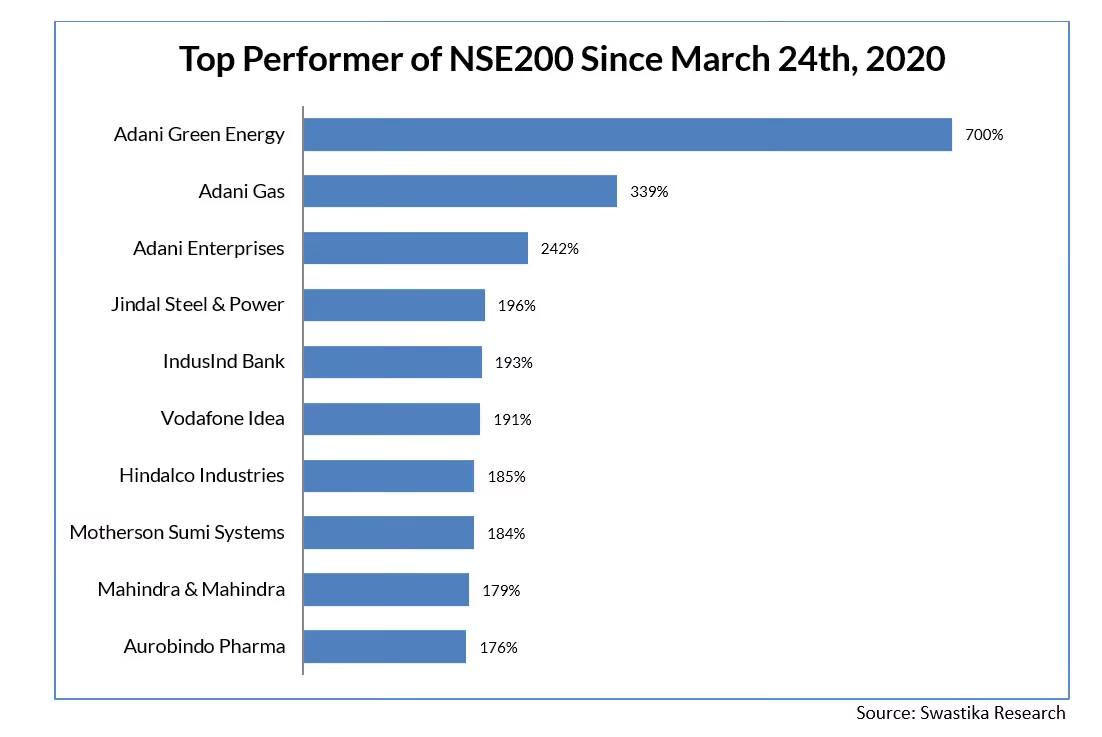
As we can see in the above graph, Adani Green Energy has rejoiced the wealth of investors by 700% which is the most NIFTY200 list of companies; the list is followed by two more companies from the Adani Group namely Adani Gas and Adani Enterprises.[/caption]
In the period of lockdown when everything came to a halt, we saw many new traders and investors entered the market and earned handsome money by investing in some of the good quality companies. The valuations were cheaper and they got an opportunity to be a long term investor.
At the time of crisis stocks were falling and buying at that price does need courage which is equivalent to catch a falling knife but the market has again proved that investing in a fundamentally sound company will always reward investors.
When we buy goods, lower prices are generally a good thing. That’s not the same case in terms of stocks as we never know how much a stock can fall. However, if you would have bought the dip in quality stocks then it will surely benefit the investors. While if an individual wants to invest for a long term then a crisis is the best time to buy because as soon as the economy will recovering it will benefit the investor.
Historically, there has been an economic crisis timely in the stock market. It can occur in the form of a pandemic, recession, or any bubble. People generally sell their portfolio when any crisis happens but as said earlier it does create an opportunity for the investors to average out their portfolio also it creates an opportunity for new investors to build their portfolio.
There have been twelve crises in the 20th century excluding the geopolitical event and the still market had hit an all-time high on 04th December 2020. Thus, a new investor should look for a dip or any crisis event to build a portfolio and invest in the long term.

Understanding the Concept of the Financial Market
The financial market plays a crucial role in any economy, and understanding its basic concepts is essential for anyone interested in investing or managing finances. In simple terms, the financial market is a platform where people buy and sell financial assets such as stocks, bonds, commodities, and currencies. It helps businesses raise capital, allows investors to make profits, and enables the economy to grow.
This blog will explain the financial market in easy-to-understand language, covering its types, key participants, and why it is important.
What is the Financial Market?
A financial market is a place where buyers and sellers come together to trade different types of financial assets. These assets can include:
- Stocks: Shares of a company that represent ownership.
- Bonds: Loans given to companies or governments in exchange for interest.
- Currencies: Trading of different currencies, such as U.S. Dollars, Euros, or Indian Rupees.
- Commodities: Physical items like gold, silver, oil, and agricultural products.
In the financial market, the prices of these assets fluctuate based on supply and demand. For example, if many people want to buy a particular stock, its price will go up. If fewer people are interested, the price will go down.
Types of Financial Markets
The financial market is broad and consists of several sub-markets that specialize in different types of trading. Here are the key types of financial markets:
1. Stock Market
The stock market is where shares of companies are bought and sold. When you buy a share, you become part-owner of the company. If the company grows and makes profits, the value of your shares can increase, and you may receive dividends. Stock markets are divided into two categories:
- Primary Market: When a company first issues shares to the public, this is called an IPO (Initial Public Offering), and it happens in the primary market.
- Secondary Market: After the IPO, the shares can be traded among investors on stock exchanges like the New York Stock Exchange (NYSE), the Bombay Stock Exchange (BSE), or the National Stock Exchange (NSE).
2. Bond Market
The bond market allows governments, municipalities, and companies to borrow money from investors by issuing bonds. When you buy a bond, you are essentially lending money to the issuer in exchange for periodic interest payments and the return of the principal amount at the end of the bond’s term.
Bonds are typically considered less risky than stocks, but the returns are also generally lower. This makes them a popular choice for conservative investors.
3. Foreign Exchange Market (Forex)
The foreign exchange market is where currencies are traded. It is the largest and most liquid financial market in the world. Investors trade currencies to make profits from changes in exchange rates. For example, if you believe the U.S. Dollar will strengthen against the Euro, you can buy Dollars and sell Euros. If the Dollar rises, you make a profit.
4. Commodities Market
In the commodities market, physical goods like gold, oil, and agricultural products are traded. Commodities can be traded either in their physical form or through financial contracts called futures, which are agreements to buy or sell a commodity at a future date for a predetermined price.
For example, a trader might buy gold futures if they believe the price of gold will increase in the coming months.
5. Derivatives Market
The derivatives market involves contracts whose value is derived from an underlying asset, such as stocks, bonds, currencies, or commodities. Common derivatives include options, futures, and swaps. These contracts allow traders to speculate on the future price movements of assets or to hedge against risk.
For instance, a wheat farmer might use a futures contract to lock in a price for their crop, protecting themselves from potential price drops in the future.
Key Participants in the Financial Market
The financial market consists of various participants, each playing a different role. The major players include:
- Investors: Individuals or institutions (like mutual funds or pension funds) that buy assets to make a profit.
- Companies: Businesses that raise money by issuing stocks or bonds.
- Governments: National and local governments that issue bonds to fund public projects.
- Financial Institutions: Banks, brokerage firms, and insurance companies that facilitate buying and selling of assets.
- Regulators: Authorities like the Securities and Exchange Commission (SEC) in the U.S. or the Securities and Exchange Board of India (SEBI) that ensure the financial markets operate fairly and transparently.
Importance of the Financial Market
The financial market plays a critical role in the global economy. Here are some of its key benefits:
1. Capital Formation
The financial market allows businesses to raise funds by selling stocks or issuing bonds. These funds are then used to invest in projects, expand operations, and create jobs, contributing to overall economic growth.
2. Investment Opportunities
The financial market offers individuals and institutions a wide range of investment options. Investors can diversify their portfolios by investing in different types of assets, helping to manage risk while aiming for higher returns.
3. Liquidity
One of the primary advantages of financial markets is liquidity. Liquidity refers to how quickly and easily an asset can be bought or sold. The financial market ensures that investors can buy or sell their assets when they need to, without significant price changes.
4. Price Discovery
In financial markets, prices are determined by supply and demand. This process of price discovery helps investors understand the fair value of an asset based on market conditions.
5. Risk Management
The financial market offers tools like derivatives that allow investors and companies to manage risks. For example, a company can use foreign exchange derivatives to hedge against currency fluctuations, protecting its profits from adverse movements in exchange rates.
Conclusion
The financial market is a dynamic system that brings together buyers and sellers of financial assets like stocks, bonds, currencies, and commodities. Understanding the different types of financial markets and how they function is essential for making smart investment decisions. Whether you’re a new investor or someone looking to expand your knowledge, the financial market offers various opportunities to grow wealth, manage risk, and achieve financial goals.
By including a mix of assets from different markets in your portfolio, you can diversify your investments and better manage risks, ensuring a more balanced approach to wealth creation.


.avif)
.avif)

.avif)



START YOUR INVESTMENT JOURNEY
Get personalized advice from our experts
- Dedicated RM Support
- Smooth and Fast Trading App
