

Why 360 ONE WAM Is Betting Big on Transaction & Broking Revenue Growth




Key Takeaways
• 360 ONE WAM is shifting focus toward transaction and broking revenue for scalable growth.
• Rising retail participation and market activity are boosting broking opportunities in India.
• Fee based recurring income is becoming more competitive, pushing firms to diversify revenue streams.
• Technology driven platforms are reshaping how wealth management firms operate.
• Investors should understand how such shifts impact profitability and valuations.
Why 360 ONE WAM Is Betting Big on Transaction and Broking Revenue Growth
India’s wealth management industry is undergoing a structural shift. Traditionally, firms relied heavily on advisory fees and long term asset management income. However, changing market dynamics and rising competition are pushing firms to rethink their strategies.
One such example is 360 ONE WAM, which is increasingly focusing on transaction and broking revenue as a key growth driver.
At first glance, this may seem like a tactical move. But in reality, it reflects deeper changes in how financial services firms operate in a fast evolving market.
Let us break down why this shift is happening and what it means for investors.
Understanding the Business Model of 360 ONE WAM
360 ONE WAM is a leading wealth and asset management firm in India, catering primarily to high net worth and ultra high net worth clients.
Its traditional revenue streams include:
• Asset management fees
• Wealth advisory charges
• Distribution income
These streams provide stability but often grow at a steady pace.
In contrast, transaction and broking income can scale faster, especially during periods of high market activity.
Why the Shift Toward Transaction and Broking Revenue
The decision to focus more on broking and transaction income is driven by several industry trends.
Rising Market Participation
India has seen a sharp increase in retail investor participation over the past few years.
Demat account openings have surged, and more investors are actively trading in equities, derivatives, and other financial instruments.
This creates a strong opportunity for broking revenue growth.
Increased Trading Activity
Volatility in markets often leads to higher trading volumes.
Whether it is global events, earnings seasons, or policy changes, investors are increasingly active in adjusting portfolios.
This directly benefits firms with strong broking platforms.
Pressure on Advisory Fees
Wealth management is becoming more competitive.
Clients are more aware of costs and often negotiate advisory fees.
This puts pressure on traditional revenue streams, making diversification essential.
Technology Is Changing the Game
Technology has become a key differentiator in financial services.
Modern investors expect seamless platforms, real time data, and advanced analytics.
Firms investing in technology can scale transaction based businesses more efficiently.
For example:
• Mobile trading apps enable instant execution
• AI driven insights improve decision making
• Data analytics helps personalize investment strategies
This makes broking and transaction revenue more attractive compared to traditional models.
Impact on Profitability and Margins
Transaction based income has both advantages and risks.
Advantages
• High scalability with lower marginal cost
• Faster revenue growth during active markets
• Cross selling opportunities with existing clients
Risks
• Revenue volatility linked to market activity
• Dependence on trading volumes
• Increased competition from discount brokers
Balancing these factors is crucial for long term sustainability.
What This Means for the Indian Financial Markets
The shift by firms like 360 ONE WAM reflects broader changes in the Indian financial ecosystem.
Rise of Hybrid Models
Many firms are now combining advisory services with broking platforms.
This allows them to offer a full suite of services while capturing multiple revenue streams.
Increased Competition
The broking industry in India has become highly competitive, with both traditional and discount brokers competing for market share.
This leads to better pricing and services for investors.
Greater Financialization
More individuals are moving from traditional savings instruments to financial markets.
This trend supports long term growth in broking and transaction revenue.
Real World Example
Consider a high net worth investor who previously relied only on advisory services.
Today, the same investor may:
• Trade equities actively
• Invest in derivatives for hedging
• Participate in IPOs and structured products
Each of these activities generates transaction income for the firm.
This shift in investor behavior is one of the key drivers behind the strategy.
What Should Investors Watch
Investors analyzing companies like 360 ONE WAM should focus on a few key metrics.
Revenue Mix
Track how much revenue comes from advisory versus transaction based income.
A diversified mix often indicates resilience.
Client Growth
An increase in active clients usually leads to higher transaction volumes.
Technology Investment
Firms investing in digital platforms are better positioned for future growth.
Regulatory Environment
Regulators like the Securities and Exchange Board of India play a crucial role in shaping the broking industry.
Changes in margin rules, fee structures, or compliance requirements can impact profitability.
Role of Research and Smart Investing Platforms
In a rapidly evolving market, having access to reliable research and advanced tools becomes essential.
Platforms like Swastika Investmart, a SEBI registered brokerage, provide investors with research driven insights, user friendly trading platforms, and strong customer support.
With a focus on technology enabled investing and investor education, Swastika Investmart helps investors navigate market changes and make informed decisions.
Such platforms are particularly useful when industry trends are shifting and new opportunities are emerging.
Frequently Asked Questions
Why is 360 ONE WAM focusing on broking revenue?
The firm is focusing on broking revenue due to rising market participation, increased trading activity, and pressure on traditional advisory fees.
Is transaction based income more profitable?
Transaction income can be highly scalable and profitable during active markets, but it may also be more volatile compared to steady advisory income.
How does this strategy impact investors?
Investors may benefit from better platforms, faster execution, and more integrated financial services.
What risks are involved in this shift?
Risks include dependence on market activity, competition from discount brokers, and revenue volatility.
How does SEBI regulation affect broking businesses?
SEBI regulations influence fee structures, trading rules, and compliance requirements, which can impact the profitability and operations of broking firms.
Conclusion
The move by 360 ONE WAM toward transaction and broking revenue is not just a tactical shift but a reflection of broader industry trends.
As market participation grows and technology transforms investing, firms are adapting to stay competitive and scalable.
For investors, this shift highlights the importance of understanding business models and revenue drivers before making investment decisions.
Staying informed and using the right tools can make a significant difference in navigating such changes.
If you are looking for expert insights, advanced trading platforms, and a reliable SEBI registered brokerage, consider starting your journey with Swastika Investmart.
Big Budget





.avif)
.avif)
.avif)
.avif)
.avif)















.avif)
.avif)
.avif)
.avif)
Latest Articles

PM Modi’s ‘MANAV’ Vision: Big Boost for India’s AI & Tech Stocks?


PM Modi’s ‘MANAV’ Vision: Big Boost for India’s AI & Tech Stocks?
India’s artificial intelligence narrative just received a major policy push. At the India AI Impact Summit 2026, Prime Minister Narendra Modi unveiled the MANAV Vision, a framework aimed at making AI ethical, inclusive, and accountable.
For investors and market watchers, the big question is clear: Will this policy momentum translate into real gains for India’s AI and technology stocks?
In this blog, we decode what the MANAV Vision means, which sectors could benefit, and how investors should approach this emerging theme.
TL;DR
• MANAV Vision focuses on ethical, inclusive and sovereign AI development
• Positive long term sentiment for IT services, data centers and digital infrastructure
• No immediate earnings trigger but strong thematic tailwind
• Investors should track AI focused companies and policy execution closely
What Is the MANAV Vision for AI?
The MANAV Vision is India’s policy framework to guide the responsible development of artificial intelligence. The government’s intent is to ensure that AI growth remains human centric and does not become concentrated in the hands of a few global players.
MANAV stands for:
• Moral and ethical AI systems
• Accountable governance and transparent rules
• National sovereignty over data
• Accessible and inclusive AI
• Valid and lawful AI deployment
The broader message is simple. India wants AI to scale rapidly, but with strong guardrails around data protection, transparency, and public benefit.
Why the MANAV Vision Matters for Indian Markets
From a stock market perspective, policy direction often shapes long term capital flows. While the MANAV announcement is not an immediate earnings catalyst, it strengthens the structural case for India’s AI ecosystem.
Three key market implications stand out.
Policy Support for the AI Ecosystem
Government backing reduces regulatory uncertainty. When policymakers clearly support a technology theme, companies tend to increase investments, partnerships, and capacity building.
We saw a similar trend in the past with digital payments after UPI promotion and with renewables after PLI schemes. AI could follow a comparable trajectory.
Boost to India’s Global Tech Positioning
India hosting a major AI summit signals intent to become a serious player in the global AI race. This improves investor perception of the country’s technology ecosystem.
Global clients may increasingly view Indian IT firms not just as cost efficient service providers but as AI solution partners.
Long Term Capex Cycle in Digital Infrastructure
AI adoption requires heavy investments in:
• Data centers
• Cloud infrastructure
• High performance computing
• Semiconductor ecosystem
Any sustained push in these areas typically benefits multiple listed players across the value chain.
Sectors Likely to Benefit
While the impact will be gradual, some segments of the market are better positioned than others.
IT Services and AI Solution Providers
Large Indian IT companies are already investing heavily in generative AI, automation, and enterprise AI solutions. The MANAV Vision strengthens the long term demand outlook.
Companies offering:
• AI consulting
• cloud migration
• data engineering
• automation platforms
could see improved deal pipelines over time.
However, investors should remember that global tech spending cycles will still drive near term performance.
Data Center and Digital Infrastructure Players
AI workloads are extremely compute intensive. This directly increases demand for data center capacity and power infrastructure.
India is already witnessing rising announcements in hyperscale data centers. Policy support for AI could accelerate this trend further.
Semiconductor and Electronics Ecosystem
Although India’s semiconductor journey is still evolving, the AI push adds strategic urgency. Over the medium term, companies linked to electronics manufacturing and chip ecosystem development may benefit from policy tailwinds.
What Are the Key Risks?
A balanced view is important. Not every policy announcement translates into immediate stock market gains.
Execution Gap Risk
India has announced several ambitious technology missions in the past. The real impact depends on:
• budget allocation
• private sector participation
• speed of implementation
Investors should track actual project announcements rather than relying only on policy headlines.
Global Tech Demand Still Matters
Indian IT stocks remain heavily dependent on US and European tech spending. Even with strong domestic AI push, weak global demand can cap near term upside.
Valuation Comfort
Many frontline IT stocks already trade at premium valuations. Any AI driven rerating may take time unless earnings growth accelerates meaningfully.
How Should Investors Approach the AI Theme?
For long term investors, the AI theme in India is clearly strengthening. However, timing and stock selection remain critical.
A practical approach could be:
• Focus on companies with proven AI capabilities
• Track deal wins and order pipelines, not just announcements
• Avoid chasing momentum after sharp rallies
• Maintain a staggered investment strategy
Remember, structural themes often play out over multiple years, not weeks.
Real World Parallel: Lessons from the Digital Payments Boom
A useful comparison is India’s digital payments story.
When UPI was launched and promoted aggressively, the immediate stock market impact was limited. But over time, companies aligned with the digital ecosystem saw significant rerating as adoption scaled.
AI in India may follow a similar path. Early policy support builds the foundation, but earnings visibility comes gradually.
The Road Ahead for India’s AI Story
The MANAV Vision signals that India wants to balance innovation with responsibility. If executed well, this framework could:
• attract global AI investments
• strengthen India’s tech exports
• deepen domestic digital infrastructure
• create new high skill employment
For the stock market, this translates into a positive long term narrative, especially for technology and digital infrastructure players.
However, investors should stay realistic about timelines. The AI opportunity is real, but it will unfold in phases.
Conclusion
PM Modi’s MANAV Vision is an important strategic step in India’s AI journey. While it may not trigger an immediate rally in AI and tech stocks, it clearly strengthens the long term structural story for the sector.
For investors, the key is to track execution, valuations, and company specific fundamentals rather than reacting purely to headlines.
If you are looking to identify strong AI and technology opportunities with research backed insights, having the right platform matters. Swastika Investmart, a SEBI registered broker, offers robust research tools, tech enabled investing platforms, and dedicated customer support to help investors make informed decisions.
Frequently Asked Questions
Is the MANAV Vision immediately bullish for IT stocks?
Not immediately. It is a long term positive but near term performance will still depend on global tech demand and company earnings.
Which sectors may benefit the most from India’s AI push?
IT services, data centers, cloud infrastructure, and parts of the electronics ecosystem are likely to gain over time.
Should investors buy AI stocks right now?
Investors should avoid impulsive buying. A staggered approach based on valuations and fundamentals is more prudent.
Does the MANAV Vision include regulation of AI?
Yes. The framework emphasizes ethical AI, accountability, lawful usage, and national data sovereignty.
How can retail investors track AI opportunities?
Monitor company disclosures on AI deals, partnerships, capex plans, and management commentary during earnings calls.

Bharti Airtel Raises Indus Towers Stake to 51.22% — Bullish Trigger?
Bharti Airtel Raises Indus Towers Stake to 51.22%: What Investors Should Know
Quick Takeaways
- Bharti Airtel increased its stake in Indus Towers through market purchases.
- Total 32.73 lakh shares were bought between February 5 and 10, 2026.
- The move aligns with earlier board approval to raise ownership.
- Investors see promoter buying as a confidence signal, though price reaction may vary.
Strategic Move: Bharti Airtel Tightens Control
Bharti Airtel has strengthened its ownership in Indus Towers to about 51.22% after acquiring additional shares from the open market. Between February 5 and February 10, 2026, the telecom giant purchased a total of 32.73 lakh shares, including a fresh lot of 20 lakh shares.
This acquisition was not sudden. In November 2025, Airtel’s board approved a plan to increase its stake by up to 5%. The recent purchases fall within that limit, signaling a structured and pre planned strategy rather than opportunistic buying.
Promoter stake increases often draw investor attention because they reflect management’s conviction about future prospects.
Why Indus Towers Matters in India’s Telecom Ecosystem
Indus Towers operates one of the largest telecom tower portfolios in the country. These towers form the backbone of wireless communication, supporting multiple telecom operators that lease space to install antennas and equipment.
In simple terms, telecom companies compete for customers, but they often share tower infrastructure. This model reduces costs and speeds up network rollout, especially for technologies like 5G.
As data consumption grows across India, demand for tower infrastructure rises. More users streaming video, gaming, or using digital services means operators need stronger networks. Stronger networks require more towers and better coverage.
Reading the Signal: Why Promoter Buying Matters
Confidence Indicator
When promoters buy shares from the market instead of selling, it often indicates confidence in the company’s growth prospects. They usually have deeper insight into operational trends, upcoming contracts, and industry direction.
Long Term Commitment
Increasing ownership strengthens promoter control and aligns management interests with shareholders. Higher stake means promoters benefit directly from value creation.
Market Interpretation
Investors often track promoter transactions closely. Positive sentiment can emerge if markets interpret the move as a signal of undervaluation or growth potential.
However, share prices do not always rise immediately. Market reaction depends on broader sentiment, sector outlook, and macroeconomic conditions.
Stock Performance Snapshot
As of February 13, 2026, at 2:31 PM, Indus Towers shares were trading around ₹465.95 on NSE, down about 1.70% from the previous close. Short term price movement can be influenced by profit booking, market volatility, or sector rotation rather than company specific fundamentals.
Seasoned investors usually focus less on daily fluctuations and more on structural trends such as earnings growth, contract wins, and debt levels.
Industry Context: Telecom Infrastructure Is a Long Game
Tower companies operate on long term leasing contracts with telecom operators. This provides predictable cash flow compared to many other sectors.
Consider a real world analogy. Owning telecom towers is similar to owning commercial real estate. Instead of retail tenants, tower firms lease space to telecom providers. As long as tenants remain, revenue continues.
India’s telecom sector is still expanding. Rural penetration, 5G rollout, and digital adoption are key drivers. Infrastructure providers stand to benefit from these structural trends.
Potential Benefits for Bharti Airtel
Increasing stake in a strategic partner can offer several advantages:
Operational synergy
Closer coordination between network rollout and tower deployment can reduce delays.
Cost optimization
Stronger control may help negotiate better infrastructure costs.
Strategic flexibility
Higher ownership gives Airtel greater influence over business decisions and long term planning.
Risks Investors Should Keep in Mind
Even positive developments come with uncertainties. Investors should evaluate:
- Sector competition among telecom operators
- Debt levels within infrastructure companies
- Regulatory changes affecting telecom tariffs or spectrum pricing
- Technological shifts that alter infrastructure needs
Balanced analysis helps investors avoid reacting emotionally to headlines.
Regulatory Oversight and Transparency
India’s capital markets operate under strict disclosure norms monitored by the Securities and Exchange Board of India. Promoter transactions must be reported, ensuring transparency for investors.
This regulatory framework builds trust because shareholders can verify whether insiders are buying or selling shares. Such transparency is essential for fair market functioning.
What This Means for the Indian Market
Large promoter purchases often improve sentiment across related sectors. Telecom infrastructure companies, equipment suppliers, and network service providers may attract renewed investor interest.
The move also reflects confidence in India’s digital growth story. Rising data consumption, smartphone adoption, and enterprise digitization continue to expand the telecom ecosystem.
Institutional investors frequently track such signals when deciding sector allocations.
How Investors Can Approach Such Developments
Instead of reacting instantly, investors often benefit from structured evaluation:
- Compare valuation with historical averages
- Review quarterly earnings trends
- Assess debt and cash flow metrics
- Track management commentary
Using professional research platforms like Swastika Investmart can help investors interpret corporate actions with deeper data insights, advanced tools, and responsive support. Access to structured research makes it easier to separate meaningful signals from market noise.
Common Questions
Why did Bharti Airtel increase its stake in Indus Towers
The purchases align with its earlier board approved plan to raise ownership and strengthen strategic control.
Is promoter buying always bullish
It is often viewed positively, but it should be analyzed alongside fundamentals and sector outlook.
Does this affect telecom sector stocks
Such moves can improve sentiment across telecom and infrastructure stocks, though broader market trends still matter.
Will Indus Towers share price rise immediately
Not necessarily. Short term price movements depend on market sentiment, liquidity, and investor expectations.
Should investors act on this news alone
No. Investment decisions should be based on detailed research, valuation analysis, and financial performance.
Final Thoughts
Bharti Airtel’s decision to raise its stake to 51.22% in Indus Towers reflects strategic intent rather than short term speculation. It signals confidence in the long term growth of telecom infrastructure, a sector that forms the backbone of India’s digital economy.
For investors, developments like these provide useful clues about where corporate leaders see future value. Tracking such signals with reliable research tools can improve decision making and reduce guesswork.
If you want access to professional grade insights, advanced analytics, and a seamless investing experience, you can begin here:
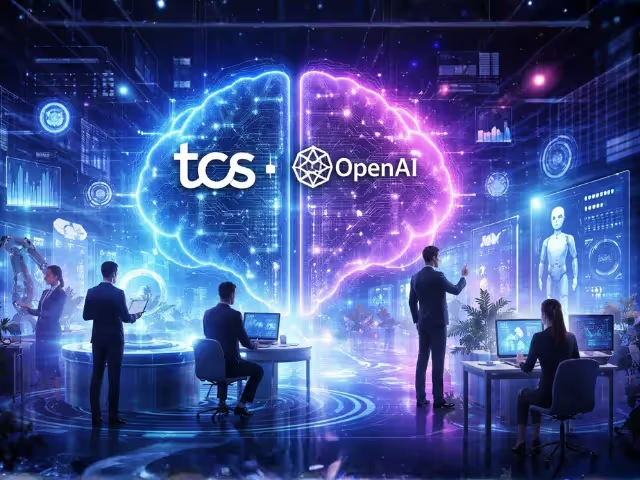
TCS Enters Agentic AI Era — Strategic Impact of the OpenAI Collaboration
TCS Enters Agentic AI Era: How the OpenAI Collaboration Could Reshape IT Services


4
Key Highlights
- The partnership signals a shift toward autonomous AI driven enterprise solutions.
- Agentic AI could redefine IT services revenue models.
- Indian IT stocks may see rerating if execution succeeds.
- Long term impact depends on enterprise adoption and regulatory clarity.
The Strategic Significance of the TCS OpenAI Collaboration
Tata Consultancy Services entering the agentic AI space through collaboration with OpenAI marks a pivotal moment for India’s IT sector. For decades, Indian technology firms built global dominance through outsourcing, application development, and consulting. Now the industry is transitioning into a phase where artificial intelligence systems can independently plan, execute, and optimize business processes.
This is not just another technology partnership. It represents a structural shift in how IT services may be delivered in the future. Instead of billing clients primarily for human effort, companies may increasingly monetize AI driven outcomes.
What Is Agentic AI and Why It Matters
Moving Beyond Automation
Traditional automation follows fixed instructions. Agentic AI, by contrast, can interpret goals, make decisions, and perform tasks without constant human supervision. It can manage workflows, coordinate systems, and even adjust strategies based on real time data.
For enterprises, this means software that acts more like a digital employee than a tool.
Real World Example
Imagine a global retailer using agentic AI to manage inventory. Instead of analysts forecasting demand manually, the system could monitor sales trends, supplier timelines, and logistics costs, then automatically place orders and optimize pricing. This level of autonomy reduces costs and improves efficiency simultaneously.
For IT service providers, delivering such capabilities can significantly increase contract value.
Why This Move Is Timely for TCS
Enterprise Demand Is Changing
Clients today want solutions that reduce operational costs rather than just support processes. AI platforms capable of independent execution directly address this demand. By collaborating early, TCS positions itself as a transformation partner rather than a traditional vendor.
Competitive Positioning
Global technology consulting firms are racing to integrate advanced AI into enterprise systems. Early adoption strengthens brand perception as an innovation leader. That perception matters because enterprise clients prefer partners who demonstrate technological leadership.
Talent and Infrastructure Advantage
India’s IT giants possess large engineering workforces and strong delivery frameworks. This makes them well suited to scale AI driven solutions quickly once platforms mature.
Market Impact for Investors
The announcement carries important implications for equity markets and sector sentiment.
Potential Valuation Upside
Companies that successfully integrate advanced AI capabilities often command higher valuation multiples. Investors tend to reward firms that show strong technological relevance in future growth areas.
Revenue Model Transformation
Agentic AI could gradually shift revenue structures from time based billing to outcome based pricing. This transition may improve margins over time if execution is efficient.
Near Term Volatility
Markets typically react with excitement to AI announcements, but price movements can fluctuate until investors see measurable financial impact. Quarterly deal wins and pipeline disclosures will be key indicators to watch.
Broader Impact on the Indian IT Sector
When a market leader moves into a new technology domain, peers often accelerate their own investments. This creates an industry wide innovation cycle.
Possible ripple effects include:
- Increased AI hiring across IT firms
- Higher research spending
- Strategic partnerships with global AI platforms
- More enterprise clients adopting automation
Such developments can strengthen India’s position as a global technology hub.
Regulatory and Policy Landscape
Artificial intelligence deployment in enterprise environments must comply with evolving data protection and governance standards. In India, market transparency and corporate disclosures are monitored by the Securities and Exchange Board of India, ensuring investors receive accurate information about strategic initiatives.
Globally, AI governance frameworks are also emerging. Companies that build compliant and secure systems may gain a competitive advantage as regulations tighten.
Risks Investors Should Consider
Even transformative technologies involve uncertainty. Investors should keep these factors in mind:
Execution complexity
Deploying advanced AI across enterprise systems requires integration expertise and client education.
Adoption timelines
Large organizations often adopt new technology gradually, which can delay revenue realization.
Cost pressures
Initial investments in infrastructure and talent can affect margins before scale benefits appear.
Balanced evaluation helps investors distinguish hype from sustainable opportunity.
Realistic Long Term Outlook
The collaboration signals strategic foresight rather than immediate financial impact. Over the next few years, success will depend on how effectively AI solutions translate into signed deals and recurring revenue streams.
If implemented well, agentic AI could become as transformative for IT services as cloud computing was a decade ago. Companies that lead early in such transitions often secure long term competitive advantages.
Why Investors Should Track Developments Closely
Major technology shifts rarely happen overnight. They unfold through phases such as pilot projects, enterprise adoption, and large scale deployment. Monitoring contract wins, client case studies, and management commentary can provide valuable insight into progress.
Research driven platforms like Swastika Investmart help investors interpret such developments through data backed analysis, strong support, and structured insights. Having access to reliable research tools can make a meaningful difference when evaluating emerging themes like AI led transformation.
Frequently Asked Questions
What is the main goal of the TCS OpenAI collaboration
The partnership aims to build advanced AI driven enterprise solutions that can automate complex business processes and improve efficiency.
Will agentic AI affect IT sector jobs
It may change job roles rather than eliminate them. Demand could rise for AI specialists, data engineers, and solution architects.
Is this positive for TCS stock long term
Potentially yes if the company successfully converts AI capabilities into large contracts and revenue growth.
How does this affect Indian IT industry competitiveness
It strengthens India’s position as a technology innovation hub and may encourage other firms to accelerate AI adoption.
Should investors act immediately on such news
Not necessarily. Long term investment decisions should be based on financial performance, execution progress, and valuation analysis.
Final Takeaway
The entry into agentic AI through collaboration with OpenAI reflects a forward looking strategy that aligns with global technology trends. It signals that the next phase of growth for IT services may be driven by intelligent systems capable of delivering measurable business outcomes. For investors, this development is worth tracking as it could shape the future trajectory of both the company and the broader sector.
If you want professional insights, research backed analysis, and a reliable investing platform to track such opportunities, you can start here:

HUL’s ₹2,000 Crore Capex Plan: What It Means for Future Growth
HUL’s ₹2,000 Crore Capex Plan: A Strategic Growth Blueprint



4
Quick Summary
- The ₹2,000 crore investment aims to expand manufacturing and supply chain capacity.
- The move reflects rising rural demand and premium product growth.
- It may strengthen margins through automation and efficiency gains.
- Long term investors could view this as a signal of sustained confidence in India’s consumption story.
Understanding the Announcement
Hindustan Unilever Limited has unveiled a ₹2,000 crore capital expenditure plan focused on capacity expansion, technology upgrades, and supply chain optimization. For a consumer goods giant known for steady performance rather than aggressive spending, this decision stands out.
Capex announcements from large FMCG companies often signal confidence in future demand. Unlike cyclical sectors, consumer goods investments are typically driven by real consumption trends rather than speculation. That makes this move particularly relevant for investors tracking India’s economic momentum.
Why This Capex Matters Now
Rising Consumption Across India
India’s consumption story has evolved in recent years. Urban demand remains strong, but rural markets are showing renewed traction after periods of slowdown. Higher government spending, improving farm incomes, and infrastructure development have supported rural purchasing power.
For a company deeply embedded in daily household consumption, expanding production capacity allows it to meet demand spikes without supply constraints.
Premiumization Trend
Consumers are increasingly shifting toward premium products such as specialized skincare, health focused foods, and high quality personal care items. Premium segments often carry better margins than mass market goods. Investing in advanced manufacturing facilities helps companies produce these higher value products efficiently.
Strategic Areas Where the Money May Go
Although detailed allocation may unfold gradually, analysts expect funds to be deployed across three major areas.
Manufacturing Expansion
New plants or expanded lines can increase output in high demand categories. This is especially important for fast moving products where stock shortages directly impact sales.
Automation and Technology
Modern factories rely on robotics, data analytics, and predictive maintenance systems. Automation reduces errors, lowers labor intensive costs, and improves consistency. Over time, this supports margin expansion.
Distribution Infrastructure
Efficient logistics networks help companies reach remote markets quickly. Investments in warehouses and digital supply chains can cut transportation costs and reduce delivery time.
Market Impact and Investor Interpretation
Capex announcements often influence stock sentiment because they reflect management’s outlook. A company willing to invest heavily typically expects demand visibility over several years.
For equity markets, such moves can have ripple effects:
- Capital goods companies may see higher order inflows
- Packaging and logistics firms could benefit
- Rural focused businesses may get sentiment support
However, investors should remember that capex initially increases expenses. Returns emerge gradually as facilities become operational.
Real World Example of Capex Driven Growth
Consider how beverage companies expanded bottling plants during periods of rising demand. Those investments allowed them to scale quickly when consumption surged during peak seasons. Firms that delayed expansion often struggled with stock shortages and lost market share.
The same principle applies here. By investing ahead of demand, companies position themselves to capture future growth rather than reacting late.
Regulatory and Policy Context
India’s manufacturing ecosystem is increasingly supported by policy initiatives that encourage domestic production. Incentives for local manufacturing, simplified compliance processes, and infrastructure development have improved the ease of doing business.
The presence of strong oversight by regulators such as the Securities and Exchange Board of India also strengthens investor confidence. Transparent disclosures and governance standards help shareholders evaluate whether capital allocation decisions are prudent.
Risks Investors Should Monitor
Even well planned expansions carry certain risks. Understanding them helps investors make balanced decisions.
Execution risk
Project delays or cost overruns can reduce expected returns.
Demand mismatch
If consumption slows unexpectedly, newly added capacity may remain underutilized.
Input cost volatility
Fluctuations in raw material prices can affect margins, even with improved efficiency.
Long term investors typically track quarterly updates to see whether capital expenditure translates into revenue growth and operating leverage.
Broader Implications for the FMCG Sector
Large scale investments by market leaders often set industry trends. Smaller competitors may follow with their own expansion plans to remain competitive. This can trigger a broader investment cycle across the sector.
It also signals confidence in India’s structural consumption growth. When companies that closely track household spending increase investments, it often reflects strong ground level demand indicators.
What It Means for Long Term Investors
For investors, this announcement highlights an important principle. Sustainable wealth creation often comes from businesses that reinvest profits into growth. Capex funded expansion, when executed well, can drive earnings compounding over many years.
That said, investment decisions should always be supported by research rather than headlines. Evaluating balance sheets, return ratios, and management commentary provides a clearer picture of whether a company’s expansion plan is likely to succeed.
Platforms such as Swastika Investmart help investors interpret such developments through detailed research tools, responsive support, and investor education resources designed for both beginners and experienced market participants.
Frequently Asked Questions
What does HUL’s ₹2,000 crore capex indicate
It suggests the company expects sustained demand growth and is preparing capacity in advance to meet future consumption.
Will this investment impact profits immediately
Short term profits may remain stable or slightly pressured due to spending, but long term gains depend on execution and demand realization.
Which sectors benefit from such capex plans
Capital goods, logistics, packaging, and industrial equipment suppliers often benefit from large manufacturing investments.
Is capex always positive for stocks
Not necessarily. It is positive when returns exceed cost of capital. Investors should track utilization and profitability metrics.
Does this reflect broader economic strength
Yes. Large consumption driven investments often signal confidence in economic stability and purchasing power trends.
Final Thoughts
The ₹2,000 crore expansion plan is more than a financial commitment. It is a strategic statement about future growth, demand visibility, and long term confidence in India’s consumption engine. For investors, such developments serve as valuable indicators of where corporate India sees opportunity.
If you want expert backed insights and research driven analysis to track opportunities like this, you can start your investment journey here:

Adani Goes All-In on AI: What the $100 Billion Data Center Push Means
Adani Goes All In on AI: What the $100 Billion Data Center Push Means



TLDR Summary
- The $100 billion investment signals India’s largest private AI infrastructure bet.
- Data centers could become a new growth engine for the conglomerate.
- The move aligns with India’s digital economy and AI policy push.
- Investors should watch execution risk, debt levels, and partnerships.
The Big Announcement and Why It Matters
The ambitious expansion by Adani Group into artificial intelligence infrastructure marks one of the boldest strategic shifts by any Indian conglomerate in recent years. The plan to deploy up to $100 billion toward hyperscale data centers and AI ecosystems is not just a business expansion. It is a signal that India’s corporate giants are preparing for a future where computing power becomes as valuable as energy or ports.
Chairman Gautam Adani has repeatedly emphasized infrastructure-led growth. Until now, that meant roads, ports, airports, and power. With this move, digital infrastructure joins that list.
The timing is strategic. Global demand for AI compute capacity is rising sharply due to generative AI adoption, enterprise automation, and cloud migration. Countries that control computing infrastructure will shape the next digital decade.
Why Data Centers Are the New Oil Fields
Exploding Demand for Compute Power
AI models need massive processing capacity. Training advanced models requires thousands of GPUs running nonstop. This has created a supply shortage in global data center capacity.
India currently accounts for a small share of global hyperscale infrastructure compared to the US and China. That gap creates an opportunity for domestic players to scale quickly.
India’s Structural Advantage
India offers three key advantages for AI infrastructure expansion:
- Low construction costs compared to Western markets
- Large engineering talent pool
- Rapidly growing digital economy
Government initiatives supporting data localization and digital public infrastructure also encourage companies to build local facilities.
Strategic Fit With Adani’s Existing Businesses
This expansion is not random diversification. It fits neatly into the group’s existing strengths.
Power and Energy Integration
Data centers require huge electricity supply. The group already operates large renewable and thermal power assets. This allows it to provide captive energy to its own facilities, lowering operating costs.
Land and Infrastructure Access
Owning ports, logistics networks, and industrial land banks makes large scale construction faster. Competitors often struggle with approvals and land acquisition. That bottleneck is less severe for infrastructure focused conglomerates.
Long Term Revenue Visibility
Unlike cyclical businesses, data centers operate on long contracts. Clients sign multi year agreements for server space and cloud capacity. This creates stable cash flow, which investors often reward with premium valuations.
Impact on Indian Markets and Investors
The announcement has several implications for equity markets and sector valuations.
1. Infrastructure and Capital Goods Boost
Companies involved in electrical equipment, cooling systems, fiber networks, and construction could benefit from large order inflows.
2. Tech Sector Re Rating
Domestic technology firms that provide AI services or cloud solutions may see improved sentiment as India builds its own computing backbone.
3. Debt and Execution Risk
Large capital expenditure projects always carry financial risk. Investors should track funding mix, project timelines, and return ratios. If execution is delayed, markets may react negatively.
Global Context: The AI Infrastructure Race
The world is currently witnessing a technology arms race. The United States, China, and Middle Eastern sovereign funds are investing heavily in compute infrastructure. Global tech firms are signing power purchase agreements just to secure electricity for data centers.
If India wants to compete in advanced AI development, domestic infrastructure is essential. Without local computing capacity, companies rely on foreign cloud providers. That can increase costs and create strategic dependence.
Large scale investments from private players can accelerate India’s push to become an AI hub.
Real World Scenario: Why This Matters to Businesses
Imagine an Indian startup building a generative AI platform. Today it might rely on overseas servers. That leads to higher latency, regulatory hurdles, and foreign currency costs.
If hyperscale facilities expand domestically, startups can deploy models locally. This reduces costs and improves performance. It also helps sectors like fintech, health tech, and logistics adopt AI faster.
Regulatory and Policy Angle
India’s regulatory environment is gradually evolving to support digital infrastructure. Data protection rules, localization policies, and incentives for electronics manufacturing all indirectly support data center growth.
Authorities have also signaled interest in building national AI compute capacity. Large private investments align well with that goal. Policymakers typically welcome such projects because they generate jobs, improve technology access, and attract global clients.
Key Risks Investors Should Monitor
Even strong long term themes carry risks. Investors should evaluate:
- Capital intensity and funding structure
- Partner ecosystem and technology sourcing
- Utilization rates once centers go live
- Competition from global cloud providers
Execution quality will determine whether the investment becomes a value creator or a balance sheet burden.
What This Means for Long Term Investors
The data center and AI infrastructure space is still in its early innings in India. Early movers could capture significant market share. However, valuations may fluctuate as projects scale.
Investors with a long horizon often benefit from tracking infrastructure themes early. The key is to combine thematic conviction with careful stock selection and risk management.
Platforms like Swastika Investmart help investors analyze such large corporate strategies through advanced research tools, reliable support, and SEBI registered advisory frameworks. Access to structured insights can make a big difference when evaluating complex capital intensive sectors.
FAQs
1. Why is the Adani AI investment significant?
It is among the largest private investments in digital infrastructure globally and signals India’s entry into the AI compute race.
2. Will this affect Adani stocks immediately?
Short term price movement depends on market sentiment. Long term performance depends on project execution and returns.
3. Which sectors benefit from data center growth?
Power equipment, cables, cooling systems, cloud services, and semiconductor supply chains.
4. Is AI infrastructure a good investment theme?
It can be promising, but investors should diversify and assess financial strength, not just growth stories.
5. Does India have enough demand for such capacity?
Yes. Rapid digital adoption, startups, fintech growth, and enterprise AI adoption are driving demand.
Conclusion
The $100 billion push into AI infrastructure reflects a major shift in India’s corporate strategy landscape. It shows that future growth may be driven not only by physical assets but also by digital backbone capacity. For investors, this development highlights a powerful emerging theme that blends technology, infrastructure, and policy support. If you want to track such transformational opportunities with professional research support, consider

RBI Approves Airtel Money as NBFC — Big Boost for Airtel’s Fintech Ambitions
Key Highlights
- RBI approval gives Airtel Money NBFC status, expanding lending and financial service scope.
- Move strengthens Airtel’s fintech strategy and digital ecosystem.
- Markets see long term growth potential in telecom led financial platforms.
- Regulatory compliance and execution will determine real impact.
RBI Approves Airtel Money as NBFC — A Turning Point for Airtel’s Fintech Vision


4
The decision by the Reserve Bank of India to approve NBFC status for Airtel Money marks a major step in the evolution of telecom led financial services. For Bharti Airtel, this is not just a regulatory milestone. It is a strategic shift that could reshape how telecom companies participate in India’s fast growing fintech ecosystem.
Investors and analysts are closely watching this development because it signals a broader trend. Telecom companies are no longer only connectivity providers. They are transforming into digital platforms offering payments, credit, and financial solutions.
Why the NBFC Approval Matters
Expanded Financial Capabilities
NBFC registration allows Airtel Money to offer a wider range of financial services. These include lending, microcredit products, and structured financial solutions. Earlier, wallet services were largely limited to payments and transfers. With NBFC status, Airtel can move deeper into financial intermediation.
This change is important because lending generates higher margins than payments alone. Payments build user base. Lending builds profitability.
Regulatory Credibility
Approval from India’s central bank strengthens trust. Financial services depend heavily on user confidence. When a platform operates under strict supervision, customers feel more comfortable using it for larger transactions or credit products.
Airtel’s Bigger Strategy: Building a Digital Ecosystem
Telecom companies hold a powerful advantage. They already have millions of customers, verified identities, and billing relationships. Airtel can use this base to cross sell financial products.
Example Scenario
Imagine a prepaid user who recharges monthly through Airtel’s app. With NBFC capabilities, Airtel could analyze payment behavior and offer a small instant loan during emergencies. The process could take seconds instead of days.
This integration of telecom data with financial analytics can unlock new business models.
Market Impact and Investor Perspective
The announcement has broader implications for Indian markets. Investors see fintech as one of the fastest growing segments in the digital economy. When a large telecom operator gains regulatory approval to expand financial services, it signals growth potential beyond traditional revenue streams.
Potential Positives for Airtel Stock
- Diversified revenue sources
- Higher average revenue per user
- Increased customer stickiness
- Long term valuation re rating
Markets typically reward companies that successfully transition from single business models to platform ecosystems.
Competitive Landscape
Airtel is not alone in the digital finance race. Several technology firms and payment platforms are expanding into lending and wealth products. However, telecom backed fintech platforms have a distinct advantage. They combine connectivity, data insights, and distribution in one integrated system.
Instead of competing solely on pricing, Airtel can compete on convenience and speed. That combination can be powerful in a country where digital adoption is accelerating rapidly.
Risks Investors Should Watch
While the opportunity is significant, execution risks remain.
Regulatory Compliance
NBFCs must follow strict norms related to capital adequacy, risk management, and reporting. Failure to meet these standards can lead to penalties or restrictions.
Credit Risk
Lending businesses always face default risk. Airtel must design strong credit assessment models to maintain asset quality.
Technology Investment
Scaling fintech operations requires secure infrastructure, data protection systems, and AI driven analytics. These investments may weigh on margins initially.
Broader Impact on India’s Digital Economy
India’s fintech ecosystem has grown rapidly due to smartphone adoption, digital identity infrastructure, and instant payment systems. The entry of telecom companies into regulated financial services adds another growth layer.
This trend could lead to:
- More financial inclusion in rural and semi urban areas
- Faster credit access for small businesses
- Increased competition that improves customer experience
Regulatory supervision from the Securities and Exchange Board of India and banking authorities ensures transparency for investors tracking such developments.
Real World Comparison
Think of telecom fintech like a supermarket expanding into banking services. Customers who already trust the brand for daily needs are more likely to try new offerings. The same psychology applies to telecom subscribers using financial tools from their existing service provider.
This built in trust can reduce customer acquisition costs and accelerate adoption.
Near Term vs Long Term Outlook
Short Term
Markets may react cautiously as investors evaluate execution plans and capital requirements. Initial investments in technology and compliance could impact profitability.
Long Term
If Airtel scales lending responsibly and integrates services smoothly, it could create a powerful digital platform with recurring revenue streams. Such transformations often take time but can deliver strong shareholder value once established.
Frequently Asked Questions
What does NBFC approval mean for Airtel Money
It allows the platform to offer lending and other financial services under regulatory supervision, expanding beyond payments.
Why is this important for investors
It opens new revenue opportunities and strengthens Airtel’s position in the fintech sector.
Will this impact Airtel’s profitability immediately
Not immediately. Initial investments may affect short term margins, but long term potential is significant.
Is Airtel entering banking now
No. An NBFC is different from a bank. It can lend and provide financial products but cannot accept demand deposits like a bank.
What should investors track next
Watch product launches, lending growth, asset quality metrics, and management guidance.
Final Thoughts
The approval of NBFC status for Airtel Money marks a strategic milestone that could redefine Airtel’s role in India’s digital economy. It shows how telecom companies are evolving into integrated technology platforms that combine connectivity, payments, and finance. While near term challenges remain, the long term opportunity is substantial if execution stays disciplined.
For investors who want reliable research insights, smart analytics, responsive support, and a tech enabled investing experience, Swastika Investmart offers a trusted platform backed by regulatory compliance and strong investor education.


.avif)
.avif)

.avif)




START YOUR INVESTMENT JOURNEY
Get personalized advice from our experts
- Dedicated RM Support
- Smooth and Fast Trading App
