The Power of Compounding – Why Starting Early Matters




Introduction
Albert Einstein reportedly called compound interest the "eighth wonder of the world." Whether or not he actually said it, the math is undeniable. Compounding is the process where your investment returns begin earning their own returns — and over time, this snowball effect becomes truly extraordinary.
The catch? Compounding needs one essential ingredient: time.
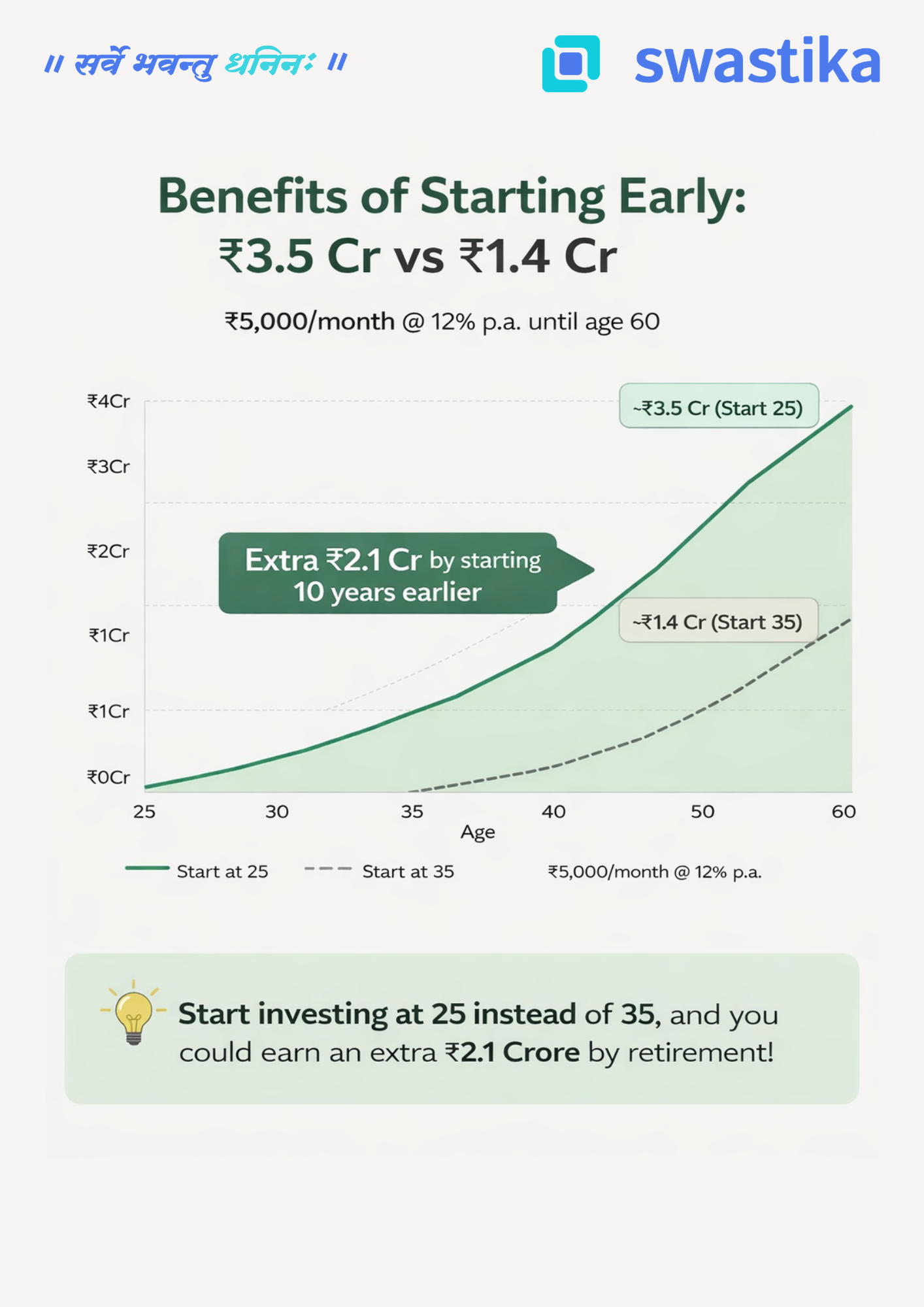
The more years you give your money to grow, the more dramatic — and life-changing — the results become. This is exactly why starting your investment journey early, even with a modest amount, can make a difference of crores by the time you retire.
A Tale of Two Investors: Arjun vs Priya
Let's bring this concept to life with a simple, real-world example.
Meet Arjun and Priya. Both are sensible, disciplined investors. Both invest ₹5,000 every month through a SIP (Systematic Investment Plan) in equity mutual funds, earning an average annual return of 12%. Both stop investing at age 60.
The only difference? Arjun starts at 25. Priya starts at 35.
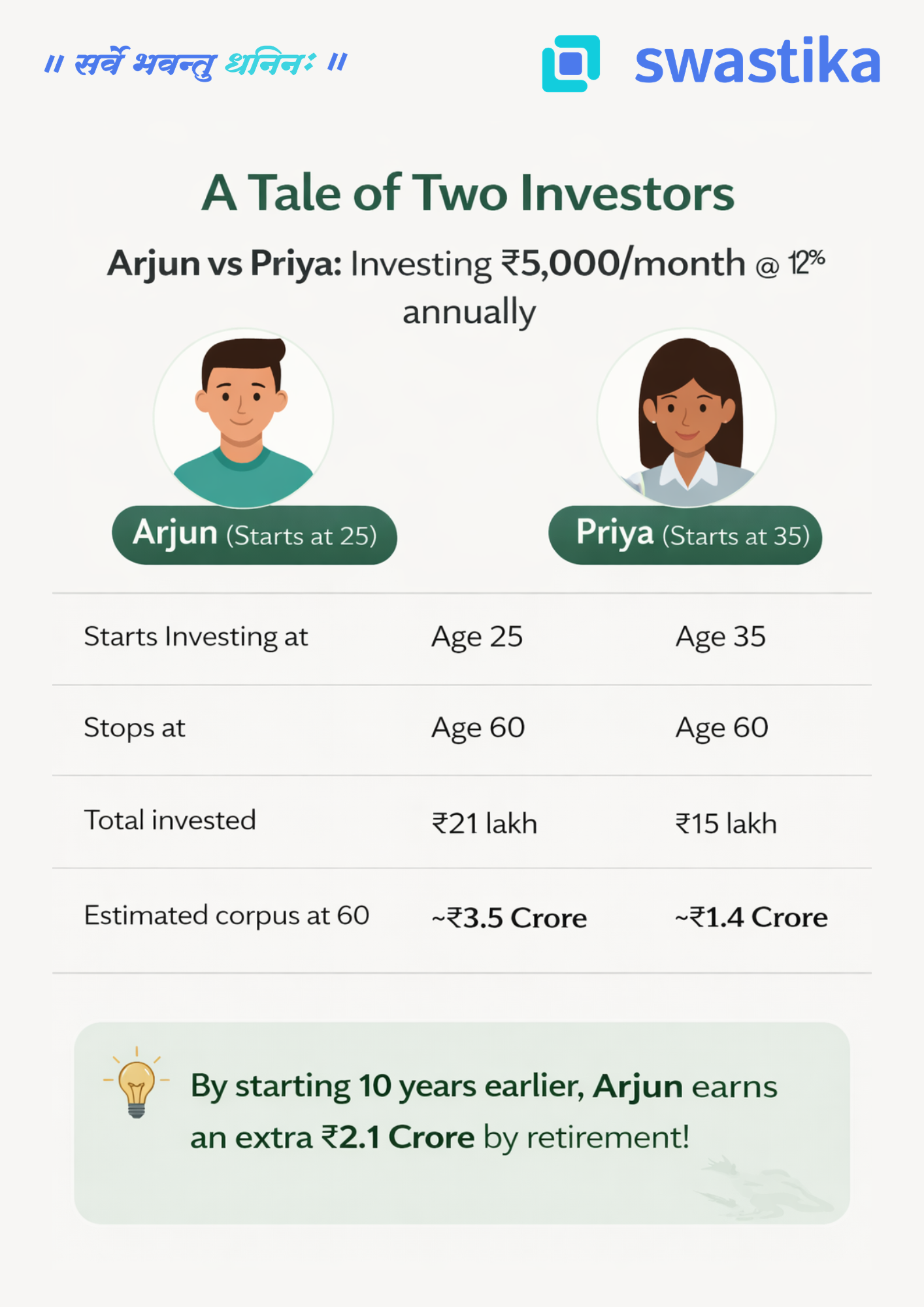
The numbers are striking. Arjun invests just ₹6 lakh more than Priya in absolute terms — yet walks away with ₹2.1 Crore more at retirement.
That extra ₹2.1 Crore didn't come from investing more aggressively or taking bigger risks. It came purely from starting 10 years earlier.
Why Does Time Make Such a Huge Difference?
This is where the magic of compounding reveals itself.
In the early years of investing, growth looks modest and almost unimpressive. But as the years pass, your corpus grows not just on your original investment, but on all the accumulated returns from previous years. The curve goes from almost flat to steeply exponential — and that steep climb happens in the later years.
When Arjun starts at 25, his money has 35 years to ride that exponential curve. Priya's money, starting at 35, only catches the last 25 years — and critically, it misses the steepest part of the climb in the final decade.
Think of it this way: the last 10 years of compounding are worth more than the first 20. That is the counterintuitive truth at the heart of long-term investing.
The Real Cost of Waiting
Many young earners tell themselves, "I'll start investing once I'm more settled — once the salary improves, once the EMI is paid off, once life is a bit easier."
But the numbers show that every year of delay is extraordinarily expensive — far more expensive than any EMI or lifestyle expense. Priya didn't invest carelessly. She invested faithfully for 25 years. Yet she ends up with less than half of what Arjun accumulated — not because she did anything wrong, but simply because she started a decade late.
The cost of waiting 10 years wasn't ₹6 lakh in additional contributions. The cost was ₹2.1 Crore in lost wealth.
Three Principles to Remember
1. Start now, not later.The best time to start investing was yesterday. The second best time is today. Even a SIP of ₹1,000–₹2,000 per month in your 20s is infinitely better than waiting for the "right time."
2. Consistency beats intensity.You don't need to invest large sums all at once. A small, steady, monthly commitment — maintained without interruption — is what unlocks the full power of compounding over decades.
3. Stay invested through market cycles.Compounding works only if you let it work. Exiting during market corrections or stopping your SIP in tough months breaks the chain. Time in the market, not timing the market, is what builds wealth.
The Bottom Line
If you are in your 20s or early 30s, you hold an asset that no amount of money can buy later: time. Use it. Start a SIP today — even a small one. Let compounding do its slow, steady, powerful work.
Because the difference between starting at 25 and starting at 35 is not just 10 years. As Arjun and Priya's story shows, that difference is ₹2.1 Crore.
Big Budget









.webp)
.webp)
.webp)
.webp)
.webp)











.webp)
.webp)
.webp)
.webp)
Latest Articles

Why Start Trading in 2026 and Trading Opportunities in India 2026


India’s stock market is no longer just a long-term investment destination. It has evolved into a dynamic trading ecosystem powered by economic growth, policy reforms, technology, and global capital flows. As 2026 approaches, many investors and professionals are evaluating whether this is the right time to actively participate in trading.
The answer, based on economic indicators and market structure, points strongly in favor. Understanding why start trading in 2026 and identifying the trading opportunities in India in 2026 can help you enter the markets with clarity rather than speculation.
India’s GDP Growth and Economic Momentum
India continues to remain one of the fastest-growing major economies globally. With sustained GDP growth supported by domestic consumption, manufacturing expansion, and infrastructure investment, corporate earnings are expected to stay resilient.
Government-led capital expenditure on roads, railways, ports, and digital infrastructure creates a ripple effect across sectors. For traders, this economic momentum translates into higher market participation, improved liquidity, and consistent price movements across indices and stocks.
A growing economy also attracts long-term institutional money, which adds depth and stability to the markets while creating short-term trading opportunities.
Political Stability and Market-Friendly Policies
One of the strongest reasons to start trading in 2026 is India’s policy continuity. Stable governance and a clear economic roadmap reduce uncertainty, which markets value highly.
Regulatory bodies like SEBI have strengthened market integrity through tighter disclosure norms, improved risk management systems, and enhanced investor protection. Faster settlement cycles and stricter margin rules have reduced systemic risks, making trading safer for retail participants.
Such reforms create a balanced environment where opportunities exist without excessive volatility driven by speculation alone.
India’s Global Relations and Geopolitical Advantage
Global geopolitical shifts are reshaping capital flows. As multinational companies diversify supply chains, India is emerging as a strategic alternative to traditional manufacturing hubs. Strong diplomatic relations with the US, Europe, Middle East, and Asia-Pacific regions support trade growth and foreign investment.
Foreign institutional investors play a crucial role in Indian markets. Their participation often drives trends, volumes, and volatility, all of which are essential for active trading strategies.
In 2026, India’s positioning as a trusted global partner enhances market sentiment and supports long-term bullishness with intermittent short-term opportunities.
Technology-Led Evolution of Trading in India
Trading in India has become increasingly technology-driven. Advanced charting tools, real-time data, mobile trading apps, and AI-supported research are now easily accessible to retail traders.
This technological evolution lowers entry barriers and allows individuals to make informed decisions. However, tools are effective only when combined with reliable research and education. Platforms that focus on trader awareness, strategy-building, and risk management stand out in this environment.
By 2026, tech-enabled trading is expected to become even more seamless, offering faster execution and deeper insights.
Key Trading Opportunities in India 2026
Several sectors and themes are expected to offer strong trading opportunities in India in 2026.
Infrastructure and capital goods companies benefit from sustained government spending. Banking and financial services are supported by credit growth and improving asset quality. Renewable energy and electric mobility align with India’s sustainability goals and global commitments.
Additionally, mid-cap and small-cap stocks may offer higher volatility and momentum-based opportunities, provided traders approach them with proper risk controls.
Index-based trading through Nifty and Bank Nifty remains popular due to liquidity and transparency, making them suitable for both beginners and experienced traders.
Why New Traders Can Benefit in 2026
Starting trading in 2026 allows beginners to learn in a relatively mature and regulated market. Increased focus on investor education, better compliance standards, and access to professional research reduce the chances of costly mistakes.
A young professional or entrepreneur who starts trading alongside long-term investing can develop market discipline, improve financial literacy, and gradually build capital over time.
The key lies in starting with realistic expectations, controlled risk, and continuous learning.
The Role of the Right Trading Partner
While market conditions matter, choosing the right broker is equally important. A SEBI-registered brokerage with strong research capabilities, advanced trading tools, and responsive customer support can significantly enhance the trading experience.
Swastika Investmart brings together research-driven insights, technology-enabled platforms, and investor education initiatives. Its focus on transparency, compliance, and client support helps traders navigate market cycles with confidence.
From beginner guidance to advanced trading strategies, having a reliable partner ensures consistency and trust.
👉 Open your trading account today
Frequently Asked Questions
Is 2026 a good year to start trading in India?
Yes. Strong economic growth, regulatory stability, and evolving market structure make 2026 a favorable entry point.
What trading segments are suitable for beginners?
Equity cash and index derivatives are often preferred due to liquidity and availability of research.
How much capital is required to start trading?
Trading can be started with modest capital, provided risk management and position sizing are followed.
Are Indian markets well regulated for traders?
Indian markets are regulated by SEBI, ensuring transparency, investor protection, and fair practices.
Conclusion: Begin Your Trading Journey with Confidence
The combination of economic growth, political stability, global relevance, and technology-driven access makes 2026 a compelling year to start trading. For those willing to approach markets with discipline and learning, trading opportunities in India in 2026 are both diverse and rewarding.
If you are planning to take your first step or upgrade your trading setup, consider partnering with Swastika Investmart. With strong research, tech-enabled investing tools, and dedicated customer support, it offers a solid foundation for your trading journey.

Mutual Funds in 2025 and Why Investing in Mutual Funds in 2026 Makes Sense
As 2025 draws to a close, Indian investors have a lot to reflect on. Equity markets moved through phases of optimism, global uncertainty, interest rate adjustments, and sector-specific rallies. Amid all this, mutual funds in India continued to play a steady and dependable role for retail investors.
Looking ahead, 2026 is shaping up to be a year where informed and disciplined investing could pay off well. Let us break down how mutual funds performed in 2025 and why investing in mutual funds in 2026 could be a smart financial decision.
How Mutual Funds Performed in 2025
Market Volatility Tested Investor Discipline
The year 2025 was marked by fluctuating global cues, geopolitical tensions, and cautious central bank policies. Indian equity markets experienced intermittent corrections, which tested short-term investors. However, long-term mutual fund investors who stayed invested saw the power of compounding at work.
Equity-oriented mutual funds benefited from India’s domestic consumption story, infrastructure push, and digitization across sectors. Debt funds provided stability during uncertain phases, while hybrid funds helped balance risk and return.
SIPs Continued to Shine
Systematic Investment Plans once again proved their value in 2025. Investors who maintained SIP discipline benefited from rupee cost averaging during market dips. Monthly SIP inflows remained strong, reflecting growing investor maturity and trust in mutual funds as a long-term investment avenue.
Sectoral and Thematic Funds Gained Attention
Funds focused on manufacturing, defense, energy transition, and technology saw increased interest. While sectoral funds carry higher risk, informed investors used them tactically alongside diversified equity funds.
Regulatory Oversight Strengthened Trust
SEBI continued to enhance transparency, risk labeling, and investor protection norms. Clear disclosures and standardized risk-o-meters helped investors make informed decisions, reinforcing trust in mutual funds regulated under Indian financial laws.
Key Lessons Investors Learned in 2025
Asset Allocation Matters
Investors who diversified across equity, debt, and hybrid mutual funds were better positioned to handle volatility. 2025 reinforced the importance of aligning investments with financial goals and risk appetite.
Long-Term View Beats Market Timing
Trying to time the market remained difficult. Those who stayed invested through market cycles benefited more than those who frequently exited and re-entered.
Research and Advisory Support Adds Value
Investors using research-backed platforms and professional guidance made better fund selections. Quality research, portfolio reviews, and ongoing support became increasingly important.
Why 2026 Could Be a Great Year to Invest in Mutual Funds
India’s Growth Story Remains Strong
India continues to be one of the fastest-growing major economies. Government focus on infrastructure, manufacturing, digital public platforms, and financial inclusion is expected to support corporate earnings over the long term. Mutual funds offer an efficient way to participate in this growth.
Favorable Environment for Equity Investments
With inflation expected to remain under control and policy reforms continuing, equity mutual funds could benefit from improved business confidence. Starting investments early in 2026 allows investors to capture growth across market cycles.
Power of Compounding Works Best Over Time
Investing in mutual funds in 2026 with a long-term horizon can significantly enhance wealth creation. Even modest monthly investments through SIPs can grow meaningfully when given time.
Wide Range of Fund Options
From large-cap stability to mid-cap growth and balanced hybrid funds, investors in 2026 have access to a broad spectrum of mutual fund categories. This allows customization based on goals such as retirement, child education, or wealth creation.
How Mutual Funds Fit Different Investor Profiles in 2026
For New Investors
Mutual funds remain one of the most beginner-friendly investment options. With low entry amounts and professional fund management, new investors can start their journey confidently.
For Working Professionals
SIPs align perfectly with monthly income cycles. Automated investing ensures discipline without requiring constant market tracking.
For Retirees and Conservative Investors
Debt and hybrid mutual funds can provide relatively stable returns and regular income options, subject to market risks.
Why Choose Swastika Investmart for Mutual Fund Investing
Swastika Investmart brings together experience, technology, and research to support investors at every stage. Being a SEBI-registered entity, Swastika follows strict regulatory standards, ensuring transparency and investor safety.
Key strengths include in-depth research tools, easy-to-use digital platforms, responsive customer support, and a strong focus on investor education. Whether you are reviewing your 2025 portfolio or planning fresh investments for 2026, having a trusted partner makes a meaningful difference.
Start your Mutual Fund journey with Swastika Now
Frequently Asked Questions
Are mutual funds safe to invest in for 2026?
Mutual funds are regulated by SEBI and managed by professional fund managers. While market risks exist, diversification and long-term investing help manage risk effectively.
Is 2026 a good time to start SIPs?
Yes. Starting SIPs early allows investors to benefit from compounding and market volatility through rupee cost averaging.
Which mutual funds are suitable for long-term goals?
Equity mutual funds and balanced hybrid funds are commonly used for long-term wealth creation, depending on risk tolerance.
How much should one invest in mutual funds?
Investment amounts depend on income, goals, and expenses. Even small monthly SIPs can be effective when continued consistently.
Conclusion
Mutual funds in 2025 proved their resilience and value for disciplined investors. As 2026 approaches, the combination of economic growth, regulatory strength, and evolving investor awareness makes mutual funds a compelling investment option.
If you are planning to invest smarter and stay aligned with your financial goals in 2026, consider starting or reviewing your mutual fund investments with Swastika Investmart. With expert research, technology-driven platforms, and trusted support, your investment journey can be both informed and confident.
Take the next step towards your financial goals.
Start your Mutual Fund journey with Swastika Now
%20(2).webp)
Stock Market Opening Outlook Today 18 December 2025 | What to Expect from Nifty, Sensex & Bank Nifty
Indian equity markets head into Thursday, 18 December 2025, with a cautious undertone as investors balance global uncertainty with domestic resilience. After a mixed close in the previous session, early indicators suggest a guarded start for benchmark indices, with traders closely tracking global markets, institutional flows, and sector-specific triggers.
While volatility remains part of the landscape, India continues to stand out as a structurally strong market backed by stable macroeconomic fundamentals and improving earnings visibility.
Global Cues Setting the Tone for Today
Asian markets traded mixed in early hours, reflecting uncertainty around global growth and interest rate expectations. US markets closed with marginal movement overnight as investors digested economic data and central bank commentary.
Key global factors influencing Indian markets today include:
- US bond yields stabilising after recent volatility
- Crude oil prices trading in a narrow range, offering relief to import-heavy sectors
- Dollar index movement impacting emerging market flows
Historically, when global cues remain mixed, Indian markets tend to open flat and gradually find direction based on domestic data and institutional activity.
Gift Nifty and Early Market Indicators
Gift Nifty signals suggest a muted opening for Indian indices, pointing towards a cautious start rather than a strong directional move. This often translates into:
- Narrow opening range for Nifty
- Stock-specific opportunities rather than broad-based rallies
- Higher importance of technical levels for intraday traders
Such sessions usually reward disciplined strategies over aggressive positions.
Nifty 50 Outlook for 18 December 2025
The Nifty index remains technically placed in a consolidation zone. After recent fluctuations, market participants are watching whether the index can sustain above key support levels during early trade.
What traders should watch today:
- Immediate support zones where buying interest may emerge
- Resistance levels that could cap any early upside
- Market breadth as an indicator of underlying strength
A sustained move beyond the opening range could define intraday momentum, while failure to do so may result in sideways action.
Bank Nifty Outlook Today
Bank Nifty remains in focus as private and PSU banks continue to influence overall market sentiment. Recent profit booking has made the index slightly volatile, but the broader trend remains intact.
Key factors influencing Bank Nifty today:
- Institutional activity in large banking stocks
- Bond yield movement impacting financials
- Stock-specific news in PSU and private lenders
If banking stocks stabilise, they could provide crucial support to the broader indices during the session.
Sectoral Trends to Track Today
Banking and Financial Services
Banking stocks are expected to open steady with selective buying in quality names. Long-term investors continue to favour well-capitalised banks with strong asset quality.
IT Sector
IT stocks may see mixed movement as currency fluctuations and global tech cues remain uneven. Short-term volatility is likely, but structural demand remains intact.
FMCG and Consumption
Defensive sectors such as FMCG may see interest if markets remain range-bound. These stocks often attract investors during uncertain sessions.
Midcaps and Smallcaps
Midcap and smallcap stocks may continue to witness stock-specific action. Investors should remain selective and avoid momentum chasing.
Institutional Flow and Regulatory Context
Foreign Institutional Investors have shown intermittent buying and selling patterns in recent sessions, reflecting global risk sentiment. Domestic Institutional Investors continue to provide stability to the market.
From a regulatory standpoint, SEBI’s ongoing focus on transparency, risk disclosures, and investor protection has strengthened confidence in Indian capital markets. These measures help maintain long-term trust and attract consistent participation across market cycles.
How Traders and Investors Can Approach Today’s Market
For traders, today’s market calls for patience and clarity. Range-bound sessions often reward:
- Defined entry and exit levels
- Strict risk management
- Avoiding overtrading in the first hour
For long-term investors, such market phases offer opportunities to review portfolios, track sector rotation, and accumulate fundamentally strong stocks gradually.
This is where access to reliable research, real-time insights, and professional guidance makes a meaningful difference.
Why Many Investors Prefer Swastika Investmart
In evolving market conditions like these, investors look for platforms that combine trust, technology, and expertise.
Swastika Investmart stands out with:
- SEBI-registered credibility and decades of market experience
- Strong research tools backed by in-depth analysis
- Dedicated customer support for investors and traders
- Tech-enabled investing platforms for seamless execution
- Continuous investor education to build long-term confidence
Rather than chasing short-term noise, Swastika focuses on empowering investors with clarity and informed decision-making.
Frequently Asked Questions
Will the Indian stock market open positive today?
The market is expected to open cautiously on 18 December 2025, with limited upside unless global cues improve during early trade.
Which sector may perform better today?
Banking and defensive sectors may remain relatively stable, while IT and midcaps could see selective movement.
Is today suitable for intraday trading?
Yes, but traders should focus on disciplined strategies and avoid aggressive positions in the absence of strong trends.
What should long-term investors do in such markets?
Long-term investors can use consolidation phases to accumulate quality stocks and rebalance portfolios.
Final Thoughts
The stock market opening outlook for today, 18 December 2025, suggests a cautious yet stable start for Indian equities. While short-term volatility may persist, India’s strong economic fundamentals and regulatory framework continue to support long-term growth.
Whether you are a trader navigating intraday moves or an investor building wealth steadily, having the right partner matters.
Markets may fluctuate daily, but informed decisions create lasting value.
%20(3).webp)
FII & DII Net Buying Today (17 December 2025) : What ₹1,940+ Crore Inflows Signal for Indian Markets
Institutional flows often provide the clearest insight into market sentiment. On 17 December 2025, Indian equity markets saw a meaningful shift as Foreign Institutional Investors recorded net buying of ₹1,171.71 crore, while Domestic Institutional Investors added ₹768.94 crore.
This simultaneous buying by FIIs and DIIs is closely watched because it reflects confidence from both global investors and domestic institutions at the same time. Even when benchmark indices show limited movement, such data helps investors understand what smart money is doing beneath the surface.
FII and DII Activity Explained for Indian Investors
Foreign Institutional Investors include overseas mutual funds, sovereign wealth funds, and global asset managers investing in Indian equities. Domestic Institutional Investors consist of Indian mutual funds, insurance companies, pension funds, and banks, all regulated by SEBI.
Historically, when both FIIs and DIIs are net buyers on the same day, markets tend to find support, especially during volatile or sideways phases.
On 17 Dec 2025, total institutional inflows of over ₹1,940 crore provided a stabilising influence on the market.
Why FIIs Turned Net Positive on 17 December 2025
FII behaviour in December 2025 has been cautious due to global factors like fluctuating US bond yields, mixed cues from global indices, and evolving expectations around interest rate cuts.
Today’s FII buying suggests selective confidence rather than broad-based risk-taking. Large-cap stocks, particularly in banking, IT services, and capital goods, attracted steady overseas interest.
For FIIs, India continues to stand out among emerging markets due to stable macroeconomic indicators, controlled inflation, and consistent GDP growth projections. The inflows seen today indicate that global investors are willing to accumulate quality Indian stocks at reasonable valuations.
Strong DII Buying Shows Domestic Confidence
Domestic Institutional Investors stepped in with ₹768.94 crore of net buying on 17 December 2025, continuing their role as market stabilisers.
Indian mutual funds, backed by consistent SIP inflows, used today’s market conditions to accumulate fundamentally strong stocks. Insurance companies and long-term domestic funds focused on sectors linked to India’s growth story such as infrastructure, financial services, and manufacturing.
In recent years, DIIs have become increasingly important in absorbing FII selling pressure, making Indian markets more resilient than before.
Market Impact of Today’s FII and DII Inflows
Despite mixed global cues, institutional buying helped Indian markets avoid sharp downside today. While benchmark indices showed limited gains, the underlying breadth improved in select sectors.
Stocks with strong earnings visibility and balance sheets saw accumulation, indicating that institutional investors are positioning themselves for the medium to long term rather than chasing short-term momentum.
For retail investors, such data highlights the importance of tracking institutional trends instead of reacting to daily index movements.
What This Means for Retail and Long-Term Investors
When FIIs and DIIs are both net positive, it usually signals confidence in the market’s underlying strength. However, it does not mean every stock will move higher.
Retail investors should focus on quality companies, diversification, and disciplined investing. Following institutional trends can help in understanding broader market direction, but investment decisions should always align with individual financial goals and risk tolerance.
Platforms like Swastika Investmart, a SEBI-registered brokerage, provide access to detailed market insights, research-backed recommendations, and tech-enabled tools that help investors interpret such data effectively.
Frequently Asked Questions
Why is FII and DII data important for Indian markets
It reflects where large institutional money is flowing, often influencing short-term market direction and long-term trends.
Is FII net buying always bullish
Not always. It indicates confidence, but markets also depend on earnings, valuations, and global factors.
How do DIIs impact market stability
DIIs often counterbalance FII selling, providing support during volatile periods through long-term investments.
Should retail investors follow FII and DII trends
Yes, as a reference point. However, decisions should be based on fundamentals and personal financial planning.
Conclusion: Reading Today’s Institutional Signals Wisely
The net buying by FIIs worth ₹1,171.71 crore and DIIs worth ₹768.94 crore on 17 December 2025 reflects cautious optimism in Indian equities. While global uncertainty persists, institutional investors appear comfortable accumulating quality stocks in the Indian market.
For investors seeking clarity amid daily market noise, understanding institutional behaviour can provide valuable perspective. With strong research tools, investor education, and responsive customer support, Swastika Investmart helps investors navigate such market phases with confidence.
Indian Stock Market Closing Today: Nifty, Sensex and Bank Nifty End Lower on 17 December 2025
The Indian stock market closed marginally lower today, Wednesday, 17 December 2025, as investors opted for caution amid mixed global signals and selective profit booking across key sectors. While the broader structure of the market remains constructive, today’s session reflected a pause after recent highs.
Benchmark indices traded in a narrow range for most of the session, indicating indecision among market participants.
At the close:
Nifty 50 settled at 25,818.55, down 0.16 percent
BSE Sensex ended at 84,559.65, lower by 0.14 percent
Bank Nifty closed at 58,926.75, declining 0.18 percent
How the Market Traded Through the Day
Indian equities opened on a muted note today, tracking cautious cues from global markets. Early gains were capped quickly as selling pressure emerged in heavyweight banking and IT stocks. Midday trading remained range bound, with institutional investors staying selective.
In the second half, the market attempted a mild recovery but failed to sustain momentum, leading to a soft close.
This kind of consolidation is often seen after strong rallies, especially when markets wait for clarity on global interest rate outlooks and upcoming macroeconomic data.
Sector Performance Overview
Banking and Financials
Banking stocks remained under pressure today, dragging Bank Nifty lower. Private sector banks witnessed mild profit booking after recent outperformance. PSU banks showed mixed movement as investors booked short term gains.
Information Technology
IT stocks traded flat to weak, influenced by subdued global tech cues and cautious outlook on overseas demand. Currency stability also reduced defensive buying in IT.
FMCG and Consumption
Defensive sectors such as FMCG provided limited support to the indices. Select consumption stocks saw buying interest as investors rotated towards stability.
Auto and Metals
Auto stocks remained mixed due to valuation concerns, while metal stocks lacked direction amid uncertain global demand outlook.
Market Breadth and Investor Sentiment
Market breadth was mixed today, indicating stock specific action rather than broad based selling. While frontline indices closed in the red, select midcap and smallcap stocks continued to attract interest.
This suggests that investors are not exiting the market but are reallocating capital selectively, focusing on quality stocks with strong earnings visibility.
Global and Domestic Triggers Influencing Today’s Close
From a global perspective, investors remained cautious ahead of key economic data releases from the United States and Europe. Expectations around future interest rate decisions by global central banks kept risk appetite in check.
Domestically, markets are digesting recent macro data and positioning ahead of upcoming quarterly earnings updates. The absence of strong triggers led to a consolidation driven session.
Regulatory stability from SEBI and continued focus on transparency in Indian capital markets continues to provide long term confidence, even during short term volatility.
What Today’s Market Close Means for Investors
Today’s mild correction does not alter the broader bullish trend of Indian equities. Instead, it highlights the importance of disciplined investing and avoiding emotional reactions to short term movements.
For long term investors, such sessions often provide opportunities to review portfolios, rebalance allocations, and focus on fundamentally strong companies.
Traders should remain cautious, respecting support and resistance levels while keeping an eye on global developments.
How Swastika Investmart Helps Investors Navigate Market Volatility
In volatile and range bound markets like today, having the right research and advisory support becomes crucial. Swastika Investmart, a SEBI registered stockbroker, empowers investors with:
• Robust equity and derivatives research
• Advanced trading platforms with real time insights
• Strong customer support for both traders and investors
• Investor education initiatives focused on risk management
• Tech enabled tools designed for informed decision making
Such an ecosystem helps investors stay prepared, even when markets move sideways or turn volatile.
👉 Open your trading account today and invest with confidence
Frequently Asked Questions
Why did the Indian stock market fall today on 17 December 2025?
The market closed lower due to cautious global cues, profit booking in banking stocks, and lack of strong domestic triggers.
Is today’s market fall a cause for concern?
No. The decline was marginal and reflects consolidation rather than a trend reversal.
Which index underperformed today?
Bank Nifty underperformed slightly, closing down 0.18 percent due to pressure in banking stocks.
What should investors do after today’s market close?
Investors should stay disciplined, avoid panic selling, and focus on quality stocks aligned with their goals.
How can Swastika Investmart support investors in such markets?
Swastika Investmart provides research backed insights, reliable platforms, and expert support to help investors navigate uncertain markets.
Final Thoughts and Investor Takeaway
The Indian stock market closing today, 17 December 2025, reflects a healthy pause after recent gains. With Nifty, Sensex, and Bank Nifty ending slightly lower, the session reinforces the need for patience and informed decision making.
Markets do not move in straight lines, and periods of consolidation often lay the foundation for the next directional move. Staying connected to credible research, strong platforms, and expert guidance can make a significant difference.
If you are looking to invest or trade with confidence in evolving market conditions, consider opening your account with Swastika Investmart and experience research driven, tech enabled investing.
👉 Open your trading account today and invest with confidence

Dhurandhar Effect on PVR Inox: A Blockbuster Boost or Just a Temporary Revival?
Key Takeaways
- Dhurandhar’s strong box office performance has lifted near-term footfalls for PVR Inox
- Single-film successes improve short-term numbers but do not guarantee structural recovery
- Long-term outlook depends on content consistency, costs, and balance sheet health
- Investor sentiment may improve, but sustainability remains the key question
Introduction: When Cinema Success Meets Stock Market Optimism
In India, cinema is not just entertainment, it is also a business that directly influences stock prices. Whenever a big-budget movie delivers strong opening numbers, multiplex stocks often move in tandem. The recent success of Dhurandhar has once again put PVR Inox in the spotlight, with investors debating whether this marks a genuine revival or just a brief relief rally.
For shareholders and market participants, the real task is to separate box office excitement from long-term fundamentals. History suggests that while blockbusters can revive sentiment, sustainable gains depend on much deeper factors.
What Is Driving the Dhurandhar Effect on PVR Inox
Dhurandhar has attracted strong footfalls across major urban centres, particularly during opening weeks. For PVR Inox, higher occupancy directly translates into better revenue visibility.
The immediate impact includes:
- Higher ticket sales and premium format utilisation
- Improved food and beverage revenues, which carry better margins
- Operating leverage benefits as fixed costs get absorbed over higher volumes
Multiplex businesses are highly sensitive to content performance. When audiences turn up in large numbers, even a few weeks of strong occupancy can materially improve quarterly performance.
Short-Term Gains vs Long-Term Sustainability
While the near-term impact is visible, investors must remember that the multiplex business is cyclical. Over the past few years, PVR Inox has faced:
- Uneven content pipeline
- Pressure from rising operating costs
- Competition from streaming platforms
A single successful movie, even a blockbuster, cannot offset structural challenges unless it is followed by a steady stream of strong releases. True recovery comes when footfalls remain consistent across quarters, not just during marquee releases.
Financial Impact: What Improves and What Remains Unchanged
From a financial perspective, Dhurandhar helps PVR Inox improve:
- Revenue per screen
- EBITDA margins in the short term
- Cash inflows during peak weeks
However, the multiplex model has high fixed costs such as rentals, salaries, and maintenance. These costs do not decline during weak content phases. As a result, earnings volatility remains high unless content performance stabilises.
For investors, this means that one strong quarter does not automatically change the long-term earnings trajectory.
Market Context: Why Investors Are Watching Closely
PVR Inox, after industry consolidation, enjoys a dominant position in India’s multiplex space. This scale provides advantages in negotiations with distributors and access to premium formats.
At the same time, the stock is sensitive to sentiment due to:
- Content-driven earnings visibility
- Valuation movements during blockbuster-led rallies
- Changing consumer behaviour post-pandemic
The Dhurandhar effect needs to be viewed in the context of broader industry recovery rather than as a standalone trigger.
Is This a Sentiment Rally or the Start of a Trend
For long-term investors, the focus should be on indicators beyond a single film’s success:
- Upcoming movie slate across languages and genres
- Trends in occupancy and average ticket prices
- Progress on debt reduction and free cash flows
- Expansion of non-ticket revenue streams
If Dhurandhar is followed by multiple successful releases, sentiment could sustain. Otherwise, the stock may revert to tracking broader discretionary spending trends.
Regulatory and Industry Considerations
The exhibition industry operates under state-level regulations related to ticket pricing and local taxes. While there are no immediate regulatory changes impacting PVR Inox, policy clarity remains important for margin stability.
Additionally, content release strategies are evolving as producers balance theatrical releases with digital platforms. This dynamic continues to influence footfall trends.
How Investors Should Approach PVR Inox Now
Rather than reacting to weekend box office numbers, investors should adopt a disciplined approach:
- Avoid chasing short-term price movements
- Focus on quarterly earnings trends
- Align investment decisions with risk appetite and time horizon
Multiplex stocks tend to reward patience during periods of consistent content performance rather than short-lived spikes.
Where Swastika Investmart Supports Smarter Investing
Analysing consumer-facing businesses like multiplex operators requires context and continuous tracking. Swastika Investmart, a SEBI-registered stockbroker, empowers investors with:
- Research-backed insights on media and consumption trends
- Tech-enabled platforms for seamless investing
- Strong customer support for timely decision-making
- Ongoing investor education to decode market signals
This helps investors look beyond headlines and stay focused on fundamentals.
Conclusion: Blockbuster Buzz or Sustainable Revival?
Dhurandhar has clearly delivered a near-term boost to PVR Inox by driving footfalls and improving sentiment. However, whether this translates into a sustainable revival will depend on content consistency, cost control, and evolving audience behaviour.
For investors, Dhurandhar should be treated as a positive data point, not a definitive turning point. Long-term outcomes will be shaped by execution, not excitement.
If you want to track such market-moving events with clarity and confidence, choose a platform that combines research, technology, and investor-first practices.
Frequently Asked Questions
How does a blockbuster movie impact PVR Inox’s performance?
A successful movie increases occupancy and food and beverage sales, improving short-term revenues and margins.
Is Dhurandhar enough to ensure long-term recovery for PVR Inox?
No. Sustained recovery requires a consistent pipeline of successful films and disciplined cost management.
Why do multiplex stocks react quickly to movie releases?
Because revenues are directly linked to footfalls, opening weekend trends often influence investor sentiment.
What are the key risks for PVR Inox investors?
Content inconsistency, high fixed costs, and competition from digital platforms remain key risks.
Should long-term investors focus on single-film performance?
No. Long-term investors should prioritise quarterly trends and structural fundamentals over one-off successes.


.webp)
.webp)

.webp)






START YOUR INVESTMENT JOURNEY
Get personalized advice from our experts
- Dedicated RM Support
- Smooth and Fast Trading App