

The Power of Compounding – Why Starting Early Matters




Introduction
Albert Einstein reportedly called compound interest the "eighth wonder of the world." Whether or not he actually said it, the math is undeniable. Compounding is the process where your investment returns begin earning their own returns — and over time, this snowball effect becomes truly extraordinary.
The catch? Compounding needs one essential ingredient: time.
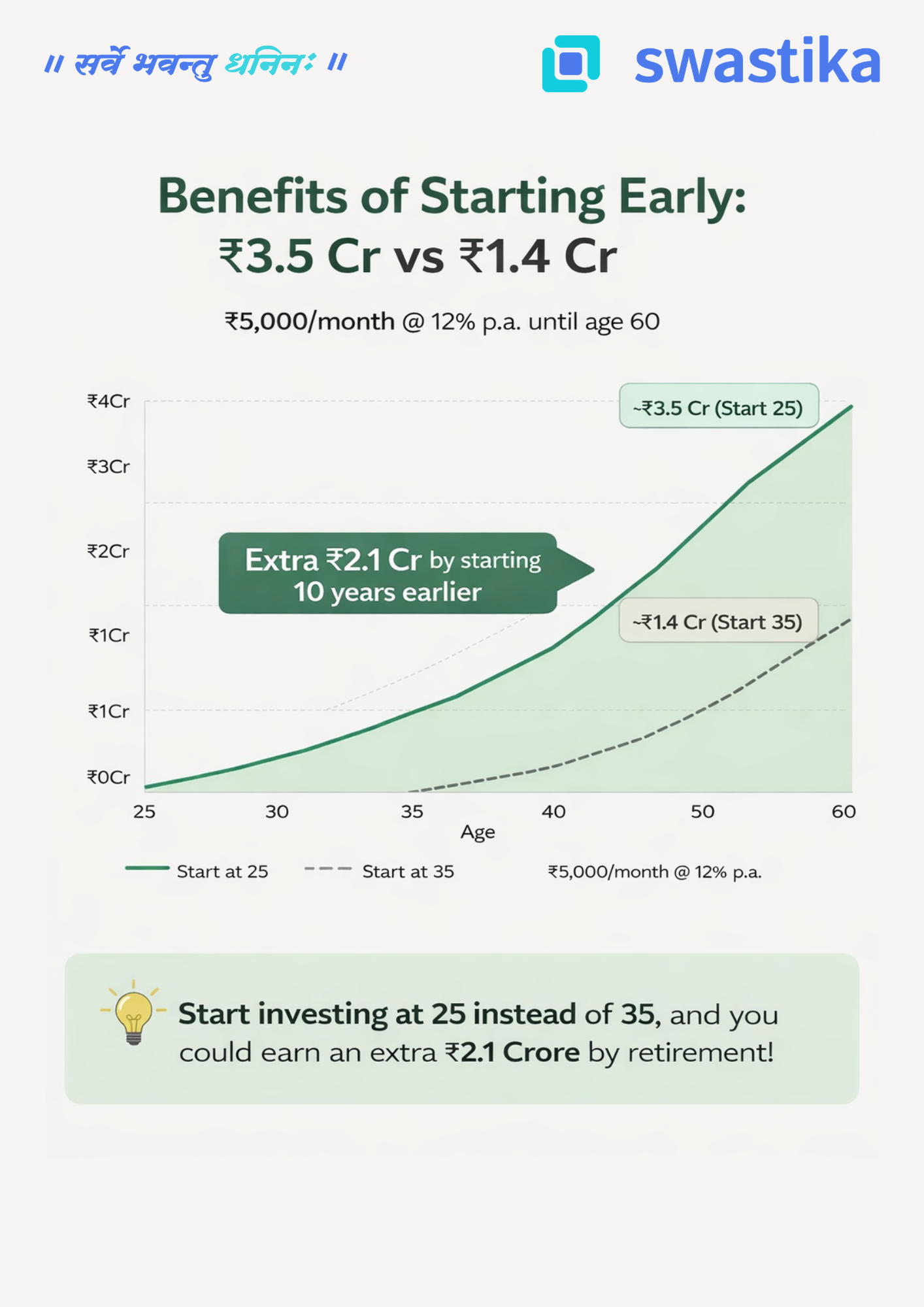
The more years you give your money to grow, the more dramatic — and life-changing — the results become. This is exactly why starting your investment journey early, even with a modest amount, can make a difference of crores by the time you retire.
A Tale of Two Investors: Arjun vs Priya
Let's bring this concept to life with a simple, real-world example.
Meet Arjun and Priya. Both are sensible, disciplined investors. Both invest ₹5,000 every month through a SIP (Systematic Investment Plan) in equity mutual funds, earning an average annual return of 12%. Both stop investing at age 60.
The only difference? Arjun starts at 25. Priya starts at 35.
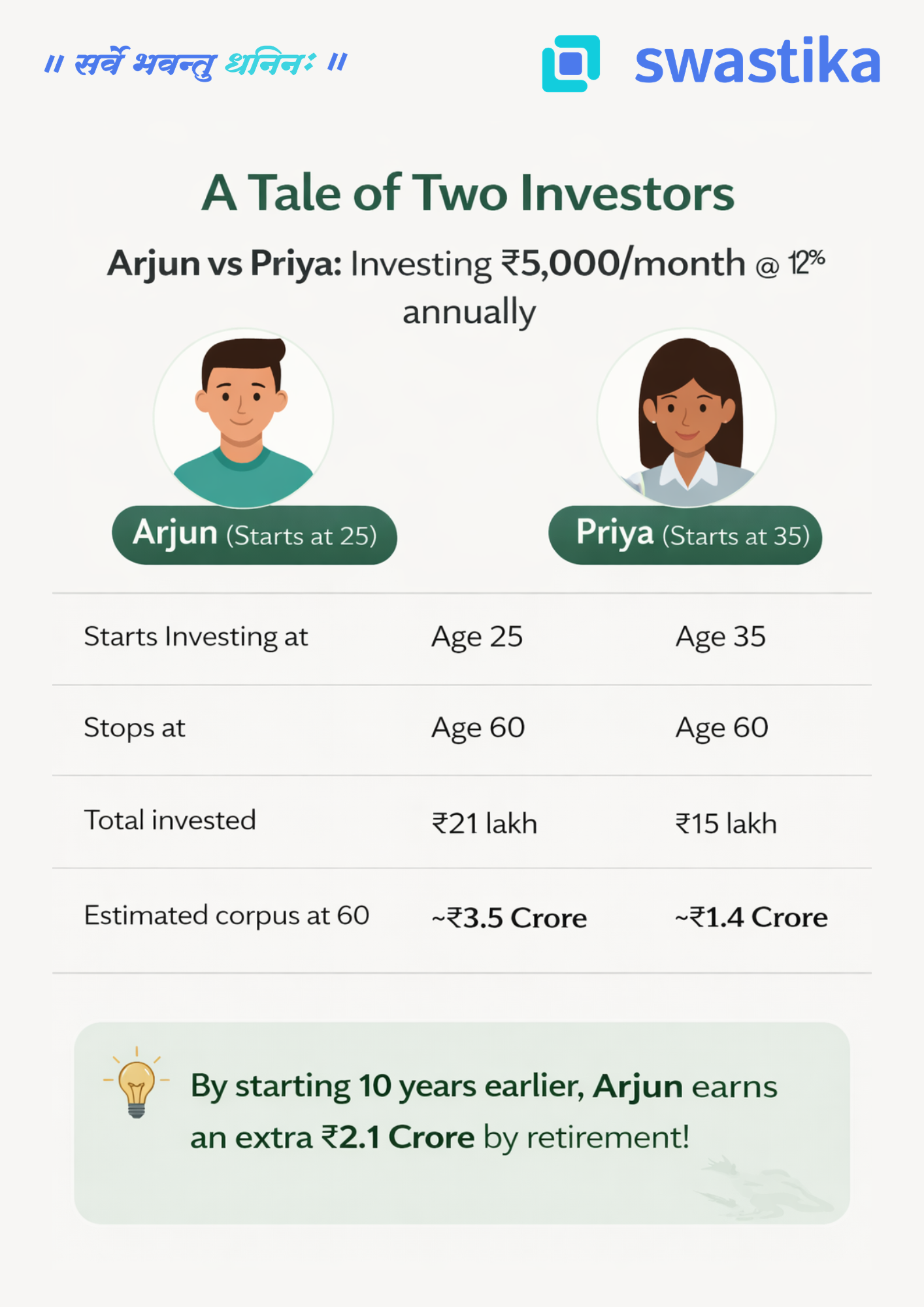
The numbers are striking. Arjun invests just ₹6 lakh more than Priya in absolute terms — yet walks away with ₹2.1 Crore more at retirement.
That extra ₹2.1 Crore didn't come from investing more aggressively or taking bigger risks. It came purely from starting 10 years earlier.
Why Does Time Make Such a Huge Difference?
This is where the magic of compounding reveals itself.
In the early years of investing, growth looks modest and almost unimpressive. But as the years pass, your corpus grows not just on your original investment, but on all the accumulated returns from previous years. The curve goes from almost flat to steeply exponential — and that steep climb happens in the later years.
When Arjun starts at 25, his money has 35 years to ride that exponential curve. Priya's money, starting at 35, only catches the last 25 years — and critically, it misses the steepest part of the climb in the final decade.
Think of it this way: the last 10 years of compounding are worth more than the first 20. That is the counterintuitive truth at the heart of long-term investing.
The Real Cost of Waiting
Many young earners tell themselves, "I'll start investing once I'm more settled — once the salary improves, once the EMI is paid off, once life is a bit easier."
But the numbers show that every year of delay is extraordinarily expensive — far more expensive than any EMI or lifestyle expense. Priya didn't invest carelessly. She invested faithfully for 25 years. Yet she ends up with less than half of what Arjun accumulated — not because she did anything wrong, but simply because she started a decade late.
The cost of waiting 10 years wasn't ₹6 lakh in additional contributions. The cost was ₹2.1 Crore in lost wealth.
Three Principles to Remember
1. Start now, not later.The best time to start investing was yesterday. The second best time is today. Even a SIP of ₹1,000–₹2,000 per month in your 20s is infinitely better than waiting for the "right time."
2. Consistency beats intensity.You don't need to invest large sums all at once. A small, steady, monthly commitment — maintained without interruption — is what unlocks the full power of compounding over decades.
3. Stay invested through market cycles.Compounding works only if you let it work. Exiting during market corrections or stopping your SIP in tough months breaks the chain. Time in the market, not timing the market, is what builds wealth.
The Bottom Line
If you are in your 20s or early 30s, you hold an asset that no amount of money can buy later: time. Use it. Start a SIP today — even a small one. Let compounding do its slow, steady, powerful work.
Because the difference between starting at 25 and starting at 35 is not just 10 years. As Arjun and Priya's story shows, that difference is ₹2.1 Crore.
Big Budget











.webp)
.webp)
.webp)
.webp)
.webp)















.webp)
.webp)
.webp)
.webp)
Latest Articles

How to Use Open Interest for Intraday Trading


What is Open Interest?
Open interest refers to the total number of outstanding options and futures contracts that have not been settled, closed out, or exercised. In simple terms, it's the number of active positions in options and futures contracts. For example, if a buyer and a seller enter into a new call option contract, open interest increases by one. Conversely, if the same buyer and seller close their contract by taking an opposite position, open interest decreases by one. If the buyer sells their contract to another buyer, the open interest remains unchanged, as there is no net change in open positions.
How to Use Open Interest for Intraday Trading
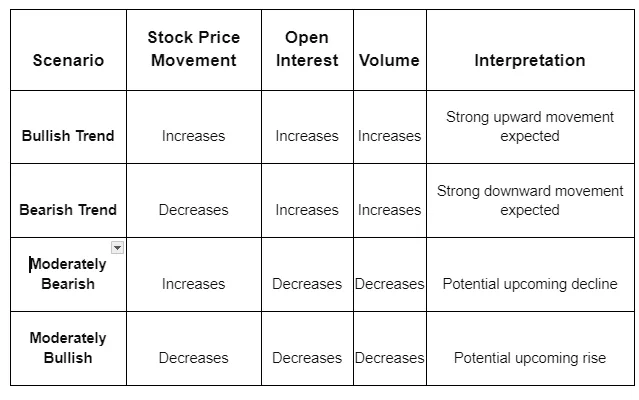
- Bullish Trend: If the stock price rises along with an increase in open interest and volume, it shows a bullish trend.
- Bearish Trend: If the stock price falls along with an increase in open interest and volume, it shows a bearish trend.
- Moderately Bearish: If the stock price rises but open interest and volume decrease, it shows a moderately bearish trend.
- Moderately Bullish: If the stock price falls but open interest and volume decrease, it shows a moderately bullish trend.
Open Interest vs. Volume
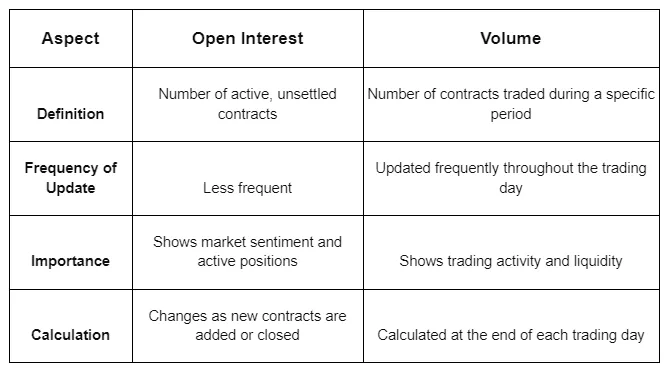
Importance of Open Interest
Monitoring open interest provides valuable insights for making decisions in financial markets. Here are some key points:
- Market Sentiment Indicator: Changes in open interest shows bullish or bearish sentiment of the market.
- Price Trend Confirmation: Rising open interest signal uptrends, while falling open interest may signal downtrends.
- Reversal Indication: Sudden changes in open interest can hint at trend reversals.
- Liquidity and Trading Activity: High open interest shows increased market liquidity and trading activity.
- Options Expiry Consideration: Important in options trading, helps in influencing decisions around expiry dates.
- Contrarian Indicator: Analyses extreme open interest situations for potential contrarian trading opportunities.
Example in INR
Suppose an investor is tracking a stock with the following details:
- Current Stock Price: ₹500
- Open Interest: 10,000 contracts
- Volume: 5,000 contracts
Conclusion
By analyzing open interest along with volume and price action, you can identify market trends. Once you've identified the trend, you can take appropriate positions. To get specific open interest data for an asset, use an open interest calculator, which is often available online for free.

Stock Market Vs Commodity Market
What is the Equity Market?
The equity market, commonly known as the stock market or share market, is a platform where people buy and sell shares of companies. In India, these shares are traded on stock exchanges or directly between individuals. To trade shares online in India, you need a "demat account" and a "trading account." These accounts function like digital wallets for your shares.
What is the Commodity Market?
Commodities are important resources that can be traded for other commodities of the same type. They are divided into two categories: hard commodities like gold and oil, and soft commodities like agricultural products and cattle. The commodity market is a place where these commodities are bought and sold, either physically or virtually. Investments in commodities can be made directly or through commodity futures contracts.
Key Differences: Equity Market vs. Commodity Market
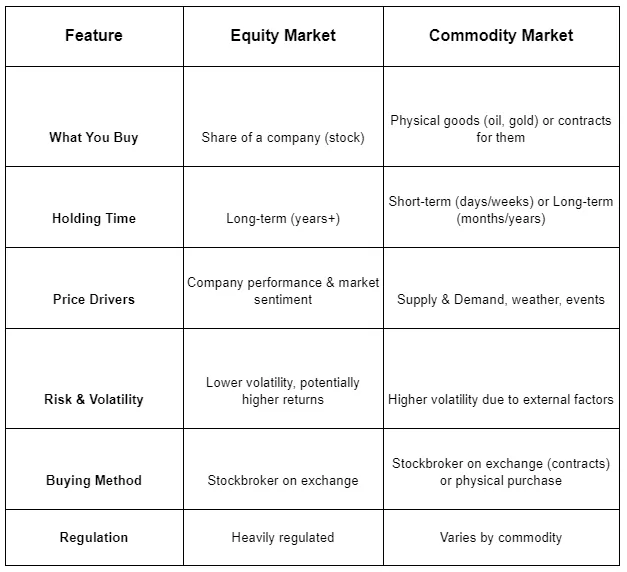
Knowing the differences between these two markets can help you decide which one suits your investment goals better. Here are some key differences:
Performance Comparison
The stock market and commodity market can perform differently:
- Stock Market: Historically, the stock market has provided higher returns, with an average annual return of around 10% over the last 100 years.
- Commodity Market: The commodity market has averaged around 3% annual returns.
Factors influencing these markets differ as well. Stock market performance is driven by company earnings, economic growth, interest rates, and geopolitical events. Meanwhile, the commodity market is influenced by supply and demand factors like weather conditions, production levels, and geopolitical events.
Which Market Should You Choose?
Choosing between the stock market and the commodity market depends on your investment goals, risk tolerance, and investment horizon:
- Long-Term Growth: The stock market may be better for long-term growth and capital appreciation.
- Short-Term Speculation: The commodity market may be suitable for short-term speculation and hedging against inflation.
Both markets carry risks. The stock market is subject to market volatility and company-specific risks, while the commodity market is influenced by supply and demand factors and geopolitical risks. It's essential to conduct thorough research and consult with a financial advisor before making any investment decisions.
Example: Comparing Returns in INR
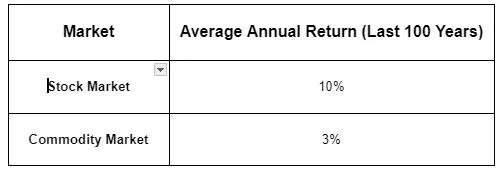
For instance, if you invested ₹1,00,000 in the stock market, you could expect an average return of ₹10,000 annually. In contrast, the same investment in the commodity market would yield around ₹3,000 annually.
Conclusion
Both the equity and commodity markets offer unique opportunities and risks. Understanding these differences and how each market works can help you make informed investment decisions. Whether you're looking for long-term growth in the stock market or short-term gains in the commodity market, it's crucial to align your investments with your financial goals and risk tolerance.

Understanding Commodity Transaction Tax (CTT): A Comprehensive Guide
In the realm of financial markets, various taxes and fees play a crucial role in regulating transactions and generating revenue for the government. One such tax that impacts commodity trading in India is the Commodity Transaction Tax (CTT). In this comprehensive guide, we will delve into the details of CTT, exploring its purpose, impact, and implications for traders and investors.
What is Commodity Transaction Tax (CTT)?
Commodity Transaction Tax (CTT) is a tax imposed by the Indian government on transactions executed on commodity exchanges. Introduced in the Finance Act, 2013, CTT is similar to the Securities Transaction Tax (STT) imposed on equity transactions. The primary objective of CTT is to generate revenue for the government and discourage speculative trading in commodity markets.
How Does CTT Work?
- CTT is imposed on the value of taxable commodities transactions conducted on recognized commodity exchanges in India. The tax rate varies depending on the type of commodity and the nature of the transaction. As of the latest guidelines, the following rates apply:
- CTT tax is 0.01% for non-agricultural commodities futures contracts and 0.05% for non-agricultural commodities options contracts. While agricultural commodities are exempt.
- CTT is typically collected by the commodity exchange at the time of the transaction and passed on to the government. It is applied to both buy and sell transactions, thereby impacting both buyers and sellers in the commodities market.
Purpose and Objectives of CTT
The imposition of CTT serves several purposes and objectives, including:
- Revenue Generation: CTT serves as a source of revenue for the government, contributing to the overall tax collection and fiscal management.
- Discouraging Speculative Trading: By imposing a tax on commodities transactions, especially in non-agricultural commodities, CTT aims to discourage speculative trading and promote more stable and orderly commodity markets.
- Level Playing Field: CTT helps create a level playing field between different asset classes by subjecting commodity trading to similar taxation as equity trading, where STT is applicable.
- Regulatory Oversight: CTT also serves as a regulatory tool, enabling authorities to monitor and regulate commodities transactions more effectively.
Impact of CTT on Traders and Investors
The imposition of CTT has several implications for traders and investors active in commodity markets:
- Cost of Transactions: CTT adds to the overall cost of trading in commodities, as traders are required to pay the tax on every transaction executed on the exchange.
- Impact on Trading Volumes: The introduction of CTT may have an impact on trading volumes in commodity markets, as it could discourage high-frequency traders and speculators from participating in the market.
- Risk Management: Traders and investors need to factor in the impact of CTT when creating their trading strategies and risk management plans. The tax can influence decision-making regarding position sizing, trading frequency, and holding periods.
- Market Liquidity: CTT may affect market liquidity in commodity markets, as it could lead to reduced trading activity and narrower bid-ask spreads.
- Compliance Requirements: Market participants need to ensure compliance with CTT regulations and reporting requirements to avoid penalties and legal repercussions.
Challenges and Criticisms of CTT
While CTT serves certain objectives, it has also faced criticism and challenges:
- Impact on Market Efficiency: Critics argue that CTT may hamper market efficiency by reducing liquidity and increasing transaction costs, especially for small investors and hedgers.
- Competitive Disadvantage: Some stakeholders believe that the imposition of CTT puts Indian commodity exchanges at a competitive disadvantage compared to global counterparts where similar taxes are not levied.
- Need for Review: There have been calls for a review of CTT rates and structures to ensure that they strike the right balance between revenue generation and market development.
Conclusion
In conclusion, Commodity Transaction Tax (CTT) is a tax levied on transactions conducted on commodity exchanges in India. It serves various purposes, including revenue generation, discouraging speculative trading, and promoting regulatory oversight. While CTT has implications for traders and investors in commodity markets, it also faces challenges and criticisms regarding its impact on market efficiency and competitiveness. As the commodities market continues to evolve, it remains essential for policymakers to review and adapt CTT regulations to ensure a balance between revenue objectives and market development goals.
Start Investing Today!

Trend Analysis in Share Market for Better Stock Picks
Spotting the Trend: How Trend Analysis Can Help You Pick Winning Stocks
The stock market can feel like a wild ride sometimes, with prices constantly going up and down. But what if you could predict these ups and downs, at least a little bit? Well, that's where trend analysis comes in!
What is Trend Analysis?
Trend analysis is like looking at the flow of the water. Is it uptrend? Is it sideways trend? Or is it downtrend?
By analyzing past price movements and trading volume, trend analysis helps you understand the overall direction of a stock's price. It is a technique used to examine data points over time to identify patterns and predict future movements.
Here's a breakdown of the key ideas:
- Data Points: This could be anything from stock prices to website traffic, depending on what you're analyzing.
- Patterns: By looking at past data points, you can see if there are any recurring trends, like prices going up and down in a specific cycle.
- Predictions: Based on the identified patterns, you can make an educated guess about what might happen in the future.
Types of Trends
There are three main types of trends in the stock market:
- Upward Trend (Bull Market Trend): Prices are generally moving higher over time. This is a good sign for investors looking to buy stocks.
- Downward Trend (Bear Market Trend): Prices are generally moving lower over time. This can be a time to be cautious or even sell some stocks.
- Sideways Trend: Prices are fluctuating within a certain range. This can be a time to wait and see before making a move.
How to Use Trend Analysis
There are many types of trend analysis tools and techniques, but here are two simple ways to get started:
- Moving Averages: This is a line on a stock chart that shows the average price over a certain period (like 50 days or 200 days). An upward sloping moving average suggests an uptrend, while a downward sloping suggests a downtrend.
Picture a line on a stock chart that shows the average price of a stock over a certain period, like the past 50 days or 200 days. If this line is going up, it means the average price is rising, suggesting the stock is on an uptrend. For example, if a stock's 50-day moving average is slowly increasing and is currently at ₹100, while the current price is ₹110, it indicates an uptrend. On the other hand, if the moving average is sloping downward and is at ₹100, while the current price is ₹90, it signals a downtrend.
- Support and Resistance Levels: These are price levels where the stock price has historically found difficulty breaking through. Support levels are areas where the price tends to bounce back up, while resistance levels are areas where the price tends to get rejected and fall back down. Imagine certain price points where a stock tends to bounce back up after falling (support) or struggles to break through and falls back down (resistance).
Let’s say a stock has a support level at ₹120. Whenever the price drops to ₹120, it tends to bounce back up because investors see it as a good buying opportunity. Similarly, if there's a resistance level at ₹150, whenever the price approaches ₹150, it struggles to go higher as investors start selling their shares, causing the price to fall back down.
How to Use Trends to Pick Stocks
Here's how you can use trend analysis to pick better stocks:
- Spot the Trend: First, find out if a stock is on the rise (uptrend) or falling (downtrend). That tells us if it's a good time to buy or sell.
- Double-Check: Use different tools to make sure you're seeing the trend right.
- Time Your Moves: Wait for the right moment to buy or sell.
- Stay Safe: Always have a plan to protect your money. Use stop-loss and take that much risk what you can afford to lose.
Trend analysis can be a powerful tool for stock pickers, but it's important to use it alongside other investment strategies. By understanding trends, you can increase your chances of making profitable investments.
Conclusion
Trend analysis is a valuable tool for identifying stock market movements and making informed investment decisions. By analyzing patterns, using moving averages, and identifying support and resistance levels, investors can spot potential opportunities. However, it should be combined with other strategies and risk management techniques for better results. Understanding trends can enhance decision-making and improve the chances of picking winning stocks.
Learn more about financial terminologies with Swastika!

Understanding the Different Types of Brokers in the Stock Market
Stock market investing can be a great way to grow your wealth, but it can also seem complicated, especially for beginners. One of the first decisions you'll need to make is who will help you navigate this exciting world: a full-service broker or a discount broker? Today, we'll be exploring the types of brokers you can choose when entering the exciting world of stock trading.
What is a Stock Broker?
Before we dive into the different types of stockbrokers, let's first understand what a stock broker actually does. A stockbroker is a professional who helps in the buying and selling of stocks and other securities on behalf of investors. They act as intermediaries between buyers and sellers in the stock market. Share market investment advisors and registered representatives (RRs) are other names for stockbrokers.
Types of Stock Brokers:
- Full-Service Brokers: Picture them as your financial advisors, offering complete services to guide you through the complex world of investing. Here's what you can expect:
- Personalized Advice: Full-service brokers provide customized investment advice based on your financial goals, risk tolerance, and market conditions.
- Diverse Investment Options: Full-service brokers provides a wide range of investment options, including stocks, bonds, mutual funds, and more.
- Research Reports: They offer in-depth research reports and market analysis to help you make better investment and stock trading decisions.
- Portfolio Management: Many full-service brokers offer portfolio management services, where they actively manage your investments on your behalf.
- Complete Financial Planning: Beyond just buying stocks, full-service brokers offers complete financial planning services, covering areas like retirement planning, tax optimization, and estate planning.
- Additional Services: From retirement planning to tax advice, full-service brokers go the extra mile to meet all your financial needs.
- Examples of full-service brokers in India include Swastika Investmart, ICICI Direct, HDFC Securities, and Kotak Securities.
- Discount Brokers: A discount broker or online stockbrokers would typically just buy and sell on behalf of their clients.
- Cost-Effective Trading: Discount brokers take lower fees and commissions compared to their full-service brokers, making them an attractive option for investors for more affordable trading.
- User-Friendly Trading Platforms: Discount brokers provide simple and user-friendly trading platforms with features for executing trades efficiently.
- Independent Investing: With a discount broker, you have full control over your investment decisions. Whether you're buying stocks, ETFs, or options, you have the complete independence to execute trades according to your investment strategy and market analysis.
- Minimal Account Maintenance Requirements: Discount brokers often have lower minimum account balance requirements, making them affordable to a broader range of investors.
- Limited Customer Support: While discount brokers may offer basic customer support services, they generally provide less personalized assistance compared to full-service brokers. Examples of discount brokers in India include Tradingo, Zerodha, Upstox, and 5paisa.
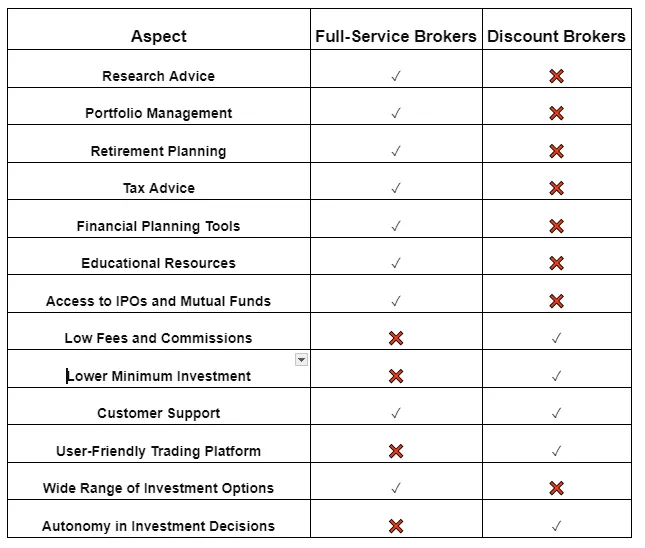
Comparison of Different Types of Brokers: Let's compare the key features of full-service, discount, and online brokers in the table below:
Conclusion:
Choosing the right type of broker is an important decision for any investor. Whether you prefer personalized advice and portfolio management or are comfortable making your own investment decisions, there's a broker out there to suit your needs. We hope this guide has helped understand the types of stock market brokers.
Learn more about Stock Market!

Put Call Ratio (PCR): Definition, Formula, and Significance
Introduction to Put Call Ratio (PCR)
Among the many tools and indicators used by investors and traders, one of the indicators to understand is the Put Call Ratio (PCR). The Put-Call Ratio (PCR) is a popular tool to know the market sentiment!
Understanding PCR
Let’s understand this in the simplest way possible. Think of the stock market as a tug-of-war between investors who think prices will go up (bullish) and those who think the prices will go down (bearish). Stock options, which give you the right to buy (call) or sell (put) a stock at a predetermined price at a predetermined date, can reveal these beliefs. The PCR uses options to understand which side is pulling harder!
Before diving into the Put Call Ratio itself, it's essential to understand the basics of call and put options, and Market sentiment?
Call options give the holder the right, but not the obligation, to buy an asset at a specified price within a predetermined time frame. On the other hand, put options give the holder the right, but not the obligation, to sell an asset at a specified price within a predetermined time frame.
Market sentiment is the feeling of most investors at a particular time. It indicates whether they're feeling positive (bullish) or negative (bearish) about the market in general or a specific stock.
- Bullish Sentiment: Investors are feeling confident and expect prices to rise.
- Bearish Sentiment: Investors are feeling cautious and expect prices to fall.
So The Put Call Ratio (PCR) is a measure of market sentiment derived from the ratio of the trading volume of put options to call options.
Formula for Calculating PCR
The PCR is calculated using a simple formula:
PCR = Put Volume / Call Volume
Put Volume and Call Volume refer to the number of put and call option contracts traded in a day.
Example: Let's say on a particular day, 100 put contracts and 50 call contracts are traded for a stock. Here's how to find the PCR:
PCR = 100 (Put Volume) / 50 (Call Volume) = 2
A PCR of 2 suggests a bearish sentiment as more investors are buying puts, indicating a price drop.
Significance of PCR
The Put Call Ratio plays a significant role in market sentiment analysis. A high PCR value suggests that investors are bearish, indicating a potential downtrend in the market. While a low PCR value suggests that investors are bullish, indicating a potential uptrend. Ideal PCR is between 0.80-1.20.
In more simple language, A PCR value greater than 1 indicates a bearish sentiment, as there are more put options being traded in comparison to call options. A PCR value less than 1 indicates a bullish sentiment, as there are more call options being traded in comparison to put options.
Understanding PCR and its relation with market sentiment Practical Examples
Positive PCR (Bearish Sentiment):
Imagine a scenario where investors are feeling nervous about a stock, say ABC Ltd. They anticipate the price to go down. Here's how PCR reflects this:
Example:
- Put Volume: 200 contracts (Investors are actively buying puts)
- Call Volume: 100 contracts (Investors are hesitant to buy calls)
- PCR = Put Volume / Call Volume = 200 / 100 = 2
A PCR of 2 indicates a negative PCR, meaning there are more puts than calls. This suggests a bearish sentiment. Investors are betting on the price to fall by buying more put options.
Negative PCR (Bullish Sentiment):
Now, let's imagine a different scenario where investors are optimistic about XYZ Ltd. They expect the price to increase. Here's how PCR reflects this:
Example:
- Put Volume: 50 contracts (Investors are less interested in puts)
- Call Volume: 150 contracts (Investors are actively buying calls)
- PCR = Put Volume / Call Volume = 50 / 150 = (1 / 3)
A PCR of (1 / 3) is a positive PCR, meaning there are more calls than puts. This suggests a bullish sentiment. Investors are looking to profit from a price rise by buying more call options.
Neutral PCR:
Sometimes, investors might be unsure about the direction of the stock price. This creates a balanced market sentiment.
Example:
Put Volume: 75 contracts
Call Volume: 75 contracts
PCR = Put Volume / Call Volume = 75 / 75 = 1
A PCR of 1 is considered neutral. Put and call volumes are equal, indicating a balanced market sentiment where investors are neither overly bullish nor bearish.
Where to Find PCR Data:
Many financial websites and trading platforms offer live and historical PCR data. You can also find specific PCRs like the Nifty 50 PCR (for the top 50 Indian stocks) or the Bank Nifty PCR (for banking stocks). Additionally, some platforms provide PCR data for individual stocks.
Conclusion:
The Put-Call Ratio (PCR) is a valuable tool to understand investor sentiment in the stock market. By analyzing the PCR along with other factors, you can gain insights into market psychology.
Learn more about financial terminologies with Swastika!


.webp)
.webp)

.webp)






START YOUR INVESTMENT JOURNEY
Get personalized advice from our experts
- Dedicated RM Support
- Smooth and Fast Trading App
