The Power of Compounding – Why Starting Early Matters




Introduction
Albert Einstein reportedly called compound interest the "eighth wonder of the world." Whether or not he actually said it, the math is undeniable. Compounding is the process where your investment returns begin earning their own returns — and over time, this snowball effect becomes truly extraordinary.
The catch? Compounding needs one essential ingredient: time.
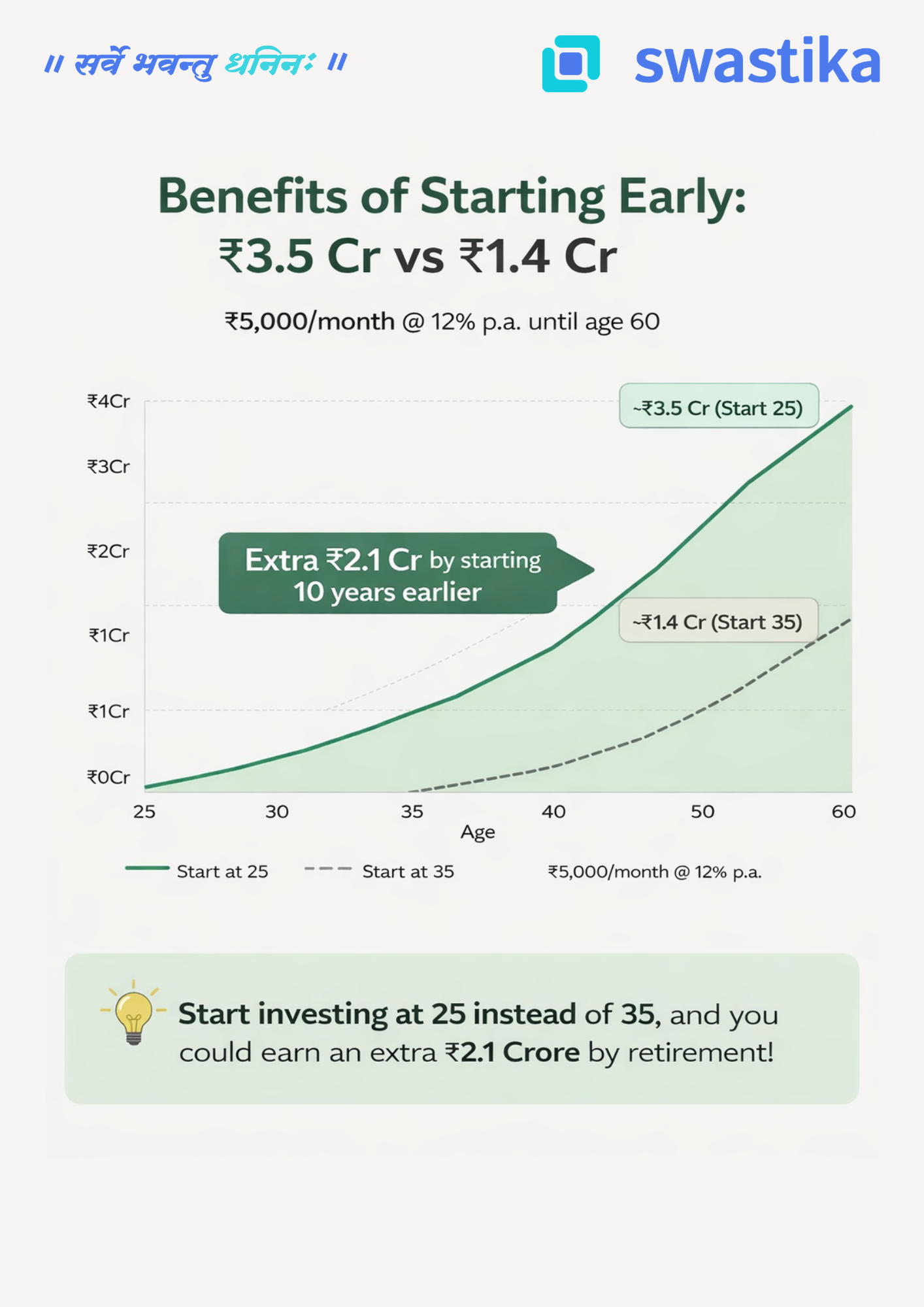
The more years you give your money to grow, the more dramatic — and life-changing — the results become. This is exactly why starting your investment journey early, even with a modest amount, can make a difference of crores by the time you retire.
A Tale of Two Investors: Arjun vs Priya
Let's bring this concept to life with a simple, real-world example.
Meet Arjun and Priya. Both are sensible, disciplined investors. Both invest ₹5,000 every month through a SIP (Systematic Investment Plan) in equity mutual funds, earning an average annual return of 12%. Both stop investing at age 60.
The only difference? Arjun starts at 25. Priya starts at 35.
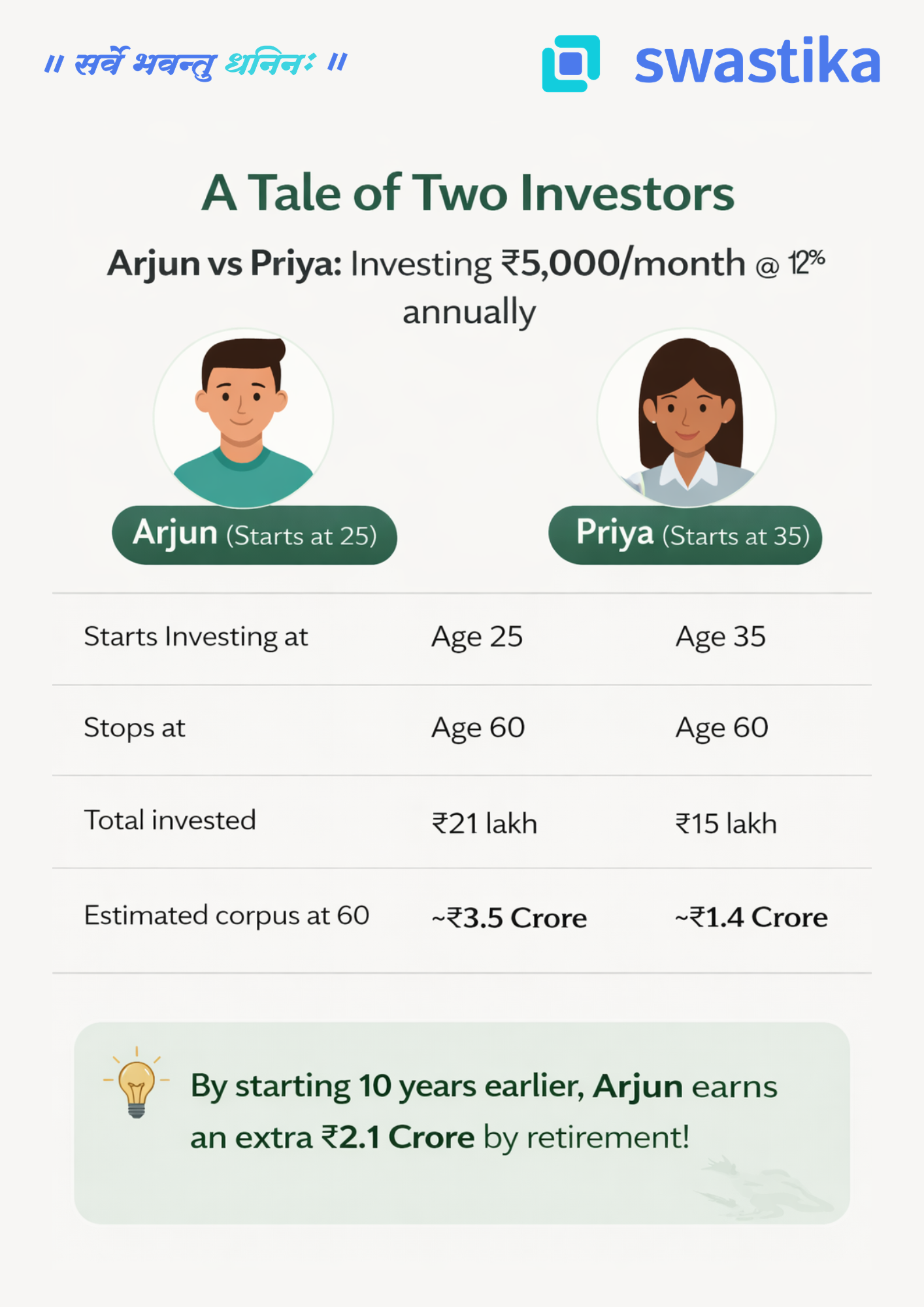
The numbers are striking. Arjun invests just ₹6 lakh more than Priya in absolute terms — yet walks away with ₹2.1 Crore more at retirement.
That extra ₹2.1 Crore didn't come from investing more aggressively or taking bigger risks. It came purely from starting 10 years earlier.
Why Does Time Make Such a Huge Difference?
This is where the magic of compounding reveals itself.
In the early years of investing, growth looks modest and almost unimpressive. But as the years pass, your corpus grows not just on your original investment, but on all the accumulated returns from previous years. The curve goes from almost flat to steeply exponential — and that steep climb happens in the later years.
When Arjun starts at 25, his money has 35 years to ride that exponential curve. Priya's money, starting at 35, only catches the last 25 years — and critically, it misses the steepest part of the climb in the final decade.
Think of it this way: the last 10 years of compounding are worth more than the first 20. That is the counterintuitive truth at the heart of long-term investing.
The Real Cost of Waiting
Many young earners tell themselves, "I'll start investing once I'm more settled — once the salary improves, once the EMI is paid off, once life is a bit easier."
But the numbers show that every year of delay is extraordinarily expensive — far more expensive than any EMI or lifestyle expense. Priya didn't invest carelessly. She invested faithfully for 25 years. Yet she ends up with less than half of what Arjun accumulated — not because she did anything wrong, but simply because she started a decade late.
The cost of waiting 10 years wasn't ₹6 lakh in additional contributions. The cost was ₹2.1 Crore in lost wealth.
Three Principles to Remember
1. Start now, not later.The best time to start investing was yesterday. The second best time is today. Even a SIP of ₹1,000–₹2,000 per month in your 20s is infinitely better than waiting for the "right time."
2. Consistency beats intensity.You don't need to invest large sums all at once. A small, steady, monthly commitment — maintained without interruption — is what unlocks the full power of compounding over decades.
3. Stay invested through market cycles.Compounding works only if you let it work. Exiting during market corrections or stopping your SIP in tough months breaks the chain. Time in the market, not timing the market, is what builds wealth.
The Bottom Line
If you are in your 20s or early 30s, you hold an asset that no amount of money can buy later: time. Use it. Start a SIP today — even a small one. Let compounding do its slow, steady, powerful work.
Because the difference between starting at 25 and starting at 35 is not just 10 years. As Arjun and Priya's story shows, that difference is ₹2.1 Crore.
Big Budget










.webp)
.webp)
.webp)
.webp)
.webp)
















.webp)
.webp)
.webp)
.webp)
Latest Articles

Sustainable Finance to become a Reality


Financial Sector plays a pivotal role in bringing awareness and funding the ever increasing issues of sustainability.
Sustainability Finance takes into account the impact of Environmental, Social and Governance (ESG) factors along with the traditional financial returns. Environmental factors consider the mitigation of climate related issues and use of resources that are sustainable. Social factors consider the human rights, inclusion of diversity, consumer protections as well as animal rights. Governance factors consider the employee related and compliance related issues in both public and private sectors. This direction to consider the impact of ESG while making investment decisions is becoming a strong reality.
After the shock that the world went through by COVID-19 pandemic, the words ESG and Sustainability are everywhere. People have realized that developing a green and sustainable society along with making a viable economic and financial model that can cope with the limits of this planet has become the key to our survival. The awareness and focus of companies to follow strong ESG criteria has increased in the recent years to a large extent.
COVID-19 has changed the rules of the game and pushed many investors to reassess their short and long term portfolio strategies and focus more on companies with better sustainability plan making corporate responsibility a growing expectation of investors.
The old myth around ESG that it effects the asset management and returns of a company can’t be further away from reality. There is a growing evidence for increase of sustainable financial products and a link between ESG factors and financial performance of a company. The millennial generation is pushing companies to focus on climate change as they want to invest in a greener future. They are also willing to veto such organizations that do not meet their demand for sustainability. Many funds are also now considering whether business governance practices by promoting transparency, business ethics and interest of stakeholders is a key part of a company’s strategy or not.
This rapid rise in investment decisions after considering the sustainability practices has led to a demand for this niche expertise in the field of finance. Very few people currently have the expertise and relevant ESG experience. Investment banks acknowledging this rarity of talent and the growing demand for such niche investment products are willing to pay a premium for these roles. Many top B schools have also started offering master’s degree in sustainability, thus pushing sustainability finance more towards reality.
Blackrock has proposed to reach “net zero” by 2050, which will lead to a drastic reduction in greenhouse gas emissions. For a global leading investment manager to pursue such goals will play a significant role ahead. This can lead to an unprecedented opportunity for sustainable finance and maybe just truly align the world with the Paris Agreement.
This shift from large investment managers to young millennial population to drive companies and their investment decisions towards sustainability will go a long way to save our world. Every industry will now have to follow sustainable business practices to sustain in the long run and make the society cleaner, greener and socially stable.

कमजोर वैश्विक अर्थव्यवस्था के कारण कीमती धातुओं में मजबूती
डॉलर में छोटी अवधि की गिरावट के कारण कीमती धातुओं के भाव में मजबूती बनी हुई हालांकि पिछले सप्ताह में फेड बैठक के मिनट्स जारी हुए और अमेरिकी बाज़ारो में थैंक्सगिविंग डे के चलते अवकाश रहा जिससे कीमती धातुओं के भाव सीमित दायरे में बने रहे और सोने में मुनाफा वसूली देखि गई। डॉलर, जो सोने के विपरीत दिशा में चलता है, 22 साल की उच्च स्तरों से 8 प्रतिशत टूट चुका है। फेड द्वारा अपनी बैठक के मिनट्स में संकेत दिए है की लगातार हो रही ब्याज दर वृद्धि की गति को कम किया जायेगा जिससे विश्व में उभरती अर्थव्यवस्था को राहत मिलेगी। फेड के मौद्रिक निति पर नरमी से अमेरिकी बेंचमार्क ट्रेज़री यील्ड फिसल कर 3.68 प्रतिशत के स्तरों पर पहुंच गई जिससे डॉलर फिसल गया और कीमती धातुओं में तेज़ी रही।
आने वाले महीनों में कीमती धातुओं की मांग अच्छी रहने के आसार बने हुए है क्योकि डॉलर के 22 साल की उचाई से पीछे हट गया है और वैश्विक आर्थिक स्थिति बिगड़ी हुई है। पिछले सप्ताह अमेरिका और जापान जैसी बड़ी अर्थव्यवस्था के पर्चेसिंग मैनेजर इंडेक्स (पीएमआई) में कमजोरी के साथ चीन में बढ़ता कोविड -19 का संक्रमण सेफ हैवन मांग बढ़ा रहा है। भारत में वेडिंग सीजन के कारण सोने की मांग मजबूत बनी हुई। वर्ल्ड गोल्ड काउंसिल के आंकड़ों के मुताबिक, सितंबर तिमाही में केंद्रीय बैंकों ने 400 मीट्रिक टन सोना खरीदा है, जो सामान्य तौर पर साल भर की खरीद के बराबर है। केंद्रीय बैंको द्वारा सोने की खरीद में बढ़ोतरी कीमती धातुओं के भाव में मजबूती के संकेत देता है।
आर्थिक आंकड़े
इस सप्ताह फेड प्रमुख पॉवेल की अर्थव्यवस्था और श्रम बाजार पर स्पीच, अमेरिकी पैरोल के आंकड़े, अमेरिका, चीन और जापान के मैन्युफैक्चरिंग पीएमआई के आंकड़े और ओपेक देशो की बैठक कीमती धातुओं के लिए महत्वपूर्ण रहेंगे।
तकनीकी विश्लेषण
इस सप्ताह कीमती धातुओं में दिसंबर वायदा की कटान रहने से कीमते सीमित दायरे में रह सकती है। फरवरी वायदा सोने की कीमतों में 52300 रुपये पर सपोर्ट है और 53700 रुपये पर प्रतिरोध है। मार्च वायदा चांदी में 61500 रुपये पर सपोर्ट और 64500 रुपये पर प्रतिरोध है।

Gold and Silver Price Forecast: Effects of Covid-19, US Interest Rates, and Global Markets
Due to concerns over Covid-19 in China slowing down the expansion of the world economy, precious metal prices stayed stable at their current levels. Since a few days ago, the US benchmark Treasury yield and the dollar, which measure a basket of six major currencies, have been in a corrective phase. The yields on US 10-year bonds have fallen below 3.7%. Members of the US Federal Reserve hinted at a less aggressive monetary policy for a future meeting in order to encourage the rising economies that drive up the price of gold. The interest rate in the USA is currently 4%, compared to a year ago when it was almost nil. While the inflation rate has decreased to 7.7% from the 40-year high of 9.1%, a negligible decrease, the interest rate is running at higher levels as a result of the current economic condition, heightening the concern of a recession.
On the other hand, China, the world's biggest producer and consumer of industrial metals is having difficulties as a result of the steps taken to reduce Covid-19 instances. Base metals and crude oil prices are being pressured by China's dampened demand, while the Russia-Ukraine war has caused a supply shortage of oil and gas in Europe. The leading central banks' stimulus programs during the pandemic and the Russia-Ukraine war caused inflation to increase, reaching levels not seen in 42 years. The US dollar index has already lost 8% of its 22-year peak. However, emerging market currencies like those of India are strengthening. While the prices of crude oil and industrial metals may continue to decline owing to the current circumstances, the outlook for precious metals is favorable for the upcoming six months.
Technical Analysis
Technically, gold prices are lingering over 52000 levels; if they maintain these levels, a strong uptrend toward 58000 levels may be witnessed in the upcoming months. Important support for gold is at 50000, while resistance is at 56000. Support for silver is at 58000, while resistance is at 66000.

Top Infrastructure Stocks to Focus on Ahead of Union Budget 2023
Infrastructure Stocks to Focus on the Ahead of the Budget
The Modi government will announce its last full budget before the 2024 general elections. The path toward boosting the manufacturing sector outlined in the last budget is likely to continue in the upcoming budget. Therefore, the central government’s priority remains to foster the nascent investment cycle through a continued increase in public capital outlays and infrastructural spending. Therefore, capital goods and infrastructure will be in focus.
KNR Construction and PNC Infrastructure remain institutional favorites for a long period. And they have delivered a good return even in a tough time for the industry. PNC Infratech and KNR Construction remain two of our preferred picks in the EPC space given their robust order books, healthy return ratios, and lean balance sheets. The road sector is gaining significant traction on account of the central government's proactive push for infrastructure development, and incumbents like KNR Construction and PNC Infra are likely to be the key beneficiaries of the structural growth opportunities available in the sector with a robust order book and better execution process.
Road, highway, bridge, and flyover building on an EPC, BOT, and Hybrid Annuity Model (HAM) basis are among the services provided by the KNR. Additionally, it works on irrigation projects, agriculture projects, and managing urban water infrastructure. Some of the customers of the Co include the National Highways Authority of India (NHAI), Ministry of Road Transport & Highways (MoRTH), Government of Telangana, Karnataka State Highway Improvement Project (KSHIP), Madhya Pradesh Road Development Corporation Ltd (MPRDCL), etc. As per our research analysis as of September 30, KNR had an order book of Rs 8,042 crore, implying a revenue visibility of more than 2–3 years. In FY23 and FY24, management expects EBITDA margins to be in the 18–19% range. Over the years, KNR Construction and PNC Infra have emerged as two of the leading EPC (engineering, procurement, and construction) players in the road sector.
PNC Infratech Limited provides infrastructure implementation solutions that include engineering, procurement, and construction ("EPC") services on a fixed-sum turnkey basis as well as on an item rate basis. It also executes and implements projects on a "Design-Build- Finance-Operate-Transfer" ("DBFOT"), Operate-Maintain-Transfer ("OMT") , Hybrid Annuity Mode (HAM), and other PPP formats. In the case of BOT and HAM, the company bid as a sponsor either alone or in a joint venture with other ventures and once the project is awarded then it is executed by incorporating a special-purpose vehicle. PNC Infratech has established itself as a capable executor in the segments of airport runways, water infrastructure, and roadways. Additionally, PNC is able to complete projects on schedule thanks to its strong execution ability, ownership of contemporary equipment, and internal teams. PNC’s order book at the end of Q2 FY23 was at Rs 19,261 crore. The company provides services to clients like NHAI, HSRDC, AAI, MSRDC, Rites, UPPCL, etc.
If we talk about valuations, then there is comfort in PNC Infratech, which is trading at a PE of 10, which is below its five-year average, while KNR is trading at a PE of 19, which is above its five-year average. Know more about the trading opportunity available to you. We are likely to see a rally in this sector as the infrastructure sector did not participate in the ongoing rally in domestic economy-facing stocks despite the sector's positive outlook.
.webp)
Introduction to Stock Trading
Stock trading is the process of buying and selling shares of companies to make a profit. It might sound complicated at first, but once you understand the basics, it becomes much easier to grasp. In this blog, we'll walk you through the essentials of stock trading, the different types of stocks, how the stock market works, and the benefits of trading stocks.
To understand stock trading thoroughly, first, you have to understand the basics of stocks and the stock market.
Stock
A stock, also referred to as equity, represents ownership in a corporation. Owning stock entitles the stockholder to a portion of the corporation's assets and income, proportional to the number of shares they possess. These units of stock are called "shares."
In other words, in order to raise money to run their businesses, corporations issue (sell) stock. Depending on the type of shares held, the shareholder who purchases stock also purchases a portion of the corporation's assets and profits. In essence, a shareholder now owns stock in the corporation issuing the stock.
Types of Stock
There are two main types of stocks:
Common Stock:
- This is the most common type of stock.
- Owning common stock gives you voting rights at the company's shareholder meetings.
- You can benefit from dividends (a share of the company’s profits) and the increase in stock price.
Example: You buy 100 shares of ABC Corporation's common stock at ₹100 per share. As a common stockholder, you get to vote on important company matters at the annual shareholder meeting. ABC Corporation announces a dividend of ₹10 per share, so you receive ₹1,000 in dividends. Additionally, if the stock price rises from ₹100 to ₹140 per share, your investment value increases from ₹10,000 to ₹14,000.
Preferred Stock:
Common stock is issued by all publicly traded firms, but only a few also issue preferred stock. The preferred stock offers its owners guaranteed dividends as well as the opportunity for price growth similar to that seen with common stock. The preferred stock dividend may be higher if a company's common stock pays dividends.
- Preferred stockholders usually don't have voting rights.
- They receive dividends before common stockholders.
- In the event of bankruptcy, preferred stockholders are paid before common stockholders.
Example: You purchase 50 shares of XYZ Corporation's preferred stock at ₹200 per share. Unlike common stockholders, you don’t have voting rights. However, XYZ Corporation promises a fixed dividend of ₹20 per share, so you receive ₹1,000 in dividends before any dividends are paid to common stockholders. If XYZ Corporation faces financial trouble and goes bankrupt, you are more likely to get paid from the company's remaining assets than common stockholders.
What is Stock Market
The stock market is a collection of markets where stocks (shares of ownership in businesses) are bought and sold. In addition to generating and sustaining wealth for individual investors, the stock market assists businesses in raising capital to fund operations.
The two main stock exchanges in India are the National Stock Exchange (NSE) and the Bombay Stock Exchange (BSE).
Understanding Stock Trading
Stock trading is a type of investment that puts short-term profits ahead of long-term gains. Stock trading entails buying and selling company shares in an effort to make a profit from daily price fluctuations. The short-term price changes of these equities are actively monitored by traders, who subsequently attempt to buy low and sell high.
Stock traders differ from traditional stock market investors in that they take a short-term perspective rather than a long-term one.
While buying and selling individual stocks can result in quick profits for those who time the market right, there is also a risk of suffering significant losses. Unlike the market as a whole, a single company's fortunes can rise faster but could tumble just as quickly.
If you do have the funds and are interested in learning how to trade, Swastika Investmart has made it easy for you to quickly trade stocks from your computer or Smartphone.
Benefits of Stock Trading
Many investors over the years, whether beginner or experienced, have made considerable profits by strategizing and investing in equities. The fact that some investors' success formulas didn't work at all, however, causes everyone to pause before investing in stocks or entering the stock market. There are greater chances of profiting from investments when an investor makes the right and proper judgments.
The stock market is, after all, extremely volatile. But compared to other investments, stock investing has a number of significant advantages.
Potential for High Returns:
- When compared to other investment options like bank FDs, investing in stocks has the potential to produce substantial returns in a short amount of time.
- Stock trading can provide substantial returns in a short period, especially if you invest in the right stocks.
Flexibility to Invest Small Amounts:
- You don't need a lot of money to start trading. You can buy small quantities of stocks based on your budget.
- Another significant benefit of investing directly in stocks is that investors can make their own purchasing decisions and are not required to make a certain monthly investment.
Hassle-free buying and selling process
- All investors can buy and sell stocks using a simple approach. Stock purchases can be made online, through a financial advisor, or through a broker.
- To open a demat account and begin trading, barely takes any time at all. An investor can quickly buy and sell stocks online without having to travel, and the proceeds are immediately credited to their bank account.
Continuous and Easy Transactions
- When an investor buys stock in a specific company, they are essentially acquiring a share in that business. As a result, buying stocks will provide investors with a sense of ownership.
- Having ownership entitles them to shareholder status and a significant voice in corporate decisions. Additionally, investors will have a voice in corporate choices.
Dividend Perks
A dividend is a payment made by a firm to its stockholders. In simpler terms, it is the yearly additional revenue that every company pays to investors.
- Owning stocks gives you a sense of ownership in the company.
- You can earn dividends, which is a portion of the company’s profits paid to shareholders.
Investment Profits
- The opportunity to increase one's income is one of the main advantages of stock market investing. The values of a specific stock may increase or decrease over time if the value of the stock market increases.
Liquidity:
- Stocks are highly liquid investments, meaning you can quickly buy and sell them.
Diversification:
- Stock trading allows you to diversify your investments across different sectors and companies, reducing risk.
How Does Stock Trading Work?
Stock trading works through exchanges. Here’s a simple process of how trading happens:
- Opening a Demat and Trading Account:some text
- To start trading, you need to open a demat (dematerialized) account and a trading account with a brokerage firm.
- Placing Orders:some text
- You can place buy or sell orders for stocks through your trading account.
- Order Execution:some text
- Your order is then matched with a seller or buyer on the stock exchange.
- Once matched, the transaction is executed.
Risks of Stock Trading
While stock trading can be profitable, it also carries risks:
- Market Volatility:some text
- Stock prices can fluctuate widely due to market conditions.
- Potential for Losses:some text
- There's always a risk of losing money, especially if the company performs poorly.
- Emotional Decision-Making:some text
- Traders may make impulsive decisions based on emotions, leading to losses.
Conclusion
Stock trading can be an excellent way to grow your wealth, but it's essential to understand the basics and the risks involved. By learning how the stock market works, the types of stocks available, and the benefits and risks, you can make smart decisions and potentially achieve your financial goals.
If you're interested in starting your stock trading journey, consider opening an account with a Swastika Investmart, which offers easy-to-use platforms for trading on both computers and smartphones. Happy trading!

Fusion Micro Finance IPO Analysis
About the Company
Fusion Micro Finance Ltd (FMFL), founded in 1994, provides financial services to women entrepreneurs from economically and socially disadvantaged backgrounds. Its network and services have increased access to formal credit (loans) at low-interest rates, ultimately improving the lives of people in rural India. FMFL provides financial assistance as well as financial literacy classes.
FMFL operates on a joint liability group-lending concept, in which a small group of women (5-7 members) guarantees each other's loans. The firm has largely focused on strategic regional diversification with a rural emphasis, embracing technology for development, nurturing and developing staff, and risk management.
Fusion Micro Finance Limited IPO
IPO DateNov 2, 2022 to Nov 4, 2022Listing Date[.]Face Value₹10 per sharePrice₹350 to ₹368 per shareLot Size40 SharesIssue Size[.] shares of ₹10(aggregating up to ₹1,103.99 Cr)Fresh Issue[.] shares of ₹10(aggregating up to ₹600.00 Cr)Offer for Sale13,695,466 shares of ₹10(aggregating up to ₹[.] Cr)Issue TypeBook Built Issue IPOListing AtBSE, NSEQIB Shares OfferedNot more than 50% of the Net OfferNII (HNI) Shares OfferedNot less than 15% of the Net OfferRetail Shares OfferedNot less than 35% of the OfferCompany PromotersThe promoters of the Company, namely, Devesh Sachdev, Creation Investments Fusion, LLC, Creation Investments Fusion II, LLC and Honey Rose Investment Ltd
600 crore fresh equity shares will be issued in Fusion Microfinance IPO. Apart from these, an offer for sale (OFS) of 13,695,466 equity shares by promoters and existing shareholders is included. Devesh Sachdev, Mini Sachdev, Honey Rose Investment Ltd., Creation Investments Fusion, LLC, Oikocredit Ecumenical Development Co-operative Society U.A., and the Global Financial Inclusion Fund.
Objects of the Fusion Micro Finance Limited IPO
The issue comprises OFS and Fresh Issue. Net Proceeds from Fresh Issues will be used to Augment the capital base of the Company.
Fusion Micro Finance Limited IPO financials
- The company's revenue increased at a 16.92% CAGR from Rs.720 Cr in FY20 to Rs.1151 Cr in FY22.
- Profit after tax fell from Rs.69.61 Cr in FY20 to Rs.21.76 Cr in FY22, owing mostly to an increase in the impairment cost on financial assets.
- The operating margin fell to 4.7% in the previous fiscal year from 19.7% in FY20.
- As of June 30, 2022, the company's Gross GNPA was 3.67%, while its Net NPA was 1.35%.
Competitive Strengths
- Broad and Diversified Pan-India Presence.
- Proven execution skills with a strong rural focus.
- Access to Diversified Capital Sources and Effective Asset Liability Management
- Proven execution skills with a strong rural emphasis.
- Access to diverse financing sources and effective asset liability management
- Strong underwriting and risk management policies.
- A cutting-edge technological operating model.
- Stable and experienced management team backed by prominent investors.
Risk Factors
1) In the previous three years, company margins have been declining. Profits in FY20 were Rs 69.6 crores, compared to Rs 21.8 crores in FY22. Despite a rise in revenues, a decline in margins is a major issue.2) OFS receives Rs 504 crores from the total IPO proceeds, while the firm receives nothing.3) A Covid epidemic has previously harmed the industry. Such pandemics are unpredictable and may have an influence in the future.4) An increase in NPAs might have an impact on the firm.5) The microfinance business in India confronts specific risks owing to the borrowers it serves, which are not often connected with other types of lending.
Outlook & Valuation
The microfinance industry has recorded healthy growth in the past few years, with microfinance lenders emerging in good numbers. Fusion Micro Finance is one such company that is among the top 10 NBFCMFIs in India. It offers loans to women entrepreneurs. Its business runs on a joint liability group-lending model, wherein a small number of women form a group and guarantee one another’s loans. The company works with a strong focus on rural areas and has a well-diversified and extensive pan-India presence. The company also has access to diversified and recognized sources of capital and has a good financial track record. Although this company's margins are now in declining mode and it is facing risk due to the category of borrowers it serves, an increase in the level of NPAs could also be a concern for the company. Secondly, the company demands a price-book (P/B) multiple of 1.8 on a post-IPO basis, whereas its peers like credit access command a P/B of 3.3. Thus, considering all the factors, we recommend a Subscribe rating for this issue, but only for high-risk investors with a long-term view.
GMP
According to market watchers, the shares of Fusion Microfinance are trading at a premium (GMP) of ₹24 in the gray market today. The company's shares are expected to be listed on the stock exchanges BSE and NSE on Tuesday, November 15, 2022. The allotment of shares is expected on 10 November 2022. The company has said in its draft paper that it wants to use the capital received from this issue to increase its base.


.webp)
.webp)

.webp)






START YOUR INVESTMENT JOURNEY
Get personalized advice from our experts
- Dedicated RM Support
- Smooth and Fast Trading App