

The Power of Compounding – Why Starting Early Matters




Introduction
Albert Einstein reportedly called compound interest the "eighth wonder of the world." Whether or not he actually said it, the math is undeniable. Compounding is the process where your investment returns begin earning their own returns — and over time, this snowball effect becomes truly extraordinary.
The catch? Compounding needs one essential ingredient: time.
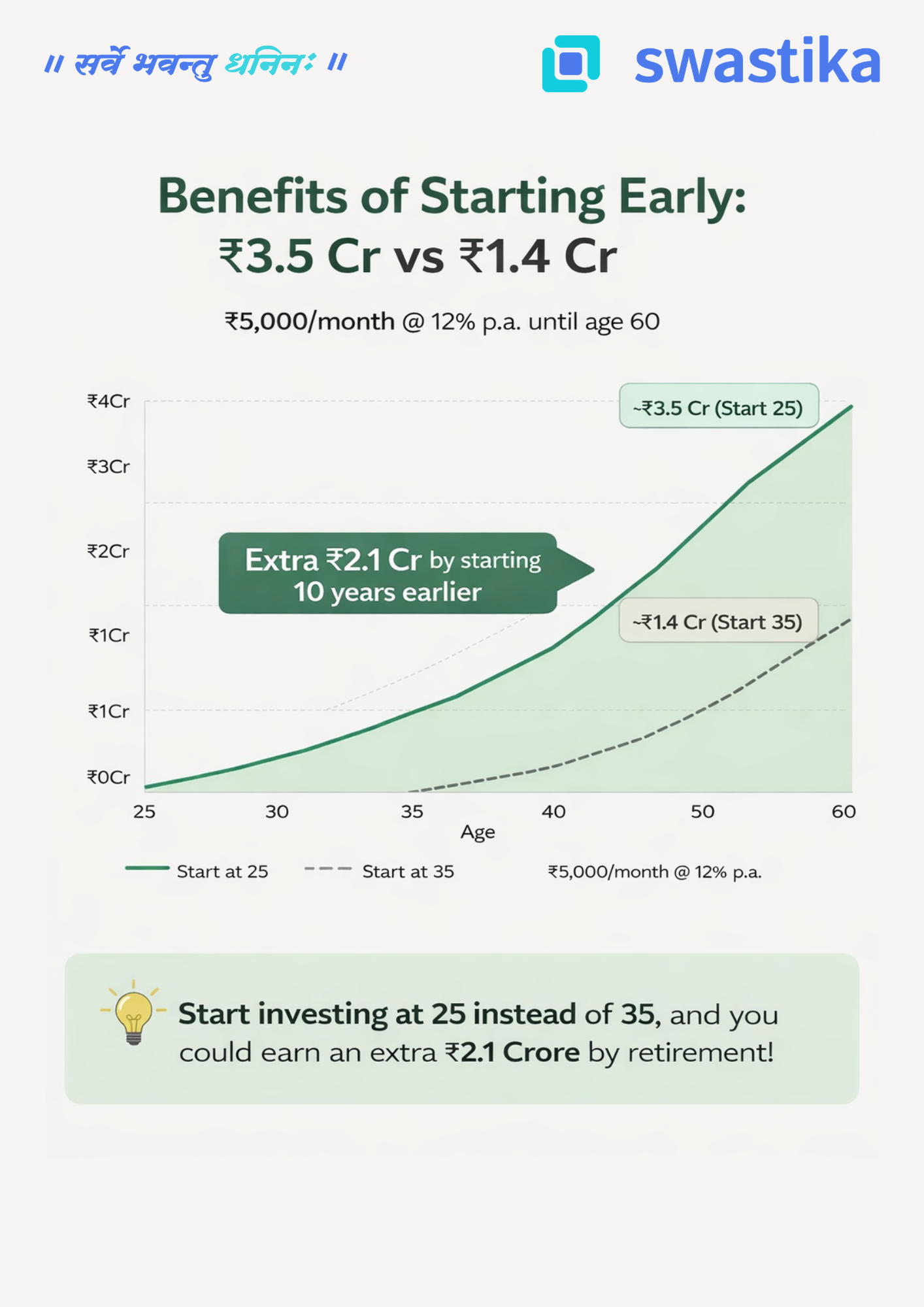
The more years you give your money to grow, the more dramatic — and life-changing — the results become. This is exactly why starting your investment journey early, even with a modest amount, can make a difference of crores by the time you retire.
A Tale of Two Investors: Arjun vs Priya
Let's bring this concept to life with a simple, real-world example.
Meet Arjun and Priya. Both are sensible, disciplined investors. Both invest ₹5,000 every month through a SIP (Systematic Investment Plan) in equity mutual funds, earning an average annual return of 12%. Both stop investing at age 60.
The only difference? Arjun starts at 25. Priya starts at 35.
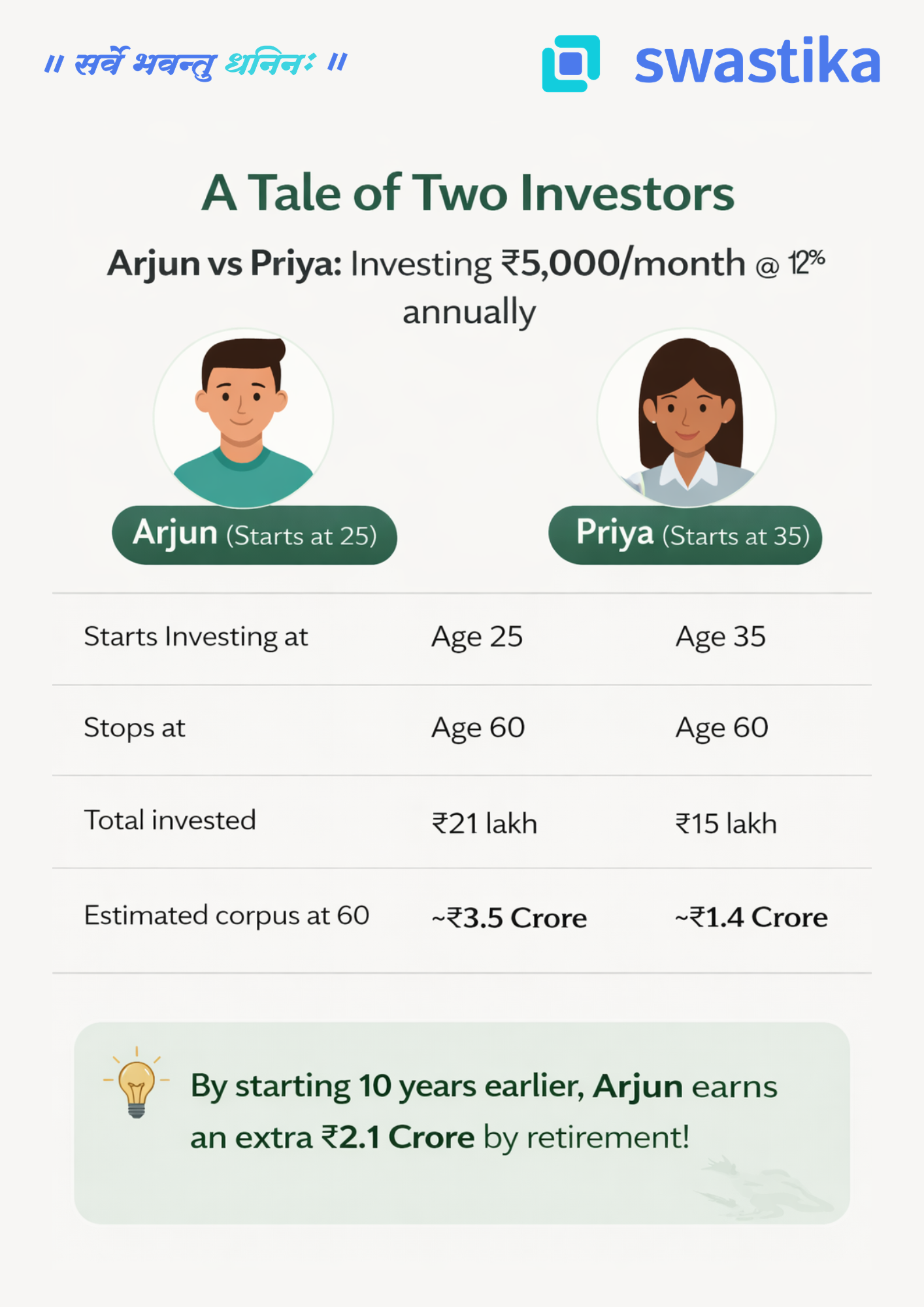
The numbers are striking. Arjun invests just ₹6 lakh more than Priya in absolute terms — yet walks away with ₹2.1 Crore more at retirement.
That extra ₹2.1 Crore didn't come from investing more aggressively or taking bigger risks. It came purely from starting 10 years earlier.
Why Does Time Make Such a Huge Difference?
This is where the magic of compounding reveals itself.
In the early years of investing, growth looks modest and almost unimpressive. But as the years pass, your corpus grows not just on your original investment, but on all the accumulated returns from previous years. The curve goes from almost flat to steeply exponential — and that steep climb happens in the later years.
When Arjun starts at 25, his money has 35 years to ride that exponential curve. Priya's money, starting at 35, only catches the last 25 years — and critically, it misses the steepest part of the climb in the final decade.
Think of it this way: the last 10 years of compounding are worth more than the first 20. That is the counterintuitive truth at the heart of long-term investing.
The Real Cost of Waiting
Many young earners tell themselves, "I'll start investing once I'm more settled — once the salary improves, once the EMI is paid off, once life is a bit easier."
But the numbers show that every year of delay is extraordinarily expensive — far more expensive than any EMI or lifestyle expense. Priya didn't invest carelessly. She invested faithfully for 25 years. Yet she ends up with less than half of what Arjun accumulated — not because she did anything wrong, but simply because she started a decade late.
The cost of waiting 10 years wasn't ₹6 lakh in additional contributions. The cost was ₹2.1 Crore in lost wealth.
Three Principles to Remember
1. Start now, not later.The best time to start investing was yesterday. The second best time is today. Even a SIP of ₹1,000–₹2,000 per month in your 20s is infinitely better than waiting for the "right time."
2. Consistency beats intensity.You don't need to invest large sums all at once. A small, steady, monthly commitment — maintained without interruption — is what unlocks the full power of compounding over decades.
3. Stay invested through market cycles.Compounding works only if you let it work. Exiting during market corrections or stopping your SIP in tough months breaks the chain. Time in the market, not timing the market, is what builds wealth.
The Bottom Line
If you are in your 20s or early 30s, you hold an asset that no amount of money can buy later: time. Use it. Start a SIP today — even a small one. Let compounding do its slow, steady, powerful work.
Because the difference between starting at 25 and starting at 35 is not just 10 years. As Arjun and Priya's story shows, that difference is ₹2.1 Crore.
Big Budget
.webp)
.webp)
.webp)
.webp)
.webp)




.webp)
.webp)
.webp)
.webp)
Latest Articles
Bajaj Finserv Announces Bonus and Share Split


Bajaj Finserv Ltd has announced a 5:1 Stock Split and 1:1 Bonus Shares
The board of directors of Bajaj Finserv Ltd has approved and announced a 5:1 stock split and 1:1 bonus shares. Following the stock split, the company's authorized share capital would increase to 1 billion equity shares with a face value of Rs. 1 each. The number of fully paid and subscribed shares will grow to 9.64 crores at the same face value. The authorized capital will eventually increase to 2 billion equity shares with a face value of Re 1 following the issuing of bonus shares. A total of 1.59 billion Re 1 share will be added to the total paid-up and subscribed capital.
Let us First Understand What is a Stock Split?
A corporation may decide to split its shares into a number of new ones in a stock split. Split shares do not diminish the shareholders' ownership position or create any new value for them. However, what they actually do is increase the number of shares of the company. Meanwhile, the face value of the shares is reduced during a split. However, the investment's overall worth stays constant.
The major advantage of a stock split is that it makes the share price more affordable for retail investors. This indicates positive sentiment of the share. Since shares are now more readily available to regular investors, there will likely be a greater demand for them, which will enhance the amount of liquidity on the market.
Why has Bajaj Finserv considered a Stock Split?
The company's business has expanded substantially over the years, and this is reflected in the share price. Bajaj Finserv's share price reached Rs 19,325 in October 2021. 98% of the total number of its shareholders are retail investors. The company signaled that it would become more challenging for retail investors to buy even a single share if the price rose from its current levels. In order to make shares more affordable to retail investors, the company is splitting shares.
What is a Bonus Issue?
An offer of free extra shares to existing shareholders is known as a bonus issue, often referred to as a scrip issue or a capitalization issue. As an alternative to increasing the dividend payout, a firm may elect to distribute more shares. Bajaj Finserv for instance provides one bonus share for one share owned.
Who is eligible for the Bajaj Finserv stock split and bonus share?
Investors who owned Bajaj Finserv prior to the record date are eligible for the stock split and bonus shares.
But what if you buy a share on 12 Sep? Since our system follows a t+2 settlement cycle you can get shares in your portfolio through a demat account by September 14, making you eligible for the bonus and the split.
Understanding its Financials:
Positives
1. The company has had a ROA of 11.56% during the past three years.
2.The company's operating income increased considerably during the last three years, with a CAGR of 13.82%.
3.Promoters own 60.76% of the stock.
4. The consolidated net profit of Bajaj Finserv for the three months ending in June 2022 increased by 57% to Rs 13.1 billion.
5. The Bajaj Group firm reported a profit of Rs. 8.3 billion last year.
6. The reviewed quarter's revenues totaled Rs 158.9 bn, an increase of 145 year-on-year growth (YoY).
7. Its subsidiary Bajaj Alliance's gross written premium climbed by 255 to Rs 31.2 billion during the quarter.
Negatives
- The stock price is trading at 62.81 times the book value.
- The PAT margin decreased by 30.29%.
Status of Bajaj Finserv Share
The share price of the stocks reached a 52-week high of Rs. 19325 a share in October 2021. On June 30, 2022, the 52-week low was Rs. 10727. Bajaj Finserv delivered has delivered, a 5-year return of about 204 percent. Moreover, it delivered returns of more than 2600 percent from the original stock price of Rs. 500 to Rs. 1790.
Inox Green Energy Services to launch its Rs 740 crore IPO
Inox Green Energy Services, a subsidiary of Inox Wind, intends to raise Rs 740 crore through an initial public offering (IPO) by October of this year.
On February 7, 2022, IGESL stated that it has filed a draft red herring prospectus with the Securities and Exchange Board of India, but withdrew it in April for unclear reasons. Inox Green Energy submitted its second draft red herring prospectus in June.
The proposed Offer comprises a Fresh Issue of Equity Shares worth up to Rs. 370 crores. and an offer to sell Equity Shares worth up to Rs. 370 crores.
The company received the observation letter on September 13. Before bringing an IPO, it is necessary for any company to get an observation letter. The company may also consider pre-IPO placements. If such placement is completed, the size of the new issue will be reduced.
Objective
After establishing itself in the Indian industry, the company intends to expand into the international market whether in South East Asia, the Gulf, or Africa.
Inox Wind will be debt-free following its Rs 740-crore initial public offering.
About Inox Green Energy Services
Inox Green Energy Services provides long-term Operation and Maintenance (O&M) services for wind farm projects, especially for Wind Turbine Generators (WTGs) and common infrastructure facilities on wind farms that facilitate power evacuation from such WTGs.
Inox Green Energy Services is now growing at a rate of 30-40% every year. Today, the volume for Inox Green Services is close to Rs 160 crore, and it is expected to reach Rs 400-500 crore in the next 3-4 years.
Inox Wind Updates
It has borrowed Rs 300 crore for the Nani Virani project, which is now being constructed by Inox Wind. It has also got an advance payment of Rs 850 crore from its important customer, a group firm.
The business would also sell its stake in the Rs 350-crore SPV before the IPO, with net proceeds of Rs 100 crore from the transaction. Aside from that, it will receive little more than Rs 200 crore from the conversion of previously issued warrants.
Meanwhile, Inox Wind said that at its next Annual General Meeting (AGM) on September 28, it will seek shareholder permission to fund up to Rs 200 crore through the issuing of 20 crore preference shares to its holding and promoter business Inox Leasing and Finance for cash.
According to the company's notice for the AGM, the board of directors approved the issuance of up to 20 crore 0.01 percent non-convertible, non-cumulative, participating, redeemable preference shares with a face value of Rs 10 each for an aggregate value not exceeding Rs 200 crore to Inox Leasing and Finance Ltd at its meeting on August 30, 2022.
It further stated that the business intends to enhance its authorized share capital from Rs 110, 11, 00,000 to Rs 310, 11, 00,000 to facilitate the issuing of preference shares.

OYO IPO: Issue Date, Price, Lot Size, Review & Details
Last year in October, Oyo parent company Oravel Stays Ltd filed a draft red herring prospectus (DRHP) with SEBI to launch an Rs 8,430-crore IPO
The prospectus was approved in January of this year, and the IPO is slated to start soon.
OYO submitted its DRHP with SEBI in October of last year and has now requested permission to file its financial accounts for FY22.
About OYO
OYO is an online marketplace for travelers to locate hotels and other places to stay. Ritesh Agarwal founded OYO in 2013 to aggregate and standardize services given by budget hotels and hostels across India. OYO Hotels and Homes manages India's largest hotel network.
About the IPO
The intial public offering includes a fresh issuance of shares worth Rs 7,000 crore and an offer-for-sale (OFS) by existing shareholders for Rs 1,430 crore. The business also stated that it will explore offering shares worth up to Rs 1,400 crore in a pre-IPO placement.
According to the sources, SoftBank, which owns 48% of OYO, will decrease its interest in the business, and its share sale would likely account for the majority of the OFS. A1 Holdings Inc (Grab) and China Lodging are two other investors that are expected to sell their IPO stakes.
The issue's global coordinators and book running lead managers are Kotak Mahindra Capital Company, JP Morgan India Private Ltd, Citigroup Global Markets India Private Ltd, ICICI Securities, Nomura Financial Advisory and Securities, and JM Financial Ltd.
OYO is aiming to cut the amount of its IPO from $1.2 billion to $800 million.
Negative market sentiment, pandemic challenges, and investor withdrawal have prompted the business to seek a lower valuation of $7 billion to $8 billion.
Objective
The offer consists of a new issue and an OFS totaling 84,300 million. The proceeds from the IPO will be utilized to reduce the company's debt and for other corporate reasons.
The fresh issue component of 70,000 million rupees would be used for repayment/prepayment of certain debt availed by their subsidiaries, 29,000 million rupees would be used for funding their organic and inorganic growth initiatives, and the remainder of the fresh issue would be used for general corporate purposes. The OFS is $14,300 million, with the proceeds going straight to the selling stockholders.
Strong Growth Momentum
OYO reported a 47% increase in monthly gross book value per hotel in Q1 FY23 compared to the previous fiscal quarter.
In Q1 FY23, OYO recorded revenue from operations of Rs 1,459.3 crore.
The company's Adjusted Gross Profit Margin has steadily increased from 33.2% in FY21 to 40.1% in FY22 and 41.3% in Q1 FY23.
Adjusted profits before interest, taxes, depreciation, and amortization (EBITDA) for the first quarter were 72.66 million Indian rupees (IPO).
Oyo recorded a loss of 18.9 billion rupees ($237 million) for the fiscal year ending March 2022, substantially lowering the previous year's loss of 33.83 billion rupees in 2021
The addendum filed by OYO shows that in the first quarter of FY23, i.e. April, May, and June, the company's sales increased and losses have come down. Gross booking value (GBV) was 24.87 billion rupees in the June quarter and 81 billion rupees in fiscal 2022, up 22% from the previous year.
OYO's revenue from operations in the first quarter stood at Rs 1,459.3 crore. The firm has registered a growth of 47% in gross booking value per hotel in Q1FY23. It stood at Rs 3.25 lakh, which was Rs 2.21 lakh in FY22.
Revenue from customer contracts grew 21% to 47.8 billion rupees for the fiscal year ending March 2022
OYO claimed that its general and administrative expenses have come down by 44.4% in FY22. In FY22, it became 515.4 crores, which was Rs 927 crores in FY21. Employee expenses also declined by 26.5% to Rs 1,117.2 crore from Rs 1,520.4 crore in FY21. Oyo said its 'storefronts' stood at 1.68 lakh at the end of Q1FY23, from around 1.57 lakh at the end of FY21.
Conclusion
Last year, the hotel-booking start-up Oravel Stays announced that it has sustained net losses every year since its inception and that its capacity to attain profitability may be delayed because of the economic consequences of the epidemic.
But now SEBI may consider the IPO document of OYO Hotels after the submission of financials for the second quarter. Considering this speed, OYO Hotels can launch its IPO by the fourth quarter of FY23. OYO submitted its DRHP with SEBI in October of last year and has now requested authorization to file the financial accounts for FY22.
Negative market sentiment, pandemic headwinds, and investor withdrawal have caused the business to seek a lower valuation of $7 billion to $8 billion. Book your IPO today!
डॉलर इंडेक्स में नरमी से तेज़ हुए सोना-चांदी।
बढ़ती हुई महंगाई को नियंत्रित करने के लिए यूरोपियन सेंट्रल बैंक द्वारा पिछले सप्ताह ब्याज दरों में 0.75 प्रतिशत की बढ़ोतरी कर दी गई जिससे यूरो सप्ताह में 1.5 प्रतिशत तेज़ हुआ और अमेरिकी डॉलर इंडेक्स, जिसमे यूरो का वेट 57.6 प्रतिशत है, सप्ताह में 1 प्रतिशत टूट गया। डॉलर में 20 साल की उचाई से गिरावट के कारण सोने और चांदी के भाव में तेज़ी रही। यूरोपीय सेंट्रल बैंक द्वारा अपेक्षा से अधिक दर में वृद्धि के बाद यूरो के दबाव के बावजूद, फेड प्रमुख पॉवेल की टिप्पणियों ने डॉलर को 20 साल के उच्च स्तर के करीब रखा जिसके कारण सोने की तेज़ी सीमित रही। एमसीएक्स में पिछले सप्ताह सोने के भाव 0.60 प्रतिशत जबकि चांदी 5 प्रतिशत तक तेज़ हुई है। केटो इंस्टीट्यूट के वार्षिक मौद्रिक सम्मेलन के एक संबोधन के दौरान फेड चेयर जेरोम पॉवेल द्वारा केंद्रीय बैंक के कठोर रुख को दोहराया और पॉवेल ने शपथ ली है कि जब तक मुद्रास्फीति अपने 2 प्रतिशत लक्ष्य के भीतर नहीं हो जाती, फेड आक्रामक रूप से नीति को सख्त बनाए रखेगा। फेड द्वारा मौद्रिक नीति पर सख्ती, आने वाले कुछ समय के लिए कीमती धातुओं की तेज़ी को सीमित रख सकता है। हालांकि, भारतीय बाज़ारो में त्यौहार का सीजन शुरू होने वाला जिससे सोने और चांदी की मांग में बढ़ोतरी होने के आसार है। त्योहारों के बीच कीमती धातुओं के सस्ते भाव कीमतों में बढ़ोतरी कर सकते है।
तकनीकी विश्लेषण:
इस सप्ताह कीमती धातुए सीमित दायरे में रहने की सम्भवना है। अक्टूबर वायदा सोने की कीमतों में 50000 रुपये पर सपोर्ट है और 51100 रुपये पर प्रतिरोध है। दिसंबर वायदा चांदी में 54000 रुपये पर सपोर्ट और 56000 रुपये पर प्रतिरोध है।

Analysis of Rakesh Jhunjhunwala Portfolio
Rakesh Jhunjhunwala started his trading career almost three decades ago with five thousand rupees. This was a time when the Sensex's score was only 150 points. According to the data available on NSE, Rakesh Jhunjhunwala's portfolio includes shares of 33 companies, whose current value is Rs 25,842 crore.
According to Trendline, his portfolio includes Titan, Tata Motors, Star Health and Allied Insurance Company, Metro Brands, Nazara Technology, Federal Bank, DB Realty, Tata Communications along with many more.
Check out Rakesh Jhunjhunwala's Portfolio
Below is the list of Rakesh Jhunjhunwala’s holdings as of the quarter ending.
Stock NameHoldings (%)Holding value (Rs cr.)Aptech Ltd23.38 %274.3Star Health and Allied Insurance Company Ltd17.51 %6,607.44Metro Brands Ltd14.43 %2,068.09NCC Ltd12.84 %501.72Nazara Technologies Ltd10.10 %409.4Rallis India Ltd9.81 %391.47Bilcare Ltd8.48 %13.92Agro Tech Foods Ltd8.22 %163.27Va Tech Wabag Ltd8.04 %125.23Geojit Financial Services Ltd7.55 %96.68Delta Corp Ltd7.48 %455.8Jubilant Pharmova Ltd6.76 %442.75Crisil Ltd5.48 %1,496.88Titan Company Ltd5.05 %9,718.08Jubilant Ingrevia Ltd4.72 %344.15Autoline Industries Ltd4.62 %10.43Karur Vysya Bank Ltd4.50 %154.91Fortis Healthcare Ltd4.23 %767.92Federal Bank Ltd3.65 %651.96Anant Raj Ltd3.39 %58.65Dishman Carbogen Amcis Ltd3.18 %60.88Indian Hotels Company Ltd2.12 %680.78Wockhardt Ltd2.08 %84.98D B Realty Ltd2.06 %34.8Prozone Intu Properties Ltd2.06 %7.42Canara Bank1.96 %701.45Edelweiss Financial Services Ltd1.60 %85.23National Aluminium Company Ltd1.36 %244.25Indiabulls Housing Finance Ltd1.28 %73.26Orient Cement Ltd1.22 %29.53Man Infraconstruction Ltd1.21 %41.67Tata Motors Ltd1.18 %1,629.46TV18 Broadcast Ltd1.17 %84.3Indiabulls Real Estate Ltd1.10 %38.58Tata Communications Ltd1.08 %302.82
Source: Tickertape
Investing in India's Macro Sector
Take note of the fact that he is investing in India's financial, healthcare, construction, and real estate investment.
Now let’s understand why this wise decision was. As The population of India is increasing. People would seek better housing and healthcare as the level of life rose. This indicates that borrowing will rise at both the individual and business levels. All of this indicates that there will always be a demand for such stocks.
As of March 31, 2021, Rakesh Jhunjhunwala holds 37 stocks in the market. He is extremely bullish on the banking sector. He was once a bear in the Harshad Mehta days and made a lot of money by shorting stocks post the securities scam in 1992.
Portfolio
The portfolio of Rakesh Jhunjhunwala demonstrates that fluctuations are a natural element of business and cannot be separated from the corporate environment. If we examine his portfolio, we can observe that his holdings have changed since the previous quarter, with eight firms showing a decline in the proportion of their holdings and five companies showing an increase.
Focus on Price rather than Opinion
Trading is focused on price and trend rather than opinion. As a result, if you buy stocks for Rs. 100 and the price drops to Rs. 90, you may cut your losses and square off your position.
Management Matters
The Tata group is renowned for having very excellent corporate ethics. According to Rakesh Jhunjhunwala, one should concentrate on buying the company rather than the stock. As a result, don't focus too much on the stock's purchase price. In the overall scheme of things, it won't really matter that much. Instead, concentrate on the company you are purchasing. Paying a little bit more for a company with solid fundamentals is not harmful.
Investing in Small-Cap Firms
Investor Rakesh Jhunjhunwala has no qualms about funding small-cap firms. This is a result of his extraordinarily aggressive investing style. Rakesh Jhunjhunwala's portfolio contains 17.75% of stocks having a market valuation of less than Rs 10,000 crore.
Think Long Term
Jhunjhunwala had invested in Titan in the year 2002-03 at Rs 3 per share. At this time the company's stock has increased to Rs 2,422. Jhunjhunwala's Titan portfolio has grown to Rs 11,000 crore from this stock itself. More than one-third of the shares in Big bull’s portfolio is owned by Titan.
Jhunjhunwala realized the inherent risks one has to face while investing and put procedure before success. He didn't follow another person. He disapproved of following established trade practices. We must continuously learn from our past investment mistakes as well as take the expertise of seasoned investors.

The Making of Indian Warren Buffet
Journey from Jhunjhuna to Dalal Street
Rakesh Jhunjhunwala, a veteran investor, stock market expert, and legendary figure of Dalal Street in India, passed away on Sunday, August 14 from a cardiac arrest.
Today as we look at his journey we find that Rakesh Jhunjhunwala was the only man aside from Warren Buffet who has amassed a billion dollars through stock market investing and that too in a developing market.
Rakesh Jhunjhunwala began his stock market journey with Rs. 5,000, which, in the middle of the 1980s, was $500. He converted that amount over the course of the following 35 years to over $4 billion or Rs 30,000 crore. If you look at the compounding ratio, it has been increased in dollar terms by over 50%.
Personal Life
Rakesh Jhunjhunwala was born on July 5, 1960. He was a son of an income tax officer and began experimenting with stocks while still a college student. His father, who was engaged in the stock market and frequently discussed stocks with friends, was a source of inspiration to him. He also picked up his first lesson from his father, who advised him to follow the news and explained that events throughout the world affect prices. The youngster told his father that he planned to invest as he grew more and more captivated by the stock market. He chose to seek a degree in CA after his father advised him to invest his own money rather than borrow from friends and relatives.
He invested under both his own name and that of his wife, Rekha Jhunjhunwala, who is a licensed chartered accountant.
Financial Career
- Jhunjhunwala was the chairman of Aptech Limited and Hungama Digital Media Entertainment Pvt. Ltd.
- He was on the board of directors for big businesses, including Prime Focus Limited, Geojit Financial Services, Bilcare Limited, Praj Industries Limited, Provogue India Limited, Concord Biotech Limited, Innovasynth Technologies (I) Limited, Mid-Day Multimedia Limited, Nagarjuna Construction Company Limited, Viceroy Hotels Limited, and Tops Security Limited.
- Jhunjhunwala and his wife founded their own business, Rare Enterprises, in 2003. Private equity investment and asset management company Rare Enterprises, based in Mumbai, makes investments in industries like biotechnology, digital entertainment, education, healthcare, and hospitality.
- Rakesh Jhunjhunwala made his first significant profit of Rs. 5 lakh in 1986. He sold 5,000 shares of Tata Tea for Rs. 143 after purchasing them for Rs. 43 each three months earlier, making a profit of Rs. 5 lakh.
- Between 1986 and 1989, he made a profit of roughly Rs 20–25 lakh. He made about Rs. 20–25 million in profits up until 1989 and decided to invest them in Sesa Goa Iron Mining Company shares (now Sesa Sterlite). He sold the 400,000 shares he had bought for Rs. 10 million, making a sizable profit.
- He served on the International Movement to Unite Nations' Board of Advisors (I.I.M.U.N.).He frequently favored equities in the financial, technology, retail, and pharmaceutical industries.
- For 176 crore, Jhunjhunwala acquired 6 of the 12 apartments at Malabar Hill's Ridgeway complex from Standard Chartered Bank in 2013. Later in 2017, he paid HSBC 195 crore to purchase the remaining 6 units in the building. After demolishing the previous structure in 2021, he started building a new, 13-storey mansion that was 70,000 square feet in size.
- His largest investment as of 2021 was in Titan Company, which is valued at Rs 7,294.8 crore. He purchased 6 billion shares of Titan in 2002–2003 for an average price of Rs. 3, which are currently worth Rs. 2100 crore.
- He invested $400 million for a 40% share in Akasa Air in 2021, co-founding the low-cost airline in India with former Jet Airways CEO Vinay Dubey.
An Interesting Fact about Rakesh Jhunjhunwala was also a movie producer. Movies like "English-Vinglish," "Shamitabh," and "Ki and Ka" were produced by him. He was the chairman of Hungama Digital media entertainment Pvt Ltd.
The investor was seen as a vibrant, forward-thinking, and relentless Indian optimist who will be remembered in the investment community for his trading and investment skills, which helped many people to believe in the India narrative and provided them with many valuable insights.


.webp)
.webp)
.webp)





START YOUR INVESTMENT JOURNEY
Get personalized advice from our experts
- Dedicated RM Support
- Smooth and Fast Trading App
