The Power of Compounding – Why Starting Early Matters




Introduction
Albert Einstein reportedly called compound interest the "eighth wonder of the world." Whether or not he actually said it, the math is undeniable. Compounding is the process where your investment returns begin earning their own returns — and over time, this snowball effect becomes truly extraordinary.
The catch? Compounding needs one essential ingredient: time.
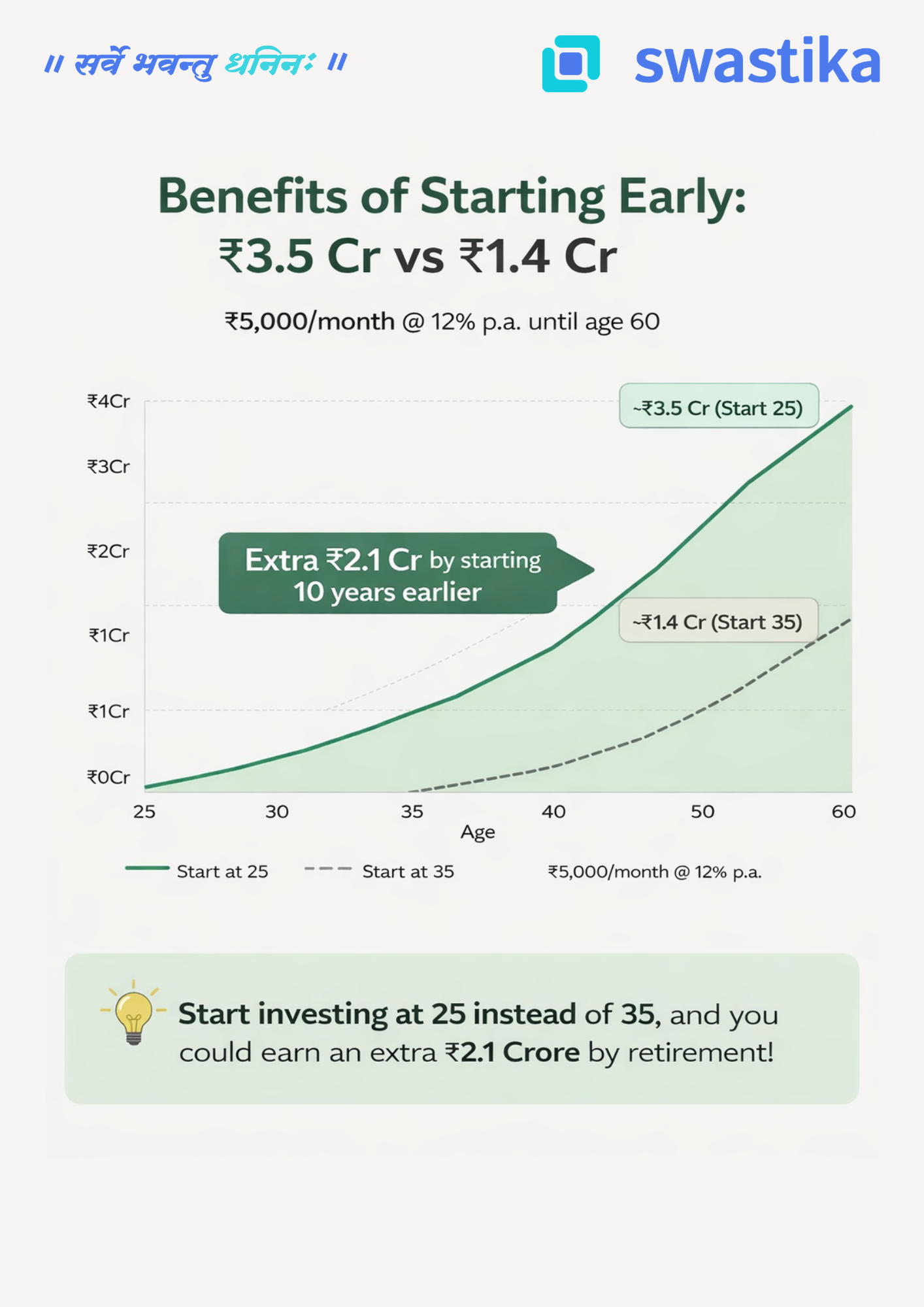
The more years you give your money to grow, the more dramatic — and life-changing — the results become. This is exactly why starting your investment journey early, even with a modest amount, can make a difference of crores by the time you retire.
A Tale of Two Investors: Arjun vs Priya
Let's bring this concept to life with a simple, real-world example.
Meet Arjun and Priya. Both are sensible, disciplined investors. Both invest ₹5,000 every month through a SIP (Systematic Investment Plan) in equity mutual funds, earning an average annual return of 12%. Both stop investing at age 60.
The only difference? Arjun starts at 25. Priya starts at 35.
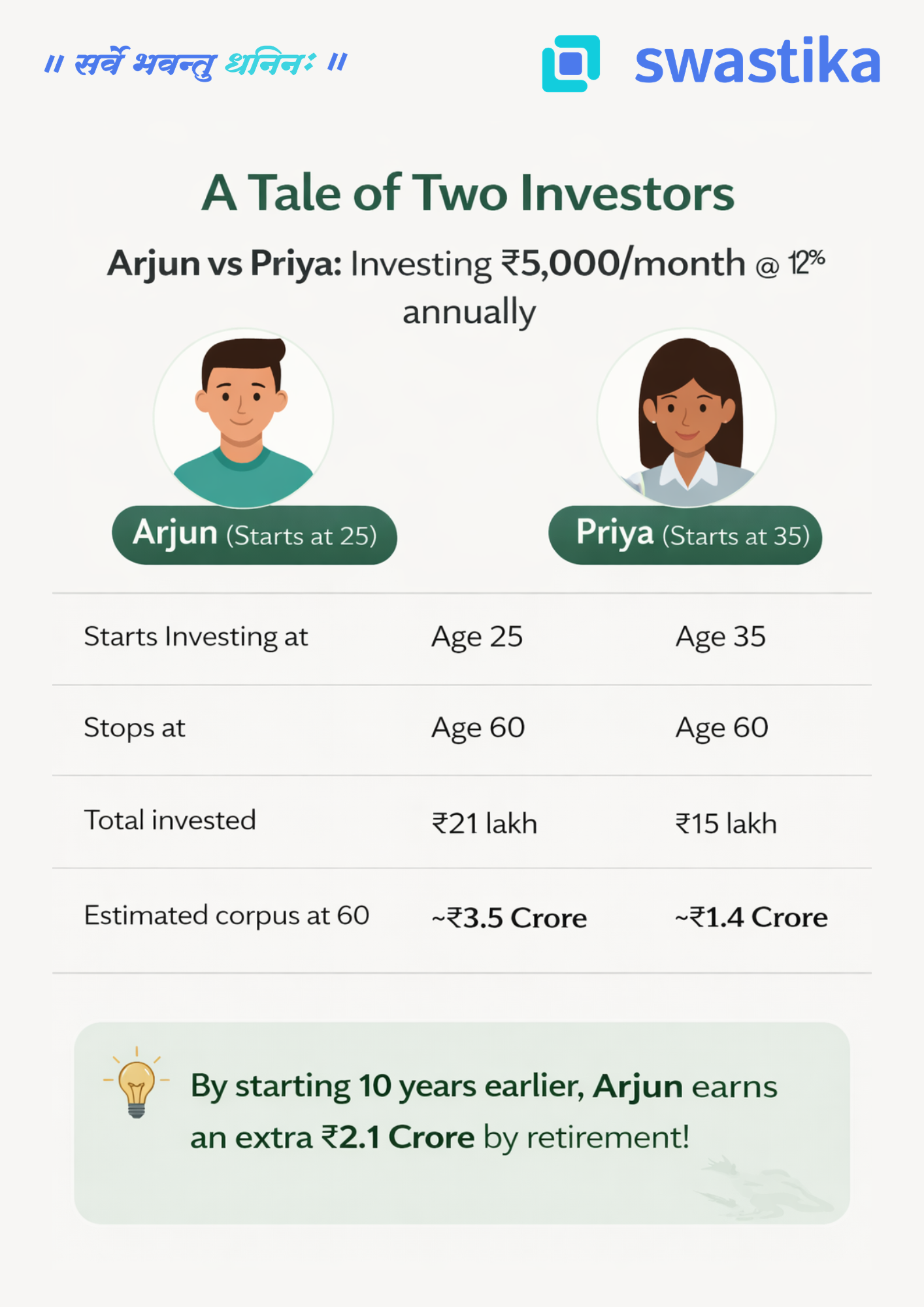
The numbers are striking. Arjun invests just ₹6 lakh more than Priya in absolute terms — yet walks away with ₹2.1 Crore more at retirement.
That extra ₹2.1 Crore didn't come from investing more aggressively or taking bigger risks. It came purely from starting 10 years earlier.
Why Does Time Make Such a Huge Difference?
This is where the magic of compounding reveals itself.
In the early years of investing, growth looks modest and almost unimpressive. But as the years pass, your corpus grows not just on your original investment, but on all the accumulated returns from previous years. The curve goes from almost flat to steeply exponential — and that steep climb happens in the later years.
When Arjun starts at 25, his money has 35 years to ride that exponential curve. Priya's money, starting at 35, only catches the last 25 years — and critically, it misses the steepest part of the climb in the final decade.
Think of it this way: the last 10 years of compounding are worth more than the first 20. That is the counterintuitive truth at the heart of long-term investing.
The Real Cost of Waiting
Many young earners tell themselves, "I'll start investing once I'm more settled — once the salary improves, once the EMI is paid off, once life is a bit easier."
But the numbers show that every year of delay is extraordinarily expensive — far more expensive than any EMI or lifestyle expense. Priya didn't invest carelessly. She invested faithfully for 25 years. Yet she ends up with less than half of what Arjun accumulated — not because she did anything wrong, but simply because she started a decade late.
The cost of waiting 10 years wasn't ₹6 lakh in additional contributions. The cost was ₹2.1 Crore in lost wealth.
Three Principles to Remember
1. Start now, not later.The best time to start investing was yesterday. The second best time is today. Even a SIP of ₹1,000–₹2,000 per month in your 20s is infinitely better than waiting for the "right time."
2. Consistency beats intensity.You don't need to invest large sums all at once. A small, steady, monthly commitment — maintained without interruption — is what unlocks the full power of compounding over decades.
3. Stay invested through market cycles.Compounding works only if you let it work. Exiting during market corrections or stopping your SIP in tough months breaks the chain. Time in the market, not timing the market, is what builds wealth.
The Bottom Line
If you are in your 20s or early 30s, you hold an asset that no amount of money can buy later: time. Use it. Start a SIP today — even a small one. Let compounding do its slow, steady, powerful work.
Because the difference between starting at 25 and starting at 35 is not just 10 years. As Arjun and Priya's story shows, that difference is ₹2.1 Crore.
Big Budget











.webp)
.webp)
.webp)
.webp)
.webp)
















.webp)
.webp)
.webp)
.webp)
Latest Articles

Ensure Financial Freedom on This Independence Day


Introduction
As we observe our nation's 75th Independence Day, let's review how freedom has changed through time.
For India's savings, a route to financial independence has been gradually carved out thanks to the efforts of governments, regulators, and financial institutions. This route capitalizes on the country's economic expansion using share markets, mutual funds, and other investment avenues that let investors reap from it.
Steps to Financial Freedom
Certain reasons have led to a rise in the importance of financial independence. Every middle-class individual should take into consideration this idea because it is no longer optional and almost a necessity.
Set a Financial Goal
To become financially free, one must plan ahead and handle their existing finances. It's crucial to organize your expenses and debts since doing so will allow you to start saving and stop depending on a set monthly salary.
Start Saving
The road to financial independence begins there. The sooner you start saving, the longer you save will eventually benefit you in long term. It makes no difference where you start, but it is more crucial that you begin making plans for the future.
Risk tolerance level
Just as important as choosing a financial objective is understanding one's risk tolerance level. One may easily narrow down the most worthwhile investment possibilities if they are aware of their level of risk tolerance. Financial decisions may become murky if one is unable to identify their personal risk tolerance.
Understand what a wonder, compound interest is
Most people will accumulate wealth more reliably by combining tiny sums of money with time and the power of compound interest.
Construct an Investment Portfolio
Choosing a variety of investments that are geared toward attaining your goals and objectives at an investment risk level that you are comfortable with is the key to building an investment portfolio. The selection of a particular investment is the second most important component after asset allocation.
Invest Systematically through SIPs each Month
Regular and systematic investing is required if you want to get the desired outcomes. A powerful feature for goal planning is a systematic investment plan (SIP). You only need to choose one of the top and most suitable mutual fund programs to SIP into.
Searching for the best mutual funds for a systematic investment plan in India? Fulfill your financial goals now with Swastika.
Add some equity to your Investment Portfolio.
Equity investments have rewarded investors by increasing their money in a fairly short amount of time when compared to other investment alternatives. By starting early, and making investments in the right stocks, one might strive to save enough money to achieve financial independence at a young age.
Live life debt-free
You must quit living in debt if you want to become financially independent. Make sure to minimize or settle your outstanding bills as soon as you can. Avoid taking out loans or using credit cards frequently to meet your immediate needs because doing so might harm your financial stability
Abundant Wealth
The "4 percent rule" is a retirement rule of thumb that states that an investor can safely withdraw 4 percent, adjusted for inflation, from a balanced portfolio of stocks and bonds each year and be reasonably certain that the money will continue to grow and won't run out. This is how financially independent people who live off their portfolio income operate.
The Road to Financial Independence
Having the right mindset is essential to achieve financial freedom. Making secure and wise investments is therefore essential to financial independence since it allows you to gradually increase your wealth. Investors who desire predictable capital growth, however, have had sleepless nights due to fluctuating stock indices and monetary policy changes. Fixed-income assets are therefore ideal for investors looking for guaranteed returns.

भू-राजनीतिक तनाव बढ़ने से सुरक्षित ठिकाने की मांग
भू-राजनितिक तनाव बढ़ने के कारण सोने में सुरक्षित मांग बढ़ने लगी है। पिछले सप्ताह घरेलु वायदा सोना तेज़ रहा और भाव 52500 रुपये प्रति दस ग्राम के स्तरों को छू गए जबकि चांदी की कीमते सीमित दायरे में रहते हुए 58800 रुपये प्रति किलो के ऊपरी स्तरों को छू गए। धीमी होती हुई ग्लोबल अर्थव्यवस्था और अमेरिकी डॉलर इंडेक्स मे दबाव सोने और चांदी के भाव को सपोर्ट कर रहा है। डॉलर की नरमी के चलते औद्योगिक धातुओं के लिए पिछले सप्ताह अच्छा रहा लेकिन चीन और यूरोज़ोन के कमजोर मैन्युफैक्चरिंग आकड़ो से सुस्त मांग के संकेतो से सप्ताह के अंत तक इनमे दबाव बनता दिखा। हालांकि, डॉलर की तुलना में रूपया पिछले दो सप्ताह से मजबूत रहा है जिससे कीमती धातुओं की बढ़त सीमित रही। भारतीय रिज़र्व बैंक द्वारा भी शुक्रवार को ब्याज दरे 0.50 प्रतिशत बढ़ा दी गई है जिससे रूपया मजबूत हुआ है। जबकि कॉमेक्स वायदा में सोना 1800 डॉलर प्रति औंस के स्तरों को पार कर गए। दुनिया भर से निराशाजनक आर्थिक संकेतो की बढ़ती संख्या ने आने वाली मंदी पर चिंताओं को बढ़ा दिया है। हालांकि, अमेरिका से जारी होने वाले पैरोल के आंकड़े मजबूत दर्ज किये गए है जिससे ऊपरी स्तरों पर कीमती धातुओं के भाव में दबाव भी बना है। सेफ हैवन मांग बढ़ने के पीछे चीन और ताईवान के बीच बढ़ रहा तनाव है जिसमे मिलिट्री ड्रिलिंग में मिसाइल दागने के बाद सोने में तेज़ी देखने को मिली है।
तकनीकी विश्लेषण:
कीमती धातुओं के भाव इस सप्ताह तेज़ी में रहने की सम्भावना है। अक्टूबर वायदा सोने की कीमतों में 51300 रुपये पर सपोर्ट है और 52500 रुपये पर प्रतिरोध है। सितम्बर वायदा चांदी में 55500 रुपये पर सपोर्ट और 59500 रुपये पर प्रतिरोध है।

मुद्रास्फीति गिरने से सीमित दायरे में सोने-चांदी के भाव
सोने के भाव में लगातार तीसरे सप्ताह भी तेज़ी जारी रही वही प्रमुख अर्थव्यवस्थाओं के आंकड़े मजबूत रहने से चांदी में भी तेज़ी देखि गई। अमेरिकी डॉलर इंडेक्स पिछले सप्ताह 1.21 प्रतिशत टुटा जिसकी कमजोरी के चलते सोने और चांदी के भाव में तेज़ी बनी रही। लेकिन, वैश्विक आर्थिक आकड़ो में सुधार के साथ मुद्रास्फीति में भी गिरावट दर्ज की गई है जिससे कीमती धातुओं की तेज़ी में लगाम लगी है। मुद्रास्फीति घटने के बावजूद फेड सदस्यों द्वारा ब्याज दरे बढ़ाने की बात कही गई है जिससे सोने और चांदी में मुनाफा वसूली भी देखने को मिल रही है।
अमेरिकी मुद्रास्फीति आकड़ो के बाद उत्पादक मूल्य मुद्रास्फीति (पीपीआई) में भी अप्रत्याशित गिरावट दर्ज की गई है। मौद्रिक नीति पर अमेरिकी फेड का रुख अभी आक्रामक है। भारत में भी अमेरिकी फेड के साथ-साथ ब्याज दरों में वृद्धि हुई है और त्यौहार की मांग आने में थोड़ा समय बाकि रहने से सोने और चांदी की कीमते लम्बी अवधि के लिहाज से अभी सीमित दायरे में बनी हुई है जिससे इनमे ऊपरी स्तरों पर दबाव बनने की सम्भावना भी नज़र आती है।
अमेरिका, चीन और भारत में मुद्रास्फीति में कमी सोने की बढ़त को फीका कर सकती है लेकिन भूराजनीतिक मुद्दो से निचले स्तरों पर सपोर्ट भी मिलता रहेगा। इस सप्ताह अमेरिका से जारी होने वाले रिटेल सेल्स और एफओएमसी मीटिंग के मिनट्स सोने और चांदी के भाव के लिए महत्वपूर्ण रहेंगे।
तकनीकी विश्लेषण
कीमती धातुओं में इस सप्ताह ऊपरी स्तरों पर दबाव रहने की सम्भावना है। अक्टूबर वायदा सोने की कीमतों में 51700 रुपये पर सपोर्ट है और 53200 रुपये पर प्रतिरोध है। सितम्बर वायदा चांदी में 57300 रुपये पर सपोर्ट और 59700 रुपये पर प्रतिरोध है।
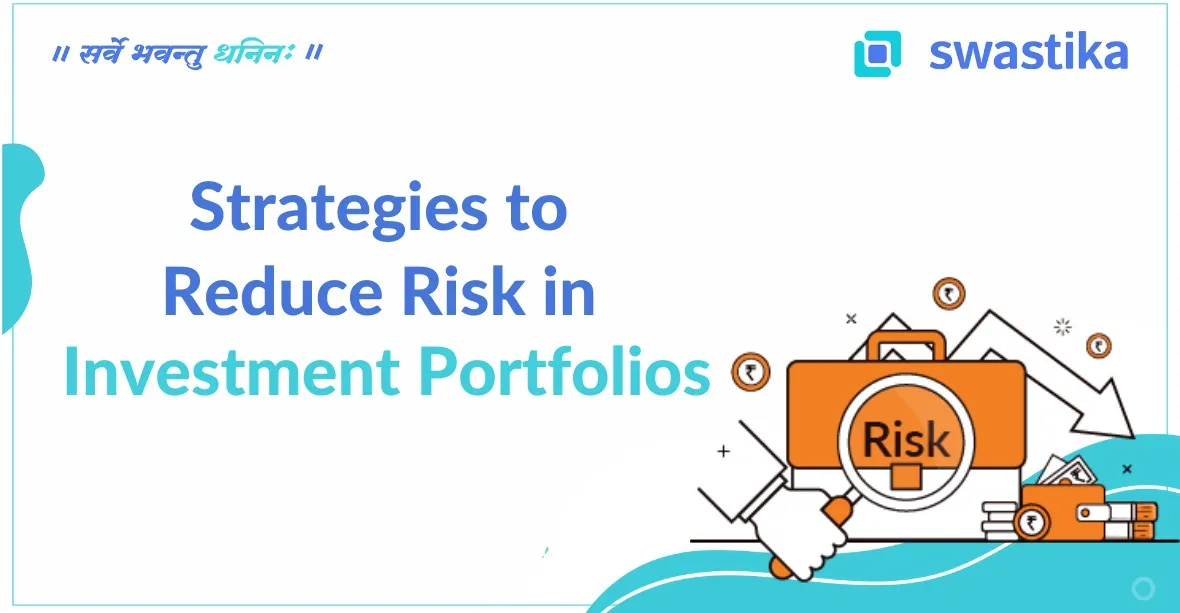
Strategies to Reduce Risk in Investment Portfolios
Investment risks can't be avoided while one can reduce these risks to manage their portfolio. It's important to address the portfolio wisely as this will ensure the investor's financial future security.
Now the point is every investment carries some risk feature with it, but a portfolio takes a lot of risks with it that depend on the number of assets managed in the portfolio.
So to overcome the overall risks, we will discuss the strategies to reduce risks in the investment portfolio.
To get detailed information about your investment portfolio, feel free to contact us - at 0120 4400700
Ways to Reduce Risk in Investment Portfolio
1. Identify Risk Tolerance Capacity
While investing the hard-earned money in the stock market, every investor has some risk-bearing capacity.
This risk tolerance capacity depends from person to person, and to determine risk factors, one can consider the age, the number of dependents, financial status etc.
Usually, people avoid such risk-taking capacity and invest more than their estimated risk to generate high returns, but this affects their portfolio when markets face downtime.
So understand your risk tolerance before investing, and this practice generates a good risk-return value that ultimately helps maintain the investment portfolio.
2. Maintain Liquidity
A financial emergency is unpredictable, i.e. it can occur anytime, so one needs to take back the investments, and it might be possible for the market facing downtime.
So to reduce this risk, try to maintain enough liquidity. Adding a few liquid assets in the portfolio lets your other investments generate long-term results.
One can keep the emergency funds aside that will equal the amount required for 3-4 months of expenses. In this way, the urgent need for cash won't affect the portfolio, and you need not compromise your long-term investments.
3. Asset Allocation
Asset allocation involves investing in different asset classes to reduce the risks involved with investment and generate high returns. Other asset classes are equity, debt, mutual funds, gold, real estate etc.
To implement an asset allocation strategy, mix investing means investing in the combination of asset classes which are inversely correlated, i.e. equity and gold, equity and debt etc.
If equity stock under performs, such gold stock balances the returns by overperforming, or vice-versa can be possible.
With this strategy, one can easily reduce the risks in the investment portfolio and secure higher revenue.
4. Diversify Investment
Once you get the combination of asset classes per your investment goals, diversify those asset classes to reduce the risks involved in investing.
This strategy helps reduce the overall risk of an investment portfolio as diversifying the investment within the same asset class divides the risks among multiple investments of that class.
For instance, you are investing in equity mutual funds and diversifying this investment among the large-cap, small-cap and mid-cap funds.
If any of the funds generate low returns, this loss is limited to that investment only because other assets are not affected.
Also Read: Portfolio Diversification: A Beginner’s Guide for Asset Allocation & More
5. Diversification across sectors
In the market, every sector is in a different phase; while a few sectors are quite risky and possess optimal returns, there are sectors which offer high returns at low risks.
So diversify your investments among multiple sectors such that if one sector is not doing well, you have an option that delivers better returns simultaneously.
For instance, The technology sector is usually in the mode of amazing growth, but this also faces downtime. At the same time, the utility sector stays consistent in terms of returns even aftermarket collapse.
6. Focus On Time in the Market
Most of the time, investors take quick decisions to buy particular stocks as their price continuously rises in the least amount of time
But without even checking the stock's past performance, investing can increase the risk. So instead of timing, the market investors should focus on the long run to stay with investments in the long term.
Because small fluctuations do not impact the portfolio much, therefore reduce the risk in the investment portfolio.
7. Invest in Index Funds
Investors should add a few index funds to their investment portfolio to reduce the risk. However, these funds are quite expensive but perform better than other funds.
Index funds produce good returns and lower expense ratios than other active funds.
Also Read: Tips and Tricks for Every New Stock Investor
8. Monitor Your Investment
Investing is not just enough. Being an investor, you always want to stay in the market for the long term, but that doesn't mean letting go of what's happening with your investments.
One should monitor the investments in a particular period. Reviewing the portfolio's performance shows the poor-performing assets and thus minimizes the risk involved.
You can track the investments for a year or every six months to help diversify the investments in the asset classes. Ultimately analyzing the performance reduces the risk in the investment portfolio.
9. Invest in Blue Chip Stocks
Investing in blue chips offers you several benefits as with the help of it, you can reduce liquidity risk to a greater extent. Hence, investors are advised to check the credit rating of debt securities to avoid any type of risks associated with it.
Although almost all blue-chip stocks involve some type of risk, investing in blue chip stocks minimizes your risks to a greater extent.
10. Monitor Regularly
We need to monitor our portfolio regularly even if you are a long-term investor. If you want to be a successful investor, you need to regularly an eye on your portfolio’s performance.
Conclusion
With every investment, you make some risks involved in it. To get high returns with your investments, follow all these strategies to reduce risk in the investment portfolio. This information aims to help you achieve your financial goals through continuous growth in your investments.

5G Spectrum Auction Ends
Introduction
India's largest-ever 5G spectrum auction in India finished on Monday with bids totaling more than Rs 1.5 lakh crore. The auction procedure lasted seven days and 40 rounds of bidding. During the 5G spectrum auction, Reliance Jio ended up being the biggest bidder. The next-generation network is considered to be essential for new technologies like artificial intelligence and self-driving automobiles, enabling the use of advanced linked gadgets using cloud computing technologies and permitting video downloads in seconds. In addition to providing customers with fast data access, 5G has the potential to support a variety of enterprise-level applications, including more immersive augmented reality and metaverse experiences, connected vehicles, and machine-to-machine communications. Keeping this in view, By October of this year, the Indian government hopes to start rolling out 5G, which it claims can deliver data speeds around ten times faster than 4G.
5G spectrum Auction Results
In the 5G spectrum auction, Bharti Airtel, Vodafone Idea, Adani Enterprises Ltd., and Reliance Jio participated Reliance Jio bid Rs 88,078 crore For 24,740 MHz of spectrum. Airtel purchased 19,876 Mhz of spectrum For Rs 43,084 crore. Vodafone Idea Ltd paid just Rs 18,799 crore for 6228 MHz of spectrum. Adani Enterprises only invested Rs 212 crore in six circles, including Gujarat, Mumbai, Karnataka, Tamil Nadu, Rajasthan, and Andhra Pradesh, for 400 MHz in the millimeter band.
Reliance JIO 5G SPECTRUM details
Within six years of its formal launch, Jio has established itself as the market leader with its 4G services, serving more than 400 million subscribers.- Jio has purchased low-band, mid-band, and mm Wave spectrum.- Jio will be the sole telecommunications provider using the 700Hz spectrum footprint to offer 5G internet access.- Jio has acquired 22 circles' worth of 700Hz and 800Hz bands.- Jio will pay Rs 7,877 crore every year with interest calculated at a rate of 7.2% per year for the next 20 years.
Financials of Reliance Jio
Jio Platforms, a division of RIL reported a 17.1% increase in gross revenue for FY22, totaling INR 95,804 Cr, while net profit increased by 23.6 Percent to INR 15,487 Cr. During FY22, Jio Platforms' EBITDA increased 20.9 percent to INR 39,112 Cr. Reliance Jio's June quarter profit jumped from 23.82 percent YoY to Rs 4,335 crore. The telecom operator's Q1 revenue saw a growth of 21.55 percent to Rs 21,873 crore. Jio had gained over 31 lakh, mobile subscribers, in May, taking its mobile customer count to 40.87 crores according to TRAI.Jio's extensive fiber network and home-grown technology platforms guarantee seamless internet access for both consumers and enterprises. Reliance will get benefit in the form of 5G tariff plans will likely lead to higher revenues for telecom companies
Latest Updates
According to Reliance, the planning for 5G coverage in 1,000 of the biggest cities of India has been finished. Using a variety of services, including heat maps, 3D maps, and ray-tracing technologies, Jio said that it is now testing the implementation of its 5G services throughout India. Jio is presently testing its own 5G RAN and Core technologies that it built on its own.
Impact on India
India will adopt 5G gradually, especially given the possibility of price hikes and the fact that just roughly 7% of all smartphones in India are 5G-capable. During the next 20 years, India's Department of Telecommunications will receive an upfront payment of $1.6 billion. The auction record the largest earnings that will aid in bolstering the government's finances at a time when India's budget deficit, is predicted to reach 6.4 percent.
Conclusion
For Indian telecoms to fuel their revenue growth by delivering ultra-high speed wireless network services, the 5G spectrum is essential. 5G can provide enterprises the ability to create their own networks. In India, mobile data consumption is expected to increase by 29% and data income to increase by 67% between 2020 and 2026 as a result of the next generation of mobile broadband, despite unsubstantiated worries about radiation levels or worries about increased pricing. The technology will also enable the country's ongoing smart city initiatives and enable manufacturers to start their Industry 4.0 journey. This ought to boost the adoption of 5G in India by e-commerce, fintech, agritech, health tech, and other digital industries.

Top EV (Electric Vehicle) Stocks to Buy in India 2022
For an investor, investing in such stocks that produce high stock market trading returns is ideal. But, on the other hand, investors look for those stocks that are relatively in demand as per market perspective and trends.
One such trending stock is electric vehicle stock. As the natural energy resources are limited and the usage is twice the availability, we are looking for an alternative. The automobile sector is now shifting towards electric vehicles.
With this adoption of electric vehicles, the stock prices of EV stocks are rising.
So let's see the list of the best electric vehicle stocks to buy in India in 2022.
Electric Vehicle Sector Segmentation
The electric vehicle sector is so huge that it is not limited to manufacturers only; instead, it is divided into four segments.
- Auto Manufacturers: this includes assemblers that assemble all the technology and parts required for any EV.
- Battery Manufacturers: for any electric vehicle, the battery is the heart of the whole vehicle, so this category includes battery manufacturers
- Auto Parts and EV Software: This category includes spare part manufacturers and advanced software required for EVs.
- Charging Stations: batteries of EVs need to be charged on a regular basis, so this category involves the companies that set up the charging stations at different places in the city.
Electric Vehicle Stocks to Buy in India
Based on four categories of electric vehicles, we are listing the best electric vehicle stocks to buy in India in 2022.
Auto Manufacturers (EV) Electric Vehicle Stocks in India
Tata Motors
With the assistance of partners like Tata Chemicals for batteries, Tata Steel for body structures, and Tata ELXSI for software, it is one of the greatest electric vehicle stock businesses in India.
Tata Motors will have a significant amount of room to grow in the near future. Tata Motors' closing price, in the last few months, was around Rs. 400.
Maruti Suzuki
Maruti Suzuki is the top brand for entry-level vehicles that are affordable. The business holds the majority of the market share because it is the oldest one.
The only thing is that other businesses have made huge progress in the EV market in a short span of time, but Maruti Suzuki has not done yet.
Sooner or later, the company will introduce an electric vehicle to the market. In the previous months, the share price reached a close of Rs. 7000 (approx).
Mahindra & Mahindra
Aside from the partnership with Reliance Industries, Mahindra & Mahindra is aiming to increase the number of electric vehicles in its lineup.
The company plans to introduce 16 electrified vehicles by 2027, spanning the SUV and light commercial vehicle classes.
Additionally, it intends to spend nearly Rs 3,000 crore over the next three years on the electric vehicle market. The stock price of this company varies from Rs. 800-850.
Hero MotoCorp Limited
As the market is focused on four wheelers electric vehicles, Hero decided to focus on the two-wheeler electric vehicle segment. Hero already established itself with its two-wheeler edition including pleasure, splendor etc.
So it better understands the two-wheeler market in India as it is affordable for the common man too. Talking about the share price of Hero MotoCorp it ranges between Rs. 2300- 2400.
Auto Parts Manufacturers and EV Software Stocks in India
Tata ELXSI Limited
Tata ELXSI is one of the leading software companies known for its contribution to the automobile industry. The company provide new technology software and design for electric vehicle.
It is also estimated that ELXSI will eventually license this specially created stock software to other auto part manufacturers. The share price of this ELXSI varies between Rs. 8000 - 8700.
Motherson Sumi Systems Limited
One of India's leading suppliers of automotive components is Motherson Sumi. Due to its immense production capacity, the company has previously acquired several small-scale auto parts makers and started producing parts, particularly for electric vehicles.
As electric vehicle parts are different from normal cars, Motherson Sumi is estimated to grow in the near future and provide services to different businesses. The share price for this company is around Rs. 140.
Battery Manufacturers for Electric Vehicle Stocks in India
Exide
One of the oldest and leading players in the list of automobile battery manufacturers is Exide.
Exide use to manufacture lead-ion batteries for typical vehicles but planning to shift to lithium-ion-based batteries for the upcoming electric vehicles. The share price of Exide industries varies between Rs. 150-170.
Tata Chemicals
Tata chemicals have a unique vision of developing an ecosystem to generate batteries by collecting all the raw materials required to make batteries.
With this vision, the company want to fabricate the batteries in their manufacturing plants and use the old batteries in the recycling process. The share price of TATA chemicals is nearly Rs. 1050.
Battery Charging Stations Electric Vehicle Stocks in India
Power Grid Corporation of India Limited
Power Grid Corporation is a government-owned firm that provides high-voltage supply and grid management to businesses including telecommunications.
The company is likely to install charging stations around the nation. The corporation going to participate in future government contracts and deals with the label of state control. The share price varies between Rs. 200 - 250.
Tata Power Company Limited
As a provider of consumer energy, TATA Power is a well-established organization. With the rapid growth in the number of EV owners in India, TATA Power and TATA Motors have joined hands to build electric vehicle battery charging and switching stations around the nation.
The company has started installing private charging stations at customers' apartments, registered car service centres, and fast charging stations at numerous public parking spaces like shopping areas.
The share price of TATA Power was estimated to be around Rs. 270.
Final Note
Here in this list of best electric vehicle stocks to buy in India in 2022 we have covered all the segments of electric vehicle stocks.
So with this proper classification of EV stocks, investors get to know all the sectors of the automobile industry in a very clear way.


.webp)
.webp)

.webp)






START YOUR INVESTMENT JOURNEY
Get personalized advice from our experts
- Dedicated RM Support
- Smooth and Fast Trading App