

The Power of Compounding – Why Starting Early Matters




Introduction
Albert Einstein reportedly called compound interest the "eighth wonder of the world." Whether or not he actually said it, the math is undeniable. Compounding is the process where your investment returns begin earning their own returns — and over time, this snowball effect becomes truly extraordinary.
The catch? Compounding needs one essential ingredient: time.
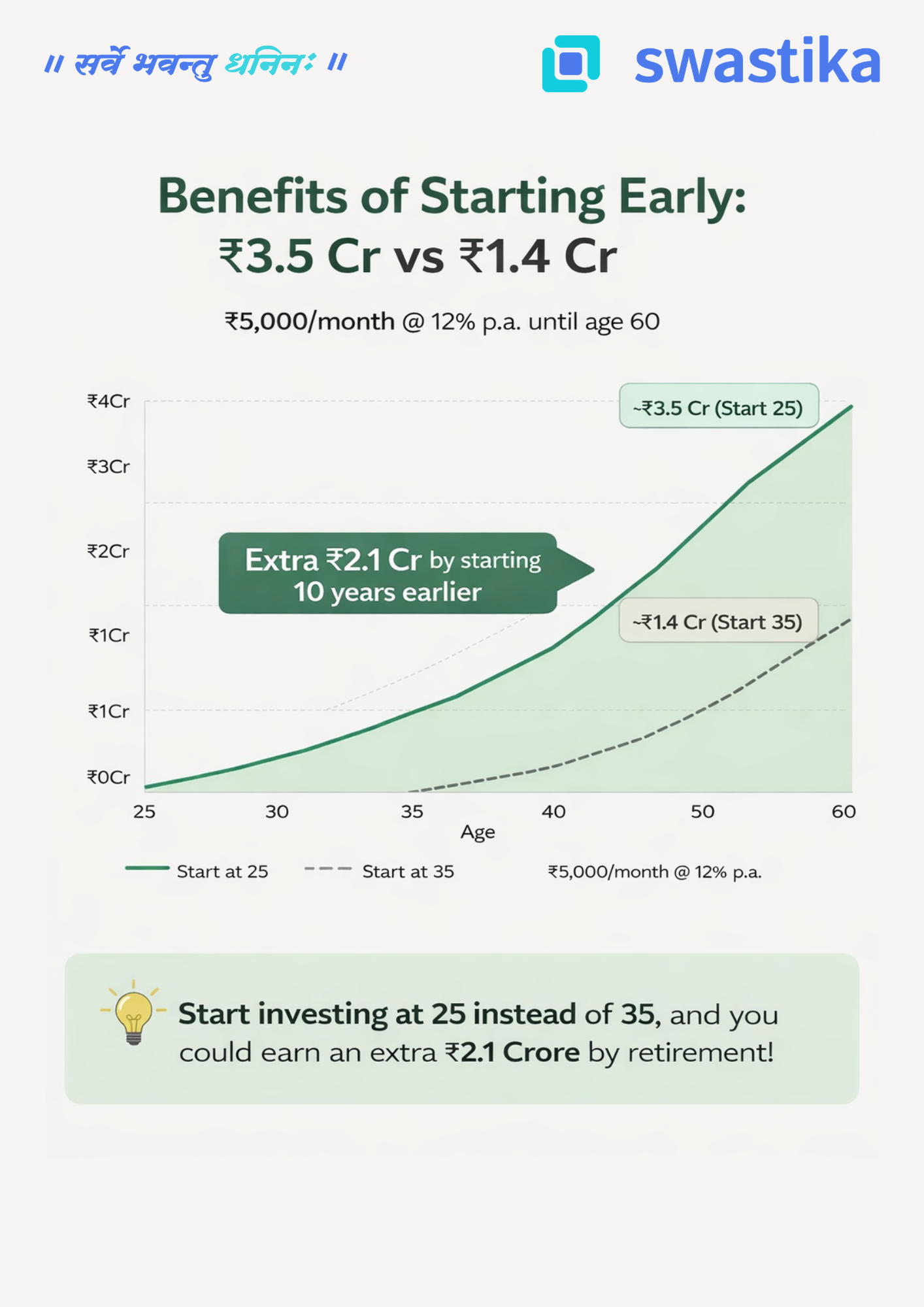
The more years you give your money to grow, the more dramatic — and life-changing — the results become. This is exactly why starting your investment journey early, even with a modest amount, can make a difference of crores by the time you retire.
A Tale of Two Investors: Arjun vs Priya
Let's bring this concept to life with a simple, real-world example.
Meet Arjun and Priya. Both are sensible, disciplined investors. Both invest ₹5,000 every month through a SIP (Systematic Investment Plan) in equity mutual funds, earning an average annual return of 12%. Both stop investing at age 60.
The only difference? Arjun starts at 25. Priya starts at 35.
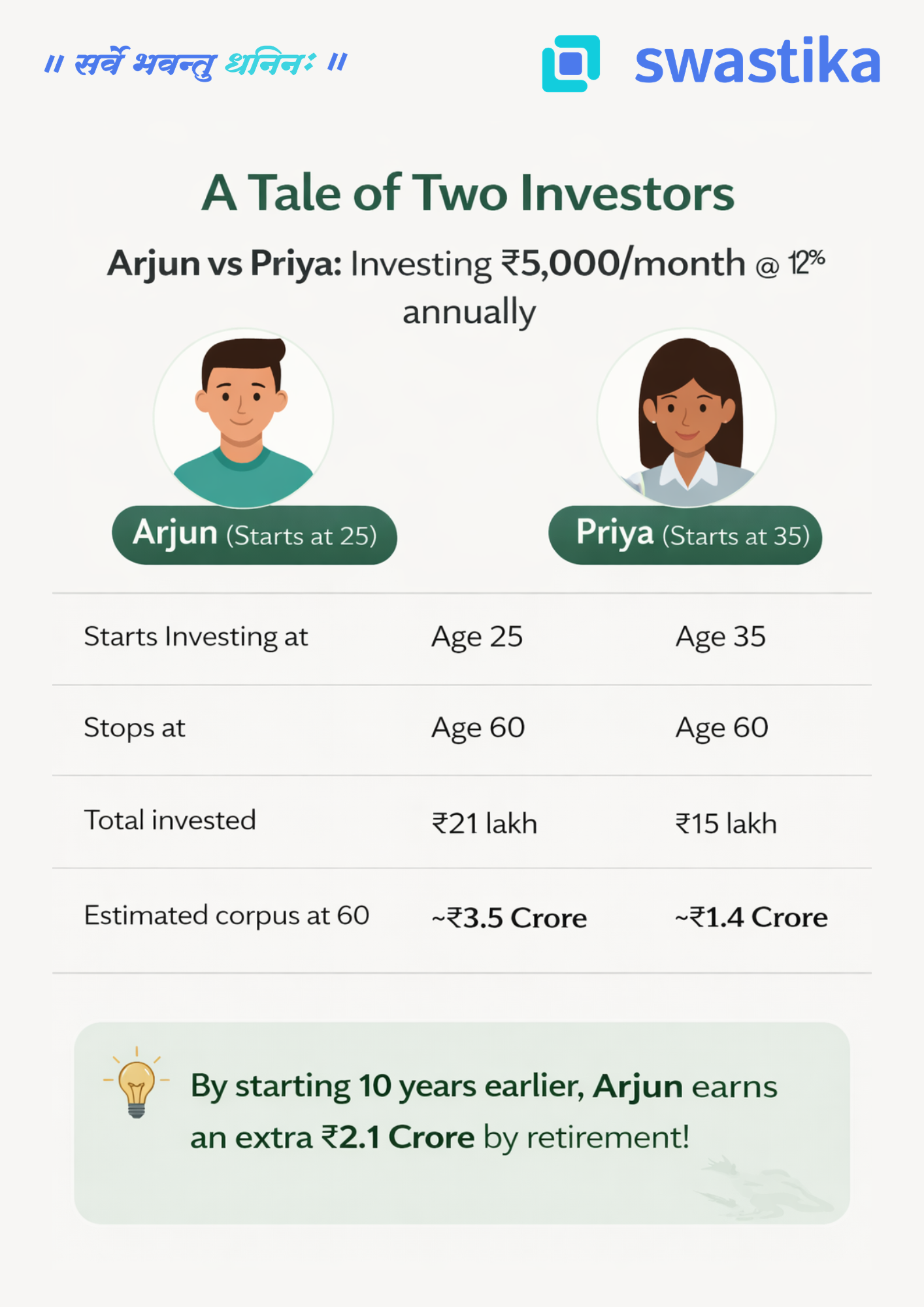
The numbers are striking. Arjun invests just ₹6 lakh more than Priya in absolute terms — yet walks away with ₹2.1 Crore more at retirement.
That extra ₹2.1 Crore didn't come from investing more aggressively or taking bigger risks. It came purely from starting 10 years earlier.
Why Does Time Make Such a Huge Difference?
This is where the magic of compounding reveals itself.
In the early years of investing, growth looks modest and almost unimpressive. But as the years pass, your corpus grows not just on your original investment, but on all the accumulated returns from previous years. The curve goes from almost flat to steeply exponential — and that steep climb happens in the later years.
When Arjun starts at 25, his money has 35 years to ride that exponential curve. Priya's money, starting at 35, only catches the last 25 years — and critically, it misses the steepest part of the climb in the final decade.
Think of it this way: the last 10 years of compounding are worth more than the first 20. That is the counterintuitive truth at the heart of long-term investing.
The Real Cost of Waiting
Many young earners tell themselves, "I'll start investing once I'm more settled — once the salary improves, once the EMI is paid off, once life is a bit easier."
But the numbers show that every year of delay is extraordinarily expensive — far more expensive than any EMI or lifestyle expense. Priya didn't invest carelessly. She invested faithfully for 25 years. Yet she ends up with less than half of what Arjun accumulated — not because she did anything wrong, but simply because she started a decade late.
The cost of waiting 10 years wasn't ₹6 lakh in additional contributions. The cost was ₹2.1 Crore in lost wealth.
Three Principles to Remember
1. Start now, not later.The best time to start investing was yesterday. The second best time is today. Even a SIP of ₹1,000–₹2,000 per month in your 20s is infinitely better than waiting for the "right time."
2. Consistency beats intensity.You don't need to invest large sums all at once. A small, steady, monthly commitment — maintained without interruption — is what unlocks the full power of compounding over decades.
3. Stay invested through market cycles.Compounding works only if you let it work. Exiting during market corrections or stopping your SIP in tough months breaks the chain. Time in the market, not timing the market, is what builds wealth.
The Bottom Line
If you are in your 20s or early 30s, you hold an asset that no amount of money can buy later: time. Use it. Start a SIP today — even a small one. Let compounding do its slow, steady, powerful work.
Because the difference between starting at 25 and starting at 35 is not just 10 years. As Arjun and Priya's story shows, that difference is ₹2.1 Crore.
Big Budget












.webp)
.webp)
.webp)
.webp)
.webp)
















.webp)
.webp)
.webp)
.webp)
Latest Articles

Dividend Stocks vs. Growth Stocks: Choosing the Right Strategy for Your Investment Portfolio


When considering investment options, investors often encounter two primary types of stocks: dividend stocks and growth stocks. Each type has distinct characteristics and benefits, catering to different investment goals and strategies. This blog will delve into what dividend and growth stocks are, their key differences, and how each can fit into your investment portfolio.
What Are Dividend Stocks?
Dividend Stocks are shares in companies that distribute a portion of their earnings to shareholders as dividends. These payments are typically made quarterly and offer a steady income stream to investors. Dividend stocks are usually associated with well-established, mature companies with a consistent track record of profitability.
Key Features of Dividend Stocks:
- Stability: Often linked to established companies with stable earnings, dividend stocks tend to be less volatile compared to growth stocks.
- Attractive Yield: Dividend yield is a key metric, calculated as the annual dividend payment divided by the stock price. A higher yield can make dividend stocks appealing, especially in low-interest-rate environments.
- Examples: In India, companies like Hindustan Unilever and Vedanta Limited are known for their consistent dividend payments, making them popular choices for income-focused investors.
What Are Growth Stocks?
Growth Stocks are shares in companies expected to grow at an above-average rate compared to other companies. These companies typically reinvest their earnings into expansion, research and development, or new projects rather than paying dividends.
Key Features of Growth Stocks:
- Capital Appreciation: Investors seek higher returns through the appreciation in stock price rather than income from dividends. The focus is on the potential for substantial growth over time.
- Reinvestment of Earnings: Growth companies often use their profits to fuel expansion, develop new products, or enter new markets, which can drive future earnings and stock price increases.
- Examples: Companies like Infosys and Zomato in India are considered growth stocks. These firms are expected to see significant growth due to their innovative business models and expanding markets.
Key Differences Between Dividend Stocks and Growth Stocks
Investment Considerations
- Dividend Stocks: Ideal for those seeking stability and income, such as retirees or conservative investors. These stocks can provide a hedge against inflation through dividend growth and offer a cushion during market downturns.
- Growth Stocks: Suitable for investors looking for high returns and willing to take on higher risk. These stocks are best for those with a longer investment horizon who can withstand market volatility.
Interesting Fact: Many investors create a balanced portfolio by combining both dividend and growth stocks. This approach can offer the stability and income from dividends while capturing the growth potential of high-growth stocks.
Conclusion
Both dividend stocks and growth stocks offer unique advantages and cater to different investment strategies. Dividend stocks provide stable income and lower risk, making them suitable for conservative investors or those seeking regular cash flow. Growth stocks, on the other hand, offer the potential for high returns through capital appreciation, attracting investors with a higher risk tolerance.
Penny Stocks Vs Value Stocks : Which is More Profitable to Invest
Investing in the stock market is a quite a challenging job, which can give you a huge amount of money in some cases, but if done improperly, it can lead to a loss of your entire investment.
The stock market requires a lot of learning about the market and how it works.
The stock market has many ups and downs and you need to have patience because even if you have a good idea about the stock, there are other factors that may affect its price.
Hence, many investors put their hard-earned money into penny stocks thinking that it may give them bountiful profits. However, this is not the case.
Now, moving into our topic which is penny stocks vs value stocks, both are risky investments but they are completely different from each other, to know more about the difference. We need to know how value and penny stocks work.
What are Penny Stocks?
Penny stocks are shares of a company that trade for a very low price. This can be because the market doesn't know the company well enough, or because the company has low enough growth potential to be priced at this level.
Penny stock trading is not necessarily a scam, but it can lead to problems if you're not careful.
What are Value Stocks?
A value stock is a stock that has a low price-earnings (P/E) ratio relative to the market value of the company's equity. The lower the P/E ratio, the more attractive it is.
Value investors try to make money by buying shares of undervalued stocks. They do this by analyzing the company's financial statements and comparing them to similar companies' earnings reports.
If there are big differences between what's happening inside a business and what's happening in its stock price, value investors may want to buy those stocks.
Is It Risky to Invest in Penny Stocks?
Penny stocks are considered to be very risky to invest in because of the low price of these stocks. These stocks do not have any form of stability and they are prone to fluctuations in their prices.
This can make them lose their value very quickly and make you lose your money.
Penny stocks are considered to be high-risk investments as they do not have any form of stability, unlike regular stocks where one can see how the company is doing and if it is going to perform better or worse in future.
This makes penny stocks very risky for investors as they cannot predict what will happen to them in future.
Is it Risky to Invest in Value Stocks?
Value stocks are stocks that have low price-to-earnings (P/E) ratios, high book value and low price-to-book value ratios. These stocks are often referred to as growth at a reasonable price (GARP) stocks.
Value investors believe in investing in companies that offer a good return on investment without having to pay too much for it. They believe in buying low and selling high, as opposed to buying high and selling even higher.
Investors try to identify undervalued companies with good growth prospects and sell them before they get overvalued or become too expensive.
Final Note
Penny stocks are risky and often used in stock market scams. Instead of risking your hard-earned money in penny stocks, invest in value stocks.
Value stocks are those that have a proven track record of delivering good returns. The best value stocks are ones with a proven track record of delivering good returns for their shareholders.
The most important thing about value investing is that you need to invest in companies with strong balance sheets and high-quality assets (such as cash).
These assets will be required to pay off debts and other obligations of the company such as interest payments and tax payments.
Penny stocks have no such requirement and can be traded without any capital requirements. The risk involved in trading penny stocks is very high because the price of these stocks can rise or fall dramatically within seconds or minutes.
This makes it difficult for the average investor to decipher what is fake news and what isn’t because they don’t have enough time to analyze the information before making an investment decision.

Best Investment Plans for Good Returns in India
People invest their money in different financial instruments so as to get good returns from them. To accomplish investing goals, they seek the best investment schemes which give the best interest rates in a fixed time. If you are an investment lover, who would like to enhance your wealth, there are certain things you would need to consider.
Before starting your investment journey, the primary thing you need to do is to find out whether you have enough funds or not. As it is important to save for the future, you need to make sure that your presentation must be secure before putting any money into a financial instrument.
Emergency money would be the second important thing you need to plan for. As 99 per cent of investment instruments come with a fixed lock-in period, the money you put into these funds cannot be withdrawn until the lock-in period gets ended.
Hence, it is suggested to keep some emergency funds as they may come into use if any immediate requirement comes like medical and other expenses.
Debt clearance is another important step you need to make before making an investment. If you get stuck somewhere in the debt, starting an investment might involve risks. If you have zero debt and also have emergency funds, you are all set to start your investment journey. Below are some of the investment options you can use for getting a better return on investment:
Best Investment Plan in India for High Returns
1) Mutual Funds
Mutual funds are popular investment options in India, offering diversified portfolios across various asset classes, which makes them relatively safer compared to the stock market. With mutual funds, your money is managed by experienced fund managers who are skilled in optimizing investment returns. A convenient way to invest in mutual funds is through a Systematic Investment Plan (SIP). SIPs allow individuals to invest a predetermined amount monthly, which is automatically deducted from their account and invested in the chosen mutual fund scheme. This method not only fosters disciplined saving habits but also aims to provide favorable returns over time.
2) Stock Market
When you invest in the stock market, as long as a firm is listed on the stock exchange, you can contribute to its capital.
A company’s equity can be acquired by purchasing its shares, and the price of those shares will change based on how well the firm is performing financially. If the company from which the equity was purchased has financial success, investors stand to gain.
Here, the important thing to ponder is that getting outstanding results is possible only if the investor is extra careful while selecting any stock.
Good stocks with prices are the safer options for beginners as they prevent them from huge losses as the market fluctuates.
3) Post Office Savings Scheme
India Post Office Scheme, the organization in charge of managing the nation's postal system, has made these deposit options available to investors. This investment choice was originally made available to encourage people to develop a lifelong habit of disciplined saving while also offering investment opportunities to support financial planning.
The simplicity of enrollment or application is what distinguishes these schemes as one of the best investing possibilities. By going to the nearest post office branch, you can make an investment in these savings plans.
4) Bonds
In other words, bonds are fixed-income investment choices that serve as collateral for a loan that a shareholder makes to a governmental or corporate borrower.
The fact that the terms for fixed interest payment, loan principal, and tenure are all covered in the bond specifics makes them one of the top investment plans in India.
As a result, it guarantees both the security of your money and an additional return.
Additionally, the relationship between bond prices and the current interest rates is inverse. It implies that these prices decrease as interest rates rise.
5) National Pension Scheme
A government-initiated investment option called the National Pension Scheme aims to protect a citizen's financial future after retirement. If you wish to save for retirement and have a low or no risk tolerance, consider NPS to be the greatest investment plan in India.
In accordance with your preferences, you may invest in government bonds, stocks, or other alternative investment opportunities under this programme.
NPS is not only among the best investment choices, but it is also the safest way to accumulate savings and investment returns for retirement. With a minimum investment of Rs. 500 and an interest rate of 8–10%, you can begin investing in the National Pension Scheme.
6) Public Provident Fund or PPF
Public Provident Fund, a government-backed investment scheme, offers you risk-free returns, making it one of the greatest investing options. Every quarter, the government revises and pays the interest.
Although PPFs have a 15-year maturity period, you can begin partial withdrawals of your money after six years have passed.
However, you can also take out loans using your PPF balance as collateral. Since the principal amount, interest earned, and maturity amount is all eligible for tax savings, it falls under the EEE category of tax savings.
PPF is thus among the greatest possible investment solutions. You are eligible for a tax deduction for your contribution to the PPF account under Section 80C of the IT Act of 1961.

फेड की नरमी से तेज़ सोना-चांदी।
यूएस फेड के नरम रुख के कारण कीमती धातुओं में तेजी आई और ब्याज दर को उम्मीदों के अनुरूप रखा गया। फेड मीटिंग के बाद यूएस बेंचमार्क ट्रेजरी यील्ड 2.7 प्रतिशत के करीब फिसल गया।
अमेरिका से जारी अग्रिम जीडीपी डेटा ने अर्थव्यवस्था में मंदी का संकेत दिया क्योंकि डेटा पूर्वानुमान से कमजोर रहा।
गुरुवार को जारी अमेरिकी सकल घरेलू उत्पाद (जीडीपी) दूसरी तिमाही में -0.9 प्रतिशत रहा, जिसने कीमती धातुओं में सेफ हेवेन के चलते तेज़ी देखने को मिली। अमेरिकी फेडरल रिजर्व ने बुधवार को ब्याज दरों को 75 आधार अंकों से बढ़ाकर 2.5 प्रतिशत कर दिया, जैसा कि बाजार को उम्मीद थी।
फेड प्रमुख जेरोम पॉवेल ने अपनी प्रेस कॉन्फ्रेंस में कहा कि सितंबर की बैठक में अंतिम दर वृद्धि का निर्णय आने वाले आर्थिक आंकड़ों द्वारा निर्धारित किया जाएगा।
हालांकि, पॉवेल ने आर्थिक मंदी आने की सम्भवना को मना किया और दर वृद्धि की स्थिति की समीक्षा के लिए जगह छोड़ी है जिससे स्पष्ट होता है की अगले साल ब्याज दरों में बढ़ोतरी नहीं होगी, इससे डॉलर और अमेरिकी ट्रेज़री यील्ड में गिरावट आई है और सोना-चांदी के भाव तेज़ हुए।
यूरोप और एशिया से सोने-चांदी की हाज़िर मांग मजबूत रहने से भी कीमती धातुओं के भाव को सपोर्ट मिला है। डॉलर की तुलना में रुपये में पिछले सप्ताह सुधार दर्ज किया गया है जिससे कीमती धातुओं में ऊपरी स्तरों पर मुनाफा वसूली भी देखि गई। पिछले सप्ताह सोने के भाव 1 प्रतिशत जबकि चांदी के भाव 5 प्रतिशत तक तेज़ हुए है।
तकनीकी विश्लेषण
कीमती धातुओं के भाव इस सप्ताह सीमित दायरे में रहने की सम्भावना है। अक्टूबर वायदा सोने की कीमतों में 51000 रुपये पर सपोर्ट है और 51800 रुपये पर प्रतिरोध है। सितम्बर वायदा चांदी में 55500 रुपये पर सपोर्ट और 58500 रुपये पर प्रतिरोध है।

Best Options Trading Strategies Every Trader Should Know
With the growing popularity of options trading in India, more people have started to join this exciting world of options trading.
It is a form of derivative contract which gives you an opportunity to buy or sell an underlying asset at a certain price at a set date in the future.
Options can be used as hedges against stock positions or as speculative plays. Options can also be used for income generation by selling short-term option positions with borrowed funds.
To get detailed information about options trading, talk to our experts - 0120 4400700
12 Options Trading Strategies
1) Bull Call Spread
A bull call spread is an options strategy that consists of purchasing a call option and selling another call option of the same type with a higher strike price.
The difference between the two strikes is the net credit received when selling the options, which is used to purchase more options with a lower strike price.
The maximum profit potential of this strategy occurs when both calls are at or near their respective expiration dates and both expire in the money.
2) Bull Put Spread
A bull put spread is an options strategy that consists of selling one put option and buying another put option of the same type with a lower strike price.
The difference between these two strikes is the net debit paid when buying the options, which is used to sell more options with a higher strike price.
The maximum profit potential on this strategy occurs when both puts are at or near their respective expiration dates and both expire in the money.
Also Read: What is a lot size in options trading?
3) Call Ratio Back Spread
The call ratio back spread is a bullish strategy that consists of purchasing a call and selling a put with the same strike price, expiration date and underlying asset.
This strategy can be used to generate a credit in the event that the underlying stock moves higher and moves beyond the breakeven point of the spread.
In this case, if you are long one call and short one put, then you would be making money on both sides of the trade if your goal is to generate a credit.
4) Synthetic Call
The synthetic call is another bullish strategy that involves selling a call with one month or less until expiry, while simultaneously buying an option which has no expiration date.
The synthetic call gives you the right to buy the stock at a certain price before it reaches its lowest price during that month. You can use this strategy to generate income while waiting for your stock to reach its lowest price.
5) Bear Call Spread
A bear call spread is a combination of two options with a strike price that is lower than the underlying stock price and one option that has a higher strike price than the stock.
The difference between the two options is called the vertical spread, and it costs less to buy than it does to sell because both options have the same expiration date.
The call with the lower strike price has greater value if you want to sell your shares early in order to profit from the rally.
The call with the higher strike price has greater value if you want to buy shares at a lower price and then sell them at a higher one.
Also Read - How to Choose Stocks for Options Trading?
6) Bear Put Spread
A bear put spread is a bullish strategy that involves selling one put, and buying a second put at a lower strike price. It works if the underlying stock falls in price, which would result in the second put becoming worthless.
In most cases, the maximum profit on this strategy is limited to the difference between the two strike prices of your puts. This strategy is most effective when you have a strong opinion on the direction of an asset's price movement.
7) Strip
The strip option is a vertical spread with a short call, short put and long position. The idea behind this strategy is to profit from volatility by selling the underlying asset at a strike price that is lower than the current market price. As a result, you will profit if the underlying asset falls below your strike price.
The strategy is based on the concept of time decay, which states that as time passes, options lose value until they expire worthlessly.
So by selling an option that has a very low strike price, you can generate profits as time goes on until expiration or until you decide to sell your position. You can also use this strategy to increase leverage in your portfolio.
8) Synthetic Put
A synthetic put is a combination of a call and put option. The trader buys one put and sells the other or vice versa.
Synthetic puts can be used as bearish options strategies. By selling a put and simultaneously buying another, you are essentially creating an unlimited risk on your long position.
This strategy is best used when the underlying asset has recently depreciated significantly in price, but there is still potential for it to decline even further.
9) Long & Short Straddles
Straddles are a combination of options that have an expiration date far in the future and one that is closer to expiration.
The closest expiration date is known as the straddle strike price, which is the highest price paid for an option contract. The most distant expiration date is known as the straddle exercise price, which is the lowest price paid for an option contract.
10) Long Straddle
Long Straddles are combinations of options with strikes above and below the current stock price. The long straddle strategy involves buying one call and one put with different expiration dates on a single underlying security.
This will give you a credit spread if your stock goes up, or a debit spread if it goes down. You can vary this type of strategy by buying a higher or lower strike call or put.
11) Long & Short Butterfly
The long butterfly is a bullish strategy that involves selling one call and buying two puts. It is designed to profit from a rise in the underlying stock's price. The long butterfly must be used with caution because it increases the potential for loss.
12) Long & Short Iron Condor
The iron condor is a bearish strategy that involves selling one call and buying two puts. It is designed to profit from a decline in the underlying stock's price. The iron condor must be used with caution because it increases the potential for loss. Start Options Trading today.
Final Note
Options trading strategies are a great way to make money in the markets. While there are many options that can be used for trading, it is important to choose the right strategy for your needs.

Pidilite: A Multibagger Stock
Introduction
Pidilite Industries Limited is a multinational chemical firm based in India. Founded by Balvant Parekh, Mr Madhukar Parekh is its current Chairman. It has been a leader in consumer and specialty chemicals in India since its establishment in 1959.
The headquarters of the business is in Mumbai, Maharashtra, India. The corporation operates five cutting-edge technological research and innovation facilities in Singapore, Thailand, Brazil, Dubai, and the United States in addition to three fully equipped internal R&D centres in India. The company employs more than 6,000 employees and has an annual revenue of 7300 crore rupees.
Up till now, four investments have been made by Pidilite Industries Limited. When Build Next raised $3.5M on July 7, 2022, they made their most recent investment. Pidilite Industries Limited has purchased three businesses. Huntsman Advanced Materials was their most recent purchase as of October 30, 2020. For 21 B, they bought Huntsman Advanced Materials.
Did you know that LIC holds around 3% shares of Pidilite?
Talking about its Top 7 shareholders, the list includes:
Holder Name Holding (%)
- Genesis Indian Investment Co Ltd 5.0
- Life Insurance Corporation Of India 3.0
- Axis Asset management Co Ltd 2.3
- Vanguard Group 0.9
- Blackrock Inc. 0.8
- Norges Bank 0.7
- UTI Asset Management Company 0.4
More than two-thirds of total sales come from its product range which primarily includes Adhesives and Sealants, Construction and Paint Chemicals, Automotive Chemicals, Art Materials, Industrial Adhesives, Industrial and Textile Resins and Organic Pigments and Preparations
Financials of Pidilite Industries Limited:
Around 15% of Pidilite Industries' total sales come from the industrial segment area, while the majority of those sales come from the consumer and retail market, which includes flagship products like Fevicol and M-Seal.
This only implies that these stock's major drivers continue to bring volume growth in the consumer and retail segments.
Over the years, Pidilite industries have proved to be a multibagger stock. Have a look at its story:
Growth of Pidilite Industries Ltd:
- In the last quarter, solid demand conditions and staggered pricing actions drove robust double-digit revenue growth.
- Consumer and Bazaar (C&B) and Business to Business (B2B) both had broad-based expansion, with metropolitan areas experiencing faster development than rural areas.
- All categories and B2B growth were up, according to C&B, with continuous growth in industrial activity as well
- The ongoing rise in input costs is having an effect on gross margins. Through pricing strategies, increasing volumes, and operational improvements, the business maintained EBITDA margins within its historical range. It has also continued to invest in its brands.
- C&B's domestic affiliates reported solid revenue growth. Due to a rebound in real estate and construction-related activity, domestic subsidiaries' B2B performance has improved sequentially.
Impact on Stock Market:
The optimism among investors appears to be maintained by two sources. Pidilite holds a dominant position in the adhesives industry. Additionally, it is said that since the adoption of the goods and services tax, it has been gaining market share from unorganized businesses. Since there is intense competition, price hikes by paint manufacturers might harm short-term demand, particularly in the decorative market.
Conclusion
Further seeing given its strong brand, solid balance sheet position, and practically unrivaled supply chain network in the sector, the firm will be a forerunner in sales recovery and wealth compounding.


.webp)
.webp)

.webp)






START YOUR INVESTMENT JOURNEY
Get personalized advice from our experts
- Dedicated RM Support
- Smooth and Fast Trading App
