

The Power of Compounding – Why Starting Early Matters




Introduction
Albert Einstein reportedly called compound interest the "eighth wonder of the world." Whether or not he actually said it, the math is undeniable. Compounding is the process where your investment returns begin earning their own returns — and over time, this snowball effect becomes truly extraordinary.
The catch? Compounding needs one essential ingredient: time.
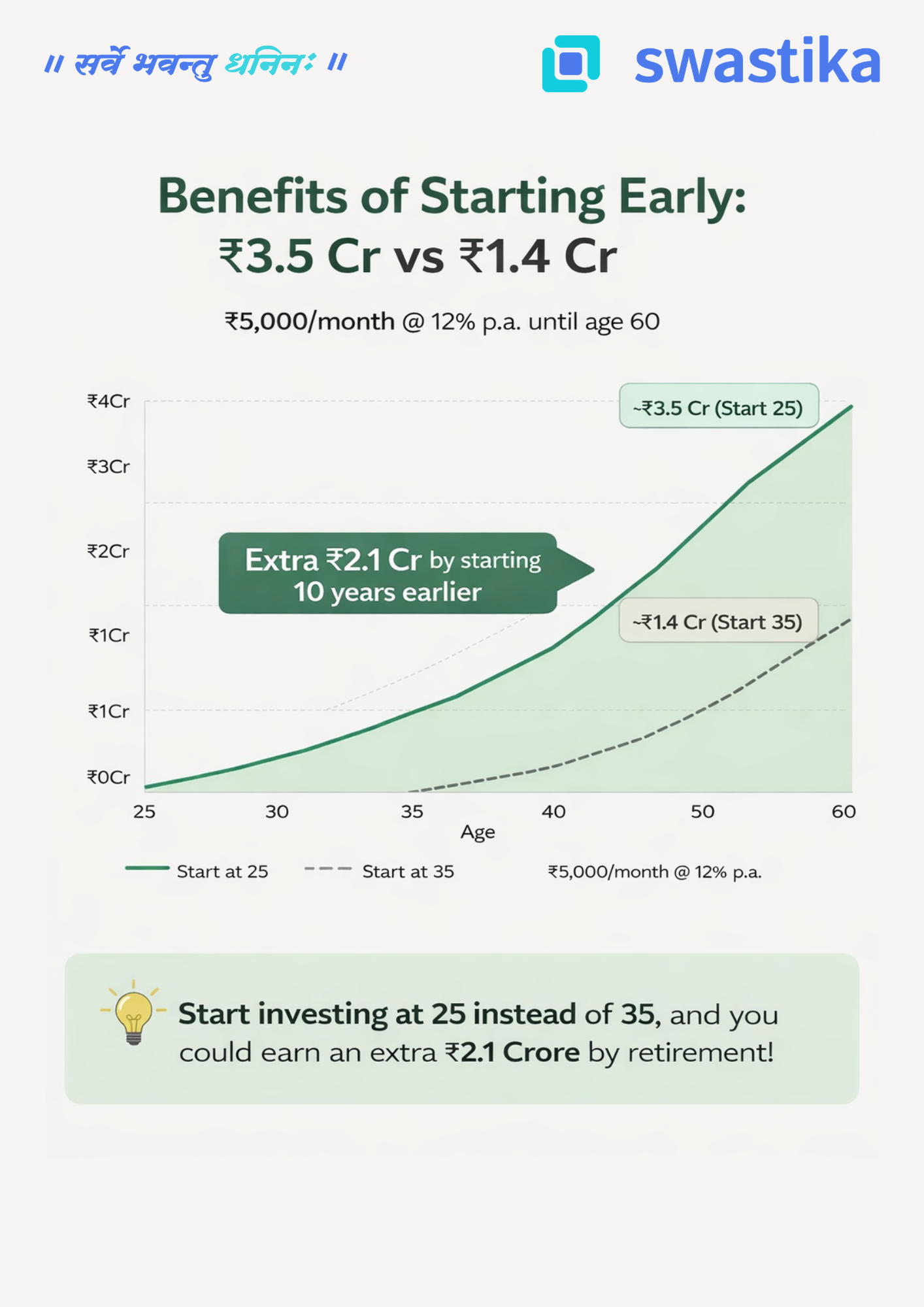
The more years you give your money to grow, the more dramatic — and life-changing — the results become. This is exactly why starting your investment journey early, even with a modest amount, can make a difference of crores by the time you retire.
A Tale of Two Investors: Arjun vs Priya
Let's bring this concept to life with a simple, real-world example.
Meet Arjun and Priya. Both are sensible, disciplined investors. Both invest ₹5,000 every month through a SIP (Systematic Investment Plan) in equity mutual funds, earning an average annual return of 12%. Both stop investing at age 60.
The only difference? Arjun starts at 25. Priya starts at 35.
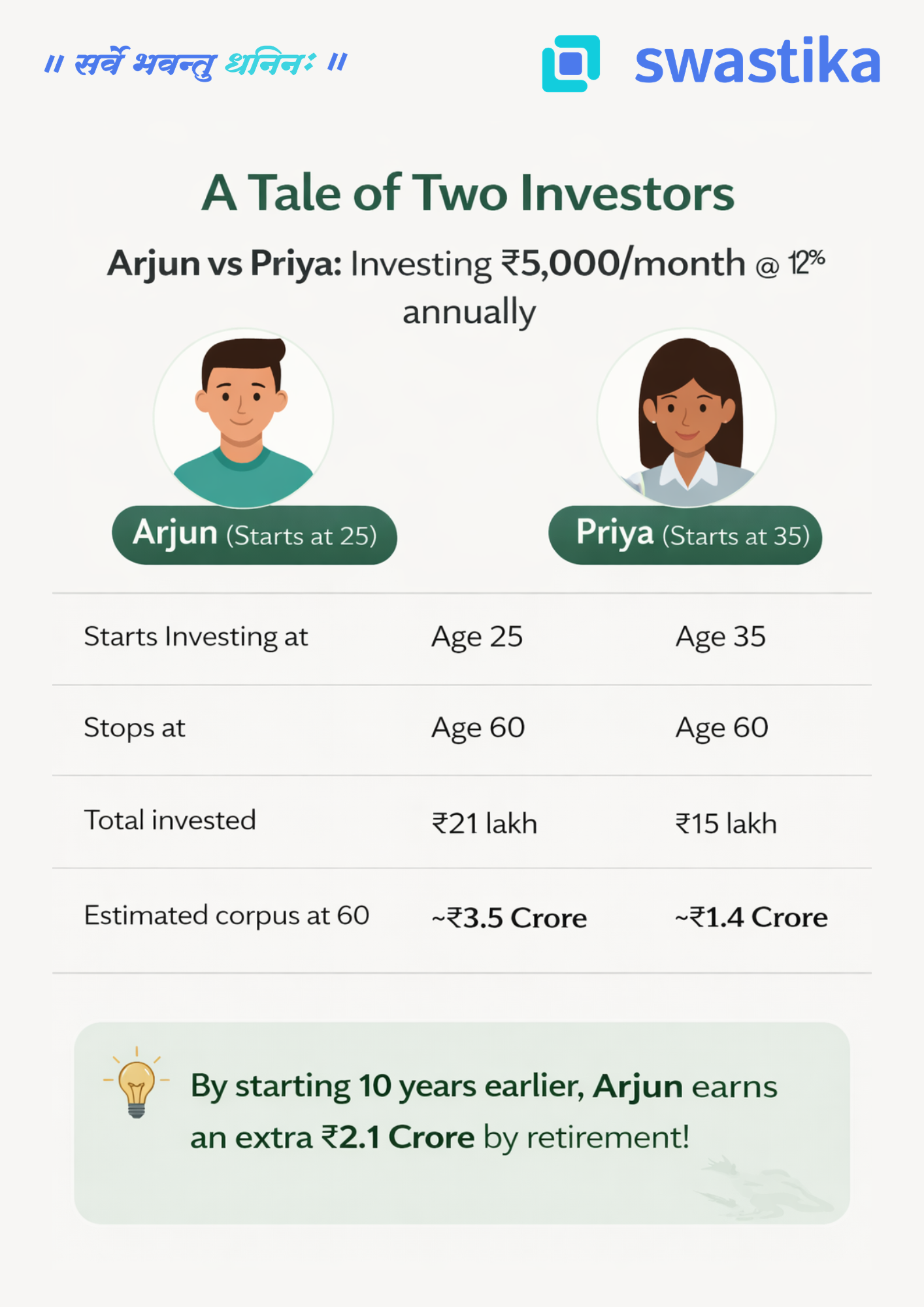
The numbers are striking. Arjun invests just ₹6 lakh more than Priya in absolute terms — yet walks away with ₹2.1 Crore more at retirement.
That extra ₹2.1 Crore didn't come from investing more aggressively or taking bigger risks. It came purely from starting 10 years earlier.
Why Does Time Make Such a Huge Difference?
This is where the magic of compounding reveals itself.
In the early years of investing, growth looks modest and almost unimpressive. But as the years pass, your corpus grows not just on your original investment, but on all the accumulated returns from previous years. The curve goes from almost flat to steeply exponential — and that steep climb happens in the later years.
When Arjun starts at 25, his money has 35 years to ride that exponential curve. Priya's money, starting at 35, only catches the last 25 years — and critically, it misses the steepest part of the climb in the final decade.
Think of it this way: the last 10 years of compounding are worth more than the first 20. That is the counterintuitive truth at the heart of long-term investing.
The Real Cost of Waiting
Many young earners tell themselves, "I'll start investing once I'm more settled — once the salary improves, once the EMI is paid off, once life is a bit easier."
But the numbers show that every year of delay is extraordinarily expensive — far more expensive than any EMI or lifestyle expense. Priya didn't invest carelessly. She invested faithfully for 25 years. Yet she ends up with less than half of what Arjun accumulated — not because she did anything wrong, but simply because she started a decade late.
The cost of waiting 10 years wasn't ₹6 lakh in additional contributions. The cost was ₹2.1 Crore in lost wealth.
Three Principles to Remember
1. Start now, not later.The best time to start investing was yesterday. The second best time is today. Even a SIP of ₹1,000–₹2,000 per month in your 20s is infinitely better than waiting for the "right time."
2. Consistency beats intensity.You don't need to invest large sums all at once. A small, steady, monthly commitment — maintained without interruption — is what unlocks the full power of compounding over decades.
3. Stay invested through market cycles.Compounding works only if you let it work. Exiting during market corrections or stopping your SIP in tough months breaks the chain. Time in the market, not timing the market, is what builds wealth.
The Bottom Line
If you are in your 20s or early 30s, you hold an asset that no amount of money can buy later: time. Use it. Start a SIP today — even a small one. Let compounding do its slow, steady, powerful work.
Because the difference between starting at 25 and starting at 35 is not just 10 years. As Arjun and Priya's story shows, that difference is ₹2.1 Crore.
Big Budget










.webp)
.webp)
.webp)
.webp)
.webp)
















.webp)
.webp)
.webp)
.webp)
Latest Articles

कमजोर अमेरिकी आंकड़ों से कीमती धातुओं को सपोर्ट।


कीमती धातुओं के भाव में पिछले सप्ताह के शुरुवात में गिरावट रही लेकिन, अक्षय तृतीया से पहले भाव कम होने से इनमे निचले स्तरों से खरीदारी देखने को मिली है। घरेलु बाज़ारो में सस्ते भाव पर मांग रहने के अलावा वैश्विक अर्थव्यवस्था में गिरावट की आशंका से कीमती धातुओं को निचले स्तरों पर सपोर्ट है। ग्लोबल ग्रोथ में कमी की आहट अमेरिका के आर्थिक आकड़ो में दिखाई देने लगी है।
पिछले सप्ताह में अमेरिका से जारी जीडीपी के आंकड़े ने कुछ निवेशकों को सुरक्षित-संपत्ति की ओर आकर्षित किया है। अमेरिकी अग्रिम जीडीपी के आंकड़े 1.1 प्रतिशत अनुमान के विरुद्ध -1.4 प्रतिशत रहे जो वैश्विक विकास में मंदी की ओर संकेत कर रहे है।हालाँकि, सितंबर 2021 के बाद से सोने की सबसे बड़ी मासिक गिरावट देखि गई है क्योंकि अमेरिकी फेडरल रिजर्व द्वारा आगामी बैठक में ब्याज दरों में आक्रामक रूप से वृद्धि की उम्मीद है, बैठक इस सप्ताह 3-4 मई को होने वाली है।
फ़ेड द्वारा ब्याज दर वृद्धि के कारण कीमती धातुओं में बने दबाव, कमजोर अमेरिकी जीडीपी आकड़ो से घटता हुआ दिखाई दे रहा है। फेड नीति निर्माता 2022 में ब्याज दरों में वृद्धि की गति को तेज करने की योजनाओं को बना रहे हैं। हालांकि, आर्थिक मंदी से बचने के लिए यह गति कितनी तेज होनी चाहिए, इस पर अभी तक सहमति नहीं बन पाई है। डॉलर, जो आमतौर पर सोने के विपरीत होता है, पिछले सत्रों के दौरान विरोधी मुद्राओं के मुकाबले 20 साल के उच्च स्तर पर पहुंच गया है, जिससे ऊपरी स्तरों पर कीमती धातुओं के भाव में दबाव है।
प्रमुख आंकड़े:
इस सप्ताह अमेरिका से जारी होने वाले आर्थिक आंकड़े कीमती धातुओं के भाव पर असर डालेंगे जिनमे, सोमवार को आईएसएम मैन्युफैक्चरिंग पीएमआई, मंगलवार को जोल्ट्स जॉब ओपेनिंग, बुधवार को फ़ेडरल रिज़र्व की बैठक, एडीपी नॉन फार्म एम्प्लॉयमेंट चेंज, गुरुवार को ब्रिटैन की मौद्रिक नीति और शुक्रवार को अमेरिकी पैरोल के आंकड़े महत्वपूर्ण है।
तकनिकी विश्लेषण:
सोने और चांदी के भाव में इस सप्ताह सुधार आने की सम्भावना है। सोने में 50800 रुपये पर सपोर्ट है और 52300 पर प्रतिरोध है। चांदी में 63500 रुपये पर सपोर्ट और 66500 रुपये पर प्रतिरोध है।

10 Key Things You Need to Keep in Mind While Picking a Small Cap Stock
How accurately do you define small-cap stocks in the context of India? There are various definitions, but large-capitalization is a term used to classify companies with relatively small market capitalization.
For your safety, you can easily consider stocks with a market capitalization of Rs 2000 to Rs 5000.
Of course, you need to do your homework before investing in these stocks online, but here are 10 things to check when buying small-cap stocks in the stock market.
1) Time Horizon
Before buying any stock, you exactly need the time horizon as it will help you decide up to what time you should hold the stock.
Time horizon can be divided into three types:
Short Term
An investment that you need to hold for 1 year comes in the short term. If you want to buy stocks that come under the short term horizon, then it would be best to invest in stable blue-chip stocks which give you good investments. These stocks hold a good balance sheet and also possess minimum risks.
Middle Term
People who want to invest in the middle term should invest in emerging market stocks and have a moderate level of risk.
Long Term
Long term investment stocks have the ability to generate long term stock market trading returns and have to recover if their prices go down due to volatility.
2) Check the Past Performance
Small-Cap stocks are the ones that have a small market capitalization. Hence it is important to check the past record of any small-cap companies. Since the company stocks carry high risks, you need to carefully examine the stock’s fundamental analysis and technical analysis before selecting any stock.
Therefore it is suggested to invest in the small case stocks that have a good track record i.e. at least of 5 years.
3) Investment Strategy
Before selecting any small case stock, you need to focus on the strategies which are used by most investors:
Value Investing
Value investing is mainly used by giant investors like Warren Buffet. This type of investing refers to the company stocks that are undervalued compared to peers in a hope of gaining good stock trading returns.
Growth Investing
In growth investing, people invest in stocks that show huge growth in terms of revenue and earnings. Investors firmly believe that any upward trend in these stocks will generate huge profits.
Income Investing
Income investing in the stocks that pay you high dividends. These are quality stocks and are investors’ favorites because the income generated by these stocks can be reinvested for higher earnings.
4) Focus on Consistent Performance
Sometimes consistency matters more than absolute performance, especially in the case of small-cap stock.
Hence it is suggested to invest in the companies that have shown growth and have a good past track record and neglect the companies which have shown poor performance. It has been seen that the consistent small-cap achieves better valuations than the other small-cap stocks.
5) Look at the Fundamentals
It is good to check the fundamentals before buying any stock:
Price to Earnings Ratio
The ratio refers to the stock price with respect to the company’s earnings on an annual basis. For instance, if a company is trading at Rs 20 per share that generates EPS of Rs 1 on annual basis; that means the share price is 20X times the company's earnings calculated annually.
Debt to Equity Ratio
Debt to equity ratio tells how much the company is in debt. It is to be noted that high debt is bad as it leads to bankruptcy.
Price to Book Value Ratio
The ratio compares the stock price to the net value of assets that are owned by the company which is then divided by the number of outstanding shares.
6) Pay Attention to Market Size and Positioning
Small-cap companies are those that have a single product or single service as they don't have much capital to expand their business. In this case, the size of the market matters a lot. Also, the company’s position in the stock market highly matters as it makes a countable difference to company valuations.
7) Check the Dividends
A dividend refers to a portion of profits companies share with their shareholders. They distribute profits in the form of dividends. Investors who are interested in dividend stocks should check the dividend history of the companies before going for any stock.
8) Check Contingent Liabilities and Auditor Qualifications
Contingent liabilities mean pending legal cases, open derivative exposures etc. Small-cap companies generally have contingent liabilities. Hence it is important to check whether a company is involved in any legal cases or not.
In addition to this, you need to check whether the auditor is not qualified or the auditor resigns from their position.
9) Volatility
Volatility badly affects small-cap stocks. The small-cap stocks with high volatility will rise on bullish days and fall drastically when the market gets into a bearish mode.
10) Keep Track of Cash Flow Statements
It is important to check the cash flow statements, especially in the case of small-cap stocks. As the small-cap stocks generally lie under liquidity constraints which means that the small-cap stocks are unable to manage their working capital effectively.
The Bottom Line
Small-cap stocks are highly volatile which makes them full of risks. It makes it difficult for investors to trade in small-cap stocks. However, you can select good small-cap stocks if you use these factors for stock trading.

Savings Vs Investing: Which One is Ideal Choice for a Beginner
Savings vs Investing: Which one is an ideal choice for a beginner? This question has been asked by thousand of people. The term saving and investing look similar to each other and hence most of the time they are used interchangeably. But if you get deep down into it, you will know that there is a thin line between the two terms.
People who are new to savings and investing should know the fundamentals of the two essential processes. Here, a simple question arises: should you start saving or investing or do both together?
In this blog, we will unlock the concepts of both savings and investing.
What is Savings?
Savings means the leftover money one deducts after the expenditure from their income.
Savings= Income - Expenditure
Saving money provides a sort of financial security as it will help people use them in case of emergencies and needs. Also, they can use this money for investments.
How to Start Savings?
Savings are usually done by putting money in monthly and yearly plans.
- Post Office Monthly Savings Schemes
- Public Provident Fund (PPF)
- National Pension Scheme
You can use any type of government-backed saving plan because of sudden huge expenses that go unrecorded. Hence, you are required to make a proper plan to save regularly and effectively.
The best possible way to start saving is by budgeting.
A budget is a plan of action that helps one to cut down several expenses and help him limit his spending on unnecessary expenditures.
If one is unsure about the limits of spending, you can use the following thumb rule 50-30-20 to start budgeting.
You can alter this rule as per your requirements and goals.
Pros and Cons of Savings
Pros
Savings remains unaffected by any events in the economy. Since it's not an invested amount, you can achieve your objectives as per the fixed schedule and a fixed amount.
Saving is the initial step toward investment. Also, it helps you to save money for your goals too in the most disciplined manner.
Cons
Because of the inflammation, the purchasing power of money can get reduced. Hence it can be suitable for short term tasks only.
Most savings plan offers low to moderate interest rates which can't be enough to beat the inflation rate.
One should use savings only if -
- You are saving for short term goals that don't require a huge amount of money.
- You are saving for the emergency fund.
- You don't have any immediate debt obligations.
What is Investing?
Although saving is necessary for financial security, there is another fundamental process for building wealth. I,e Investing.
Investing is the process of -
- Finding the fundamental goals.
- Researching the financial goals.
- Allocating our savings to create more wealth aiming at those goals.
How to Begin Investing?
As savings are usually done with government schemes, investing is mainly done through the stock market and mutual funds.
Investing is quite complex compared to savings, however with the right kind of knowledge, one can easily invest in the stock market through stock trading.
Investment should be classified as short term, medium and long term goals. Also, it depends on one’s risk appetite.
What is a Risk?
Risk is the amount you can afford to lose. It’s also known as an investor’s risk appetite.
Before investing in any stocks, you need to do a complete analysis of a company: fundamental analysis and technical analysis.
Fundamental Analysis: It is the process of analyzing the financial status of a company and the industry in which it is operating to make any investment or trading decisions.
Technical Analysis: Through technical analysis, you can analyze the charts with the help of patterns and indicators which are in turn used to find out the possible price trends in the future.
Pros and Cons of Investing
Investing helps you to combat inflationary pressure. Investing in the equity segment can make your money grow at a faster rate so that it can beat inflation in the future.
Investing beats inflation with a unique feature which is known as compounding of wealth. Hence, the earlier you invest, the more of your earnings will multiply with the passage of time.
Due to the growth of wealth, you don’t require to set as much money for a goal as compared to simply saving money.
Cons
Investing needs adequate knowledge, strong analytical skills and emotional intelligence. It requires a lot of practice to become a skillful investor.
Investments can be affected by a variety of factors such as company results, and economical events.
Hence, before investing your money in any financial instrument, one needs to study all the necessary factors for wealth building.
What is the Right Time to Invest?
Well, if you want to make your financial future secure, then investing is something that comes second to none.
The advantage that comes into play, you need to invest money for a long term of at least 10 years.
Therefore, one should choose to invest when -
- You are saving up for a goal for which you will need money for at least 10 years such as child marriage, retirement etc.
- There is a fall in the interest rates offered by the bank deposits and monthly savings plans.
Should You Save and Invest Together as a Beginner?
Here is an important point to note savings come before investing and never together. This is because, how will you invest if you don't save money for it.
If you are a beginner, who wants to save or invest money will be someone who has just started earning money.
If you are stuck in a situation, then you need to clear financial objectives and goals first. Once the habit of discipline is built, a beginner will find it to maintain that discipline for the investment as well.
The Bottom Line
Saving and investing are two terms that are interrelated with each other. Beginners who want to build their wealth, need to save their money first, build a successful financial plan and move on.
If you are one of those who have little or less idea about investing, then it's the right time to go for wealth managers as they will assist you in finding your goals and achieving them. There are many stockbroking firms that help people find their paths in investing.

आर्थिक एवं भू राजनितिक जोखिम से तेज़ कीमती धातुए।
अपेक्षा से अधिक मुद्रास्फीति के आंकड़ों से सोने की कीमते कॉमेक्स वायदा में 1980 डॉलर प्रति औंस के स्तर तक पहुंच गई है। प्रमुख अर्थव्यवस्थाओं के मुद्रास्फीति आकड़ो में बढ़ोतरी दर्ज की गई है जबकि अमेरिकी मुद्रास्फीति मार्च माह में कम होने के बाद भी साल -दर साल बढ़ी है जिससे यह 40 साल की उचाई पर बरक़रार है।
बढ़ती हुई मुद्रास्फीति के बीच तेज़ी से ब्याज दर बढ़ोतरी और बैलेंस शीट में कटौती, चिंता का विषय है। जिसके कारण अमेरिका के साथ वैश्विक अर्थव्यवस्था क्षतिग्रस्त हो सकती है इसलिए कीमती धातुओं के साथ अमेरिकी बांड यील्ड और डॉलर इंडेक्स में बढ़ोतरी देखी जा रही है। कच्चे तेल के भाव में तेज़ी फिर से दिखाई देने लगी है और ब्रेंट तेल के भाव पिछले सप्ताह में 8 प्रतिशत तेज़ हो कर 111 डॉलर प्रति बैरल पर पहुंच गए है जो मुद्रास्फीति में सपोर्ट करेंगे।
भू -राजनीतिक जोखिम, कोविड वापसी की दस्तक और महामारी के कारण छोटे देशो की चरमराती हुई अर्थव्यवस्था सोने और चांदी के भाव को सपोर्ट कर रही है। घरेलु वायदा बाजार में सोने के भाव पिछले सप्ताह 1.8 प्रतिशत तेज़ हो कर 53000 रुपये प्रति दस ग्राम के स्तरों पर पहुंच गए है और चांदी के भाव 3 प्रतिशत तेज़ हो कर 69000 रुपये प्रति किलो के स्तरों पर पहुंच चुके है। इस सप्ताह के लिए चीन से जारी होने वाले आर्थिक आंकड़े, फेड प्रमुख जेरोम पॉवेल का बयान, अंतर्राष्ट्रीय मुद्रा कोष की बैठक और फ्रांस राष्ट्रपति के चुनाव सोने और चांदी की कीमतों के लिए महत्वपूर्ण रहेंगे।
तकनीकी विश्लेषण
इस सप्ताह सोने और चांदी के भाव तेज़ रह सकते है। जून वायदा सोने में 52500 रुपये पर सपोर्ट और 53300 रुपये पर प्रतिरोध है। मई वायदा चांदी में 68000 रुपये पर सपोर्ट और 70000 रुपये पर प्रतिरोध है।

Upcoming IPOs in India 2022 That You Need to Know
What are the Upcoming IPOs in 2022
The year 2021 was a remarkable year for India as the country raised more growth post-pandemic. Many companies went public in 2021 which was considered the major breakthrough of IPOs and SME IPO in the Indian stock market history. This year, many upcoming IPOs in 2022 are ready to hit the primary market.
However, there were some cases where IPOs such as Paytm experienced the biggest stock crash. If we talk about the year 2022, many companies are expected to go public as a result many of them have already submitted DRHP to SEBI.
It has been seen that SEBI has shown a lot of flexibility in approving DRHP, however, the companies make delays in launching their IPOs.
Here, we will mention some of the IPOs that will come in April 2022:
LIC IPO was all set to launch in the first month of this year, but somehow it got postponed. The primary reason behind the sudden delay of the LIC IPO is the Russia-Ukraine war.
Now, many sources have confirmed that the LIC IPO will come out on 12 May 2022.
Although a large number of companies are ready to go public, LIC IPO is the one that everyone has an eye on.
Here, we will figure out which companies are likely to go public in April 2022
Company NameIPO Size (Approx)Expected IPO DateLIC IPO Rs 66000 CroreApril/May 2022National Stock ExchangeRs 10000 CroreApril 2022Oyo RoomsRs 8,430 CroreApril 2022DelhiveryRs 7,460 CroreApril 2022Ola CabsRs 7,300 CroreApril 2022PharmeasyRs 6,250 CroreApril 2022Bajaj EnergyRs 5,450 CroreApril 2022Emcure PharmaceuticalsRs 4,500 CroreApril 2022Go AirlinesRs 3,600 CroreApril 2022BoAt ElectronicsRs 3,500 CroreApril 2022Droom TechnologiesRs 3000 CroreApril 2022Jana Small Finance BankRs 2000 CroreApril/May 2022MobiKwikRs 1900 Crore April/ May 2022Arohan Financial BankRs 1800 CroreApril/ May 2022Northern Arc CapitalRs 1800 CroreApril/ May 2022IxigoRs 1600 CroreApril/ May 2022Utkarsh BankRs 1350 CroreApril/ May 2022Penna CementRs 1,550 CroreApril/ May 2022Fincare Small Finance BankRs 1,330 CroreApril/ May 2022Paradeep PhosphatesRs 1,225 CroreApril/ May 2022Sterlite PowerRs 1,250 CroreApril/ May 2022ESAF Small Finance BankRs 998 CroreApril/ May 2022Hexagon NutritionRs 600 CroreApril/ May 2022Skanray technologiesRs 400 Crore + OFSApril/ May 2022ESDS SoftwareRs 322 Crore + OFSApril/ May 2022
List of Upcoming IPOs in India 2022
Here, we present a quick snapshot of the upcoming IPOs in India 2022 that will hit the primary market in April 2022
1) National Stock Exchange
NSE is expecting to hit the primary market in April. This is because the top stock exchange company has received approval from SEBI to launch its IPO. According to SEBI guidelines, NSE cannot launch its IPO on the platform itself, hence NSE is seeking multiple listings on BSE and on other international platforms.
2) OYO Rooms
OYO Rooms is considered India’s one of the largest hospitality startups in the area of digital room business. The company submitted its DRHP to SEBI last year. Hence, it is looking forward to launching its IPO in the current month.
With the IPO, the company is planning to raise a capital of Rs 8,430 Crore. Of which, Rs 7000 Crore will be counted at freshly issued shares and the rest is through OFS.
3) Delhivery
India’s new-age logistics company is planning to launch its IPO of Rs 7,460 Crore. The IPO will come with a fresh issue of Rs 5000 Crore and OFS of Rs 2460 Crore.
4) Ola Cabs
India’s largest local cab booking service is planning to go public with an Rs of Rs 7,300 Crore. Since Ola filed for DRHP months ago, the company has decided to hold its pre-planned IPO for the next few months. Ola has selected City bank group, and Kotak Mahindra bank to manage its IPO.
5) PharmEasy
It is an online portal that connects the pharma store and customers together and is considered the largest retailer in the pharma industry. PharmEasy also provides doctor consultations and online prescriptions.
6) Bajaj Energy
Bajaj energy is a renowned thermal power generating company as it helps manage, develop, manage, and finance many thermal power plants in India. As per the DRHP filed with Bajaj Energy, the company is planning to raise Rs 5,450 Crore through its IPO.
7) Emcure Pharmaceuticals
Emcure Pharmaceuticals is a well-known name in the pharmaceutical industry. The company is planning to raise its IPO of Rs 4500 Crore of which Rs 1,100 Crore by way of fresh issue and Rs 3,400 Crore for OFS.
8) Go Airlines
Go Airlines or Go Air is an ultra-low-cost airline based in Mumbai. The company hit the headlines just after it decided to launch its IPO of Rs 3,600 Crores. The public offer will include only a fresh issue of equity shares with a face value of Rs 10 per equity share.
9) boAt Electronics
boAt electronics has marked its name in the audio equipment and wearable industry. Its products include headphones, earphones, wireless speakers, wearables etc. The company now has decided to go public with an IPO of Rs 2000 Crore.
The lead managers of boAt IPO are Axis Capital, BofA Securities, Credit Suisse Securities and ICICI Securities.
10) Droom Technology Limited
Droom Technologies is a data science company that facilitates the transaction of automobiles through an online platform. The company has filed its DRHP regarding its IPO of Rs 3000 Crore. Of the total amount, the fresh issue comprises Rs 2000 Crore and Rs 1 Crore is for OFS.
Takeaway
The IPO boom is still on as many companies are seeking expansion and growth. After the 1st pandemic, many of them had gone through heavy losses and hence they are planning to launch an IPO to clear their debt and increase profitability for the organization.
The primary market acts as a boon for investors as they gain huge profits from the IPO release. Beginners also book profit from these IPOs by purchasing a “LOT” but most of them feel nervous as they are new in the stock trading arena.

Lot Size in Options Trading
What is a Lot Size in Options Trading
The lot size plays a significant role in Futures and Options trading. If you need to get a clear understanding of Futures and Options, lot size is the primary concept you need to go through.
In this blog, we will figure out what a lot size is and how different derivative contracts have different lot sizes.
What is a Lot Size?
A lot size refers to a fixed quantity of shares one can buy or sell as per the contracts.
If you have been into trading for more than 6 months or more, you may have heard that a company has x number of lot sizes. This simply means that the company has fixed its shares a lot.
The Security and Exchange Board of India decides the lot size of stocks and indices that are traded on NSE and BSE. For instance, Nifty Future has a lot size of 50 which means if someone wants to buy Nifty Futures, he wants to trade in the multiple of 50 as the lot size of Nifty is 50.
Like Nifty Futures, equity futures also have a lot of sizes. For example, Reliance Futures has a lot size of 250. If someone buys a lot of Reliance Futures which are currently trading at Rs 5500, that means the value of Reliance Futures is 250*5500=1,375,000
How are Futures and Options' Lot Size Decided?
SEBI is the apex body that decides the lot size of each company that is involved in stock trading. When Futures and Options trading came into existence, it was the regulatory body that had decided the notional value of Rs 2,000,00.
After deciding the notional value, SEBI fixes lot size to a certain number that would value more than 2 Lakh when multiplied by the market value. It was done to save the losses of small investors who try Futures and Options.
When SEBI noticed that more lots were purchased by the retail investors, it revised the lot value to Rs 5 Lakh. New additions were introduced after F&O, which kept the lot value to Rs 7.5 Lakh.
Also, the proposal came in front of SEBI to change the value of lot size to Rs 10 Lakh so that only risk-bearing investors can trade in the F&O.
Why are Lot Sizes Modified?
When SEBI notices any major changes in the value of shares that would make significant divergence with the lot values, the regulator revises the lot sizes.
Let’s understand with an example: XYZ company has a lot size of 1500. The F&O trading price is Rs 555, hence the lot value is Rs 8,32,500.
Suppose the trading price of a share rises up to Rs 1000. As per the fixed lot size, the total value of the lot will become Rs 15 lakh which will be a big divergence from the decided lot value.
By seeing the case, the stock market regulator may take action to revise the lot size to a downward price which would be a better reflection of the lot value.
The reverse case also happens. In these types of cases, the lot size has been revised upward so that it is more compatible with the indicative value.
Purpose of Lot Size in Options Trading
The primary reason to trade in lots in F&O is standardization. The standardization can be done in several ways. Futures and Options across indices come with 1 month, 2 months, and 3 months tenure.


.webp)
.webp)

.webp)






START YOUR INVESTMENT JOURNEY
Get personalized advice from our experts
- Dedicated RM Support
- Smooth and Fast Trading App
