

Common Mistakes New Investors Make and How to Avoid Them.




Key Takeaways
- Emotional decisions often lead to poor investment outcomes
- Lack of research and overconfidence can damage long-term returns
- Ignoring diversification increases risk significantly
- A disciplined and informed approach is key to successful investing
Why New Investors Often Struggle
Entering the stock market can feel exciting, especially when you see others making quick profits. But the reality is different. Many new investors end up making avoidable mistakes that hurt their returns.
In India, with increasing participation in markets regulated by the Securities and Exchange Board of India, first-time investors have more access than ever. Yet access without understanding can lead to costly errors.
Let’s look at the most common mistakes and how you can avoid them.
Investing Without a Clear Goal
The Mistake
Many beginners invest without knowing why they are investing. They buy stocks based on trends, tips, or social media hype.
How to Avoid It
Start with a clear objective:
- Wealth creation
- Retirement planning
- Short-term goals
For example, if you are investing for retirement, your strategy will be very different from someone trading for short-term gains.
Following the Herd
The Mistake
Buying stocks just because everyone else is buying is one of the biggest pitfalls. This often leads to entering at high prices and exiting at losses.
How to Avoid It
Do your own research. Understand the business, financials, and future potential before investing.
A stock trending online does not always mean it is fundamentally strong.
Ignoring Diversification
The Mistake
Putting all your money into one or two stocks can be risky. If those stocks underperform, your entire portfolio suffers.
How to Avoid It
Diversify across:
- Sectors
- Asset classes
- Market caps
For instance, combining banking, IT, and FMCG stocks can help balance risk.
Trying to Time the Market
The Mistake
Many new investors try to buy at the lowest price and sell at the highest. In reality, this is extremely difficult, even for experienced investors.
How to Avoid It
Focus on long-term investing. Systematic Investment Plans and regular investing can reduce the impact of market volatility.
Lack of Patience
The Mistake
Expecting quick returns often leads to disappointment. Markets do not move in a straight line.
How to Avoid It
Give your investments time to grow. Wealth creation is a gradual process.
For example, investors who stayed invested during market corrections have historically benefited from long-term growth.
Not Understanding Risk
The Mistake
Many beginners invest without assessing their risk tolerance. This leads to panic during market corrections.
How to Avoid It
Understand your risk appetite before investing. If you are uncomfortable with volatility, consider a balanced approach with both equity and debt.
Overtrading
The Mistake
Frequent buying and selling increases transaction costs and reduces overall returns.
How to Avoid It
Invest with a clear strategy. Avoid unnecessary trades unless there is a strong reason.
Ignoring Financial Ratios and Fundamentals
The Mistake
Investing without analyzing company fundamentals can lead to poor stock selection.
How to Avoid It
Learn basic metrics like:
- Price to Earnings ratio
- Return on Equity
- Debt levels
These indicators help evaluate the quality of a company.
Not Having an Exit Strategy
The Mistake
Many investors know when to buy but not when to sell.
How to Avoid It
Set clear exit rules:
- Target price
- Stop loss
- Change in fundamentals
This helps protect profits and limit losses.
Real-World Example
Consider a new investor who buys a stock based on a tip without research. The stock rises initially, but when it corrects, the investor panics and sells at a loss.
Now compare this with an investor who studies the company, invests gradually, and holds for the long term. The second approach is more likely to generate consistent returns.
Impact on Indian Markets
The rise of retail investors has significantly changed market dynamics. While this increases liquidity, it also brings volatility when decisions are driven by emotions rather than fundamentals.
Regulators like the Securities and Exchange Board of India continue to promote investor awareness and protect market integrity. However, the responsibility of making informed decisions lies with the investor.
Why Guidance Matters
Investing is not just about buying stocks. It is about understanding markets, managing risk, and staying disciplined.
Platforms like Swastika Investmart offer research-backed insights, advanced tools, and strong customer support to help investors make better decisions.
With SEBI-registered services and a focus on investor education, Swastika Investmart helps bridge the gap between information and action.
Frequently Asked Questions
What is the biggest mistake new investors make?
The most common mistake is investing without proper research or clear goals.
Is it safe to follow stock tips?
Relying solely on tips can be risky. It is better to do your own analysis before investing.
How important is diversification?
Diversification helps reduce risk and protects your portfolio from major losses.
Can beginners time the market?
Timing the market consistently is difficult. A long-term approach is more effective.
How can I avoid emotional investing?
Having a clear plan and sticking to it can help reduce emotional decision-making.
Conclusion
Every investor makes mistakes, especially in the beginning. What matters is learning from them and improving your approach.
By setting clear goals, diversifying your portfolio, and staying disciplined, you can avoid common pitfalls and build long-term wealth.
If you are looking to start your investment journey with expert guidance, research-driven insights, and a reliable platform, you can begin here:
Big Budget





.avif)
.avif)
.avif)
.avif)
.avif)













.avif)
.avif)
.avif)
.avif)
Latest Articles

Venus Pipes Limited IPO


Venus Pipes & Tubes Limited (“Venus Pipes”) was incorporated on February 17, 2005. Venus Pipes is a pipes and tubes manufacturer with the sole focus on manufacturing welded and seamless pipes in a single metal category, i.e., stainless steel.
- The company manufactures stainless steel tubular products in 2 broad categories: (i) seamless tubes/pipes; and (ii) welded tubes/pipes.
- Under their brand name “Venus”, they supply their Products for applications in diverse sectors including Chemicals, Engineering; Fertilizers; Pharmaceuticals, Power, Food Processing; Paper; and Oil and Gas.
- Venus Pipes has one manufacturing plant which has separate seamless and welded divisions with the latest product-specific equipment and machinery. As of February 28, 2022, their Manufacturing Facility has a total installed capacity of 10,800 MTPA. They are proposing to expand their existing manufacturing capacity for welded pipes/tubes and seamless pipe/tubes.
- As of February 28, 2022, they have exported their products to 20 countries including Brazil, the UK, Israel and countries in the European Union, etc.
Outlook & Valuation
The company has grown well in the last three financial years due to improvements in the commodity cycles and high steel prices. The company’s current capacity utilization is above 90% and the company expects to more than double its capacity using the SME IPO proceeds. Further, they also plan to set up a piercing line for manufacturing hollow pipes with the capacity of 800 MT per month, as their backward integration strategy.
With the piercing plant, they will be able to produce hollow pipes from the SS round bar. Their products are largely used in industries like pharmaceuticals, food processing, etc. The GoI has announced Production Linked Incentive (“PLI”) schemes for boosting the domestic manufacturing in certain sectors, which shall have a consequent positive impact on their order book.
And schemes like Make in India, and Atmanirbhar Bharat that focus on indigenous manufacturing augur well for the company. China export rebate cessation and BIS norms provide industry tailwinds. The company has priced the issue at a P/E of 21.03 based on annualized numbers for FY22 which is slightly above its industry median P/E. Further, the commoditized & cyclical nature of the business and small issue size makes this issue suitable for aggressive investors only with a long term view.
KEY MANAGERIAL PERSONNEL
- Jayantiram Motiram Choudhary is the Chairman, Non-Executive Director and one of the Promoters of the company. He has been associated with the company since its incorporation. He has over 10 years of experience in the steel industry and over 4 years of experience as a director of Accuracy Shipping Ltd.
- Arun Axaykumar Kothari is the Promoter, Managing Director and CFO of the company. He has been associated with the company since September 14, 2021. He looks after and manages the entire accounting and financial operations of the company and is responsible for setting processes, systems and procedures in place to control and streamline the financial and commercial transactions of the Company.
- Pavan Kumar Jain is the Company Secretary and compliance officer. He has also been associated with the company since August 18, 2020. He has around 3 years of experience in finance, accounting and secretarial work.
- Kumar Shishir C Sinha is the president (marketing) of the company. He has been associated with the company since March 01, 2021. He has over 30 years of experience in stainless steel pipes and tubes.
- Kunal Bubna is the president (finance and accounts) of the company. He has been associated with the company since July 01, 2021. He has over 14 years of experience in accounting and secretarial work.
- Bharat Kumar Prajapati is the production head of the company. He has been associated with the company since September 02, 2020. He has over 20 years of experience in the pipe industry.
- Om Prakash Mishra is the vice-president (operations) of the company. He has been associated with the company since December 13, 2021. He has over 23 years of experience in the manufacturing industry.
COMPETITIVE STRENGTHS
- International Accreditations and product approvals
- Specialized production of Stainless Steel Pipes and Tubes
- Multi-fold demand of the Products
- Customer Diversification
- A key beneficiary of CAPEX in the chemical and engineering sector
- Venus supplies high-quality pipes for industrial use (B2B) and does not cater to the lower-end market of domestic furniture, retail, etc.
KEY STRATEGIES
- Increasing existing capacity
- Backward integration and cost optimization to improve margins
- Tap new geographies to increase export
- Continue to improve operating efficiencies through technology enhancements
KEY CONCERNS
- The issue size is too small.
- Valuation is on the higher side.
- Cyclical and commoditized industry
- Highly competitive industry.
COMPARISON WITH LISTED INDUSTRY PEERS (AS OF 31ST MARCH 2021)
Name of the CompanyEPS (Basic)NAVP/ETotal Income (Cr)RoNW (%)Venus Pipes & Tubes Ltd18.0430.4828.01312.059.18%Jindal Saw Ltd10.02218.399.6910,872.04.69%Ratnamani Metal & Tubes Ltd59.07425.3541.512,341.513.9%
FINANCIALS (RESTATED CONSOLIDATED)
Particulars (Rs. In Millions)FY 2021FY 2020FY 2019Equity Share Capital8.738.738.73Other Equity31.207.543.44Net Worth39.9316.2812.17Revenue from Operations309.33177.81118.75EBITDA34.7811.648.29Profit Before Tax30.956.494.95Net Profit for the year23.634.133.75
DISCLAIMER:
The information contained herein is strictly confidential and is meant solely for the information of the recipient and shall not be altered in any way, transmitted to, copied or distributed, in part or in whole, to any other person or to the media or reproduced in any form, without prior written permission of Swastika Investmart Ltd. (“SIL”).
The contents of this document are for information purposes only. This document is not investment advice and must not alone be taken as the basis for an investment decision. Before taking any decision to invest, the recipient of this document must read carefully the Red Herring Prospectus (“RHP”) issued to know the details of IPO and various risks and uncertainties associated with the investment in the IPO of the Company.
All recipients of this document must before acting on the given information/details, make their own investigation and apply independent judgment based on their specific investment objectives and financial position. They can also seek appropriate professional advice from their own legal and tax consultants, advisors, etc. to understand the risks and investment considerations arising from such investment.
The investor should possess appropriate resources to analyze such investment and the suitability of such investment to such investor’s particular circumstances before making any decisions on the investment. The Investor shall be solely responsible for any action taken based on this document.
SIL shall not be liable for any direct or indirect losses arising from the use of the information contained in this document and accept no responsibility for statements made otherwise issued or any other source of information received by the investor and the investor would be doing so at his/her/its own risk. The information contained in this document should not be construed as a forecast or promise or guarantee or assurance of any kind. The investors are not being offered any assurance or guaranteed or fixed returns on their investments.
The users of this document must bear in mind that past performance if any, are not indicative of future results. The actual returns on investment may be materially different from the past. Investments in Securities market products and instruments included in the IPO of the Company are highly risky and they are generally not an appropriate avenue for someone with limited resources/ limited investment and low-risk tolerance.
Such investments are subject to market risks including, without limitation, price, volatility and liquidity and capital risks. Therefore, the users of this document must carefully consider all the information given in the RHP including the risk factors before making any investment in the Equity Shares of the Company.
Swastika Investmart Ltd or its analysts did not receive any compensation or other benefits from the companies mentioned in the report or third party in connection with the preparation of the research report. Accordingly, neither Swastika Investmart Ltd nor Research Analysts have any material conflict of interest at the time of publication of this report.
Compensation of our Stock Market Research Analysts is not based on any specific merchant banking, investment banking or brokerage service transactions.
Swastika Investment Ltd may have issued other reports that are inconsistent with and reach different conclusions from the information presented in this report. The research entity has not been engaged in a market-making activity for the subject company. The research analyst has not served as an officer, director or employee of the subject company. We have not received any compensation/benefits from the Subject Company or third party in connection with the Research Report.
Corporate & Administrative Office - 48, Jaora Compound, M.Y.H. Road, Indore - 452 001 | Phone 0731 - 6644000
Compliance Officer: Ms. Sheetal Duraphe Email: compliance@swastika.co.inPhone: (0731) 6644 241
Swastika Investmart Limited, SEBI Reg. No. : NSE/BSE/MSEI: INZ000192732 Merchant Banking: INM000012102 Investment Adviser: INA000009843 MCX/NCDEX: INZ000072532 CDSL/NSDL: IN-DP-115-2015 RBI Reg. No.: B-03-00174 IRDA Reg. No.: 713.

ब्याज दर बढ़ोतरी के संकेतो से सोने-चांदी में मंदी।
अमेरिकी फेडरल रिजर्व की सख्त नीतियों के कारण डॉलर के मजबूत होने से सोने और चांदी के भाव तीन महीने के निचले स्तर के करीब आ गए है। डॉलर 20 साल के उच्चतम स्तर पर पहुंच गया है। निवेशक मंदी को लेकर चिंतित हैं इसलिए मुद्रा को बढ़ावा देने वाली नीतियों को अपना रहे है जिससे कीमती धातुओं के साथ शेयर बाज़ारो में भी गिरावट देखी गई है।
फेड चेयर जेरोम पॉवेल ने स्थिर कीमतों को अर्थव्यवस्था का "आधार" बताया है, साथ ही गुरुवार को हुई स्पीच में कहा कि मुद्रास्फीति को शांत करने के लिए केंद्रीय बैंक की लड़ाई में "कुछ दर्द शामिल रहेगा" क्योंकि उच्च ब्याज दरे सभी को प्रभावित कर सकती है। उनके मुताबिक मुद्रास्फीति का लगातार बढ़ना, ब्याज दर में वृद्धि से ज्यादा घातक होगा।
आर्थिक आकड़ो में, गुरुवार को जारी अमेरिकी मुद्रास्फीति अनुमान से बढ़कर 8.3 प्रतिशत रही जबकि चीन में भी मुद्रास्फीति और पीपीआई के आकड़ो में बढ़ोतरी रही है। भारत में मुद्रास्फीति साल-दर-साल अप्रैल में बढ़कर 7.79 प्रतिशत हो गई है जो पिछले माह 6.95 प्रतिशत पर थी। कीमतों में लगातार बढ़ोतरी प्रमुख केंद्रीय बैंको पर ब्याज दर वृद्धि का दबाव बढ़ा रहा है।
हालांकि, गुरुवार को जारी अमेरिकी प्रोड्यूसर प्राइस इंडेक्स (पीपीआई) ने अप्रैल में महीने-दर-महीने 0.5 प्रतिशत की वृद्धि दिखाई, जो मार्च में 1.6 प्रतिशत की वृद्धि की तुलना में धीमी है, लेकिन ऊर्जा उत्पादों की बढ़ती लागत का दबाव थोड़ा कम रहने से पीपीआई आकड़ो में कमी दर्ज की गई है। बढ़ती हुई मुद्रास्फीति का मुख्य कारण महामारी और युद्ध है। फेड चेयर जेरोम पॉवेल ने जून और जुलाई में 0.50 प्रतिशत की ब्याज दर वृद्धि के संकेत दिए है।
जिससे सोने और चांदी की कीमतों में लगातार दबाव बना हुआ है। घरेलु वायदा सोने के भाव पिछले सप्ताह 2.5 प्रतिशत और चांदी के भाव 6 प्रतिशत टूट गए है। जिससे सोना 50000 रुपये प्रति दस ग्राम और चांदी 58800 रूपये प्रति किलो के निचले स्तरों पर कारोबार कर रही है।
तकनीकी विश्लेषण:
सोने और चांदी के भाव में इस सप्ताह फेड चेयर जेरोम पॉवेल के बयान होने से, भाव दबाव में रह सकते है। सोने में 49500 रुपये पर सपोर्ट है और 51000 पर प्रतिरोध है। चांदी में 56000 रुपये पर सपोर्ट और 60500 रुपये पर प्रतिरोध है।

Delhivery Limited IPO
About Delhivery Limited IPO
- Delhivery Limited (“Delhivery”) was incorporated on June 22, 2011. Delhivery is the largest and fastest-growing fully-integrated logistics services player in India by revenue as of Fiscal 2021.
- Delhivery provided supply chain solutions to a diverse base of 23,113 Active Customers such as e-commerce marketplaces, direct-to-consumer e-tailers and enterprises and SMEs across several verticals.
- Their in-house logistics technology stack is built to meet the dynamic needs of modern supply chains. They have over 80 applications through which they provide various services.
- Delhivery collects, structures, stores and processes vast amounts of transaction and environmental data to guide real-time operational decision making.
- Delhivery operated 21 fully and semi-automated sortation centres and 82 gateways across India (excluding Spoton) as of December 31, 2021.
- They had a Rated Automated Sort Capacity of 3.70 million shipments per day as of December 31, 2021.
- Delhivery operates a pan-India network and provides its services in 17,488 postal index number (“PIN”) codes, as of December 31, 2021.
Outlook & Valuation
The company has a good track record of execution built on its proprietary technology and has scaled up significantly since its incorporation in 2011 to emerge as the largest fully-integrated logistics player in the country.
The runway of opportunity also appears good given India’s long-term growth prospects and the crucial role logistics plays when it comes to commerce. Another point to note is that, in India, the share of organized players is much lower compared to developed countries.
It reported revenue from operations of ₹4,811 crores for the nine months ended December 21. Annualizing this implies a very strong FY19-22 revenue CAGR of around 57 per cent.
However, the high growth of the company is due to the acquisitions made, organic growth has been slower in comparison to overall growth. The company does not have a past track record of profitability given its focus on growth.
While it has reached near break-even on an adjusted EBITDA basis for nine-month FY22 (adjusted EBITDA margin of negative 0.72%), the profitability at net profit levels is yet to be seen and depends on a lot of variables in the future. Investors need to note that the logistics business is a low-margin business and the scale of operation determines the profitability due to operating leverage.
Nevertheless, the current market environment is not conducive to aggressive risk-taking when it comes to unprofitable companies.
The issue is priced at a Price to Sales ratio of 5.4 (based on annualized revenues of 9 months ending December 2021). We suggest investors enter the company post listing after analyzing how the business evolves in terms of revenue growth and profitability. Thus, we recommend “Avoid” the issue.
KEY MANAGERIAL PERSONNEL
- Sahil Barua is the Managing Director and Chief Executive Officer of the company. He has previously been associated with Bain & Company India Pvt. Ltd. as a Consultant.
- Sandeep Kumar Barasia is the Executive Director and Chief Business Officer of the company. He was previously associated with Bain & Company India Pvt. Ltd. as a Vice-President (Partner).
- Kapil Bharati is the Executive Director and Chief Technology Officer of the company. He has previously served as Founder and Chief Technology Officer at Athena Information Solutions Pvt. Ltd. and as Senior Manager of Technology at Sapient and Publicis Sapient.
- Ajith Pai Mangalore is the Chief Operating Officer of the company. He has been associated with the company since April 6, 2013.
- Amit Agarwal is the Chief Financial Officer of the company. He has been associated with the company since August 4, 2012.
- Pooja Gupta is the Chief People Officer of the company. She has been associated with the company since April 1, 2021.
- Sunil Kumar Bansal is the Vice President - of Corporate Affairs, Company Secretary and Compliance Officer of the company. He has been associated with the company since August 23, 2021.
COMPETITIVE STRENGTHS
- Rapid growth, extensive scale and improvement in unit economics
- The proprietary logistics operating system
- Vast data intelligence capabilities
- The integrated portfolio of logistics services
- Strong relationships with a diverse customer base
- Extensive ecosystem of partners, enabling an asset-light business model and extended reach
KEY STRATEGIES
- Expand investments in infrastructure and network
- Continue to build scale in existing business lines
- Deepen the customer relationships
- Enhance the technology (software and hardware) capabilities
- Expand into high-growth international markets similar to India
KEY CONCERNS
- The company is not yet profitable.
- The issue is overvalued compared to its peers.
- The high growth is due to acquisitions, thus organic growth remains slower.
- The overall industry is highly competitive
COMPARISON WITH LISTED INDUSTRY PEERS (AS OF 31ST MARCH 2021)
Name of the CompanyEPS (Basic)NAVP/ETotal Income (Cr)RoNW (%)Delhivery(8.05)54.79*●+38,382.91(14.66)Peer GroupBlue Dart Express Ltd42.91249.48150.3732,923.6017.08TCI Express Ltd26.15112.8966.888,516.4023.12Mahindra Logistics Ltd4.1679.65119.3932,811.905.05
FINANCIALS (RESTATED CONSOLIDATED)
Particulars (Rs. In Millions)FY 2021FY 2020FY 2019Equity Share Capital16.339.759.58Other Equity27,997.6531,302.5933,481.53Net Worth28,367.9731,704.0633,882.83Revenue from Operations36,465.2727,805.7516,538.97EBITDA(1,370.71)(1,720.47)(1,003.79)Loss Before Tax(4,157.43)(2,688.02)(17,833.04)Net Loss for the year(4,155.37)(2,679.61)(17,837.63)

Benefits of Investing in Multi Asset Funds
Multi-asset funds are usually meant for those investors who are risk averse. They don't have much experience in the stock market, but want to earn good stock trading returns on their investments.
These funds invest in stocks, bonds and other fixed income instruments. The percentage of each depends on the fund manager's market analysis. They can keep the same equity exposure or increase it if they think the market is going up.
This makes multi asset funds less volatile than pure equity funds, as they also invest in fixed income instruments which provide stability to the portfolio. Multi asset funds have lower returns than pure equity funds, but higher than debt funds.
Get the detailed information about Multi-asset funds Call us at 0120 4400700
How is a multi-asset fund different from an equity mutual fund or a debt mutual fund?
A multi-asset fund is a type of mutual fund that invests in a variety of asset classes.
While most funds invest only in stocks (equity funds), or in bonds (debt funds), or in a combination of stocks and bonds (balanced funds), multi-asset funds take this concept to the next level and invest in other asset classes as well.
These asset classes include real estate, gold, commodities, and international stock exchanges.
The allocation between these asset classes depends on the underlying objective of the fund.
For example, if the objective is capital protection, then the fund will have a relatively higher allocation towards debt and gold, while equity exposure will be low.
If the objective is moderate growth with modest volatility, then the allocation will be more towards equity than debt.
Benefits of Investing in Multi-asset Funds
There are many good and valid reasons to invest in Multi-Asset Funds. These funds can be a boon for investors who have a low-risk appetite or are looking to diversify their portfolio.
Here are some benefits of investing in Multi-Asset Funds
1. Diversification and Lower Risk
One of the most important advantages of multi-asset funds is diversification.
Apart from diversification across sectors, they also offer diversification across asset classes such as equity, debt, real estate, gold etc.
Investing in different asset classes means diversifying your portfolio to spread out your risk. It is advisable not to put all your eggs in one basket.
2. Flexibility of Investments
Multi-asset funds offer greater flexibility as they can invest in any class or combination of asset classes depending on the market conditions and the fund manager’s outlook towards particular assets.
Such flexibility enables them to outperform over longer periods of time when compared to other single asset class investment options such as equity or debt mutual funds.
3. Managing Inflation
If you’re investing for the long term, managing the impact of inflation is critical to ensure that your savings retain their value over time.
By investing in multi-asset funds, you are investing in a basket of assets that have a higher return potential than a single asset class, helping you beat inflation.
4.Portfolio Customization
Multi-asset funds also offer the flexibility to invest in different asset classes with varying risks and returns.
For example, if an investor has excess exposure to equities through their SIPs, they can invest in a multi-asset fund that has exposure to debt and other asset classes like gold.
This offers them the flexibility to customize their portfolio based on risk appetite and investment goals. Want to know more about Multi-asset Funds feel free to contact us.
Final Note
A multi-asset fund is an all-weather option for an investor, as it invests across various asset classes and sectors, thereby reducing the overall risk of the portfolio. This makes multi-asset funds suitable for investors who have a moderate risk appetite.

Life Insurance Corporation of India IPO
About LIC
Life Insurance Corporation of India (“LIC”) was established on September 1, 1956, under the LIC Act by merging and nationalizing 245 private life insurance companies in India. LIC has been providing life insurance in India for more than 65 years and is the largest life insurer in India, with a 61.6% market share in terms of premiums (or GWP), a 61.4% market share in terms of New Business Premium (or NBP), a 71.8% market share in terms of a number of individual policies issued, an 88.8% market share in terms of a number of group policies issued for Fiscal 2021, as well as by the number of individual agents, which comprised 55% of all individual agents in India as at December 31, 2021.
- LIC is ranked 5th globally by life insurance GWP (comparing the LIC’s life insurance premium for Fiscal 2021 to the global peers’ life insurance premium for 2020) and 10th globally in terms of total assets (comparing the LIC’s assets as of March 31, 2021, with other life insurers’ assets as at December 31, 2020).
- LIC is the largest asset manager in India as of December 31, 2021, with AUM of ₹40.1 trillion, on a standalone basis which is 1.1 times the entire Indian mutual fund industry’s AUM.
- The company’s product focus is more on PAR Products
- The primary distribution channel for an individual business is the agency, which accounted for 96.2% of NBP for individual products as of Dec ’21.
- The favourable demographic tailwinds support India’s growth story, combined with under penetration in life insurance. GWP for life insurers is forecasted to grow at 14-15% CAGR in FY21-26 to reach Rs. 12.4 lakh crore.
Issue Offer
Issue Opens on May 4, 2022Issue Close on May 9, 2022Total IPO size (cr)19,517- 20,557Fresh issue(cr)-Offer For Sale (cr)20,557Price Band (INR)902 - 949Market Lot15 shares Face Value (INR)10 Retail Allocation 35% Listing On May 17, 2022
Issue Break-up (%)
QIB Portion50NIB Portion15Retail Portion35
Shareholding (No. of Shares)
Pre Issue6,324,997,701Post Issue6,324,997,701
Indicative Timetable
Finalisation of Basis of Allotment May 12, 2022Refunds/Unblocking ASBA Fund May 13, 2022Credit of equity shares to DP A/c May 16, 2022Trading commences May 17, 2022
Objects of the Issue
- To carry out an offer for
- To achieve the benefits of listing
Outlook and Valuation
LIC's embedded value, which is a measure of the consolidated shareholder's value in an insurance company, is around Rs 5.4 lakh crores as of September 30, 2021. So, at a valuation of ~Rs. 6 lakh crores, the issue is priced at a Price to Embedded Value of ~1.1, which is at a discount compared to its listed Indian as well as global peers. LIC is synonymous with insurance in India and enjoys a huge competitive advantage in terms of brand value, a huge network of agents and behemoth scale.
However, there are concerns with the company like losing market share to private players, lower profitability & revenue growth compared to private players, lower VNB margins and short term persistency ratios, but the valuation at Price to Embedded Value of 1.1 discounts the above concerns.
The company plans to focus on protection products, non-par products, and linked products to improve its VNB margins in the future. The issue has an Rs. 60 discount for policyholders and an Rs. 45 discount for employees and retailers.
Nevertheless, investors must be aware that the business of insurance is long term in nature; therefore we recommend this issue for the long term only.
KEY MANAGERIAL PERSONNEL
- Raj Kumar is the Managing Director of LIC. He joined LIC in the year 1984 and has experience in the insurance sector. He has also served as the CEO of LIC Mutual Fund Asset Management Ltd and was also the zonal manager, Bhopal, executive director (estate and office services), Mumbai, amongst others, of LIC. He was also the senior divisional manager of the Gorakhpur and Jaipur divisions of LIC.
- Siddhartha Mohant, Ipe Mini, and Bishnu Charan Patnaik are the other three managing directors.
- Pramod Ranjan Mishra is the Executive Director (investment operations) and Chief Investment Officer of LIC. Previously, he has held various other positions in LIC and has also held the position of CEO, LIC (Nepal) Ltd.)
- Muraleedharan Purushothaman is the Executive Director – of marketing/ product development and chief marketing office of LIC. He joined LIC on November 1, 1985. He has also held several other positions in LIC and was also the CEO of Life Insurance Corporation (Nepal) Ltd.
- Sunil Agrawal is the Chief Financial Officer of LIC. He joined LIC on February 21, 2022.
- Tablesh Pandey is the Executive Director (investment – risk management and research)/ chief risk officer/ actuarial core group central office) of LIC. He joined LIC on February 22, 1988.
- Pawan Agrawal is the Company Secretary and Compliance Officer of LIC. He joined LIC on April 16, 2021.
COMPETITIVE STRENGTHS
- 5th largest life insurer globally by GWP and the largest player in the fast-growing and underpenetrated Indian life insurance sector.
- A behemoth, having a huge scale leading to one of the lowest operating expense to income ratios in the Industry.
- Great brand value and product recall.
- The largest network of agents.
- One of the largest distribution networks and geographical reach.
- Largest asset manager in India with an established track record of financial performance and profitable growth.
KEY STRATEGIES
- Increasing market share of bancassurance channel by tying up with more bank partners and improving their productivity by providing them with digital solutions for on-boarding customers for their products.
- Increasing up-selling and cross-selling to individual customers and beneficiaries of group products to cover their varied financial needs.
- Improving the share of non-participating products by increasing the focus on sales of Ulip, protection products, pension/annuity products and health insurance.
- Increasing direct sales of their individual products on their website by increasing marketing of their corporation’s website and adding more products that are available for purchase on their website.
KEY CONCERNS
- The government will still be the major shareholder and key manager, thus any future government intervention or adverse action might be detrimental to shareholders.
- Insurance is a complex business for novice investors to understand.
- There are concerns with the company like losing market share to private players, lower profitability & revenue growth compared to private players, lower VNB margins, and short-term persistency ratios.
- High dependency on agency network, increasing its commission costs.
COMPARISON WITH LISTED INDUSTRY PEERS (AS OF 31ST MARCH 2021)
Name of the Company EPS (Basic)EV Rs. BNP/EV Total Income (Cr)RoNW (%) Life Insurance Corporation of India 4.705, 396.81.1405, 85045.65% Peer Group SBI Life Insurance Co.14.55302.03.7750,25014.00%HDFC Life Insurance Co.6.74295.43.9638,58015.75%ICICI Prudential Life Insurance Co.6.66302.02.4935,73010.48%
FINANCIALS (RESTATED CONSOLIDATED)
Particulars (Rs. In Millions)FY 2021FY 2020FY 2019Equity Share Capital100.00100.00100.00Other Equity6,705.47891.66798.44Net Worth6,514.64854.65815.33Premium Earned405,398.50382,475.52339,971.63Income from Investments285,520.42242,836.31225,043.54EBITDA2,980.352,718.522,642.37Net Profit for the year2,974.142,710.482,627.38
Low-Risk Investment Options
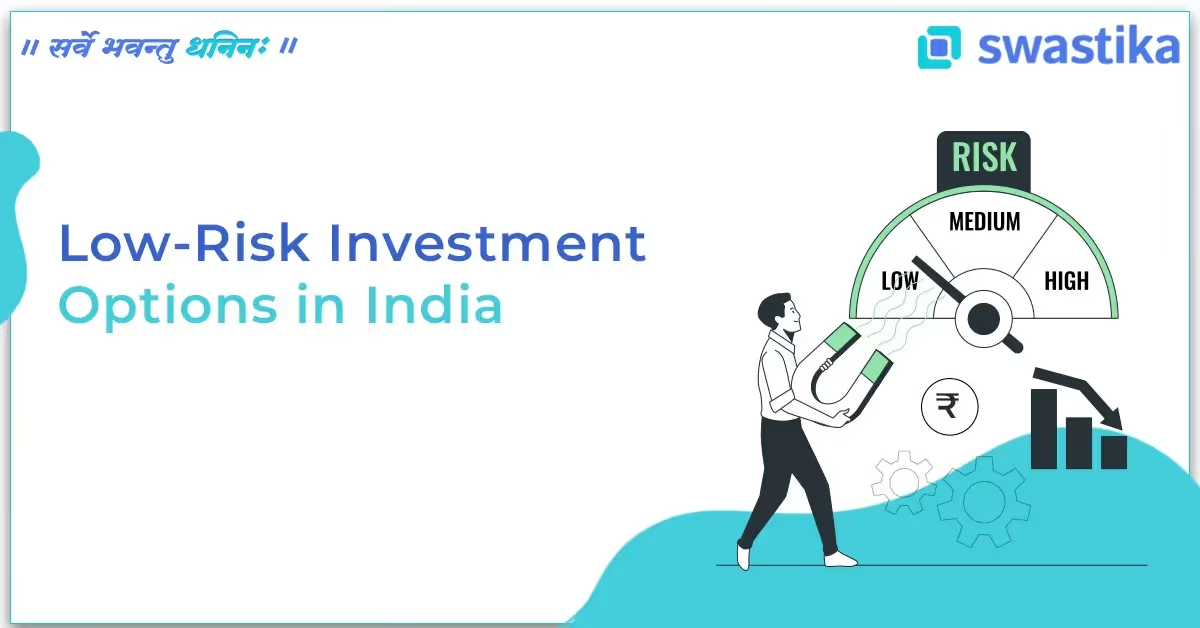
Nowadays, everyone is looking for better returns. But the higher the return, the higher the risk. This is where low-risk investment options in India come into play.
If you are an investor who prefers safety to risk, then you are probably interested in low-risk investments.
The challenge with low-risk investments is that they don't offer super returns. They mostly guarantee capital preservation and a modest rate of return.
One way to maximize your income while minimizing risk is to diversify your investments across different asset classes. Here's a list of some of the most popular low-risk investment options in India.
Get the detailed Information about low-risk investments in India - call us at 0120 4400700
List of Low-Risk Investment Options in India
Public Provident Fund (PPF)
Public Provident Fund (PPF) is a long-term investment and savings instrument that is backed by the Government of India.
It offers an attractive rate of interest and returns are fully exempted from tax. It can be opened at any post office or designated branch of public sector banks in India. PPF accounts can now also be opened online.
Tenure - 15 Years
Objective - Long-term Investment Goals
Tax on returns - Nil
Interest rate - 7.9 percent
Tax on investments Nil up to Rs 1.5 lakh under Section 80C of Income Tax Act, 1961
Also Read - PPF Vs Mutual Fund SIP: Which Investment Instrument Gives You Better Returns
Reserve Bank of India (RBI) Bond
The Reserve Bank of India (RBI) Bond is the most popular low-risk investment option in India. It offers tax benefits under Section 80C and the interest earned is taxable as per your income tax slab rate.
If you choose to invest in RBI Bonds, here are a few things you need to know:
Eligibility for investment: You should be an Indian citizen above the age of 18 years.
Max amount allowed for investment: You can only invest up to 10 lakhs in these bonds.
Rate of interest: 7.75 per cent, payable annually.
Mutual Funds
Investing in mutual funds is a low-risk, high-return investment avenue. They invest in both equity and debt instruments, thereby generating returns for investors by offering them a steady stream of income and capital appreciation.
Mutual funds are managed by professional fund managers who invest an investor’s hard-earned money in different types of securities like stocks, bonds, and gold to earn a higher return on investment.
In the past 10 years, the average return generated by mutual funds was 12 per cent annually.
Though the returns vary depending on the asset class you choose. In equity mutual funds, the returns may be higher or lower than the average depending on the fund category you have chosen. Consult with our experts about investing in Mutual Funds
Gold ETFs
Gold has always been perceived as one of the safest investment options. It is also considered to be a hedge against inflation.
But gold in physical form does not generate any income and requires safe storage facilities. Also, there are security-related problems involved in storing gold at home.
However, if you invest in gold exchange-traded funds (ETFs) instead of buying physical gold, then these problems can be avoided. Gold ETFs invest in physical gold and track its price movements.
The only difference between investing in a Gold ETF and investing in physical gold is that the former is more liquid compared to the latter.
As per the latest data available on the website of the Association of Mutual Funds of India (AMFI), the average return generated by Gold ETFs over one year is 21%.
Also Read - Investment in Commodity Trading
Stocks
Investing in the stock market is risky and requires a lot of research from the investor to understand the fundamentals of investing.
If you want to trade in stocks or invest in equity funds, you need to have your PAN card ready as it is mandatory to trade in equity.
For those who want to invest directly in stocks, it is important to know how much money you want to invest and how long you are willing to wait for your investment to grow.


.avif)
.avif)

.avif)




START YOUR INVESTMENT JOURNEY
Get personalized advice from our experts
- Dedicated RM Support
- Smooth and Fast Trading App
