
Nifty Share Price And Market Pulse: Key Movers, IPO Watch, And Real Estate Leads



Key Takeaways
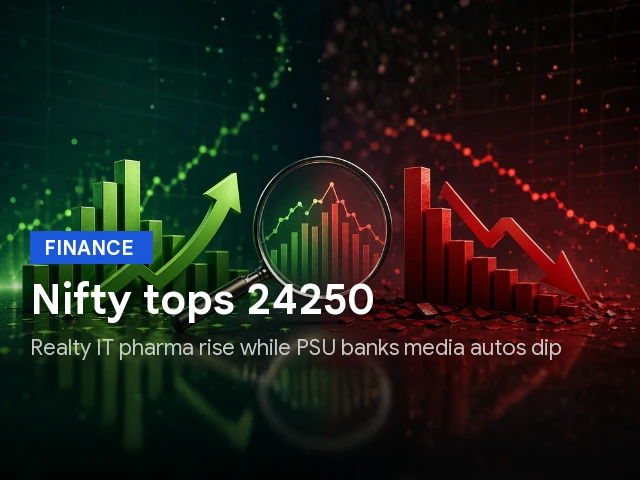
- Nifty share price closed at 24,270.85, up 95.15 points (0.39%).
- Sensex rose to 77,763.91, up 261.79 points (0.34%), with breadth positive across large caps.
- Nifty Realty index jumped 2.19% to 890.80, led by Lodha Developers up 5.08% among realty movers.
- Knack Packaging IPO subscribed 57.46x with price band 161-170 and a minimum lot of 88 shares.
nifty share price momentum continued as barometers extended their winning streak to a third session. The nifty share price at the close was 24,270.85 for the Nifty 50, up 95.15 points or 0.39%, while the Sensex rose 261.79 points to 77,763.91, a gain of 0.34%. Over three sessions, the Sensex has gained 1.68% and the Nifty 1.69%, signaling improving risk appetite despite intraday volatility. The India VIX slid 3.98% to 11.80, signaling a softer near-term volatility environment. In the broader market, the BSE 150 MidCap Index fell 0.25% while the BSE 250 SmallCap Index rose 0.09%, painting a nuanced view of market breadth.
Nifty Share Price Movements: Above 24,250 As Three-Session Rally Continues
Realty, IT, and pharma stocks led the advance as the Nifty Realty index climbed 2.19% to 890.80, continuing a four-session run with an 8.78% gain across the period. Real estate movers included lodging a broad rally: Lodha Developers up 5.08%, Oberoi Realty up 3.45%, Anant Raj up 3.37%, Brigade Enterprises up 3.32%, DLF up 2.73%, Phoenix Mills up 1.95%, Godrej Properties up 1.24%, and Sobha up 0.72%. On the downside, Aditya Birla Real Estate fell 1.06% and Prestige Estates Projects fell 0.27%. These moves underscore a bias toward real estate plays on improving sentiment and funding activity.
Knack Packaging IPO Watch: Subscription Rate And Price Band
The Knack Packaging IPO opened on 01 July 2026 and closed on 03 July 2026. The issue was priced in a band of Rs 161-170 per share and allowed bids for a minimum of 88 equity shares and multiples thereof. Bids received stood at 1,08,97,61,376 against 1,89,64,018 on offer, resulting in a subscription of 57.46 times. This level of oversubscription indicates strong investor interest in the packaging niche and reflects anticipation of solid growth in end-use industries.
Lodha Developers Stock And Real Estate Movers: A Day Of Gains
The real estate space consolidated gains with Lodha Developers stock up 5.08%, contributing to the sector's broader strength. Oberoi Realty rose 3.45%, Anant Raj 3.37%, Brigade Enterprises 3.32%, DLF 2.73%, Phoenix Mills 1.95%, Godrej Properties 1.24%, and Sobha 0.72%–all adding to a positive tone for realty leadership. Meanwhile, Aditya Birla Real Estate declined by 1.06% and Prestige Estates Projects by 0.27%, underscoring that sector rotation included both winners and laggards in a high-beta space.
HCL Technologies Stock Price Action And AI Transformation Deal
The hcl technologies stock surged 5.80% after the company announced an agreement with a Europe-headquartered Fortune Global 50 Firm to transform their global digital workplace and enterprise networks using Artificial Intelligence. This move signals a widening adoption of AI-led modernization in enterprise IT infrastructure, potentially creating spillover benefits across tech services and related software ecosystems. The broader tech space remained responsive to AI-related news as large-cap software names displayed strength in today’s session.
Global Cues And Market Signals: US Jobs Data, PMI Readings, And Brent Crude
Global markets reflected a mixed but cautiously optimistic mood: most European indices traded lower, while Asian markets closed higher as weaker-than-expected US jobs data stoked expectations of a future Federal Reserve rate cut. Japan's services PMI rose to 52.2 in June from 50.0 in May, indicating renewed expansion, while China's services activity remained above the 50-mark with a PMI of 54.1. In the US, the Dow Jones Industrial Average climbed to a record close of 52,900.07 as 57,000 jobs were added in June, below May’s revised 129,000 and below expectations of 110,000; the S&P 500 rose slightly to 7,483.24 and the Nasdaq fell 0.8% to 25,832.67. The Independence Day holiday kept major exchanges closed in the US on this Friday, resuming normal trade on Monday.
Rupee And Commodities Snapshot: USDINR, Brent Crude
The partially convertible rupee hovered around 95.2100 per dollar, versus 95.3550 in the previous session, while Brent crude for Sep 2026 settlement gained 0.24% to $71.97 a barrel, contributing to the energy complex’s mixed but bounded volatility as global demand signals evolved.
Corporate And Market Depth: Key Corporate Moves And Broad Indicators
On the corporate front, Maharashtra Seamless rose 0.77%, and Zydus Lifesciences gained 3.63% after signing a MoU with Apollo Hospitals to introduce Shield, a Multi-Cancer Detection test available in India. Central Bank of India rose 0.68% after reporting YoY growth in global gross advances to Rs 3,54,895 crore as of 30 June 2026, up from Rs 2,75,595 crore as of 30 June 2025. PC Jeweller rallied 3.74% following a ~21% YoY revenue uptick for the quarter ended 30 June 2026. Mahindra & Mahindra Financial Services slipped 1.21% as disbursements were guided to about Rs 15,560 crore with YoY growth around 21% (excluding finance lease). Bajaj Finance gained 1.30% after new loans booked rose 20% YoY to 1.61 crore in Q1 FY27, compared with 1.35 crore in the corresponding quarter last year.
In the broader market, the Dow’s performance was notable with a 594.83-point rise to 52,900.07, a record, while the S&P 500 traded near 7,483 and the Nasdaq hovered around 25,833. The day’s market breadth showed a positive tilt as 2,264 shares rose and 1,975 fell on the BSE, with 206 unchanged, underscoring selective leadership amid broader consolidation. First Published: Jul 03 2026 | 4:16 PM IST.
Frequently Asked Questions
What was the Nifty share price close today and the Sensex level?
The Nifty 50 closed at 24,270.85, up 95.15 points (0.39%), while the Sensex settled at 77,763.91, up 261.79 points (0.34%).
Which sectors led the market today and what was the Nifty Realty index movement?
Realty, IT and pharma shares advanced, with the Nifty Realty index climbing 2.19% to 890.80, contributing to a four-session gain of 8.78%.
How did Knack Packaging perform as an IPO, including subscription rate and price band?
Knack Packaging IPO opened on 01 July 2026 and closed on 03 July 2026, with a price band of Rs 161-170. It was subscribed 57.46 times, with bids of 1,08,97,61,376 against 1,89,64,018 on offer; minimum lot is 88 shares.
What moved HCL Technologies stock today and what deal influenced it?
HCL Technologies stock rose 5.80% after announcing an AI-driven transformation deal with a Europe-headquartered Fortune Global 50 Firm to upgrade their digital workplace and enterprise networks.
What were the key US and global cues affecting markets today?
US job data showed 57,000 jobs added in June, with May revised to 129,000 and expectations around 110,000. The Dow rose to a record close of 52,900.07, while the S&P 500 and Nasdaq were around 7,483 and 25,833 respectively; markets also noted softer near-term volatility as India VIX fell 3.98% to 11.80.
Conclusion
For the retail investor, today’s session reinforces that resilient breadth and sector leadership can coexist with modest volatility, especially as realty, IT, and select pharma names outperformed. The next step is to build a framework that combines price action with fundamental signals from corporate news and macro data: use trend-following rules for broad exposures and selective, risk-managed bets on realty names or tech leaders showing AI-driven order books. To dive deeper into stock-level analysis and tailor ideas to your portfolio, consider Swastika’s Sarthi AI stock assistant, which can help translate today’s price moves into actionable ideas and risk controls: Swastika's Sarthi AI stock assistant.
As you digest these moves, keep a ready watchlist on the nifty share price level around 24,250 to 24,500 and monitor the Nifty Realty, IT, and pharma segments for continued leadership. Use the current data as a baseline to assess how fresh IPO activity, like Knack Packaging’s robust subscription, and AI-driven corporate strategies might shape risk and return in the weeks ahead. The interplay between domestic strength and global cues will likely keep the market range-bound with selective bursts of upside, making disciplined position sizing and scenario planning essential for retail investors.
Latest Articles

Happy Forgings Limited IPO: Launch Date, Offer Price, GMP, and Details


Happy Forgings Limited is an Indian manufacturer specializing in designing and manufacturing heavy forgings and high-precision machined components. The company manufactures, designs and tests various products such as crankshafts, front axle carriers, steering knuckles, differential housings, transmission parts, pinion shafts, suspension products and valve bodies for different industries and customers.
OBJECTS OF THE ISSUE
- Purchase of equipment, plant and machinery.
- Prepayment of all or a portion of certain outstanding borrowings.
KEY MANAGERIAL PERSONNEL
Paritosh Kumar
Chairman and Managing Director of the Company. He has been associated with the Company since incorporation and accordingly has over 44 years of experience in the industrial sector. He is involved in the strategic decision making of the Company, oversees the Company’s business activities and is involved in setting up the governance standards of the Company.
Ashish Garg
Managing Director of the Company. He has approximately 17 years of experience in the industrial sector. He currently manages the Company’s business operations, financial performance, growth strategies and investments in different capacities and product developments.
Narinder Singh Juneja
Chief Executive Officer and Whole- time Director of the Company. He has over 35 years of experience in the industrial sector. Prior to joining our Company, he served as the assistant engineer with Krishna Forgings.
Pankaj Kumar Goyal
Chief Financial Officer of the Company. He has been associated with the Company since April 1, 2013. In the Company, he handles finance and accounts department. He has over 10 years of experience in the finance sector.
Bindu Garg
Company Secretary and Compliance Officer of the Company. She has been associated with the Company since November 2, 2021 and was appointed as the Company Secretary of the Company since July 12, 2022. In the Company, she handles the secretarial functions. She has over 18 years of experience in the finance and secretarial sector.
COMPANY PROFILE
- The company's customer base includes AAM India Manufacturing Corporation Private Limited, Ashok Leyland Limited, Bonfiglioli Transmissions Private Limited, Dana India, IBCC Industries (India) Private Limited, International Tractors Limited, JCB India Limited, Liebherr CMCtec India Private Limited, Mahindra & Mahindra Limited, Meritor HVS AB, Meritor Heavy Vehicle Systems Cameri SPA, SML ISUZU Limited, Swaraj Engines Limited and others.
- With over 40 years of experience of manufacturing and supplying quality and complex components according to customers' specifications, it has emerged as a leading player in the domestic crank shaft manufacturing industry with the second largest production capacity.
- The company has served customers in various regions including Brazil, Italy, Japan, Spain, Sweden, Thailand, Turkey, the United Kingdom and the United States of America.
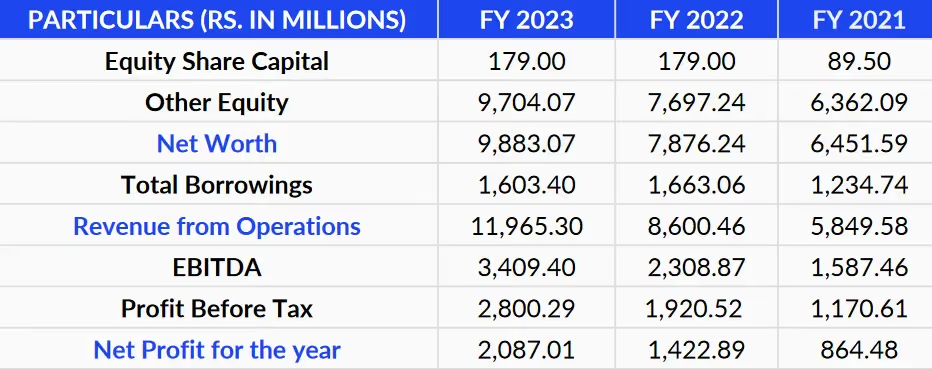
- Happy Forging Limited has three manufacturing facilities, two in Kanganwal and one in Dugri, all located in Ludhiana, Punjab. As of FY2023, the operational revenue of the company has increased by 43.02%.
COMPETITIVE STRENGTHS
- Fourth largest engineering-led manufacturer of complex and safety-critical, heavy forged, and high precision machined components in India.
- Integrated manufacturing operations coupled with in-house product and process design capabilities. Diversified business model, well placed to take advantage of potential alternative engine technologies. Long-standing relationships with customers across industries.
- Track record of consistently building capabilities and infrastructure, with a focus on capital efficiency.
- Experienced Promoters and senior management team.
KEY STRATEGIES
- Leverage in-house engineering and product development capabilities.
- Foray into light weight forging and machining with the introduction of aluminum components. Increase the wallet share and acquire new business.
- Capitalize on increasing demand from international markets to grow exports. Expand capacity at its existing manufacturing facilities.
KEY CONCERNS
- Its business largely depends upon its top 10 customers.
- The company does not have agreements having commitment on the part of its customers. It depends on a few suppliers for the supply of steel, its primary raw material.
- Its business is dependent on the performance of certain industries, particularly commercial vehicles. It faces competition in India and overseas in its business.
- Due to the geographic concentration of its manufacturing facilities, its operations are susceptible to local and regional factors.
- Pricing pressure from its customers may adversely affect its business.
COMPARISON WITH LISTED INDUSTRY PEERS (AS ON 31ST MARCH 2023)

FINANCIALS (RESTATED CONSOLIDATED)
OUTLOOK & VALUATION
Happy Forging is a well-experienced and fourth-largest manufacturer of complex machine components. The company shares along-standing relationship with its large customer base. It has a diversified business model and a track record of consistent growth. The financial performance of the company has also been strong. Further, it has plans for capacity expansion and new business acquisitions.
However, investors should remain mindful of certain business dependencies. Reliance on the top 10 customers, potential pricing pressure from clients, and competition within the industry introduce some risks. Dependence on a limited number of suppliers also merits consideration.
Despite these considerations, Happy Forgings' attractive valuation of 36.44x P/E, coupled with its impressive track record and promising outlook, makes it a worthy investment option for investors seeking exposure to the manufacturing sector.
DISCLAIMER:
The information contained herein are strictly confidential and are meant solely for the information of the recipient and shall not be altered in any way, transmitted to, copied or distributed, in part or in whole, to any other person or to the media or reproduced in any form, without prior written permission of Swastika Investmart Ltd. (“SIL”). The contents of this document are for information purpose only. This document is not an investment advice and must not alone be taken as the basis for an investment decision. Before taking any decision to invest, the recipient of this document must read carefully the Red Herring Prospectus (“RHP”) issued to know the details of IPO and various risks and uncertainties associated with the investment in the IPO of the Company. All recipients of this document must before acting on the given information/details, make their own investigation and apply independent judgment based on their specific investment objectives and financial position. They can also seek appropriate professional advice from their own legal and tax consultants, advisors, etc. to understand the risks and investment considerations arising from such investment. The investor should possess appropriate resources to analyze such investment and the suitability of such investment to such investor’s particular circumstances before making any decisions on the investment. The Investor shall be solely responsible for any action taken based on this document. SIL shall not be liable for any direct or indirect losses arising from the use of the information contained in this document and accept no responsibility for statements made otherwise issued or any other source of information received by the investor and the investor would be doing so at his/her/its own risk. The information contained in this document should not be construed as forecast or promise or guarantee or assurance of any kind. The investors are not being offered any assurance or guaranteed or fixed returns on their investments. The users of this document must bear in mind that past performances if any, are not indicative of future results. The actual returns on investment may be materially different than the past. Investments in Securities market products and instruments including in the IPO of the Company are highly risky and they are generally not an appropriate avenue for someone with limited resources/ limited investment and low risk tolerance. Such Investments are subject to market risks including, without limitation, price, volatility and liquidity and capital risks. Therefore, the users of this document must carefully consider all the information given in the RHP including the risks factors before making any investment in the Equity Shares of the Company.
Swastika Investmart Ltd or its analysts did not receive any compensation or other benefits from the companies mentioned in the report or third party in connection with preparation of the research report. Accordingly, neither Swastika Investmart Ltd nor Research Analysts have any material conflict of interest at the time of publication of this report. Compensation of our Research Analysts is not based on any specific merchant banking, investment banking or brokerage service transactions. Swastika Investment Ltd may have issued other reports that are inconsistent with and reach different conclusion from the information presented in this report. Research entity has not been engaged in market making activity for the subject company. Research analyst has not served as an officer, director or employee of the subject company. We have not received any compensation/benefits from the Subject Company or third party in connection with the Research Report.
CORPORATE & ADMINISTRATIVE OFFICE - 48, Jaora Compound, M.Y.H. Road, Indore - 452 001 | Phone 0731 - 6644000
Compliance Officer: Ms. Sheetal Duraphe Email: compliance@swastika.co.in Phone: (0731) 6644 241
Swastika Investmart Limited, SEBI Reg. No. : NSE/BSE/MSEI: INZ000192732 Merchant Banking: INM000012102 Investment Adviser: INA000009843 MCX/NCDEX: INZ000072532 CDSL/NSDL: IN-DP-115-2015 RBI Reg. No.: B-03-00174 IRDA Reg. No.: 713.
Suraj Estate Developers IPO: Launch Date, Offer Price, GMP, and Details
Suraj Estate Developers Limited is a real estate construction company. The company develops residential and commercial real estate in the South Central Mumbai region. The company's projects include Suraj Eleganza-II and ICICI Apartments, CCIL Bhavan(Phase-I up to 6th floor) and Tranquil Bay-I, Elizabeth Apartment and Mon Desir, St. Anthony Apartments, Lumiere and Tranquil Bay-II, Brahmsidhhi CHS, Jacob Apartments, Suraj Eleganza-I and Gloriosa Apartments and others.
OBJECTS OF THE ISSUE
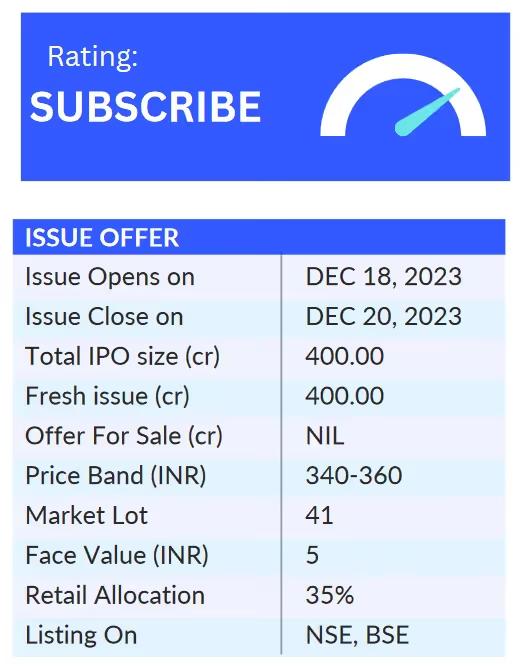
- Repayment of the aggregate outstanding borrowings.
- Acquisition of land or land development rights.
KEY MANAGERIAL PERSONNEL
Rajan Meenatha konil Thomas
Chairperson and Managing Director of the Company. He has been associated with Company since its incorporation. He has received Lifetime Achievment Award from ET Now in the year 2022. He has over 36 years of experience in various aspects of real estate business.
Rahul Rajan Jesu Thomas
He holds a bachelor’s degree in Commerce from the University of Mumbai and corporate finance certificate from Harvard University. He has received 40 under 40 award from Realty+ in the year 2022. He has over 16 years of experience in various aspects of real estate business.
Shreepal Shah
Chief Financial Officer ofCompany. He holds a bachelor’s degree in Engineering from University of Mumbai and a master’s degree in Business Administration from University of Pune. Prior to joining Company, he was working with P.Raj & Co., Chartered Accountants providing business and finance advisory.
Shivil Kapoor
Company Secretary of the Company. He holds a bachelor’s degree in Commerce from Devi Ahilya Vishwavidyalya, Indore, bachelor’s degree in Law from Devi Ahilya Vishwavidyalaya , Indore and is a member of the Institute of Company Secretaries of India.
Dipen Sheth
Vice President - Sales of the Company. He holds a bachelor’s degree in Commerce from University of Mumbai. Prior to joining Company, he was associated with Kanakia Spaces Private Limited and Oasis Lifespaces Private Limited.
COMPANY PROFILE
- Suraj Estate has developed more than 10lakh square feet of land in Mumbai.
- In the residential portfolio, Suraj Estate is present in the "Value Luxury' and "Luxury' segments invariouspricecategorieswithunitvaluesrangingfromRs.10.00milliontoRs.130.00million.
- The company focuses primarily on value luxury, luxury segments , and commercial segments. SEDL is now venturing into residential real estate development in the Bandra sub-market.
- The company's projects include Suraj Eleganza-II and ICICI Apartments, CCIL Bhavanand Tranquil Bay- I, Elizabeth Apartment and Mon Desir, St. Anthony Apartments, Lumiere and TranquilBay-II, Brahmsidhhi CHS, Jacob Apartments, Suraj Eleganza-Iand Gloriosa Apartments and others.

COMPETITIVE STRENGTHS
- Established brand with along-standing presence in Value Luxury Segment and Luxury Segment in the residential real estate market of South Central Mumbai region
- Diversified portfolio encompassing product offerings across various price points in value luxury and luxury segments.
- Strong expertise in tenant settlement in redevelopment projects Experienced promoters and management team.
KEY STRATEGIES
- Enhance leading market position in the South Central Mumbai region by leveraging Upcoming Projects
- Continue to focus on redevelopment projects through asset - lightmodel
- Continue to expand Land Reserves in the South Central Mumbai region and opportunistically build a position in other sub-markets within the MMR region.
- Continue to selectively develop Commercial Projects in the South Central Mumbai region.
KEY CONCERNS
- Business is dependent on the performance of, and the conditions affecting, the real estate sub- markets in the South-Central Mumbai region.
- Any uncertainty in the title to real estate assets could have a material adverse impact on current and future revenue.
- The industry in which the company operates is competitive and highly fragmented resulting in increased competition that may adversely affect results.
- Any negative cash flows in the future would adversely affect cash flow requirements.
COMPARISON WITH LISTED INDUSTRY PEERS (AS ON 31ST MARCH 2023)

FINANCIALS (RESTATED CONSOLIDATED)
OUTLOOK & VALUATION
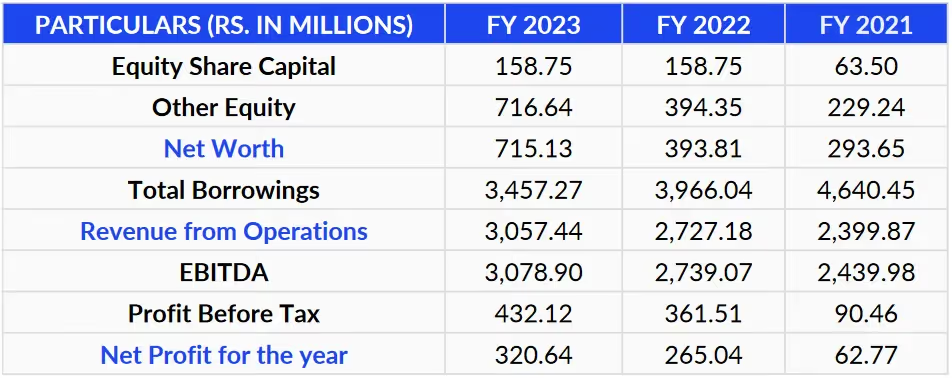
Since 1986, SEDL has been a real estate developer in the South Central Mumbai area, working on projects in both the residential and commercial sectors.The residential portfolio of SEDL is situated in the sub-markets of Mahim, Dadar, Prabhadevi, and Parel, which are part of the South Central Mumbai micro market. It has shown consistent growth over the stated periods, and the manage mentis optimistic that this trend will continue.
With extensive market knowledge ,SED Lisa market leader in the combined South-Central Mumbai submarkets; yet, the company must contend with competition from a range of national and regional real estate developers.
The IPO is coming at a P/E of 35.64 which looks fairly priced so we recommend applying for this IPO for listing gains.
DISCLAIMER:
The information contained herein are strictly confidential and are meant solely for the information of the recipient and shall not be altered in any way, transmitted to, copied or distributed, in part or in whole, to any other person or to the media or reproduced in any form, without prior written permission of Swastika Investmart Ltd. (“SIL”). The contents of this document are for information purpose only. This document is not an investment advice and must not alone be taken as the basis for an investment decision. Before taking any decision to invest, the recipient of this document must read carefully the Red Herring Prospectus (“RHP”) issued to know the details of IPO and various risks and uncertainties associated with the investment in the IPO of the Company. All recipients of this document must before acting on the given information/details, make their own investigation and apply independent judgment based on their specific investment objectives and financial position. They can also seek appropriate professional advice from their own legal and tax consultants, advisors, etc. to understand the risks and investment considerations arising from such investment. The investor should possess appropriate resources to analyze such investment and the suitability of such investment to such investor’s particular circumstances before making any decisions on the investment. The Investor shall be solely responsible for any action taken based on this document. SIL shall not be liable for any direct or indirect losses arising from the use of the information contained in this document and accept no responsibility for statements made otherwise issued or any other source of information received by the investor and the investor would be doing so at his/her/its own risk. The information contained in this document should not be construed as forecast or promise or guarantee or assurance of any kind. The investors are not being offered any assurance or guaranteed or fixed returns on their investments. The users of this document must bear in mind that past performances if any, are not indicative of future results. The actual returns on investment may be materially different than the past. Investments in Securities market products and instruments including in the IPO of the Company are highly risky and they are generally not an appropriate avenue for someone with limited resources/ limited investment and low risk tolerance. Such Investments are subject to market risks including, without limitation, price, volatility and liquidity and capital risks. Therefore, the users of this document must carefully consider all the information given in the RHP including the risks factors before making any investment in the Equity Shares of the Company.
Swastika Investmart Ltd or its analysts did not receive any compensation or other benefits from the companies mentioned in the report or third party in connection with preparation of the research report. Accordingly, neither Swastika Investmart Ltd nor Research Analysts have any material conflict of interest at the time of publication of this report. Compensation of our Research Analysts is not based on any specific merchant banking, investment banking or brokerage service transactions. Swastika Investment Ltd may have issued other reports that are inconsistent with and reach different conclusion from the information presented in this report. Research entity has not been engaged in market making activity for the subject company. Research analyst has not served as an officer, director or employee of the subject company. We have not received any compensation/benefits from the Subject Company or third party in connection with the Research Report.
CORPORATE & ADMINISTRATIVE OFFICE - 48, Jaora Compound, M.Y.H. Road, Indore - 452 001 | Phone 0731 - 6644000
Compliance Officer: Ms. Sheetal Duraphe Email: compliance@swastika.co.in Phone: (0731) 6644 241
Swastika Investmart Limited, SEBI Reg. No. : NSE/BSE/MSEI: INZ000192732 Merchant Banking: INM000012102 Investment Adviser: INA000009843 MCX/NCDEX: INZ000072532 CDSL/NSDL: IN-DP-115-2015 RBI Reg. No.: B-03-00174 IRDA Reg. No.: 713.

Motisons Jewellers IPO Date, Price, GMP, Review, Details
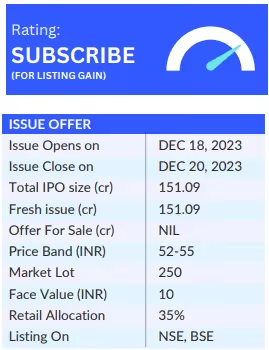
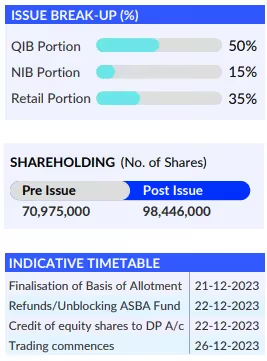
Motisons Jewellers Limited is a Jewellery retail player with a history of more than 2 decades in the jewellery industry. It has experienced entrepreneurs as its Promoters with over 20 years of experience. Its jewelry business includes selling jewellery made of gold, diamond, kundan, and other jewellery products that include pearl, silver, platinum, precious, semi-precious stones, and other metals. Its other offerings include gold and silver coins, utensils, and other artifacts.
OBJECTS OF THE ISSUE
- Funding the working capital requirements of the Company.
- General corporate purposes.
Sandeep Chhabra
Promoter, Chairman and Whole Time Director of the Company. He has been associated with the company since 1997. He has more than two decades of experience in the business of manufacturing and retailing of jewellery. He mentors, guides and provides perspective to the Board and management of the Company for strategic planning and enriching the brand for long run.
Sanjay Chhabra
Promoter and Managing Director of the Company. He has been associated with the company since 1997. He has an experience of more than two decades in jewellery industry. Being a part of the top management, Mr. Sanjay Chhabra is responsible for devising long-term business plans, new business initiatives and achieving customer service excellence.
Laksh Chhabra
Joint Managing Director of the Company. He has joined the Company in 2022. He has entered into the business with innovation driven vision and is currently responsible for finance and accounting operations.
Kaustubh Chhabra
Chief Financial Officer of the Company. He holds bachelor’s degree in administration from Kalinga University, Raipur. He has the experience of 5 years. Prior to joining this Company, he has worked as Director of Finance in Khyati Gems DMCC, Dubai. He joined the Company in July 2022.
Naresh Kumar Sharma
Company Secretary and Compliance Officer of the Company. He joined the Company as the Company Secretary and Compliance Officer in September 2023. He has 18 years of experience in secretarial sector. He is responsible for undertaking various functions in the Company including ensuring conformity with the regulatory provisions applicable to the Company.
COMPANY PROFILE
- The Company started its jewellery business in 1997 with a single showroom in Jaipur, Rajasthan and since then, it expanded its network of showrooms and the product portfolio and currently operates 4 showrooms under the “Motisons” brand, located across the city of Jaipur, Rajasthan.
- In addition to selling products at showrooms, it also sells its products through online platform. The Company primarily source finished jewellery from third-party suppliers located across India. Additionally, to cater to the increasing demand in the market, it also engage artisans on job work basis and has its own manufacturing facilities located in Jaipur, Rajasthan.
- Its product profile includes traditional, contemporary, and combination designs across jewellery lines.
- It has a dedicated design team, focused on developing new products and designs that meet customers’
- requirements.
COMPETITIVE STRENGTHS
- Established brand name with heritage and a legacy of over two decades. Strategic location of showrooms.
- Diversified product portfolio.
- Established systems and procedures to mitigate risks and efficiencies in inventory management. Promoters with strong leadership and a demonstrated track record.
KEY CONCERNS
- The Company is heavily dependent on third parties for supplying its products. All its four showrooms are in one geography namely Jaipur, and Rajasthan.
- It operates in a highly competitive market. Its competitors include both organized pan-India
- Jewellers as well as unorganized local players.
- Any customer complaints or negative publicity or concerns about the purity and quality of its products may have an adverse effect on its business.
- Under-utilization of manufacturing capacity may have a negative impact on the future financial condition of the Company.
- Its income and sales are subject to seasonal fluctuations.
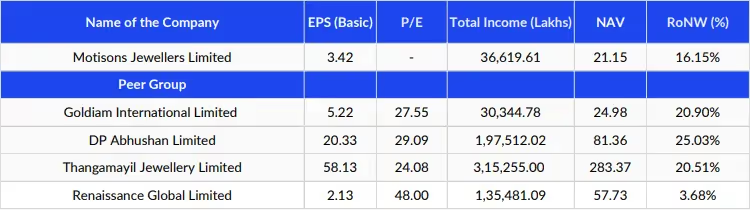
COMPARISON WITH LISTED INDUSTRY PEERS (AS ON 31ST MARCH 2023
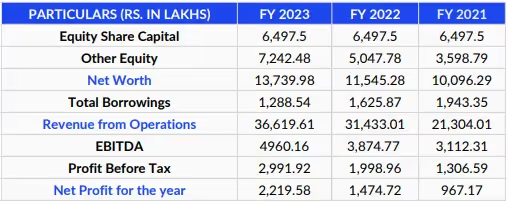
FINANCIALS (RESTATED CONSOLIDATED)
OUTLOOK & VALUATION
Motisons Limited, a well-established brand exceeding 20 years in the jewelry industry with strategically located showrooms in Jaipur, Rajasthan, The company has a diversified product portfolio and has demonstrated a strong track record of growth.
Motison's commitment to retail network expansion and technology integration further strengthens its growth prospects. However, the highly competitive landscape and dependence on third-party suppliers present key challenges. Additionally, the company is susceptible to negative publicity and seasonal demand fluctuations.
Despite these considerations, the IPO's attractive valuation of 16x P/E offers a degree of risk mitigation. Considering Motisons' strong brand, proven track record, and growth plans, alongside
DISCLAIMER:
The information contained herein are strictly confidential and are meant solely for the information of the recipient and shall not be altered in any way, transmitted to, copied or distributed, in part or in whole, to any other person or to the media or reproduced in any form, without prior written permission of Swastika Investmart Ltd. (“SIL”). The contents of this document are for
information purpose only. This document is not an investment advice and must not alone be taken as the basis for an investment decision. Before taking any decision to invest, the recipient of this document must read carefully the Red Herring Prospectus (“RHP”) issued to know the details of IPO and various risks and uncertainties associated with the investment in the IPO of the Company. All recipients of this document must before acting on the given information/details, make their own investigation and apply independent judgment based on their specific investment objectives and financial position. They can also seek appropriate professional advice from their own legal and tax consultants, advisors, etc. to understand the risks and investment considerations arising from such investment. The investor should possess appropriate resources to analyze such investment and the suitability of such investment to such investor’s particular circumstances before making any decisions on the investment. The Investor shall be solely responsible for any action taken based on this document. SIL shall not be liable for any direct or indirect losses arising from the use of the information contained in this document and accept no responsibility for statements made otherwise issued or any other source of information received by the investor and the investor would be doing so at his/her/its own risk. The information contained in this document should not be construed as forecast or promise or guarantee or assurance of any kind. The investors are not being offered any assurance or guaranteed or fixed returns on their investments. The users of this document must bear in mind that past performances if any, are not indicative of future results. The actual returns on investment may be materially different than the past. Investments in Securities market products and instruments including in the IPO of the Company are highly risky and they are generally not an appropriate avenue for someone with limited resources/ limited investment and low risk tolerance. Such Investments are subject to market risks including, without limitation, price, volatility and liquidity and capital risks. Therefore, the users of this document must carefully consider all the information given in the RHP including the risks factors before making any investment in the Equity Shares of the Company.
Swastika Investmart Ltd or its analysts did not receive any compensation or other benefits from the companies mentioned in the report or third party in connection with preparation of the research report. Accordingly, neither Swastika Investmart Ltd nor Research Analysts have any material conflict of interest at the time of publication of this report. Compensation of our Research Analysts is not based on any specific merchant banking, investment banking or brokerage service transactions. Swastika Investment Ltd may have issued other reports that are inconsistent with and reach different conclusion from the information presented in this report. Research entity has not been engaged in market making activity for the subject company. Research analyst has not served as an officer, director or employee of the subject company. We have not received any compensation/benefits from the Subject Company or third party in connection with the Research Report.
CORPORATE & ADMINISTRATIVE OFFICE - 48, Jaora Compound, M.Y.H. Road, Indore - 452 001 | Phone 0731 - 6644000
Compliance Officer: Ms. Sheetal Duraphe Email: compliance@swastika.co.inPhone: (0731) 6644 241
Swastika Investmart Limited, SEBI Reg. No. : NSE/BSE/MSEI: INZ000192732 Merchant Banking: INM000012102 Investment Adviser: INA000009843 MCX/NCDEX: INZ000072532 CDSL/NSDL: IN-DP-115-2015 RBI Reg. No.: B-03-00174 IRDA Reg. No.: 713.

ब्याज़ दरों में कटौती के संकेतो से तेज़ सोना-चांदी।
फेड बैठक के बाद सोने की कीमतें प्रमुख स्तरों 2050 डॉलर से ऊपर चढ़ गईं और अमेरिकी डॉलर इंडेक्स 102 के निचले स्तरों पर पहुंच गया। फेडरल रिजर्व द्वारा ब्याज दरों में बढ़ोतरी नहीं की जाएगी और 2024 में ऋण लेने की लागत कम करने के संकेत दिए है। पिछले सप्ताह फेड ने अपनी इस साल की आखरी बैठक में ब्याज दरों को उम्मीद के मुताबिक यथावत रखा और अगले साल अनुमान से ज़्यादा बार ब्याज दरों में कटौती करने के संकेत दिए, जिससे कीमती धातुओं के भाव चमक गए और अमेरिकी डॉलर, जो चार महीने के निचले स्तरों पर पहुंच चुका है, के साथ बेंचमार्क ट्रेज़री यील्ड गिर कर 4 प्रतिशत के नीचे पहुंच गई है। लेकिन, सोने की कीमते अभी उच्चतम स्तर से दूर है क्योकि बाज़ार में यह अनिश्चिता बनी हुई है की फेड कब ब्याज दरें घटाना शुरू करेगा।
फेड ने कहा है कि ब्याज दरें अब 5.5 प्रतिशत पर पहुंच गई हैं, और केंद्रीय बैंक 2024 में कम से कम तीन बार दरों में कटौती करेगा जिससे ब्याज दरें घट कर 4.6 प्रतिशत हो जाएगी। फेड चेयरमैन पॉवेल ने मुद्रास्फीति पर जीत की घोषणा करना जल्दबाजी बताया, फिर भी उन्होंने कम मुद्रास्फीति परिदृश्य का अनुमान लगाया है। फेड फंड वायदा कीमतों के अनुसार 70 प्रतिशत से अधिक संभावना है कि फेड मार्च 2024 में 25 आधार अंकों की कटौती करेगा। लेकिन, दरों में कटौती पर अनिश्चितता आने वाले महीनों में आशावाद को कम कर सकती है, क्योकि अमेरिकी अर्थव्यवस्था में मजबूती अभी भी मुद्रास्फीति में बढ़ोतरी का कारण बन सकती है।
तकनिकी विश्लेषण :
इस सप्ताह कीमती धातुओं के भाव में तेज़ी रह सकती है। एमसीएक्स फ़रवरी वायदा सोने में सपोर्ट 60500 रुपये पर है और रेजिस्टेंस 64000 रुपये पर है। मार्च वायदा चांदी में सपोर्ट 73000 रुपये पर है और रेजिस्टेंस 78000 रुपये पर है।

गोल्ड और सेंसेक्स पहुंचे नई उचाई पर।
एमसीएक्स में सोने की कीमते अपने उच्चतम स्तरों को पार कर चुकी है और स्थिर बनी हुई है। बढ़ती आर्थिक मंदी पर बढ़ती चिंताओं के बीच, एशिया भर से पर्चेसिंग मैनेजर इंडेक्स (पीएमआई) आकड़ो ने सोने की सुरक्षित मांग को काफी हद तक मजबूत बना रखा है। नवंबर में सोना मजबूत रहा, क्योंकि बाजार को यकीन हो गया है कि फेडरल रिजर्व ब्याज दरों में और वृद्धि नहीं करेगा, और 2024 में दरों में कटौती शुरू कर देगा। लेकिन संभावित ब्याज दरों में कटौती का समय बाजारों के लिए अनिश्चितता का एक प्रमुख बिंदु बना हुआ है। सोने के साथ -साथ निवेशकों का भरोसा जोखिम सम्पत्तिओं में भी बढ़ने लगा जिससे सोना और सेंसेक्स अपने उच्चतम स्तरों पर पहुंच गए है। भू-राजनीतिक मुद्दों और उच्च ब्याज दरों के कारण जारी अनिश्चितता के कारण सोने और इक्विटी के बीच विपरीत संबंध टूट गया है, और इन मुद्दो के कारण वैश्विक अर्थव्यवस्था की वृद्धि धीमी हो गई है जिससे सुरक्षित आश्रय की मांग बढ़ गई है। वैश्विक अर्थव्यवस्था दबाव में है जबकि भारतीय अर्थव्यवस्था फल-फूल रही है और विदेशी निवेशक भारतीय बांड में रुचि लेने लगे हैं जो निवेशकों को जोखिम भरी संपत्तियों की ओर भी आकर्षित कर रहा है। अमेरिका के तीसरी तिमाही के आंकड़े बेहतर दर्ज किये गए है और अगले साल ब्याज दर कटौती की उम्मीद से बेंचमार्क अमेरिकी ट्रेज़री यील्ड में गिरावट बनी हुई है जो सोने और चांदी के भाव को सपोर्ट कर रही है। अमेरिकी सकल घरेलू उत्पाद तीसरी तिमाही में 5.2 प्रतिशत वार्षिक दर से बढ़ रहा है, जो पहले बताए गए 4.9 प्रतिशत से संशोधित है और 2021 की चौथी तिमाही के बाद से सबसे तेज़ विस्तार है। मुद्रास्फीति के आंकड़े अब घटने लगे जिससे ब्याज दरों में कटौती जल्द शुरू होने के आसार बनने लगे है। पिछले सप्ताह फरवरी वायदा सोना 2 प्रतिशत तेज़ हो कर 62800 रुपये प्रति दस ग्राम और मार्च वायदा चांदी 3 प्रतिशत तेज़ हो कर 77800 रुपये प्रति किलो पर कारोबार कर रहे है। इस सप्ताह रोज़गार बाज़ार के आंकड़े कीमती धातुओं के लिए महत्वपूर्ण रहेंगे।
तकनिकी विश्लेषण
इस सप्ताह कीमती धातुओं के भाव में तेज़ी रह सकती है। एमसीएक्स फ़रवरी वायदा सोने में सपोर्ट 61800 रुपये पर है और रेजिस्टेंस 64000 रुपये पर है। मार्च वायदा चांदी में सपोर्ट 74000 रुपये पर है और रेजिस्टेंस 80000 रुपये पर है।

स्थिर मुद्रास्फीति और ब्याज दर कटौती के अनुमान से मजबूत सोना।
सोने और चांदी में फेड के मिनट्स जारी होने के बाद अमेरिका में थैंक्स गिविंग डे के चलते सिमित दायरे में कारोबार रहा। हालांकि, अमेरिकी ट्रेज़री यील्ड और डॉलर इंडेक्स में नरमी के कारण सोने के भाव को सपोर्ट मिल रहा है। जबकि यूरोज़ोन से जारी होने वाले मैन्युफैक्चरिंग पीएमआई के आंकड़े अनुमान से बेहतर दर्ज किये गए जिससे यूरोमें मजबूती पिछले सप्ताह भी क़ायम रहीऔर डॉलर इंडेक्स में दबाव रहा। रुपये में कमजोरी से भी सोने की कीमतों को सपोर्ट मिलाहुआ है।
नवंबर की शुरुआत से ही अमेरिकी ट्रेजरी यील्ड में भारी गिरावट देखी गई है, जो छह प्रतिशत या लगभग तीस आधार अंक से घट गई है। और, अमेरिकी डॉलर ने अन्य प्रमुख मुद्राओं के मुकाबले कमज़ोरी दिखाई है, जिससे यह सूचकांक 106 के उच्च स्तरों से गिरकर 103.70 से नीचे आ गया है,जो लगभग तीन प्रतिशत की गिरावट का संकेत देता है। फेडरल रिजर्व द्वारा दरों में निरंतर बढ़ोतरी की उम्मीदों और अगले वर्ष के लिए मुद्राबाजार वायदा द्वारा अनुमानित 85 आधार अंकों की कटौती की उम्मीदों से सोने की राह स्थिर बनी हुई है।
मुद्रास्फीति अनुमान की रिपोर्ट के मुताबिक, उपभोक्ताओं को अगले पांच वर्षों में लगभग 3.2 प्रतिशत की मुद्रास्फीति दर की उम्मीद है। इस अनुमान पर बारीकी से नजर रखी जाती है क्योंकि यह फेडरल रिजर्व के ब्याज दर निर्णयों को प्रभावित कर सकता है और अगर उम्मीदें ऊंची बनी रहती हैं तो मुद्रास्फीति के मजबूत होने पर लगातार चिंता को दर्शाता है।
तकनिकी विश्लेषण : इस सप्ताह कीमती धातुओं के भाव में तेज़ी रह सकती है। एमसीएक्स दिसंबर वायदा सोने में सपोर्ट 60000 रुपये पर है और रेजिस्टेंस 62500 रुपये पर है। दिसंबर वायदा चांदी में सपोर्ट 71000 रुपये पर है और रेजिस्टेंस 76000 रुपये पर है।
Big Budget


Popular Articles


.avif)
.avif)
.avif)



START YOUR INVESTMENT JOURNEY
Get personalized advice from our experts
- Dedicated RM Support
- Smooth and Fast Trading App