


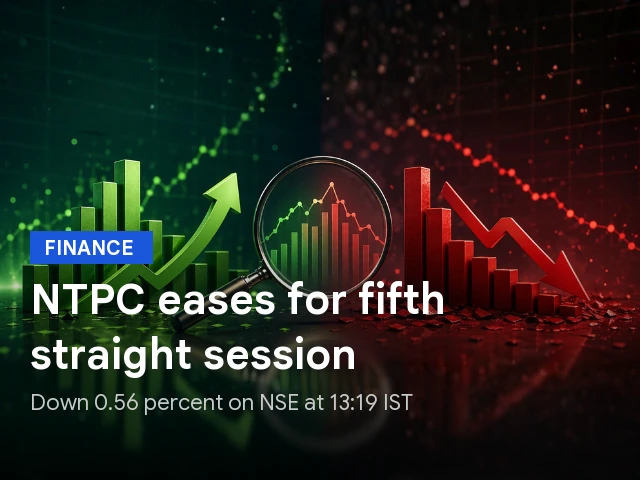
NTPC Share Price Insights: Fifth Straight Session Eases And Market Context



Key Takeaways
- NTPC share price eased for the fifth straight session, around Rs 346.75 on NSE.
- NTPC stock price rose 1.55% in the last year, while NIFTY declined 5.14% and Nifty Energy rose 6.91%.
- July futures stood at Rs 347.85, signaling near-term price alignment with the spot.
- NTPC PE is 14.6x based on TTM earnings to March 26.
NTPC share price eased for the fifth straight session, quoted at Rs 346.75 on the NSE as of 13:19 IST. This move frames a session where the benchmark NIFTY is around 24,052.3, up 0.71%, while the Sensex sits near 77,018.87, higher by about 0.67% for the day. The year-to-date view remains mixed: NTPC has gained 1.55% over the last 12 months as NIFTY slides 5.14% and the Nifty Energy index climbs 6.91%. Volume in NTPC today stood at 101.69 lakh shares, versus the 1-month average of 134.92 lakh. The July futures contract for NTPC sits at Rs 347.85, down 0.33%, signaling near-term alignment with the cash price. The stock carries a price-earnings ratio of 14.6x on TTM earnings to March 26.
NTPC Share Price Momentum After Five Straight Sessions
NTPC share price has shown a pause after five successive sessions of declines, with the current quote at Rs 346.75 on the NSE as of 13:19 IST. The intraday movement placed NTPC down 0.56% on the day, underscoring a risk-off tone that often accompanies short-term consolidation. In the broader market, NIFTY trades around 24,052.3, up roughly 0.71%, while the Sensex hovers near 77,018.87, up about 0.67%. The energy complex continues to be a source of relative strength in the market context, with the Nifty Energy index showing resilience. Over the past year, NTPC has risen 1.55%, compared with a 5.14% decline in the NIFTY and a 6.91% rise in the Nifty Energy index. On the volume front, today’s turnover was 101.69 lakh shares, below the 1-month average of 134.92 lakh. A close look at the chart suggests potential support near the Rs 340–345 zone, with resistance near Rs 350–355, depending on energy sector momentum. If momentum shifts above Rs 350, bulls could revisit a test of the Rs 355–360 area in coming sessions.
Market Context: Nifty And Energy Sector Movements
The present market context shows the NIFTY up around 0.71% on the day to about 24,052.3, while the Sensex is near 77,018.87, up about 0.67%. NTPC sits in a sector that has been relatively resilient; the Nifty Energy index is up about 0.69% on the day and has posted a 0.04% increase over the last month. NTPC’s daily volume stood at 101.69 lakh shares today, below the 1-month average of 134.92 lakh, underscoring a day of cautious participation. Such dynamics imply that energy names, including NTPC, may still attract steady interest even as the broader market exhibits mixed momentum.
Trading Signals: Futures And Short-Term Indicators
The July futures contract for NTPC is priced at Rs 347.85, down 0.33% on the day, indicating near-term alignment with the cash price. With a P/E ratio of about 14.6x based on trailing twelve months earnings to March 26, the stock sits at a moderate valuation relative to the sector. For traders, the Rs 347–350 zone will be critical in the near term; a break above could invite fresh buyers, while a break below Rs 340 could put pressure on the stock. The path for NTPC will likely mirror the energy sector’s broader rhythm and macroeconomic cues like interest rates and risk appetite.
NTPC Share Price History And Chart Perspective
Looking at the ntpc share price history, NTPC has gained 1.55% over the last year, while the NIFTY has fallen 5.14% and the Nifty Energy index has advanced 6.91%. The ntpc share price history shows a mild up-and-down trajectory that suggests consolidation rather than a robust breakout. The last month has seen NTPC ease by about 1.39%, indicating a temporary pause in the upward drift, even as energy stocks display selective strength. A chart view would emphasize watching the supports near Rs 340 and resistance around Rs 355–360, with the longer-term trend dependent on broader market and energy-specific catalysts.
NTPC Earnings And Valuation Considerations
NTPC’s earnings framework remains anchored by a moderate valuation, with a trailing P/E of approximately 14.6x based on earnings to March 26. This indicates a valuation that reflects stable earnings and a defensively positioned utility play within India’s power sector. Investors should monitor the evolution of fuel costs, base tariffs, and hydropower dynamics, as these variables can influence earnings stability in the coming quarters. While near-term price action may oscillate with energy-sector sentiment, the longer-term case for NTPC hinges on steady project execution and policy clarity, which keep the valuation in a reasonable band for a utility stock.
Frequently Asked Questions
What is NTPC share price today?
As of 13:19 IST on the NSE, NTPC share price is Rs 346.75, with the stock easing for the fifth straight session.
How did NTPC perform in the last year compared to the NIFTY?
NTPC stock price jumped 1.55% in the last year, while the NIFTY declined 5.14% and the Nifty Energy index rose 6.91%.
What is the July futures price for NTPC?
The July futures price for NTPC is Rs 347.85, down 0.33% on the day.
What is NTPC's price-to-earnings ratio based on TTM earnings?
NTPC's price-to-earnings ratio is 14.6x based on trailing twelve months earnings to March 26.
Where can I access AI stock research for NTPC?
You can access institution-level stock research via Swastika's Sarthi AI stock assistant.
Conclusion
For the retail investor, the NTPC share price action indicates a pause rather than a definitive reversal. With the stock around Rs 346–347 and a 14.6x trailing PE, the setup favors a wait-and-watch approach in the near term, particularly as the July futures hover near Rs 347. A test of support near Rs 340 or a break above Rs 350 could provide more clarity on the next directional move. The practical takeaway is to couple price action with broader energy-sector momentum and to manage risk through clear stop levels and position sizing.
For deeper, institution-level stock research that blends experience, analysis, and trusted data, consider Swastika Investmart’s Swastika's Sarthi AI stock assistant. This tool helps retail investors navigate NTPC and other sector names with AI-powered insights and research that complement traditional analysis.
Open your trading and demat account here
Reference :
Latest Articles

Choosing the Right Online Trading Platform: Key Factors to Consider


In today's fast-paced world, online trading platforms have become indispensable tools for investors. Whether you're a seasoned trader or just starting out, selecting the right platform is crucial for your success. With so many options available, it can be overwhelming to make the right choice. However, by considering a few key factors, you can narrow down your options and find the platform that best suits your needs.
User-Friendly Interface:
One of the most important factors to consider when choosing an online trading platform is its user interface. A user-friendly interface makes it easy for you to navigate the platform, execute trades, and access important information. Look for platforms that offer intuitive design and clear layout, ensuring that you can quickly find what you need without any confusion.
Asset Variety:
Different traders have different investment preferences. Some may be interested in stocks, while others prefer currency trading, bonds, or commodities. Before selecting a platform, consider the range of assets it offers for trading. Choose a platform that provides access to the markets and assets you're interested in trading, allowing you to diversify your portfolio and seize opportunities across different sectors.
Research and Analysis Tools:
Successful trading requires thorough research and analysis. Therefore, it's essential to choose a platform that provides robust research and analysis tools. Look for features such as real-time market data, customizable charts, technical indicators, and research recommendation. These tools can help you make informed trading decisions and stay ahead of market trends.
Security Measures:
Security is paramount when trading online. You'll be entrusting your funds and personal information to the platform, so it's crucial to ensure that it offers robust security measures. Look for platforms that use encryption technology to protect your data and have measures in place to prevent unauthorized access to your account. Additionally, check if the platform is regulated by reputable authorities, which adds an extra layer of security and ensures compliance with industry standards.
Trading Fees and Commissions:
Trading fees and commissions can have a significant impact on your trading profitability. Before choosing a platform, carefully consider its fee structure. Some platforms offer commission-free trading, while others may charge fees per trade or spread costs. Additionally, be aware of any hidden fees or inactivity charges that may apply. Calculate the overall cost of trading on each platform to determine which one offers the best value for your investment.
Customer Support:
In the world of online trading, issues and questions can arise at any time. Therefore, it's essential to choose a platform that offers reliable customer support. Look for platforms that provide multiple channels of support, such as phone, email, and live chat. Additionally, consider the responsiveness and helpfulness of the support team by reading reviews and testimonials from other users.
Mobile Compatibility:
With the rise of mobile trading, having access to a mobile-compatible platform is essential for traders on the go. Choose a platform that offers a mobile app or a responsive mobile website, allowing you to trade conveniently from your smartphone or tablet. Ensure that the mobile platform offers the same features and functionality as the desktop version, enabling seamless trading experiences across devices.
In conclusion, choosing the right online trading platform is a critical decision that can significantly impact your trading success. By considering factors such as user-friendliness, asset variety, research tools, security measures, fees, customer support, and mobile compatibility, you can find the platform that best aligns with your trading goals and preferences. Take the time to research and compare different online trading platforms before making your decision, ensuring that you're well-equipped to navigate the financial markets effectively.

How Algo Trading is useful for Day Traders
In the fast-paced world of day trading, every second counts. Traders are constantly seeking an edge, a way to stay ahead of the curve and increase their profits in the ever-changing financial markets. One powerful tool that has revolutionized the way day traders operate is algo trading. With its ability to execute trades at lightning speed and analyze vast amounts of data in real-time, algo trading has become an indispensable asset for day traders seeking to gain an edge in the market.
Algo trading involves the use of computer algorithms to automate trading decisions, from determining when to enter or exit a trade to managing risk and executing orders. These algorithms are programmed to follow predefined sets of rules and criteria, allowing traders to execute trades with precision and efficiency. Unlike human traders, algorithms can process vast amounts of market data in milliseconds, enabling them to identify profitable trading opportunities and execute trades at optimal prices.
Eliminate Human Emotions from Trading
One of the key benefits of algo trading for day traders is its ability to eliminate human emotions from the trading process. Emotions such as fear and greed can often cloud a trader's judgment and lead to irrational decision-making. By automating trading decisions, algo trading removes the emotional element from the equation, allowing traders to stick to their predetermined trading strategies and avoid making impulsive decisions based on emotions.
Speed and Efficiency
Another advantage of algo trading is its speed and efficiency. In the fast-paced world of day trading, every second counts, and being able to execute trades quickly can make all the difference. Algorithms can analyze market data and execute trades in a fraction of the time it would take a human trader to do so manually, allowing day traders to capitalize on fleeting opportunities and react to market changes in real-time.
Backtest & Optimize Trading Strategies with Historical Data
Algo trading allows day traders to backtest and optimize their intraday trading strategies with historical data. By simulating trades using past market data, traders can evaluate the performance of their strategies and make necessary adjustments to improve their profitability. This data-driven approach to trading enables traders to make more informed decisions and refine their strategies over time, increasing their chances of success in the market.
Trade in Multiple Markets Simultaneously
Additionally, algo trading enables day traders to diversify their trading strategies and trade multiple markets simultaneously. With the ability to monitor and execute trades across various asset classes and markets, traders can spread their risk and capitalize on opportunities in different sectors. This diversification not only helps to reduce risk but also allows traders to take advantage of market movements across a broader range of assets.
Ability to Implement Complex Trading Strategies
Furthermore, algo trading offers day traders the ability to implement complex trading strategies that would be difficult or impossible to execute manually. Whether it's high-frequency trading, arbitrage strategies, or statistical arbitrage, algorithms can automate the execution of sophisticated trading strategies that require split-second timing and precise execution. This level of automation not only frees up time for traders but also allows them to focus on developing and refining their trading strategies rather than getting bogged down in the mechanics of trade execution.
In conclusion, algo trading has emerged as a game-changer for day traders, providing them with a powerful tool to gain an edge in the competitive world of financial markets. With its ability to automate trading decisions, eliminate emotions, and execute trades with speed and efficiency, algo trading platforms have become an indispensable asset for day traders seeking to increase their profits and stay ahead of the curve. By harnessing the power of algorithms, day traders can take their trading to the next level and unlock new opportunities for success in the dynamic world of day trading.

Types of Algo Trading Based on Frequency
Algo trading has revolutionized the way financial markets operate. It involves using computer programs to automate trading decisions, executing orders at lightning speed based on predefined criteria. One crucial aspect of algo trading is the frequency at which trades are executed. Let's explore the different types of algo trading based on frequency and how they impact the trading landscape.
High-Frequency Trading (HFT):
High-frequency trading is the fastest and most dynamic form of algo trading. It involves executing a large number of trades within milliseconds or even microseconds. HFT firms use advanced algorithms and high-speed connections to capitalize on small price discrepancies across markets. These trades often involve buying and selling large volumes of assets, profiting from tiny price differentials. HFT strategies can include market making, arbitrage, and statistical arbitrage.
HFT has sparked debate due to concerns about market stability and fairness. Critics argue that HFT firms may gain an unfair advantage over traditional traders and exacerbate market volatility. Regulators have implemented measures such as minimum resting times for orders to address some of these concerns.
Low-Frequency Trading:
Low-frequency trading involves executing trades over longer timeframes, ranging from minutes to days or even weeks. Unlike HFT, which relies on rapid-fire trades, low-frequency trading strategies focus on capturing larger price movements over time. These strategies often involve fundamental analysis, technical analysis, or a combination of both.
Low-frequency trading is more accessible to individual investors and smaller institutional players compared to HFT. It allows traders to take a more thoughtful and strategic approach to decision-making, considering broader market trends and fundamentals.
Medium-Frequency Trading:
Medium-frequency trading occupies the middle ground between high and low-frequency trading. Trades are executed with a frequency that falls between the rapid-fire pace of HFT and the longer holding periods of low-frequency trading. Medium-frequency trading strategies can vary widely, depending on the specific objectives and timeframes of the trader.
Medium-frequency trading strategies often leverage a combination of technical and fundamental analysis to identify opportunities. Traders may seek to capitalize on short to medium-term trends or market inefficiencies, adjusting their positions accordingly as market conditions evolve.
Each type of algo trading frequency has its advantages and challenges. High-frequency trading offers the potential for rapid profits but requires sophisticated technology and infrastructure. Low-frequency trading allows for more deliberate decision-making but requires patience and discipline. Medium-frequency trading strikes a balance between the two, offering flexibility and adaptability.
Regardless of the chosen frequency, algo trading requires careful planning, robust risk management, and continuous monitoring. Traders must stay abreast of market developments, refine their strategies, and adapt to changing conditions. By understanding the different types of algo trading based on frequency and their respective characteristics, traders can choose the approach that best aligns with their objectives and risk tolerance.
In conclusion, algo trading platforms have transformed the financial landscape, offering unprecedented speed and efficiency in executing trades. By categorizing algo trading strategies based on frequency, traders can gain insights into the various approaches and their implications. Whether it's high-frequency, low-frequency, or medium-frequency trading, each type offers unique opportunities and challenges for traders seeking to navigate the complexities of modern markets.

Algo Trading Platforms: Revolutionizing the Financial Markets
In the fast-paced world of finance, technology is continuously reshaping how trades are executed. One of the most significant innovations in recent years is algo trading platforms. These platforms are revolutionizing the financial markets by leveraging algorithms to automate trading processes. Let's delve into how algo trading platforms are transforming the landscape of finance.
What is Algo Trading?
Algo Trading is the process of executing trades automatically based on predefined instructions using computer algorithms. These algorithms are designed to analyze market data, identify trading opportunities, and execute trades at optimal prices and timing without human intervention.
Algo trading relies on mathematical models and historical data to make trading decisions. These models may incorporate various factors such as price movements, volume, volatility, and other market indicators to generate trading signals. Once a trading signal is generated, the algorithm automatically sends orders to the market, often within milliseconds, to capitalize on the identified opportunity.
The Rise of Algo Trading Platforms
Traditionally, trading in financial markets required human traders to manually execute trades based on their analysis and intuition. However, with the advent of algo trading platforms, much of this process is now automated. These platforms provide traders with powerful tools and infrastructure to develop, backtest, and deploy trading algorithms quickly.
Key Features and Benefits
Speed and Efficiency
Algo trading platforms can execute trades in a fraction of a second, allowing traders to capitalize on fleeting market opportunities. This speed is crucial in today's fast-moving markets, where every millisecond counts.
Accuracy and Consistency
Algorithms follow predefined rules rigorously, eliminating the possibility of human error or emotional decision-making. This consistency helps traders stick to their strategies and reduces the risk of costly mistakes.
Backtesting and Optimization
Algo trading platforms enable traders to backtest their strategies using historical market data. This allows them to assess the performance of their algorithms under various market conditions and fine-tune them for optimal results.
Diversification and Risk Management
Algo trading platforms allow traders to diversify their portfolios across multiple instruments and markets easily. Additionally, risk management tools built into these platforms help traders mitigate potential losses and preserve capital.
24/7 Trading
Unlike human traders who need rest, algo trading platforms can operate round the clock, taking advantage of trading opportunities in different time zones and markets worldwide.
Conclusion
Algo trading platforms are reshaping the financial markets by automating trading processes and enabling traders to execute strategies with speed, accuracy, and efficiency. Nevertheless, as technology continues to advance, algo trading platforms are likely to play an increasingly significant role in the future of online stock market trading.

Top 5 Forex Trading Strategies for Success
Experienced Forex traders don't rely on just one strategy. They use different strategies for different situations. Knowing how to adapt strategies to different market conditions is important for success. Understanding economics basics is also crucial. There are many strategies to choose from, some are based on technical charts, while others focus on understanding market events. Here are the top 5 top Forex trading strategies for success:
Support & Resistance Trading Strategy
Every Forex trader needs to know how to find support and resistance levels on charts, no matter what they're trading. These levels act like barriers in Forex markets, stopping prices from going higher or lower. You can easily spot them on price charts, and they show up on all Forex charts and timeframes. Trading with support and resistance is a great way to predict where prices might go next. These levels not only tell us what the market feels but also where it's not a good idea to make a trade. They create a kind of map on the chart, showing where prices have turned around before. Being able to guess where prices might go next is really helpful, and you can do it just by looking at a Forex chart.
Trend Trading Strategy
This popular trading strategy is all about following the direction in which prices are moving. Traders look for trends, either going up or down, and then use indicators like RSI (Relative Strength Index) to help them spot entry points. When the RSI goes above 70 or below 30, it might mean a price change is coming. To exit a trade, traders set stop and limit orders based on support and resistance levels. Learning this strategy is important because it can lead to big profits for traders.
Fibonacci Trading Strategy
The Fibonacci trading strategy is named after a famous Italian mathematician and is quite popular in Forex. It's mainly for medium to long-term trading. It helps identify support and resistance levels in the market. This strategy works best when the market is moving in trends. Here's how it works: when the market is going up, traders buy at a Fibonacci support level during a pullback. When the market is going down, traders sell at a Fibonacci resistance level during a pullback. The strategy relies on specific levels like 0.328, 0.5, or 0.618 for potential trade entries. While many traders use this strategy, it takes practice to master.
Scalping Trading Strategy
Scalping is a trading method where traders aim to make small profits from quick price changes. It's good for new traders because it's low-risk, but experienced traders can also benefit. Instead of aiming for big wins, scalpers focus on winning lots of small trades. Unlike longer-term traders who might win fewer trades but with bigger profits, scalpers win more often but with smaller gains. They need a strict plan for when to exit trades because one big loss could erase many small gains. While scalping needs patience and attention, it can be a successful strategy.
Candlestick Trading Strategy
Candlestick charts are the most popular charts in Forex trading. Unlike other types like line or bar charts, candlesticks give more insight into past price movements. Traders use them to predict future prices based on past actions. Candlesticks represent price changes over a specific time, from minutes to months. Their formations help traders decide when to enter or exit trades. They're especially helpful in volatile times, but still useful in calmer markets, especially when combined with other indicators.
In short, there are lots of strategies for forex trading online, and the best one for you depends on what works for you. Forex trading involves testing different methods, so trying our top 5 strategies is a great way to get to know some effective techniques.

A Beginner's Guide: How to Invest in Mutual Funds Online
Investing in mutual funds has become increasingly popular due to its accessibility and potential for returns. With the advent of online platforms, investing in mutual funds has become even more convenient. If you're new to the world of mutual fund investments and want to learn how to invest online, this comprehensive guide will walk you through the process step by step.
Understanding Mutual Funds:
Before diving into online investing, it's crucial to understand what mutual funds are. Mutual funds are investment vehicles that pool money from multiple investors to invest in a diversified portfolio of stocks, bonds, or other assets.
Set Your Investment Goals:
Determine your investment objectives and risk tolerance. Are you investing for retirement, saving for a specific goal, or building wealth over the long term? Understanding your goals will help you choose the right mutual funds for your portfolio.
Research Different Types of Mutual Funds:
Mutual funds come in various types, including equity funds, debt funds, hybrid funds, and index funds. Each type has its own risk-return profile. Conduct thorough research to understand the characteristics of each type and choose funds that align with your investment objectives.
Select a Reputable Online Platform:
Choose a reliable online platform or brokerage to invest in mutual funds. Look for platforms that offer a user-friendly interface, a wide range of fund options, low fees, and excellent customer service. Popular online platforms include stock broking firms, and investment apps.
Open an Account:
Sign up and open mutual fund account online. You may need to provide personal information, such as your name, address, social security number, and bank account details. Follow the platform's instructions to complete the account opening process.
Complete KYC Verification:
Most online investment platforms require you to undergo Know Your Customer (KYC) verification as per regulatory requirements. This process involves submitting identity and address proof documents, such as a PAN card, Aadhaar card, and utility bills.
Explore Fund Options:
Once your account is set up and KYC is completed, explore the available mutual fund options on the platform. Pay attention to factors such as fund performance, expense ratios, investment minimums, and fund manager credentials.
Diversify Your Portfolio:
Diversification is key to managing risk in your investment portfolio. Spread your investments across different asset classes, sectors, and geographic regions to reduce the impact of market fluctuations on your overall returns.
Invest Regularly:
Take advantage of systematic investment plans (SIPs) to invest a fixed amount regularly in mutual funds. SIPs help you benefit from rupee-cost averaging and mitigate the impact of market volatility on your investments.
Monitor Your Investments:
Keep track of your mutual fund investments regularly. Monitor fund performance, review your asset allocation, and make adjustments to your portfolio as needed to stay on track with your investment goals.
Investing in mutual funds online offers convenience, flexibility, and the potential for wealth accumulation over time. By following these steps and staying disciplined with your investment strategy, you can embark on a rewarding journey towards financial success.
Big Budget


Popular Articles



.avif)
.avif)

.avif)



START YOUR INVESTMENT JOURNEY
Get personalized advice from our experts
- Dedicated RM Support
- Smooth and Fast Trading App
