

Adani Power ₹4,194 Cr Stake - Should You Buy or Hold in Your Portfolio?


TLDR
- Adani Power to acquire 24% stake in Jaiprakash Power Ventures Ltd for ₹4,194 crore.
- Direct impact on your portfolio may include volatility in energy stocks and potential re-rating of thermal assets.
- Top priority sectors: Power & Utilities and Energy Infrastructure.
- Action: Review exposure to energy names and prepare to adjust on regulatory clarity and integration progress.
News Context and Market Impact
What Happened
Adani Power announced its plan to acquire Jaiprakash Power Ventures Ltd's 24% stake, held by Jaiprakash Associates, in a transaction valued at ₹4,194 crore. The agreement accelerates Adani Power's asset base in the thermal segment and expands its generation footprint through a strategic stake in JPVL's assets.
Why This Matters
The deal signals ongoing consolidation in India's power sector, potential synergies in fuel procurement and capacity utilization, and could influence valuations across listed players in the thermal space. For retail investors, it offers greater visibility into a major expansion move by a prominent player, while also raising questions about debt levels, financing structure, and integration risk.
Portfolio and Strategy Focus
What This Means For Your Portfolio
If you hold Adani Power or related energy names, expect near-term volatility around this deal and its financing details. A prudent approach is to avoid overexposure to a single promoter-led energy bet and maintain a diversified mix. Align your holdings with a balance of growth prospects and risk controls, particularly given debt and asset quality concerns in thermal assets.
Sectors To Watch - Priority Order
- 1st Priority: Power & Utilities - rationale: consolidation can alter asset mix and pricing power.
- 2nd Priority: Energy Infrastructure & M&A - rationale: potential pipeline and funding changes may affect valuations.
- Avoid Now: Real Estate - rationale: not a primary beneficiary of this deal and remains exposed to liquidity risk.
Action Points For Investors
- SIP investors: Maintain diversified contributions and avoid top-heavy bets on a single power stock.
- Lumpsum investors: Consider waiting for regulatory clarity and a fuller financial picture before new commitments in the sector.
- Traders: Prepare for short-term volatility around Adani Power and peers; set stop-loss levels and watch for management commentary on integration plans.
Swastika Investmart notes that this deal highlights the ongoing consolidation in the Indian power sector. For you, it emphasizes the need for a diversified portfolio and careful risk management as asset bases evolve under large corporate buyers. Keep monitoring regulatory approvals and asset performance and adjust exposure accordingly.
Risks and Cautions
Key Risks To Watch
- Execution and integration risk if the deal proceeds with complex regulatory approvals.
- Debt impact and funding requirements that could affect Adani Power’s balance sheet.
- Valuation and asset performance risk if the acquired assets underperform or face operational challenges.
Frequently Asked Questions
What does Adani Power's Jaiprakash deal mean for your investments?
It signals expansion in the thermal space and possible upside for Adani Power, but you should monitor regulatory clearances, financing details, and how the assets perform before adjusting your holdings.
Should you buy Adani Power stock after this deal?
Only if it aligns with your risk tolerance and portfolio plan; do not rush based on a single deal—wait for more details on financing, timing, and integration.
How could this acquisition affect thermal asset valuations?
Valuations may re-rate on expected synergies and utilization improvements, but debt levels and integration risk could constrain upside in the near term.
What near-term catalysts should investors watch?
Regulatory approvals, financing announcements, management commentary on integration plans, and asset performance updates will be key near-term catalysts.
Conclusion
The Adani Power-JPVL deal marks a meaningful step in sector consolidation. Monitor regulatory clearances, financing details, and asset integration progress, and align your holdings with your risk tolerance and diversification goals.
Big Budget





.avif)
.avif)
.avif)
.avif)
.avif)














.avif)
.avif)
.avif)
.avif)
Latest Articles

Understanding the Types and Features of Bonds


Introduction:
Bonds are one of the most essential financial instruments available to investors. They are popular for their stability and predictable returns, making them a key component in a balanced investment portfolio..
1. What Are Bonds?
Bonds are debt securities issued by various entities such as governments, municipalities, and corporations to raise capital. When you purchase a bond, you're essentially lending money to the issuer. In return, the issuer promises to pay you periodic interest (known as the coupon) and return the bond’s face value (or principal) when it matures.
Did you know The concept of bonds dates back to ancient Mesopotamia, where they were used to record debts and obligations. Fast forward to today, and bonds remain a cornerstone of modern finance!
2. Types of Bonds
Let's dive into the various types of bonds available in the market, with examples relevant to Indian investors:
a. Government Bonds
Government bonds are issued by national governments and are considered one of the safest investments. In India, these are known as Government Securities (G-Secs). They are backed by the government’s ability to tax its citizens, which minimizes the risk of default.
Example: The 10-year Government of India Bond is a common benchmark bond that many investors in India consider for long-term stability.
Did you know Did you know that India’s first-ever bond issue dates back to 1811? It was issued by the East India Company to fund its operations in the country.
b. Corporate Bonds
Corporate bonds are issued by companies to fund their operations or expansion. These bonds typically offer higher interest rates than government bonds due to the increased risk associated with the issuer's financial health.
Example: HDFC, a leading financial services company in India, frequently issues corporate bonds that offer attractive returns compared to government bonds.
c. Municipal Bonds
Municipal bonds are issued by state governments, cities, or other local government entities. In India, these bonds are not as prevalent as in some other countries, but they do exist. The interest from these bonds is often exempt from certain taxes, making them appealing to investors in higher tax brackets.
Example: Some Indian states have issued municipal bonds to fund infrastructure projects like the development of smart cities.
d. Zero-Coupon Bonds
Zero-coupon bonds do not pay periodic interest. Instead, they are issued at a discount to their face value, and the investor receives the full face value at maturity. This type of bond can be useful for long-term financial goals.
Example: The Reserve Bank of India has issued zero-coupon bonds in the past, which are sold at a deep discount and redeemed at face value upon maturity.
e. Convertible Bonds
Convertible bonds are hybrid securities that can be converted into a predetermined number of the issuing company’s shares. These bonds offer the potential for equity-like returns while providing the safety of a bond.
Example: Tata Motors has issued convertible bonds that can be converted into equity shares, offering investors both stability and potential for growth.
f. High-Yield Bonds (Junk Bonds)
High-yield bonds, also known as junk bonds, are bonds with a lower credit rating, which means they carry a higher risk of default. To compensate for this risk, they offer higher interest rates.
Example: Some smaller Indian companies, particularly in the infrastructure and real estate sectors, may issue high-yield bonds to attract investors willing to take on more risk for higher returns.
3. Key Features of Bonds
Understanding the key features of bonds is crucial for making informed investment decisions. Here are some important aspects to consider:
a. Face Value (Par Value)
The face value, or par value, is the amount the bondholder receives when the bond matures. In India, corporate bonds typically have a face value of ₹1,000.
b. Coupon Rate
The coupon rate is the interest rate the bond pays, usually expressed as an annual percentage of the face value. In India, interest payments on bonds are often made semi-annually.
Example: A corporate bond from Infosys might offer a coupon rate of 8%, meaning the investor would receive ₹80 per ₹1,000 bond each year.
c. Maturity Date
The maturity date is when the bond’s principal amount is repaid to the bondholder. Bonds can have short-term, medium-term, or long-term maturities, depending on the issuer's needs and the investor's preferences.
Example: A 5-year bond issued by Reliance Industries would return the principal amount after five years, along with the final interest payment.
Did you know The longest-maturity bond ever issued was a 100-year bond, sometimes referred to as a "century bond." In 2020, India’s largest steelmaker, Tata Steel, issued such a bond!
d. Yield
Yield represents the bond’s return on investment. It can vary based on factors like the bond’s price, coupon rate, and remaining time to maturity. Yield is an important measure for comparing the potential returns of different bonds.
e. Credit Rating
Bonds are rated by agencies like CRISIL, ICRA, and CARE in India, which assess the issuer’s creditworthiness. Higher ratings (like AAA) indicate lower risk, while lower ratings (like BB or lower) suggest higher risk.
Example: A bond issued by the State Bank of India (SBI) might have a AAA rating, indicating a very low risk of default.
Did you know India’s bond market was largely developed after the 1991 economic reforms, and today it’s one of the fastest-growing bond markets in Asia!
f. Callable Bonds
Callable bonds can be redeemed by the issuer before the maturity date, usually at a premium. This feature benefits the issuer if interest rates drop, allowing them to refinance at a lower cost.
Example: Some bonds issued by Indian corporations like ICICI Bank are callable, giving the issuer flexibility to manage their debt efficiently.
Conclusion
Bonds are a versatile investment option that can offer varying degrees of risk and return. By understanding the different types and features of bonds, Indian investors can make informed decisions that align with their financial goals, whether they're seeking safety, income, or growth potential.

Stove Kraft IPO
Stove Kraft was originally incorporated in 1999. They are primarily involved in the manufacture of kitchen appliances, equipment and utensils. Stove Kraft is a kitchen solution and an emerging home solutions brand. Further, it is one of the leading brands for kitchen appliances in India and is one of the dominant players for pressure cookers and a market leader in the sale of free-standing hobs and cooktops.
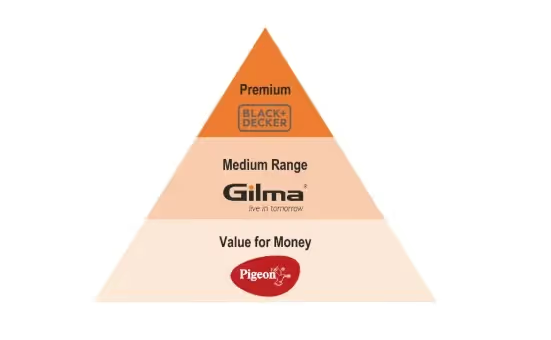
Stove Kraft is engaged in the manufacture and retail of a wide and diverse suite of kitchen solutions under its Pigeon and Gilma brands and proposes to commence manufacturing of kitchen solutions under the BLACK + DECKER brand, covering the entire range of value, semi-premium and premium kitchen solutions, respectively.
Its kitchen solutions comprise of cookware and cooking appliances across its brands, and its home solutions comprise various household utilities, including consumer lighting, which not only enables it to be a one-stop-shop for kitchen and home solutions but also offer products at different pricing points to meet diverse customer requirements and aspirations.
The company has a strong distribution network as under the "Pigeon" brand, it has 651 distributors in 27 states and 5 union territories and 12 distributors for exports and under the "Gilima" brand, it has 65 stores across 4 states and 28 cities.
It not just distribute its products in the Indian market but also exports them to countries like the USA, Mexico, Kenya, Qatar, Sri Lanka, Fiji, Bahrain, Kuwait, etc. Stove Kraft has manufacturing facilities at Bengaluru (Karnataka) and Baddi (Himachal Pradesh).
All Pigeon and Gilima branded appliances are manufactured at its Bengaluru unit and the Baddi facility focuses on the Oil Company Business (OCB) to manufacture products like LPG stoves, inner lid cookers, etc.
Products and Brands:
Stove Krafts products are sold under three brands, viz. Pigeon, Gilma and BLACK + DECKER to cater to the value, semi-premium and premium customer segments, respectively. Set out below is a brief overview of the class of products retailed under each of the brands:
Pigeon:
Pigeon, which is value for money brand, offers a wide array of products under various sub-categories. Set out below is an overview of the products currently offered by us under the Pigeon brand:
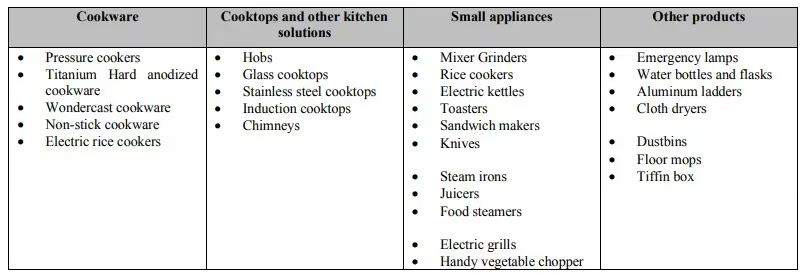
Some of the marquee innovative products, such as the Super Cooker, Infinity glass cooktops and Super Storm Advanced mixer grinder, are sold under the Pigeon brand. The Pigeon ‘super cooker’ is an innovative offering which provides the functionalities of straining, serving, induction cooking compatibility and non-stick, energy-efficient cooking in a single product.
Gilma:

Gilma brand, which focuses on the semi-premium customer segment, is sold exclusively through Gilma branded stores which are designed to offer the customer a modular kitchen experience. Currently, the Gilma portfolio comprises of chimneys, hobs and cooktops across price ranges and design offerings. We believe that our Gilma products combine premium design with effective performance, offered at a competitive price. While Gilma chimneys come built with higher suction power and a lifetime warranty, the hobs offer features such as anti-rust stainless steel body, energy efficiency and one-touch auto-ignition. Similarly, Gilma LPG stoves are designed keeping in mind thermal efficiency, durability and portability. Gilma LPG stoves use toughened glass and brass burners and come with a two-year warranty.
BLACK + DECKER
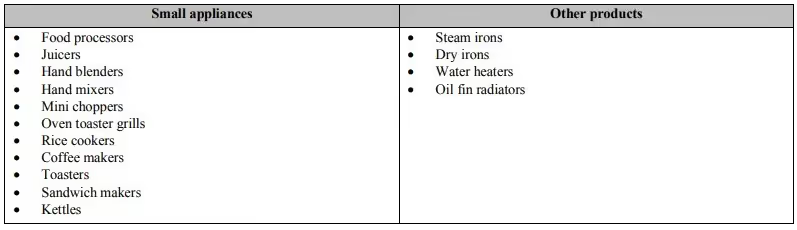
BLACK + DECKER is a renowned name internationally in the field of, inter alia, kitchen appliances. Presently, we offer the following products under the BLACK + DECKER brand, aimed at the premium segment of customers:
IPO Details:
Subscription Dates25 – 28 January 2021Price BandINR 384 – INR 385Fresh issueINR 95 croresOffer For SaleINR 317.63 croresTotal IPO sizeINR 412.63Minimum bid (lot size)38 SharesFace Value INR 10 per shareRetail Allocation10%Listing OnNSE, BSE
Strengths of the Company:
- A one-stop-shop for a well-recognized, award-winning portfolio of kitchen solutions brands with a diverse range of products across consumer preference
- Widespread, well-connected distribution network with a presence across multiple retail channels and a dedicated after-sales network
- Strong manufacturing capability with efficient backward integration;
- Consistent focus on quality and innovation
- Professional management with a successful track record and extensive experience in the kitchen solutions industry, and a young and dynamic workforce
- Strong track record and financial stability
IPO Objective:
- To make the repayment or prepayment payment of the company's borrowings fully or partially
- To meet general corporate purposes.
Financial Performance:
Financial performance (in INR crore)FY2018FY2019FY2020H1 FY2021Revenue534.6642.6672.9329.5Expenses547.1641.4669.4300.7Net income-11.70.92.930.1Margin (%)-2.20.10.49.1
IPO Tentative Time Table
21 Jan 2020: Price Band announced
22 Jan 2020: Anchor List
25 Jan 2021: Offer Opens
28 Jan 2021: Offer Closes
3 Feb 2021: Finalization of Basis of Allotment
3 Feb 2021: Unblocking of ASBA“
4 Dec 2020: Credit to Demat Accounts
5 Feb 2021: Listing on NSE & BSE
Risks:
- Expenses on raw materials increase or the cost of production rises for any other reason, the company will not be able to break even.
- There are unresolved legal issues with regard to certain land parcels which fall inside the factory space.
- There are several outstanding cases — both criminal and civil — against the company and the Stove Kraft Limited owner, Rajendra Gandhi.
Outlook:
Eyeing the brand reorganization and their focus on the innovation of products to meet the needs of the customer we expect that the fundamental of the company will boost up. The company's revenue from operations stood at Rs 328.8 crore in the April-September 2020 period, up from 4.2 percent from the year earlier. Its net profit jumped to Rs 28.8 crore in the same period, against Rs 4.4 crore a year ago. Stove Kraft IPO is priced at 34.5x PE on a trailing basis while the PE of the industry is 46x. We assign a "Subscribe" rating only for listing gain.
Regional Economic Cooperation
Regional economic cooperation is considered to be an approach of moving towards a world economy. in the up to date situation, regional economic cooperation is taken into account because it is the means for enhancing economic development and providing economic security at intervals within a particular region.
Regionalism is being channeled in addressing problems like trade, food and energy security, global climate change, connectivity and also the happening of health epidemics. The regional commissions are instrumental in building strategic partnerships with regional and sub-regional organizations. This joint work has helped bring universal values and norms to the regions.
Of course, the international organization regional commissions are central to the work. Every day, they promote regional cooperation and integration and extend their experience for socioeconomic development. They’re stimulating innovative ideas, together with on finance for development and different means of implementation.
They’re spearheading international organization regional efforts to support their member countries within the implementation of the 2030 Agenda together, by promoting integration, policy coherence, reinforced knowledge and peer learning.
What Benefits will Regional Economic Cooperation Provide?
- Regional economic cooperation will alter stronger transport and trade connectivity through coordinated physical investments and harmonization of policies, rules, and procedures. Economic corridors and worth chains traversing sovereign borders are often promoted.
- Regional Economic Cooperation allows participating countries to fully use underutilized economic potential in terms of human, natural and technological resources.
- Regional Economic Cooperation helps in industrial diversification and in reducing economic dependence, provides scope for participating countries to expand existing industrial activities and additionally to begin new ones.
- Regional cooperation will promote economic and monetary stability through countries of Central Asia adopting synchronous fiscal, monetary, and rate policies to forestall monetary contagion, addressing shared general risks in banking systems, implementing common regulation and superior standards, and sharing lessons and knowledge.
- Regional cooperation is often a force for job creation. New standards for technical education that promotes school and student exchanges, in specialized subject areas and introducing new productivity-enhancing technologies at the regional level for cost-effectiveness. New employment and entrepreneurship opportunities will take place.
- Regional Economic Cooperation allows participating countries to take advantage of the potential complementarities and additionally to determine strategic alliance between enterprises with a motive to enhance their fight in the international market.
- Most significantly, regional cooperation will facilitate building enough economic stakes within the region that promote peace and prosperity and well diminish the threat of aggression and war. This might pave the approach for elevating regional economic cooperation to a replacement pinnacle.
Guidelines:
There are certain guidelines for promoting Regional Economic Cooperation
- Cooperation ought to support equality, equity and mutual profit-taking absolutely under consideration the economic social inequality moreover because of the variations within the level of development among countries within the region.
- Cooperation ought to involve commitment towards the common goals on the part of all collaborating countries with equal respect for each other.
- Cooperation ought to be supporting consultation, deliberation, and accord on all economic and different connected problems.
- Cooperation ought to complement and turn on existing bilateral and different reasonable arrangements among member countries.
- Cooperation ought to support modalities of economic openness and reciprocity and as per principles of the multilateral trading system established.
Drawbacks:
The drawbacks concerned in making regional agreements embody the following:
- In essence, regional agreements have fashioned new trade barriers with countries outside of the trading alliance. Member countries might trade additional with one another than with nonmember nations. This might mean raised trade with a less economical or costlier producer as a result of its membership. During this sense, weaker corporations are often protected unknowingly with the alliance agreement acting as an import barrier.
- Countries might move production to cheaper labor markets in member countries. Similarly, staff might move to realize access to higher jobs and wages. Sudden shifts employed will tax the resources of member countries.
- Nations might realize that they need to administer up additional of their political and economic rights.
History shows that Economic recovery and favorable regional dynamics in Central Asia add any momentum to the current era of regional economic cooperation. They tend to seize the chance provided by these fortuitous developments and deliver lasting peace, progress, and prosperity for countries and other people within the region and on the far side.
Regional integration will expand markets and input sources, higher allocating resources across the region, therefore a fast economic process. It can even improve risk-sharing. However, there also are drawback risks, starting from potential contagion to growing financial gain difference and polarization.
Some Important Regional Organizations are as follows:
- Association of South-East Nations (ASEAN)
- Bay of Bengal Initiative for Multi-Sectoral Technical and Economic Cooperation (BIMSTEC)
- South Asian Association for Regional Cooperation (SAARC)
- Asia-Pacific Economic Cooperation (APEC)
- Indian Ocean Rim Association (IORA)

Home First Finance IPO
Home First Finance Corporation was founded in 2010 based in Mumbai. The company is an affordable housing finance company. The company offers home loans to lower and middle class to buy homes. They also offer loans against property, developer finance to buy commercial properties as well.
The company has a diverse lead generation source channel including connectors, contractors, architects, affordable housing developers, and others. As on Sep 30, 2019, the business has a strong branch network of 65 branches across 60 districts in 11 different states and a union territory in India with a key presence in markets such as Maharashtra, Karnataka, Tamil Nadu, and Gujarat.
It offers quick and transparent loan transactions through its mobile app. As on Sep 30, 2019, it has serviced a total of 37,086 active loans. Its Gross Loan Assets have grown at a CAGR of 69.8% between FY2017 and FY2019 and increased from INR8,473.16 million as of 31 March 2017 to INR31,133.76 million as of 30 September 2019.
Strengths of the Company:
1) Technology-driven affordable housing company.
2) Strong penetration in the largest housing finance market.
3) Diversified lead source channel.
4) Sound fundamentals.
IPO Objective:
1) To augment a company's capital base to meet future capital requirements.
2) Listing benefits.
IPO Details:
Home First Finance IPO details
Subscription Dates
21 – 25 January 2021
Price Band
INR517 – 518 per share
Fresh issue
INR265 crore
Offer For Sale
INR888.72 crore
Total IPO size
INR1,153.72 crore
Minimum bid (lot size)
28 shares
Face Value
INR 2 per share
Retail Allocation
35%
Listing On
NSE, BSE
Tentative Timetable
19th Jan – Announcement of Price Band
20th Jan – Anchor Investors Allotment
21st Jan – Offer Opens
25th Jan – Offer Closes
29th Jan – Finalization of Basis of Allotment
01st Feb – Unblocking of ASBA Accounts
02nd Feb – Credit of Equity Shares to Depository Accounts
03rd Feb – Commencement of Trading
Financial Performance:
Home First Finance’s financial performance (in INR crore)
FY2018FY2019FY2020H1 FY2021Revenue134.2270.9419.7243.2Expenses110.0205.7312.4172.8Net income16.045.179.152.8Net margin (%)11.916.618.821.7
Outlook:
AUM of the company Stands around Rs 3700 cr while the net worth of the company is Rs. 988 cr. For the six months ended September 30, 2020 and the financial year 2020, it sanctioned 2,591 and 15,591 loans on account of leads generated through 887 and 2,553 connectors, respectively. At the upper price band of Rs 518, the issue is priced at a 4.1x P/BV ratio. The RoE and RoA of HFFC is 11% and 2.94% respectively.
Revenue of the company is increasing YoY with a strong strong increase of 150% in total assets. The profit of HFFC increased by 70% CAGR since 2018 with an increase in profit margins. Eying the growth in real estate, NBFC-Housing companies are expected to have a strong boost. We assign a "Subscribe" rating for listing gain and long term.

Importance of Research Report
Writing research reports is a creative process. Creativity is the sense of how an analyst structures the report and communicates the message. What he does is take in a lot of financial information and give out an understandable version of what that financial information means. The process of converting numbers to views does demand certain qualities.
Research analysts make a difference by how they present their views, conclusions, and recommendations. The communication aspect of an analyst's job is as important as analysis, of which writing a research report is one.
Writing a Good Research Report -
Just like writing projects, compiling research reports also has three important steps - Planning, Drafting, and Editing.
The Major Points of a Research Report includes:
The writing process has to be planned as to how each section will be approached and assign a deadline for each. As there are many reports to be written and the workload shall be high near the quarterly results season, it is important to maintain high levels of discipline otherwise the delay can affect the work. Once done with the planning, work should begin on each section.
Generally, each organization has a template of its own, and therefore working on a predefined structure makes the work a little bit easier. Almost all the sections of a research report are fact-based and therefore filling them is more of a copy-paste function but certain important sections require an understanding of the business and thorough communication with management.
Fact-based sections in the Research Report:
- Peer group analysis, shareholding patterns, company fundamentals, and key financial indicators.
- Source of information: Annual reports, quarterly reports, calculations.
The view-based section of the research report:
- Company Business, Key Strengths, Key Concerns, Industry Overview.
- Source of information: Communication with management, Personal Understanding of the business and industry.
- Once the draft is ready it should be rechecked for financial figures and other errors and edited accordingly.
- Every year many reports are prepared by analysts but only a few make a remarkable presence. Things which should be avoided while preparing a report:
- Unnecessary details that are of no use should not be mentioned in it.
- Avoid using long sentences for description, make them precise & simple
- Use simple language which everyone can understand.
How to Read Crude Oil Inventory Data
Crude Oil is one of the most popular trading instruments among commodity traders. But before doing trade on any instrument every trader must know about the news related to that instrument, fundamental outlook, demand & supply factor, technical outlook.
Analyzing Crude Oil Inventory
Some important inventory data needs to keep in focus while analyzing crude oil inventory:
- U.S. API Weekly Crude Oil Stock
- U.S. Crude Oil Inventories
- U.S. Gasoline Inventories
- U.S. EIA Weekly Distillates Stocks
These are the important crude oil reports released in the United States among these all U.S. API Weekly Crude Oil Stock and U.S. Crude Oil Inventories are the two main important crude oil inventory reports.
API inventory report is released by the American Petroleum Institute (API) and other one U.S. Crude Oil Inventory is released by the Energy Information Administration (EIA).
API provides the information of all segments of America’s oil and natural gas industry. They have more than 600 members who produce, process and distribute most of the nation’s energy. The industry supports more than ten million U.S. jobs and is backed by a growing grassroots movement of millions of Americans.
API was established in 1919 as a Standards Setting Organization. EIA is an agency of the United States Federal Statistical System and also a part of the US energy department. The U.S. Energy Information Administration (EIA) collects, analyzes, and disseminates independent and impartial energy information to promote sound policymaking, efficient markets, and public understanding of energy and its interaction with the economy and the environment.
EIA provides a wide range of information and data products covering energy production, stocks, demand, imports, exports, and prices and prepares analyses and special reports on topics of current interest.
Release Day & Time:
U.S. API Weekly Crude Oil Stock inventor is released on Tuesday Night at 02:00 AM (IST), which gives a glimpse of the movement of the crude oil for the day trading session on Wednesday before releasing US Crude Oil inventory data, whereas US crude oil inventory data is released on Wednesday night between (08:00 PM to 09:00 PM). In case of any holiday in the US are any other factors, release date and time may vary.
Other important data like U.S. Gasoline Inventories, U.S. EIA Weekly Distillates Stocks, U.S. EIA Weekly Distillates Stocks are also released at the same time with US Crude oil inventory (EIA) on Wednesday.
Gasoline is generally used as fuel in vehicles and it is made from crude oil and other petroleum products.
Oil refineries companies and blending facilities produce motor gasoline to sell it at retail fuel stations.
Now the question is how it affects the crude oil price so simply to understand this logic we have a case here.
Case - US crude oil inventory fell and in numbers, it is less as compared to forecast so it means the price should move upside according to US crude oil inventory data but at the same time, gasoline inventory data rose which is a ready fuel to use in-vehicle engines it means supply is more than expectation, which will cap the upside movement of the crude oil price.
Conclusion:
You can check all these data and can keep yourself updated regularly by following the website: Investing.com under “Economic Calendar”.
The conclusion is that while analyzing US crude oil inventory data we have to analyze all other related inventory reports at the same time. If all the reports provide clear indications of demand and supply then we can decide whether we have to buy or sell. If data is mixed so it means that price will move in a range.


.avif)
.avif)

.avif)




START YOUR INVESTMENT JOURNEY
Get personalized advice from our experts
- Dedicated RM Support
- Smooth and Fast Trading App
