

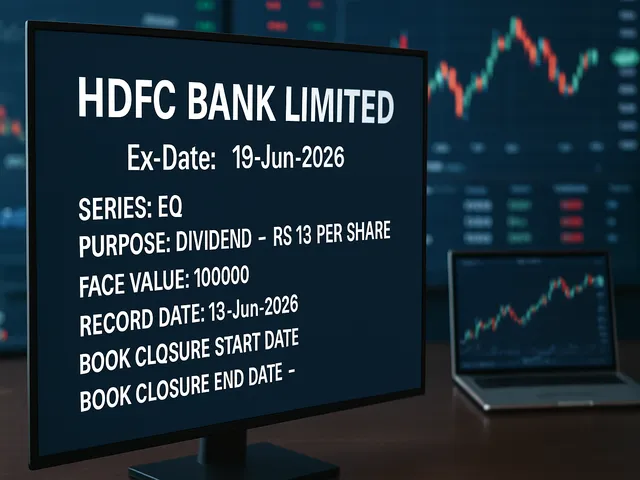
HDFC Bank Limited - Ex-Date: 19-Jun-2026



Quick Takeaways
• HDFC Bank announces a Rs 13 per share dividend for the EQ series with ex-date and record date on 19-Jun-2026.
• Ex-date explains eligibility: ownership before 19-Jun-2026 qualifies for the payout.
• Dividend yield depends on the stock price and may affect short-term price movements around the ex-date.
• Book closure dates aren’t specified in the notice; verify timings through official filings and exchanges.
HDFC Bank Dividend Alert: Rs 13 Per Share Ex-Date 19-Jun-2026
Overview of the announcement
HDFC Bank has announced a dividend on its equity shares for the series EQ, with a payout of Rs 13 per share. The ex-date and the record date are both set for 19 June 2026. The notice lists the face value as Rs 100,000 per share, a nominal value used in regulatory filings. No book-closure dates are specified in the notice, so investors should verify the final dates with the exchange or the bank's investor relations portal. This dividend reflects the bank's ongoing practice of returning capital to shareholders at regular intervals, a common feature among large Indian lenders.
What ex-date means and why it matters
Ex-date is the key cutoff for eligibility. If you buy shares on or after the ex-date, you will not receive the declared dividend for this cycle. Those who hold shares before the ex-date qualify for the payout, subject to being registered as a shareholder on the record date. On or around the ex-date, the stock price often adjusts downward to reflect the impending dividend, though market moves can overshadow this adjustment. The record date confirms who is entitled to receive the dividend, and in this case it is 19 June 2026. For investors, understanding these dates helps avoid missing out on expected income and ensures correct settlement timing across brokers and exchanges.
Dividend yield and portfolio impact
The Rs 13 per-share dividend provides a clear income component, but the realized benefit depends on the share price at the ex-date. Yield is calculated as annual dividend divided by the market price, so higher prices reduce the percentage yield and lower prices increase it, all else equal. Remember that total return includes price movement and taxes, not just the dividend amount. This means a stock could deliver a modest dividend but strong price appreciation, or vice versa, influencing overall performance. For those comparing dividend opportunities, it helps to look at historical payout consistency and the longer-term trend in the stock's returns rather than a single payout event.
Yield calculation basics
As a simple illustration, if a share trades around Rs 6,000 and pays Rs 13 in annualized dividend, the nominal yield from this payout is about 0.22% before tax and after price effects are considered. That figure would change with the actual trading price on the ex-date. In practice, many investors weigh such dividends against alternative income options and volatility risk, while also considering how the dividend aligns with their investment horizon and risk profile.
Practical steps for investors
To qualify for the Rs 13 dividend, you should hold HDFC Bank shares before the ex-date of 19 June 2026 and remain registered on the record date. If you acquire shares on or after the ex-date, you would typically miss this payout. Since the notice does not provide book closure dates, it is wise to confirm the exact timeline from official filings or the exchange. Aligning trading plans with corporate actions helps ensure you receive expected income without disrupting other parts of your strategy.
For retail investors, platforms like Swastika Investmart provide research snippets and market updates that help track corporate actions such as dividends. These resources can simplify understanding of when payouts are expected and how to position your portfolio accordingly. By staying informed, investors can avoid missing out on eligible dividends due to timing issues.
It is also worth noting the tax implications of cash dividends. In India, dividend incomes are generally taxable as part of total income, and tax treatment can vary across regimes and years. Investors should consult a tax advisor to understand how the Rs 13 per share payout fits into their personal tax situation and overall investment plan.
Tax considerations and corporate actions
Dividend payments are a form of shareholder value distribution and are distinct from capital gains. Regulatory filings and exchange notices remain the most reliable source for payout timing and any related corporate actions, including changes in capital structure or shareholder registers. Keeping an eye on these sources can help investors adjust expectations and avoid surprises around payout timing or eligibility.
Conclusion
The Rs 13 per share dividend for HDFC Bank, with ex-date and record date lined up for 19 June 2026, provides a defined income event for shareholders. While the headline amount is straightforward, the real takeaways include understanding eligibility, the interaction with stock price on the ex-date, and how this payout fits into a broader investment plan. Staying informed through official channels and reliable market updates supports a disciplined approach to dividend investing.
Frequently Asked Questions
What is the ex-date for HDFC Bank's dividend?
The ex-date is 19 June 2026, which determines who qualifies to receive the Rs 13 per share dividend.
How much dividend is being paid per share?
Rs 13 per equity share for the series EQ.
Why is the record date important?
The record date identifies shareholders who are eligible to receive the dividend; you must be registered as a holder by the record date.
Big Budget





.avif)
.avif)
.avif)
.avif)
.avif)















.avif)
.avif)
.avif)
.avif)
Latest Articles

Tips and Tricks to Learn Stock Market Trading in India


Share market is a place where everyone wants to make money through investments irrespective of terms. Many investors are masters in doing intraday trading, however, some of them want to play safe and often go for long term investments.
For beginners, it is always difficult to decide whether to invest or not to invest in the stock market as they think that stock trading is full of risks. Well, they are not wrong. Although the share market is full of risks, it offers a huge positive return to many investors.
Share Market Investment Tips
To successfully trade in the stock market, all you need is to learn some highly impactful stock market tips and tactics and you are ready to go.
Before you get a deep dive into stock market trading:
Let's understand the basics first.
Demat and Trading Account
This is the foremost step to enter into the stock market. Opening a Demat account is a must as without it you can't trade online. Demat account is a dematerialization where you can buy, sell and hold your shares in a dematerialized form. Once you open a Demat account, you can start to invest in the stock market.
Stock Market Research
Many beginners believe that stock research is not that important, they instead rely on futile stock tips and unreliable sources.
As you all know, financial markets are full of risks, inconsistencies and volatility. Therefore it is crucial to do a bit of research and planning before buying any stock.
Stock market research and analysis are crucial for any investor because it helps them to get the full insight of stocks such as stock’s history, its past performance, its share price and trends.
Based on the research, you can get an idea when the stock will give you a positive return or not.
Difference Between Primary And Secondary Market
When a company first time lists its shares (IPO) in the share market, it is known as the primary market. Once the shares get listed on the stock exchange, the company gets an authority to trade in the market, which is termed as the secondary market.
Who determines the share price in the Stock Market?
The share market majorly depends on demand and supply. When a company is earning many profits, its share prices go up. As the demand for the stocks goes high, more investors want to buy those stocks which in turn increase the prices of stocks or vice versa.
Role of Broker in Share Market
A stockbroker assists you in buying and selling of shares. Apart from helping in buying and selling, they also provide tips and recommendations on stocks such as which stocks one should buy, how to successfully invest in the share market, which is the best time to sell a share and more.
The Bottom Line
The stock market is indeed a great way to achieve financial gains. Anyone who has done enough research and analysis can easily earn money from the stock market. Although there are many risks and uncertainty associated with the stock market, a smart investment will definitely give you positive returns. For beginners, there are numerous stock broking companies available in India. These companies assist beginners in selecting the right investment type while trading in the stock market.

How to Choose Stocks for Options Trading?
Options Trading is becoming insanely popular among investors as it allows them to hedge risk while earning a good income. Also, options trading allows many traders to hedge risks, speculate high yield stocks, and earn income.
There are different strategies through which investors can diversify their portfolios and earn high returns. With options trading, you can buy or sell an asset at a set price at a certain date.
An option trader needs to determine the correct underlying asset as the value of options stock gets derived from the underlying asset. Hence to increase trading options, traders need to focus on selecting the right underlying stocks to trade.
As you add some options to your portfolio, you will get to realize that the method of buying and selling is really helpful. This is because options stocks add more leverage and protection as well as yield high earnings.
Apart from investing goals, options contracts help you to achieve what you are trying to do. For instance, you may add option contracts to hedge against stocks that are currently running in a downturn thus helps to lessen the losses.
How Traders Choose the Right Stocks for Options Trading
Do Some Research
It is important to do some research to find the best stocks for options trading. Do research related to review earning reports, monitor upcoming events, industry-related search, and check how these events impact the stock market.
Check out the management team of a company, go through their website and press releases, check out the products and services they provide and check if they provide any proven record of success or not.
Choose the Liquidity Factor
Before selecting any stocks in options trading, make sure that the stocks you choose are highly liquid. This is because liquidity allows you to enter the trade and exit from the trade more easily that too without paying heavy slippages.
The most liquid stocks with greater volumes indicate that the trading volume of a stock is ongoing and cannot be affected by any upcoming event. Many investors often get confused with the liquidity of stocks and the liquidity of their options. However, the case is somewhat different from what you think. If a stock is liquid that doesn't mean that its options are also liquid.
Keep a Track of Implied Volatility
Volatile options trading provides greater returns irrespective of underlying stocks moves up or down. Implied volatility is the most important factor to determine the options price as it tells you whether a market is expecting to move or not.
High volatility always comes with high premiums that help to determine that the volatility will not get increased which causes the option to get exercised.
In contrast to this, lower implied volatility means benefits to the buyer of the option as it gives cheaper priced options.
For greater gains, traders can also compare a stock’s historical volatility with its implied volatility. For options traders, it is crucial to keep an eye on upcoming events that could affect the implied volatility of an underlying asset.
Identify Upcoming Events that Impact Stock Prices
Traders who are interested in options trading, need to pay a little attention to stock-specific events. Economic data release, earning reports, election results, and product launches have a significant impact on stock prices.
Here, traders need to predict when a stock is likely to have a big price movement. Carefully notice that movement, get into it, and exit before the movement is over and starts to reverse.
Stick to Your Watchlist
It is feasible to create a watchlist of stocks with whom you are more familiar with the movements and behavior of stocks. For beginners, it is suggested to stick to those stocks on which you made correct predictions in the past. This is recommended for those, who are not much experienced.
Determine Your Investment Objective
If you are an options trader, you need to determine what your trading objectives are. Knowing investing objectives help traders to get a clear idea of what are the goals that help them to choose the best investment strategies.
Final Thoughts
Needless to say, options trading helps traders to hedge risks when the stock market goes down. However, there are multiple points you need to consider while investing in the stock market. Traders need to do a bit of research, review historical data and charts to identify trends before investing in options trading.

6 Crucial Factors that Affect Stock Prices in India
Many of you have often wondered about stock trading and its movements. If you closely monitor the stock market movements, you may get noticed that stock market trends do not move in a single direction.
Sometimes they are up, sometimes they are down. Indeed, it's a big challenge to predict the fluctuations of prices in the Indian stock market as it is difficult to get the exact catch of stock market trends and position.
Needless to say, stock markets are highly volatile in nature. Therefore, stock prices are affected by several factors.
Before taking a dig deep into the stock market trends, let's understand the demand-supply chain first.
Stock market trading works like any other market and mainly focuses on demand-supply chains. For instance, the price of a product is determined by the demand and supply of that product. Let’s understand it with a suitable example:
Many people buy watermelon during the summer as it helps them to stay dehydrated and healthy. As the summer comes, the price of watermelon suddenly increases, which makes retailers purchase watermelon at a higher price than the normal rate.
The above example defines the mechanism of stock prices. The stock market mainly works on demand and supply. Demand and supply play a significant role in determining share prices. If the demand for a particular stock rises, the stock prices start to increase which in turn attract more bidders to bid the maximum to buy the share.
If the demand for a stock increases, the price increases or vice versa.
Here, we will uncover some crucial factors that affect the stock market prices:
Company Related Factors
Any changes in the company whether it is positive factors or negative factors can directly affect a stock’s price. Such factors are increased sales revenue, debt repayment, upliftment in the cash flow statements. Positive factors are:
Company’s dividends - If a company declares dividends to its shareholders, it can directly affect the price of a stock.
Any new changes regarding the present profit or future growth of a company.
Launch of a New Product - If a company first time launches its new product such as IPO, it highly affects that company’s share price.
Negative Factors are:
Any product failure of a company can highly affect the share’s price.
If a company merges with another company, that too affects the share price.
Company’s total employee turnover and high manufacturing costs can also influence the share’s price. Other factors include the scams or scandals involving a company.
Exchange Rates
Indian stock market heavily depends on exchange rates. This is because the value of Indian rupee directly affects the share prices. As the Indian rupee hardens with respect to other currencies, the goods sold by Indian companies become expensive in foreign markets. On the other hand, softening of Indian rupee decreases the value of goods sold in foreign markets.
A strong Indian rupee is the main cause behind the upliftment of stock prices in the Indian stock market.
Stock Market Trends
You must be aware of the terms bull market and the bear market if you are experienced investors. The bull market and bear market trends cause a great stock market fluctuation.
Bull Market Trends
In the Bull market trend, investors are keenly interested in the future of the stock market. Hence they invest more money in the stock market which in turn leads to an overall increase in the stock market prices.
Bear Market Trends
In bear market trends, investors are worried about the money that they have invested in the stock market. They are uncertain about unpredictable market trends which in turn makes the stock prices fall.
Government Policies
The policies controlled by the government have a high impact on stock market trends as the policies directly affect the investor’s sentiments and the economy. If the policies deemed in the favor of investors, share price gain. On the other hand, if the policies fail to comply with investor’s investments, it negatively affects the stock market.
Demonetization in India was the best example of government policy that affected the entire stock market. When demonetization was firstly foisted in India, the stock market crashed due to lack of liquidity.
Natural Disasters
Any natural calamity such as drought, earthquakes, floods badly affect the stock price of a company. These disasters not only impact on human displacement but also lead to asset destruction which in turn reduce the stock market price. For instance, a share trading company faces many difficulties during the natural disasters which in turn lead to depreciation of revenue. Hence it is advisable to check the weather forecast before investing in any share of the company.
Political Situation
Politics can heavily influence the Indian stock market. Before the election, there is huge volatility in the stock market. The rise or fall of share price mainly depends on the expectations of voters. The movements in stock prices were observed when the NDA government was formed led by prime minister Narendra Modi.
Takeaway
Needless to say, stock prices of a company may rise or fall due to certain factors that even the best analysts sometimes fail to recognize the actual reasons behind the fluctuation of a share price. Do remember that each stock price is unique and so its price variations. It is impossible to predict the actual reasons behind the stock’s price. If you are seeking investment in the long run, these factors help you to make the best investment decisions.

Learn the Impact of the Foreign Institutional Investments on Stock Market
“FII” is commonly used amongst investors in the stock market. This is because FII is such entities that pool large amounts of money and invest in financial securities such as real estates, investment assets and the stock market and more. As they invest the bulk of their money in the stock market, the inflow and outflow of money highly affect the stock market movement significantly. There are many headlines you see in the news when the stock market drops. For instance, Sensex falls 500 points on FII selling. Such incidents happen when FIIs pull their money from various investment sectors. Nowadays Indian stock market has become the best destination for FII. Foreign institutional investors poured more money into the stock market than other investment sectors. They have to buy and selling powers in their hands and hence they can change the course of the market within minutes. In India, FII are bound to not invest in equity issued by Asset Reconstruction Company. Also, they are not allowed to invest in any organization who is involved in chit fund, Nidhi company, agricultural activities and real estate business. Before we take a dig deep into getting benefits from FIIs, let's understand about FII and how do they affect the Indian stock market:FII are those institutional investors who invest in a country outside on one where the organizations are based. For example, US Mutual funds invest in the Indian stock market. FII pools large amounts of money and invests in those securities that highly impact the stock market movements.
Why do FIIs enter the Stock Market?
Like any other investors, FIIs look for the investment opportunities which provide them better return against their investments. Keeping in mind, they primarily focus on emerging markets like India, China, Brazil and more. The main reason behind the selection of emerging countries is that these countries have been growing at a greater pace as compared to other developed countries and offer better investment opportunities for FII. India’s high GDP rate over the few years forced FIIs to invest in Indian stock market. Apart from growth, there are other important parameters such as liquidity, political influence and geographical conditions. Although any stock market easily welcomes FIIs to invest their money, however, they have the potential to create chaos in the stock market.
Why is FII important for developing an economy like India?
FIIs are good for developing economies such as India as FII investment strengthens the global confidence in an economy and stock market. For countries like India, the investment amount brought in by foreign institutions generally adds to foreign reserves which can be used by the government to import oil, machinery and more.FII investment in a country boosts the economy of that country which in turn makes FDI follow suit. With the significant increase of foreign investments in any country makes FDI take part in management such as joint venture, merger, investments in technology-oriented products and more. FII always purchases stocks by doing fundamental analysis of each stock such as evaluation, research of those stocks that lead to increased demand on companies to become transparent to retail investors. Secondly, FII cash inflow brings a large capital which is the main cause of the opening of the stock market. Needless to say, FIIs invest huge foreign capital in the Indian stock market which strengthens the confidence of local investors of Indian stock market. Also, FIIs cash inflow not only uplifts the stock price movements in financial markets but also improves the alignment of asset prices to fundamentals. Another crucial benefit of FIIs is that they increase the competition and efficiency of financial markets.
FII’s Effect on the Indian Stock Market
FII holding percentage is considered as an important factor while analyzing a stock. When a percentage of holding increases in stocks, the stock price goes high or vice versa. If an FII invests in any company, the growth of the company automatically increases. A financially stable company that has a stable FII percentage of holdings would be considered as a safer investment option. Hence, when FII removes its part of stocks from a company, the price of stock actually falls.
Conclusion
FIIs hold a great contribution to the Indian stock market, however, their investment percentage is fluctuating from time to time. Besides, FIIs investment in the Indian stock market is considered as a major factor that influences the stock price of a company. Hence, FIIs are a crucial economic indicator that helps investors to analyze a single stock and the whole stock market in an effective way.

What is Equity Trading in the Stock Market?
Equity trading involves buying and selling shares or stocks of companies on the stock market. It's a way for investors to own a part of a company and benefit from its growth. Equity trading has a long history in India, dating back to the establishment of the Bombay Stock Exchange in Mumbai. Over the years, it has grown in popularity, especially among young investors, due to the potential for positive returns with minimal hassle.
The Evolution of Trading in India
Trading in India started with manual processes and lengthy documentation, which was tedious. However, with the advent of online trading, the process has become much more straightforward. Now, investors can easily trade shares online by opening a Demat account, which holds their shares in an electronic format.
Types of Trading in the Indian Stock Market
There are two main types of trading in India:
- Intraday Trading: In this type, you buy and sell shares within the same day. You must square off your position before the market closes.
- Delivery Trading: This type allows you to hold shares for more than one day, possibly even weeks, months, or years. Though the brokerage for delivery trading is higher, it carries less risk compared to intraday trading.
How to Start Equity Trading in India
Equity trading in India has become increasingly accessible and popular, especially with the rise of online trading platforms. Here's a step-by-step guide to help you get started:
1. Understand the Basics
- What is Equity Trading? Equity trading involves buying and selling shares of companies listed on stock exchanges. When you buy shares, you become a part-owner of the company and can benefit from its growth and profits.
- Types of Trading: Familiarize yourself with the two main types of trading:some text
- Intraday Trading: Buying and selling shares on the same day.
- Delivery Trading: Holding shares for more than one day, allowing for long-term investment.
2. Open a Demat and Trading Account
- Demat Account: This account holds your shares in an electronic format. It's essential for trading in the stock market.
- Trading Account: Linked to your Demat account, this is where you execute buy and sell orders.
- How to Open: You can open these accounts through a brokerage firm. Many firms offer the convenience of opening accounts online.
3. Link Your Bank Account
Your trading account needs to be linked to your bank account for seamless transactions. This ensures that you can easily transfer funds when buying or selling shares.
4. Choose the Right Broker
- Registered with SEBI: Ensure that the brokerage firm you choose is registered with the Securities and Exchange Board of India (SEBI).
- Brokerage Fees: Compare fees across different brokers to find one that suits your trading style.
- Platform Features: Look for a trading platform that is user-friendly and offers tools like research reports, technical analysis, and customer support.
5. Start with Low-Risk Stocks
As a beginner, it's wise to start with stocks that have lower risk. Blue-chip stocks or stocks from well-established companies are often more stable and less volatile.
6. Manage Your Risk
- Set a Stop Loss: A stop loss helps you limit potential losses by automatically selling a stock when it reaches a certain price.
- Diversify Your Portfolio: Spread your investments across different sectors to reduce risk.
7. Learn to Analyze Stocks
- Fundamental Analysis: Focuses on a company’s financial health, including earnings, assets, and liabilities.
- Technical Analysis: Involves studying charts and price patterns to predict future stock movements.
8. Monitor the Market
Stay updated with market news, trends, and economic indicators that can affect stock prices. Many trading platforms offer real-time updates and analysis.
9. Start Trading
With your accounts set up and some basic knowledge, you can start trading. Begin with small investments, and as you gain experience and confidence, you can increase your investment amounts.
10. Continuous Learning
The stock market is dynamic, and continuous learning is essential. Keep up with market trends, financial news, and advanced trading strategies to refine your approach.
Methods to Invest in the Stock Market
Selecting the right online stock broker is crucial. Here are some strategies:
- Investment Strategies: Start with a small amount and define your risk tolerance.
- Financial Analysis: Research is key. Understanding the past and present performance of stocks will help you make informed decisions.
- Charts and Indicators: Use fundamental and technical analysis to predict stock price movements.
Advantages of Equity Trading
- Higher Returns Over Time: While equities can be volatile in the short term, they tend to outperform other investments over the long term.
- Protection Against Inflation: Equities are a good hedge against inflation, helping you maintain your purchasing power.
- Potential for Dividends: Established companies often pay regular dividends, providing a steady income.
- Wealth Creation: Equities can be a key component of a long-term financial plan.
How to Get Into Equity Trading
There are several ways to start trading equities:
- Day Trading: Involves analyzing stock price movements and closing positions by the end of the trading day.
- Options vs. Equity Trading: Options are contracts for future transactions at a set price, while equities can be held indefinitely and offer dividends.
- Social Trading: This involves copying the strategies of successful traders, making it a good option for beginners.
Conclusion
Equity trading is a great way to invest and grow your wealth, but it comes with risks. It's important to do your research and understand the basics before you start. Open a live trading account, utilize the tools and resources available, and begin your journey in the stock market. With the right strategies, equity trading can be a profitable venture.

Top 10 Dussehra Picks
In our Dussehra exclusive, we bring together an assorted list of exclusive Top 10 picks from our research analysts.
Central Depository Services Ltd (CDSL): CMP – 460 TGT 625
- Central Depository Services (India) Ltd (CDSL) is the first listed Indian securities depository based in Mumbai.
- The main function of CDSL is to facilitate holding of dematerialized securities enables securities transactions to be processed by book entry.
- CDSL facilitates holding and transacting in securities in the electronic form and facilitates settlement of trades on stock exchanges.
- Only 3% of the people have Demat account in India therefore big opportunity lies for depository companies.
- Duopoly market where CDSL holds 52% market share and growing rapidly as compared to NSDL because it is focusing more on retail investors/traders.
- We may be at the cusp of a long-term trend, similar to what played out through the 1980-2000 era in the US capital markets. During that period, retail participation, which was around 5-6% in the early 80s, ramped up to 45.7% by early 2000.
- There is huge scope for growth in other investment instruments like the bond market which will be a trigger for growth in CDSL.
- Its subsidiary CDSL venture ltd is a key player in eKYC.
- Its subsidiary CDSL Insurance Repository Ltd which helps policyholders to keep an insurance policy in electronic form will help CDSL to create another avenue for growth.
- Asset light business with no debt.
- It trades with 55-60% EBIDTA margin with more than 15% ROE which is expected to rise further.
- Risk: A brutal fall in the Equity market and any change in technology may disrupt the business.
HDFC Life Limited (HDFC LIFE): CMP – 564 TGT 675
- HDFC Life Limited is a long-term life insurance provider with its headquarters in Mumbai, offering individual and group insurance services.
- HDFC Life's products include Protection, Pension, Savings, Investment, Health along with Children and Women plans. The company also provides an option of customizing the plans, by adding optional benefits called riders, at an additional price.
- As compared to other developed economies, India remains vastly under-insured, both in terms of penetration and density. The ‘protection gap’ in India is amongst the highest in the world at 92.2% as of 2014.
- Despite the recent COVID-19 outbreak dampening growth projections for economies across the globe, the structural story for insurance remains intact. Insurance remains a multi-decade opportunity in the Indian context and insurers are well poised to maximize the long-term growth potential of the industry.
- The proportion of the insurable population (people between the ages of 20 and 64) is expected to touch almost 1 billion by 2035, thus outlining the need for long-term savings and protection plans.
- The number of people above the age of 60 years is expected to triple by 2050 as compared to 2015, thus providing insurers with an opportunity to tap the retirement space by way of offering long-term income and annuity products.
- Within the private sector, the top 7 insurers account for 78% of the market (in terms of individual WRP) in FY 2020. (Weighted Received Premium).
- Life insurance penetration in India, which is measured as a ratio of premium to GDP rose marginally from 2.74 in 2018 to 2.82 in 2019 while density which is measured as the ratio of premium to total population also increased marginally from 54.0 in 2018 to 58.0 in 2019.
- The share of the working population is expected to reach 40% in 2030. With the rise in the working population, the sale of pure protection products as well as ULIPs is on the rise.
- With rising per capita incomes and growing nuclear families, there is a need for increased coverage.
Bajaj Finserv Ltd. (BAJAJFINSRV): CMP – 5831 TGT 7500
- Bajaj Finserv Limited, a part of Bajaj Holdings & Investments Limited, is an Indian financial services company focused on lending, asset management, wealth management and insurance.
- It has an umbrella of financial services including loan, life insurance, general insurance, mutual fund, stock broking, credit card, etc which all are going to witness decent growth.
- We can expect value unlocking in the future when the company may plan to list some of its subsidiaries.
- It is a holding company of Bajaj Finance which is a leader in retail finance and has a low cost of funding.
- It is likely to bring disruption in the stock broking industry because of its low brokerage plan.
- During the year, the Company incorporated a wholly-owned subsidiary called Bajaj Finserv Health Ltd. Over time, this entity is expected to create a digital ecosystem in the healthcare segment connecting customers with service providers in the healthcare space such as doctors, hospitals, nursing homes, pharmacies, diagnostic centres, and the like by offering a complete range of products including financial solutions.
- The company is continuously working on innovative products to cater to the needs of retail consumers.
- It is maintaining ROE of more than 15% consistently.
Divis Laboratories Ltd. (DIVISLAB): CMP – 3068 TGT 4200
- Divis Laboratories Ltd. is an Indian pharmaceutical company. It produces active pharmaceutical ingredients (APIs) and intermediates for the manufacture of generic drugs.
- One of the leading Active Pharma ingredient (API) players in the world which has six multi-purpose manufacturing facilities from two sites with all support infrastructure like utilities, environment management and safety systems.
- Covid19 has disrupted the global supply chain mainly for the Pharma industry where the world is looking for an alternative option other than China for their API need where India is going to play a major role in the World Pharma Industry.
- The Indian government has set aside Rs . 10,000 crore ($1.2bn) for the pharmaceutical industry to shift the country away from its reliance on active pharmaceutical ingredients (APIs) produced in China.
- In an attempt to prevent a similar occurrence in the future, the Indian government plans to finance the construction of three bulk drug parks, through an investment of Rs. 3,000 crore over the next five years.
- The government will create a production-linked incentive scheme for the promotion of domestic manufacturing of critical drug intermediates and APIs in the country.
- Indian Pharma companies are expected to do well due to their scale, cost advantage, and a preference for increased sourcing from India. Most of the investors, therefore, are interested in API manufacturers, domestic formulations businesses and drug makers that specialize in acute chronic diseases
- Divis Lab has well experienced and has quality management.
- Stock is trading at PE of 53 but ROE of 25% which is likely to rise further justifies premium valuations.
- It is generating around 40% of the operating profit margin.
PNC Infratech Limited (PNCINFRA): CMP – 172 TGT 225
- PNC Infratech Ltd (PNC) is an Infrastructure construction, development and management company; expertise in the execution of projects including highways, bridges, flyovers, airport runways, industrial areas and transmission lines
- The infrastructure sector is going to play a key role in recovery in the economy and similar to capital goods sectors, the Infra sector didn’t perform post-2007.
- One of the quality company which stands strongly against sector headwinds.
- PNC Infra has delivered good profit growth of 43.39% CAGR over the last 5 years
- The executable order book stood healthy at Rs15,525cr which is 3.2x FY20 revenue, provides revenue visibility.
- PNC remains our preferred pick in the EPC space given its robust order book, comfortable working capital cycle, healthy return ratios and lean balance sheet. Notwithstanding near term hiccups on account of Covid-19, PNC is likely to tide over with resilient fundamentals.
SRF Limited (SRF): CMP – 4422 TGT 5550
- SRF Limited is a chemical-based multi-business conglomerate engaged in the manufacturing of industrial and specialty intermediates. The company has operations in three countries namely India, Thailand and South Africa and an upcoming facility in Hungary and has commercial interests in more than seventy-five countries.
- Chemical is another space where India is likely to gain a major share of the world chemical industry as the world is looking for alternatives to China whereas China itself is shutting many chemical plants due to pollution control measures.
- Over the last 5 years, SRF has incurred CAPEX of INR 53b – constituting 63% of the CAPEX incurred over the last decade. Thus, CAPEX intensity has increased in the last 5 years. SRF plans to spend INR12-13b on CAPEX in FY21 across geographies and segments.
- Lower refrigerant prices, weak demand in end-user industries due to a slowdown in the auto sector, and tepid demand from the white goods segment due to COVID-19 impacted this segment. However, exports continued to improve. Going forward, the management expects better demand from the replacement market and faster utilization (from 3 years expected earlier) in the recently commissioned hydrofluorocarbon (HFC) capacity.
- SRF's Chemical Business saw robust growth during Q4 on strong demand from agrochemical and pharmaceutical customers. In FY20, growth was well over the previously guided 40-50% growth rate. The segment clocked revenue over INR 1,650 crore, an over-60%-growth-rate during the fiscal, due to strong demand and improving capacity utilization. The management guided at a 20-25% growth rate in FY21, led by a strong order book. Trends from the Pharma segment and Latin American markets continue to improve. This segment will be a major growth driver for SRF as its contribution to the revenue mix improves (~23% in FY20 from ~15% in FY19).
- The company was successful in achieving its guided growth rate of 40-50% for FY20 in the Specialty Chemicals business and registered revenues of ~16.5bn for the full year.
- Specialty Chemicals contributed ~Rs 16.5bn out of the total Chemical business revenues for FY20. Speciality business delivered a healthy performance due to strong export demand especially coming from its Agro and Pharma customers and improved utilization levels on its enhanced capacities.
Siemens India Ltd (SIEMENS): CMP – 1280 TGT 1550
- One of the world’s biggest producers of energy-efficient, resource-saving technologies, Siemens is a pioneer in infrastructure and energy solutions, automation and software for industry and is a leader in medical diagnosis. Siemens also provides business-to-business financial solutions, rail automation and wind power solutions.
- It is said that tough times act as an opportunity where Governments across the world need to take major steps to bring the economy on the track where Capex will play a major role, therefore, we are bullish on capital good space which didn’t give any return since 2007.
- Valuations are attractive and the cycle is likely to turn upside for this sector.
- Make in India and make for the world theme is likely to act as a catalyst for the company.
- The company remains focused on Digitization and localization, creating smart infrastructure.
- It is a virtually a debt-free company with ROCE of around 19%.
Larsen And Toubro Infotech Ltd (LTI): CMP – 3061 TGT 4100
- LTI is a global technology consulting and digital solutions company helping more than 420 clients succeeds in a converging world, with operations in 32 countries. LTI helps clients in digital transformation with LTI’s Mosaic platform enabling clients mobile, Analytics, IoT and cloud journeys.
- The technology sector may continue to outperform due to major disruption in word post Covid19 where stock picking will remain a key factor.
- L&T Infotech (LTI) is one of the fastest-growing midcaps IT companies in India. It is part of the L&T group and provides services like ADM, Enterprise solutions, Infrastructure management services, etc.
- LTI has been growing significantly faster than both mid and large-cap peers have over the past few years on the back of strong deal wins.
- Promoters held 74.53% stake in the company as of March 31, 2020, while FIIs held 9.46%, DIIs 7.19% and public and others 8.81%.
- LTI is maintaining ROE of more than 30% for the last 3 years.
- LTI Management is optimistic & confident about the future growth potential capitalizing its core strategy (Digitizing the core, Data-driven organization, Experience transformation, and Operate to transform) with customer centricity as the key engagement tool.
Bajaj Auto Ltd (BAJAJ-AUTO): CMP – 3082 TGT 3700
- Bajaj Auto is the world’s sixth-largest manufacturer of motorcycles and the second-largest in India. It is also the world’s largest three-wheeler manufacturer. The company is based in Pune, Mumbai with plants in Chakan (Pune), Waluj (near Aurangabad) and Pantnagar in Uttarakhand. Bajaj Auto is India’s largest exporter of motorcycles and three-wheelers.
- The only company to witness revenue growth at the time of slowdown in the auto sector.
- Social distancing and lockdown are acting as the key driver for the growth in the two-wheeler industry.
- We expect the Company to fare well in the current environment on the back of its diversified portfolio mix and dual focus on entry and premium segment.
- Bajaj Auto is also coming up with new models in the premium segment and already has a strong market share in the 2-wheeler export market. We believe that going forward; the premium segment along with exports will drive the next leg of growth in 2 wheeler industry over the long term.
- Bajaj Auto is working towards its goal of achieving a market share of ~24% in the domestic 2W market. Its current market share stands at ~19% in the motorcycle segment as of Q1FY21. Management expects the market share gains to be driven by innovative product launches.
- Bajaj Auto brought its historic brand back to life with the launch of the next-generation Chetak in an electric avatar
- We remain positive on the long term growth prospects of the Company owing to 1) strong financial profile of the company, 2) Diversified portfolio mix (domestic 2W, 3W, EV and exports) 3) Innovation in products with a dual focus on entry and premium segment 4) Its ability to sustain profitability despite weak volumes/ exports 4) Partnerships with global MNCs and new product launches.
Dixon Technologies Ltd (DIXON): CMP – 9800 TGT 13000
- Dixon Technologies (India) Limited is the largest home-grown design-focused and solutions company engaged in manufacturing products in the consumer durables lighting and mobile phones markets in India.
- Its diversified product portfolio includes (i) consumer electronics like LED TVs; (ii) home appliances like washing machines; (iii) lighting products like LED bulbs and tubelights downlighters and CFL bulbs; (iv) mobile phones and (v) CCTV & Digital Video Recorders (DVRs).
- Contract manufacturing is going to be the next big theme India as the world is looking for an alternative option for China and the Indian government is continuously focusing on the electronic segment for “Make in India” boost where tag line of Dixon technologies “Brand behind brands” itself tells a lot about the company.
- Rising manufacturing costs in other economies, growing labour costs in China & tendency by bigger original equipment manufacturer (OEMs) to outsource manufacturing instead of building their infrastructure is driving the growth of the EMS market in India. More & more brands are going to focus on branding & distribution & manufacturing as part of the value chain will be outsourced
- Market leader in the industry who does contract manufacturing for big brands like Samsung, Panasonic India Pvt. Ltd, Philips Lighting India Ltd, Haier Appliance (I) Pvt. Ltd, Gionee, Surya Roshni Ltd.
- Dixon Ltd has entered into an agreement with the Chinese big brand Xiaomi for the manufacturing of Smart LED TV.
- The increasing penetration of the internet has led to a surge in mobile phone demand, leading to a significant rise in production. Dixon currently manufactures feature phones, smartphones, PCBA for mobiles with a backward integration framework.
- It has also entered into medical device equipment manufacturing and management is very optimistic about it.
- It has entered into a new line of business to manufacture set-top boxes where Jio is its key client.
- Valuations are overstretched but we believe that it has the potential to see multifold growth in the next decade by looking sector outlook, management commitments and its product portfolio.


.avif)
.avif)

.avif)




START YOUR INVESTMENT JOURNEY
Get personalized advice from our experts
- Dedicated RM Support
- Smooth and Fast Trading App
