

The Power of Compounding – Why Starting Early Matters




Introduction
Albert Einstein reportedly called compound interest the "eighth wonder of the world." Whether or not he actually said it, the math is undeniable. Compounding is the process where your investment returns begin earning their own returns — and over time, this snowball effect becomes truly extraordinary.
The catch? Compounding needs one essential ingredient: time.

The more years you give your money to grow, the more dramatic — and life-changing — the results become. This is exactly why starting your investment journey early, even with a modest amount, can make a difference of crores by the time you retire.
A Tale of Two Investors: Arjun vs Priya
Let's bring this concept to life with a simple, real-world example.
Meet Arjun and Priya. Both are sensible, disciplined investors. Both invest ₹5,000 every month through a SIP (Systematic Investment Plan) in equity mutual funds, earning an average annual return of 12%. Both stop investing at age 60.
The only difference? Arjun starts at 25. Priya starts at 35.
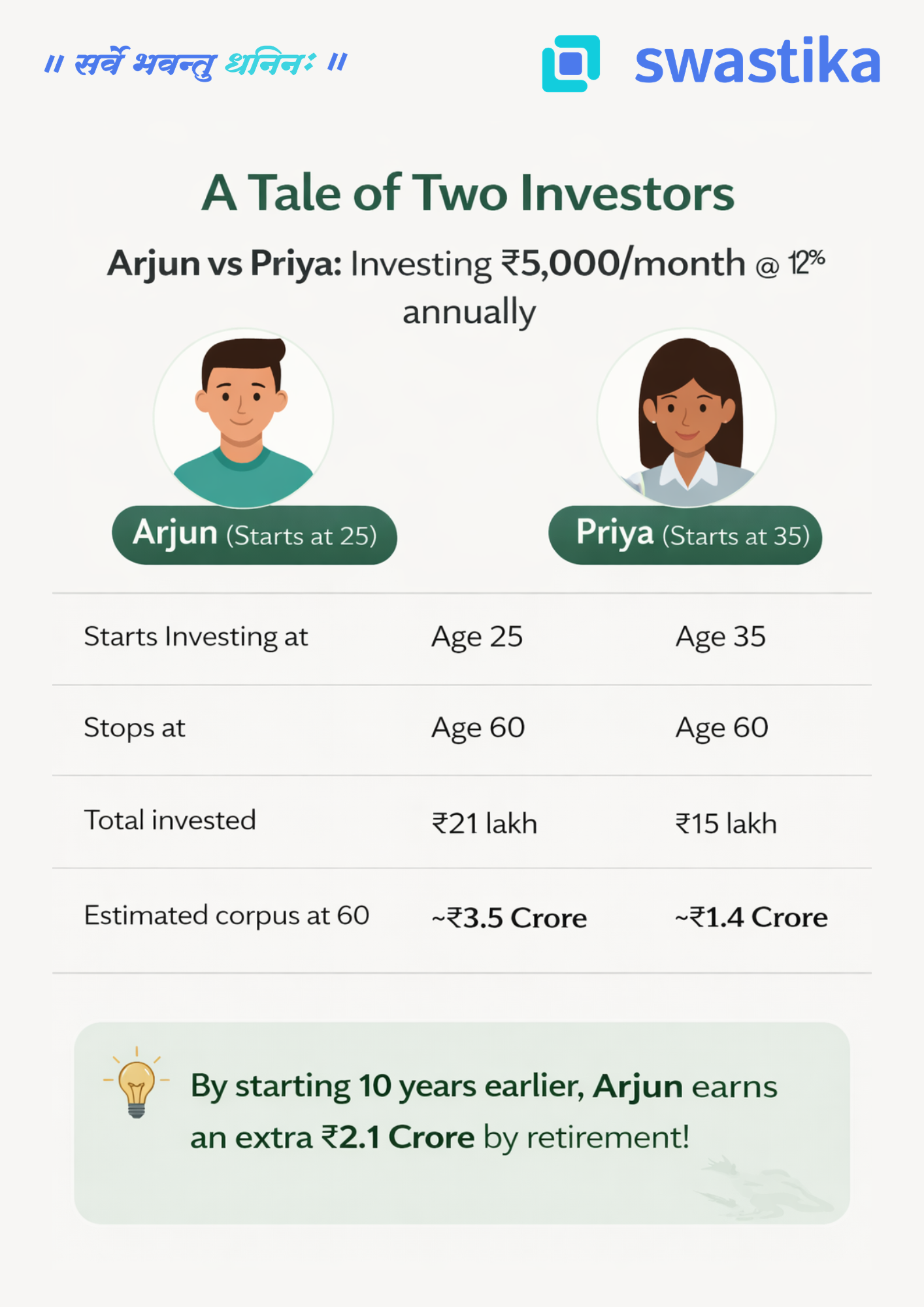
The numbers are striking. Arjun invests just ₹6 lakh more than Priya in absolute terms — yet walks away with ₹2.1 Crore more at retirement.
That extra ₹2.1 Crore didn't come from investing more aggressively or taking bigger risks. It came purely from starting 10 years earlier.
Why Does Time Make Such a Huge Difference?
This is where the magic of compounding reveals itself.
In the early years of investing, growth looks modest and almost unimpressive. But as the years pass, your corpus grows not just on your original investment, but on all the accumulated returns from previous years. The curve goes from almost flat to steeply exponential — and that steep climb happens in the later years.
When Arjun starts at 25, his money has 35 years to ride that exponential curve. Priya's money, starting at 35, only catches the last 25 years — and critically, it misses the steepest part of the climb in the final decade.
Think of it this way: the last 10 years of compounding are worth more than the first 20. That is the counterintuitive truth at the heart of long-term investing.
The Real Cost of Waiting
Many young earners tell themselves, "I'll start investing once I'm more settled — once the salary improves, once the EMI is paid off, once life is a bit easier."
But the numbers show that every year of delay is extraordinarily expensive — far more expensive than any EMI or lifestyle expense. Priya didn't invest carelessly. She invested faithfully for 25 years. Yet she ends up with less than half of what Arjun accumulated — not because she did anything wrong, but simply because she started a decade late.
The cost of waiting 10 years wasn't ₹6 lakh in additional contributions. The cost was ₹2.1 Crore in lost wealth.
Three Principles to Remember
1. Start now, not later.The best time to start investing was yesterday. The second best time is today. Even a SIP of ₹1,000–₹2,000 per month in your 20s is infinitely better than waiting for the "right time."
2. Consistency beats intensity.You don't need to invest large sums all at once. A small, steady, monthly commitment — maintained without interruption — is what unlocks the full power of compounding over decades.
3. Stay invested through market cycles.Compounding works only if you let it work. Exiting during market corrections or stopping your SIP in tough months breaks the chain. Time in the market, not timing the market, is what builds wealth.
The Bottom Line
If you are in your 20s or early 30s, you hold an asset that no amount of money can buy later: time. Use it. Start a SIP today — even a small one. Let compounding do its slow, steady, powerful work.
Because the difference between starting at 25 and starting at 35 is not just 10 years. As Arjun and Priya's story shows, that difference is ₹2.1 Crore.
Big Budget











.webp)
.webp)
.webp)
.webp)
.webp)
















.webp)
.webp)
.webp)
.webp)
Latest Articles

Importance of Price-Sales Ratio to Value Companies


We can see that price-to-sales is the most popular valuation ratio used on YCharts.
That is because the P/S ratio is easy to calculate by a stock trading and can be used for companies with a wide range of earnings and cash flow profiles.
P/S is also a very useful valuation ratio for high growth companies. Many high growth companies do not have positive earnings or cash flow in their early years.
P/S does not require earnings, so it can be applied to young companies as well as more established businesses.
Want to know more about the P/S ratio? Feel free to mail us - hello@swastika.co.in
What is a Price-Sales Ratio?
Price-to-sales ratio (P/S) is the ratio of a company's stock price to its sales per share. It is calculated as market capitalization divided by the revenue per share.
The price-sales ratio is similar to the price-earnings ratio in that it helps investors determine whether a stock is undervalued or overvalued.
The P/S ratio can be used with any type of company, but it is most commonly applied to those companies that are not profitable or whose profits are not consistent.
The P/S metric does not consider whether a company is earning a profit, only how much revenue it generates for each share outstanding.
Because profit margins vary widely across industries, the price-sales ratio does not always provide a meaningful comparison between companies in different sectors.
Also Read - Is It Good To Buy Low P/E Ratio Stocks?
There are Several Determinants of the P/S Ratio and they are:
- Growth Rate: companies with a high growth rate will have a higher P/S ratio
- Industry Norms: different industries have different norms for P/S ratio, so an industry average is important
- Profitability: if the company is unprofitable, then there will not be any sales to get a ratio for, so it does not make sense to use this method in that case
Get confused no issues talk to our experts to get detailed information about determinations of P/S ratio - 0120 4400700
What is the Importance of Price-sales Ratio While Valuing Companies?
Price-Sales Ratio is a ratio of Price per share / Sales per share. For ex: Price per share = ₹100, Sales per share = ₹200 then the price-sales ratio = 100/200 = ₹0.5 which means that for every rupee in sales, the company's market value is 50 Paisa.
This ratio gives us the value of a company per share in terms of sales.
When comparing companies from different industries, it is important to compare their price sales ratios within their respective industry group.
Because different industries have different profitability and capital structures.
P/S ratio for typical technology companies tends to be higher than for other types of companies because investors are willing to pay more for growth.
The P/S ratio is also useful in comparing two companies that are growing at different rates because the P/S ratio will adjust accordingly and make them easy to compare.
Know all about stock market trading.
The PSR Ratio has Some Drawbacks:
- It cannot be used as a tool to compare companies across different industries as each industry has its own norms and average P/S ratios. For Example: software companies normally have high P/S ratios compared to manufacturing companies due to higher margins in the former and lower margins in the latter.
- It cannot be used alone as a valuation tool and should only be used in combination with other valuation metrics such as EV/EBITDA (earnings before interest, taxes, depreciation, and amortization), EV/Sales etc.
- Since accounting practices differ from country to country, the country-specific price-sales ratios should be used for comparison instead of comparing global/pan-industry.
What is a Good P/S Ratio?
A price-to-sales ratio is a company’s share price divided by the company’s revenue per share. It compares a company’s stock price to the total revenue of the business.
If a company's P/S ratio is between 1 and 2, it is considered to be a good investment. However, a P/S ratio of less than 1 is considered excellent.
For example, imagine that Company A has a P/S ratio of five, while Company B has a P/S ratio of 10.
You can conclude that investors expect Company B to grow faster than Company A. This makes sense, because investors expect to pay more for future earnings growth.
Also Read about intraday trading
Difference Between PE Ratio and P/S Ratio
The P/S ratio is the Price to Sales Ratio. The price/Sales ratio (PS ratio) for a sector is calculated by taking the sum of the market capitalization of all the stocks in the sector and then dividing it by their aggregate sales.
Higher the ratio, the more expensive the sector. Lower the ratio, the cheaper the sector.
The Price/Earnings (PE) Ratio for a sector is calculated by dividing the total market capitalization of all the stocks in that sector by its total earnings.
If a company has a PE ratio of 25, it means investors are willing to pay ₹25 for every rupee of its earnings.
The higher the ratio, the higher is the risk associated with that company’s stock. The lower the PE ratio, the lower is the risk associated with that stock.
Conclusion
It can be concluded that there are many advantages and disadvantages to valuing companies, it depends on the companies.

Income Stocks - Types and Features
In stock market trading, if the stock pays regular dividends with a record of steady dividend growth is called an income stock.
Companies usually issue income stocks with stable cash flows and well-established financial infrastructure.
It's also quite common for companies that issue income stocks to have long histories of success, a large market capitalization, and to operate at a mature stage in their growth curve.
Income stocks are often compared with value stocks. While income stocks pay out dividends at a high rate, value stocks are often trading at a price lower than the company's fundamental value or the stock's book value.
Investors generally invest in income stocks to get a stable cash flow from their investment without putting too much risk on their money.
Income stocks are generally considered less risky than other types of investments.
If you face any difficulty in understanding income stocks then feel free to mail us and talk to our experts.
What are the Types of Income Stocks?
Income stocks are considered to be less risky as compared to growth stocks.
Suppose a company is well established and has a consistent track record of paying dividends. In that case, it can be considered an income stock.
Income stocks are considered good for investors who want stability and regular stock trading returns in dividends.
Types of Income Stocks:
High Yielding Dividend Stocks
High yielding dividend stocks refer to companies with a long history of paying high dividend yields.
These companies have a steady cash flow stream and can afford to pay higher dividend yields.
Low Yielding Dividend Stocks
Low yielding dividend stocks refer to those companies that payout low or moderate dividend yields.
Such companies generally have a stable financial position. They reinvest their cash flows into their business to expand and grow.
Learn everything about share market trading
Features of Income Stocks
Regular Dividends
Dividend-paying stocks are those whose payments are made by a company to its stockholders. Most income stocks pay dividends regularly, whether monthly, quarterly or annually.
The amount of each dividend payment can vary depending on the company's profitability.
The total amount of dividends paid by a company over a given period is its dividend yield or dividend payout ratio.
Also, Read - 5 Smart Rules to Follow While Investing in Dividend Paying Stock
Low Risk
Income stocks offer lower risk than many other investments - they are usually large, well-established companies with long track records of paying stable or rising dividends.
Steady Growth Potential
Income stocks have the potential for steady growth through reinvesting their dividends into the business or using them for acquisitions.
Moderate Volatility
The price of income stocks tends to be less volatile than those of speculative growth stocks but more volatile than defensive shares (which pay lower yields and have less scope for capital gains).
Defensive in Nature
It has been found that income stocks are highly defensive in nature. They don't fluctuate with the frequent changes in the market.
Minimum Capital Investment
Income stocks don't reinvest their profits. Instead, they distribute most of their profits to the shareholders in the form of dividends. As a result, they lack a surplus fund for further investments.
Benefits of Income Stocks
These stocks provide stable dividends to shareholders as compared to other stocks.
Income stocks are less risky as they are less volatile than other stocks.
These are apt for those who have a low-risk appetite investment mindset viz students, non-income people, older people and more.
Companies that issue income stocks have a strong financial background and hence they provide stable dividends to their shareholders.
Companies that issue income stocks mostly come under the large-cap market.
Conclusion
Yes, it is good to invest in income stocks.
We would say that you should make sure you do not put all your eggs in one basket.
If you are investing for the long term, it makes sense to have a lot of different investments.
Income stocks are a great place to start when you begin investing as they are not too risky but offer a decent amount of risk.

Everything You Should Know about Defensive Stocks
One of the main reasons for stock traders to invest in defensive stocks is as a defensive measure against economic uncertainty.
These companies are so-called because they tend to be less volatile and more stable than the wider market, even in times of economic turmoil.
In this blog, we'll outline what makes a stock defensive, how to recognize which shares are defensive, and why you might want to include them in your portfolio.
To get more information about defensive stocks in detail, feel free to write to us at - hello@swastika.co.in
What is a Defensive Stock?
A defensive stock is expected to maintain a stable share price during an economic downturn or when the broader market falls.
Typically these are companies with products or services that people will continue to buy regardless of how much they spend.
How Do You Identify Defensive Stocks in the Indian Stock Market?
Typically, defensive stocks have the following characteristics:
- They are low-growth businesses but generate stable cash flow from operations.
- They have stable and predictable earnings growth, usually in the single digits.
- They pay out a large portion of their earnings as dividends.
As a result, investors typically turn to defensive stocks to reduce risk in their portfolios, especially during uncertain times in the market cycle.
Also Read - Everything about Stock Market Trading
Defensive Stocks Have the Following Characteristics:
Stable Revenue and Earnings Growth: Defensive stocks have steady revenue and earnings growth which means they don't make large profits or losses in any particular year.
Low Debt: Most defensive stocks have very little debt. Debt is not something these companies would want to carry on their books as it affects their valuation.
High-Profit Margin: Defensive Stocks also tend to have high-profit margins, compared to other sectors, because of the stability in their businesses. This high-profit margin keeps them profitable during economic downturns.
Stable Dividends: The dividend payment for most defensive stocks is stable and growing steadily over some time.
These dividend payments are also less volatile than consumer discretionary or technology stocks.
Advantages of Defensive Stocks in India
Defensive stocks are companies that sell products and services that are considered essential and non-cyclical.
These products are not affected by economic downturns and always remain in demand.
For example, a company that sells FMCG products like soap, toothpaste, shampoo etc., or a pharmaceutical company can be considered as a defensive stock.
The recession affects the demand for these products because people still need to buy food, medicines, and other items for daily use.
Defensive stocks generally have competitive advantages like low-interest rate loans, government contracts etc.
These stocks tend to be less volatile than cyclical stocks and provide a greater level of security to investors. Defensive stocks also offer higher dividend yields.
Why Defensive stocks are suitable for your Portfolio
Defensive stocks are those which can weather economic downturns and market volatility.
These stocks can provide stability to your portfolio, and hence they are known as defensive stocks.
The characteristics of defensive stocks include stable or consistent earnings, regular dividend payouts, low beta, lower risk profile and low volatility.
Defensive stocks belong to sectors with essential products or services and are used in all phases of the economic cycle.
So, when the economy is weak or during periods of uncertainty, these stocks perform relatively well compared to the overall market.
Open Demat account to invest in defensive stocks.
Industries Come under Defensive Stocks
Utilities
Electric utilities, water, and gas are examples of defensive stocks. Similarly, communications service companies such as telephone and cable television companies are also defensive.
Since utility companies primarily deal in essential services and communication, these businesses remain fairly stable during recessions.
Pharmaceuticals
Pharmaceutical companies are another example of defensive stocks. These companies generate revenue by selling drugs that treat chronic conditions like high blood pressure, diabetes, and arthritis.
Although some prescription drug sales may decrease during a downturn due to patients' inability to afford them, new customers will enter the market.
Also Read - Everything about Intraday trading.
Consumer Staples
Consumer staples are non-discretionary products that people buy regardless of income levels or economic cycles.
For example, consumers still need food and personal care items even during economic downturns.
Consumer staple stocks are also considered defensive because they offer stable earnings with modest growth prospects;
These qualities make them appealing to conservative investors seeking low-risk equities.
Food Stocks
Food stocks are a great example of defensive stocks. Food items like rice and wheat are in high demand regardless of the economic conditions.
When the economy is booming, people buy more food products, but even when the economy is struggling, they still buy basic food items like wheat and rice.
Defensive stocks are a must-have in every investor's Portfolio. They help to create a balanced portfolio and reduce overall risk.
Conclusion
Defensive stocks are not affected by economic downturns and hence, their value does not decrease much in bearish market conditions. These stocks are ideal for investors who want to create a diversified portfolio.

Understanding Corporate Actions and Their Impact on Stock Prices
Corporate actions are key events that companies undertake, which can directly impact their stock prices, financial health, and how investors perceive them. Whether it's issuing dividends, conducting stock splits, or merging with another company, these actions play a significant role in the stock market. Let’s break down the most common corporate actions and their effects on stock prices, with examples from Indian stocks to illustrate.
What Are Corporate Actions?
Corporate actions are decisions made by a company that affect its shareholders. These actions can lead to changes in stock prices, which investors need to understand to make informed decisions. Here are some of the most common corporate actions:
Types of Corporate Actions
1. Dividends
Dividends are payments made to shareholders from a company’s earnings. They can be in the form of cash or additional shares.
Impact on Stock Price: When a dividend is declared, the stock price usually drops by the dividend amount on the ex-dividend date. For instance, if a company announces a ₹5 dividend, the stock price might decrease by ₹5 on the ex-dividend date.
Example: Consider a company like HDFC Bank. When it declares a cash dividend, the stock price adjusts to reflect the dividend payout. If HDFC Bank declares a ₹10 dividend, its stock price might drop by ₹10 on the ex-dividend date.
2. Stock Splits
A stock split increases the number of shares outstanding by issuing more shares to existing shareholders. For example, in a 2-for-1 split, shareholders receive two shares for every one they own, but the share price is halved.
Impact on Stock Price: The total value of shares held by an investor remains the same, but the price per share changes according to the split ratio. If a stock priced at ₹200 undergoes a 2-for-1 split, the new price would be ₹100, and shareholders would own twice as many shares.
Example: Reliance Industries has conducted stock splits in the past. For instance, if Reliance's stock was trading at ₹2,000 and underwent a 5-for-1 split, the price would adjust to ₹400, but shareholders would now have five times more shares.
3. Bonus Shares
Bonus shares are additional shares given to existing shareholders at no extra cost, usually based on the number of shares they already own.
Impact on Stock Price: The stock price typically drops to reflect the increase in the number of shares. For example, if a company issues a 1:1 bonus, the share price might halve, but shareholders will own double the number of shares.
Example: Tata Motors has issued bonus shares before. If Tata Motors issues a 1:1 bonus, the stock price might decrease, but shareholders will have twice as many shares as before.
4. Mergers and Acquisitions
Mergers involve two companies combining to form a new entity, while acquisitions occur when one company takes over another.
Impact on Stock Price: The stock price reaction depends on the deal. Generally, the acquiring company's stock price might drop due to the costs involved, while the target company's stock price usually rises. The long-term effect depends on how well the deal is executed.
Example: When Hindustan Aeronautics Limited (HAL) acquired smaller defense firms, HAL’s stock price reacted to the perceived benefits of the acquisition. Conversely, the stock of the acquired firms often saw a spike.
5. Rights Issues
A rights issue allows existing shareholders to buy additional shares at a discount to the current market price.
Impact on Stock Price: The stock price might fall to account for the dilution due to the new shares being issued. For example, if a company issues new shares at ₹50 while the current price is ₹83, the market price might adjust downward to reflect the dilution.
Example: If Infosys announces a rights issue at ₹1,000 when the market price is ₹1,200, the stock price might fall to around ₹1,050 to reflect the new shares being issued.
Impact on Stock Prices
Immediate Reaction: Corporate actions often cause immediate fluctuations in stock prices. For instance, a dividend announcement can lead to a temporary drop in stock price on the ex-dividend date.
Long-Term Effects: The long-term impact depends on how the corporate action affects the company's overall financial health and future prospects. Successful mergers or strategic stock splits can lead to increased stock prices if they create value and growth opportunities.
Conclusion
Corporate actions are significant events that can influence stock prices in various ways. By understanding these actions—such as dividends, stock splits, bonus shares, mergers, and rights issues—investors can better navigate the stock market. Monitoring these events helps investors make informed decisions and anticipate market reactions, allowing them to align their strategies accordingly.

अनिश्चितता से कीमती धातुओं को सपोर्ट।
पिछले सप्ताह में सोने और चांदी के भाव तेज़ रहे क्योंकि रूस और यूक्रेन के बीच चल रही शांति वार्ता में कोई खास प्रगति नहीं हुई। जिसके कारण लगातार अनिश्चिता और मुद्रास्फीति दोनों बढ़ने के कारण निवेशकों की सुरक्षित निवेश की मांग से कीमती धातुओं के भाव तेज़ हो रहे है।
गुरुवार को नाटो प्रमुख और यूरोपियन यूनियन देशो के साथ प्रेसिडेंट जो बाइडेन की बैठक हुई जिसमे रूस पर कुछ अतिरीक्त प्रतिबंद लगाए गए। इसमें रूस द्वारा पश्चिमी प्रतिबंधों को कम करने के लिए किये जा रहे सोने में लेनदेन और कच्चे तेल की आपूर्ति पर निशाना साधा गया है।
कजाकिस्तान की कच्चे तेल पाइप लाइन से इसकी आपूर्ति रुकने के कारण पिछले सप्ताह कीमते तेज़ रही और बढ़ती हुई कच्चे तेल की कीमतों से कीमती धातुओं के भाव को समर्थन मिला है।
हालांकि, अमेरिकी बांड यील्ड 2019 के उच्च स्तरों के पास पहुंच चुकी है और इसमें लगातार चल रही बढ़ोतरी के कारण कीमती धातुओं के भाव में ऊपरी स्तरों पर दबाव भी रहा है। रूस - यूक्रेन युद्ध और एनर्जी कीमतों में बढ़ोतरी आवश्यक वस्तुओ की आपूर्ति को चिंता में डाल रहा है।
यूरोपियन देश रूस से कच्चे तेल का बड़ा हिस्सा आयात करते है प्रतिबंधों के कारण कीमतों में अप्रत्याशित बढ़त को रोकने के लिए अमेरिका, यूरोपियन देश को कच्चे तेल और प्राकृतिक गैस की आपूर्ति बढ़ाएगा।
इस सप्ताह बाजार की नज़र अमेरिकी एडीपी नॉन फार्म एम्प्लॉयमेंट चेंज और पैरोल के आकड़ो पर रहेगी जिससे कीमती धातुओं के भाव को नई दिशा मिल सकती है।
तकनीकी विश्लेषण:
इस सप्ताह भी सोने और चांदी के भाव में तेज़ी जारी रहने की सम्भावना है। जून वायदा सोने में 51500 रुपये पर सपोर्ट और 53000 रुपये पर प्रतिरोध है। मई वायदा चांदी में 67000 रुपये पर सपोर्ट और 71000 रुपये पर प्रतिरोध है।

LIC IPO Updates - Check Issue, Closing & Allotment Date
LIC IPO Updates
Swastika comes with the fresh information of Life Insurance Corporation of India's initial public offering (IPO) which will hit the market next month. Here, we will discuss the latest LIC IPO Updates including issue, closing, allotment date and more.
The IPO comprises over 31.6 crore shares or five per cent of the government's stake in the insurance behemoth.
India is all set to launch the country's largest-ever public offering, as the state-run Life Insurance Corporation of India (LIC) filed a Draft Red Herring Prospectus (DRHP) with the SEBI for selling a five per cent stake by the government.
Employees and policyholders of the insurance giant would get a discount over the floor price.
For this, it is mandatory that the policy should have been issued on or before February 13, 2022. Investors must link PAN to the policy by February 28, 2022
About LIC IPO Latest Information February 2022
LIC IPO Price Band Coming soon LIC IPO Date Coming soon Fresh issue NIL Offer For Sale 316,249,885 shares Total IPO size 316,249,885 shares Face Value INR 10 per share Minimum bid (lot size) Coming soon Retail Allocation 35% Listing On NSE, BSE
How many Shares in LIC IPO are Reserved for HNIs and Retail Investors?
The investors' portion for QIB is 50%, NII is 15%, and Retail is 35%.
Of which, 50 percent will go to retail investors, 15 percent to non-institutional investors (NII) and 35 percent to qualified institutional buyers (QIB).
Recent Updates For LIC Policyholders
If a policyholder does not update PAN details by February 28, 2022, they will not be eligible for availing the reserved shares of LIC's IPO.
A policyholder shall ensure that their PAN details are updated in the policy records of LIC at the earliest.
How to Apply for a LIC IPO?
To get the benefit of a discount on the price of LIC IPO. LIC policyholders Should link your Pan Card with Policy; the following are the steps to link your Pan.
How to Update PAN details on the LIC Website
- Visit the official LIC website https://licindia.in/ Or Link your policy with PAN directly https://linkpan.licindia.in/UIDSeedingWebApp/
- Select the 'Online PAN Registration' option from the home page.
- Tap the 'Proceed' button on the Online PAN Registration page.
- Provide your correct email address, PAN, mobile number, and LIC policy number.
- Enter the Captcha code in the box.
- Click on 'Get OTP'
- Once you've received the OTP, input the OTP digits into the space provided for it on the port.
- LIC Versus Indian Peers
Life Insurance Corporation of India (LIC) continues to be the market leader, with a 66% share in the overall life insurance market, followed by HDFC
Life Insurance at 9.8%, ICICI Prudential Life Insurance at 8.4%, Aditya Birla Sun Life Insurance at 5.4% and SBI Life Insurance at 4.2%.
"It is not surprising that LIC has maintained its leadership position amid the Covid-induced crisis," said Madan Sabnavis, chief economist at CARE Ratings Ltd., "due to its vast network across India and strong brand recall among customers."
Indian Govt plans to tap around 180 investors in mega roadshows of LIC
For the roadshows of Life Insurance Corporation of India's (LIC's) listing, the government will approach large investors who have not yet anchored any initial public offering (IPO) and those who focus only on large public offerings, officials in the know said.
In an effort to connect with more than 180 investors, government officials have started virtual roadshows.
The roadshows are part of the government's preparations for the biggest-ever public listing in India.
The government wants to make sure that there is a good spread among anchor investors and it is not just limited to a few big names.
The Government of India is approaching new investors as well.
Conclusion
LIC IPO is going to be the biggest IPO in India.


.webp)
.webp)

.webp)






START YOUR INVESTMENT JOURNEY
Get personalized advice from our experts
- Dedicated RM Support
- Smooth and Fast Trading App
