

The Power of Compounding – Why Starting Early Matters




Introduction
Albert Einstein reportedly called compound interest the "eighth wonder of the world." Whether or not he actually said it, the math is undeniable. Compounding is the process where your investment returns begin earning their own returns — and over time, this snowball effect becomes truly extraordinary.
The catch? Compounding needs one essential ingredient: time.
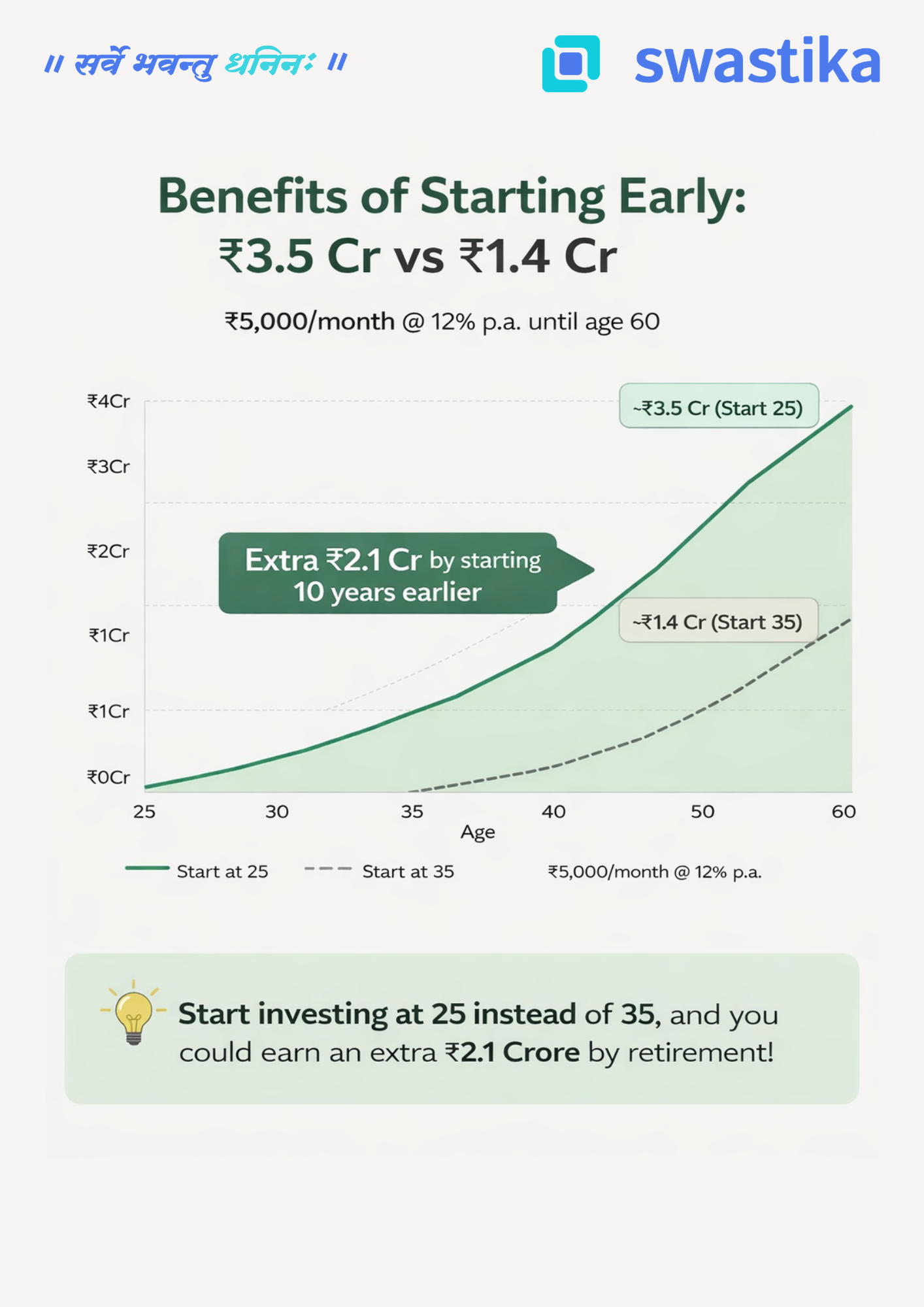
The more years you give your money to grow, the more dramatic — and life-changing — the results become. This is exactly why starting your investment journey early, even with a modest amount, can make a difference of crores by the time you retire.
A Tale of Two Investors: Arjun vs Priya
Let's bring this concept to life with a simple, real-world example.
Meet Arjun and Priya. Both are sensible, disciplined investors. Both invest ₹5,000 every month through a SIP (Systematic Investment Plan) in equity mutual funds, earning an average annual return of 12%. Both stop investing at age 60.
The only difference? Arjun starts at 25. Priya starts at 35.
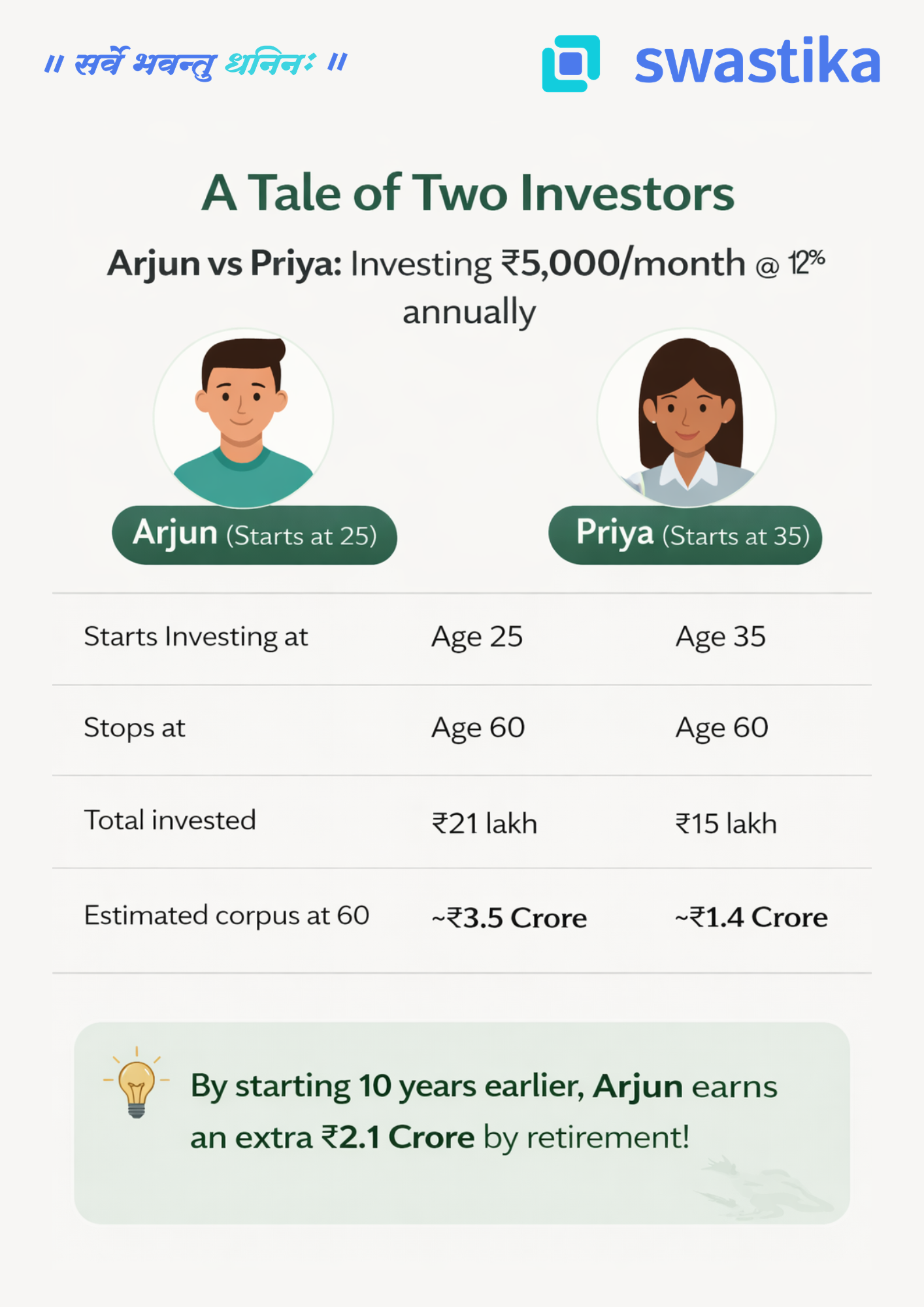
The numbers are striking. Arjun invests just ₹6 lakh more than Priya in absolute terms — yet walks away with ₹2.1 Crore more at retirement.
That extra ₹2.1 Crore didn't come from investing more aggressively or taking bigger risks. It came purely from starting 10 years earlier.
Why Does Time Make Such a Huge Difference?
This is where the magic of compounding reveals itself.
In the early years of investing, growth looks modest and almost unimpressive. But as the years pass, your corpus grows not just on your original investment, but on all the accumulated returns from previous years. The curve goes from almost flat to steeply exponential — and that steep climb happens in the later years.
When Arjun starts at 25, his money has 35 years to ride that exponential curve. Priya's money, starting at 35, only catches the last 25 years — and critically, it misses the steepest part of the climb in the final decade.
Think of it this way: the last 10 years of compounding are worth more than the first 20. That is the counterintuitive truth at the heart of long-term investing.
The Real Cost of Waiting
Many young earners tell themselves, "I'll start investing once I'm more settled — once the salary improves, once the EMI is paid off, once life is a bit easier."
But the numbers show that every year of delay is extraordinarily expensive — far more expensive than any EMI or lifestyle expense. Priya didn't invest carelessly. She invested faithfully for 25 years. Yet she ends up with less than half of what Arjun accumulated — not because she did anything wrong, but simply because she started a decade late.
The cost of waiting 10 years wasn't ₹6 lakh in additional contributions. The cost was ₹2.1 Crore in lost wealth.
Three Principles to Remember
1. Start now, not later.The best time to start investing was yesterday. The second best time is today. Even a SIP of ₹1,000–₹2,000 per month in your 20s is infinitely better than waiting for the "right time."
2. Consistency beats intensity.You don't need to invest large sums all at once. A small, steady, monthly commitment — maintained without interruption — is what unlocks the full power of compounding over decades.
3. Stay invested through market cycles.Compounding works only if you let it work. Exiting during market corrections or stopping your SIP in tough months breaks the chain. Time in the market, not timing the market, is what builds wealth.
The Bottom Line
If you are in your 20s or early 30s, you hold an asset that no amount of money can buy later: time. Use it. Start a SIP today — even a small one. Let compounding do its slow, steady, powerful work.
Because the difference between starting at 25 and starting at 35 is not just 10 years. As Arjun and Priya's story shows, that difference is ₹2.1 Crore.
Big Budget











.webp)
.webp)
.webp)
.webp)
.webp)
















.webp)
.webp)
.webp)
.webp)
Latest Articles

Impact of EBITDA on Business and Stock Market


EBITDA stands for Earnings before Income, Tax, Depreciation, and Amortization. This is an important metric that tells you a company’s operating performance such as whether a company has an ability to generate cash flow or not. Many stock analysts use EBITDA to know a company's net earnings so as to know the share trading value of the same.
Introduction to EBITDA
EBITDA is basically a financial metric that tells a company about its financial performance before tax, depreciation etc. EBITDA can also be used as a net income. In other words, EBITDA is a useful tool that helps company professionals to evaluate a business.
Business experts use EBITDA to compare two small businesses. Here are the important factors which need to be considered:
Earnings - Income get from an investment
Interest - Money paid toward a loan or debt incurred by deferring loan repayment
Tax - The government applied tax on the organization
Depreciation - The decrease in the life of the asset
Amortization - The process of reducing or paying off debt at regular intervals.
Asset - An asset which has some value and that can be tangible and intangible such as real estate and intellectual property.
EBITDA as a Financial Metric
Many experts considered EBITDA as a financial metric as it tells a firm’s operating profit without taking into account things like equipment, property and investment amount.
However, it is often used to cover the poor financial judgment. With all these aspects, it is still considered as an important financial metric.
EBITDA Vs EBIT
EBITDA and EBIT are very much similar to each other. The only difference is that EBITDA includes Interest, Tax, Depreciation and Amortization whereas EBIT includes only Interest and tax. EBITDA is mainly used to compare different companies while EBIT is used to evaluate the profitability of a single company.
EBIT gives you complete information regarding a company’s operational health without the loss of money for Interest and Tax, however, it excludes a portion of money which is spent on Amortization and Depreciation.
How to Calculate EBITDA?
The formula for calculating EBITDA is given below:
EBITDA = Net Income + Interest Expense + Taxes + Depreciation + Amortization
Steps to Measure EBITDA
1) Acquire the Business Income Statement
An income statement simply means a document which depicts a business’s overall revenue and costs in different periods such as a fiscal quarter or a year. Income statements can be categorized into 2 categories: such as revenue and expenses. These categories can be subdivided into different categories such as specific earnings or costs.
2) Find out Figures
All the figures that can be used to calculate the EBITDA are present in the income statement. Now, you need to find interest expenses and taxes. This will be counted as a non-operating subcategory of the expense category. After that, you are required to write depreciation and amortization numbers.
3) Calculate EBITDA
The calculation of EBITDA can be done as:
Net Income + Tax + Interest Expense + Depreciation and Amortization
What is EBITDA Margin?
EBITDA margin shows the cash profit a firm can generate in a year. The calculation of margin can be more useful if analysts compare a firm’s performance to its competitors.
The formula of EBITDA is:
EBITDA Margin = EBITDA/ Aggregate Revenue
The EBITDA of XYZ is Rs 7,00,000 while the aggregate revenue for the same is Rs 70,00,000. A second company called DEF’s EBITDA is registered as Rs 8,00,000, while its aggregate revenue is 85,00,000.
According to the formula discussed above:
EBITDA Margin of Company XYZ Ltd is 7,00,000/70,00000 = 10%
EBITDA Margin of company DEF Ltd is 800000/8500000 = 9.41%
When One Can Use EBITDA?
EBITDA can be used in the following business activities:
Budgeting
If you want to add the cost of extra machinery in your next year’s budget plan, EBITDA will come into play as it will tell you the overall company’s financial health along with the right timings regarding the addition of extra expense.
Downsizing
If you want to downsize your staff but get confused about your decisions, EBITDA analysis will help you make decisions objectively, not subjectively.
Investing
Let's say you've had your eye on a firm and are considering investing. The EBITDA may help you determine whether the firm has high growth potential, especially when compared to comparable companies, and whether or not joining the team is beneficial.
Forming an Exit Strategy
If you're ready to retire from your firm and want to sell it, and EBITDA analysis can show buyers that it's a good investment and help you choose the right asking price.
Conclusion
EBITDA is used to measure a company’s overall financial performance. Analysts use it as an alternative to the net income in some circumstances.

What are Capital Gains & How to Save Tax On Capital Gains
Tax is something that every individual has to pay whether on the income earned or the business involved. Taxes are compulsory contributions that are applied to individuals or corporations by government entities.
By collecting taxes from the public, the government uses the amount collected in public services such as building roads, schools, medicare and more.
The tax applies to many things. You normally pay tax on income earned, but many of you don't know that tax can be applicable to selling capital assets. In addition to this, if someone made gains from transferring capital assets, that can also be subject to gains tax.
In this blog, we will discuss the capital gain tax in India.
What is Capital Gain?
The profit or benefit you earned by selling a capital asset is known as a capital gain. The profit you made from the capital asset is of two types: Short Term Capital Gains and Long Term Capital Gains.
These gains heavily depend on the duration of the assets that come under your category.
Let’s know the conditions when you are required to pay capital gains:
- If you sold an asset that comes under the category of a capital asset.
- If you did sales and made some profit out of it.
- The sale is made in the previous year (immediately before the assessment year)
What’s Included in Capital Gains?
1. Property
It includes both tangible and intangible properties.
- Tangible properties can be:
- Building
- Machine
- Land
Intangible properties include:
- Patent
- Trademark
- Lease Rights
2. Securities
The securities that FIIs hold under the rules of SEBI.
Assets that are not Included under capital assets:
- The raw material that is used in the business, as well as the stock, is used in any business or profession.
- Items used for daily use such as clothing, footwear, utensils etc.
- Household items such as movable furniture, personal vehicles etc.
- Agriculture land is located in the rural part of India.
- Gold bonds are issued by the government.
What are Short Term Capital Gains and Long Term Capital Gains?
Capital gains come in two types: Short Term Capital Gains and Long Term Capital Gains. Since short term capital gains are not subject to security transaction tax are added to your income and then taxed as per the income tax slabs.
If the gains come under the scope of securities transaction tax, then a 15% of taxation is applied to a surcharge and education cess. However, a Long Term Capital Gain attracts a 20% tax in addition to a surcharge and education cess.
Short Term Capital Assets
A capital asset which you hold for 36 months can be called a short term capital asset.
There are other specific assets whose holding period can be lowered to 24 months or 12 months.
Exceptions
Short term assets generally have criteria of holding for 24 months.
Examples are: Unlisted shares
Immovable properties such as buildings, land and house.
Note: If you exceed the holding period for more than 24 months, a Long Term Capital Gain would be applied.
Short Term assets Have a Holding Period of 12 months.
Equity shares that are listed on the Indian Stock Exchange
Units from UTI
Zero-Coupon Bonds
Government Securities and Debentures are listed on the stock market in India.
Long Term Capital Assets
Capital assets which you can hold for more than 36 months can be classified as long term capital assets. Mobile assets for instance jewellery, if held for 36 months, will be considered long term assets.
What is Long Term Capital Gain Tax (LTCG)
Long Term Capital Gains refer to the profit that you make from an investment for a long period. LTCG can be held for 1-3 years.
These gains are eligible to be taxed under the Income Tax Act called Long Term Capital Gain Tax.
Long term capital gains for debt and equity funds are very different. As equity funds have no tax on long term gains, debt funds have a 20% tax with indexation.
There is no tax exemption on Short Term Capital Gain Tax, Long Term Capital Gain Tax are subject to tax deductions. This shows that you can save money on Long Term Capital Gain Tax by applying certain rules which come under Income Tax Act.
If you want to get an exemption from paying capital gain tax is the reinvestment of the amount received from the sale of the property.
Take a look at the three main exemptions for long term capital gain:
Section 54: This includes the long term capital gain on the sale of a house and the reinvestment of the amount received on the other house.
Section 54EC: Long term capital gains on the sale of a house and reib=vest the amount received in bonds.
Section 54F: This relates to long-term capital gains on the sale of any asset other than a home and the reinvestment of the proceeds in the purchase of a home.
Capital Gains Account Scheme
You can deposit long-term capital gains in a CAGS account if you cannot invest them within the prescribed time frame. The funds must be used within a certain time frame to construct or purchase another residential property.

20 साल की ऊंचाई से फिसला डॉलर, कीमती धातुए मजबूत।
लगातार दूसरा सप्ताह सोने और चांदी के भाव के लिए बेहतर साबित हुआ है, हालांकि फेड मिनट्स के चलते कीमती धातुओं में बढ़त सीमित रही।
पिछले सप्ताह में घरेलु वायदा सोना 200 रुपये तेज़ होकर 51000 रुपये प्रति दस ग्राम के स्तरों पर पहुंच गया जबकि चांदी 800 रुपये तेज़ हुई और भाव 62400 रुपये प्रति किलो पर रहे। डॉलर, जो आमतौर पर सोने के विपरीत दिशा में चलता है, लगातार दूसरे सप्ताह गिरा है जबकि पिछले सप्ताह इसमें 1.4 प्रतिशत की गिरावट हुई है। फेड मिनट्स के मुताबिक आगे दो बार ब्याज दर वृद्धि के बाद अर्थव्यवस्था पर इसके प्रभाव का विश्लेषण किया जायेगा, जिसमे माना जा रहा है की महामारी के दौरान आक्रामक मौद्रिक नीति अर्थव्यवस्था को क्षति पंहुचा सकता है।
जिससे कीमती धातुओं के भाव को निचले स्तरों से सपोर्ट मिलने लगा है। अमेरिकी ट्रेजरी की पैदावार कम हो गई है, बेंचमार्क 10-वर्षीय नोट छह सप्ताह के निचले स्तर पर पहुंच गया है। मुद्रास्फीति का डर अभी दूर नहीं हो रहा है, जबकि आर्थिक आंकड़े और कॉर्पोरेट घोषणाएं धीमी आर्थिक विकास की ओर इशारा करती हैं। अमेरिकी जीडीपी -1.5 प्रतिशत तक गिर गया, जबकि यह -1.3 प्रतिशत पहले पूर्वानुमानित था।
पेंडिंग होम सेल्स का डेटा पिछले महीने के -1.6 प्रतिशत से कम हो कर -3.9 प्रतिशत तक घट गया। हालांकि, पिछले सप्ताह बेरोजगारी के दावे मजबूत रहे।
पिछले सप्ताह जापान से जारी मुद्रास्फीति के आकड़ो में बढ़ोतरी दर्ज की गई है जिससे कीमती धातुओं के भाव तेज़ हुए है।
तकनीकी विश्लेषण:
सोने और चांदी के भाव में इस सप्ताह तेज़ी जारी रहने की सम्भावना है। सोने में 50500 रुपये पर सपोर्ट है और 51500 पर प्रतिरोध है। चांदी में 61400 रुपये पर सपोर्ट और 63500 रुपये पर प्रतिरोध है।

Tax on Gold Investment in India
Gold has always been a popular investment option for investors. The yellow metal has been used as a store of wealth and a medium of exchange throughout history.
However, in the past few years, there has been a global surge in gold prices due to the global economic slowdown and rising inflation.
With the increase in gold prices, investors are now looking at investing in gold as an investment option. This has increased demand for gold-related products, including gold ETFs and gold mutual funds.
These products provide an easy way to invest in gold without taking possession of physical gold.
In this blog, we will discuss taxation on different types of gold investments like physical gold, digital gold, paper gold, and Gold derivatives.
Get the detailed information about Tax on Gold Investment Call us at 0120 4400700
Different Types of Gold Investments in India
Physical Gold
If you want to buy physical gold, then there are several options. You can choose between bars and coins, which are available in a wide range of sizes and weights. There is also jewellery, which can be bought directly from the manufacturer or a jeweler.
Digital Gold
Another way to invest in gold is through digital options like exchange-traded funds (ETFs). These are typically traded on stock exchanges just like stocks, bonds, and mutual funds but instead, represent shares in physical assets such as oil or gold bullion stored in vaults somewhere else in the world.
Also Read about Venus Pipes Limited IPO
Derivative Contracts
Derivative contracts are agreements between two parties to purchase or sell something at a future date for an agreed-upon price.
Derivative contracts are used to hedge risk and speculate on future prices by buying or selling gold contracts before they expire.
Paper Gold
The most common type of derivative contract is paper gold. Paper gold refers to trading on futures exchanges without taking possession of gold itself.
Paper gold also includes options that give buyers or sellers the ability to buy or sell futures contracts at a specified price within a specified period of time.
Tax on Gold Investment in India
Tax on Physical Gold Investment
Any individual who sells physical gold will be subject to a 20% tax rate and 4% cess on LTCG(Long-term capital gain).
If you sell gold within three years of buying it, it is considered short-term; if sold after three years, it is considered long-term.
Know more about Strategies to Invest in Commodity Trading
Tax on Digital Gold
If you sell your digital gold after holding it for less than three years, then you will be taxed at applicable income tax slab rates. However, if you hold your digital gold for more than three years, then long-term capital gains tax is applicable on selling it at 20.8% (including cess) with the indexation benefit.
The easiest way is by buying shares of an exchange-traded fund (ETF) which tracks some measure of gold prices, such as GLD or GDXJ.
But these ETFs don't always track real physical gold and may use futures contracts instead, which may not always be liquid enough to trade easily.
Tax on Gold Derivatives
In India, the taxation of derivative contracts is quite a complicated process. It involves several aspects such as capital gains tax, dividend distribution tax, and income tax.
When a company's annual revenue is less than Rs 2 crore, 6% of the profits are taxed. Taxation on derivatives contracts can be claimed as company income, lowering the tax burden associated with such transactions.
Also Read about Delhivery Limited IPO
Tax on Paper Gold
Long-term capital gains taxes are 20% + 4% less if you buy gold through mutual funds or ETFs.
If you buy physical gold and then sell it, you will have to pay long-term capital gains tax on the profit. The long-term capital gains tax rate is 20% + 4% less if you buy gold through mutual funds or ETFs.
However, if you sell the physical gold after holding it for more than one year, that transaction would be considered a long-term capital gain and taxed at 20%.
Final Note
Gold is considered to be the most valuable commodity in terms of its weight, purity, and durability.
The value of gold has been recognized since ancient times, which is why it has always been considered a storehouse of value by people from all over the world. Several countries have allowed their citizens to invest in gold as a way to save for the future.

Venus Pipes Limited IPO
Venus Pipes & Tubes Limited (“Venus Pipes”) was incorporated on February 17, 2005. Venus Pipes is a pipes and tubes manufacturer with the sole focus on manufacturing welded and seamless pipes in a single metal category, i.e., stainless steel.
- The company manufactures stainless steel tubular products in 2 broad categories: (i) seamless tubes/pipes; and (ii) welded tubes/pipes.
- Under their brand name “Venus”, they supply their Products for applications in diverse sectors including Chemicals, Engineering; Fertilizers; Pharmaceuticals, Power, Food Processing; Paper; and Oil and Gas.
- Venus Pipes has one manufacturing plant which has separate seamless and welded divisions with the latest product-specific equipment and machinery. As of February 28, 2022, their Manufacturing Facility has a total installed capacity of 10,800 MTPA. They are proposing to expand their existing manufacturing capacity for welded pipes/tubes and seamless pipe/tubes.
- As of February 28, 2022, they have exported their products to 20 countries including Brazil, the UK, Israel and countries in the European Union, etc.
Outlook & Valuation
The company has grown well in the last three financial years due to improvements in the commodity cycles and high steel prices. The company’s current capacity utilization is above 90% and the company expects to more than double its capacity using the SME IPO proceeds. Further, they also plan to set up a piercing line for manufacturing hollow pipes with the capacity of 800 MT per month, as their backward integration strategy.
With the piercing plant, they will be able to produce hollow pipes from the SS round bar. Their products are largely used in industries like pharmaceuticals, food processing, etc. The GoI has announced Production Linked Incentive (“PLI”) schemes for boosting the domestic manufacturing in certain sectors, which shall have a consequent positive impact on their order book.
And schemes like Make in India, and Atmanirbhar Bharat that focus on indigenous manufacturing augur well for the company. China export rebate cessation and BIS norms provide industry tailwinds. The company has priced the issue at a P/E of 21.03 based on annualized numbers for FY22 which is slightly above its industry median P/E. Further, the commoditized & cyclical nature of the business and small issue size makes this issue suitable for aggressive investors only with a long term view.
KEY MANAGERIAL PERSONNEL
- Jayantiram Motiram Choudhary is the Chairman, Non-Executive Director and one of the Promoters of the company. He has been associated with the company since its incorporation. He has over 10 years of experience in the steel industry and over 4 years of experience as a director of Accuracy Shipping Ltd.
- Arun Axaykumar Kothari is the Promoter, Managing Director and CFO of the company. He has been associated with the company since September 14, 2021. He looks after and manages the entire accounting and financial operations of the company and is responsible for setting processes, systems and procedures in place to control and streamline the financial and commercial transactions of the Company.
- Pavan Kumar Jain is the Company Secretary and compliance officer. He has also been associated with the company since August 18, 2020. He has around 3 years of experience in finance, accounting and secretarial work.
- Kumar Shishir C Sinha is the president (marketing) of the company. He has been associated with the company since March 01, 2021. He has over 30 years of experience in stainless steel pipes and tubes.
- Kunal Bubna is the president (finance and accounts) of the company. He has been associated with the company since July 01, 2021. He has over 14 years of experience in accounting and secretarial work.
- Bharat Kumar Prajapati is the production head of the company. He has been associated with the company since September 02, 2020. He has over 20 years of experience in the pipe industry.
- Om Prakash Mishra is the vice-president (operations) of the company. He has been associated with the company since December 13, 2021. He has over 23 years of experience in the manufacturing industry.
COMPETITIVE STRENGTHS
- International Accreditations and product approvals
- Specialized production of Stainless Steel Pipes and Tubes
- Multi-fold demand of the Products
- Customer Diversification
- A key beneficiary of CAPEX in the chemical and engineering sector
- Venus supplies high-quality pipes for industrial use (B2B) and does not cater to the lower-end market of domestic furniture, retail, etc.
KEY STRATEGIES
- Increasing existing capacity
- Backward integration and cost optimization to improve margins
- Tap new geographies to increase export
- Continue to improve operating efficiencies through technology enhancements
KEY CONCERNS
- The issue size is too small.
- Valuation is on the higher side.
- Cyclical and commoditized industry
- Highly competitive industry.
COMPARISON WITH LISTED INDUSTRY PEERS (AS OF 31ST MARCH 2021)
Name of the CompanyEPS (Basic)NAVP/ETotal Income (Cr)RoNW (%)Venus Pipes & Tubes Ltd18.0430.4828.01312.059.18%Jindal Saw Ltd10.02218.399.6910,872.04.69%Ratnamani Metal & Tubes Ltd59.07425.3541.512,341.513.9%
FINANCIALS (RESTATED CONSOLIDATED)
Particulars (Rs. In Millions)FY 2021FY 2020FY 2019Equity Share Capital8.738.738.73Other Equity31.207.543.44Net Worth39.9316.2812.17Revenue from Operations309.33177.81118.75EBITDA34.7811.648.29Profit Before Tax30.956.494.95Net Profit for the year23.634.133.75
DISCLAIMER:
The information contained herein is strictly confidential and is meant solely for the information of the recipient and shall not be altered in any way, transmitted to, copied or distributed, in part or in whole, to any other person or to the media or reproduced in any form, without prior written permission of Swastika Investmart Ltd. (“SIL”).
The contents of this document are for information purposes only. This document is not investment advice and must not alone be taken as the basis for an investment decision. Before taking any decision to invest, the recipient of this document must read carefully the Red Herring Prospectus (“RHP”) issued to know the details of IPO and various risks and uncertainties associated with the investment in the IPO of the Company.
All recipients of this document must before acting on the given information/details, make their own investigation and apply independent judgment based on their specific investment objectives and financial position. They can also seek appropriate professional advice from their own legal and tax consultants, advisors, etc. to understand the risks and investment considerations arising from such investment.
The investor should possess appropriate resources to analyze such investment and the suitability of such investment to such investor’s particular circumstances before making any decisions on the investment. The Investor shall be solely responsible for any action taken based on this document.
SIL shall not be liable for any direct or indirect losses arising from the use of the information contained in this document and accept no responsibility for statements made otherwise issued or any other source of information received by the investor and the investor would be doing so at his/her/its own risk. The information contained in this document should not be construed as a forecast or promise or guarantee or assurance of any kind. The investors are not being offered any assurance or guaranteed or fixed returns on their investments.
The users of this document must bear in mind that past performance if any, are not indicative of future results. The actual returns on investment may be materially different from the past. Investments in Securities market products and instruments included in the IPO of the Company are highly risky and they are generally not an appropriate avenue for someone with limited resources/ limited investment and low-risk tolerance.
Such investments are subject to market risks including, without limitation, price, volatility and liquidity and capital risks. Therefore, the users of this document must carefully consider all the information given in the RHP including the risk factors before making any investment in the Equity Shares of the Company.
Swastika Investmart Ltd or its analysts did not receive any compensation or other benefits from the companies mentioned in the report or third party in connection with the preparation of the research report. Accordingly, neither Swastika Investmart Ltd nor Research Analysts have any material conflict of interest at the time of publication of this report.
Compensation of our Stock Market Research Analysts is not based on any specific merchant banking, investment banking or brokerage service transactions.
Swastika Investment Ltd may have issued other reports that are inconsistent with and reach different conclusions from the information presented in this report. The research entity has not been engaged in a market-making activity for the subject company. The research analyst has not served as an officer, director or employee of the subject company. We have not received any compensation/benefits from the Subject Company or third party in connection with the Research Report.
Corporate & Administrative Office - 48, Jaora Compound, M.Y.H. Road, Indore - 452 001 | Phone 0731 - 6644000
Compliance Officer: Ms. Sheetal Duraphe Email: compliance@swastika.co.inPhone: (0731) 6644 241
Swastika Investmart Limited, SEBI Reg. No. : NSE/BSE/MSEI: INZ000192732 Merchant Banking: INM000012102 Investment Adviser: INA000009843 MCX/NCDEX: INZ000072532 CDSL/NSDL: IN-DP-115-2015 RBI Reg. No.: B-03-00174 IRDA Reg. No.: 713.

ब्याज दर बढ़ोतरी के संकेतो से सोने-चांदी में मंदी।
अमेरिकी फेडरल रिजर्व की सख्त नीतियों के कारण डॉलर के मजबूत होने से सोने और चांदी के भाव तीन महीने के निचले स्तर के करीब आ गए है। डॉलर 20 साल के उच्चतम स्तर पर पहुंच गया है। निवेशक मंदी को लेकर चिंतित हैं इसलिए मुद्रा को बढ़ावा देने वाली नीतियों को अपना रहे है जिससे कीमती धातुओं के साथ शेयर बाज़ारो में भी गिरावट देखी गई है।
फेड चेयर जेरोम पॉवेल ने स्थिर कीमतों को अर्थव्यवस्था का "आधार" बताया है, साथ ही गुरुवार को हुई स्पीच में कहा कि मुद्रास्फीति को शांत करने के लिए केंद्रीय बैंक की लड़ाई में "कुछ दर्द शामिल रहेगा" क्योंकि उच्च ब्याज दरे सभी को प्रभावित कर सकती है। उनके मुताबिक मुद्रास्फीति का लगातार बढ़ना, ब्याज दर में वृद्धि से ज्यादा घातक होगा।
आर्थिक आकड़ो में, गुरुवार को जारी अमेरिकी मुद्रास्फीति अनुमान से बढ़कर 8.3 प्रतिशत रही जबकि चीन में भी मुद्रास्फीति और पीपीआई के आकड़ो में बढ़ोतरी रही है। भारत में मुद्रास्फीति साल-दर-साल अप्रैल में बढ़कर 7.79 प्रतिशत हो गई है जो पिछले माह 6.95 प्रतिशत पर थी। कीमतों में लगातार बढ़ोतरी प्रमुख केंद्रीय बैंको पर ब्याज दर वृद्धि का दबाव बढ़ा रहा है।
हालांकि, गुरुवार को जारी अमेरिकी प्रोड्यूसर प्राइस इंडेक्स (पीपीआई) ने अप्रैल में महीने-दर-महीने 0.5 प्रतिशत की वृद्धि दिखाई, जो मार्च में 1.6 प्रतिशत की वृद्धि की तुलना में धीमी है, लेकिन ऊर्जा उत्पादों की बढ़ती लागत का दबाव थोड़ा कम रहने से पीपीआई आकड़ो में कमी दर्ज की गई है। बढ़ती हुई मुद्रास्फीति का मुख्य कारण महामारी और युद्ध है। फेड चेयर जेरोम पॉवेल ने जून और जुलाई में 0.50 प्रतिशत की ब्याज दर वृद्धि के संकेत दिए है।
जिससे सोने और चांदी की कीमतों में लगातार दबाव बना हुआ है। घरेलु वायदा सोने के भाव पिछले सप्ताह 2.5 प्रतिशत और चांदी के भाव 6 प्रतिशत टूट गए है। जिससे सोना 50000 रुपये प्रति दस ग्राम और चांदी 58800 रूपये प्रति किलो के निचले स्तरों पर कारोबार कर रही है।
तकनीकी विश्लेषण:
सोने और चांदी के भाव में इस सप्ताह फेड चेयर जेरोम पॉवेल के बयान होने से, भाव दबाव में रह सकते है। सोने में 49500 रुपये पर सपोर्ट है और 51000 पर प्रतिरोध है। चांदी में 56000 रुपये पर सपोर्ट और 60500 रुपये पर प्रतिरोध है।


.webp)
.webp)

.webp)






START YOUR INVESTMENT JOURNEY
Get personalized advice from our experts
- Dedicated RM Support
- Smooth and Fast Trading App
